May 13 Tornado in Northern Missouri

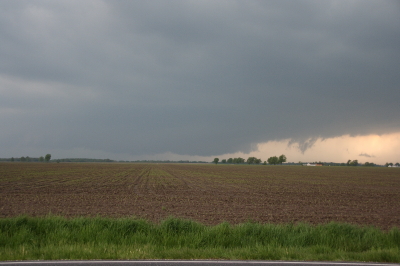
Updraft Base

Updraft Base

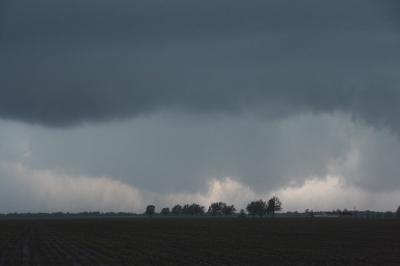
This is the view that met us as we pulled off the road a couple miles north of Edina, Missouri, yesterday evening. “We” were Bill Oosterbaan, Derek Mohr, and me, and what we were looking at was the only supercell in Missouri on Wednesday, May 13, to produce a tornado–this despite a sizeable moderate risk that swept across most of Illinois and Missouri all the way down to Kansas and Oklahoma.

The storm was showing strong rotation, and had already put down a damaging tornado twenty miles to our west in Kirksville. We lost Internet connection as we approached the storm, but our last scan showed what appeared to be a storm merger with two distinct areas of rotation. The radar didn’t lie, and the proof of it provided an interesting scenario.

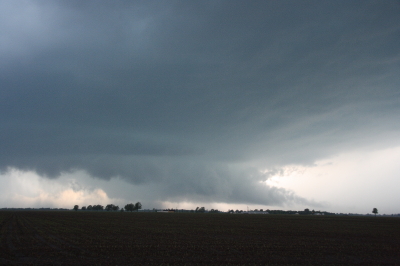
Wall Cloud Forming

Wall Cloud Forming

In the second image, you can see a ragged patch of scud ascending to the right and in front of the lowering in the background. This is the beginnings of what became an impressive wall cloud. Within a couple of minutes, the scud had matured into this…
Wall Cloud

Wall Cloud

The tail cloud to the right continued to grow to an astonishing length, displaying vigorous motion, feathering in rapidly toward the updraft. Meanwhile, a rain curtain began to wrap in from the south behind the wall cloud. This suggested a second mesocyclone following in the wake of the first area of rotation. I commented on this in the video I took of the storm, and my hunch soon proved true.

As the storm drew nearer, another prominent lowering began to emerge. It was exhibiting rapid motion, moreso than the more visually interesting wall cloud in the foreground. A tornado appeared immanent within this broad rotation, and in another minute multiple vortices were square dancing in the distance. One vortex soon tightened up and became dominant, fattening up into a nice hose. But the rain bands were starting to conceal the tornadic activity, and in a bit it was hard to tell exactly what was happening.

The storm quickly evolved into a nasty high precipitation beast, and from then on any tornadoes were effectively cloaked in rain.

Sorry, no stills of a well-formed tornado–I had set my camera down in favor of my video recorder–but I did manage to capture what looks to have been the beginnings of the multiple vortex phase.
Multiple Vortex Tornado

Multiple Vortex Tornado

No, you can’t see any visible touchdown in the photo, so maybe the circulation wasn’t tornadic at that moment.  If not, it was shortly after. I sure wouldn’t have wanted to be standing underneath it.

After the chase, Bill dropped Derek and me off where we had left our cars at the K-Mart in Springfield, Illinois. Then the three of us headed off in our respective directions–Bill toward Corydon, Indiana; Derek toward northern Michigan; and I back toward Grand Rapids. On my way home, I picked up fellow Michigan chasers Mike Kovalchick and Mike Bishop. They had experienced an automotive failure that took them out of the chase, forcing them to ditch their vehicle in Lincoln–truly a bummer. It was great to reconnect with Mike Kovalchick, and to meet Mike Bishop for the first time. Having a couple fellow storm chasers in the car sure made the long trip home seem shorter.

The day out chasing did me a world of good, but I need a good night’s sleep, and I have work to do tomorrow. By the time the next round of weather arrives, though, I should be primed and ready to go.
Getting a New Laptop

Last week my four-year-old laptop dissolved into a screenful of horizontal lines. It had been acting squirrely, and with the help and guidance of my ladyfriend Lisa, who is an absolute genius with computers and software, I had already had it partially apart for an inspection. It rewarded our efforts with a total freakout.

A day later, Lisa had the problem fixed. The laptop now seems to be behaving itself, at least so far. The problem may have been mismatched memory cards. Lisa removed one of the cards, and that may have done the trick. We’ll see. I’ve already seen the laptop behave itself beautifully for day after day on previous occasions, only to suddenly start behaving like it’s on drugs for no discernible reason. Sad to say, I just don’t trust it, nor does Lisa. And obviously, whether I’m writing copy for clients on the road or chasing storms, I’ve got to have a laptop I can depend on. It’s part of my livelihood as well as my safety net.

So I finally knuckled under and bought a Dell Latitude. And while I was at it, I bought the extra-tough E6400 ATG. That oughta last me for a while. Shock-resistant. Dust resistant. Moisture resistant. Faster than greased lightning on ExLax. And, I might add, pricey. But if it lasts me five years, I’ll be happy, and it sounds like it ought to.

Meanwhile, if it turns out that the mismatched memory chips were in fact the culprit, and that my old laptop behaves itself from here on, then it should serve as a great backup.

I hate to spend so much money for this new machine. But I’d hate even more to have my radar suddenly break up into a bunch of lines while I’m chasing a tornadic supercell in Kansas. And I have a feeling that this new laptop is going to be a dream. So I guess it’s money well spent. I can’t wait to find out.

Remembering May 3, 1999

View from the balcony.

View from the balcony.

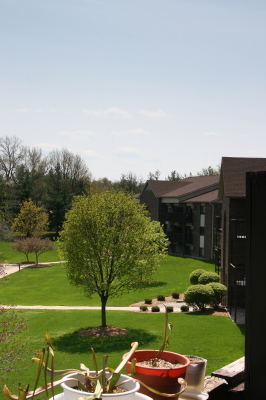
Looking at my recent posts, it dawns on me that it has been a while since I brightened things up with a few photos. The above is a purely gratuitious shot of my small apartment complex in Caledonia, Michigan, taken from my balcony. In the foreground, you can see some of The Kids–that is, my carnivorous plants. They’re long and lank right now from being forced to gather what sun they’ve been able to sitting indoors by the sliding door. April’s temperature fluctuations have permitted only occasional forays outside, but I think that at this point they’re there to stay. Now the bright, direct sun can do its work, strengthening their stems so that in another month or two, new leaves on the pitcher plants should stand up straight and tall.

Actually, the Sarracenia oreophila has already been doing just fine in that regard. Once I took it out of refrigeration, it wasted no time sending up a fine crop of stout, trumpet-shaped leaves. Unfortunately, hornets are drawn to the taller pitcher plants like crazy, and they don’t take kindly to being trapped in them. I’ve had to tape several of the oreo leaves after they collapsed due to hornets chewing holes through the sides in order to escape. I’ve got to believe that hornets aren’t the normal fare for Sarracenias in the wild. My plants occupy a habitat three stories above ground level, not exactly the same kind of ecosystem as an Alabama mountain bog or a southern savannah.

Anyway, as you can see from the photo, today is gorgeous here in Michigan, with temps in the upper sixties–on the cool side of warm. A body can wear shorts or jeans, a T-shirt or a long-sleeve; either works perfectly on a day like today. Me, I’m in shorts. I have no plans to go anywhere, since I’m still a bit wheezy from my cold, but it’s nice to just sit here and look out the window at blue sky, white blossoms, and tress leafing out.

Ironically, this picture-perfect May day is the tenth anniversary of the 1999 Oklahoma Tornado Outbreak. On this date, the infamous Moore/Bridge Creek Tornado tore a path from west of Amber to Midwest City, taking 36 lives and becoming the last tornado to be rated an F5 under the original, now passe Fujita scale. A wind max in this tornado of 301 mph, give or take 20 mph, recorded by the Doppler on Wheels (DOW) remains the fastest tornado wind ever measured to date, placing the Bridge Creek tornado at the upper end of even the most extreme tornadoes. Powerful as it was, another monstrous tornado which plowed through the town of Mulhall that same day may have been even stronger.

It’s hard to fathom winds of that velocity. It’s faster than most BB guns. To help you visualize such a wind speed, if a piece of lumber was blowing at you at 301 mph from a house disintegrating 450 feet away, you’d have approximately one second to duck. Granted, the DOW reading was 105 feet above ground, and the surface winds were likely to have been somewhat slower. But I doubt that information would have been very reassuring to residents of Bridge Creek that day as they watched the storm bearing down on them.

What a cheery thought. I think I’ll return to today’s bright sunshine and enjoy it. Storm season is at hand, my cold is on its way out, and I hope to get out to the Plains in another couple of weeks and chase some supercells. But for now, it’s May 3 and the day is beautiful here in Michigan. Who could ask for more?

The Tornado Fest That Wasn’t

Now that Sunday’s brouhaha in Tornado Alley is over and done, the big question seems to be, where were all the tornadoes? The turnout was there, the fans were waiting, but besides the rope and the wedge/multivortex/stovepipe that my buddies Bill and Tom witnessed near Crawford, Oklahoma, in company with a multitude of other chasers, there just wasn’t anything to make postcards out of. The big show never showed. Even the lone supercell that wandered north out of Texas into Oklahoma’s higher helicities never produced, despite its lack of competition. Oh, there were a couple of twisters in Kansas, and with a tally of four, Iowa had the most reports of all. Ironically,  it wasn’t even in the PDS high risk area.

This is by no means to criticize the crew at the SPC; those are some highly adept meteorological minds, the finest in the world. No, it’s just to muse at the vagaries of the weather. Rudimentary as my own forecasting skills are, I’ve nevertheless come to realize that no matter how good a forecaster one becomes, the weather is still the weather. Capricious. Subject to subtleties that no one gives weight to until after the fact. The butterfly beats its wings and a tornado fires up in Texas–or a seemingly volatile setup falls apart.

Judging from the YouTube videos and the photos posted on Stormtrack, a lot of people managed to be in the right place at the right time for the one storm in Oklahoma that did produce a couple very photogenic tornadoes. But the event was a far cry from high-risk mayhem.

Guess I can’t feel bad about that, since I was sitting at home nursing a chest cold while my mates were out there roaming the Plains. The cold now seems finally poised to start breaking up, and hopefully in another day or two I’ll feel halfway human again. It’s just as well that I get this nonsense out of the way now, so I’m up to snuff physically in a couple weeks when my buds and I head out to the Alley for an extended tour. I hope that by then, there won’t be any lack of the right ingredients in the atmospheric brew to make the trip worthwhile.

Wedging into Tornado Season

Bill called to say that he and the crew just saw a wedge out there in western Oklahoma. The LSR gives the town of Crawford, near the Texas panhandle border, as the location.

Good for the lads–and the lass, as I understand there’s a new female member of the crew. As for me, sitting here in my La-Z-Boy sofa, nursing a chest cold and watching the radar, naturally I feel like shooting myself through the head. A wedge on a PDS day–and the show is just getting started. And I’m not there! AAAAAHHHHHH!!!!!!!

If there’s any consolation, it’s knowing that I’ve been able to make myself useful doing a little nowcasting. And it sounds like the team got some cool footage. Can’t wait to see it.

Mostly, though, I can’t wait to kick whatever is causing this blasted chest congestion and get out to take some video of my own. Tornado season 2009 is underway!

Shifting gears, last night’s gig at One Trick Pony with Francesca and Friends was a blast, even if I was feeling under the weather. Wright McCargar and I had a discussion about the impact of musicians on each other’s playing. In my experience, one bad musician can drag a whole group of good musicians down; and, conversely, one great musician can kick good players up to the next level. There’s nothing like being with really good musicians, and Francesca and her rhythm section are exactly that.

Moving back to storm chasing, it’s time for me to publish this post and then check out the radar. The storms bumping off of the dryline look to be going tornadic, and I’m thinkin’ that my buddies will have their hands full for the next five or six hours. Sure wish I was with them. But GR2AE ought to keep me entertained; maybe I can capture a few radar grabs to correspond with the photos that I’m sure will be coming back from out west.

Moderate Risk in West Oklahoma and Texas

My buddies Bill and Tom Oosterbaan and Derek Mohr are heading for today’s sweet zone out in western Oklahoma. The Storm Prediction Center has placed the area under a moderate risk, with an indication of strong tornadoes. No doubt. With CAPE exceeding 2,000 and decent helicity and upper-level support increasing by 0Z, all the ingredients will be there. I’d imagine the guys will be playing the triple point per the SPC, where helicity will be maximized. Should be quite the caravan out there today. A person with a popcorn truck and GR3 could make a killing on a chase day.

Farther north, back here in Michigan, we’re sitting under our first light risk day of the year. As I write, it’s approaching 11 a.m. and the temperature is already in the upper 70s with dewpoints tapping on 60 degrees. But the forecast soundings look miserable, with adequate bulk shear but squat in the way of directional turning and some truly weird-looking hodographs. The sounding for 21Z out in the east central Texas panhandle, on the other hand, out around Mobeetie and Wheeler, looks great.

Sigh.

Well, we’ve got rain outside. Big drops.

At least “the kids”–my collection of carnivorous plants–will be happy. I just potted my three latest arrivals: a parrot pitcher plant, a maroon-throat variety of the pale pitcher plant, and the Gulf variety of the sweet pitcher plant. They’re sitting out on the deck along with the rest of my little family, soaking in the warmer temperatures, humidity, ambient light, and now the precip. It’s a fine day for the plants here in Michigan, and a good one as well for writers and jazz musicians if not storm chasers.

Time to fire up the radar and see what’s on the way.

Convective Inhibition: SBCINH vs MLCINH

Some months back, I wrote a review of F5 Data, a powerful weather forecasting tool that aggregates a remarkably exhaustive array of atmospheric data–including over 160 different maps and a number of proprietary indices–for both professional and non-professional use. Designed by storm chaser and meteorologist Andrew Revering, F5 Data truly is a Swiss Army Knife for storm chasers, and thanks to Andy’s dedication to his product, it just keeps getting better and better.

My own effectiveness in using this potent tool continues to grow in tandem with my development as an amateur forecaster. Today I encountered a phenomenon that has puzzled me before, and this time I decided to ask Andy about it on his Convective Development forum. His insights were so helpful that, with his permission, I thought I’d share the thread with those of you who are fellow storm chasers. If you, like me, have struggled with the whole issue of CINH and of figuring out whether and where capping is likely to be a problem, then I hope you’ll find this material as informative as I did.

With that little introduction, here is the thread from Andy’s forum, beginning with…

My Question

SBCINH vs MLCINH

I’m looking at the latest GFS run (6Z) for Saturday at 21Z and see a number of parameters suggesting a hot spot around and west of Topeka. But when I factor in convective inhibition, I get either a highly capped environment or an uncapped environment depending on whether I go by MLCINH or SBCINH. I note that the model sounding for that hour and for 0Z shows minimal capping, which seems to favor the surface-based parameter.

From what I’ve seen, SBCINH often paints a much more conservative picture of inhibition, while MLCINH will show major capping in the same general area. How can I get the best use out of these two options when they often paint a very different picture?

Andy’s Answer

This is a great question, and very well worded… I guess I should expect that from a wordsmith!

SB *anything* is calculated using a surface-based parcel. ML *anything* is calculated using a mixed layer parcel. It is done by mixing the lowest 100mb temperature and lowest 100mb dew points and using those values as if those values were the surface conditions, and then raising from those values.

This is why when you look at a sounding it looks to favor the SB CIN because the parcel trace on those soundings is always raised from the surface. If you were to ‘average’ or mix the lowest 100mb temperatures by simply finding the section of the temperature line that is 100mb thick at the bottom of the sounding, and find the middle of that line (average value) and see what that temperature is, and then go to the surface and find where that temperature would be on the sounding at the surface, and raise the parcel from there (after doing the same thing with the dewpoint temperature) then you will have the ML Parcel trace and would then have MLCIN and MLCAPE to look at in the sounding.

A drastic difference in capping from SBCIN to MLCIN indicates that there is a drastic difference in values just above the surface that are causing this inconsistency. So when the parcel is mixed it washes out the uncapped air you get from the surface value.

We have different ways of looking at these values with different parcel traces because quite frankly, we never know where this parcel is going to be raised from. The same idea is why we have Lifted Index and Showalter Index. ITs the same index, but Showalter uses the values at 850mb and pretends thats the surface, while Lifted Index uses the surface as the surface.

We just never know where the parcel is going to raise from.

It seems to be consensus that ML-anything is typically the favored parcel trace. This means smaller CAPE and bigger CIN usually.

I have stuck strictly to my APRWX CAP index for years now because it considers both of these, as well as the temperature at 850mb, 700mb, and temperatures at heights from the surface up to 3000m, cap strength/lid strength index, as well as some other things when looking at capping. It seems to perform very well.

To summarize though… capping is a bear. If anything is out of line, you’ll easily get capped. So what I do is look at every capping parameter I can, and if *anything* is suggesting it being capped, then plan for it to be capped during that time period.

Now to confuse the situation even more, keep in mind that capping only means that you won’t get a storm to take in parcels from the suggested parcel trace location… IE.. from the surface. You can be well capped and have elevated storms above the cap. However for them to be severe you tend to need ‘other’ parameters in place, such as very moist air at 850mb (say 12c dew), some strong winds at that level, etc. to feed the storm.

Another map that is neat to look at for capping is the LFC-LCL depth. You may be capped, but want to be in position where the cap is ‘weakest’ and may have the best chances at breaking… with this map you get into your area of interest and then look at this map and find where the LFC-LCL depth is ‘smallest’.

For a capped severe situation, this usually means high values with a donut hole of smaller values in the middle. This is a great indication that the cap would break most easily in the middle of that donut.

This map (in a different, but similar form) can be seen on the SPC Mesoanalysis web site as LFC-LCL Relative Humidity. Its the same idea, but on their map you want high humidity values for weakening cap indication.

——————

So there you have it–Andy’s manifesto on capping. It’s a gnarly subject but an important one, the difference between explosive convection and a blue-sky bust. There’s a lot more to it than looking at a single parameter on the SPC’s Mesoanalysis Graphics site. If nothing else, this discussion has brought me a step or two closer to knowing how to use the ever-increasing kinds of forecasting tools that are available.

Highlights of the 1965 Palm Sunday Tornado Memorial in Bristol, Indiana

Yesterday I made the drive to the Elkhart County Historical Museum in Bristol, Indiana, to attend the forty-fourth memorial observance of the 1965 Palm Sunday Tornadoes. The occasion may have been low-key, but it was nevertheless remarkable. A couple of the factors that made it so were purely personal. I finally got to meet my long-distance friend and owner of the Tornado Memorial Park in nearby Dunlap, Debbie Watters. We’ve connected so well across the miles via email that when we finally got to talk person to person, it was as natural as if we’d hung out together forever. It was a double pleasure to meet her daughter and husband as well.

Then there was my other “tornado lady” friend, Pat McIntosh, who attended the meeting with her brother, John. What a sweetie! The three of us caught dinner afterward near Middlebury.

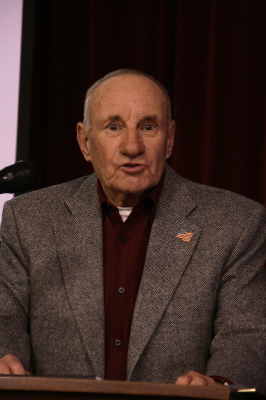
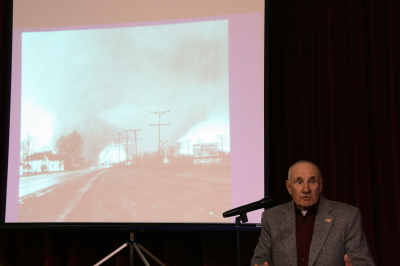
The stories and memories were amazing, and some quite touching and emotional. One huge highlight for me is captured in the photos below. In the first photo, the image shown on the projector screen depicts the notorious twin funnels that swept through the Midway Trailer Park south of Dunlap, Indiana. The image is one of the most famous tornado photographs ever taken, and the man standing next to it is the person who took it, retired Elkhart Truth newspaper photographer Paul Huffman.

Paul Huffman stands next to a projection of his Pulitzer Award-winning photo of the Midway twin funnels.

Paul Huffman stands next to a projection of his Pulitzer Award-winning photo of the Midway twin funnels.

Paul and his wife were traveling north on US 33 shortly after 6:00 p.m. on April 11, 1965, when they spotted the tornado moving in from the southwest. Stopping the car, Paul grabbed his camera and snapped a series of six dramatic photographs as the tornado morphed from a narrow funnel into the two-legged monster that devastated the hapless trailer court, then moved off to the northeast in a cloak of rain.

How fast was the tornado moving, I wanted to know. Fast, Paul said. Probably seventy miles an hour. How close was he, someone else asked. Around a quarter-mile. Were he and his wife at all close to the debris? An ironic smile. Yes, his wife replied, the two of them experienced some debris falling around them. Would a flattened automobile qualify?

Paul Huffman speaks at the 2008 memorial observation of the 1965 Palm Sunday Tornadoes.

Paul Huffman speaks at the 2008 memorial observance of the 1965 Palm Sunday Tornadoes.

One powerful moment occurred after the event had officially ended and people were milling around the tables full of memorabilia. My friend Pat was showing me a photo Paul had taken during rescue operations at the trailer court. In the photo was a young Pat, laying on a stretcher. Over her hovered her husband, Bill. To the right stood a fireman.

As we looked at the photo, an elderly gentleman standing nearby named Dwight Kime said, “That fireman was my brother-in-law.” Dwight himself had been one of the rescue workers. As it turned out, he was the one who found Pat and Bill’s baby, Chris, amid the rubble–one of the youngest of the ten fatalities in the trailer court. Dwight was visibly moved as he came to understand that Pat had been the child’s mother. It has been forty-four years since that terrible evening, but the memories–and the hidden sadness–never fade. I am glad that Pat’s little boy was found and cared for in death by such a tenderhearted man as Dwight Kime. And I am just as glad that, after all these years, he and Pat got to meet and talk at last. That is God’s grace.

Storm Chasing Selectivity (aka Impulse Control, aka Curbing the Impulse to Chase Any and Every Dumb System That Comes Down the Pike)

If the developmental curve of storm chasing is analogous to the seasons of life, then I think I’ve moved out of adolescence into young adulthood. Just as testosterone-driven impulses become tempered with knowledge and experience as callow youth transitions into maturity, so do idiotic, desperate, SDS-and-adrenaline-fueled urges to chase at the drop of a hat become balanced by an awareness of how stupid it is to waste time and gas driving hundreds of miles in pursuit of borderline scenarios.

Living in Michigan carries a steeper price tag than living in Kansas or even Iowa when it comes to busted chases. I can’t afford not to be selective, and I think I’ve finally internalized that lesson. As this year’s convective weather season has begun to ramp up, so far my greatest attainment hasn’t been successful chases, but rather, my refusal to get pulled into 2,000-mile excursions this early in the year.

Dixie Alley has had its moments, but so far they’ve been nothing like 2008. Tornado Alley has also offered a few setups, even one or two moderate risks, but I’ve been content to follow them at home on the radar, and I’ve been glad I did. If I lived in Oklahoma, I’d have been on them in a heartbeat. But when the party’s over and you live in Michigan–well, it had better have been a darned good party, because it’s a long drive home.

True, I chased at the beginning of this month in Kansas and Oklahoma. But I was already in the neighborhood, so to speak, and the chase opportunities were just frosting on the cake. I was happy with the Hutchinson, KS, action on March 7, but I probably wouldn’t have gone after it if I’d had to travel 800 miles to see it instead of simply heading north up I-35 from Norman.

Until last year, my chases have largely been event-driven. A system would move in and my buddy Bill, or Kurt, or Tom, and I would head out to Illinois, or Iowa, or Kansas, Nebraska, or Texas, or wherever, and chase it.  Last May was the first time I’ve spent more than three days out west. The logistics were different and definitely superior, and a change in my life circumstances–i.e. getting “restructured” with a decent severance, and starting my own business as a freelance writter–allowed me to tap into them.

This year I hope to spend even more time out on the Great Plains. The nature of my profession allows me that flexibility, and I love it.  This may be the year when I finally take a ten-day chase vacation and conduct my business out on the road.

I hope so. It’s been a long winter, I’ve waited a long time, and I’ve been very patient.

And now I’m itching to see some tornadoes.

A Tornado Ghost Town

Two years after being completely leveled by a 1.7-mile-wide tornado, the town of Greensburg, Kansas, is  far down the road to recovery and has become a shining emblem of Green America. Not so with Picher, Oklahoma. One year after its visitation by an EF-4 monster, half of the small mining town is worse than gone, and the other half appears just a shadow’s breath away from becoming a ghost town

neighborhood1

Picher, Oklahoma

The town’s demise is not due strictly to the tornado; the storm simply drove the last, very large nail into the coffin. Driving into the community from any direction, you’ll inevitably see the true culprits: vast piles of tailings tainted with the toxic residues of zinc and lead mining operations. Ironically, the same industry that at one time formed the town’s economic backbone has also spelled its doom. Unlike Greensburg, Kansas, which went green and found its salvation in  national attention and an influx of funds, poor little Picher is blighted beyond redemption.

According to the Washington Post, “The mines were shut down in the 1970s, and all that is left in and around Picher are about 1,000 people and giant gray piles of mining waste, known locally as ‘chat,’ some hundreds of feet tall and acres wide, that loom over abandoned storefronts and empty lots.

“The piles are loaded with heavy metals that have contaminated the air and the groundwater and placed the northeastern Oklahoma town in the middle of the Tar Creek Superfund Site, the largest and one of the most polluted in the country. To add to Picher’s misery, a federal study released in January determined that the abandoned mines beneath the city could cause cave-ins without warning.”

That was back in January, 2007, before the tornado. There certainly are no thousand souls left in Picher today. I doubt there are one hundred. It’s a depressing, ugly, desolate place. Yet there are people who remember and love it as home, and a handful who still call it so.

Nothing Left

Nothing Left

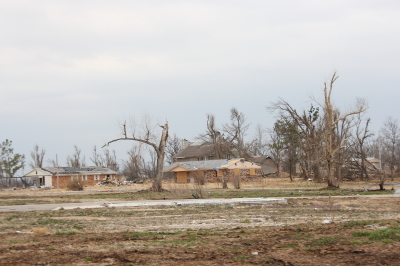
Last Saturday, my buddy Bill Oosterbaan and I began our chase day with a visit to Picher. The northern part of the town is just a town, though with its empty streets, it reminded me of the set for a spaghetti Western. As for the southern part, it’s blown to smithereens.

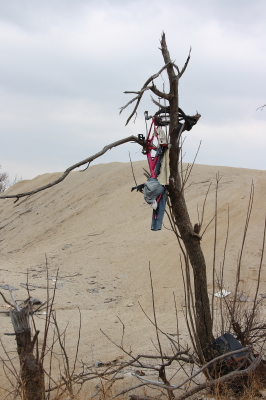
bike-in2

Bike in Tree

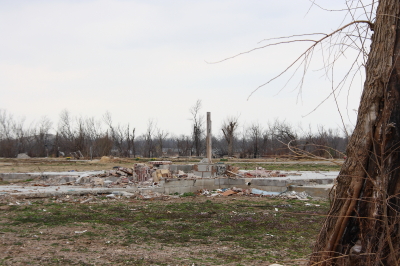
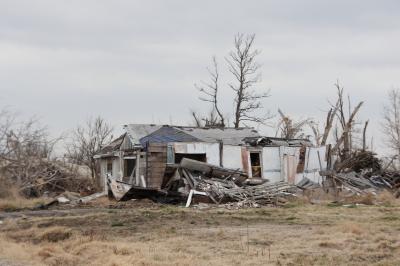
Many of the homes have been cleared away, leaving only cement slabs where neighborhoods once stood. Other battered structures remain, their siding stripped away, roofs missing, walls torn out, twisted window frames gazing vacantly at a landscape of tortured trees, tornado trash, lethal chat hills, and toxic lagoons. Debris litters the fields, and sheets of tin and other objects wrap and twist around the treetops. No one is in a hurry to clean any of it up. There’s no need to. No one is coming back.

What's Left of a House

What's Left of a House

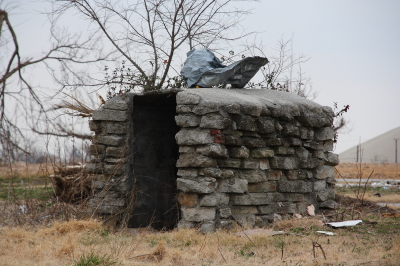
On the north end of the damage track stands an old storm cellar. Presumably, in a tornado that claimed seven lives, the cellar saved a few when the time came for it to serve its purpose. Once a house stood nearby; today, the rough-hewn block shelter stands alone, much like the rest of what is left of Picher, Oklahoma. The cellar resembles a crypt, and in a way, I suppose it is–a memorial marker for a town that is no more.

Storm Cellar

Storm Cellar