Moderate Risk in West Oklahoma and Texas

My buddies Bill and Tom Oosterbaan and Derek Mohr are heading for today’s sweet zone out in western Oklahoma. The Storm Prediction Center has placed the area under a moderate risk, with an indication of strong tornadoes. No doubt. With CAPE exceeding 2,000 and decent helicity and upper-level support increasing by 0Z, all the ingredients will be there. I’d imagine the guys will be playing the triple point per the SPC, where helicity will be maximized. Should be quite the caravan out there today. A person with a popcorn truck and GR3 could make a killing on a chase day.

Farther north, back here in Michigan, we’re sitting under our first light risk day of the year. As I write, it’s approaching 11 a.m. and the temperature is already in the upper 70s with dewpoints tapping on 60 degrees. But the forecast soundings look miserable, with adequate bulk shear but squat in the way of directional turning and some truly weird-looking hodographs. The sounding for 21Z out in the east central Texas panhandle, on the other hand, out around Mobeetie and Wheeler, looks great.

Sigh.

Well, we’ve got rain outside. Big drops.

At least “the kids”–my collection of carnivorous plants–will be happy. I just potted my three latest arrivals: a parrot pitcher plant, a maroon-throat variety of the pale pitcher plant, and the Gulf variety of the sweet pitcher plant. They’re sitting out on the deck along with the rest of my little family, soaking in the warmer temperatures, humidity, ambient light, and now the precip. It’s a fine day for the plants here in Michigan, and a good one as well for writers and jazz musicians if not storm chasers.

Time to fire up the radar and see what’s on the way.
Convective Inhibition: SBCINH vs MLCINH

Some months back, I wrote a review of F5 Data, a powerful weather forecasting tool that aggregates a remarkably exhaustive array of atmospheric data–including over 160 different maps and a number of proprietary indices–for both professional and non-professional use. Designed by storm chaser and meteorologist Andrew Revering, F5 Data truly is a Swiss Army Knife for storm chasers, and thanks to Andy’s dedication to his product, it just keeps getting better and better.

My own effectiveness in using this potent tool continues to grow in tandem with my development as an amateur forecaster. Today I encountered a phenomenon that has puzzled me before, and this time I decided to ask Andy about it on his Convective Development forum. His insights were so helpful that, with his permission, I thought I’d share the thread with those of you who are fellow storm chasers. If you, like me, have struggled with the whole issue of CINH and of figuring out whether and where capping is likely to be a problem, then I hope you’ll find this material as informative as I did.

With that little introduction, here is the thread from Andy’s forum, beginning with…

My Question

SBCINH vs MLCINH

I’m looking at the latest GFS run (6Z) for Saturday at 21Z and see a number of parameters suggesting a hot spot around and west of Topeka. But when I factor in convective inhibition, I get either a highly capped environment or an uncapped environment depending on whether I go by MLCINH or SBCINH. I note that the model sounding for that hour and for 0Z shows minimal capping, which seems to favor the surface-based parameter.

From what I’ve seen, SBCINH often paints a much more conservative picture of inhibition, while MLCINH will show major capping in the same general area. How can I get the best use out of these two options when they often paint a very different picture?

Andy’s Answer

This is a great question, and very well worded… I guess I should expect that from a wordsmith!

SB *anything* is calculated using a surface-based parcel. ML *anything* is calculated using a mixed layer parcel. It is done by mixing the lowest 100mb temperature and lowest 100mb dew points and using those values as if those values were the surface conditions, and then raising from those values.

This is why when you look at a sounding it looks to favor the SB CIN because the parcel trace on those soundings is always raised from the surface. If you were to ‘average’ or mix the lowest 100mb temperatures by simply finding the section of the temperature line that is 100mb thick at the bottom of the sounding, and find the middle of that line (average value) and see what that temperature is, and then go to the surface and find where that temperature would be on the sounding at the surface, and raise the parcel from there (after doing the same thing with the dewpoint temperature) then you will have the ML Parcel trace and would then have MLCIN and MLCAPE to look at in the sounding.

A drastic difference in capping from SBCIN to MLCIN indicates that there is a drastic difference in values just above the surface that are causing this inconsistency. So when the parcel is mixed it washes out the uncapped air you get from the surface value.

We have different ways of looking at these values with different parcel traces because quite frankly, we never know where this parcel is going to be raised from. The same idea is why we have Lifted Index and Showalter Index. ITs the same index, but Showalter uses the values at 850mb and pretends thats the surface, while Lifted Index uses the surface as the surface.

We just never know where the parcel is going to raise from.

It seems to be consensus that ML-anything is typically the favored parcel trace. This means smaller CAPE and bigger CIN usually.

I have stuck strictly to my APRWX CAP index for years now because it considers both of these, as well as the temperature at 850mb, 700mb, and temperatures at heights from the surface up to 3000m, cap strength/lid strength index, as well as some other things when looking at capping. It seems to perform very well.

To summarize though… capping is a bear. If anything is out of line, you’ll easily get capped. So what I do is look at every capping parameter I can, and if *anything* is suggesting it being capped, then plan for it to be capped during that time period.

Now to confuse the situation even more, keep in mind that capping only means that you won’t get a storm to take in parcels from the suggested parcel trace location… IE.. from the surface. You can be well capped and have elevated storms above the cap. However for them to be severe you tend to need ‘other’ parameters in place, such as very moist air at 850mb (say 12c dew), some strong winds at that level, etc. to feed the storm.

Another map that is neat to look at for capping is the LFC-LCL depth. You may be capped, but want to be in position where the cap is ‘weakest’ and may have the best chances at breaking… with this map you get into your area of interest and then look at this map and find where the LFC-LCL depth is ‘smallest’.

For a capped severe situation, this usually means high values with a donut hole of smaller values in the middle. This is a great indication that the cap would break most easily in the middle of that donut.

This map (in a different, but similar form) can be seen on the SPC Mesoanalysis web site as LFC-LCL Relative Humidity. Its the same idea, but on their map you want high humidity values for weakening cap indication.

——————

So there you have it–Andy’s manifesto on capping. It’s a gnarly subject but an important one, the difference between explosive convection and a blue-sky bust. There’s a lot more to it than looking at a single parameter on the SPC’s Mesoanalysis Graphics site. If nothing else, this discussion has brought me a step or two closer to knowing how to use the ever-increasing kinds of forecasting tools that are available.

Highlights of the 1965 Palm Sunday Tornado Memorial in Bristol, Indiana

Yesterday I made the drive to the Elkhart County Historical Museum in Bristol, Indiana, to attend the forty-fourth memorial observance of the 1965 Palm Sunday Tornadoes. The occasion may have been low-key, but it was nevertheless remarkable. A couple of the factors that made it so were purely personal. I finally got to meet my long-distance friend and owner of the Tornado Memorial Park in nearby Dunlap, Debbie Watters. We’ve connected so well across the miles via email that when we finally got to talk person to person, it was as natural as if we’d hung out together forever. It was a double pleasure to meet her daughter and husband as well.

Then there was my other “tornado lady” friend, Pat McIntosh, who attended the meeting with her brother, John. What a sweetie! The three of us caught dinner afterward near Middlebury.

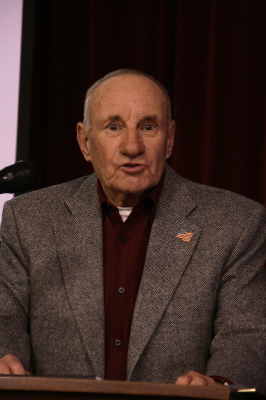
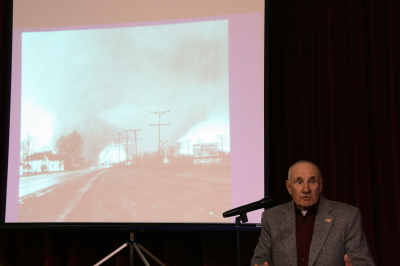
The stories and memories were amazing, and some quite touching and emotional. One huge highlight for me is captured in the photos below. In the first photo, the image shown on the projector screen depicts the notorious twin funnels that swept through the Midway Trailer Park south of Dunlap, Indiana. The image is one of the most famous tornado photographs ever taken, and the man standing next to it is the person who took it, retired Elkhart Truth newspaper photographer Paul Huffman.

Paul Huffman stands next to a projection of his Pulitzer Award-winning photo of the Midway twin funnels.

Paul Huffman stands next to a projection of his Pulitzer Award-winning photo of the Midway twin funnels.

Paul and his wife were traveling north on US 33 shortly after 6:00 p.m. on April 11, 1965, when they spotted the tornado moving in from the southwest. Stopping the car, Paul grabbed his camera and snapped a series of six dramatic photographs as the tornado morphed from a narrow funnel into the two-legged monster that devastated the hapless trailer court, then moved off to the northeast in a cloak of rain.

How fast was the tornado moving, I wanted to know. Fast, Paul said. Probably seventy miles an hour. How close was he, someone else asked. Around a quarter-mile. Were he and his wife at all close to the debris? An ironic smile. Yes, his wife replied, the two of them experienced some debris falling around them. Would a flattened automobile qualify?

Paul Huffman speaks at the 2008 memorial observation of the 1965 Palm Sunday Tornadoes.

Paul Huffman speaks at the 2008 memorial observance of the 1965 Palm Sunday Tornadoes.

One powerful moment occurred after the event had officially ended and people were milling around the tables full of memorabilia. My friend Pat was showing me a photo Paul had taken during rescue operations at the trailer court. In the photo was a young Pat, laying on a stretcher. Over her hovered her husband, Bill. To the right stood a fireman.

As we looked at the photo, an elderly gentleman standing nearby named Dwight Kime said, “That fireman was my brother-in-law.” Dwight himself had been one of the rescue workers. As it turned out, he was the one who found Pat and Bill’s baby, Chris, amid the rubble–one of the youngest of the ten fatalities in the trailer court. Dwight was visibly moved as he came to understand that Pat had been the child’s mother. It has been forty-four years since that terrible evening, but the memories–and the hidden sadness–never fade. I am glad that Pat’s little boy was found and cared for in death by such a tenderhearted man as Dwight Kime. And I am just as glad that, after all these years, he and Pat got to meet and talk at last. That is God’s grace.

Storm Chasing Selectivity (aka Impulse Control, aka Curbing the Impulse to Chase Any and Every Dumb System That Comes Down the Pike)

If the developmental curve of storm chasing is analogous to the seasons of life, then I think I’ve moved out of adolescence into young adulthood. Just as testosterone-driven impulses become tempered with knowledge and experience as callow youth transitions into maturity, so do idiotic, desperate, SDS-and-adrenaline-fueled urges to chase at the drop of a hat become balanced by an awareness of how stupid it is to waste time and gas driving hundreds of miles in pursuit of borderline scenarios.

Living in Michigan carries a steeper price tag than living in Kansas or even Iowa when it comes to busted chases. I can’t afford not to be selective, and I think I’ve finally internalized that lesson. As this year’s convective weather season has begun to ramp up, so far my greatest attainment hasn’t been successful chases, but rather, my refusal to get pulled into 2,000-mile excursions this early in the year.

Dixie Alley has had its moments, but so far they’ve been nothing like 2008. Tornado Alley has also offered a few setups, even one or two moderate risks, but I’ve been content to follow them at home on the radar, and I’ve been glad I did. If I lived in Oklahoma, I’d have been on them in a heartbeat. But when the party’s over and you live in Michigan–well, it had better have been a darned good party, because it’s a long drive home.

True, I chased at the beginning of this month in Kansas and Oklahoma. But I was already in the neighborhood, so to speak, and the chase opportunities were just frosting on the cake. I was happy with the Hutchinson, KS, action on March 7, but I probably wouldn’t have gone after it if I’d had to travel 800 miles to see it instead of simply heading north up I-35 from Norman.

Until last year, my chases have largely been event-driven. A system would move in and my buddy Bill, or Kurt, or Tom, and I would head out to Illinois, or Iowa, or Kansas, Nebraska, or Texas, or wherever, and chase it.  Last May was the first time I’ve spent more than three days out west. The logistics were different and definitely superior, and a change in my life circumstances–i.e. getting “restructured” with a decent severance, and starting my own business as a freelance writter–allowed me to tap into them.

This year I hope to spend even more time out on the Great Plains. The nature of my profession allows me that flexibility, and I love it.  This may be the year when I finally take a ten-day chase vacation and conduct my business out on the road.

I hope so. It’s been a long winter, I’ve waited a long time, and I’ve been very patient.

And now I’m itching to see some tornadoes.

Using Sequence in Jazz Solos: Some Exercises

Howdy, campers. As promised, I’m back with a few exercises on sequences that you can actually wrap your fingers around.

Before you proceed further, please take a moment to read my introductory post on this topic, written a couple days ago.

And now, assuming that you’ve done as I requested and acquired a foundational grasp of what sequence is and why it’s such a handy tool for the jazz musician, here’s the first exercise. It illustrates the concept of diatonic sequence. The sequence happens to move up by thirds starting on the chord tones of a C major 7, but it could just as easily move up or down by seconds, or fourths, or up and down at random intervals.

Diatonic Sequence

You could use the same pattern over a C7 by changing the note B to a Bb. But my point isn’t to show you how to outline a chord. It’s to demonstrate how the use of diatonic sequence provides a sense of logic and cohesiveness which you can use to advantage in improvising a jazz solo.

Sequence does such a good job at “making sense” of an idea that you don’t even have to play in key to sound good. In fact, “wrong notes” can sound very cool when you play them as part of a sequence. The temporary harmonic clash creates color and interest.

Sequentially mirroring an idea exactly, interval for interval, is one way to quickly slip out of key, letting the weight of the sequence rather than harmonic agreement justify the use of individually questionable tones. In the following example, root movement descends by major thirds.

Notice that the idea resolves to a chord tone. It’s cool to take your listeners for a temporary excursion into outer space, but you generally want to bring them back to planet earth again with a healthy dose of consonance.

Exact Repetion

Again, the movement downward by major thirds is just one possibility.

You can add further interest by shifting the rhythm of a sequence. The following shows the same sequence as above, but the six-note pattern is now imposed on a 4/4 setting rather than 3/4. I’ve marked the separations between each group of notes in the sequence.

Exact Repetition with Syncopation

Note that I’ve used the sequence over a different chord, an F#+7(#9), another nice application for the augmented sound implied by the major third root movement.

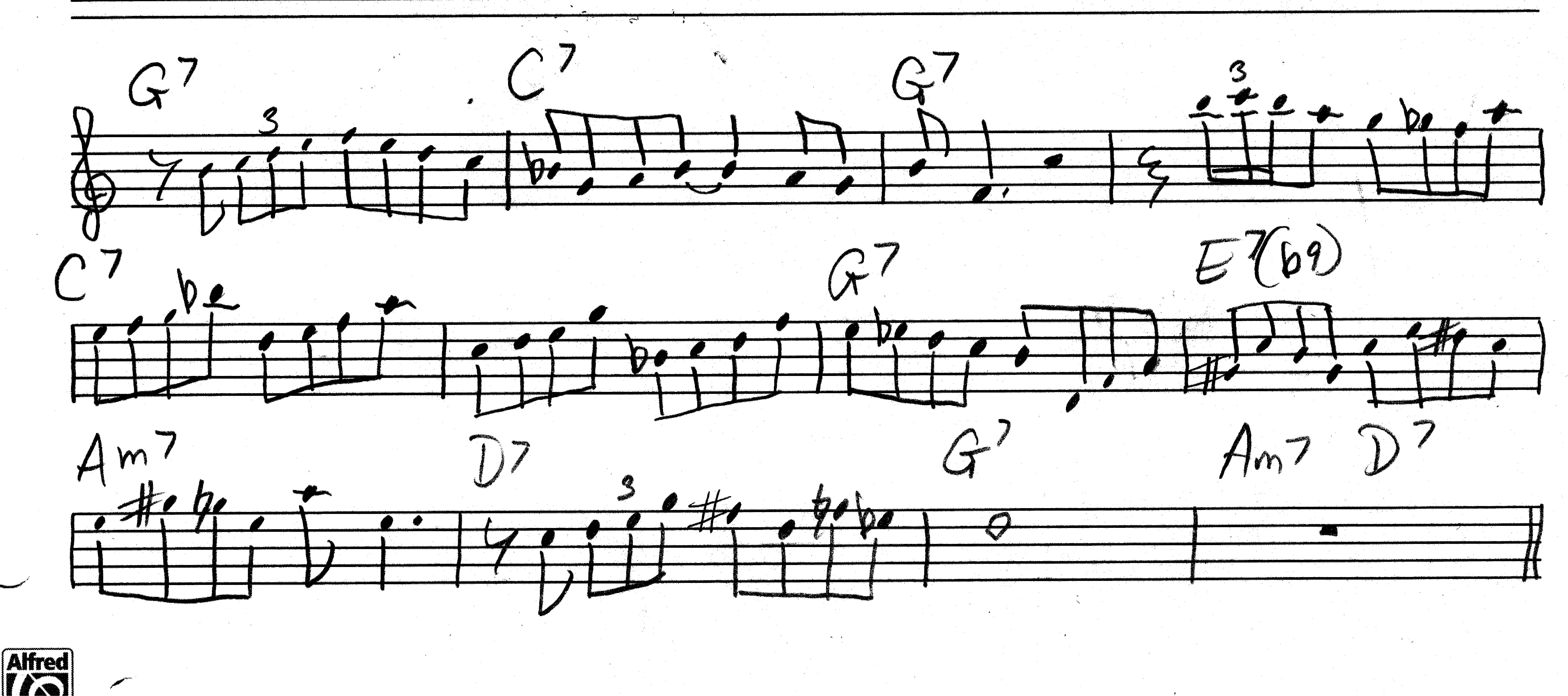
Finally, here is a twelve-bar blues to illustrate the use of sequence in an actual jazz solo. The ideas may seem a bit forced, but they give you a feel for how both diatonic sequence and exact repetition might be applied in an improvisation.

sequenceblues

The above illustrations just touch on the myriad creative and highly personal ways that sequence can be used in jazz solos. To recap: sequence can help you organize musical material in a way that creates cohesiveness and momentum, and that gives “wrong notes” a powerful sense of rightness when you want to play outside the changes.

Like any other component of music, sequence needs to be used judiciously. The right amount adds spice; too much just sounds overdone and even boring. Listen to how the greats of jazz use sequence, work with it yourself, take risks, and let your ear be the judge. And need I say…have fun!

The Last Snows of Winter

As I begin this post, it’s snowing outside.

Spring has sprung, and it’s snowing.

All irony aside, there’s nothing particularly unusual about that this time of year. Late March through mid-April are prone to the residual effects of winter. Fuzzy catkins may cover the pussy willows in the marshes, skunk cabbages bloom in the swamps and wet woods, and robins pogo across the lawns in search of earthworms, but that doesn’t mean the snows are entirely done with us.

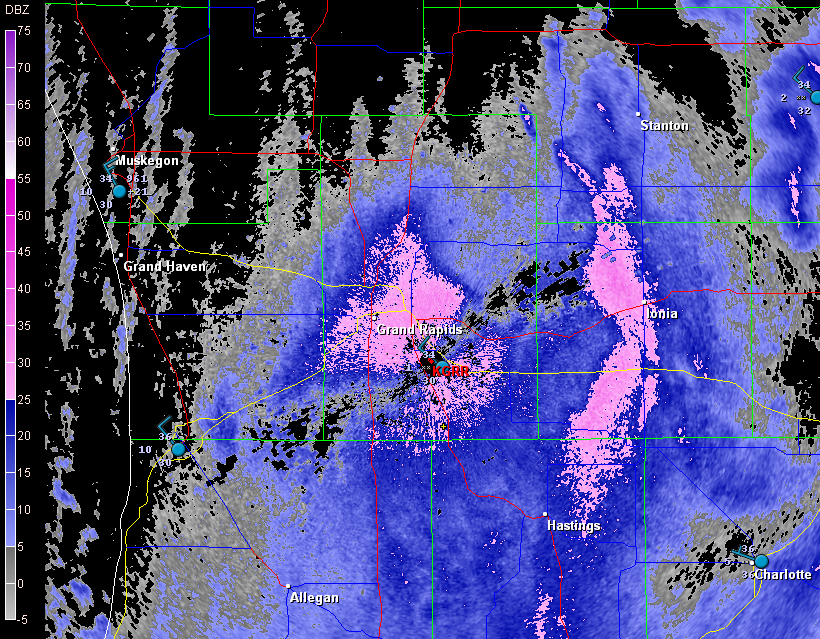
See for yourself. Here’s the radar for my area from just a few minutes ago.

GR2 radar scan shows a snowy afternoon in West Michigan.

GR2 radar scan shows a snowy afternoon in West Michigan.

I don’t mind. Even though the forecast through the week calls for colder temperatures and an occasional dusting of the white stuff, I know it’s all just transitory. We’ve already seen 70 degree temperatures and had our first lightning storm. Today is just winter being a poor loser.

Me, I’m looking ahead. The wildflowers and the weather systems are waking up together, and with the year’s first, shakedown storm chase in Tornado Alley already under my belt, I’m content in knowing that the main action is now mere weeks away.

Bring it on. I’m ready!

Using Sequence in Jazz Improvisation

Okay, campers, listen up: it’s time to talk about…

SEQUENCE.

Yes, sequence. A fundamental building block of music, and a very handy device in the improviser’s toolkit.

What is sequence? There’s nothing mysterious about it. Sequence is simply the repetition of a melodic idea beginning with different tones. Sequence can be diatonic within a key, and many scale exercises consist of scale material organized sequentially. Sequence can also be an exact, interval-for-interval repetition of a motif (or lick), which often–indeed, almost inevitably–will take you out of key.

The beauty of sequence lies in the coherency it brings to a solo. Sequence is a means of organizing melodic material in a way that the listener can immediately relate to. In the midst of a free-form flow of melody, sequence provides a sense of logic, a momentary theme for the ear to latch onto and follow through one or more permutations.

In its simple, diatonic form, sequence creates interest as you navigate your way through a single scale, chord, or ii-V7-I cadence. But sequence can also be used to take you out of key The strength of repetition has a way of making “wrong” notes sound right–a quality that becomes increasingly important when you’re playing tunes with little in the way of harmonic interest. When you’re in the midst of a two-chord jam, diatonic scales get boring pretty quickly. You’ve got to create energy. How? By using chromaticism–tones outside the key center that add color. Sequence is a great way to do so in an organized fashion.

Now, one picture is worth a thousand words, right? “Don’t tell me, show me,” is what you’re thinking. Relax. I’m not going to leave you hanging without a few examples. I’ll provide some material you can practice in an upcoming post. Right now, I just want to introduce the concept of sequence and whet your eagerness to get a few exercises under your fingers.

“But I want to start noooowwww!!!

Patience, Grasshopper. It’s Saturday afternoon, it’s spring, and I want to get out and enjoy the day. Stay tuned, though. I’ll be back with a few goodies. Promise.

First Storm Chase, 2009

What a memorable way to kick off storm season 2009! Yesterday, I chased supercells in Kansas with my buddy, Bill Oosterbaan, and today we attended Tim Vasquez’s severe weather forecasting workshop in Norman, Oklahoma. I’m writing this post from a Best Western Hotel maybe a mile north of where the 1999 Moore tornado crossed I-35. All in all, not a bad past couple of days for a lad from Michigan.

Yesterday’s chase began with a visit to Picher, Oklahoma. The southern portion of this tiny town got wiped out last spring by an EF-4 tornado. Today, a year later, that desolate landscape shows scant chance of recovery. It’s a sobering place to visit.

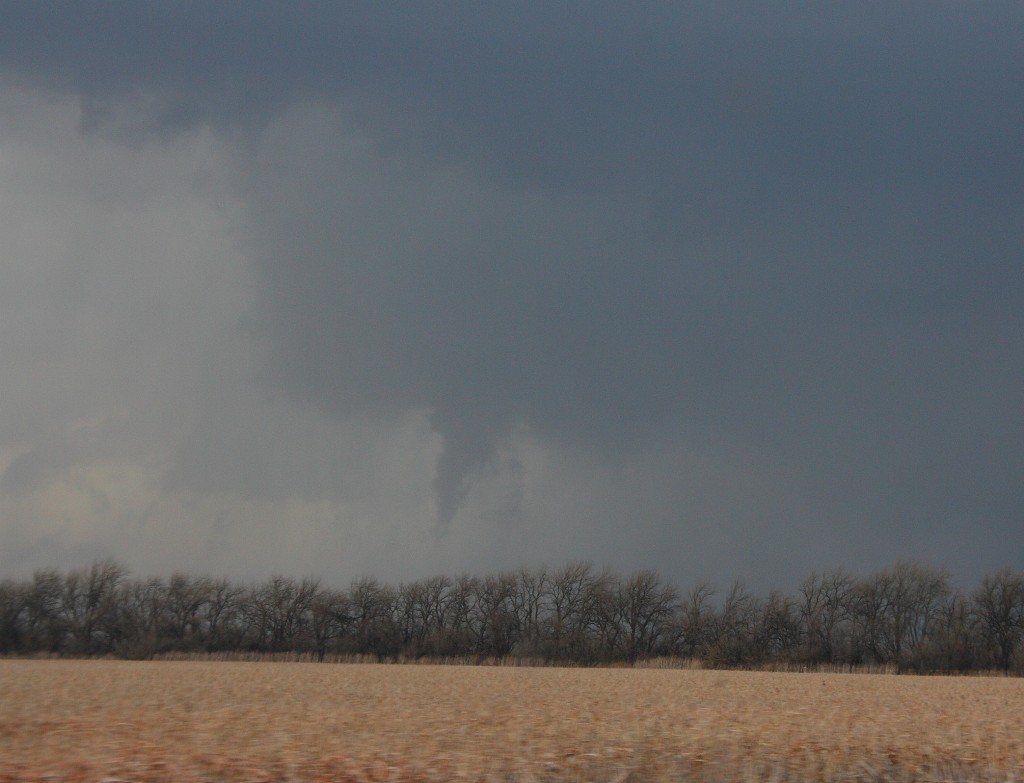
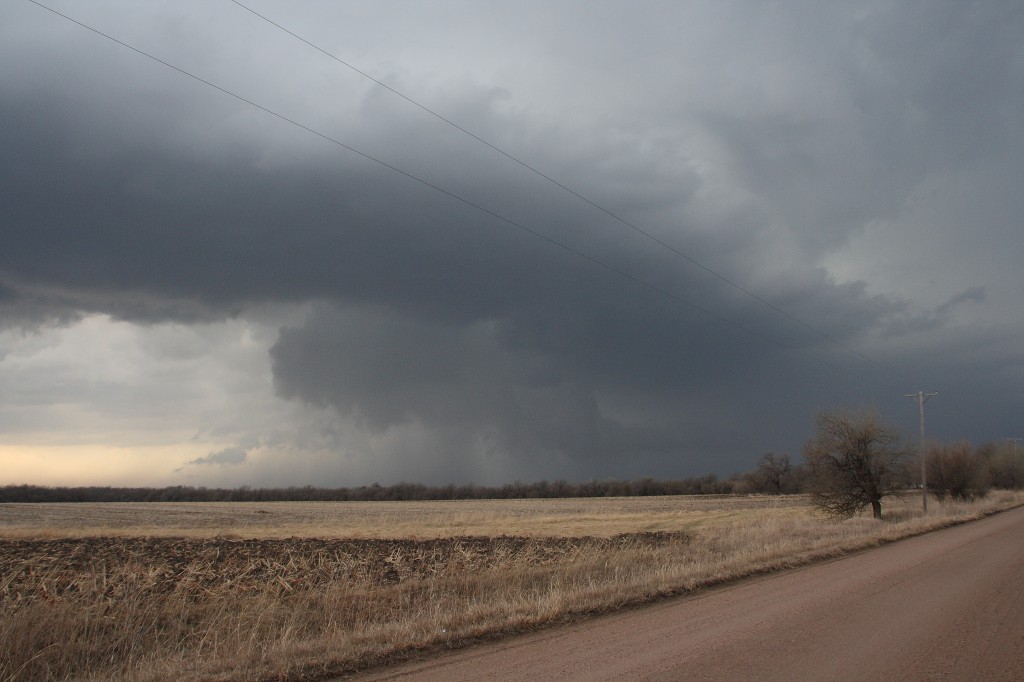
But that’s another story for a different post. Right now, I just want to share a couple images from yesterday’s chase. The moisture was marginal, with dewpoints averaging around 55 degrees up toward the warm front north of Wichita. That’s where we headed, in search of the better helicities. A lot of folks questioned the setup, but it produced. The storm we intercepted put out four tornadoes, though those occurred before we caught up with it. We still saw some nice structure, including a nice wall cloud and a funnel. Check ’em out.

Funnel Cloud

Funnel Cloud

Nice Structure!

Nice Structure!

Severe Weather Forecasting Workshop and Southern Plains Drought

It’s Thursday, and I’m in Louisville, Kentucky, with my buddy Bill. He’s got business here, and I’m taking care of business here on my laptop, and then we head to Norman, Oklahoma, for a severe weather forecasting workshop with Tim Vasquez. At times like this, I’m grateful for the freedom and mobility that come with being a freelance writer. As long as there’s work for me to do, I can do it pretty much anywhere provided I have my laptop and Internet access.

I’ve been hoping to catch a little early-season convective excitement this Saturday. Not sure that’s going to happen, though. The wild card seems to be moisture, but capping may also be a problem. It would be a shame to make the journey to Oklahoma and not see a little decent, Great Plains weather. Of course, that’s not the focus of the trip–the forecasting workshop is–but still, a supercell or two would be nice. Unfortunately, it looks like a cold front will provide the lift that finally busts the cap, and that suggests “linear.”

Sunday is the workshop, so I don’t much care what the weather does that day. I’ll be in class.

Monday may offer another crack at things, and it may be our best opportunity. It’s too far out to say (for that matter, Saturday is still a bit too far off yet to feel either good or bad about it), but assuming that the southern Plains at least get a bit of rain to relieve their dry spell and give the ground a good soaking, moisture may not be the question mark that it is for Saturday’s setup.

Frankly, the current forecast discussion on Stormtrack is the first time I’ve given serious thought to the effect of soil conditions on convection. I had always thought of ground moisture and evapotranspiration as just enhancements to the return flow, not potential deal-breakers. To my mind, a nice, deep low pulling in rich dewpoints from the Gulf of Mexico would more than compensate for dry regional conditions. But more than one seasoned Great Plains storm chaser has looked at the current drought conditions in Texas and Oklahoma and opined skeptically about the chances for 2009 being a good chase year in the West unless the region sees some rain.

Ah, well. The season hasn’t even begun yet, so I’ll take what I can get and hope for better as we move into May and June. Right now, it’s nice to simply see the sun shine, feel fifty-degree temperatures, and know that winter is drawing to a close.

Monte Montgomery Concert Tomorrow Night

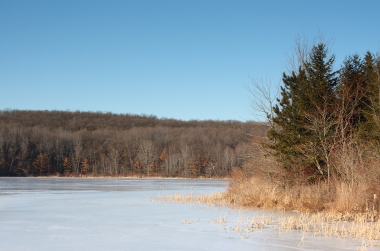
Whew, I have let waaaay too much time elapse since the last time I posted an entry in this blog. Let me mollify you with a nice, bright, sunny image from this cold, early March day. The following photo is one of a number that I took out at Pickerel Lake near Grattan Township in east-central Kent County. It’s a beautiful area, and with spring rapidly rolling in, today was a great day to capture the beauty of the icy landscape while I still can.

Pickerel Lake

Pickerel Lake

Cold as this day has been, there’s no question that warmer weather is moving in. By Thursday, temperatures here in the Grand Rapids area should be in the forties. But I won’t be here. I’ll be with my storm chasing buddy Bill down in Louisville, Kentucky, where he’ll be meeting with some of his clients while I do my own business on my laptop. Then from Louisville, we head out to Norman, Oklahoma, for an all-day severe weather forecasting workshop with Tim Vasquez on Sunday. I’m really looking forward to it!

On the way out there, I hope to catch some early season action. The GFS is calling for a low to be positioned in Colorado or somewhere out there, and with a little luck, we’ll see the right combination of moisture, lift, and kinematics to make life interesting somewhere between Louisville and Norman. Arkansas looks likely. We’ll see.

More immediately, and on the musical side of things, tomorrow night is the Monte Montgomery concert at the Intersection in downtown Grand Rapids. The concert got rescheduled from its original date last September due to illness, and now the time has arrived.

I’ll be playing with the Ed Englerth band as the opening act for Monte.  We rehearsed last night and sounded tight, and today I took my horn to the shop and got a leak tightened down, so all in all, I feel good about playing tomorrow.

If you’re in the neighborhood, come on out to the concert. Ed’s material is strong, and if you’ve never heard Monte, prepare to be stunned. The man is a brilliant guitar player, rated one of the all-time top 50 by Guitar Player magazine. The show starts at 7:00 p.m. Admission is $10 (cheap!),  and worth every penny. See my events calendar for more details.