Remembering April 11, 1965: Highlights of the Palm Sunday Tornado Memorial Service

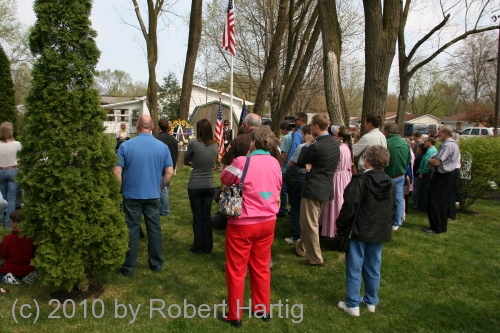
If you’ve been following this blog lately, then you’re well aware that yesterday was the 45th anniversary of the 1965 Palm Sunday Tornado Outbreak. The commemoration held at the Tornado Memorial Park in Dunlap, Indiana, came together beautifully thanks to the hard work of my friend Debbie Watters, who owns the park. To say that it was a memorable event understates some of the truly amazing things that transpired.

Dan McCarthy, the meteorologist in charge at KIND in Indianapolis, was the keynote speaker. Dan did a superb job describing the strides that severe weather forecasting and the warning system have taken since 1965, and explaining how the Palm Sunday Outbreak served as a catalyst for those changes. If there is any comfort to hearts that still ache over the loss of loved ones in the storms, Dan suggested that at least part of it may lie in knowing that a tornado catastrophe of such magnitude is unlikely to ever happen again.

Several other speakers followed Dan. Last of all was Debbie. I think one reason she does so well behind a microphone is that she pours her heart out toward her listeners. At a gathering of tornado survivors and their families, the needs may not be readily apparent; but Debbie, having lost her brother Stevie in the Dunlap F5, knows what lies below the surface. It had to have taken some courage to address the subject of survivor guilt as honestly and
straightforwardly as Debbie did, but it’s only in shining light on such a painful issue that its grip can perhaps be broken on people who, over four decades later, still wonder why they lived while their loved one died

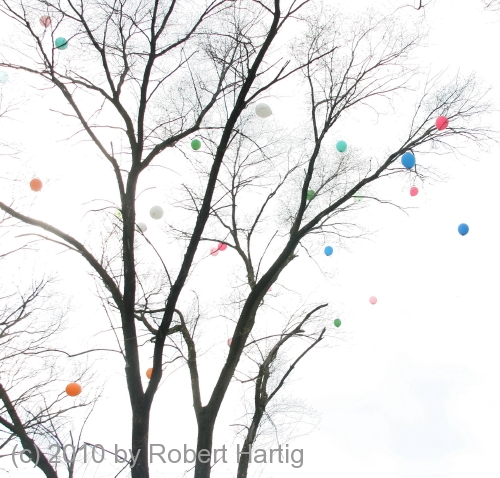
At the end of the service, there was a balloon launch in loving memory of the Elkhart County tornado victims. It was a poignant moment, watching those bright, merry balloons soar skyward into the blue.

But it was the behind-the-scenes happenings, the interpersonal connections, that will live on in my mind. There were some heartwarming moments, and a few that were just plain incredible. Debbie had always wondered who the stranger was who saved her mother’s life after the tornado, and who sheltered the two of them in his car until an ambulance arrived. Yesterday, a woman introduced herself to Debbie as the man’s wife. You can imagine what a powerful meeting that was for both women.
Among the roughly 150 attendees, I was delighted to see Paul and Elizabeth Huffman. Paul is the retired Elkhart Truth photographer who took the famous image of twin funnels straddling US 33 south of Dunlap, destroying the Midway Trailer Court. That photo, one of six in a sequence, is arguably the most famous and dramatic tornado photograph of all time, and one that has inspired more than one young kid to pursue meteorology as a career.

Now in his eighties, Paul is a peppery and humorous personality, and his wife, Elizabeth, is a sweetheart. It was fascinating, in talking with them, to get insights into how things played out that day. Paul wasn’t even aware of the twin-funnel structure when he snapped the photo; in his viewfinder he saw just the rightmost funnel. It was only when the startling image of “The Twins” emerged in development that Paul realized he had captured something extraordinary on film.

I was particularly pleased when one of the speakers, Brian Beaver–an award-winning radio correspondent formerly with IPR–took time to publicly recognize Paul and honor him for his achievement.

My friend Pat Bowman and her brother John were also present. But of course they would be–Pat is integrally knit into these events. She and Deb are my two “tornado ladies,” dear to each other and to me. The way that the three of us connected is a pretty incredible story in its own right, and it all started with Pat. Actually, it started long before, with a newspaper account of a young couple’s tragic loss of their child, and of a small boy’s prayers for them in response. There is a reason that Pat is very special to me. But that story is for another time.
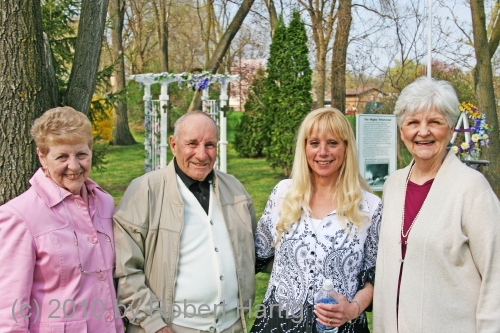
The last photo on this page is one I will always treasure. That’s Elizabeth and Paul Huffman on the left. Debbie is the blonde, and that’s Pat on the right. God gifts us with people, and it was a blessing to me to see these four together. The threads of events that connect them are intricate and remarkable, and I feel privileged to see the connections continue to unfold in their lives and in mine.

Looking Back: A 45-Year Retrospective on the 1965 Palm Sunday Tornadoes

Today marks the 45th anniversary of the Palm Sunday Tornadoes, the second worst tornado outbreak in Midwest history. Between the time that the first funnel dropped in eastern Iowa shortly before 2:00 EST and the time when the last one dematerialized in the night sky over Ohio eleven hours later, tornadoes took 272 lives in six Great Lakes states.

This April 11 also happens to be a Sunday, but while it is a moody day, it holds no threat of violent weather. I’m sure we’ll see our share of that this spring, but not today. At the moment, I’m sipping on my morning cup of coffee; then I’ll shower up and head down to the historical museum in Bristol, and then to the tornado memorial park in Dunlap, Indiana, where my friend, Debbie Watters, has organized her commemorative event. If you’re interested in attending, click here for details and a map.

It is strange how something that happened over four decades ago, and in which I was not directly involved, has remained with me all these years. But the ripples of that long-ago Palm Sunday evening have extended into many lives. Today’s event will draw not only survivors, many of whom are now well advanced in years, but also their children, their nieces and nephews, their grandchildren. The wind’s roar still echoes through a broad patchwork of lives, young and old.

The Palm Sunday Tornadoes were formative not just in family histories and individual lives; they were also a seminal event in severe weather meteorology and operational forecasting. Out of that disaster came a remarkable paper by Dr. Theodore Fujita, published in the “Monthly Weather Review,” which presented the first truly in-depth analysis of a tornado outbreak. For the first time, you can see a system for tracking tornado families and their members. You’ll find Fujita’s evidence for multiple vortices, a now well-established phenomenon which was unknown at the time.

It was out of the Palm Sunday Tornado Outbreak that Skywarn evolved in the interest of enhancing public safety during severe weather events. The Weather Bureau’s communication infrastructure, which suffered some fatal breakdowns during the outbreak, was scrutinized for improvement. Civil defense sirens, hitherto unused to alert Great Lakes residents of approaching tornadoes, were harnessed as part of the public alert system. And the very language of severe weather warnings was changed. “Tornado forecasts” became “tornado watches” to help the public better distinguish between a watch, issued when conditions are favorable for tornadoes to develop, and a warning, when a tornado has actually been detected, whether by radar or actual visual confirmation.

I’ll have more to report when I return from today’s doings. Right now, I need to finish my coffee and hit the shower and then the road.

The Cap Won

I don’t know why so many storm chasers decided to chase in northern Missouri this last Monday. I could have told folks it had “cap bust” written all over it–didn’t fool me for a minute, as you can see by reading my post written the day before.

Ahem…right, so I got snookered too. The GFS was spot on about the cap, and the NAM way underforecast it. As a result, Missouri chasers wound up sitting under relentlessly empty skies waiting for convection to fire. It finally did in northeast Kansas–after dark. Storms ignited along a boundary (the warm front? ) and a couple went supercellular and even tornado-warned for a heartbeat before the cap re-exerted itself and squenched them.

The real action, ironically, took place in central Illinois and Indiana, well east of where most folks–including me–had expected. Supercells cut a swath along the warm front through Terre Haute, Indianopolis, and parts east and southeast into Kentucky, and a number of purple boxes lit up the radar screen. Nevertheless, SPC storm reports list only one confirmed tornado that touched down near Hillsboro, Illinois, northeast of Saint Louis.

Them’s the breaks. I didn’t chase that day, and I’m glad that I didn’t because I’d almost certainly have gotten skunked in Missouri when I could have driven straight south down US 41 to Terre Haute, not even having to mess with Chicago traffic, and waltzed on into the sweet zone.

Ah, well. I chased today–if chasing is what you can call a guaranteed grunge fest–down toward a warm front by the Michigan border. The trip was my compensation prize for not heading out when it really counted these past few days. The SPC had outlooked a five percent tornado risk this afternoon, and supercells were making their way northeast across Illinois toward Indiana. I figured that if they held together, I might catch them, but not surprisingly, they mushed out.

That was okay. I was chasing blind, with no radar and few expectations other than the hope that I’d at least see some lightning. I did, and called it good. The main storm season is still on the way, and there’s no need to fret over spilled milk when the cow is just priming its udder. It won’t be long now.

First Supercell of 2010 in Michigan

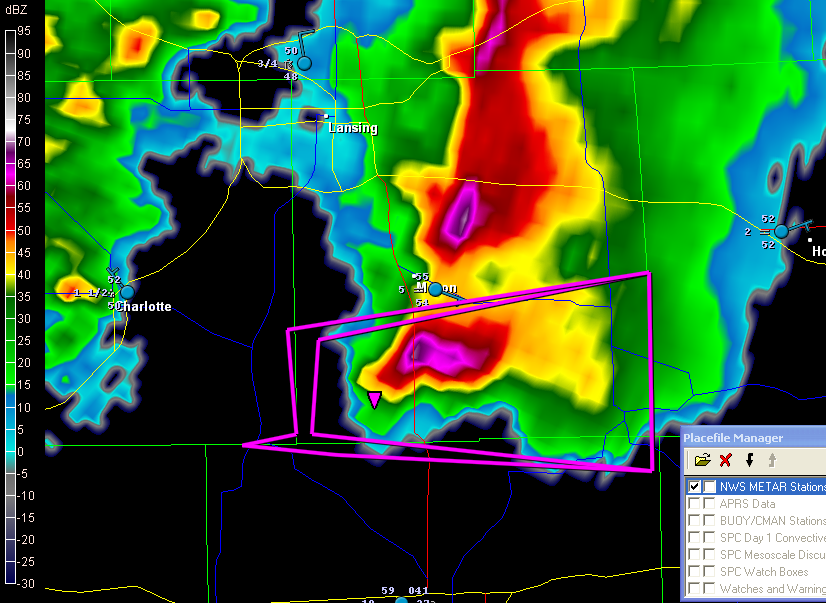
Michigan’s first supercell of the year rolled through southern Michigan this morning, prompting our state’s first tornado warning for 2010. The cell was a sweet little tail-end Charlie that showed bursts of decent rotation and triggered a series of TVSs. It is presently getting set to exit the state near Mount Clemens, leaving behind it a series of hail reports up to an inch but nothing more. It’s what one would expect given the cool temperatures, low dewpoints, and weak-to-borderline low-level helicity.

Here’s a GR3 radar grab of the storm as it was crossing US 127 south of Mason; click on it to enlarge it. A scan or two prior the cell had a nice hook to it, and you can still see the suggestion of a weak echo region with inflow coming in from the east.

Caledonia got nailed by the northern part of the line earlier. At 10:20 a.m., the sky was as dark as a black cat’s belly and the parking lot lights were on. There were one-inch hail reports in the area; my friend Kurt Hulst called to tell me that he had gotten marbles over at his apartment and wondered whether any of that had come my way. It hadn’t, but we got a truly massive downpour, really something to see. It’s going to bring a lot of green to an already nicely greening landscape.

More storms in the forecast for today. Yeah! Bring ’em on!

NAM Model Soundings for Northwest Missouri

The GFS wants to cap the crap out of tomorrow’s setup, but the NAM paints a much more positive picture in northwestern Missouri. Having looked over the SREF, I have a hunch that it’s the GFS that is out to lunch regarding convective inhibition, at least in that neck of the woods. Frankly, I find this thought rather annoying since I’ll just be armchair chasing tomorrow, and I feel pretty certain that some significant tornadoes are going to occur in northern Missouri and maybe Iowa.

For those of you who will be chasing, you might enjoy taking a gander at these NAM model soundings for 22Z Monday, April 5. (Click on the images to enlarge them.) If those verify, then there ought to be some very busy storm chasers tomorrow afternoon. The soundings are for Saint Joseph and Kansas City, Missouri.

If you’re one of those who are hitting the road tomorrow in pursuit of Big Weather: have fun, get great photos/video, and stay safe.

Midwest Storm Chase Shaping Up for Monday

Monday is shaping up to be one of those days that will tear me in two: the first really decent storm chasing setup in the Midwest, beautifully accessible, but my finances are too meager right now for me to do anything about it. Aaargh!

Just look at this TwisterData 12Z NAM forecast sounding for April 5, 00Z, in extreme northeastern Missouri, up near Cantril, Iowa (click to enlarge). It’s near a nice 1 km EHI bullseye. Nice CAPE, nice veering with height, just a dab of CINH–what more could you ask for? The hodograph, not shown, curves beautifully.

However the exact mesoscale details shake out come Monday, the models have lately been coming together nicely to paint a compelling warm-front picture in southeast Iowa, northeast Missouri, and western Illinois.  Somewhere in that vicinity, tornadoes look likely. Maybe farther west, too, though capping may be an issue. Right now, though, I’m not current on the  dryline/triple point play; my attention is focused on my own back yard.

This promises to be a sweet setup for Great Lakes chasers. Maybe there’ll be some fortuitous way I can seize the opportunity, but I have an idea that I’ll be armchair chasing Monday afternoon and eating my heart out. As for Tuesday, well, there’s been talk about that, but right now I’m not as excited about it. Monday’s the day. Oh, man. So near and yet so far–gotta get to it some kinda way.

1965 Palm Sunday Outbreak Commemorative Event: Update

Here’s the latest on the 45-year anniversary commemoration of the 1965 Palm Sunday Tornadoes (click here for original notification):

  • Date: Sunday, April 11, 2010
  • Time: 3:30 EST
  • Location: Palm Sunday Tornado Memorial, corner of Amy and Cole Streets, Dunlap, IN, south of Elkhart. Click here for Wayfaring Map.
  • Event organizer: Debbie Forsythe-Watters

The event will feature a number of speakers, including Dan McCarthy, this year’s keynote speaker. Dan is the meteorologist in charge at KIND, the National Weather Service office in Indianapolis. He is the author of 40th Anniversary of the Palm Sunday Outbreak: How It Changed Preparedness & Forecasting, a presentation which he delivered at the 9th Annual Ohio Severe Weather Symposium.

Lest that sound a bit intimidating to those who aren’t weather weenies, Dan is a great guy. I haven’t met him in person, but we’ve connected on Facebook and swapped a few emails, and he strikes me as a very likeable, down-to-earth person who knows how to talk to his listeners, not above them. I don’t know what he has in mind, but I very much doubt he’s going to deliver a college-level weather lecture. Rather, I suspect that he’ll have some understandable and fascinating insights to share on the second worst Midwestern tornado outbreak in modern history.

It’s also possible that Paul and Elizabeth Huffman may show up. Paul is the press photographer who took the famous shot of the twin funnels hitting the Midway Trailer Park two miles south of Dunlap. He and his wife are elderly, and their attendance will depend on how they’re feeling that day. It’s an unpressured arrangement between Debbie and the Huffmans, so we’ll keep our fingers crossed and leave it at that.

In any event, if you have any stake in the 1965 Palm Sunday Outbreak, don’t miss this event. Come expecting to connect with people who in one way or another were affected by the Palm Sunday Tornadoes. If you’re a survivor of the tornadoes, you’ll meet others who also lived through them, and you’ll have stories to share. If you lost a loved one in the storms, you’ll meet others who know what it was like to endure such a loss—who still, after all this time, feel the ache and understand yours. If you’re a child or relative of someone who experienced the tornadoes, you’ve heard some of the stories; this will be your chance to hear others, and to gain insights into your mother or father, aunt or uncle.

No matter who you are, if you’re interested in the 1965 Palm Sunday Tornadoes and you live in the area, in northern Indiana or southern Michigan, I think you’ll find this a worthwhile and memorable afternoon.

45 Year Commemorative Event Planned for 1965 Palm Sunday Tornadoes

April 11 this year will mark the 45th anniversary of the second worst Midwestern tornado outbreak of modern times. The 1965 Palm Sunday Outbreak is noteworthy not so much for the number of tornadoes involved as for their violence and the number of fatalities they produced. Out of 38 “significant” (F2 or greater) tornadoes that occurred in six state over 11 hours, 19 were rated at F4 and two at F5. Going by NOAA’s death toll and adding to it one Iowa resident who died a month later from his injuries, 272 men, women, and children lost their lives in the storms.

One of the victims was Stevie Forsythe, the brother of my friend Debbie Forsythe-Watters. Debbie is the owner of a tornado memorial park that occupies the property where her childhood home in Dunlap, Indiana, just south of Elkhart, was swept away by F5 winds. To learn more about the park, check out my earlier post on the Dunlap tornado memorial, complete with photos.

Debbie is currently planning this year’s commemorative event, to be held on the date of the tornadoes: Sunday, April 11. If you take an interest in this historic and influential weather disaster, you may wish to attend the service. It will be held on the park grounds. The time has yet to be determined, but it will likely be in the late afternoon.

I will post more information as details are solidified.

Moisture Return Getting Primed for April?

So far most of the systems that have moved across the CONUS have lacked the moisture needed to produce tornadoes. But that may be about change toward the end of March. If the GFS is good for at least suggesting possibilities, then the Gulf of Mexico may finally start to open up and introduce 60s dewpoints well up into Dixie Alley, and upper 50s into the Midwest.

Just for kicks, I ran a series of today’s 12Z models for 21Z and 18Z out through 384 hours, and I found the first glimmer of better days around 159 hours in east Texas, shifting to Mississippi and Alabama at 180 hours. By the end of March, around 300 hours, deeper incursions of adequate to decent dewpoints were stretching north.

Let’s not get into the foibles of long-range forecasts, okay? We all know about them, and this post isn’t even a wishcast, just pure speculation. At this time of year, with El Nino gradually weakening, it seems reasonable to think that the moisture fetch will start improving as March transitions into April.

On the one hand, the ENSO charts call for cooler-than-normal sea surface temperatures in the Gulf; on the other hand, warmer weather ahead, common sense, and plain old gut instinct suggest that something’s gotta give. A tornado-less February, fine; a downscale March, understandable; but I just can’t image a convectively wimpy April.

Update on Palm Sunday Tornadoes Book

In a post a few months ago, I mentioned that I was writing a book on the 1965 Palm Sunday Tornadoes. I’ve kept the project largely under wraps, but yesterday I passed a significant mile marker, and I’m too pleased to not say anything. So here’s the news: as of last night, chapter two is completed.

That may not seem like such a grand achievement, but if you knew the amount of time it has taken me to accomplish it, both in doing the research and in waiting for the opportunity to pull together important pieces of information, then you would understand how formidable has been the logjam that I’ve just broken through. I can’t overstate how much pleasure I take in saying that, praise God, this bit of work is now behind me, and while the next part of the job will also take time, it should be relatively straightforward.

Chapter two deals with the meteorological and operational forecasting concerns of the Palm Sunday Outbreak. My goal in writing this chapter has been to create a solid context for the personal accounts which will commence in chapter three. I’ve striven to provide a decent overview of how a weak surface low centered over Denver on April 9, 1965, evolved into an historical weather disaster two days later on April 11. My challenge: furnish essential meteorological information that will interest and educate a popular readership rather than overwhelm them, without “dumbing down” to the point where weather weenies who desire a bit of substance would feel disappointed.

I’m extremely happy with the results, which include a historical backdrop of America and the state of meteorology in the United States at the time of the tornadoes; a chronology of tornado forecasts and warnings woven into a fast-paced narrative; a colorful description of the outbreak’s first tornado as it formed and moved across eastern Iowa; and the energy required to engage readers to the end, building enough momentum to launch them easily and naturally into chapter three.

Brag, brag, brag. Hey, don’t YOU brag about YOUR kids? I’ve worked hard to earn this  mellow but celebratory mood I’m in. This has been a big hurdle I’ve crossed, and I don’t mind giving myself an attaboy. Now comes the next phase of the book, which will consist of the stories of Palm Sunday Tornado survivors. Look for further updates a few months from now.