August Reminiscences: My First Successful Storm Chase

Ah, August. In its own way, it’s a lot like February: a month whose respective season of the year has settled in and ripened into predictability. Upper winds are weak and storms are often the pop-up type, providing a quick flash-and-bang along with localized rainfall before fizzling out. Yet on the horizon, like the first cirrus wisps of a fast-moving cold front, you can see change coming.

This morning I awakened to the distant grumble of thunder, and when I opened the drapes, the sky was an odd, fish-flesh paleness with darkness moving in. Oh, joy! Upon hearing me stir, Lisa stepped into the room with a smile and told me that a squall line was approaching. Now, that’s the way I like an August day to begin! I fired up the computer and consulted GR3. It was a skinny line, but the NWS was saying big things about it’s being quite the wind machine. Eight miles up the road, the KGRR station ob reported heavy rain; yet here in Caledonia, we got just a mild spray of precipitation, the lightning called it quits, and the line which had threatened to enter like a lion left like a lamb. Now it’s no longer even detectable on the radar.

More thunder is in the forecast for today, though, and for the next few days, as a weak warm front sloshes back and forth and as air mass storms generate more boundaries to fire up convection. It’ll be a bland but enjoyable show.

While my attitude toward August may seem patronizing, this month is capable of producing an occasional potent surprise. On August 24, 2007, I was sitting in the Hastings library when a line of storms formed just to the west and drifted directly overhead. I had my laptop with me with GR3 running, but my forecasting skills and overall experience were still pretty embryonic, and I dismissed some telltale signs, both radar and visual, because forecast models indicated a straight-line wind event.

The storms matured overhead, blasting Hastings with rain and lightning, and then moved to the east and steered an EF-3 tornado through the town of Potterville. I could have easily intercepted it if I had known what the heck I was doing. There it was, a perfect chase opportunity, gift-wrapped with a large ribbon and dropped smack into my lap, and I was too dumb to untie the bow. Aaargh! Four years later, I could still whap myself alongside the head.

But God showers his kindness even on the ignorant. My first successful chase was eleven years earlier, back in August of, I believe, 1996. I don’t remember the exact date, but I can assure you that in those days, cluelessness was a level of expertise I had yet to attain. However, I had at least learned a few things about storm structure and a few concepts such as shear and CAPE. So when the morning blossomed into an exceptionally sticky day–dewpoints had to have been in the mid-70s–and when I noticed clouds in the afternoon leaning over and curling at the tips, I sensed that something was up.

Around 4:30, I happened to glance out of one of the wrap-around windows at the place where I worked and did a double-take. A wall cloud was forming just a mile or so to my south. Hot dang! I watched it for a bit as it moved eastward, then decided to do something about it.

Leaving work early, I hopped into my little Nissan Sentra and blasted after the storm. I had no laptop, no radar, no weather radio, no experience, and very little knowledge. Instinctively I stayed to the south side of the storm. But as it neared Ionia, I could no longer make out cloud features. I wasn’t even certain that the storm still existed. I hit M-21 and traveled east a ways, then north, smack into the precip core. Yep, the storm was still there. But where was the wall cloud? Was there still a wall cloud?

Emerging from the rain, I headed back west, then south down M-66, effectively circling the supercell. As I approached Ionia from the north, the wall cloud came once again into view. Cool! The storm most definitely still had its teeth.

I tracked behind the storm down M-21, getting right to the rear edge of the circulation. Near Muir, a streak of white condensation shot suddenly out of the woods on the right side of the road half a mile in front of me. Was that a tornado? I wasn’t sure, but it looked mighty promising. Also a bit unnerving. I dropped back and put a little more distance between me and the updraft area.

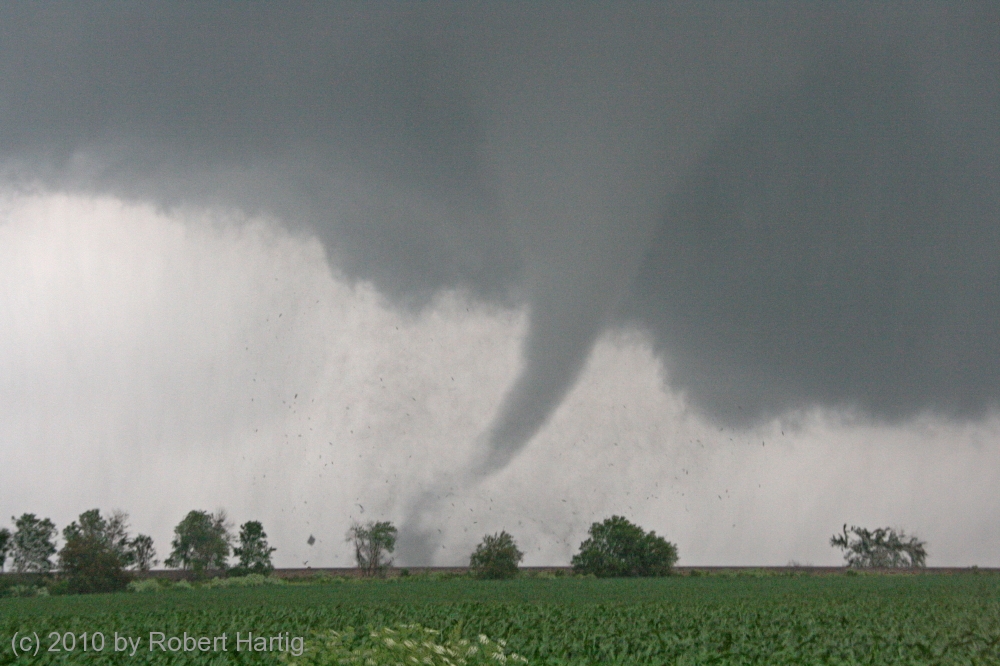
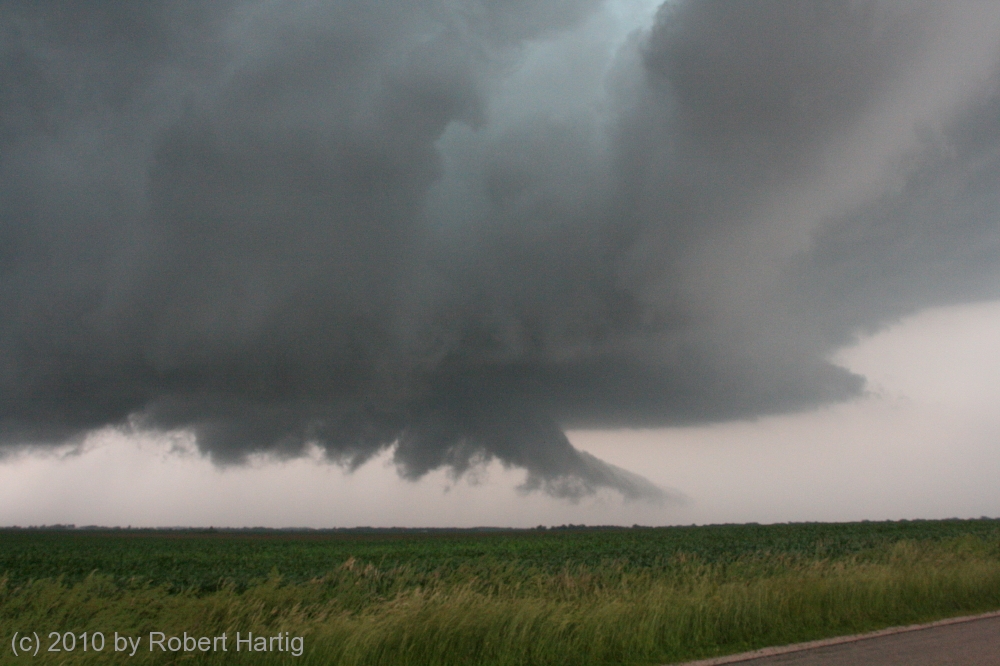
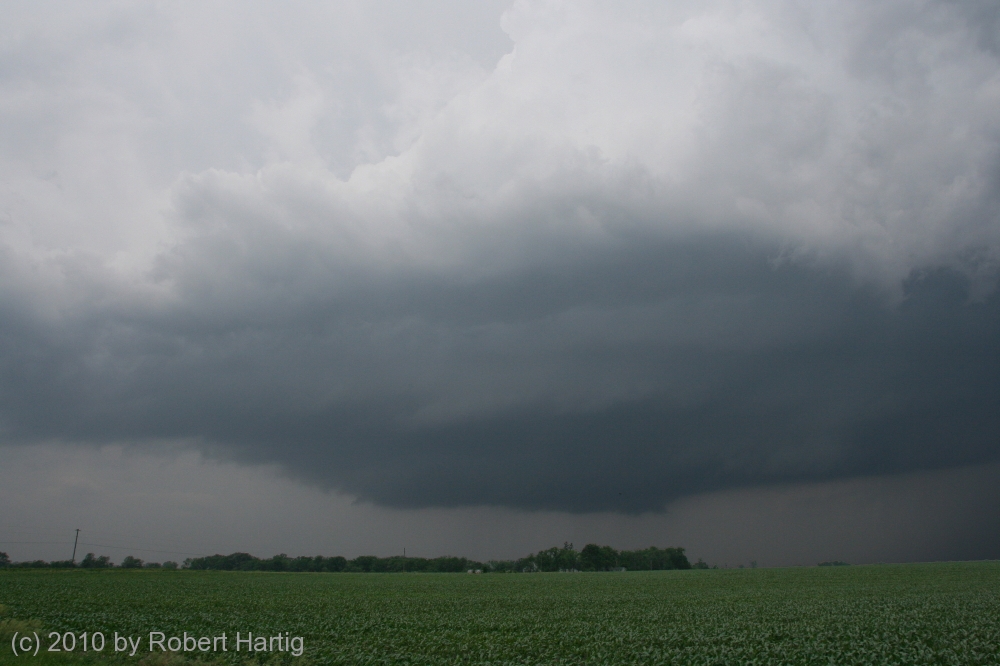
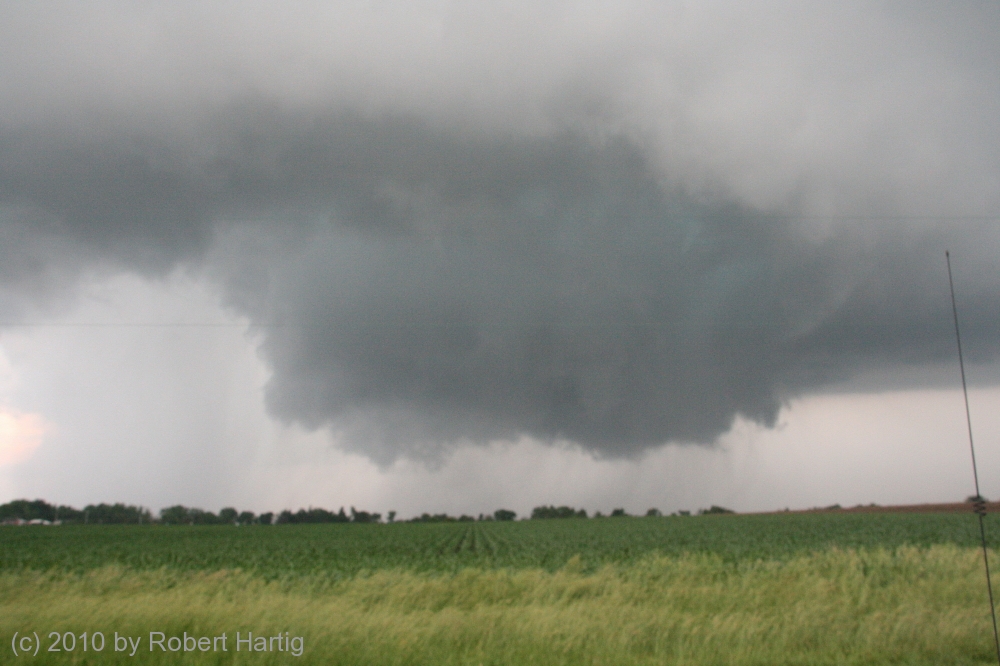
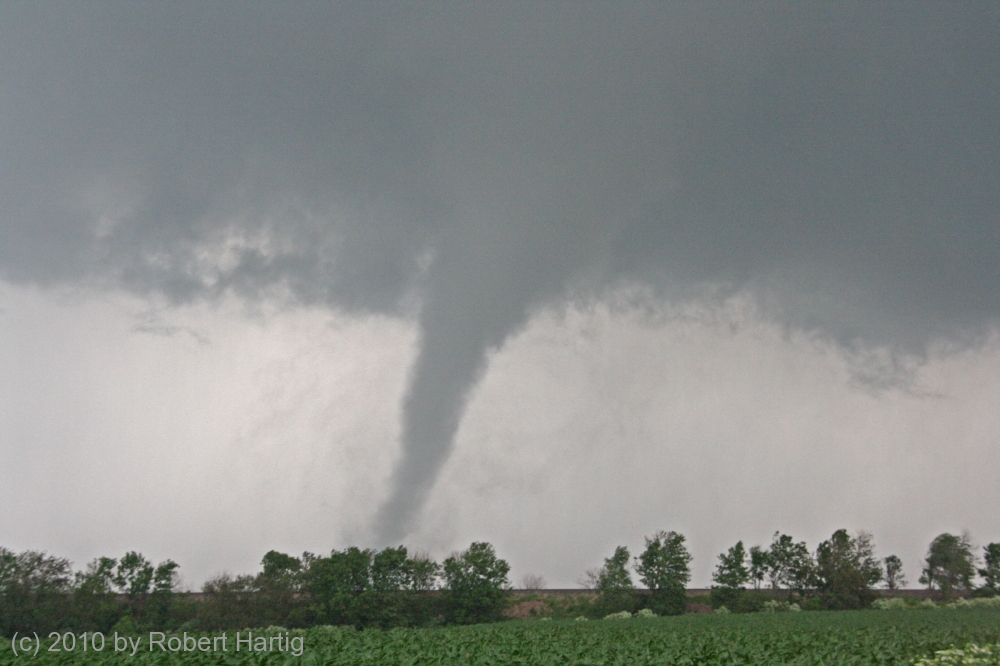
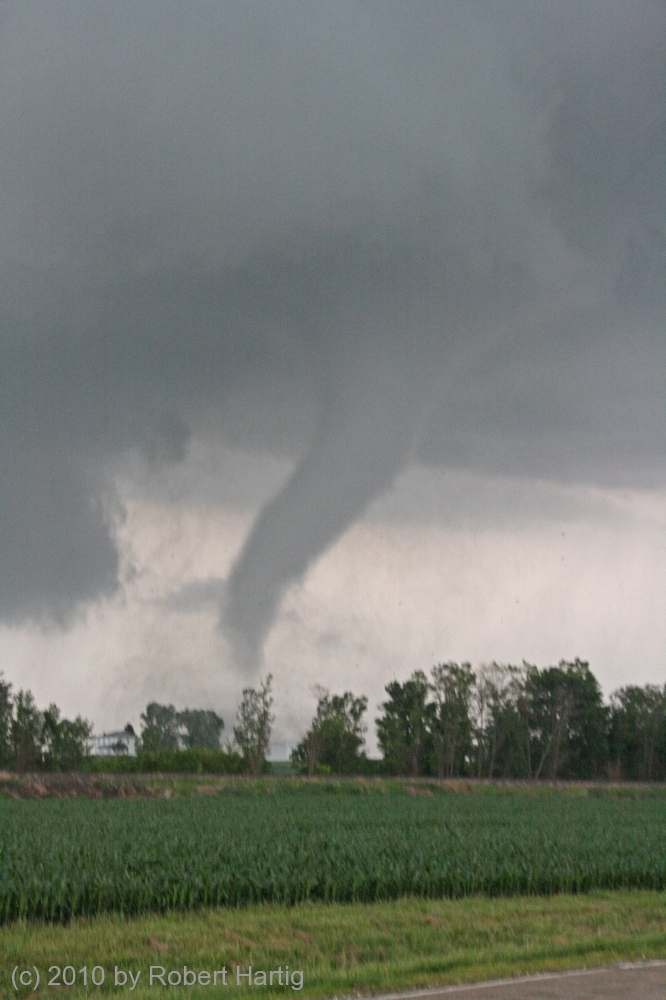
A while later, somewhere in the open country around St. Johns, I parked and observed as the wall cloud reorganized east of me. While I didn’t realize it at the time, I was watching a classic supercell, as nicely structured and impressive as anything I’ve seen out in the Great Plains. It tightened up, with a nice inflow band feeding into it. Then, to my astonishment, a beautiful, slender white tube materialized underneath it a mile away. Extending fully to the ground, the ghost-like tube translated slowly to my right for a distance of probably no more than half a mile, then dissipated. I had just seen my first tornado!

At that point, the storm weakened. No doubt it was just pulsing, but I dropped it and headed for home. However, I soon discovered that another storm was right on the heels of the first one, making a beeline toward me down M-21.

What were the odds that it, too, would be a supercell? Plenty, of course, but to me at that time they seemed as remote as lightning striking twice in the same place. Nevertheless, something told me that I needed to exercise caution, a hunch that verified as I headed back into Muir. An evil-looking flying saucer meso was approaching the town. Hmmm…maybe it would be prudent of me to drop south.

A couple miles out of the path of the updraft, I parked, got out of the car, and stood on the roadside listening to the thunder grumble and watching as the mesocyclone drifted uneventfully over Muir and vanished off to the northeast. Then I climbed back into my vehicle and headed back to M-21, and west toward home.

I was stoked. I had witnessed my very first tornado! Wow! Thank you, Lord, thank you, thank you, thank you!

It was a milestone in my life so huge that hitting the deer just outside of Ada seemed like practically a non-event. Within a nanosecond, the yearling bounded out of the woods and into my path, driven by a powerful urge to bond with my radiator. Much to both of our chagrin, it succeeded.

But you know, I love a good story, and I recognized all the elements of a great one, a real red-letter day. Not only had I experienced my first successful storm chase, but to top it off, I had also collided with a whitetail and demolished my front end. It doesn’t get much better than that–or at least, it wouldn’t until fourteen years later on May 22, 2010, in South Dakota. That was the ultimate storm chasing experience. But that’s another story.

As for this story, all fun and excitement aside, I had learned a sobering lesson about the dangers of storm chasing. I had come face to face with the dark side of nature–with a force that, beautiful as it was, was also fearful, uncontrollable, and deadly, capable of wreaking havoc on a scale that beggars description. No question about it, deer are dangerous. I enjoy seeing them at a distance, just not up close.
Oldies But Goodies

Sorry–I seem to have let an entire week slip by without posting. Many bloggers have a knack for slapping out short, cogent posts in 15 minutes or so, but that’s not a gift of mine. Just about every post takes me several hours to write, particularly the ones that include musical exercises. So when I have other things packing my schedule, the prospect of sitting down and creating a post can seem daunting.

That has been the case this week. Could be a streak of just plain old laziness somewhere in the mix, too, but mainly, these past few days have been busy ones. My brothers Pat and Terry arrived for a two-week visit Monday, so family has been a priority. And work still goes on, regardless–gotta make a living.

Today my bros, my sister, Diane, and I headed to Newaygo, rented some kayaks, plopped them into the Muskegon River, and spent the afternoon taking a delightful 6-mile drift with the current. The Muskegon is a surpassingly beautiful stretch of water. I saw three bald eagles soaring overhead, slews of large turtles sunning themselves on logs, several kingfishers, a green heron, and brilliant red cardinal flowers rimming the banks in swampy areas. Altogether it was a most satisfying day.

But of course, as I said, I haven’t had time to write. So I figured that instead, I’d refer you to a couple of links to archived articles. The first is one I wrote one year ago, titled “Will I Ever Become a Good Jazz Improviser?” The second article is for storm chasers by guest poster Andrew Revering of Convective Development, Inc., on how to forecast severe weather during northwest flow.

I hope you enjoy the articles, and will find your journey back to last August’s posts profitable and refreshing. As for me, I’m tired. It has been a long day, it’s now after midnight, and I’m going to bed. G’night!

July 22 West Michigan Supercell and Lightning Fest

I haven’t seen a storm like last night’s storm in Michigan in a long, long time. Man, what a beauty!

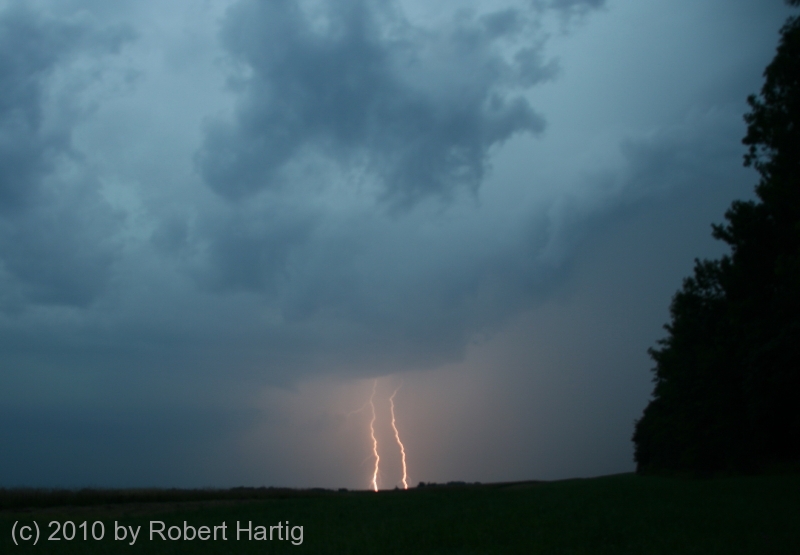
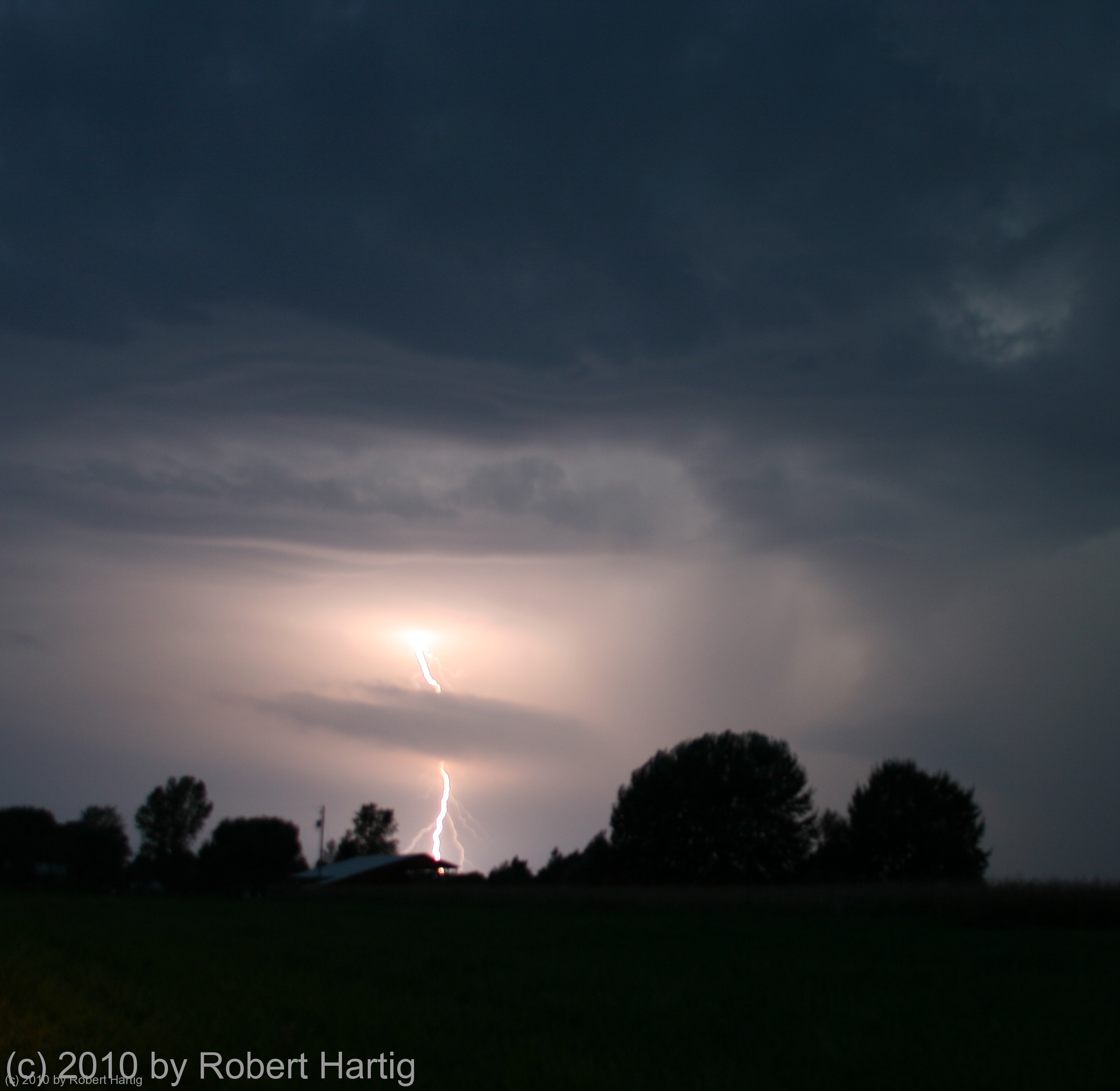
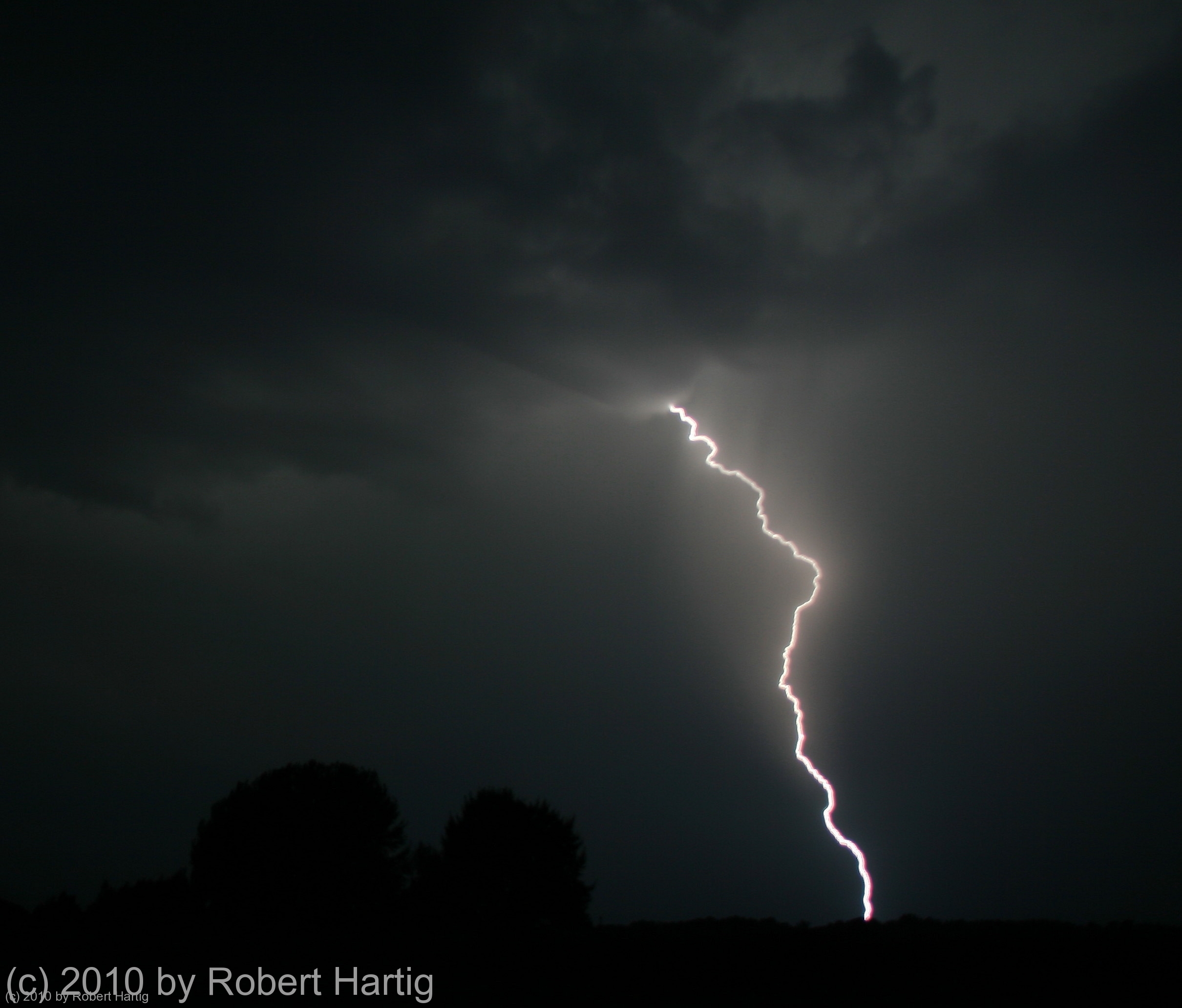
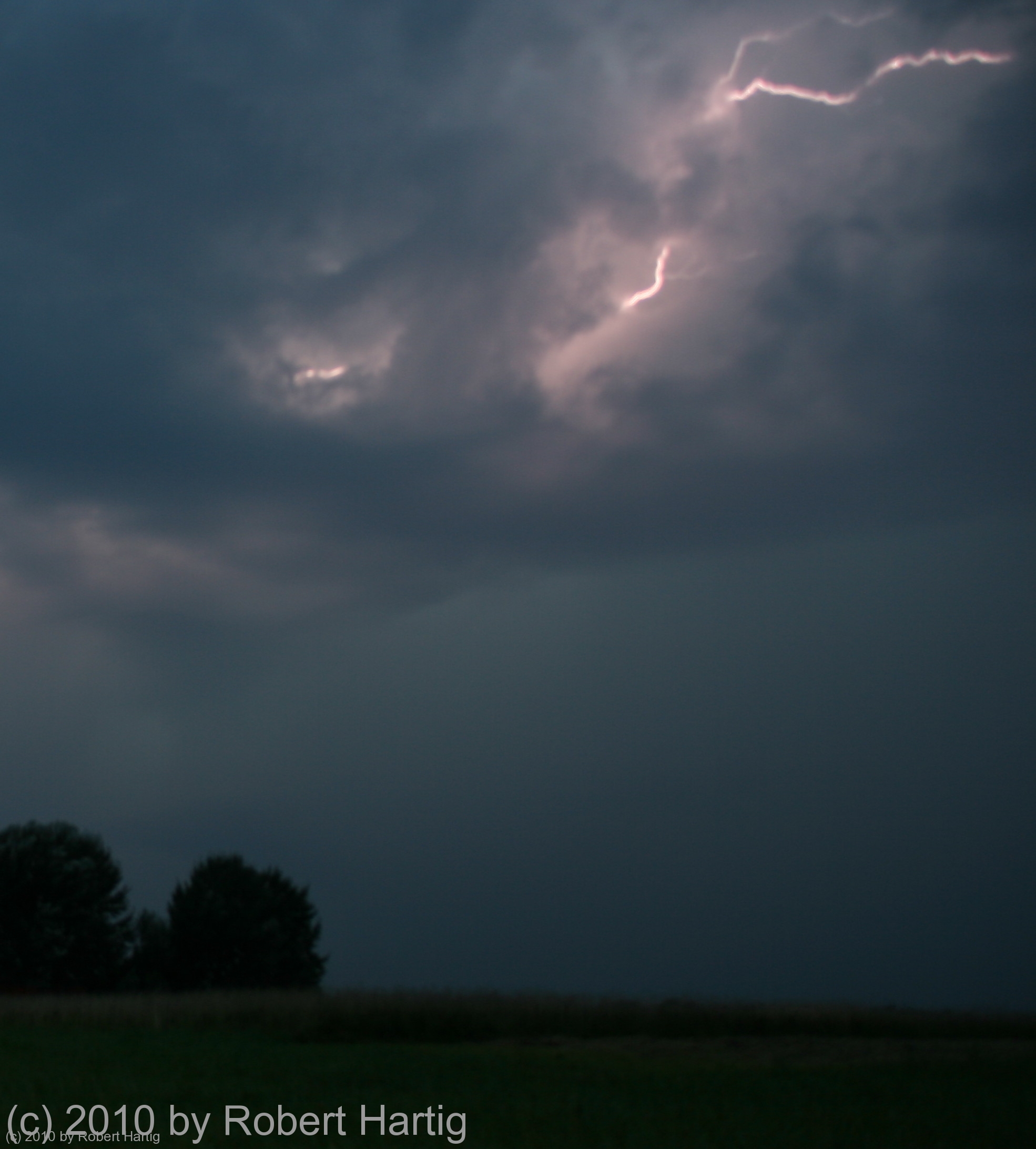
Non-stop lightning, much of it appearing to be positive strokes that lasted for seconds at a time, along with a veritable feast of anvil crawlers, made for a photographic smorgasbord. Plus, the storm structure–as much of it as I could make out at night, illuminated by the incessant lightning–was truly impressive. If only the storm had arrived an hour earlier, when there was enough light to really see the thing!

I had just finished doing a couple of interviews down in Dunlap, Indiana, for the book I’m writing on the 1965 Palm Sunday Tornadoes. My meetings

required me to forgo chasing a supercell that moved through the Battle Creek area as the warm front lifted northward, and I was curious to find out what had happened with it. Pulling into a parking lot, I fired up my computer, opened GR3, and gaped. A line of supercells was advancing across Lake Michigan from Wisconsin. The first one in the line looked great–SRV showed definite rotation–and, headed on an ESE trajectory, the storm was poised to make landfall around Saugatuck. Winds there were almost straight easterly, and they were beautifully backed across most of lower Michigan. Hmmm…what did the VAD wind profile look like at Grand Rapids? Dang, sweet! How the heck did that kind of setup wind up in Michigan?

The storms weren’t moving terribly fast, around 25 knots. Could I make it in time? I was bloody well going to try. There was no denying the rush of adrenaline now galvanizing me, thrusting me into chase mode. I hit US 20 and headed west past South Bend, where the highway merged into US 31 north.

I still had a good 40 miles to go by the time I connected with I-196 near Benton Harbor. I wasn’t sure whether I’d catch the storm by the time it made landfall. Maybe I’d be better off playing more to the east. But I decided to take my chances, and that turned out to be the right move. I couldn’t have timed it better.

As I approached M-89, the eastern part of the storm had made landfall, but the radar showed the rotation still out over Lake Michigan. It wouldn’t be there for long, though, and, having shifted its trajectory south of Douglas, it was now heading straight at me.

Bingo! This was exactly what I’d been hoping for. Leaving the Interstate, I headed east along M-89 and found a nice, open field a mile down the road, just west of 66th Street, 4 miles south of Douglas and 4 miles west of Fennville. Then, turning my car around to face the incoming storm, I parked and grabbed my camera out of the back seat.

The lightning in this beast requires superlatives to describe it. There seemed to be a never-ending supply of high-voltage CGs, delivered with the unbridled, over-the-top enthusiasm of a 4th of July fireworks finale and accompanied by the incessant grumbling of thunder. There were times, as the lightning cells moved past me and surrounded me, when I felt like I was sitting inside an immense flashbulb–a flashbulb that kept firing again, and again, and again. Oh, man, what an extravaganza of pure, searing power and beauty! I’ve done my best to capture it, but my skills as a lightning photographer fall far short of what this storm had to offer. Now, my buddy Kurt Hulst, he’s Da Man when it comes to getting fantastic lightning shots, and I know he got some last night. Me, I seem to have a problem getting a good, crisp focus at night, but I try.

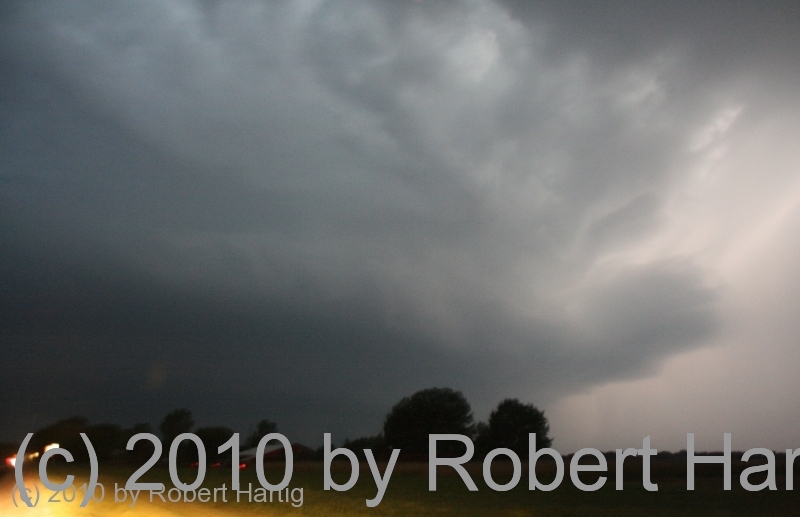
By and by, the flickerings began to illuminate a cloud feature I’d been looking for: a hint of a beavertail off to my northwest. It’s location confirmed what the radar was telling me: the storm’s mesocyclone was moving straight at me. I was in a perfect location–and all this time, standing out in the field near my car, I had yet to feel so much as a drop of rain.

The mosquitoes were thick and nasty, and I was getting eaten alive, but viewing at my position was excellent. Farther east, I’d be getting into thick woods, and since the storm wasn’t exactly rocketing along, I stayed put until the meso got too close for me to be able to distinguish its features. Then I moseyed east a few miles.

I parked again for a few minutes at 63rd Street and noted that what had begun as a stubby beavertail had rapidly grown into an enormous inflow stinger. To my northwest, I could see what appeared to be a large, low wall cloud–hard to determine exactly what it was or what it was doing at night, but it looked convincing enough that I called it in to KGRR.

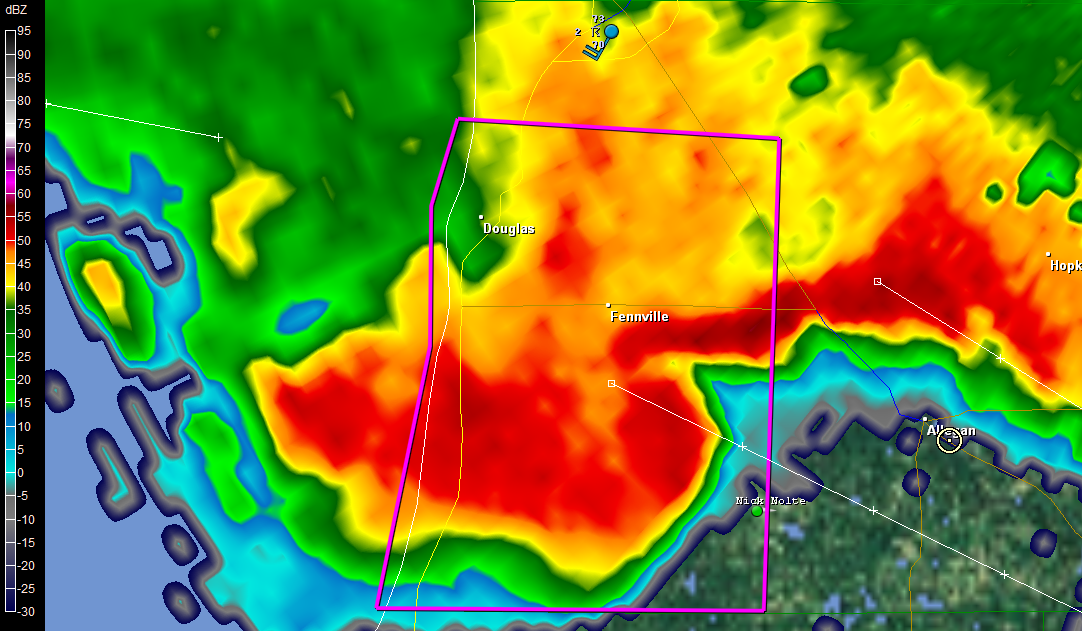
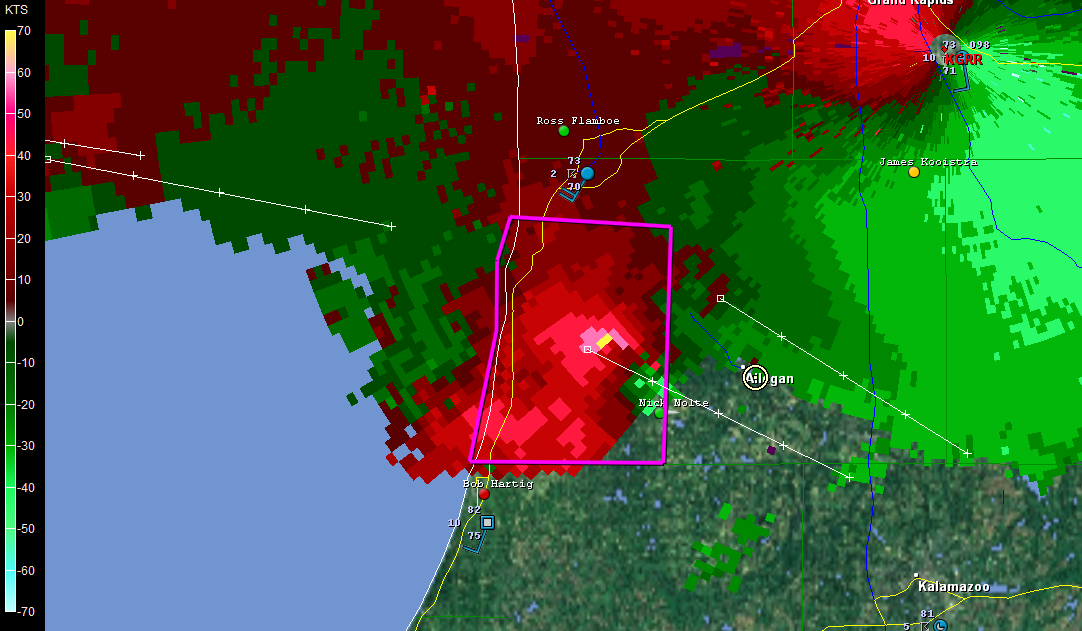
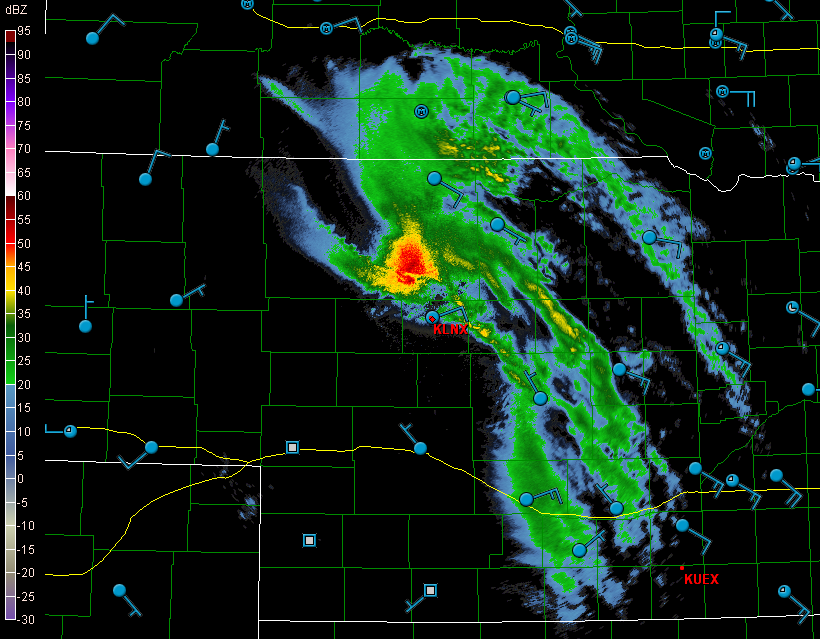
I tracked just ahead of this storm all the way to Plainwell. M-89 proved to be a perfect route, angling southeast along roughly the same path that the storm was taking. On the outskirts of Allegan, I stopped long enough to grab a few radar images. On this page, you can see a nice vault on the base reflectivity, and pronounced rotation on the storm relative velocity. (The circle just southeast of the town center marks my location. Ignore the marker with my name farther to the southwest on SRV; it’s old, an archive from when I dropped off of Spotter Network.)

A little farther down the road, I pulled aside again where a large, open stretch afforded good viewing. The mesocyclone was clearly visible, with a formidable-looking flange on the north side, nice striations, and an impressive inflow band circling in overhead. I hung out at that location until the lightning drew too close for comfort, then hopped back into my car and continued east.

At Plainwell, I dropped south on US 131 past the Kalamazoo exit, caught M-43 west for a mile or so, then parked in a parking lot and let the storm’s southernmost edge blow past me. The storm was still tornado-warned, but the radar indicated that it was weakening–cloud tops lower, VIL not as robust. North of me, just on the other side of M-43, a sheet of rain cascaded out of the wind-blown darkness into the luminous orange domain of the street lamps. Within half a minute, it was upon me, and for a short while, I sat and enjoyed the blast of downdraft and deluge. The rain that I had managed to elude all night had finally caught up with me.

Finally, as the storm bowed out on its journey eastward, I drove back to US 131 and headed for home. I stopped again for a while at the Martin exit, long enough to see what would become of another supercell that was moving inland from the Lake. It, too, quickly bowed out, but, in keeping with the tone of the day, it lit the after-midnight sky with a bombardment of lightning.

It was good to finally pull into my parking lot, climb the stairs to my apartment, and step inside. It had been one heck of a day, and I was ready to call it a good one and hit the sack.

As nasty a storm as it was, why didn’t the Allegan County supercell drop tornadoes? The storm earlier in the afternoon had produced at least one tornado near the Battle Creek airport; why not this one too? After all, it and

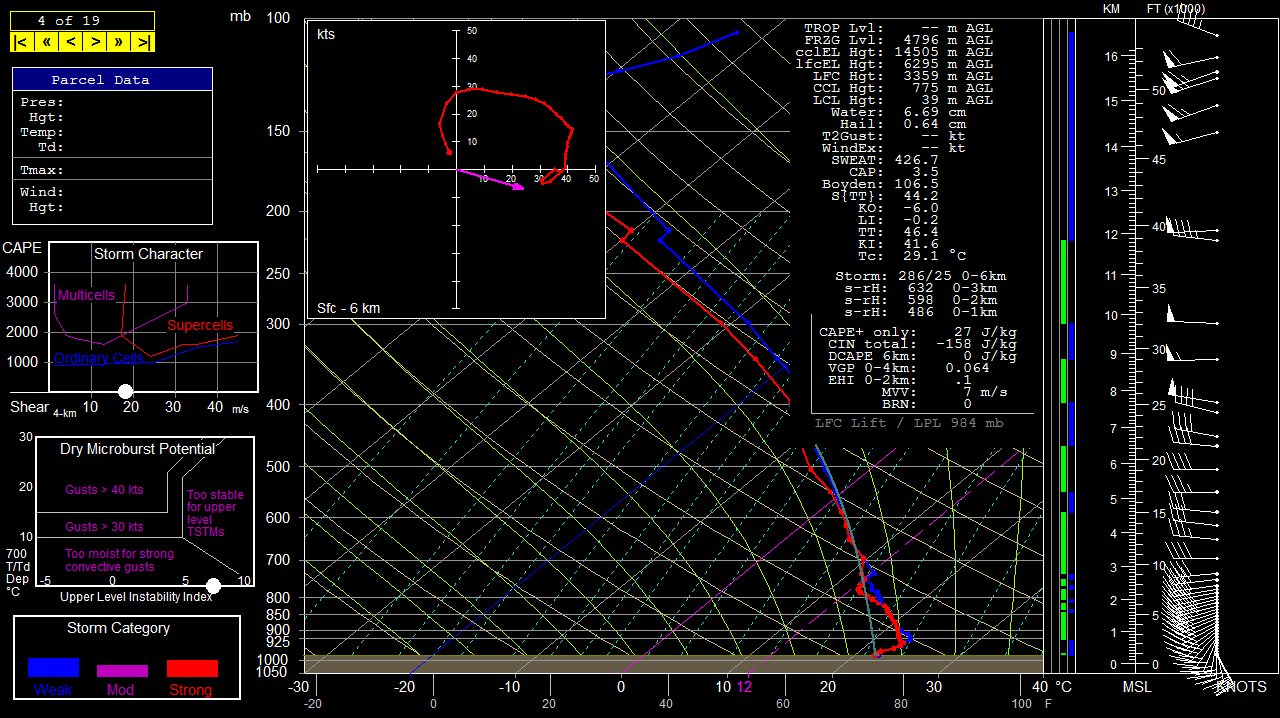
its compatriots had peppered Wisconsin with tornadoes prior to crossing the Lake and heading for West Michigan. All I can surmise is, CAPE was an issue. Winds certainly appeared favorable for tornadoes, and F5 mesoanalysis indicated 1 km helicities ranging from 150-250 across the area as late as 1:00 a.m. The RUC model sounding for KGRR maybe overdoes helicity, but it’s interesting to see what it says about instability. All I can think is that daytime CAPE–whatever it may have been; I never took the time to find out–petered out after sundown, and the shear alone wasn’t enough to spin up tornadoes. That’s my guess as a non-meteorologist, and I’m ready to get other insights and opinions from more knowledgeable heads than mine.

Whatever the case, last night’s was one heckuva storm, and the kind of chase I don’t get to enjoy too often in Michigan. It was nice to finally get such a great opportunity.

1965 Palm Sunday Tornado Book: The Next Phase

Even as my book “The Giant Steps Scratch Pad” nears completion–it now awaits only the cover, which is being designed by a graphic designer friend of mine–my other, more ambitious project is also moving along. That would be my book on the 1965 Palm Sunday Tornadoes.

With important (to me, at least) information in my hands and a key interview now completed, the latest delay has been purely my own making. But it’s about to end. This afternoon I head down to Elkhart, Indiana, to interview my first two tornado survivors, one a retired police officer and the other an emergency worker who helped with rescue operations at the Midway Trailer Court.

This is exactly the boot in the butt I need to get myself going on the next phase of the book: firsthand accounts of tornado survivors. In the months to come, I anticipate making trips to northern Indiana and southeast Michigan, not to mention places in my hometown area of Grand Rapids, in order to get people’s stories straight from the sources.

If anyone reading this post was directly involved in the tornadoes (that is, you got hit by one of the tornadoes or otherwise witnessed a tornado in action) or knows of someone who was whom you think I might want to interview, please leave a comment on this post or else contact me.

Also, if you know of photographs of the actual storms that aren’t already in common circulation, I’d be keenly interested in seeing them. I’m not talking about damage photos, nor am I talking about photos such as the twin funnels hitting Midway that are accessible online. Rather, I’m thinking of old, long-forgotten photographs that might be sitting in your dresser drawer that you or your Uncle Pete snapped with the old Brownie camera. That kind of picture.

This next part will take time to complete, but it should be easier overall than the first part, particularly the second chapter. More updates will follow when I have news that’s worth sharing.

Tornado Event Shaping Up for Tomorrow in Iowa, Minnesota, and Wisconsin

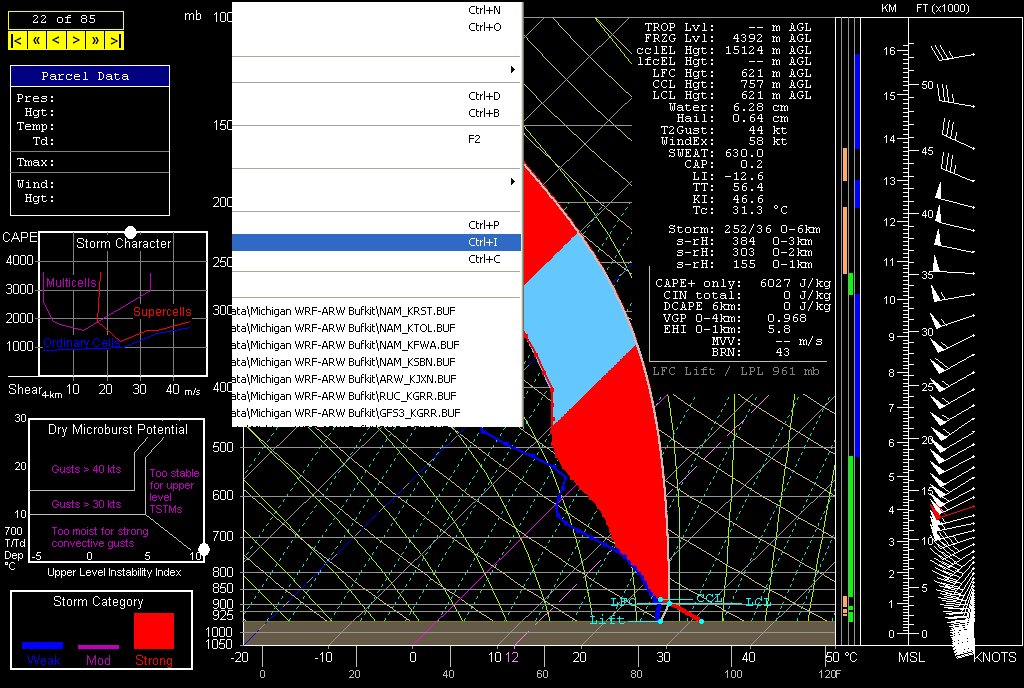
Look at this skew-T and hodograph and tell me they’re not to die for. They’re the 00Z NAM for tomorrow, 21Z, at Rochester, Minnesota. Click on the images to enlarge them. (Apologies for the weird pulldown menu obscuring parts of the images. I don’t know why that happened.)
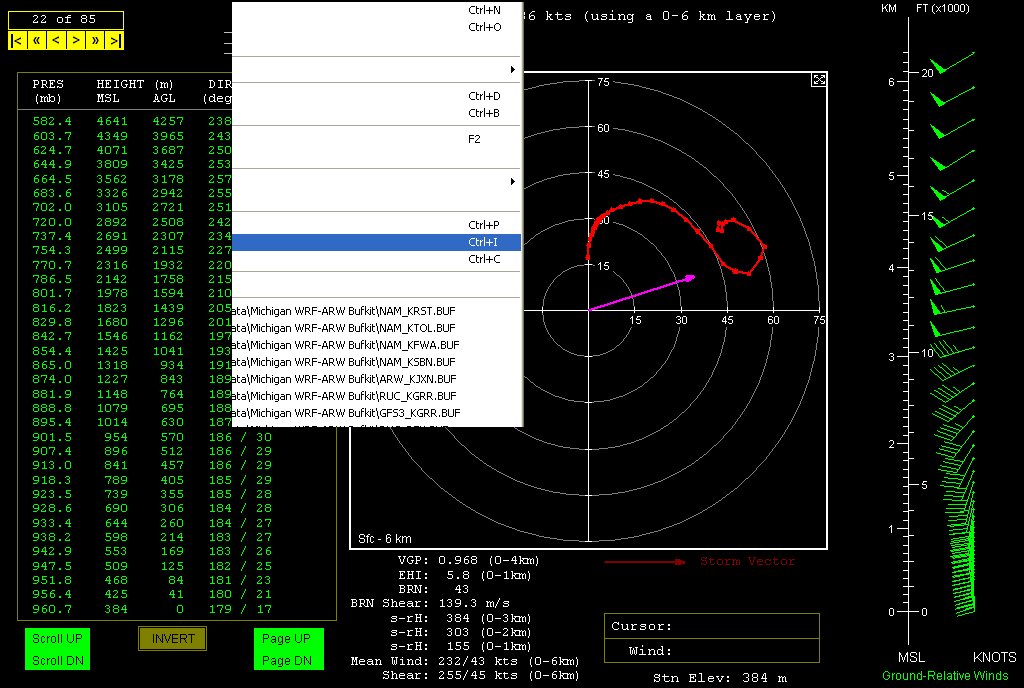
Unfortunately, I can’t afford to chase tomorrow, but I have a hunch that those who do will be rewarded for their efforts. This particular sounding is just a sampler. I’m not sure what to think about that surface-based CAPE. It’s

over 6,000 J/kg. If that even comes near to verifying, the western Great Lakes could be in for a convective blitzkrieg. The 1 km EHI is 5.8 and the 4 km VGP is .968.  Lifted index at -12.6–can that be right? I guess I kind of suspect readings like that–the instability seems just plain absurd.

Wish I could make it out there. Good luck to those who do, and stay safe. For a summer setup, this thing looks insane. I will be watching the radar tomorrow evening, that’s for sure.

Freak Tornado in Wisconsin

A weak cold front has slowly been working its way through Michigan today, with storms firing ahead of it in a very soupy warm sector. Ugh! With temperatures the past several days ranging from the upper 80s to 90 degrees and dewpoints as high as 73 here in Caledonia, it’s about time things cooled off and dried out a bit.

Unfortunately–or fortunately, depending on your point of view–all that lovely moisture has been wasted on insipid lapse rates and humdrum wind fields. What can you do with 500 mb winds of 25 knots or less? Answer: not much.

So what’s with that red dot in Wisconsin in yesterday’s storm reports? Not only did a tornado occur near the town of Cambria, but from the looks of the YouTube videos I saw, it was fairly impressive. Certainly those were more than momentary spin-ups which that Little Storm That Shouldn’t Have put down.

How on earth did it do that? There was nothing happening synoptically that suggested even a remote possibility of tornadoes. So when that puny cell across the lake from me went tornado-warned on GR3 yesterday, I just shrugged it off. Obviously a fluke, some weak Doppler-detected rotation, signifying nothing.

Just goes to show how Mother Nature can mess with your head. According to the NWS office in Milwaukee, that little stinker put down a tornado that lasted 14 minutes, traveled four miles, and did EF1 damage. The level 2 velocity couplet on it was unmistakable. Here’s the full writeup by KMKX, complete with radar images and a photo of the storm right after the tornado had lifted.

Storm chaser Scott Weberpal speculated on Stormtrack that there may have been some kind of interaction between an outflow boundary left by earlier convection. I can’t imagine any better explanation for why what should have been a pussycat of a pulse-type summer storm turned into a barn wrecker. Had the storm gone tornadic farther east, the lake breeze might have been suspect, but the cell was well inland from Lake Michigan.

Today I noticed a couple storms over in the Flint area displaying weak rotation on the radar, and one of them took on that telltale supercellular shape. Given the anemic upper winds, I’d normally have instantly written them off, but after yesterday…well, I watched and wondered, not expecting anything and therefore not disappointed when nothing happened, but still curious. What might happen if any cells firing in that vicinity moved into the Huron lake breeze zone, where the veering surface winds were liable to back?

As it turns out, the storms behaved the way you’d have expected them to given their environment. The last of the line is presently moving through southeast Michigan. But dewpoints are still in the low 70s, and a few popcorn cells are sprinkling the radar. Through my sliding glass door, I can see a big, mushy tower making its debut. Think I’ll grab my saxophone and camera and head out to get some practice in. With a little luck, maybe I’ll get a few lightning photos as a bonus.

An Independence Day Double-Header: Summer Weather Is Here

It’s July 4, Independence Day. Happy Birthday, America! For all the problems that face you, you’re still the best in so many, many ways. One of those ways, which may seem trite to anyone but a storm chaser, is your spring weather, which draws chasers like a powerful lodestone not only from the all over the country, but also from the four corners of the world.

no images were found

This has been an incredible spring stormwise, but its zenith appears to have finally passed for everywhere but the northern plains. And right now, even those don’t look particularly promising. That’s okay. I think that even the most hardcore chasers have gotten their fill this year and are pleased to set aside their laptops and break out their barbecue grills.

Now is the time for Great Lakes chasers to set their sights on the kind of weather our region specializes in, which is to say, pop-up thunderstorms and

no images were found

squall lines. The former are pretty and entertaining. The latter can be particularly dramatic when viewed from the eastern shore of Lake Michigan, sweeping in across the water like immense, dark frowns on the edge of a cold front. If you enjoy lightning photography, the lakeshore is a splendid place to get dramatic and unobstructed shots. Not that I can speak with great authority, since so far my own lightning pictures haven’t been all that spectacular. But that’s the fault of the photographer, not the storms.

The images on this page are from previous years. So far this year I’ve been occupied mainly with supercells and tornadoes, but I’m ready to make the shift to more garden variety storms, which may not pack the same adrenaline punch but lack for nothing in beauty and drama.

July 4th is a date that cold fronts seem to write into their planners. I’ve seen a good number of fireworks displays in West Michigan get trounced by a glowering arcus cloud moving in over the festivities. But tonight looks promising for Independence Day events. Storms are on the way, but they should hold off till well after the party’s over.  That means we’ll get two shows–the traditional pyrotechnics with all the boom, pop, and glittering, multicolored flowers filling the sky; and later, an electrical extravaganza, courtesy of a weak cold front. A Fourth of July double-header: what could be finer than that?

Getting Set for a Backyard Chase

Last night’s bow echo certainly didn’t disappoint. I first spotted it in Wisconsin when it was a supercell putting down tornadoes near Milwaukee and thought, “That sucker is headed straight at us.” I watched as it hit Lake Michigan, maintaining rotation for a while but eventually morphing into a big bow echo. But what a bow echo! That northern book-end vortex really cranked as it moved inland and into the Kent County area. For a few scans of the radar, it looked like a small hurricane. Little wonder that it generated tornado warnings with a few reports of sightings by spotters and law enforcement.

But nasty a storm as it was, last night’s weather was probably just a prelude to what today, Wednesday, has in store. Veering surface winds taken into account, this could nevertheless be a tornado day for Michigan. The NAM shows a 70 knot 500 mb jet max blowing through the area, CAPE over 2,500, 70 degree dewpoints, and STPs to make a chaser happy.

Looks like it’ll be Kurt Hulst and me on this one. Bill is heading to Lansing to hang out with Ben Holcomb, and I think Mike Kovalchick is going to join them. That’s a good place to start. I’m not sure that I want to play quite so far east early in the game tomorrow, but I’m sure we’ll wind up well east of Lansing before the day is done. As of the 00Z run, it looks like the H5 will be nosing into West Michigan around 18Z, kissing an intensifying LLJ. Kurt and I had talked about setting up shop around I-96 and M-66. We’ll see what the 6Z run has to show us and play it from there.

At last, a Michigan chase with some real potential! And while I had guessed that storm motions would be in the neighborhood of 40 knots, the NAM decelerates them to a very manageable 25 knots. This could prove to be an interesting day, though I hope not a terribly impactful one. Southern Michigan has a lot of population centers, and I inevitably have mixed feelings whenever I see a big weather event shaping up for this area.

June 5 Storm Chase: Illinois Tornado Outbreak

We were close to the tornado, roughly a quarter mile south of it, paralleling it as it tore an eastward course through the Illinois fields. Dirt and shredded corn swirled around its base like an aura. As Kurt Hulst and I  pulled aside and stepped out of the car to take pictures, we could hear the roar. It wasn’t loud, just audible and big, very big, an intensely focused sound like an immense blowtorch or a rocket engine. Yet, close as Kurt and I were to the tornado, we were out of its path and beyond the range of any apparent debris, and I sensed no particular danger.

A brief staccato of blue flashes suddenly lit up the base of the funnel, accompanied by a loud bang, and chunks of debris flew skyward and centrifuged out. The tornado had hit a structure out in the field, most likely an outbuilding of some kind.

Fortunately, there was little real harm the twister could do out there in the broad Illinois prairie. Not yet, anyway. But a little way to the east lay Yates City, and two-and-a-half miles farther, the community of Elmwood…

The day had started off rather inauspiciously, with the previous evening’s aggressive SPC outlook degrading into a forecast for straight-line winds. The 12Z NAM, too, looked unpromising, and the RUC corroborated it, with mostly southwesterly surface winds veering with height to a unidirectional, westerly mid- and upper-level flow. A persistent batch of cloud cover from a mesoscale convective system threatened to minimize daytime heating and instability. In a word, the setup wasn’t one that suggested tornadoes.

But with a trough digging in from the west, rich moisture, great shear, and at least a semblance of clearing moving in from the southwest, Kurt and I decided to chance it anyway. Our friend and fellow Michigan chaser Ben Holcomb had alerted us the previous evening to the evolving weather situation, and after reading Friday night’s Day 2 Convective Outlook and scanning the NAM, which showed an impressive juxtaposition of the right ingredients, including high helicities stretching along I-80 from Iowa into Indiana, we knew that we had to go.

So off we headed for Illinois late Saturday morning. As Kurt pointed out, the forecast models don’t always have a good grasp on things. One thing we could tell from both the NAM and RUC, though, was that the best parameters now lay well south of I-80. Accordingly, we set our sights on Galesburg, and once there, we continued on, crossing the river at Burlington and heading west into Iowa.

I took a dewpoint reading of over 72 degrees on my Kestrel at New London. The air was juicy. But the clearing we had driven through in western Illinois was giving way to a an extensive mid-level cloud deck. Rather than continuing to forge farther west toward the cold front, we decided to backpedal eastward in the hope that convection would fire near the edge of the cloud shield. This idea became a moot point as the cloud cover rapidly expanded across the river into Illinois.  But better parameters still lay in our area. We were presently in an area of maximum sigtors and optimal 1 km helicity, and on the radar, a scattering of blue popcorn echoes suggested that localized convection was trying to get started. Anticipating that these features would all translate to the east, we drifted back in that direction.

We soon noticed a cloud base with a tower reaching up toward the higher cloud deck. It showed on the radar, as did another stronger one directly down the road from us. As we headed toward it, the second echo progressed from yellow to red. Not far to our northeast, we could see a rain curtain. Skirting it, we moved east of the developing storm cell, parked, and got our first good look at it.

The cell was organizing nicely and was already showing supercellular characteristics–nice separation of the  saucer-like updraft base from the precipitation core; a strong, crisp, tilted updraft tower; the first signs of banding, and a hint of an inflow stinger. Positioned on the southeast edge of the convective cluster in southeast Iowa, it was in a favorable position to

ingest moist inflow unimpeded by other storms as it drifted at 30 knots toward Illinois.

This was our storm. We tracked with it back across the river, watching it develop, watching the base lower and the first hint of a wall cloud blossom and put on muscle, watching it tighten as the RFD notch wrapped around it.

Just southeast of  Maquon, Illinois, we saw it: a cloud of dust billowing up from the ground with brief, streaming tendrils of condensation forming and dissipating above it. Tornado! It was a brief appearance of maybe a minute’s duration, but the storm was just getting started, mustering energy for the next round.

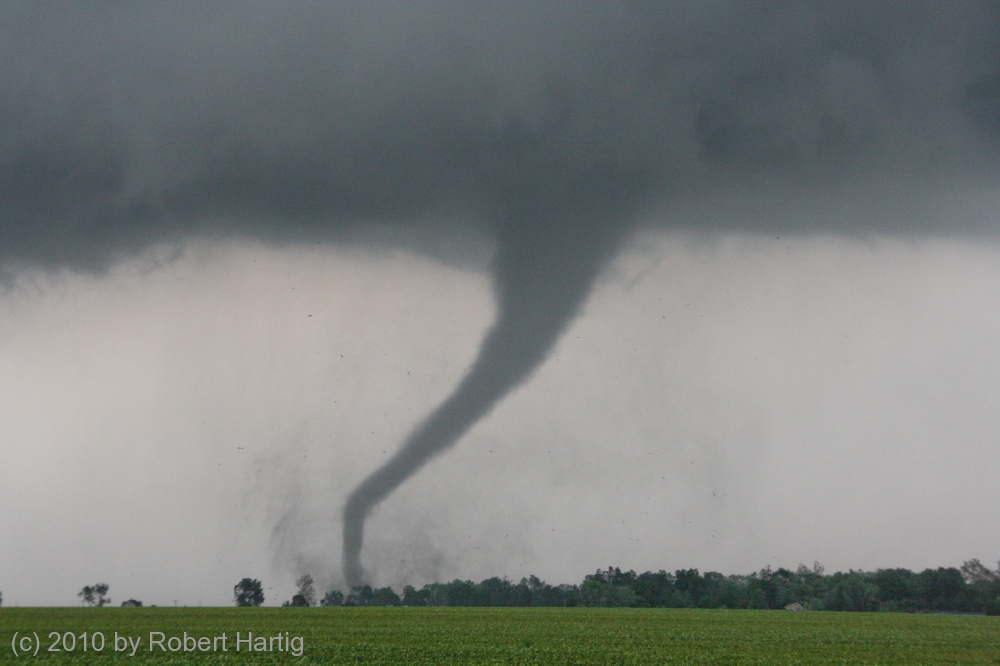
We didn’t have long to wait. A minute or two later, as we proceeded down CR 8, a slender elephant’s trunk of a funnel probed its way earthward, intensified, and began gobbling its way through the corn, closing in to within a quarter-mile of us before turning straight east.

This turned out to be a beautiful, highly photogenic tornado, all the moreso for the amazing display of lightning that accompanied it. Kurt took some great video of it which will give you a much better appreciation for how

electrified the tornadic environment was. At one point, at the 8:50 mark, you can see a bolt shoot directly from the funnel to the ground. I didn’t have the good fortune to witness the famed Mulvane, Kansas, tornado, but I’ve got to believe that this storm was similar in terms of its incessant lightning.

The funnel morphed through a variety of elegant formations, and the overall storm structure was beautiful. It was a stunning and mesmerizing sight, but with growing concern, Kurt and I realized that it was making its way toward Yates City and didn’t show any sign of weakening.

Fortunately, the funnel veered slightly to the northeast, passing just to the north of the town. At that point, it was an intense drillpress spinning furiously a mile distant. We closed the gap and tracked with it as it headed toward the larger town of Elmwood, just a couple miles down the road.

What was the funnel doing? It appeared to be shifting to the right. Oh my gosh! Elmwood was going to get hit! The tornado was beginning to rope out,

but not in enough time to spare the town. Taking a hard right, it plowed through the town center. Three-quarters of a mile ahead of us, power lines arced and transformers exploded, debris blasted into the air, and a large dust cloud billowed skyward.

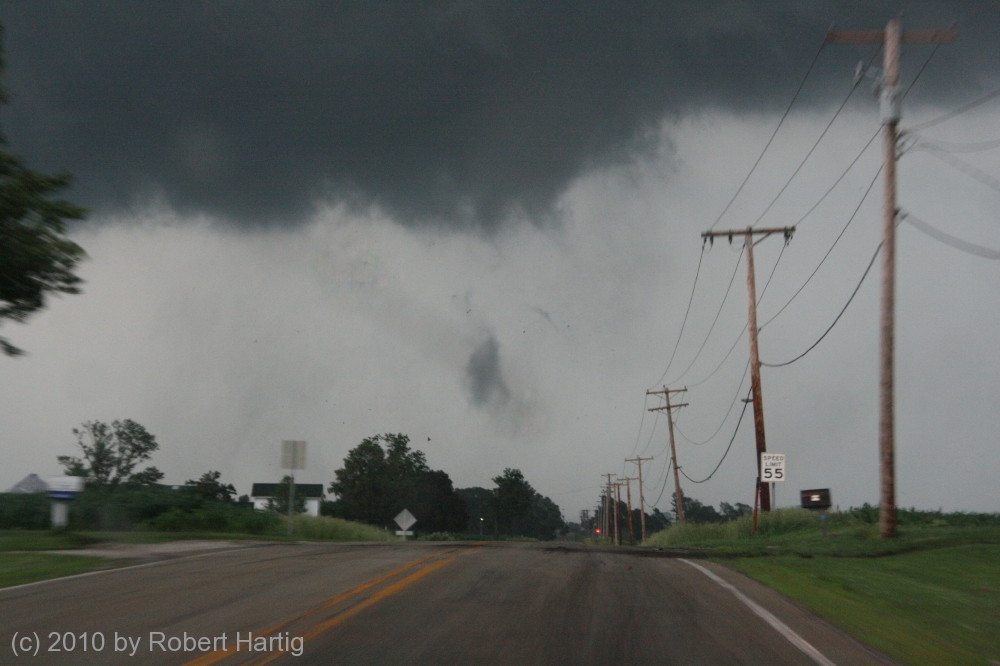
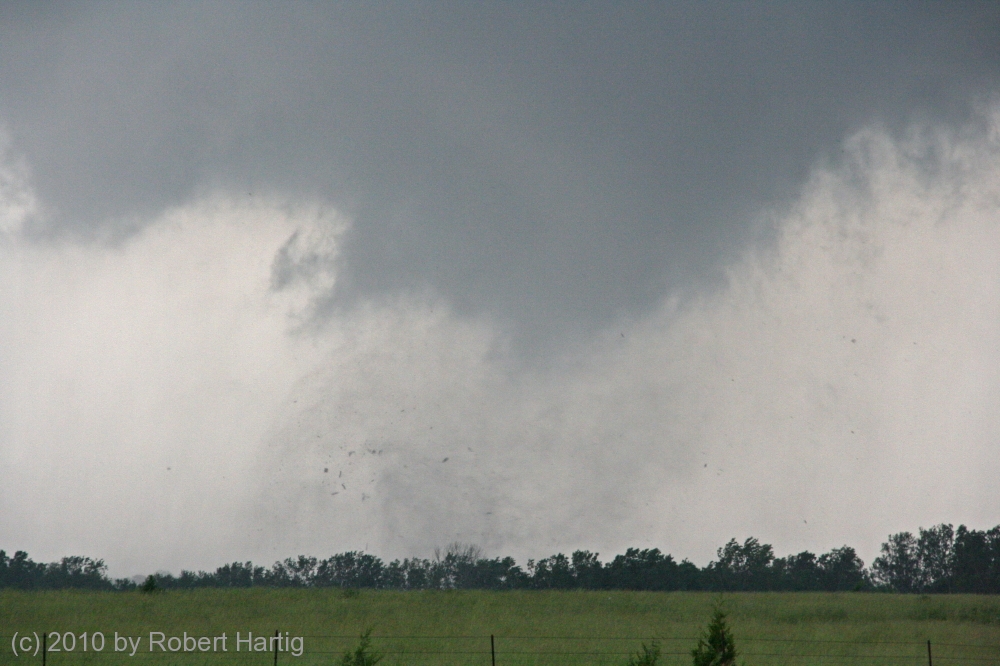
It is a weird and awful feeling to witness a community get hit by a tornado. I’ve seen it happen twice before in Springfield, Illinois, and in Iowa City, but those were night time events. It’s different in broad daylight, when you can see what’s happening. The rather blurry photo shown here was taken just before the tornado crossed Main Street in downtown Elmwood. It’s not a very dramatic shot. You can see a few pieces of debris floating in the air and no more than a cloud tag to mark the presence of the tornado. But a second or two after the photo was taken, things got very nasty in that town. If there’s anything at all good to be said about what happened there, it’s that no one got killed or, as far as I’m aware, even injured.

A couple hundred yards south of Elmwood, the tornado dissipated. Gone, poof, vanished just like that. There’s a certain ugly irony about a force of nature that can wreak havoc in a community and then vanish a few seconds later without a trace. If the tornado had dissipated just thirty seconds sooner, a lot of people might have experienced just a good scare rather than a local disaster.

Kurt and I continued tracking with the storm as it made its way toward Peoria. The next tornado soon formed–a larger, bowl-shaped cloud with multiple vortices. This broadened out into a large tornado cyclone with multiple areas of rotation that produced, among other things, a brief but spectacular horizontal vortex. Sorry, I have no photos to show of it. It had gotten too dark, we were moving, and any picture I took at that point would have been blurred beyond recognition.

In Peoria, we got a bit snagged by roads and traffic, but thanks to Kurt’s great driving, we soon found ourselves heading east on I-74. As we crossed the Illinois River, I could see what appeared to be a large cone funnel to our north making its way across what was probably Upper Peoria Lake, silhouetted by frequent strobes of lightning.

Catching CR 115 at Goodfield, we headed north to Eureka, then continued east along US 24. We were still tracking with the storm, which was slowly weakening as the next tornadic supercell to its north began to dominate. It was still no pansy-weight, though, and at Chatsworth, in a final show of strength, it spun down a brief but well-defined rope tornado.

As our storm merged with the northern storm around Kankakee, Kurt and I caught I-57 and headed home. After May 22 in South Dakota, I really didn’t expect that I’d get another decent storm chase in. But this El Nino year, which got off to such a rotten start for storm chasers, now is paying dividends with some highly photogenic tornadoes.

And the season isn’t over yet. There’s no telling what the rest of June may hold. I doubt I’ll be making any more forays this year into the Plains, but if the Great Lakes region continue to light up, I’ve got my camera and laptop ready.

To see more photos from this chase, click here. And while you’re at it, check out the rest of my images of storms, tornadoes, wildflowers, people, and whatnot in my photos section.

Michigan in the Crosshairs Today?

Most of the time when I chase storms in Michigan, it’s as a wannabe sitting in my armchair gazing wistfully at my radar as I follow the action out west. Every once in a while, though, I get something right here in my own state that’s worth hopping into my car and driving after with my laptop and camera at hand and hope in my heart.

Today is shaping up to be such a day. It’s about time. June is upon us, and that means the peak tornado season has finally arrived for Michigan. Frankly, that term, “peak tornado season,” strikes me as glaring overkill when it comes to Michigan. But we usually have a few incidents every year, and today could be one of them. Perusing the last couple of NAM runs, including the 00Z, and running a few model RAOB soundings, I’m casting my eyes on the Flint-Pontiac area, where surface winds appear to remain, if not backed, at least southerly at 00Z tomorrow evening.

With dewpoints at or exceeding 65 degrees below a warm front draped across central Michigan, straight westerly mid- and upper-level winds with 45-50 knots at 500 mbs, and forecast SBCAPE upwards of 2,000 J/kg, there certainly look to be some decent ingredients in the vat. Insolation will be either the eye of newt that either makes the magic happen tomorrow or the missing ingredient that quashes instability thanks to blowoff from storms farther west.

no images were found

Attached are a couple soundings, the first for 23Z at Flint and the other for 00Z at Pontiac. Not bad-looking hodographs, particularly for Michigan. As you can see, the surface winds are southerly. Farther west, they veer to the southwest, though they by no means create a unidirectional scenario. Interestingly, while the STP and Stensrud Tornado Risk indices spotlight the area around Flint, F5 Data’s APRWX tornado index bullseyes Grand Rapids down toward Kalamazoo. Maybe that’s because a 500 mb jet max noses into this area by 00Z.

no images were found

Traditionalist that I am, I prefer backed, or at least southerly, surface winds if I can get them.  So as of the 00Z run, I’m eyeballing parts east, probably up around Flint near the warm front. The morning run may tell a different story. I just hope it’ll be a positive one.

Here’s to sunny skies, decent CAPE, and a good, productive backyard chase!

ADDENDUM: I wrote the above last night. The morning picture changes things a bit. Specifically, the satellite shows a nasty batch of CAPE-killing clouds blowing into the area from an MCS out west. That’s bad news. However, the clouds show some clearing expanding in their midst. That’s good news. Moreover, Mike Kovalchick sent me an HRRR model radar image showing a supercell popping up in mid-Michigan at 22Z. I’m sure that’s dependent on decent CAPE, which presumes enough clearing for good afternoon heating.

This latest info is good to have, but it doesn’t change my game plan, which is to wait and see what happens by the afternoon.