Warmest West Michigan Summer in 55 Years

This summer of 2010 has been the warmest summer in West Michigan since 1955, according to WOOD TV meteorologist Bill Steffen. Temperatures in the 90s have predominated, with dewpoints in the upper 70s,  and Lake Michigan water temps–in the mid 70s this morning–have been as high as 80 degrees. That’s like swimming in bathwater, and I’m not even referring to the lake–I’m talking about just stepping outdoors.

We made it as high as 93 degrees yesterday, and it looks like hot temperatures are going to hang around for a few more days until a weak cold front modifies things a bit and hopefully brings a few storms to make life interesting. I’m all for hot and sticky under the right circumstances, but a glance at RAOB model soundings for RUC and NAM shows utterly placid conditions. Winds at 500 millibars are doddering along at a geriatric 10-15 knots, and the rest of the atmosphere is keeping pretty much the same pace.

The great storms of May and June are so far past that they seem like ancient history. Who all besides me is ready for a nice, deep trough to come sweeping across our area? Patience, patience, lads and lasses. The fall season is coming. This stifling heat and humidity will soon get stirred up with episodes of cooler air sweeping in from Canada, and the weather machine will kick into gear once again. Then we can all fire up our laptops and Rain-X our windshields for one last blast before the snows fly.
Great Lakes Waterspout Season Is at Hand

Now is the time of year when waterspouts start putting in an appearance on the Great Lakes. I had largely forgotten about spouts until a few days ago when my friend and fellow weather weenie Mike Kovalchick mentioned them in an email. Bing! A light blinked on in my head: That’s right! Waterspouts!

I’ve never seen a waterspout. But then, until last year about this time with my buddy Kurt Hulst, I’d never made a point of going out after them. Kurt and I busted that day, but maybe this year I’ll get lucky, provided I increase my chances by taking more opportunities to chase spouts.

I have zero experience forecasting waterspouts. Thankfully, there’s a snappy little graph called the Waterspout Nomogram that simplifies the process. Developed by Wade Szilagyi of the Meteorological Service of Canada, the Waterspout Nomogram provides a quick visual aid for determining when certain critical parameters are in place for four different classifications of waterspout: tornadic, upper low, land breeze, and winter.

The tornadic variety is self-explanatory, and any storm chaser with some experience making his or her own forecasts should have a good feel for when that kind of waterspout is likely. Mike favors the 500 mb cold-core, closed low setup, which to my thinking may be a variant of the first in producing low-top supercells. The remaining two, land breeze and winter, seem to involve different dynamics. For all the waterspout categories, one of the constraints is that for spouts to occur, winds at 850 mbs have to be less than 40 knots, something I find particularly interesting in the case of supercell-based waterspouts.

In any event, I’m hoping that this year is my year to finally witness a spout or two. Michigan chasers and weather weenies, it’s time to pay attention to the marine forecasts. The “second season” can include action right along the lakeshore even when nothing’s popping anywhere else. Make sure you bring your shotgun just in case a waterspout gets too close for comfort (written with a wink and a grin).

August Reminiscences: My First Successful Storm Chase

Ah, August. In its own way, it’s a lot like February: a month whose respective season of the year has settled in and ripened into predictability. Upper winds are weak and storms are often the pop-up type, providing a quick flash-and-bang along with localized rainfall before fizzling out. Yet on the horizon, like the first cirrus wisps of a fast-moving cold front, you can see change coming.

This morning I awakened to the distant grumble of thunder, and when I opened the drapes, the sky was an odd, fish-flesh paleness with darkness moving in. Oh, joy! Upon hearing me stir, Lisa stepped into the room with a smile and told me that a squall line was approaching. Now, that’s the way I like an August day to begin! I fired up the computer and consulted GR3. It was a skinny line, but the NWS was saying big things about it’s being quite the wind machine. Eight miles up the road, the KGRR station ob reported heavy rain; yet here in Caledonia, we got just a mild spray of precipitation, the lightning called it quits, and the line which had threatened to enter like a lion left like a lamb. Now it’s no longer even detectable on the radar.

More thunder is in the forecast for today, though, and for the next few days, as a weak warm front sloshes back and forth and as air mass storms generate more boundaries to fire up convection. It’ll be a bland but enjoyable show.

While my attitude toward August may seem patronizing, this month is capable of producing an occasional potent surprise. On August 24, 2007, I was sitting in the Hastings library when a line of storms formed just to the west and drifted directly overhead. I had my laptop with me with GR3 running, but my forecasting skills and overall experience were still pretty embryonic, and I dismissed some telltale signs, both radar and visual, because forecast models indicated a straight-line wind event.

The storms matured overhead, blasting Hastings with rain and lightning, and then moved to the east and steered an EF-3 tornado through the town of Potterville. I could have easily intercepted it if I had known what the heck I was doing. There it was, a perfect chase opportunity, gift-wrapped with a large ribbon and dropped smack into my lap, and I was too dumb to untie the bow. Aaargh! Four years later, I could still whap myself alongside the head.

But God showers his kindness even on the ignorant. My first successful chase was eleven years earlier, back in August of, I believe, 1996. I don’t remember the exact date, but I can assure you that in those days, cluelessness was a level of expertise I had yet to attain. However, I had at least learned a few things about storm structure and a few concepts such as shear and CAPE. So when the morning blossomed into an exceptionally sticky day–dewpoints had to have been in the mid-70s–and when I noticed clouds in the afternoon leaning over and curling at the tips, I sensed that something was up.

Around 4:30, I happened to glance out of one of the wrap-around windows at the place where I worked and did a double-take. A wall cloud was forming just a mile or so to my south. Hot dang! I watched it for a bit as it moved eastward, then decided to do something about it.

Leaving work early, I hopped into my little Nissan Sentra and blasted after the storm. I had no laptop, no radar, no weather radio, no experience, and very little knowledge. Instinctively I stayed to the south side of the storm. But as it neared Ionia, I could no longer make out cloud features. I wasn’t even certain that the storm still existed. I hit M-21 and traveled east a ways, then north, smack into the precip core. Yep, the storm was still there. But where was the wall cloud? Was there still a wall cloud?

Emerging from the rain, I headed back west, then south down M-66, effectively circling the supercell. As I approached Ionia from the north, the wall cloud came once again into view. Cool! The storm most definitely still had its teeth.

I tracked behind the storm down M-21, getting right to the rear edge of the circulation. Near Muir, a streak of white condensation shot suddenly out of the woods on the right side of the road half a mile in front of me. Was that a tornado? I wasn’t sure, but it looked mighty promising. Also a bit unnerving. I dropped back and put a little more distance between me and the updraft area.

A while later, somewhere in the open country around St. Johns, I parked and observed as the wall cloud reorganized east of me. While I didn’t realize it at the time, I was watching a classic supercell, as nicely structured and impressive as anything I’ve seen out in the Great Plains. It tightened up, with a nice inflow band feeding into it. Then, to my astonishment, a beautiful, slender white tube materialized underneath it a mile away. Extending fully to the ground, the ghost-like tube translated slowly to my right for a distance of probably no more than half a mile, then dissipated. I had just seen my first tornado!

At that point, the storm weakened. No doubt it was just pulsing, but I dropped it and headed for home. However, I soon discovered that another storm was right on the heels of the first one, making a beeline toward me down M-21.

What were the odds that it, too, would be a supercell? Plenty, of course, but to me at that time they seemed as remote as lightning striking twice in the same place. Nevertheless, something told me that I needed to exercise caution, a hunch that verified as I headed back into Muir. An evil-looking flying saucer meso was approaching the town. Hmmm…maybe it would be prudent of me to drop south.

A couple miles out of the path of the updraft, I parked, got out of the car, and stood on the roadside listening to the thunder grumble and watching as the mesocyclone drifted uneventfully over Muir and vanished off to the northeast. Then I climbed back into my vehicle and headed back to M-21, and west toward home.

I was stoked. I had witnessed my very first tornado! Wow! Thank you, Lord, thank you, thank you, thank you!

It was a milestone in my life so huge that hitting the deer just outside of Ada seemed like practically a non-event. Within a nanosecond, the yearling bounded out of the woods and into my path, driven by a powerful urge to bond with my radiator. Much to both of our chagrin, it succeeded.

But you know, I love a good story, and I recognized all the elements of a great one, a real red-letter day. Not only had I experienced my first successful storm chase, but to top it off, I had also collided with a whitetail and demolished my front end. It doesn’t get much better than that–or at least, it wouldn’t until fourteen years later on May 22, 2010, in South Dakota. That was the ultimate storm chasing experience. But that’s another story.

As for this story, all fun and excitement aside, I had learned a sobering lesson about the dangers of storm chasing. I had come face to face with the dark side of nature–with a force that, beautiful as it was, was also fearful, uncontrollable, and deadly, capable of wreaking havoc on a scale that beggars description. No question about it, deer are dangerous. I enjoy seeing them at a distance, just not up close.

Oldies But Goodies

Sorry–I seem to have let an entire week slip by without posting. Many bloggers have a knack for slapping out short, cogent posts in 15 minutes or so, but that’s not a gift of mine. Just about every post takes me several hours to write, particularly the ones that include musical exercises. So when I have other things packing my schedule, the prospect of sitting down and creating a post can seem daunting.

That has been the case this week. Could be a streak of just plain old laziness somewhere in the mix, too, but mainly, these past few days have been busy ones. My brothers Pat and Terry arrived for a two-week visit Monday, so family has been a priority. And work still goes on, regardless–gotta make a living.

Today my bros, my sister, Diane, and I headed to Newaygo, rented some kayaks, plopped them into the Muskegon River, and spent the afternoon taking a delightful 6-mile drift with the current. The Muskegon is a surpassingly beautiful stretch of water. I saw three bald eagles soaring overhead, slews of large turtles sunning themselves on logs, several kingfishers, a green heron, and brilliant red cardinal flowers rimming the banks in swampy areas. Altogether it was a most satisfying day.

But of course, as I said, I haven’t had time to write. So I figured that instead, I’d refer you to a couple of links to archived articles. The first is one I wrote one year ago, titled “Will I Ever Become a Good Jazz Improviser?” The second article is for storm chasers by guest poster Andrew Revering of Convective Development, Inc., on how to forecast severe weather during northwest flow.

I hope you enjoy the articles, and will find your journey back to last August’s posts profitable and refreshing. As for me, I’m tired. It has been a long day, it’s now after midnight, and I’m going to bed. G’night!

Survivor Guilt: The Unseen Tornado Trauma

“The thief comes only to rob and kill and destroy; I have come that [you] may have life, and have it to the full.”–Jesus (John 10:10)

Forty-five years after he lost his younger brother in one of the 1965 Palm Sunday Tornadoes, Pete Johnson still finds it hard to talk about what happened that dreadful evening in northern Indiana. He feels responsible for his brother’s death.

The name Pete Johnson is fictitious. I doubt the man I interviewed yesterday afternoon would mind if I shared his real name or that of his brother, but my conversation with him is so fresh, and my topic so potentially sensitive, that out of care and respect I’m calling him Pete in this post.

Pete was with his family visiting an aunt and uncle in Dunlap, Indiana, when the deadliest tornado of the entire six-state outbreak swirled into view outside the picture window. As his relatives sought shelter indoors, Pete’s parents packed the kids into their car and took off down the road in a frantic attempt to outrun the tornado. They didn’t succeed. Pete’s dad told him that a house hit the car. All Pete remembers is experiencing a blow to the head and then regaining consciousness out in a field, where he’d been blown by the wind. Rescue workers rushed him off to a hospital. It would be some time before he learned that his younger brother, Mark, hadn’t survived.

Mark’s body wasn’t found until a week later, buried under debris in the devastated Sunnyside neighborhood. Pete wants to believe that his brother’s death wasn’t his fault. But still, after all these years, he wonders: What if…?

What if he’d gone straight to the car instead of hiding in the closet, as his aunt had told him to do? Maybe those few extra seconds would have saved his brother’s life. What if his family had ridden out the tornado at his aunt and uncle’s house, which sustained only minimal damage? What if…?

There’s no satisfying the what-ifs of survivor guilt. You can respond to them with your head, perhaps, but your heart doesn’t buy the answers, not when the wound goes as deep as the loss of a loved one taken by a disaster. There’s seemingly no closure, no tying off of the open ends, no last stone to turn after which the supply of unturned stones finally ceases. At the bottom of it all lies a tyrannical, perpetually haunting lie: “I’m to blame.”

People with survivor guilt suffer–and “suffer” is an appropriate word–from a form of self-imposed penance for not having been the one to perish instead of their loved one. Reliving the incident year after year, they blame themselves for failing to foresee the unforeseeable and stop the unstoppable, for not preventing things over which they had no power. Really, for not being God.

Tornadoes are quirks of the atmosphere, not so much objects as unfathomably powerful processes dependent on an ironically delicate balance of ingredients. Earlier this year I watched one take out the heart of an Illinois town, then disappear into nothingness seconds later. Like lions and Alaskan brown bears, tornadoes are magnificent but also deadly and unpredictable.

As a storm chaser, I’m captivated by the beauty and drama of tornadoes. Yet I’m also keenly aware of their dark side. Who isn’t? The human impact of tornadoes, when it occurs, is seldom conservative and often it’s wholesale. Homes blown to pieces. Trees debarked, debranched, uprooted and thrown hundreds of feet. Vehicles crumpled into balls of metal. Worst of all, bodies mangled and lives ended.

But there’s another kind of damage that can’t be seen. Long after the dead have been buried, long after houses and neighborhoods have been rebuilt, years after people have gotten on with their lives, a sadness lingers. And for many, survivor guilt haunts them. You can build a new home, you can buy a new car, but you can’t replace a loved one, and what do you do with your own wounded heart?

I believe there’s healing for those who struggle with survivor guilt. I don’t mean the sorrow of losing someone close; that will always remain, and it is not necessarily a bad thing. But the sting of guilt which serves no good purpose is exactly the kind of thing Jesus came to put an end to.

Let me be clear, as I share from a Christian perspective, that I have little interest in dogma, any more than Jesus did. The wounds that life can inflict are too real for game-playing. But just as it’s possible to glibly quote the Bible in a way that misses its meaning and heart, it’s equally possible to lightly dismiss the Bible and so miss not only its unnervingly pinpoint assessment of the human condition, but also the power and hope of the gospel for some very practical life issues.

The life, ministry, and teachings of Jesus reveal the heart of a God who desires that we should find true, deeply rooted peace in our souls that flows from the peace we have with him. For those who trust in him, Jesus has resolved the issue of guilt in all its forms, including survivor guilt, with a power and effectiveness that extend beyond the unpredictable events of our lives to a deep and certain, eternal foundation. In his execution on the cross, Jesus took everything that runs counter to the character and will of God and, absorbing it into himself as the eternal scapegoat for mortal mankind, put it to death. Then, in his resurrection, he opened the doorway to a new kind of life that is not subject to the values and limitations of this world.

This is fancy language, but for those who struggle with survivor guilt, the bottom line is simple: God looks at you and says, “Not guilty.” His heart toward you is that you should have life, not death; peace, not self-recrimination. That’s no mere religious proposition–it’s the living, breathing, passionate longing of God for your best, your freest, and your highest.

Given the reality of what God desires for you, the question isn’t whether you could have done something that might have saved your loved one. You’ll never know. That question is a deception from the devil, who loves to torment people with issues that have endless complexities and no resolution. It’s really no question at all–it’s a prison sentence and a distraction from the simplicity of faith. The true, powerful question is whether you’ll stop holding yourself accountable when God himself doesn’t, and stop beating up an innocent person whom he loves very much: yourself.

As you consider that question, here’s another one to contemplate along with it: If the situation had been reversed and you had been the one who perished while your loved one lived, would you have wanted your surviving loved one to live the rest of their days with the guilt that has haunted you? Wouldn’t you rather have desired with all your heart that he or she would think of you with love but not guilt, and fulfill the gift and potential of their life in freedom?

What you would want for your loved one would surely be your loved one’s desire for you. Love does not condemn, but frees and blesses.

I realize that what I’ve proposed is easier said than done. I just want to put the possibility before you–the seed of a new way of thinking which, I hope, can make a difference for you. I’m well aware that I haven’t experienced what you’ve experienced. My struggles have been my own. Yet they have been significant in their own right, and in the face of them, Jesus has made me a freer man as only Jesus can. So my words to you are spoken both humbly and frankly, with a longing that you should know peace at last, peace that only the love and grace of God can bring.

One of the titles by which the Scriptures call Jesus is “Prince of Peace.” The peace he offers rests not on life circumstances, but on an interpersonal relationship with him in which the quality of life that resides in him flows to us. It is a life in which guilt, shame, and torment can’t be found. If you belong to him, then the peace which is native to that life is more than his will for you–it is your very birthright as a child of God.

My prayer for you, if you struggle with survivor guilt, is that your birthright will become real to you in a way that frees you from a weight that is not really yours to carry. Bring it to Jesus and trust him with it. You don’t know what to do with it; he does. Letting him do so is a journey he’s eager to make with you if you’re willing to make it with him.

July 22 West Michigan Supercell and Lightning Fest

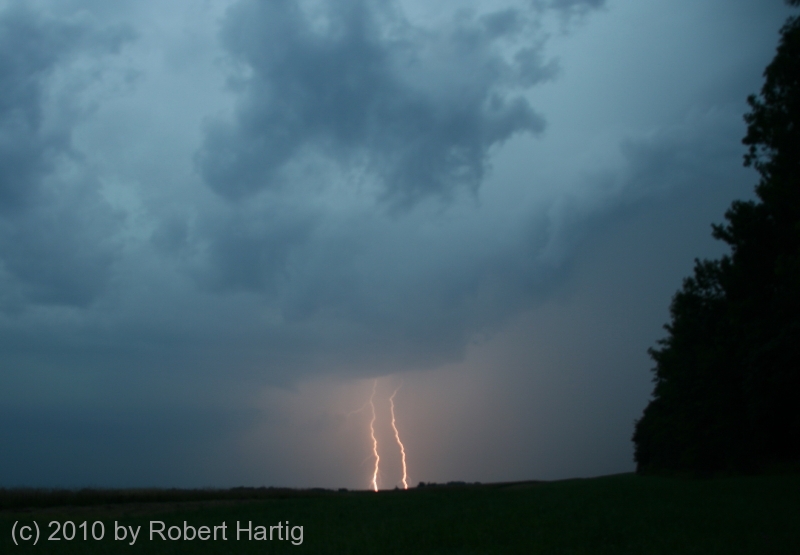
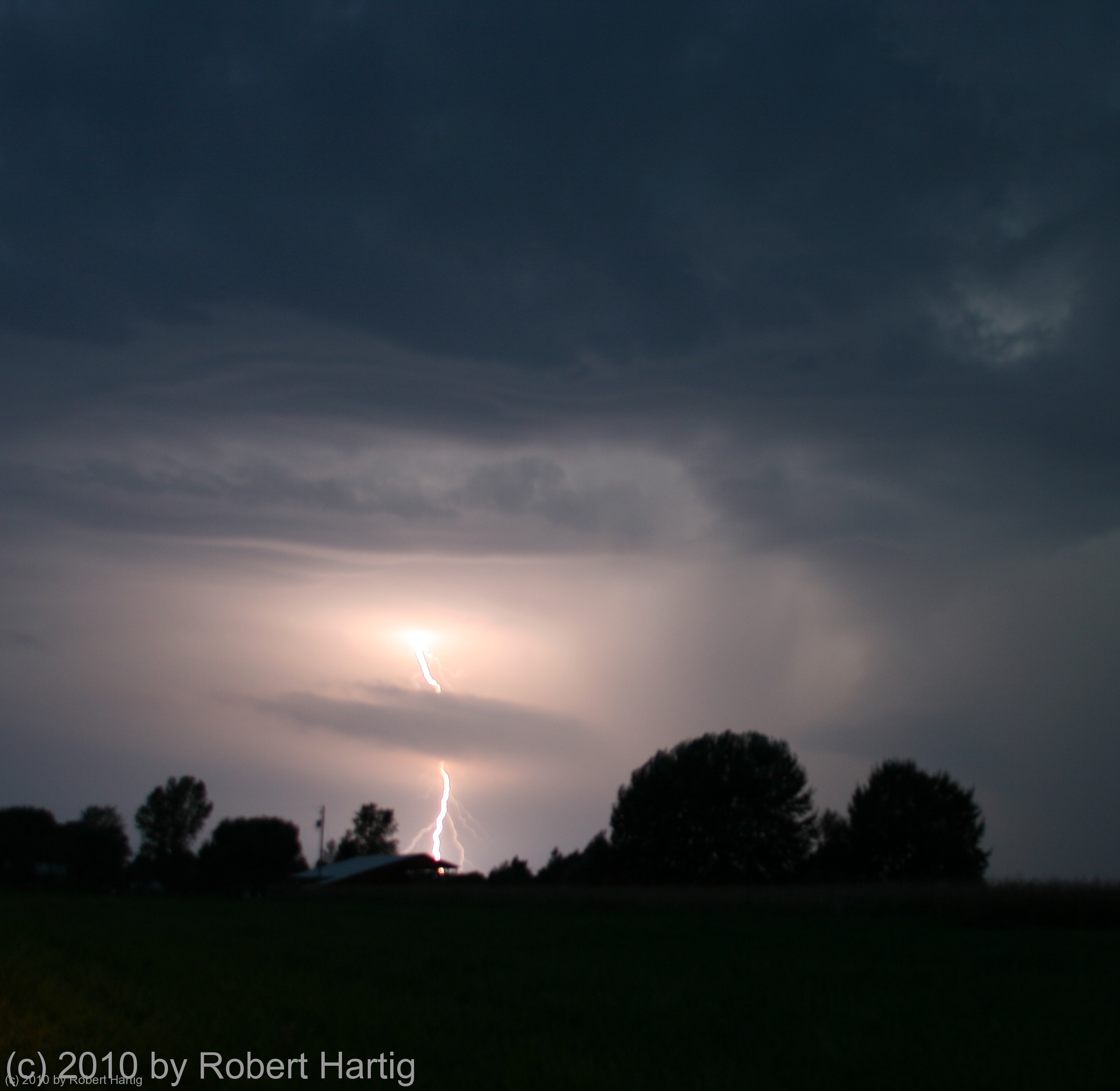
I haven’t seen a storm like last night’s storm in Michigan in a long, long time. Man, what a beauty!

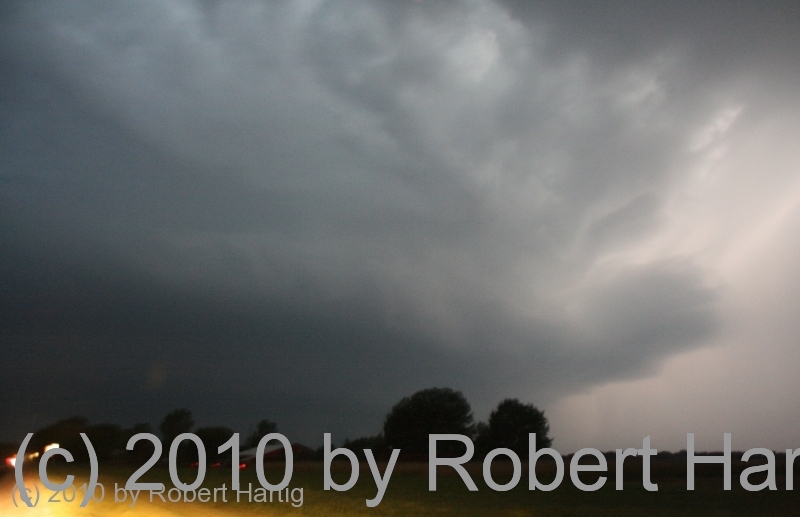
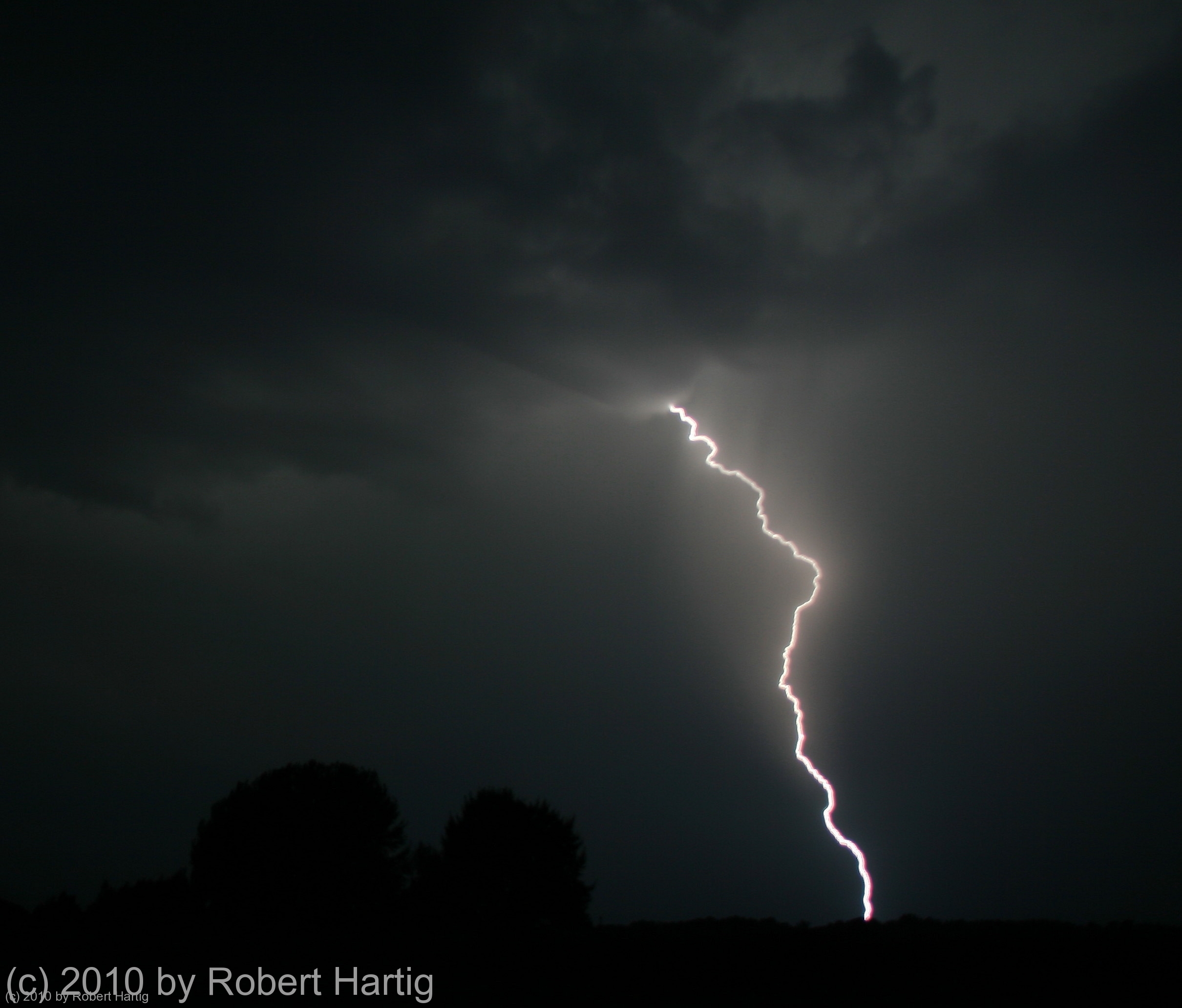
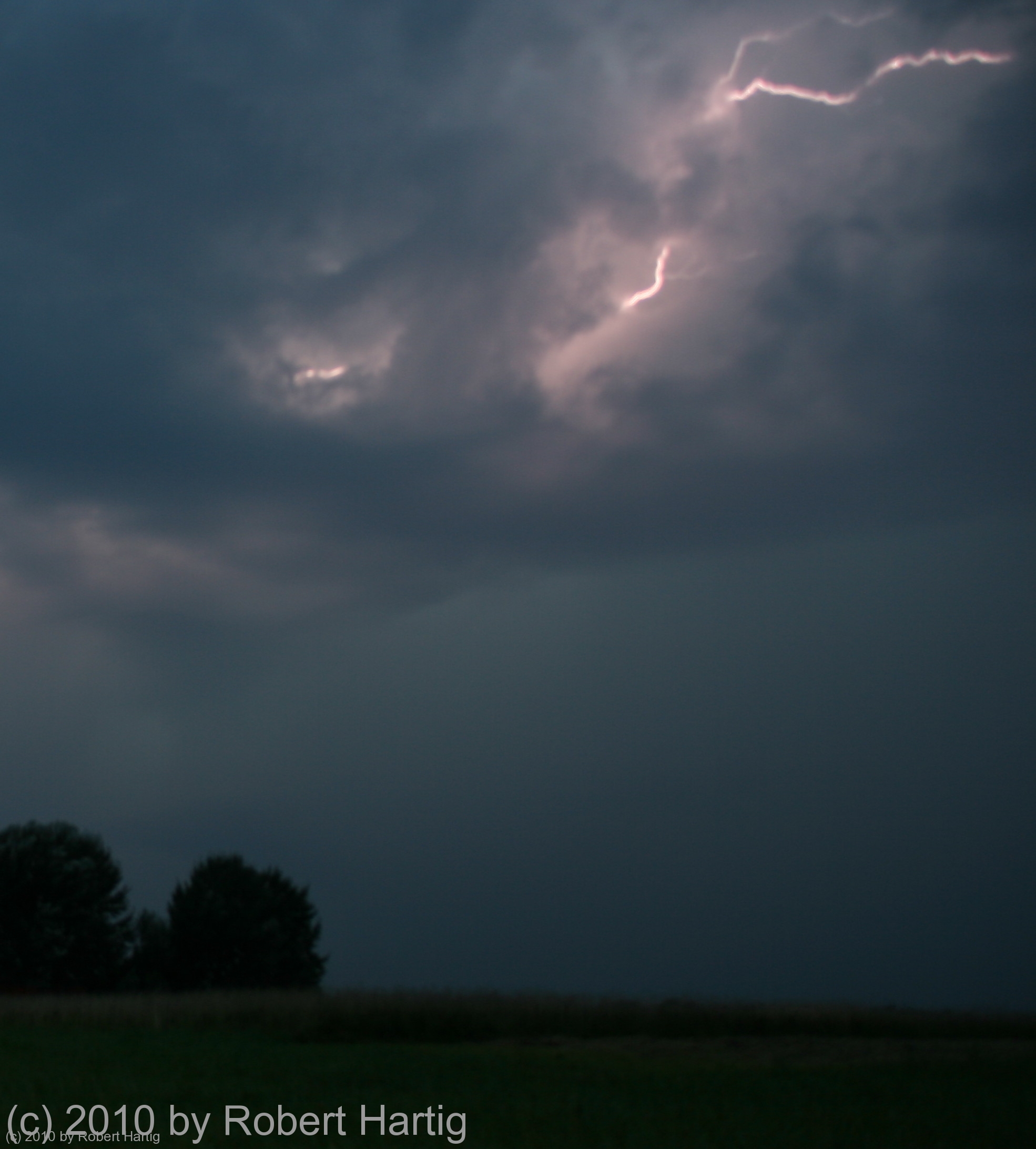
Non-stop lightning, much of it appearing to be positive strokes that lasted for seconds at a time, along with a veritable feast of anvil crawlers, made for a photographic smorgasbord. Plus, the storm structure–as much of it as I could make out at night, illuminated by the incessant lightning–was truly impressive. If only the storm had arrived an hour earlier, when there was enough light to really see the thing!

I had just finished doing a couple of interviews down in Dunlap, Indiana, for the book I’m writing on the 1965 Palm Sunday Tornadoes. My meetings

required me to forgo chasing a supercell that moved through the Battle Creek area as the warm front lifted northward, and I was curious to find out what had happened with it. Pulling into a parking lot, I fired up my computer, opened GR3, and gaped. A line of supercells was advancing across Lake Michigan from Wisconsin. The first one in the line looked great–SRV showed definite rotation–and, headed on an ESE trajectory, the storm was poised to make landfall around Saugatuck. Winds there were almost straight easterly, and they were beautifully backed across most of lower Michigan. Hmmm…what did the VAD wind profile look like at Grand Rapids? Dang, sweet! How the heck did that kind of setup wind up in Michigan?

The storms weren’t moving terribly fast, around 25 knots. Could I make it in time? I was bloody well going to try. There was no denying the rush of adrenaline now galvanizing me, thrusting me into chase mode. I hit US 20 and headed west past South Bend, where the highway merged into US 31 north.

I still had a good 40 miles to go by the time I connected with I-196 near Benton Harbor. I wasn’t sure whether I’d catch the storm by the time it made landfall. Maybe I’d be better off playing more to the east. But I decided to take my chances, and that turned out to be the right move. I couldn’t have timed it better.

As I approached M-89, the eastern part of the storm had made landfall, but the radar showed the rotation still out over Lake Michigan. It wouldn’t be there for long, though, and, having shifted its trajectory south of Douglas, it was now heading straight at me.

Bingo! This was exactly what I’d been hoping for. Leaving the Interstate, I headed east along M-89 and found a nice, open field a mile down the road, just west of 66th Street, 4 miles south of Douglas and 4 miles west of Fennville. Then, turning my car around to face the incoming storm, I parked and grabbed my camera out of the back seat.

The lightning in this beast requires superlatives to describe it. There seemed to be a never-ending supply of high-voltage CGs, delivered with the unbridled, over-the-top enthusiasm of a 4th of July fireworks finale and accompanied by the incessant grumbling of thunder. There were times, as the lightning cells moved past me and surrounded me, when I felt like I was sitting inside an immense flashbulb–a flashbulb that kept firing again, and again, and again. Oh, man, what an extravaganza of pure, searing power and beauty! I’ve done my best to capture it, but my skills as a lightning photographer fall far short of what this storm had to offer. Now, my buddy Kurt Hulst, he’s Da Man when it comes to getting fantastic lightning shots, and I know he got some last night. Me, I seem to have a problem getting a good, crisp focus at night, but I try.

By and by, the flickerings began to illuminate a cloud feature I’d been looking for: a hint of a beavertail off to my northwest. It’s location confirmed what the radar was telling me: the storm’s mesocyclone was moving straight at me. I was in a perfect location–and all this time, standing out in the field near my car, I had yet to feel so much as a drop of rain.

The mosquitoes were thick and nasty, and I was getting eaten alive, but viewing at my position was excellent. Farther east, I’d be getting into thick woods, and since the storm wasn’t exactly rocketing along, I stayed put until the meso got too close for me to be able to distinguish its features. Then I moseyed east a few miles.

I parked again for a few minutes at 63rd Street and noted that what had begun as a stubby beavertail had rapidly grown into an enormous inflow stinger. To my northwest, I could see what appeared to be a large, low wall cloud–hard to determine exactly what it was or what it was doing at night, but it looked convincing enough that I called it in to KGRR.

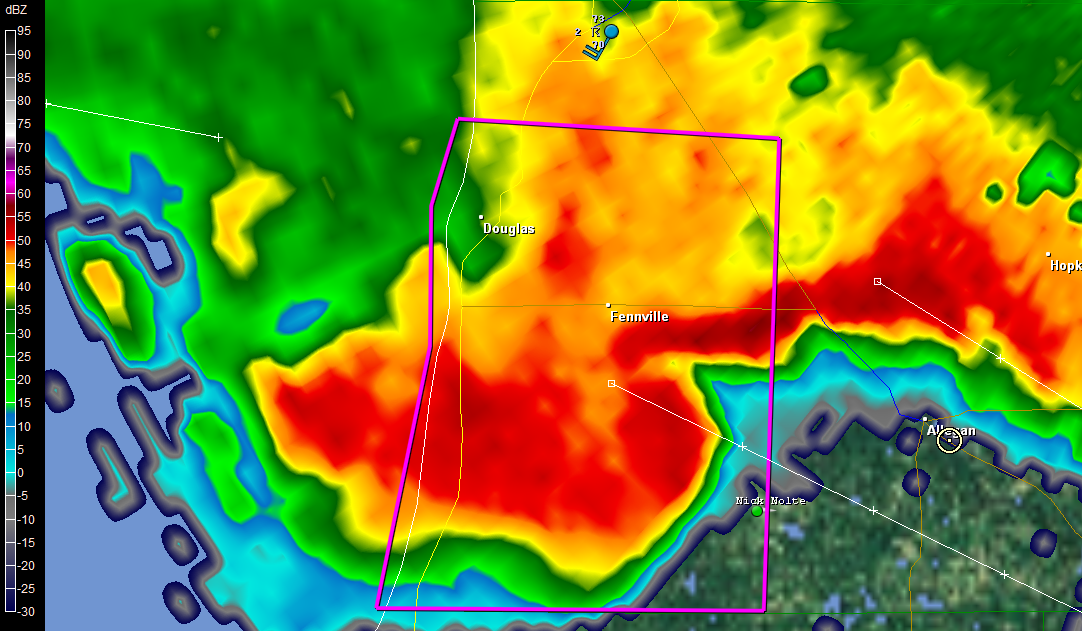
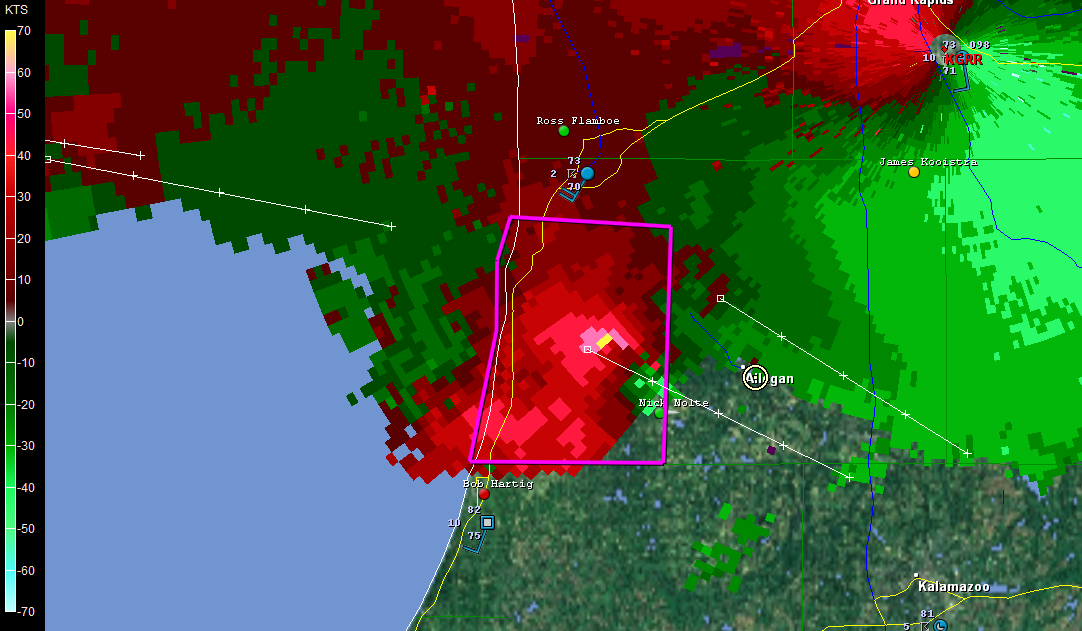
I tracked just ahead of this storm all the way to Plainwell. M-89 proved to be a perfect route, angling southeast along roughly the same path that the storm was taking. On the outskirts of Allegan, I stopped long enough to grab a few radar images. On this page, you can see a nice vault on the base reflectivity, and pronounced rotation on the storm relative velocity. (The circle just southeast of the town center marks my location. Ignore the marker with my name farther to the southwest on SRV; it’s old, an archive from when I dropped off of Spotter Network.)

A little farther down the road, I pulled aside again where a large, open stretch afforded good viewing. The mesocyclone was clearly visible, with a formidable-looking flange on the north side, nice striations, and an impressive inflow band circling in overhead. I hung out at that location until the lightning drew too close for comfort, then hopped back into my car and continued east.

At Plainwell, I dropped south on US 131 past the Kalamazoo exit, caught M-43 west for a mile or so, then parked in a parking lot and let the storm’s southernmost edge blow past me. The storm was still tornado-warned, but the radar indicated that it was weakening–cloud tops lower, VIL not as robust. North of me, just on the other side of M-43, a sheet of rain cascaded out of the wind-blown darkness into the luminous orange domain of the street lamps. Within half a minute, it was upon me, and for a short while, I sat and enjoyed the blast of downdraft and deluge. The rain that I had managed to elude all night had finally caught up with me.

Finally, as the storm bowed out on its journey eastward, I drove back to US 131 and headed for home. I stopped again for a while at the Martin exit, long enough to see what would become of another supercell that was moving inland from the Lake. It, too, quickly bowed out, but, in keeping with the tone of the day, it lit the after-midnight sky with a bombardment of lightning.

It was good to finally pull into my parking lot, climb the stairs to my apartment, and step inside. It had been one heck of a day, and I was ready to call it a good one and hit the sack.

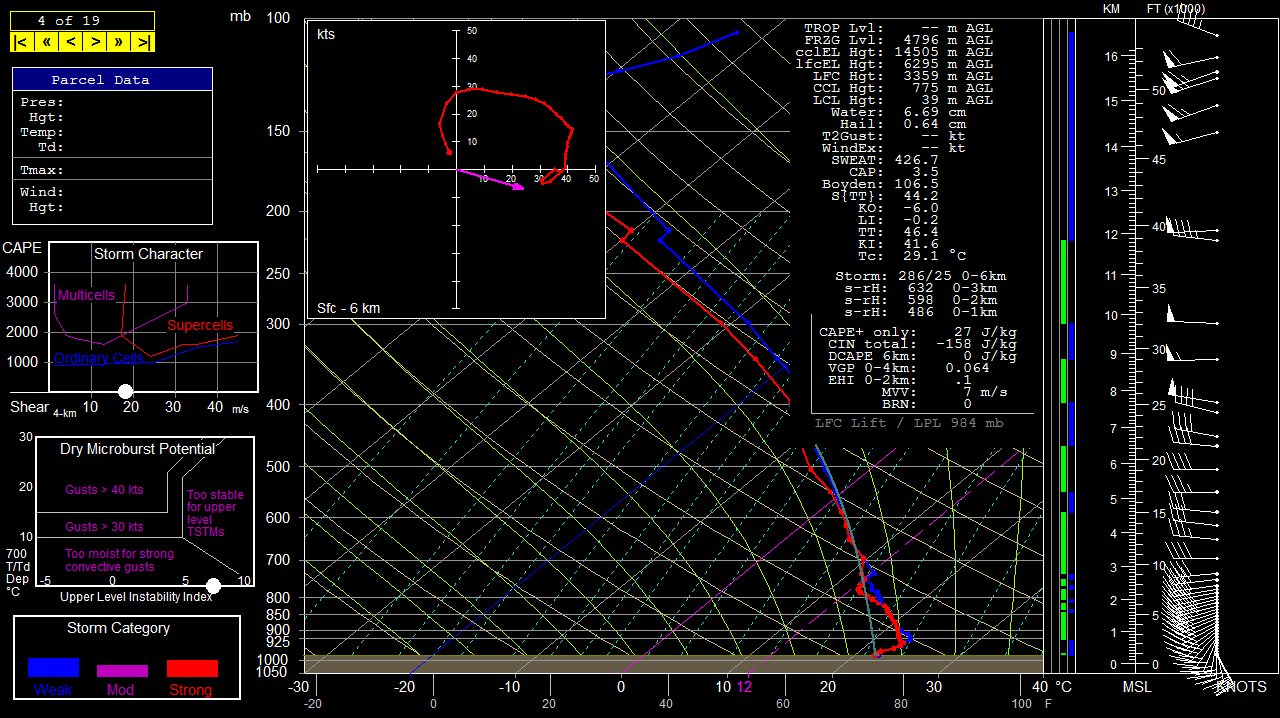
As nasty a storm as it was, why didn’t the Allegan County supercell drop tornadoes? The storm earlier in the afternoon had produced at least one tornado near the Battle Creek airport; why not this one too? After all, it and

its compatriots had peppered Wisconsin with tornadoes prior to crossing the Lake and heading for West Michigan. All I can surmise is, CAPE was an issue. Winds certainly appeared favorable for tornadoes, and F5 mesoanalysis indicated 1 km helicities ranging from 150-250 across the area as late as 1:00 a.m. The RUC model sounding for KGRR maybe overdoes helicity, but it’s interesting to see what it says about instability. All I can think is that daytime CAPE–whatever it may have been; I never took the time to find out–petered out after sundown, and the shear alone wasn’t enough to spin up tornadoes. That’s my guess as a non-meteorologist, and I’m ready to get other insights and opinions from more knowledgeable heads than mine.

Whatever the case, last night’s was one heckuva storm, and the kind of chase I don’t get to enjoy too often in Michigan. It was nice to finally get such a great opportunity.

1965 Palm Sunday Tornado Book: The Next Phase

Even as my book “The Giant Steps Scratch Pad” nears completion–it now awaits only the cover, which is being designed by a graphic designer friend of mine–my other, more ambitious project is also moving along. That would be my book on the 1965 Palm Sunday Tornadoes.

With important (to me, at least) information in my hands and a key interview now completed, the latest delay has been purely my own making. But it’s about to end. This afternoon I head down to Elkhart, Indiana, to interview my first two tornado survivors, one a retired police officer and the other an emergency worker who helped with rescue operations at the Midway Trailer Court.

This is exactly the boot in the butt I need to get myself going on the next phase of the book: firsthand accounts of tornado survivors. In the months to come, I anticipate making trips to northern Indiana and southeast Michigan, not to mention places in my hometown area of Grand Rapids, in order to get people’s stories straight from the sources.

If anyone reading this post was directly involved in the tornadoes (that is, you got hit by one of the tornadoes or otherwise witnessed a tornado in action) or knows of someone who was whom you think I might want to interview, please leave a comment on this post or else contact me.

Also, if you know of photographs of the actual storms that aren’t already in common circulation, I’d be keenly interested in seeing them. I’m not talking about damage photos, nor am I talking about photos such as the twin funnels hitting Midway that are accessible online. Rather, I’m thinking of old, long-forgotten photographs that might be sitting in your dresser drawer that you or your Uncle Pete snapped with the old Brownie camera. That kind of picture.

This next part will take time to complete, but it should be easier overall than the first part, particularly the second chapter. More updates will follow when I have news that’s worth sharing.

While I Was Out Chasing Sunday’s Storms…

Win a few, lose a few, the saying goes. Maybe so, but when it comes to chasing storms in Michigan, sometimes the losses seem just flat-out absurd.

Take this last Sunday, for instance. Kurt Hulst and I traveled over a hundred miles in order to intercept a storm down by Plainwell and track with it through the jungles of Allegan and Barry Counties, searching for a decent location for viewing. Meanwhile, a cell blew up just to our north and put down a tornado just four miles southwest of my apartment in Caledonia. If that isn’t a swift kick in the pratt with the steel-toed boot of irony, I don’t know what is.

True, it was a weak tornado; and true, it was probably rain-wrapped and hard to see; and true, it lasted only a minute or so, and catching it would have been pure serendipity. But still…just four freeking miles away… In the words of the inimitable Charlie Brown, “AAAUUUGGHHHHH!!!”

Sunday wasn’t the first time this kind of thing has happened to me, either. A few years ago, I was heading back north through Indiana, homeward bound from a futile chase, when my buddy Bill Oosterbaan called to inform me that a tornado had just passed through Caledonia. If I had been home, I could have stepped outside my sliding door and watched it blow through a couple blocks to my east. But no, that would have been too simple. I had to go gallivanting all over the countryside in search of what, in my absence, was delivered gift-wrapped to my backyard.

Chase storms for a while and you’ll find yourself collecting flukes, ironies, hindsights, and head-banging experiences like some people collect porcelain animals. It just goes with the territory, particularly if you live in the Great Lakes, where picking a chase target is nine times out of ten just an educated crapshoot.

Well, what the heck–at least Kurt and I saw a fairly impressive wall cloud east of Plainwell, out near West Gilkey Lake. We were too far away to confirm rotation, but the cloud was morphing rapidly, displaying obvious rapid motion. For a minute I thought it might even be putting down a tornado, but at our distance, we couldn’t make out enough details to know one way or the other. I called in a report to KGRR, then watched the storm fizzle and die shortly after.

Here one second, gone the next–that’s how it goes here in Michigan, supercell heaven of the Midwest.

Tornado Event Shaping Up for Tomorrow in Iowa, Minnesota, and Wisconsin

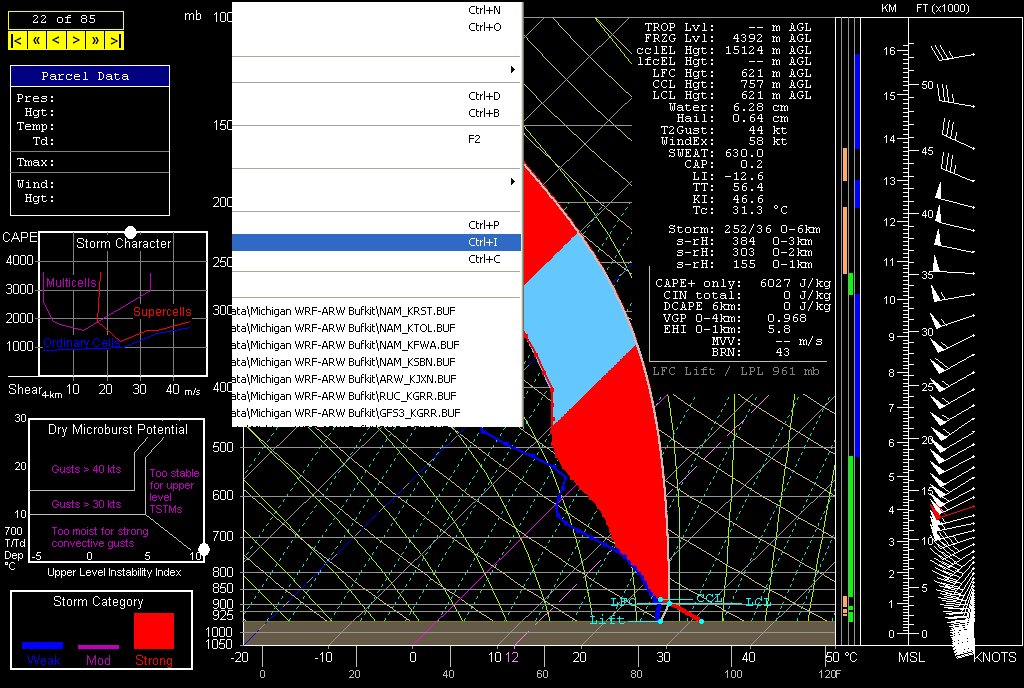
Look at this skew-T and hodograph and tell me they’re not to die for. They’re the 00Z NAM for tomorrow, 21Z, at Rochester, Minnesota. Click on the images to enlarge them. (Apologies for the weird pulldown menu obscuring parts of the images. I don’t know why that happened.)
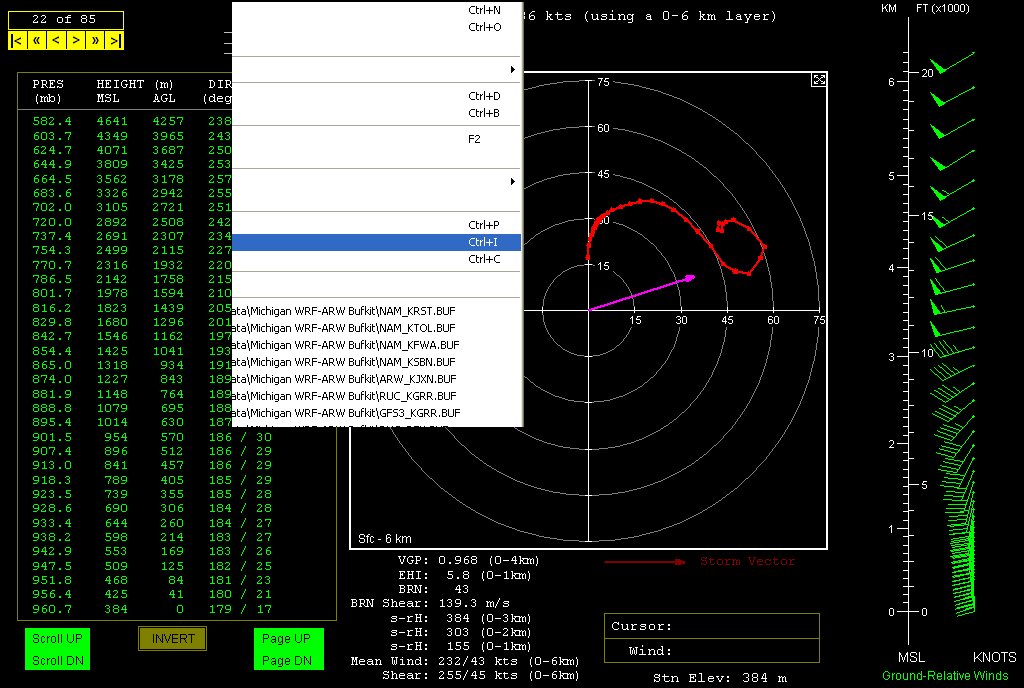

Unfortunately, I can’t afford to chase tomorrow, but I have a hunch that those who do will be rewarded for their efforts. This particular sounding is just a sampler. I’m not sure what to think about that surface-based CAPE. It’s

over 6,000 J/kg. If that even comes near to verifying, the western Great Lakes could be in for a convective blitzkrieg. The 1 km EHI is 5.8 and the 4 km VGP is .968.  Lifted index at -12.6–can that be right? I guess I kind of suspect readings like that–the instability seems just plain absurd.

Wish I could make it out there. Good luck to those who do, and stay safe. For a summer setup, this thing looks insane. I will be watching the radar tomorrow evening, that’s for sure.

Freak Tornado in Wisconsin

A weak cold front has slowly been working its way through Michigan today, with storms firing ahead of it in a very soupy warm sector. Ugh! With temperatures the past several days ranging from the upper 80s to 90 degrees and dewpoints as high as 73 here in Caledonia, it’s about time things cooled off and dried out a bit.

Unfortunately–or fortunately, depending on your point of view–all that lovely moisture has been wasted on insipid lapse rates and humdrum wind fields. What can you do with 500 mb winds of 25 knots or less? Answer: not much.

So what’s with that red dot in Wisconsin in yesterday’s storm reports? Not only did a tornado occur near the town of Cambria, but from the looks of the YouTube videos I saw, it was fairly impressive. Certainly those were more than momentary spin-ups which that Little Storm That Shouldn’t Have put down.

How on earth did it do that? There was nothing happening synoptically that suggested even a remote possibility of tornadoes. So when that puny cell across the lake from me went tornado-warned on GR3 yesterday, I just shrugged it off. Obviously a fluke, some weak Doppler-detected rotation, signifying nothing.

Just goes to show how Mother Nature can mess with your head. According to the NWS office in Milwaukee, that little stinker put down a tornado that lasted 14 minutes, traveled four miles, and did EF1 damage. The level 2 velocity couplet on it was unmistakable. Here’s the full writeup by KMKX, complete with radar images and a photo of the storm right after the tornado had lifted.

Storm chaser Scott Weberpal speculated on Stormtrack that there may have been some kind of interaction between an outflow boundary left by earlier convection. I can’t imagine any better explanation for why what should have been a pussycat of a pulse-type summer storm turned into a barn wrecker. Had the storm gone tornadic farther east, the lake breeze might have been suspect, but the cell was well inland from Lake Michigan.

Today I noticed a couple storms over in the Flint area displaying weak rotation on the radar, and one of them took on that telltale supercellular shape. Given the anemic upper winds, I’d normally have instantly written them off, but after yesterday…well, I watched and wondered, not expecting anything and therefore not disappointed when nothing happened, but still curious. What might happen if any cells firing in that vicinity moved into the Huron lake breeze zone, where the veering surface winds were liable to back?

As it turns out, the storms behaved the way you’d have expected them to given their environment. The last of the line is presently moving through southeast Michigan. But dewpoints are still in the low 70s, and a few popcorn cells are sprinkling the radar. Through my sliding glass door, I can see a big, mushy tower making its debut. Think I’ll grab my saxophone and camera and head out to get some practice in. With a little luck, maybe I’ll get a few lightning photos as a bonus.