Street Musician on the Paul Henry Thornapple Trail

Yesterday I made my first dollar ever as a street musician. It wasn’t a conscious effort. I’ve never busked in my life, and if I were to take up busking as a serious practice, I wouldn’t choose the place I was at. For that matter, the term “street musician” doesn’t at all capture the essence of either my location or my activity.

I was out on the Paul Henry Thornapple Trail in Middleville, one of my favorite outdoor spots to practice my saxophone. The Paul Henry is an old railroad bed that has been converted to a paved hiking trail. It winds through an area of considerable natural beauty, blessed with an impressive diversity of habitats and a commensurately large variety of wild birds.  Along the south side of the trail, the lovely Thornapple River flows serenely by. To the north, an ancient millpond serves as a haven for sandhill cranes, great blue herons, mute swans, and other waterfowl. Red-headed woodpeckers flit among the trees, and farther down, where the open marsh grades into a hardwood swamp, cardinal flowers punctuate the shade-dappled trailside with exclamations of crimson.

I love to take my sax out to the trail, out to the bridge over the short channel connecting the Thornapple River to the millpond, and practice my horn. I was doing so yesterday evening, hammering out some material in the keys of Eb and F#, when a red-headed woodpecker flew up and perched on the trunk of a small tree not fifteen feet away. It was a striking bird, with black wings and upper body, a white breast, and a shocking red head–a sight rarely seen in these parts but one you can’t miss when it’s in front of you. However, not being a seasoned bird watcher, I wasn’t quite certain it was a woodpecker.

So when an elderly couple came strolling along the trail, I addressed them. “Did you see the bird that flew into that tree?” I asked. “It’s got a bright red head. I think it’s a red-headed woodpecker.  Do you know your birds? Maybe you can tell me.”

The man said no, he didn’t know what kind of bird it was, but he wanted to give me something. He unfolded a dollar bill that he had in his hand and handed it to me. “We’ve been listening to you down the trail,” he said with a smile.

I laughed and accepted the dollar bill from him. “Thanks!” I replied. “I think I’ll frame it. That’s the first dollar I’ve ever made as a busker–and I’m not even busking!”

The three of us talked for a while about the woodpeckers, and music, and the beauty of the trail. Then the couple went their way and I pocketed the dollar and returned to my practicing.

One of the rewards of practicing outdoors is the variety. You never know what you’ll see or whom you’ll meet.

And with that thought, it’s time to end this post and go practice my horn. See you in July.
June 5 Storm Chase: Illinois Tornado Outbreak

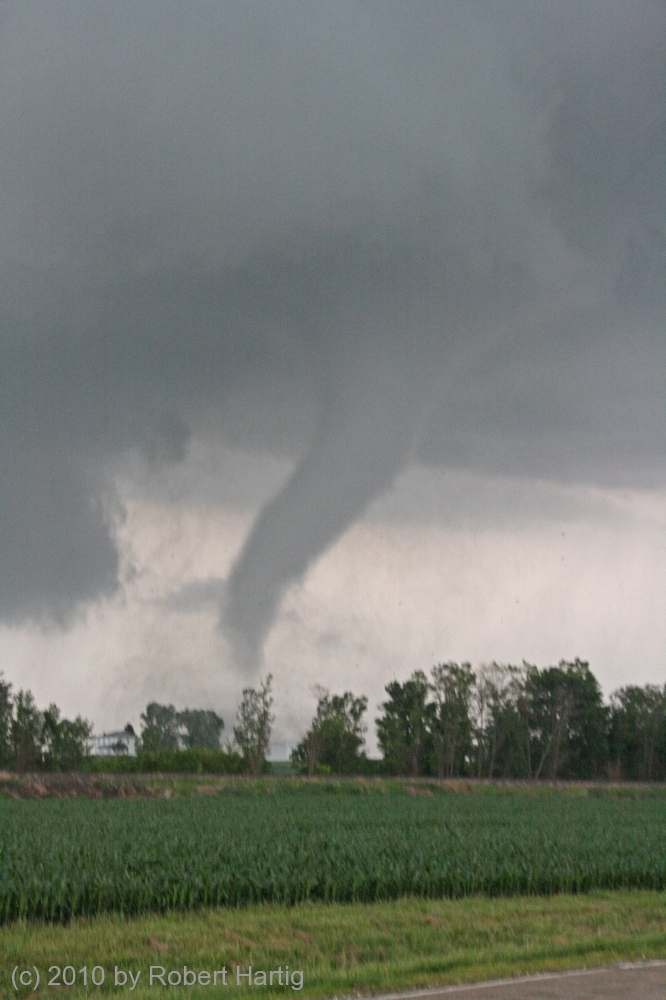
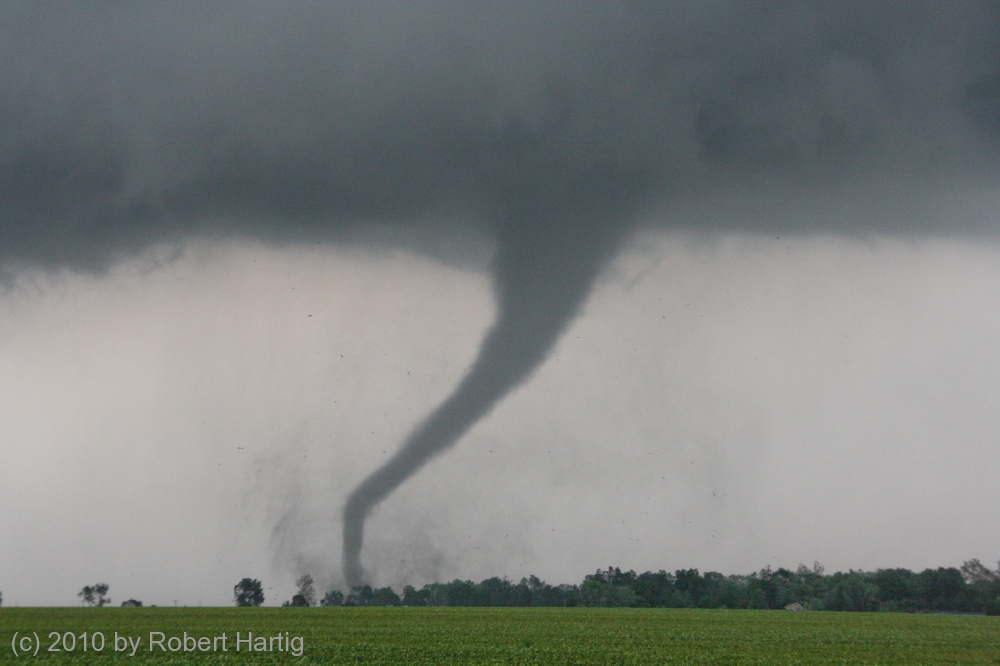
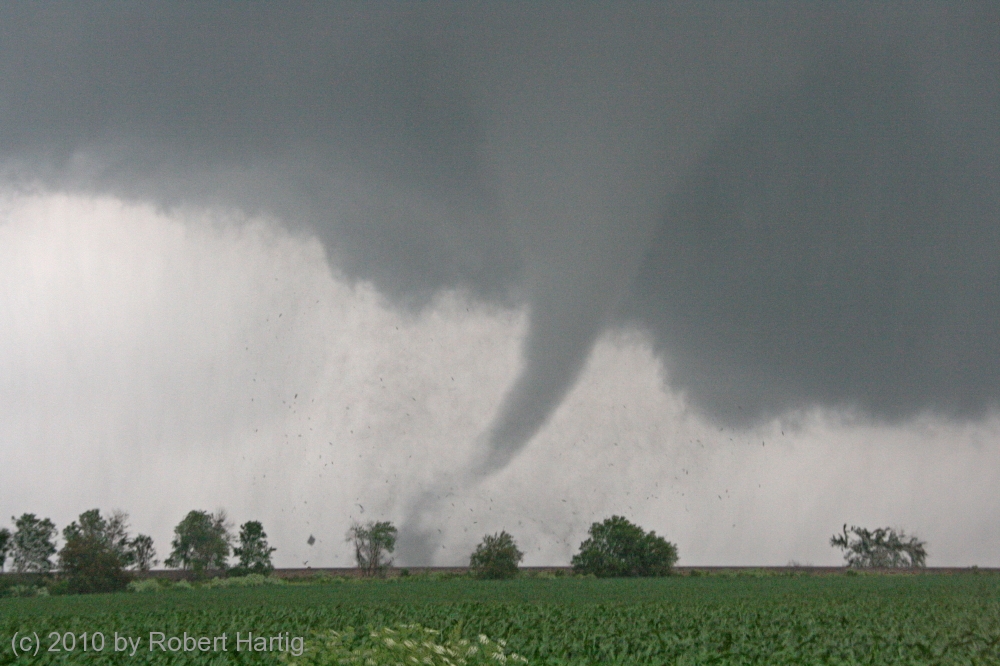
We were close to the tornado, roughly a quarter mile south of it, paralleling it as it tore an eastward course through the Illinois fields. Dirt and shredded corn swirled around its base like an aura. As Kurt Hulst and I  pulled aside and stepped out of the car to take pictures, we could hear the roar. It wasn’t loud, just audible and big, very big, an intensely focused sound like an immense blowtorch or a rocket engine. Yet, close as Kurt and I were to the tornado, we were out of its path and beyond the range of any apparent debris, and I sensed no particular danger.

A brief staccato of blue flashes suddenly lit up the base of the funnel, accompanied by a loud bang, and chunks of debris flew skyward and centrifuged out. The tornado had hit a structure out in the field, most likely an outbuilding of some kind.

Fortunately, there was little real harm the twister could do out there in the broad Illinois prairie. Not yet, anyway. But a little way to the east lay Yates City, and two-and-a-half miles farther, the community of Elmwood…

The day had started off rather inauspiciously, with the previous evening’s aggressive SPC outlook degrading into a forecast for straight-line winds. The 12Z NAM, too, looked unpromising, and the RUC corroborated it, with mostly southwesterly surface winds veering with height to a unidirectional, westerly mid- and upper-level flow. A persistent batch of cloud cover from a mesoscale convective system threatened to minimize daytime heating and instability. In a word, the setup wasn’t one that suggested tornadoes.

But with a trough digging in from the west, rich moisture, great shear, and at least a semblance of clearing moving in from the southwest, Kurt and I decided to chance it anyway. Our friend and fellow Michigan chaser Ben Holcomb had alerted us the previous evening to the evolving weather situation, and after reading Friday night’s Day 2 Convective Outlook and scanning the NAM, which showed an impressive juxtaposition of the right ingredients, including high helicities stretching along I-80 from Iowa into Indiana, we knew that we had to go.

So off we headed for Illinois late Saturday morning. As Kurt pointed out, the forecast models don’t always have a good grasp on things. One thing we could tell from both the NAM and RUC, though, was that the best parameters now lay well south of I-80. Accordingly, we set our sights on Galesburg, and once there, we continued on, crossing the river at Burlington and heading west into Iowa.

I took a dewpoint reading of over 72 degrees on my Kestrel at New London. The air was juicy. But the clearing we had driven through in western Illinois was giving way to a an extensive mid-level cloud deck. Rather than continuing to forge farther west toward the cold front, we decided to backpedal eastward in the hope that convection would fire near the edge of the cloud shield. This idea became a moot point as the cloud cover rapidly expanded across the river into Illinois.  But better parameters still lay in our area. We were presently in an area of maximum sigtors and optimal 1 km helicity, and on the radar, a scattering of blue popcorn echoes suggested that localized convection was trying to get started. Anticipating that these features would all translate to the east, we drifted back in that direction.

We soon noticed a cloud base with a tower reaching up toward the higher cloud deck. It showed on the radar, as did another stronger one directly down the road from us. As we headed toward it, the second echo progressed from yellow to red. Not far to our northeast, we could see a rain curtain. Skirting it, we moved east of the developing storm cell, parked, and got our first good look at it.

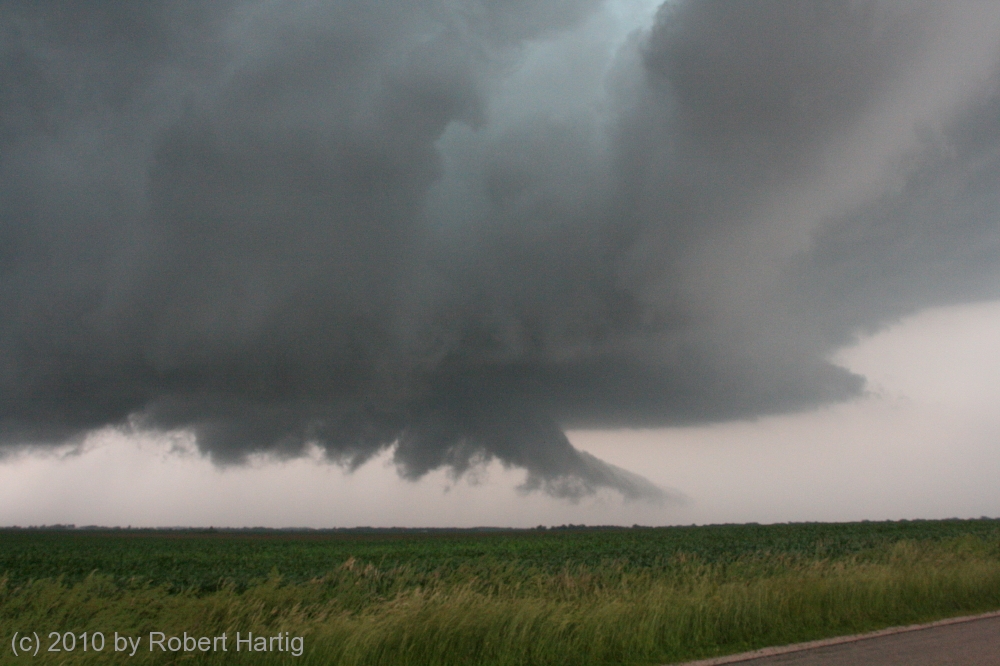
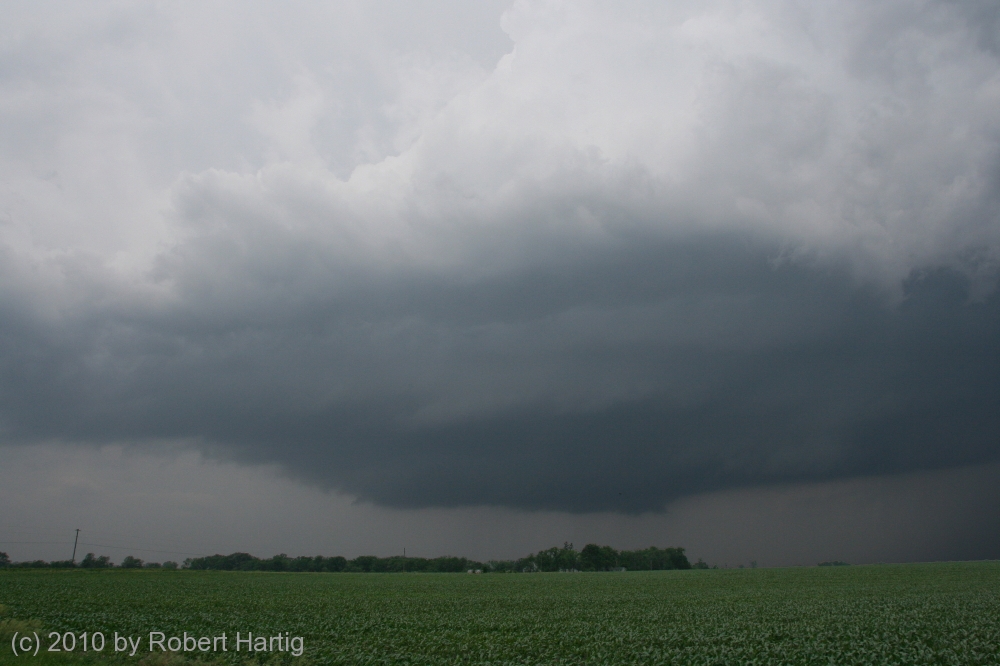
The cell was organizing nicely and was already showing supercellular characteristics–nice separation of the  saucer-like updraft base from the precipitation core; a strong, crisp, tilted updraft tower; the first signs of banding, and a hint of an inflow stinger. Positioned on the southeast edge of the convective cluster in southeast Iowa, it was in a favorable position to

ingest moist inflow unimpeded by other storms as it drifted at 30 knots toward Illinois.

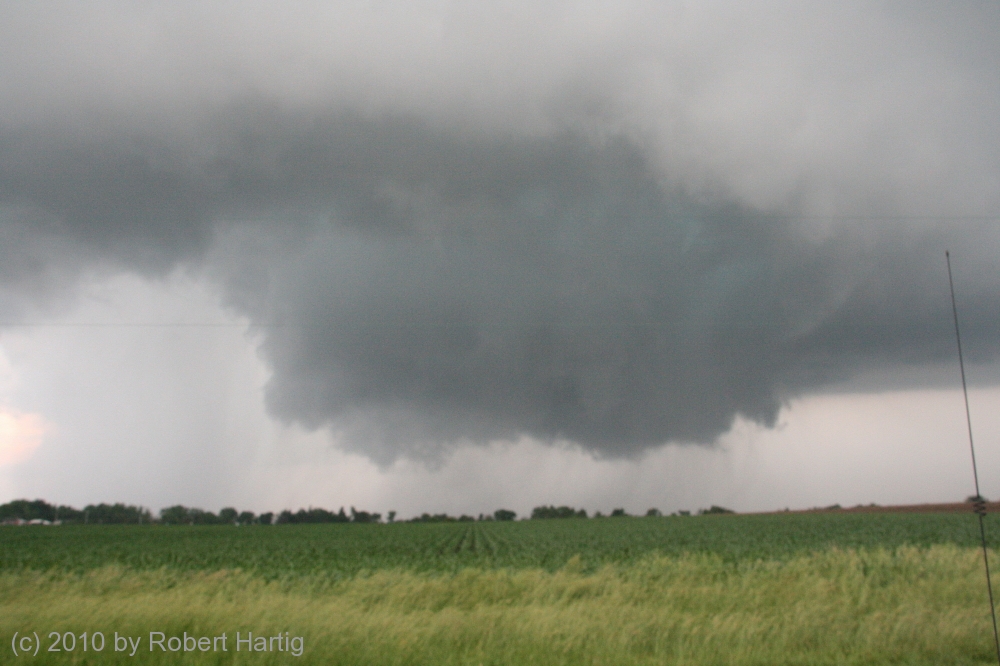
This was our storm. We tracked with it back across the river, watching it develop, watching the base lower and the first hint of a wall cloud blossom and put on muscle, watching it tighten as the RFD notch wrapped around it.

Just southeast of  Maquon, Illinois, we saw it: a cloud of dust billowing up from the ground with brief, streaming tendrils of condensation forming and dissipating above it. Tornado! It was a brief appearance of maybe a minute’s duration, but the storm was just getting started, mustering energy for the next round.

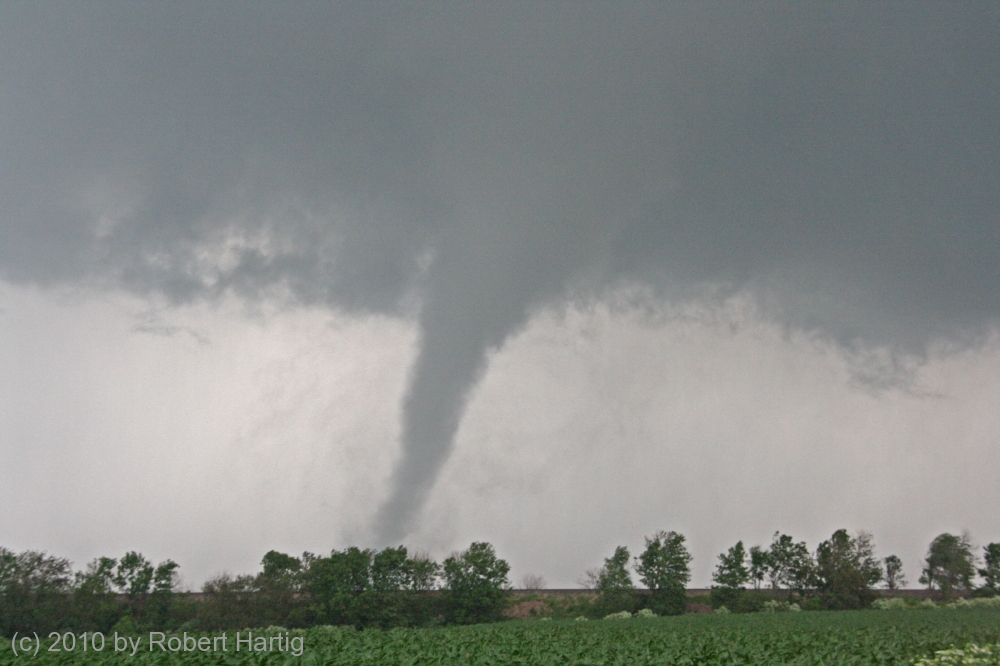
We didn’t have long to wait. A minute or two later, as we proceeded down CR 8, a slender elephant’s trunk of a funnel probed its way earthward, intensified, and began gobbling its way through the corn, closing in to within a quarter-mile of us before turning straight east.

This turned out to be a beautiful, highly photogenic tornado, all the moreso for the amazing display of lightning that accompanied it. Kurt took some great video of it which will give you a much better appreciation for how

electrified the tornadic environment was. At one point, at the 8:50 mark, you can see a bolt shoot directly from the funnel to the ground. I didn’t have the good fortune to witness the famed Mulvane, Kansas, tornado, but I’ve got to believe that this storm was similar in terms of its incessant lightning.

The funnel morphed through a variety of elegant formations, and the overall storm structure was beautiful. It was a stunning and mesmerizing sight, but with growing concern, Kurt and I realized that it was making its way toward Yates City and didn’t show any sign of weakening.

Fortunately, the funnel veered slightly to the northeast, passing just to the north of the town. At that point, it was an intense drillpress spinning furiously a mile distant. We closed the gap and tracked with it as it headed toward the larger town of Elmwood, just a couple miles down the road.

What was the funnel doing? It appeared to be shifting to the right. Oh my gosh! Elmwood was going to get hit! The tornado was beginning to rope out,

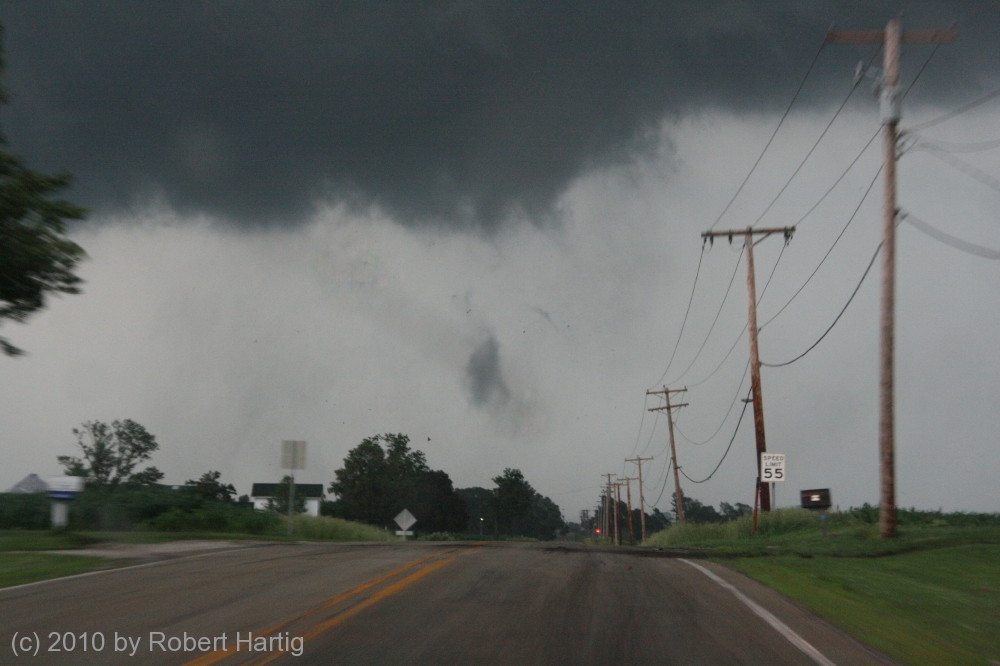
but not in enough time to spare the town. Taking a hard right, it plowed through the town center. Three-quarters of a mile ahead of us, power lines arced and transformers exploded, debris blasted into the air, and a large dust cloud billowed skyward.

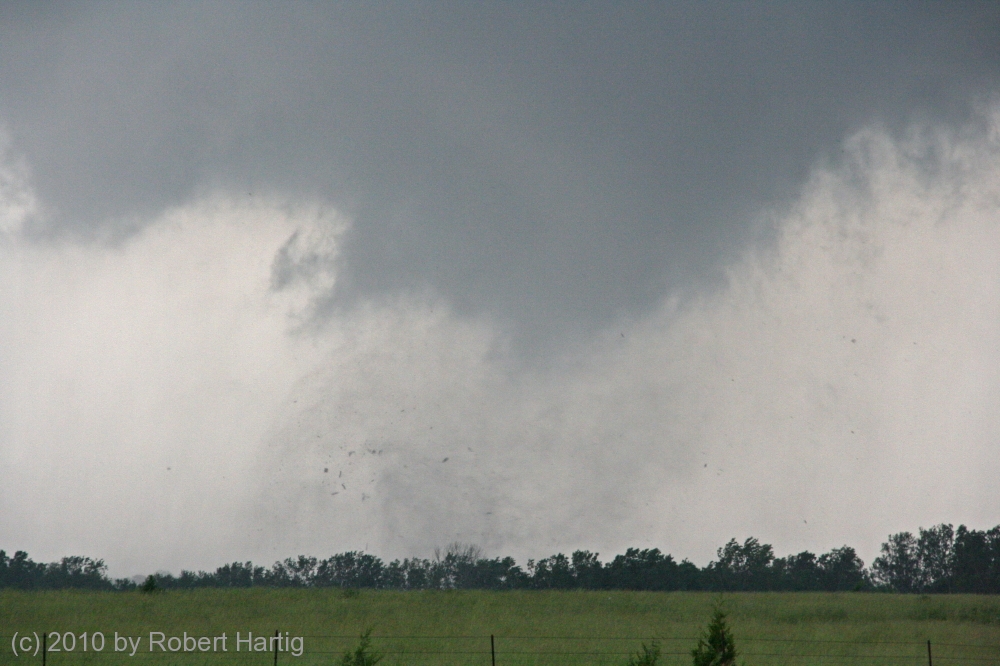
It is a weird and awful feeling to witness a community get hit by a tornado. I’ve seen it happen twice before in Springfield, Illinois, and in Iowa City, but those were night time events. It’s different in broad daylight, when you can see what’s happening. The rather blurry photo shown here was taken just before the tornado crossed Main Street in downtown Elmwood. It’s not a very dramatic shot. You can see a few pieces of debris floating in the air and no more than a cloud tag to mark the presence of the tornado. But a second or two after the photo was taken, things got very nasty in that town. If there’s anything at all good to be said about what happened there, it’s that no one got killed or, as far as I’m aware, even injured.

A couple hundred yards south of Elmwood, the tornado dissipated. Gone, poof, vanished just like that. There’s a certain ugly irony about a force of nature that can wreak havoc in a community and then vanish a few seconds later without a trace. If the tornado had dissipated just thirty seconds sooner, a lot of people might have experienced just a good scare rather than a local disaster.

Kurt and I continued tracking with the storm as it made its way toward Peoria. The next tornado soon formed–a larger, bowl-shaped cloud with multiple vortices. This broadened out into a large tornado cyclone with multiple areas of rotation that produced, among other things, a brief but spectacular horizontal vortex. Sorry, I have no photos to show of it. It had gotten too dark, we were moving, and any picture I took at that point would have been blurred beyond recognition.

In Peoria, we got a bit snagged by roads and traffic, but thanks to Kurt’s great driving, we soon found ourselves heading east on I-74. As we crossed the Illinois River, I could see what appeared to be a large cone funnel to our north making its way across what was probably Upper Peoria Lake, silhouetted by frequent strobes of lightning.

Catching CR 115 at Goodfield, we headed north to Eureka, then continued east along US 24. We were still tracking with the storm, which was slowly weakening as the next tornadic supercell to its north began to dominate. It was still no pansy-weight, though, and at Chatsworth, in a final show of strength, it spun down a brief but well-defined rope tornado.

As our storm merged with the northern storm around Kankakee, Kurt and I caught I-57 and headed home. After May 22 in South Dakota, I really didn’t expect that I’d get another decent storm chase in. But this El Nino year, which got off to such a rotten start for storm chasers, now is paying dividends with some highly photogenic tornadoes.

And the season isn’t over yet. There’s no telling what the rest of June may hold. I doubt I’ll be making any more forays this year into the Plains, but if the Great Lakes region continue to light up, I’ve got my camera and laptop ready.

To see more photos from this chase, click here. And while you’re at it, check out the rest of my images of storms, tornadoes, wildflowers, people, and whatnot in my photos section.

May 7, 2010, Northwest Ohio Supercells

Yesterday’s outbreak of supercells in the southeastern Great Lakes was no tornado breeder, but it made for an enjoyable chase. I left Caledonia around 10:30 with Bowling Green in mind as a target, noting that the SPC had outlooked a narrow, northern swath of northeast Indiana and northern Ohio with a 10 percent tornado risk.

I wound up rendezvousing with my long-time chase buddy Bill Oosterbaan in Ashton, Indiana, where Mike Kovalchick also joined us. (Note to self: that Baptist church parking lot on the west edge of town has a fantastic hilltop view to the west.) We dropped south to Waterloo, where I parked my car at a convenience store, then hopped in Bill’s vehicle, and we headed east, watching as a cumulus field began forming overhead. The warm front was moving in, and when we left Ashton, the chilly temps were already rising and bringing the dewpoints with them.

Farther to the east, we hooked up with Ben and Mike Holcomb, and CMU meteorology students Aric Cylkowski and Cort Scholten. Our contingent of four vehicles at the Sonic drive-in made up what was probably the first chaser convergence that Bryan, Ohio, has ever experienced, and probably the last.

From there, we dropped south toward the warm front, which had stalled over the area. Temps had been in the lower 70s in Bryan, with east-northeasterly winds and dewpoints around 59 degrees; farther down the road, at our new location in a parking lot next to a cemetery, we gained another degree of dewpoint and the surface winds veered. On the radar, one discrete cell to our southwest began to take on supercellular  characteristics. We decided to intercept it, and the chase was on.

But another cell formed southwest of our storm, and in its tail-end position, it rapidly evolved into the main player of the day. So we left the storm we were on and headed toward the new one, which was hooking nicely. A couple miles south of the town of Paulding, we encountered one of the most flat-out beautiful hailstorms I’ve ever seen. It moved toward us in shifting, pearly strands across the fields. I tinkered frantically with the settings on my camera in order to get a fast enough shutter speed for snapping pics from our moving vehicle–there was no shoulder to the road, and no stopping–but by the time I finally had what I needed and Bill had found a turn-off, the amazing nuances and texture of the hail shaft had blended into a homogeneous sheet (click image to enlarge). I took a couple quick photos which nowhere near capture the essence of what we had seen just a minute or two prior; then, with maybe thirty seconds to spare from getting cored, we beat a hasty retreat.

Out in the field just to our southwest, we could see a crapload of dust being kicked up by the rear flank downdraft. We pulled aside and let it pass 100 feet or so in front of us. In the photo, notice how the dust fills the ditch to the right. I’ve read some discussions about the wisdom of the longstanding advice to abandon one’s car during a tornado and seek shelter in a ditch. Maybe that’s a best option in a worst-case scenario, but judging from the photo, it looks to me like the wind is doing a pretty good job of invading the ditch. Depending on the depth of a given ditch, tornado-force winds could conceivably just scoop a person up and launch them into the main air stream.

But I digress. The hail and RFD were the highlights of the day. From then on, it truly was a storm chase, and a futile one. With the storm rocketing to the east-northeast at 70 mph, we had a choice of barreling eastward and losing the storm to the north, or northward and watching it vanish to the east. We pursued it longer than we should have, but we had a fun time of it. The roads in that part of Ohio are great, the countryside is flat and open, and overall, the territory is fabulous for chasing. But when storms are moving at such breakneck speeds, the best road grids in the country–and these probably qualify–can’t compensate.

I managed to get a few shots of a cool, bell-shaped wall cloud as the storm moved away from us. Eventually, though, we called the chase off and started on our way back. West of Paulding, we encountered significant wind damage–large trees snapped off at their bases and pieces of outbuildings scattered across the fields at a couple farms. Could have been weak tornado damage, but it was likelier the work of straight-line winds.

I should probably mention the rope funnel that hung down from a small storm as we headed back toward Waterloo. Okay, it wasn’t really a funnel, just evidence of what wishful thinking can do with a snaky-looking cloud.

Back in Waterloo, I picked up my car, hit I-69 north, and headed home.

I noticed that Illinois-based storm chaser Adam Lucio was also on these storms, and appreciated his Facebook comment that you don’t need tornadoes in order to have an enjoyable chase. I wholeheartedly agree. Yesterday was a great chase, particularly for the Great Lakes, and that hail shaft near Paulding alone made my day.

Of course, everyone has been rumbling about the big event shaping up for Monday in the Plains. Wish I could go, but it’s not in the budget. Best wishes to everyone who heads out. Stay safe, get good photos and video, and have fun.

The Return of the Trains: Sax Reflections from the Railroad Tracks

It’s good to see the trains again.

As a jazz saxophonist who loves to practice his horn in his car parked by a set of railroad tracks out in the countryside, I noticed last year that something was missing. Used to be, I could count on seeing the distant semaphore light turn green and watching as the white pinpoint of a headlamp miles down the tracks brightened, drawing closer until I could hear the rumble and then the roar of the locomotive and the clatter of freight cars rushing past. I enjoyed that experience at least once, and normally two or three times, during most practice sessions.

But as the bottom dropped out of the economy and Detroit’s auto industry languished, the giant spigots that sent the trains hurtling along the pipeline between Lansing and Grand Rapids closed to a trickle. Those hundred-car, three-locomotive strings I was so used to became, just like that, a thing of yesterday.

Until lately. It gives me much pleasure to say that the trains are returning.

I still don’t see them with the frequency I used to, but I am noticing that there are more of them, and they are growing longer. Two days ago, parked by the tracks in Alto, I paused in my practice to watch as a train boomed by in front of me…and kept on booming. It was one of those hundred-car affairs, just like in the good old days, which really aren’t old at all but certainly were enjoyable.

Now those days seem to be on the way back. It may be a modest return, but the spigots are reopening. It’s heartwarming to think, as I sit by my beloved tracks working out my saxophone chops, that I’m once again likely to hear the sound of another horn, far off in the distance and growing closer, and to feel the powerful, exhilarating, reassuring rhythm of a train rushing by.

The Cap Won

I don’t know why so many storm chasers decided to chase in northern Missouri this last Monday. I could have told folks it had “cap bust” written all over it–didn’t fool me for a minute, as you can see by reading my post written the day before.

Ahem…right, so I got snookered too. The GFS was spot on about the cap, and the NAM way underforecast it. As a result, Missouri chasers wound up sitting under relentlessly empty skies waiting for convection to fire. It finally did in northeast Kansas–after dark. Storms ignited along a boundary (the warm front? ) and a couple went supercellular and even tornado-warned for a heartbeat before the cap re-exerted itself and squenched them.

The real action, ironically, took place in central Illinois and Indiana, well east of where most folks–including me–had expected. Supercells cut a swath along the warm front through Terre Haute, Indianopolis, and parts east and southeast into Kentucky, and a number of purple boxes lit up the radar screen. Nevertheless, SPC storm reports list only one confirmed tornado that touched down near Hillsboro, Illinois, northeast of Saint Louis.

Them’s the breaks. I didn’t chase that day, and I’m glad that I didn’t because I’d almost certainly have gotten skunked in Missouri when I could have driven straight south down US 41 to Terre Haute, not even having to mess with Chicago traffic, and waltzed on into the sweet zone.

Ah, well. I chased today–if chasing is what you can call a guaranteed grunge fest–down toward a warm front by the Michigan border. The trip was my compensation prize for not heading out when it really counted these past few days. The SPC had outlooked a five percent tornado risk this afternoon, and supercells were making their way northeast across Illinois toward Indiana. I figured that if they held together, I might catch them, but not surprisingly, they mushed out.

That was okay. I was chasing blind, with no radar and few expectations other than the hope that I’d at least see some lightning. I did, and called it good. The main storm season is still on the way, and there’s no need to fret over spilled milk when the cow is just priming its udder. It won’t be long now.

Unbagging the Kids

Yesterday I took the kids out of the refrigerator, where I’ve kept them in bags since December, and have been busy burying them in dirt one by one. Before you pick up the phone in horror and dial the authorities, let me explain that the “kids” are my carnivorous plants, and refrigerating them is essential for meeting their dormancy requirement. As I think of it, the fact that, in addition to being fanatical about tornadoes, I also have a sizable collection of carnivorous plants probably seems fairly ghoulish in its own right, but the truth is, while I may be eccentric, I’m fairly harmless.

For that matter, compared to some members of the International Carnivorous Plant Society, I’m just a dabbler at a fascinating hobby that can be taken much farther than I have the money or the room for. My modest, apartment-balcony-sized collection is nevertheless something I take much delight in. At present it consists of all eight Sarracenia species, including a few subspecies and varieties, and a whole brigade of Venus flytraps.

Not only did the roots of most of my plants grow quite a bit last year, but most of them have also subdivided, which has necessitated my purchasing more and larger pots this year. This has been particularly true of the Venus flytraps. You just wouldn’t believe how the things multiply. I started with five plants a few years ago and now have 2.5 million of them. At least, it seemed like that many back in December when I had to remove them from their pots, wash them off individually, separate their corms at their growth points, remove all of the dead leaves and anything that could rot, wash them in sulfur solution to prevent mold, wrap them in sphagnum moss, spray the moss with fungicide, place them in bags, and finally, stick them in the refrigerator. If that sounds like a tedious process, pat yourself on the back for figuring it out. It took me two evenings to process five freezer bagfuls of flytraps.

Now I face the joyous prospect of unbagging my Venus flytraps and repotting them, and I’m not even sure how many I actually have. Probably somewhat fewer than 2.5 million, but still a lot. The good thing is, planting them will probably take considerably less time than I spent preparing them for the fridge.

As for the pitcher plants, I finished potting the last two bags tonight. Yahoo! I can hardly wait to see how big my Sarracenias will get this year in the bigger pots, particularly since they’re getting a month’s head start on last year. April 2009 was cold the entire month; this year, we’ve already hit the mid 60’s these past few days. And the plants had already begun growing in the refrigerator, sending out pale leaves and white flower stalks. Now that they’re getting some warmth and sunlight, I have a hunch that at least some of them, if not all, are going to go absolutely gonzo.

If you want to meet some of the kids, go to my wildflower and outdoors photos and then click on the sundews, North American pitcher plants, and Venus flytrap galleries. The photos are from 2009. Keep an eye out in a month or two for updates. By then, a lot of the plants will be in flower. This year ought to be a spectacular display, so stay tuned.

Wavespray on Lake Michigan

no images were found

If March coming in is anywhere nearly as leonine as February going out, it will be a March lion indeed. Today the wind was blowing hard out at Holland Beach, churning Lake Michigan into a grand spectacle of roiling billows, crashing surf, and smoke-like spume torn from the wave tops and carried along on the gale.

It was a marvelous sight. Lisa preceded me out onto the pier, and when I caught up with her, she was standing there, laughing as the waves burst

no images were found

against the ice shelf and threw blasts of icy water toward her. That’s my kind of gal! Someone who takes joy in the wild side of nature.

Unfortunately, the water got all over my camera and onto my lens, so the latter part of my photos are somewhat distorted by water droplets. But I don’t mind terribly, because the effect is actually rather moody. I guess if I was going to have something go wrong with my photos, I would pick that.

no images were found

Speaking of photos, the four here were all taken from the beach and out on the pier. Click on them to enlarge them.

In taking them, I got more soaked than I realized; and the wind chill being what it was with the northwest wind blasting in off the big lake, I rapidly got much colder than I ever expected. But it was worth it to get some shots of Lake Michigan’s raw, unfettered side.

no images were found

I haven’t edited these images. I’m slapping them up here just as they are–maybe not works of art, but a taste of the kind of effect the shoreline is capable of delivering when the gales blow hard across the big waters.

The Smart Shopper’s Guide to Swan Meat

It’s gratifying to know, in these troubled times when so many are struggling financially, that you can purchase swan meat for just $50.00 a pound. That’s right, there are deals to be had and ways to satisfy the well-known American craving for swan at bargain-basement prices. The kicker is, you’ve got to purchase the entire bird. But at rates this low, why would you not?

Presumably, when you order a bird from 1-800-STEAKS.COM, you’re getting a black swan as shown in the web page photo.* The page doesn’t actually specify that it’s a black swan, nor does it tell you how much meat you’re getting for your money, because, heck, why not make things more fun by making the customer guess, right?  At the time of this writing, I defy you to search the page content and find any details beyond the fact that you’re getting swan for $999.00–a steal at $500 off the regular price of $1,499.00.

Since it really is kind of important to know where in the size spectrum between a chicken and a sperm whale the swan in question lies, it’s off to Wikipedia we go, you and I, where we learn that a mature black swan weighs anywhere between eight and twenty pounds. Very good, now we’re getting somewhere. But in what form will our swan be delivered to us? After all, it’s swan MEAT that we’re after, and that is what the site advertises. So should we expect it to come pre-packaged, or frozen whole with the feathers still on it, or what?

Finding no immediate information, off we go again to do more research, this time to the Exotic Meat Market, which offers competitive prices on black, mute, and black neck swans and is pleased to answer some of our pressing questions.*

Ah! The swans are live. We will not be receiving our eight to twenty pounds of swan meat in nicely prepared parcels. No, our swan meat will be arriving in the freshest of all possible conditions, honking and hissing and flapping its wings and ready to vigorously assert its personal views on being converted into table fare. So we shall have our work cut out for us, but the Exotic Meat Market sweetens the deal with prices that make us want to shout for joy, they are so ridiculously low.

Here, for instance, is the pricing information for a single live, male black swan:

Regular price: $1,299.00
Sale price: $599.00

Black Swan – Live Male blswlima

[Add to cart]

I’m not sure what “blswlima” means. Maybe the swan comes with Lima beans. Regardless, you can see right away that here is a platinum deal if ever there was one, with the Exotic Meat Market undercutting 1-800-STEAKS.COM by $200 on their regular price and $400 on the sale price. I know, I know–it makes you want to rub your eyes in disbelief. Disbelief is a common reaction to prices like these. Nevertheless, it’s true: you can purchase live, aggressively fresh swan meat–between eight and twenty pounds, we’re still not entirely clear on that–for a low, low, not quite 600 bucks.

And that’s not all. Mute swan, a non-native species which is rapidly becoming a weed bird in United States lakes and rivers, also sells for just $599.99. And black neck swan, regularly $2,499.99, is currently on sale for a paltry $1,999.99. That’s a $500 SAVINGS! (Though it should be mentioned that the black neck swan doesn’t come with Lima beans.)

But perhaps you’re the outdoorsy type who prefers to head out to the swan blind and harvest your own. If that’s the case, you’ll appreciate this recipe for mute swan burgers. I realize that you’ve probably already got your own half-a-dozen-or-so favorite ways of preparing America’s favorite poultry, but in a country where the mere mention of swan sets mouths to watering, one more recipe can’t hurt.

Let me know how you like it. As for me, I think tonight I’ll settle for fried chicken.

ADDENDUM, March, 2013: Over three years have passed since I wrote this article, but it continues to draw traffic. I’ve spent hours writing serious, marvelously practical posts that have long since settled into the sedimentary layers of blogdom, while an aberration I knocked off in an hour or so has attained modest immortality. Weird. Must be a lot of folks are just crazy about swan. That or else they enjoy a chuckle or two. Probably the latter. So if you enjoyed this post, you might also want to check out my assessment of the Giraffe Test. It’ll set your mind at ease, particularly if you’re a business professional.

_______________

* The link I had to this site no longer works and has been removed.

Getting Ready for the Skunk Cabbage

Here’s some news that will put joy in your heart: skunk cabbage days are almost here! (And all the people shouted, “Hurrah!” and donned their festive garments.)

It’s true. Sometime within the next three weeks or so, the odd, purple cowls of Symplocarpus foetidus will start pushing up through the mud and matted leaves of the wetlands where they grow, generating enough heat to melt their way through the ice and snow and provide a microclimate for early insects. Here in the Great Lakes, the skunk cabbage is the year’s first wildflower, and I always get happy when I see it begin to show. It’s a charming little plant, though there’s nothing particularly pretty about it. This plant doesn’t care about “pretty.” It’s all about character and nail-toughness. Skunk cabbage has the grit of a pioneer.

It also has the smell of a pioneer, as you’ll find out if you ever hold a piece of the broken flower or leaf up to your nose and get a whiff. It smells a lot like an armpit that hasn’t been washed in a month. Taken all around, this is not the kind of wildflower you’d feel inclined to gather a bunch of and take home to stick in a vase. But, appearing with the robins and redwing blackbirds, it is nevertheless a welcome harbinger of the warmer months. I’m surprised that some Michigan town hasn’t claimed it and instituted an annual skunk cabbage festival. Not too surprised, though.

Speaking of warmer months, they don’t seem to be in any hurry to put in an appearance, and I’m starting to wonder whether Punxatawney Phil might not have been conservative in his forecast of another six weeks of winter. Another major winter storm is poised to dump another 6-10″ of snow on West Michigan this evening through tomorrow, and more snow is in the forecast for the next ten days.

Snow, snow, and yet again snow. If you like the stuff, just stick around. Sooner or later, Michigan always delivers.

More Winter Weather for the South? More Long-Range Musings from a Michigan Snow Grinch

There’s talk about another round of snow hitting the South toward the end of February. It’s a bit strange to see how much discussion goes on about snowfall as an anomaly when here in Michigan, it’s a way of life. Today, snow was in the forecast in the Grand Rapids area. But that’s the norm in February. I’m used to looking out the window and seeing snow in its various forms: big, fat, fluffy flakes; small, sharp, crystalline flakes; hard, dry graupel that bounces off the sidewalk like Styrofoam crumbs; frigid diamond-chips that barely qualify as snow, they’re so fine and so tremendously cold, cold, cold.

The snow du jour on this fine, wintry Monday has been the big stuff–merry, white clumps cascading by the billions out of the mid-February sky, twirling, diving, swooping, soaring, pirouetting on the wind–snow that looks as if God sliced open an enormous feather pillow and has been emptying its contents in fits and starts over my hometown of Caledonia. I grudgingly admit, snow Grinch that I am, that it has been a darn pretty sight.

Yes, you heard me say it. Even an avowed, long-time loather of snow such as I has his moments, times when the beauty of winter transcends its miseries and those dancing flakes warm my attitude with their frozen magic. It’s a bit easier to admit to toward the end of an El Nino winter that has been less snowy than usual.

Nevertheless, I’ve never taken the kind of interest in winter weather that I have in warm-weather convection. I don’t make a habit of following forecast models daily in February, I possess only a rudimentary understanding of their interpretation at this time of year, and I get caught by surprise by events that blizzard enthusiasts have been following with eager eyes. You maybe can’t understand my indifference unless you’ve lived in a place where the snow is going to come to you whether you look for it or not, and you will be scraping plenty of it, along with generous portions of ice, off your car windshield for four or five months.

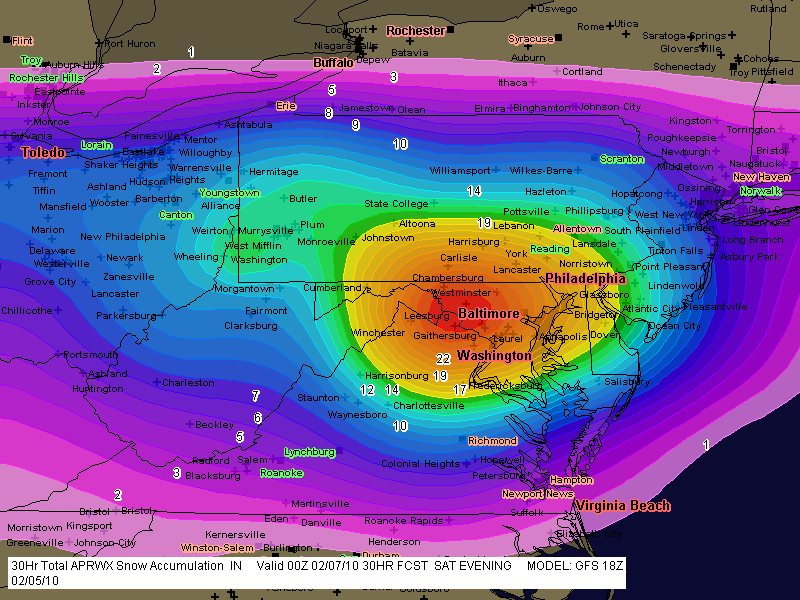
So, is the South due for another round of snow in a week or so? I dunno. Out of curiosity, I ran a GFS snowfall totals loop out to 384 hours a little while ago, and it suggests a pretty good dumping, beginning in Pennsylvania and parts east–why am I not surprised?–and then spreading the joy to northern Oklahoma, Missouri, and Tennessee as another system moves through. That’s probably the system that folks are harping about. But as everyone knows and everyone is quick to say, it’s still a long way out, and nobody knows for sure what’s going to happen right now. That’s particularly true for someone like me, who hasn’t bothered to cultivate winter forecasting skills in a place where snow is as inevitable as death and taxes, and for many, only slightly more enjoyable.

A little dark humor there, folks. Don’t hold it against me if you’re one who loves snow. You’re welcome to remove as much of it as you wish from my vehicle for free, take it home with you, and enjoy it to your heart’s content. Come, ease your craving. I call that a generous offer. But act soon! It’s only good through April.