July 22 West Michigan Supercell and Lightning Fest

I haven’t seen a storm like last night’s storm in Michigan in a long, long time. Man, what a beauty!

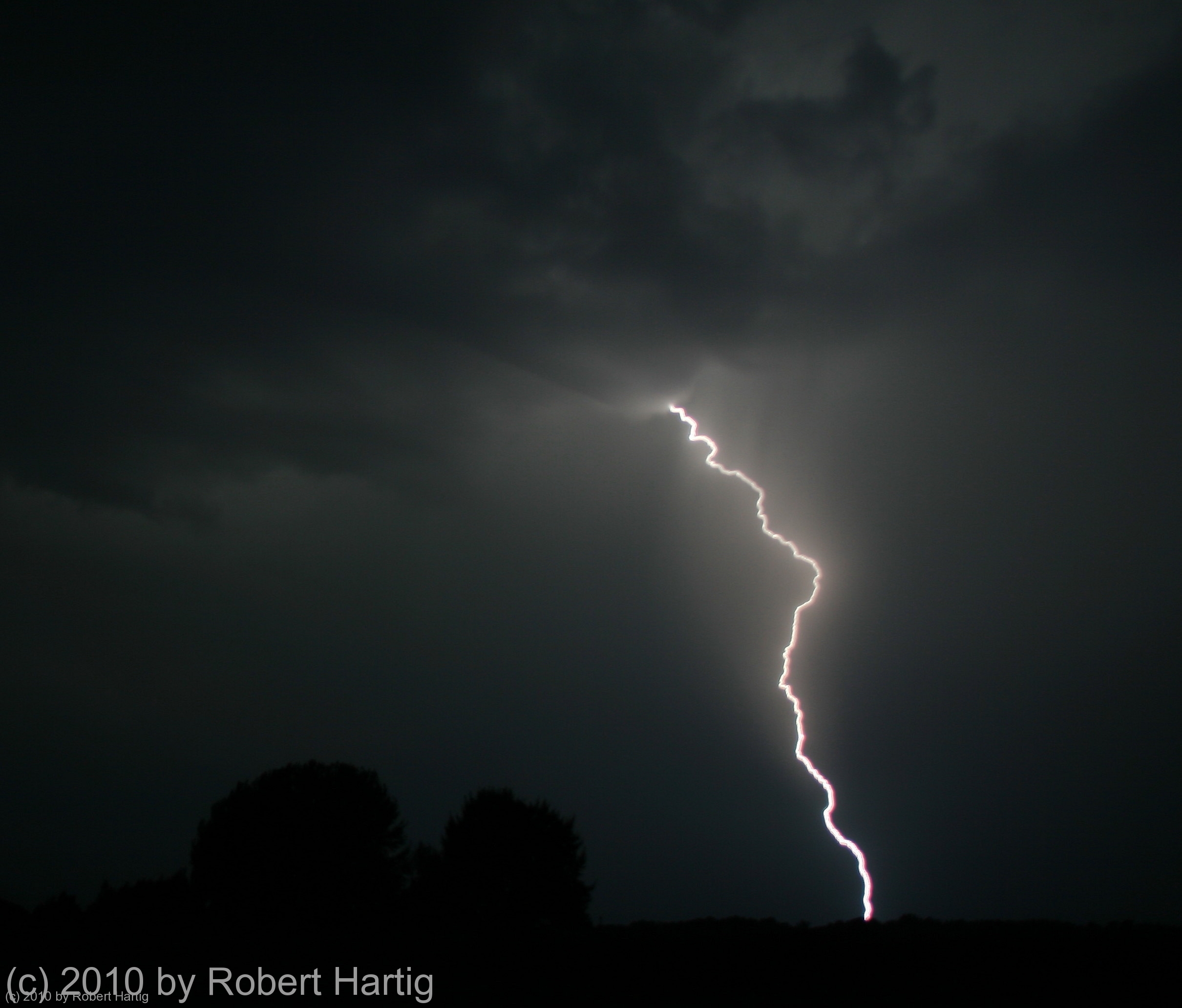
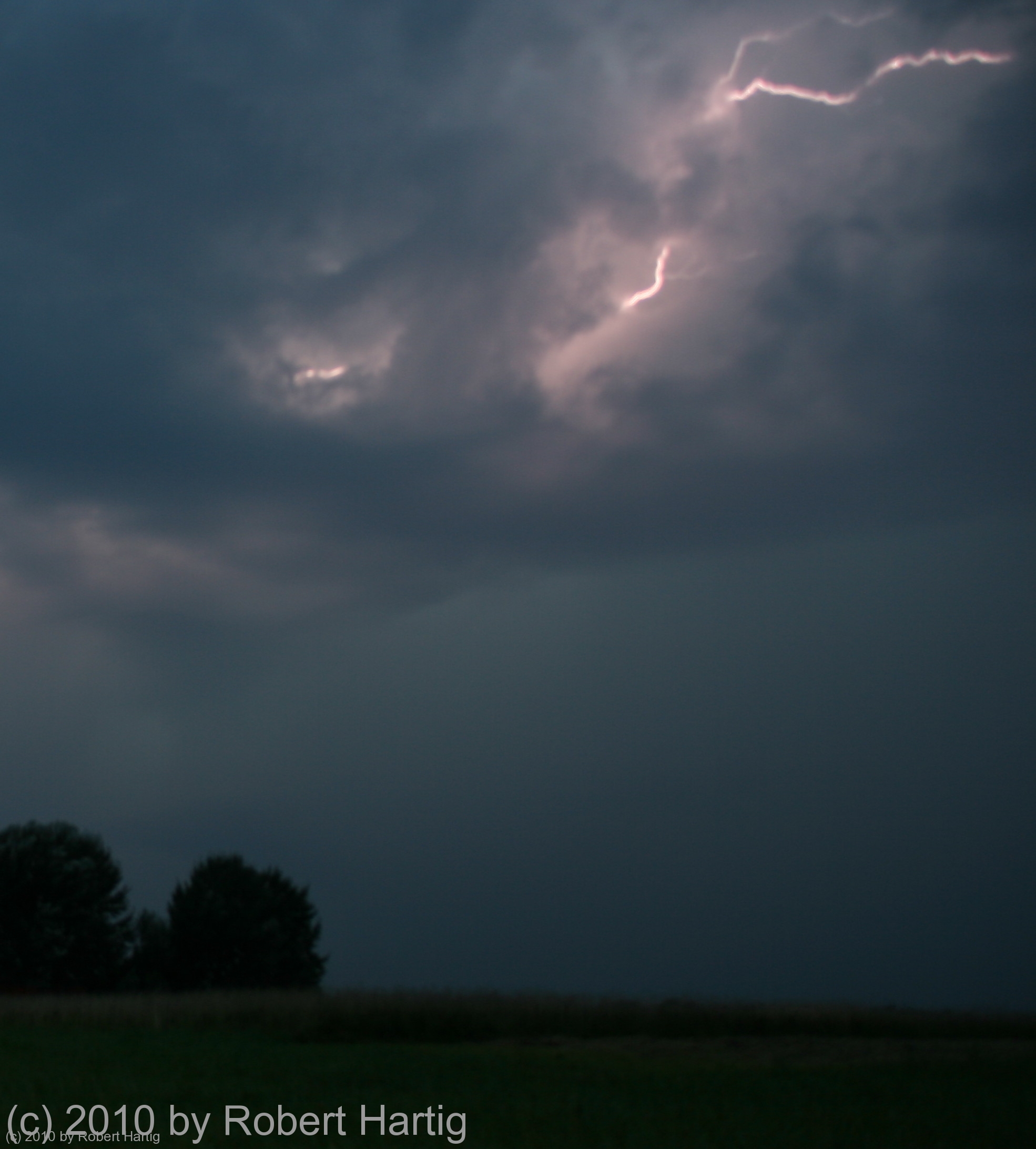
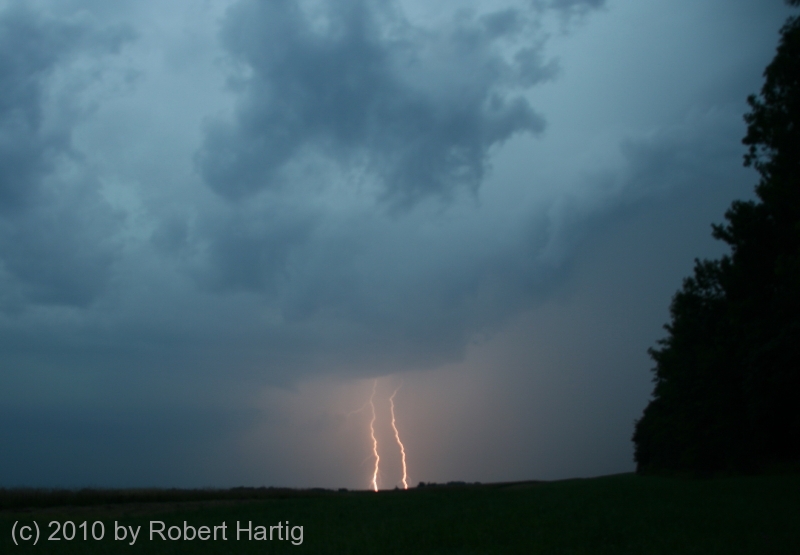
Non-stop lightning, much of it appearing to be positive strokes that lasted for seconds at a time, along with a veritable feast of anvil crawlers, made for a photographic smorgasbord. Plus, the storm structure–as much of it as I could make out at night, illuminated by the incessant lightning–was truly impressive. If only the storm had arrived an hour earlier, when there was enough light to really see the thing!

I had just finished doing a couple of interviews down in Dunlap, Indiana, for the book I’m writing on the 1965 Palm Sunday Tornadoes. My meetings
required me to forgo chasing a supercell that moved through the Battle Creek area as the warm front lifted northward, and I was curious to find out what had happened with it. Pulling into a parking lot, I fired up my computer, opened GR3, and gaped. A line of supercells was advancing across Lake Michigan from Wisconsin. The first one in the line looked great–SRV showed definite rotation–and, headed on an ESE trajectory, the storm was poised to make landfall around Saugatuck. Winds there were almost straight easterly, and they were beautifully backed across most of lower Michigan. Hmmm…what did the VAD wind profile look like at Grand Rapids? Dang, sweet! How the heck did that kind of setup wind up in Michigan?

The storms weren’t moving terribly fast, around 25 knots. Could I make it in time? I was bloody well going to try. There was no denying the rush of adrenaline now galvanizing me, thrusting me into chase mode. I hit US 20 and headed west past South Bend, where the highway merged into US 31 north.

I still had a good 40 miles to go by the time I connected with I-196 near Benton Harbor. I wasn’t sure whether I’d catch the storm by the time it made landfall. Maybe I’d be better off playing more to the east. But I decided to take my chances, and that turned out to be the right move. I couldn’t have timed it better.

As I approached M-89, the eastern part of the storm had made landfall, but the radar showed the rotation still out over Lake Michigan. It wouldn’t be there for long, though, and, having shifted its trajectory south of Douglas, it was now heading straight at me.
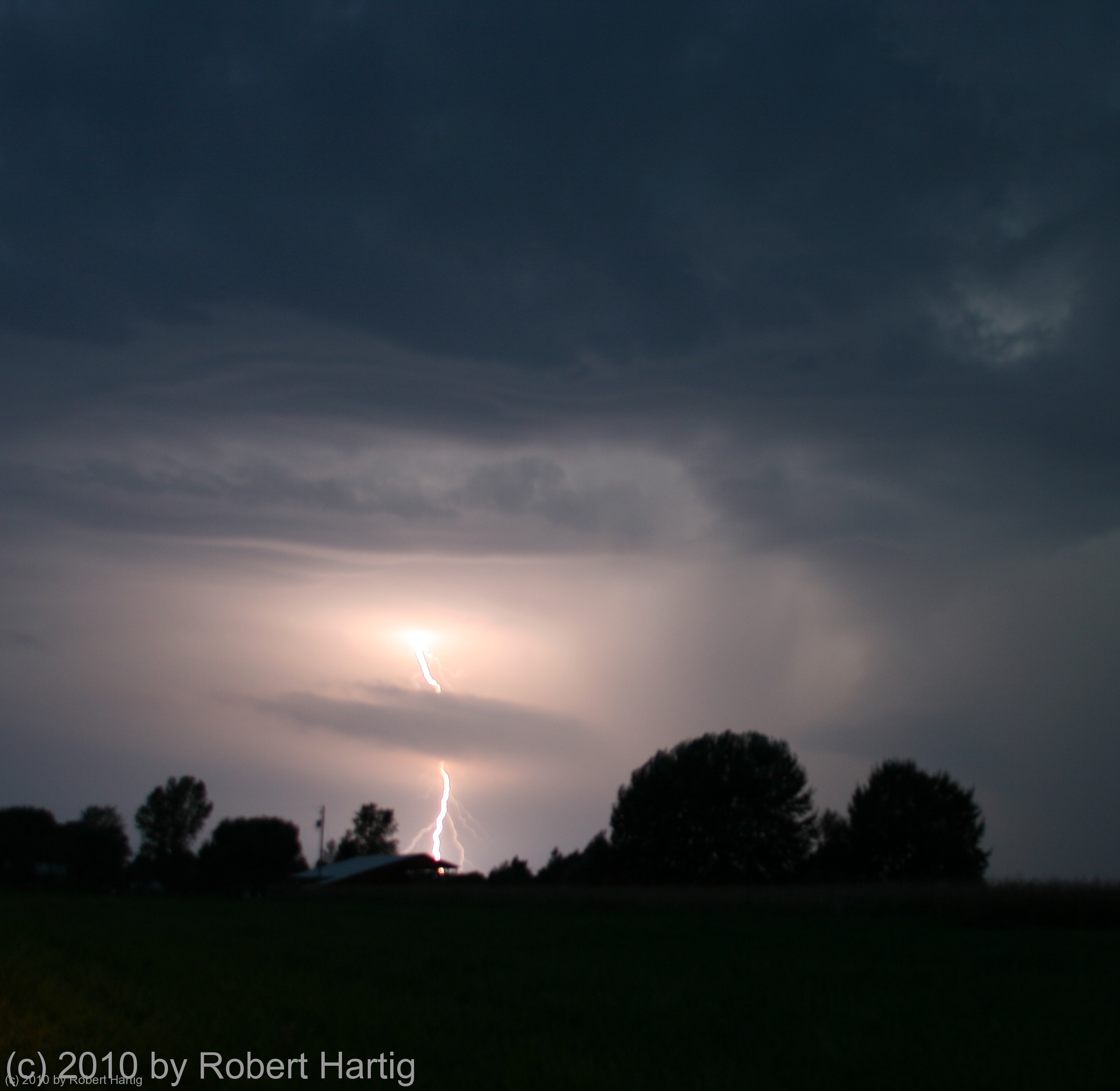
Bingo! This was exactly what I’d been hoping for. Leaving the Interstate, I headed east along M-89 and found a nice, open field a mile down the road, just west of 66th Street, 4 miles south of Douglas and 4 miles west of Fennville. Then, turning my car around to face the incoming storm, I parked and grabbed my camera out of the back seat.

The lightning in this beast requires superlatives to describe it. There seemed to be a never-ending supply of high-voltage CGs, delivered with the unbridled, over-the-top enthusiasm of a 4th of July fireworks finale and accompanied by the incessant grumbling of thunder. There were times, as the lightning cells moved past me and surrounded me, when I felt like I was sitting inside an immense flashbulb–a flashbulb that kept firing again, and again, and again. Oh, man, what an extravaganza of pure, searing power and beauty! I’ve done my best to capture it, but my skills as a lightning photographer fall far short of what this storm had to offer. Now, my buddy Kurt Hulst, he’s Da Man when it comes to getting fantastic lightning shots, and I know he got some last night. Me, I seem to have a problem getting a good, crisp focus at night, but I try.
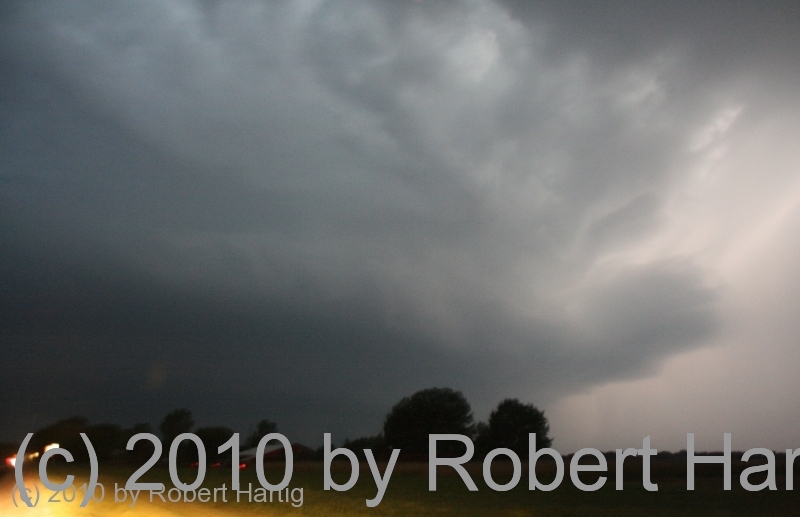
By and by, the flickerings began to illuminate a cloud feature I’d been looking for: a hint of a beavertail off to my northwest. It’s location confirmed what the radar was telling me: the storm’s mesocyclone was moving straight at me. I was in a perfect location–and all this time, standing out in the field near my car, I had yet to feel so much as a drop of rain.

The mosquitoes were thick and nasty, and I was getting eaten alive, but viewing at my position was excellent. Farther east, I’d be getting into thick woods, and since the storm wasn’t exactly rocketing along, I stayed put until the meso got too close for me to be able to distinguish its features. Then I moseyed east a few miles.

I parked again for a few minutes at 63rd Street and noted that what had begun as a stubby beavertail had rapidly grown into an enormous inflow stinger. To my northwest, I could see what appeared to be a large, low wall cloud–hard to determine exactly what it was or what it was doing at night, but it looked convincing enough that I called it in to KGRR.
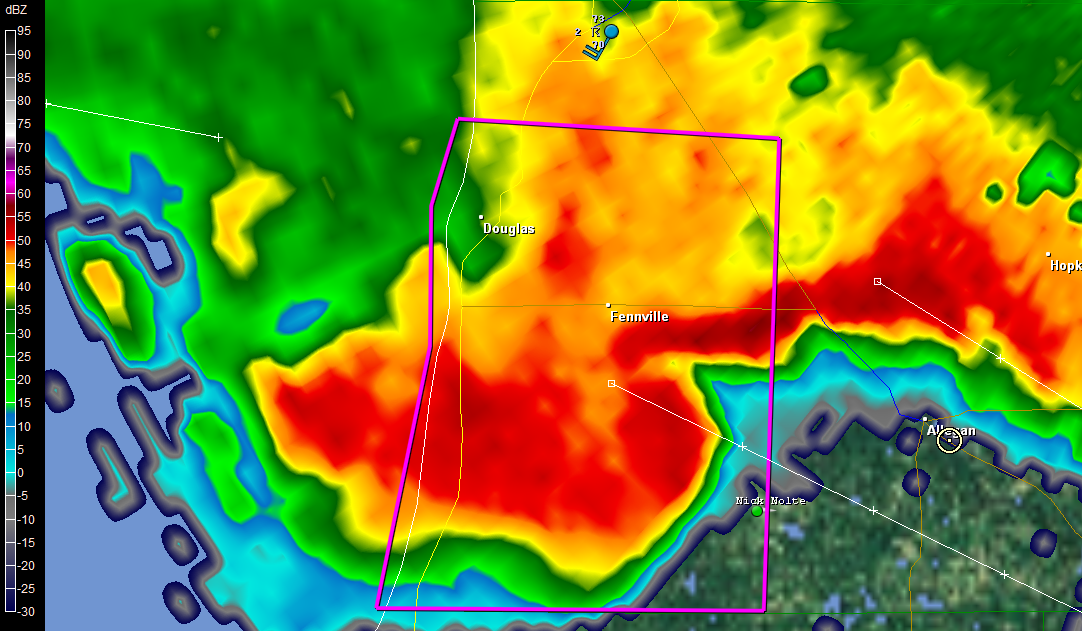
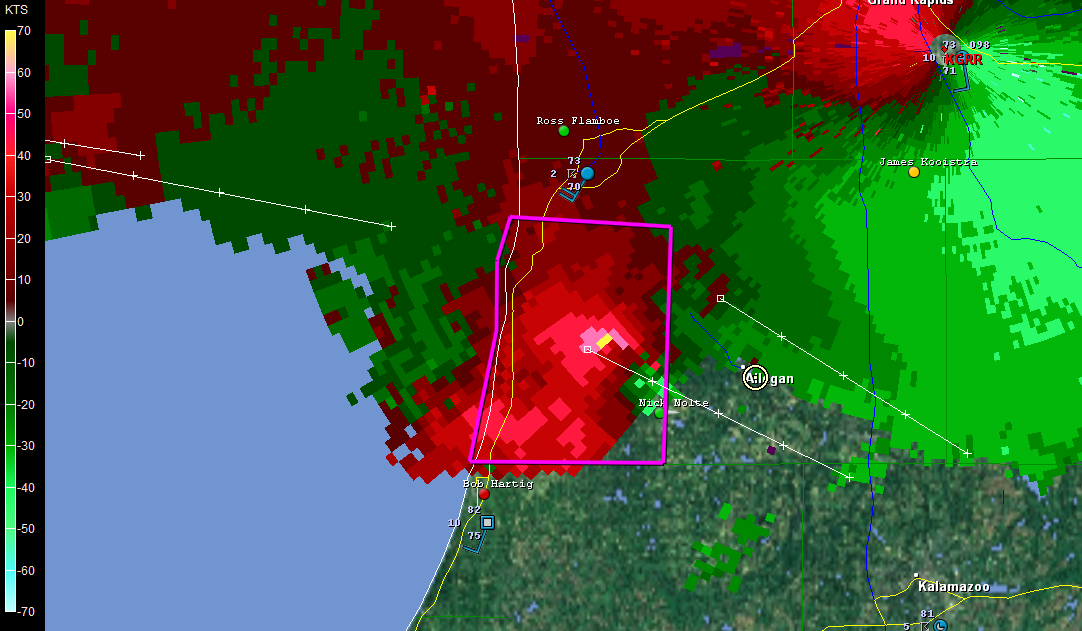
I tracked just ahead of this storm all the way to Plainwell. M-89 proved to be a perfect route, angling southeast along roughly the same path that the storm was taking. On the outskirts of Allegan, I stopped long enough to grab a few radar images. On this page, you can see a nice vault on the base reflectivity, and pronounced rotation on the storm relative velocity. (The circle just southeast of the town center marks my location. Ignore the marker with my name farther to the southwest on SRV; it’s old, an archive from when I dropped off of Spotter Network.)

A little farther down the road, I pulled aside again where a large, open stretch afforded good viewing. The mesocyclone was clearly visible, with a formidable-looking flange on the north side, nice striations, and an impressive inflow band circling in overhead. I hung out at that location until the lightning drew too close for comfort, then hopped back into my car and continued east.

At Plainwell, I dropped south on US 131 past the Kalamazoo exit, caught M-43 west for a mile or so, then parked in a parking lot and let the storm’s southernmost edge blow past me. The storm was still tornado-warned, but the radar indicated that it was weakening–cloud tops lower, VIL not as robust. North of me, just on the other side of M-43, a sheet of rain cascaded out of the wind-blown darkness into the luminous orange domain of the street lamps. Within half a minute, it was upon me, and for a short while, I sat and enjoyed the blast of downdraft and deluge. The rain that I had managed to elude all night had finally caught up with me.

Finally, as the storm bowed out on its journey eastward, I drove back to US 131 and headed for home. I stopped again for a while at the Martin exit, long enough to see what would become of another supercell that was moving inland from the Lake. It, too, quickly bowed out, but, in keeping with the tone of the day, it lit the after-midnight sky with a bombardment of lightning.

It was good to finally pull into my parking lot, climb the stairs to my apartment, and step inside. It had been one heck of a day, and I was ready to call it a good one and hit the sack.

As nasty a storm as it was, why didn’t the Allegan County supercell drop tornadoes? The storm earlier in the afternoon had produced at least one tornado near the Battle Creek airport; why not this one too? After all, it and
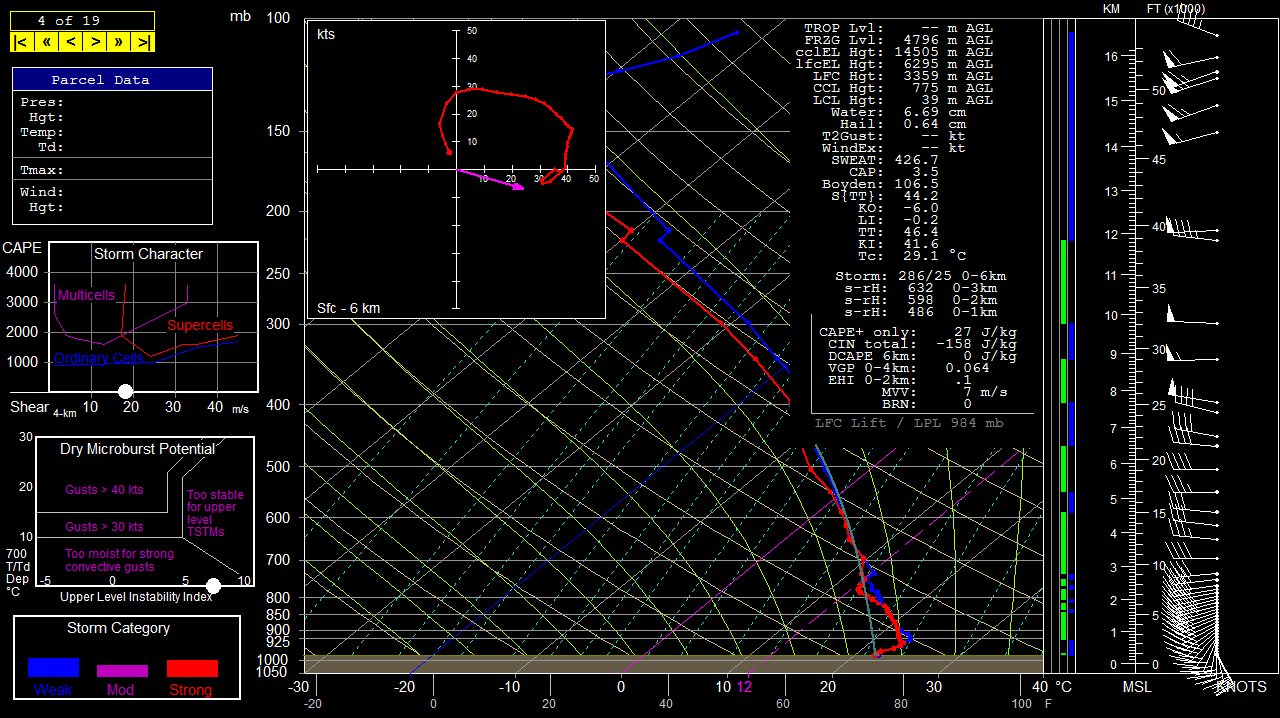
its compatriots had peppered Wisconsin with tornadoes prior to crossing the Lake and heading for West Michigan. All I can surmise is, CAPE was an issue. Winds certainly appeared favorable for tornadoes, and F5 mesoanalysis indicated 1 km helicities ranging from 150-250 across the area as late as 1:00 a.m. The RUC model sounding for KGRR maybe overdoes helicity, but it’s interesting to see what it says about instability. All I can think is that daytime CAPE–whatever it may have been; I never took the time to find out–petered out after sundown, and the shear alone wasn’t enough to spin up tornadoes. That’s my guess as a non-meteorologist, and I’m ready to get other insights and opinions from more knowledgeable heads than mine.

Whatever the case, last night’s was one heckuva storm, and the kind of chase I don’t get to enjoy too often in Michigan. It was nice to finally get such a great opportunity.
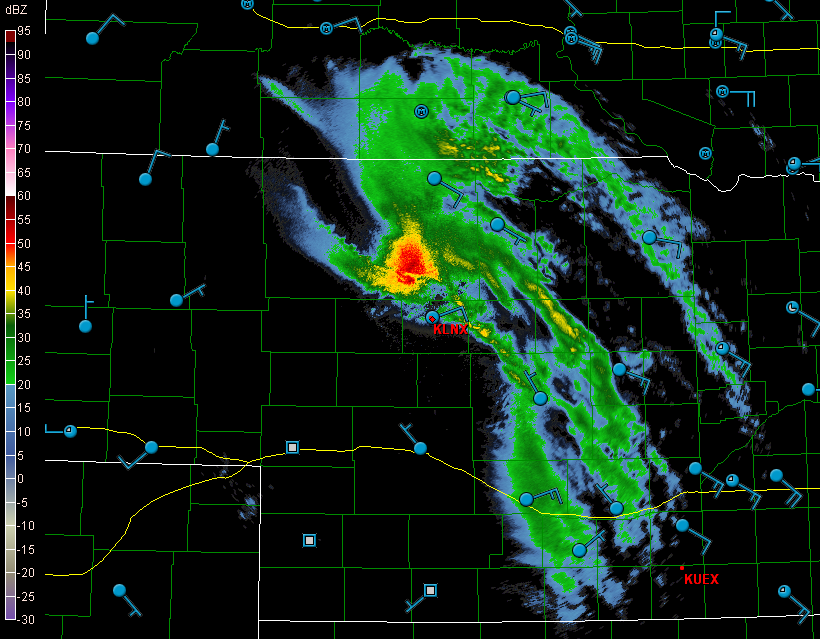
While I Was Out Chasing Sunday’s Storms…

Win a few, lose a few, the saying goes. Maybe so, but when it comes to chasing storms in Michigan, sometimes the losses seem just flat-out absurd.

Take this last Sunday, for instance. Kurt Hulst and I traveled over a hundred miles in order to intercept a storm down by Plainwell and track with it through the jungles of Allegan and Barry Counties, searching for a decent location for viewing. Meanwhile, a cell blew up just to our north and put down a tornado just four miles southwest of my apartment in Caledonia. If that isn’t a swift kick in the pratt with the steel-toed boot of irony, I don’t know what is.

True, it was a weak tornado; and true, it was probably rain-wrapped and hard to see; and true, it lasted only a minute or so, and catching it would have been pure serendipity. But still…just four freeking miles away… In the words of the inimitable Charlie Brown, “AAAUUUGGHHHHH!!!”

Sunday wasn’t the first time this kind of thing has happened to me, either. A few years ago, I was heading back north through Indiana, homeward bound from a futile chase, when my buddy Bill Oosterbaan called to inform me that a tornado had just passed through Caledonia. If I had been home, I could have stepped outside my sliding door and watched it blow through a couple blocks to my east. But no, that would have been too simple. I had to go gallivanting all over the countryside in search of what, in my absence, was delivered gift-wrapped to my backyard.

Chase storms for a while and you’ll find yourself collecting flukes, ironies, hindsights, and head-banging experiences like some people collect porcelain animals. It just goes with the territory, particularly if you live in the Great Lakes, where picking a chase target is nine times out of ten just an educated crapshoot.

Well, what the heck–at least Kurt and I saw a fairly impressive wall cloud east of Plainwell, out near West Gilkey Lake. We were too far away to confirm rotation, but the cloud was morphing rapidly, displaying obvious rapid motion. For a minute I thought it might even be putting down a tornado, but at our distance, we couldn’t make out enough details to know one way or the other. I called in a report to KGRR, then watched the storm fizzle and die shortly after.

Here one second, gone the next–that’s how it goes here in Michigan, supercell heaven of the Midwest.

A Fun Gig at the Boatwerks

One of the things I enjoy most is playing jazz with friends whose musicianship I respect and whose company I enjoy. Interpersonal dynamics make such a difference. The format does too. My preferred habitat is the small combo, which offers a maximum amount of spontaneity and creative interplay, and allows me to stretch out as a sax soloist.

All of what I’ve just described was the setting today out on the patio at the Boatwerks in Holland, Michigan. The musicians were Paul Sherwood on drums, Wright McCargar on keyboards, and Dave DeVos on bass–guys I’ve played with quite a bit over the past few years and whose abilities I trust.

This gig was my introduction to the Boatwerks, and it was a delightful one. The Boatwerks is situated on the south side of the channel that connects Lake Macatawa to Lake Michigan, across from Holland State Park. It is a lovely setting and today’s audience was an appreciative one. The only improvement I could have asked for would have been to dial down the temperature and dewpoints by about 10 degrees. Unfortunately the weather doesn’t take requests, and me being a sweaty kinda guy, my face quickly began perspiring like a sprinkler system. Kiss any images of being a cool jazz musicianly type good-bye!

That was just a minor detraction, though. This was the kind of gig I love to do: three hours in a beautiful location outdoors on the waterfront on a pleasant summer afternoon. I had really been looking forward  to it, and I was pleased with how my chops rose to the occasion. They’ve been feeling great lately. The practice I’ve been doing in the keys of F# and Eb seems to be paying dividends all across the board.

Between Paul and me, we did a few vocal numbers as well as instrumentals. I love to sing, and while it has taken me time to muster up the confidence to do so, it turns out that I’ve got a pretty decent voice. It was nice to be able to sing “Days of Wine and Roses” and “My Funny Valentine” and then follow up the lyrics with a sax solo.

The Boatwerks is a great place and I hope we’ll get an opportunity to play there again soon.

Freak Tornado in Wisconsin

A weak cold front has slowly been working its way through Michigan today, with storms firing ahead of it in a very soupy warm sector. Ugh! With temperatures the past several days ranging from the upper 80s to 90 degrees and dewpoints as high as 73 here in Caledonia, it’s about time things cooled off and dried out a bit.

Unfortunately–or fortunately, depending on your point of view–all that lovely moisture has been wasted on insipid lapse rates and humdrum wind fields. What can you do with 500 mb winds of 25 knots or less? Answer: not much.

So what’s with that red dot in Wisconsin in yesterday’s storm reports? Not only did a tornado occur near the town of Cambria, but from the looks of the YouTube videos I saw, it was fairly impressive. Certainly those were more than momentary spin-ups which that Little Storm That Shouldn’t Have put down.

How on earth did it do that? There was nothing happening synoptically that suggested even a remote possibility of tornadoes. So when that puny cell across the lake from me went tornado-warned on GR3 yesterday, I just shrugged it off. Obviously a fluke, some weak Doppler-detected rotation, signifying nothing.

Just goes to show how Mother Nature can mess with your head. According to the NWS office in Milwaukee, that little stinker put down a tornado that lasted 14 minutes, traveled four miles, and did EF1 damage. The level 2 velocity couplet on it was unmistakable. Here’s the full writeup by KMKX, complete with radar images and a photo of the storm right after the tornado had lifted.

Storm chaser Scott Weberpal speculated on Stormtrack that there may have been some kind of interaction between an outflow boundary left by earlier convection. I can’t imagine any better explanation for why what should have been a pussycat of a pulse-type summer storm turned into a barn wrecker. Had the storm gone tornadic farther east, the lake breeze might have been suspect, but the cell was well inland from Lake Michigan.

Today I noticed a couple storms over in the Flint area displaying weak rotation on the radar, and one of them took on that telltale supercellular shape. Given the anemic upper winds, I’d normally have instantly written them off, but after yesterday…well, I watched and wondered, not expecting anything and therefore not disappointed when nothing happened, but still curious. What might happen if any cells firing in that vicinity moved into the Huron lake breeze zone, where the veering surface winds were liable to back?

As it turns out, the storms behaved the way you’d have expected them to given their environment. The last of the line is presently moving through southeast Michigan. But dewpoints are still in the low 70s, and a few popcorn cells are sprinkling the radar. Through my sliding glass door, I can see a big, mushy tower making its debut. Think I’ll grab my saxophone and camera and head out to get some practice in. With a little luck, maybe I’ll get a few lightning photos as a bonus.

An Independence Day Double-Header: Summer Weather Is Here

It’s July 4, Independence Day. Happy Birthday, America! For all the problems that face you, you’re still the best in so many, many ways. One of those ways, which may seem trite to anyone but a storm chaser, is your spring weather, which draws chasers like a powerful lodestone not only from the all over the country, but also from the four corners of the world.

no images were found

This has been an incredible spring stormwise, but its zenith appears to have finally passed for everywhere but the northern plains. And right now, even those don’t look particularly promising. That’s okay. I think that even the most hardcore chasers have gotten their fill this year and are pleased to set aside their laptops and break out their barbecue grills.

Now is the time for Great Lakes chasers to set their sights on the kind of weather our region specializes in, which is to say, pop-up thunderstorms and

no images were found

squall lines. The former are pretty and entertaining. The latter can be particularly dramatic when viewed from the eastern shore of Lake Michigan, sweeping in across the water like immense, dark frowns on the edge of a cold front. If you enjoy lightning photography, the lakeshore is a splendid place to get dramatic and unobstructed shots. Not that I can speak with great authority, since so far my own lightning pictures haven’t been all that spectacular. But that’s the fault of the photographer, not the storms.

The images on this page are from previous years. So far this year I’ve been occupied mainly with supercells and tornadoes, but I’m ready to make the shift to more garden variety storms, which may not pack the same adrenaline punch but lack for nothing in beauty and drama.

July 4th is a date that cold fronts seem to write into their planners. I’ve seen a good number of fireworks displays in West Michigan get trounced by a glowering arcus cloud moving in over the festivities. But tonight looks promising for Independence Day events. Storms are on the way, but they should hold off till well after the party’s over.  That means we’ll get two shows–the traditional pyrotechnics with all the boom, pop, and glittering, multicolored flowers filling the sky; and later, an electrical extravaganza, courtesy of a weak cold front. A Fourth of July double-header: what could be finer than that?

Street Musician on the Paul Henry Thornapple Trail

Yesterday I made my first dollar ever as a street musician. It wasn’t a conscious effort. I’ve never busked in my life, and if I were to take up busking as a serious practice, I wouldn’t choose the place I was at. For that matter, the term “street musician” doesn’t at all capture the essence of either my location or my activity.

I was out on the Paul Henry Thornapple Trail in Middleville, one of my favorite outdoor spots to practice my saxophone. The Paul Henry is an old railroad bed that has been converted to a paved hiking trail. It winds through an area of considerable natural beauty, blessed with an impressive diversity of habitats and a commensurately large variety of wild birds.  Along the south side of the trail, the lovely Thornapple River flows serenely by. To the north, an ancient millpond serves as a haven for sandhill cranes, great blue herons, mute swans, and other waterfowl. Red-headed woodpeckers flit among the trees, and farther down, where the open marsh grades into a hardwood swamp, cardinal flowers punctuate the shade-dappled trailside with exclamations of crimson.

I love to take my sax out to the trail, out to the bridge over the short channel connecting the Thornapple River to the millpond, and practice my horn. I was doing so yesterday evening, hammering out some material in the keys of Eb and F#, when a red-headed woodpecker flew up and perched on the trunk of a small tree not fifteen feet away. It was a striking bird, with black wings and upper body, a white breast, and a shocking red head–a sight rarely seen in these parts but one you can’t miss when it’s in front of you. However, not being a seasoned bird watcher, I wasn’t quite certain it was a woodpecker.

So when an elderly couple came strolling along the trail, I addressed them. “Did you see the bird that flew into that tree?” I asked. “It’s got a bright red head. I think it’s a red-headed woodpecker.  Do you know your birds? Maybe you can tell me.”

The man said no, he didn’t know what kind of bird it was, but he wanted to give me something. He unfolded a dollar bill that he had in his hand and handed it to me. “We’ve been listening to you down the trail,” he said with a smile.

I laughed and accepted the dollar bill from him. “Thanks!” I replied. “I think I’ll frame it. That’s the first dollar I’ve ever made as a busker–and I’m not even busking!”

The three of us talked for a while about the woodpeckers, and music, and the beauty of the trail. Then the couple went their way and I pocketed the dollar and returned to my practicing.

One of the rewards of practicing outdoors is the variety. You never know what you’ll see or whom you’ll meet.

And with that thought, it’s time to end this post and go practice my horn. See you in July.

Getting Set for a Backyard Chase

Last night’s bow echo certainly didn’t disappoint. I first spotted it in Wisconsin when it was a supercell putting down tornadoes near Milwaukee and thought, “That sucker is headed straight at us.” I watched as it hit Lake Michigan, maintaining rotation for a while but eventually morphing into a big bow echo. But what a bow echo! That northern book-end vortex really cranked as it moved inland and into the Kent County area. For a few scans of the radar, it looked like a small hurricane. Little wonder that it generated tornado warnings with a few reports of sightings by spotters and law enforcement.

But nasty a storm as it was, last night’s weather was probably just a prelude to what today, Wednesday, has in store. Veering surface winds taken into account, this could nevertheless be a tornado day for Michigan. The NAM shows a 70 knot 500 mb jet max blowing through the area, CAPE over 2,500, 70 degree dewpoints, and STPs to make a chaser happy.

Looks like it’ll be Kurt Hulst and me on this one. Bill is heading to Lansing to hang out with Ben Holcomb, and I think Mike Kovalchick is going to join them. That’s a good place to start. I’m not sure that I want to play quite so far east early in the game tomorrow, but I’m sure we’ll wind up well east of Lansing before the day is done. As of the 00Z run, it looks like the H5 will be nosing into West Michigan around 18Z, kissing an intensifying LLJ. Kurt and I had talked about setting up shop around I-96 and M-66. We’ll see what the 6Z run has to show us and play it from there.

At last, a Michigan chase with some real potential! And while I had guessed that storm motions would be in the neighborhood of 40 knots, the NAM decelerates them to a very manageable 25 knots. This could prove to be an interesting day, though I hope not a terribly impactful one. Southern Michigan has a lot of population centers, and I inevitably have mixed feelings whenever I see a big weather event shaping up for this area.

Michigan in the Crosshairs Today?

Most of the time when I chase storms in Michigan, it’s as a wannabe sitting in my armchair gazing wistfully at my radar as I follow the action out west. Every once in a while, though, I get something right here in my own state that’s worth hopping into my car and driving after with my laptop and camera at hand and hope in my heart.

Today is shaping up to be such a day. It’s about time. June is upon us, and that means the peak tornado season has finally arrived for Michigan. Frankly, that term, “peak tornado season,” strikes me as glaring overkill when it comes to Michigan. But we usually have a few incidents every year, and today could be one of them. Perusing the last couple of NAM runs, including the 00Z, and running a few model RAOB soundings, I’m casting my eyes on the Flint-Pontiac area, where surface winds appear to remain, if not backed, at least southerly at 00Z tomorrow evening.

With dewpoints at or exceeding 65 degrees below a warm front draped across central Michigan, straight westerly mid- and upper-level winds with 45-50 knots at 500 mbs, and forecast SBCAPE upwards of 2,000 J/kg, there certainly look to be some decent ingredients in the vat. Insolation will be either the eye of newt that either makes the magic happen tomorrow or the missing ingredient that quashes instability thanks to blowoff from storms farther west.

no images were found

Attached are a couple soundings, the first for 23Z at Flint and the other for 00Z at Pontiac. Not bad-looking hodographs, particularly for Michigan. As you can see, the surface winds are southerly. Farther west, they veer to the southwest, though they by no means create a unidirectional scenario. Interestingly, while the STP and Stensrud Tornado Risk indices spotlight the area around Flint, F5 Data’s APRWX tornado index bullseyes Grand Rapids down toward Kalamazoo. Maybe that’s because a 500 mb jet max noses into this area by 00Z.

no images were found

Traditionalist that I am, I prefer backed, or at least southerly, surface winds if I can get them.  So as of the 00Z run, I’m eyeballing parts east, probably up around Flint near the warm front. The morning run may tell a different story. I just hope it’ll be a positive one.

Here’s to sunny skies, decent CAPE, and a good, productive backyard chase!

ADDENDUM: I wrote the above last night. The morning picture changes things a bit. Specifically, the satellite shows a nasty batch of CAPE-killing clouds blowing into the area from an MCS out west. That’s bad news. However, the clouds show some clearing expanding in their midst. That’s good news. Moreover, Mike Kovalchick sent me an HRRR model radar image showing a supercell popping up in mid-Michigan at 22Z. I’m sure that’s dependent on decent CAPE, which presumes enough clearing for good afternoon heating.

This latest info is good to have, but it doesn’t change my game plan, which is to wait and see what happens by the afternoon.

Back Yard Chase with Possible Wall Cloud

I hadn’t planned to chase storms today, but Kurt Hulst made me an offer too good to turn down, and off we went. For all the hoopla, with a tornado watch covering most of Indiana and Ohio and a 10 percent tornado risk outlined in exactly the same area south of the Michigan border as last week, the storms nevertheless turned out to be pretty garden variety.

In fact, nothing materialized south of us where we expected it to. Instead, Kurt and I got pleasantly surprised when a couple of cells fired up to our west near Plainwell and almost immediately took on supercellular characteristics. A southwest-northeast-oriented outflow boundary was working its way east, and it provided convergence that fired up a slowly growing line of storms in the weakly unstable warm sector.

We locked onto a promising-looking cell in central Michigan whose top, at between 40-45,000 feet, was the highest of the day. Base level SRV showed on-again/off-again weak circulation for this storm, and reflectivity had it

hooking nicely at different times. It was no monster supercell, but it had its moments. I took photos of a nice lowering while parked just south of the intersection of R Drive and 23 Mile Road 12 miles south of Charlotte. I’d call the feature a wall cloud. While I couldn’t verify rotation, the vertical motion and the position of the lowering just south of the rain shaft under the updraft base were pretty suggestive.

What you see was as good as it got. I reported the lowering to KGRR after taking the photos, but the storm began to crap out on us even as I was talking with the meteorologist. We dropped it a few minutes later and headed south to catch a new, developing cell. We’d probably have done better to stick with what we had, as it appeared to strengthen again briefly on radar while the new one went linear right away.

Chases in Michigan more often than not prove to be just entertaining diversions–fun, but it ain’t Kansas, Toto. This one fit that description. It was good to get out with Kurt, and also good to get home without having spent too many miles chasing nothing of any consequence.

Another Lower Great Lakes Storm System

The eastern Great Lakes looks to be once again under the gun for severe weather, with a setup that looks reminiscent of last week’s, albeit with some variations. The low is weaker but there’s juicier moisture, helicities may integrate a little better with instability, and it seems to me that the 500 mb jet is better positioned. Once again, though, surface winds veer rapidly south of the warm front, so while the mechanism for another batch of supercells is in place, the tornado potential is less certain. The SPC convective outlook shows a 5% tornado risk. That seems about right, though maybe part of the area will get upgraded this afternoon.

After looking at the morning NAM and RUC, I once again like the area south of Toledo. Bowling Green was my initial target last week, and I’d pick it again this week if I wanted to drive that far. If I chase storms at all today, I may just wind up dropping south down 131 toward the warm front, depending.

By the way, I haven’t posted a thing about Monday’s tornado fest in Oklahoma and I probably should. I wasn’t there to experience it, but my buddies Kurt Hulst and Bill Oosterbaan teamed up for it, and Ben Holcomb made it down there as well, and everyone scored. Bill tells me that he and Kurt saw seven confirmed tornadoes.

Me, I watched the outbreak unfold on the radar and ate my heart out. It really was a heck of a thing to observe. The SRVs were jaw-dropping, and I saw one low-level Delta velocity of 177 knots. Those storms were the real deal, and a huge contingent of chasers was on them. Among the highlights was the Wakita, OK, multi-vortex that a number of chasers captured on video. The clips I’ve seen show what looks like a basketful of snakes dancing.

Unfortunately, five people died in the storms. If there’s anything positive that can be said about the loss of life, it’s that the paths of the storms through mostly rural areas no doubt kept casualties lower than they could have been. One supercell dropped tornadoes in Oklahoma City, and all it takes is one. But that’s better than multiple population centers getting hit by storms the intensity of Monday’s storms.