Interview with Paul and Elizabeth Huffman: Insights into a Historic Tornado Photograph

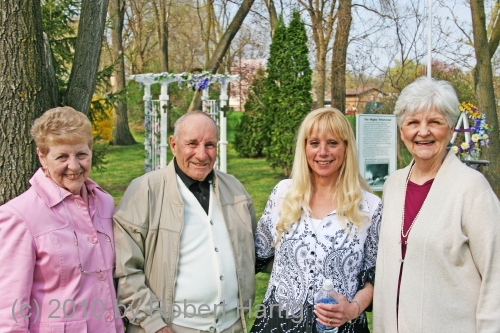
Meet Paul “Pic” Huffman and his wife, Elizabeth. A very photogenic couple, wouldn’t you say? And, I might add, a lovely one–two very nice, warm people who welcomed me into their house near Elkhart, Indiana, yesterday for a conversation I’ve been looking forward to a long, long time.

Forty-five years ago, on the evening of April 11, 1965, Paul and Elizabeth were homeward bound on US 33 when Elizabeth spotted what looked like a column of smoke off to the west. “Look at that smoke,” she told Paul. “Something’s burning.”

“That’s not smoke,” Paul replied.

Pulling the car off onto the shoulder, he grabbed his camera out of the back seat. Then, scrambling out of the vehicle and hooking his leg around the front bumper to steady himself in the wind, Paul Huffman began snapping photos as a tornado moved across the field, broadening and intensifying on its rapid journey toward the Midway Trailer Park less than half a mile up the road.

One of Paul’s photos, taken as debris from mobile homes exploded skyward, became not only the instant icon of the second worst tornado outbreak in Midwestern history, but also what is undoubtedly the most famous tornado photograph of all time. With the emotional impact peculiar to black-and-white photography, Paul’s photo depicts twin funnels straddling US 33 like a pair of immense, black legs. It is a chilling image, instantly recognizable to anyone interested in tornado research or severe weather history.

Researching for a book I’m writing on the 1965 Palm Sunday Tornadoes, I’ve come across several variations of Paul’s story by different writers. The discrepancies have been enough to leave me feeling frustrated. The Huffmans’ account strikes me as integral to a book on the outbreak, and as a matter of both responsible writing and simple respect, I’ve wanted to learn the facts and offer as accurate a writeup as possible. I was delighted last year, then, to learn that Paul would be one of the featured speakers at a Palm Sunday Outbreak commemorative event at the Bristol Museum.

Of course I attended the commemoration, where I connected with my friends Pat Bowman and Debbie Watters (my two “tornado ladies”) and also met Paul and Elizabeth for the first time. It was then that I requested an interview. Now, a year-and-a-half later, I finally got the opportunity.

When I arrived at their house, the Huffmans were standing outside surveying damage to their property from the previous day’s derecho. A small tree was down, a flagpole had gotten blown over, and a lot of tree litter had filled the yard. It seemed ironic that I was meeting Paul and Elizabeth on the wings of another bad storm.

They invited me inside, and we had a great chat that covered a lot more ground than just the tornadoes. In their early 80s, the Huffmans are an engaging twosome with plenty of stories to share. Paul, who served as a reporter for the Elkhart Truth, regaled me with several accounts from back in the day, including a flyover directly over a smokestack of the newly built Cook nuclear power plant, and a humorous mishap on the roof of a quonset hut. But of course, the main focus was his experience with the Midway tornado.

I won’t go into details here because it’s been a long day and I’m tired, and besides, I haven’t had a chance to review the interview tape. But here are a few noteworthy highlights:

* Paul never saw the twin funnels when they occurred. He was too busy snapping pictures, and he saw only the rightmost funnel in his viewfinder. Not until later, when he developed his film in his darkroom at home, did he realize what an unusual image he had captured.

* Among the larger pieces of debris raining around the Huffmans’ vehicle was a car which got flung overhead and landed on the other side of the railroad tracks that parallel US 33.

* The Huffmans never heard any of the tornado forecasts that were broadcast that day. But Paul, working outdoors earlier in that balmy afternoon sunshine, sensed that bad weather was on the way and mentioned it to Elizabeth.

* Ted Fujita interviewed the Huffmans at their house. Paul said that during his visit, Fujita seemed, oddly enough, to be more interested in Saint Elmo’s fire than in the tornado.

Paul’s overall work as a photojournalist won him a number of awards, but I’m sure that he and Elizabeth would agree that it was his one remarkable, serendipitous photograph of “The Twins” that gained him fame, if not necessarily fortune. It is strange to think how an ordinary, down-to-earth man can find himself in the right place at the right time, doing what he was designed to do–in Paul’s case, taking photographs–and wind up having an impact that shapes lives and vocations. It’s impossible to say how many people have been affected by Paul’s powerful and horrifying photo of the Midway tornado, but I know that it has helped to inspire a few notable careers in meteorology and media, not to mention many a storm chaser. It was a treat to finally get to sit down and talk with the man who took that picture, and to enjoy him and his wife not merely for their fascinating account, but also for the fine, intelligent, humorous, hospitable people that they are.

Counterpoint: Why I STILL Love Playing Rhythm Changes

In his recent guest article on Stormhorn.com, my esteemed colleague Kurt Ellenberger explained why he dislikes–nay, loathes, abhors–soloing over rhythm changes.

By George, I enjoy calling Kurt that: “my esteemed colleague.” It sounds so dignified, so prawpuh, so…so pretentious. Hmmm…I relent, Kurt. That description is as cloying as some of the sacred jazz cows that I know you’d like to kebab. So I’ll retract the “esteemed colleague” bit and just call you my friend; a funny, thoughtful, and insightful guy; and, need I say, an absolute monster musician.

But I still disagree with you about rhythm changes.

To an extent, that is. I’ll begin my rebuttal to your post by agreeing with you. Given your musical experience and the high level at which you play, you get to hate rhythm changes to your heart’s content, along with any other musical formulae that you choose. You’ve attained, man. Once a person has mastered the rudiments of jazz to a world-class degree, there’s no need to keep rehashing them. The point of laying a foundation is to build something new upon it, not enshrine it.

This being said, foundations are important, and rhythm changes are an exercise in foundational material. Moreover, whether they’re banal is a matter of  perspective.

In his post, Kurt provides an analysis of rhythm changes that emphasizes their mostly static harmonic nature, with the exception of a temporary digression to the circle of fifths at the bridge section, which Kurt labels as trite. Overall, he is unimpressed by RCs.

But “trite” is simply a viewpoint, and viewpoints are personal. Some perspectives change as an individual accumulates experiences, while others deepen as time helps to clarify and reinforce them. This, I think, is the heart of the matter. As Kurt puts it, following his analysis, “In general, I prefer music that has a higher degree of harmonic activity and direction, or, absent that (as in music of a more minimalist nature, much of which I enjoy tremendously), there must be some other complexity in play to retain my interest. These preferences have become more pronounced over the years. As a result, I’ve lost interest in a lot of tunes that are similar in construction.”

Note the words “prefer” and “preferences.” They are personal terms. Everyone is entitled to his or her preferences, but one’s reasons for them are not necessarily a definitive yardstick for determining the value of a thing, particularly when other criteria can also be applied.

If I ever attain to Kurt’s level of harmonic and overall musical sophistication, then perhaps I’ll feel as he does about rhythm changes and the 32-bar song form overall. Probably not, though. Rhythm changes just never bothered me at the onset the way they did Kurt. But then–and this should come as no surprise–I see them in a different light.

For one thing, I’m a saxophonist, and as such, my concerns as they apply to my instrument are purely melodic. By this I don’t mean that I’m uninterested in harmony–I’m keenly interested in it, of course–but rather, that I’ve only got one note at a time at my disposal, not entire clusters. This alone creates a different outlook than Kurt has as a pianist.

For another thing, I’ve taken a different and slower developmental path than Kurt’s. For still another, I’ve worked on rhythm changes by choice, not because of an educational or cultural mandate. Finally, I’m me, with my own set of preferences and dislikes. And on both artistic and practical levels, I find playing rhythm changes to be enjoyable, valuable, and, yes, challenging.

On the practical level, rhythm changes are a great way to take rudimentary elements of improvisation such as turnarounds, cycles, and ii-V7s out of isolation and set them in an applied context. I’ve already addressed this matter in my original post on rhythm change, so I won’t rehash it here. The points I made then remain valid. From a developmental standpoint, RCs are–like that other even more foundational form, the blues–good for you. You don’t have to build your world around them, but learning how to play them well gives you some substantial building blocks which you can adapt in other ways that may interest you more. As a musical exercise, I view rhythm changes in somewhat the same category as scale work and etudes.

As a young improviser, I first began to make the leap from technique to musicality by memorizing a Charlie Parker solo based on rhythm changes. Today, I’m still finding RCs invaluable for helping me to build my chops in different keys. I’m convinced of their value. A raftload of Charlie Parker contrafacts can’t be wrong.

However, those same Charlie Parker tunes are now very old, and jazz has traveled in a lot of directions from its 1940s bebop watershed. Bird himself, in the final years of his life, felt that he had taken bebop as far as he could and was seeking a new direction. Which brings me to the artistic aspect of rhythm changes.

Rhythm changes, banal? I suppose they can be, but I don’t think they have to be. Listen to Michael Brecker ripping through “Oleo” and tell me that’s banal. The difference lies in Michael’s approach. He’s not merely regurgitating old licks; he has developed his own voice and is applying it masterfully to the changes. Michael certainly doesn’t seem disenchanted.

While I can’t say for sure, I suspect that the late tenor master had absorbed so much music of all different kinds that he didn’t much care whether he was playing a sparklingly contemporary, harmonically complex tune or an old chestnut. Like Kurt, I’m sure that Michael had his preferences, but that didn’t keep him from weaving magic with rhythm changes and, to all appearances, enjoying himself in the process.

Kurt mentions getting locked into a formulaic approach to RCs. I know what he means–I face that same challenge. But since I don’t have an innate bias against rhythm changes, I view the rote licks and patterns as just a framework which, as I master it, can ultimately enable me to move beyond it. Kurt knows, far better than I, that rhythm changes, like any tune, can be altered in creative ways that are only limited by one’s imagination.

And, I might add, by one’s level of interest. If a player isn’t motivated to explore the possibilities, then rhythm changes, like any well-worn standard in the American songbook, will indeed become banal through over-repetition of the same-old-same-old. I fully concur with Kurt that there has to be some level of complexity present, some kind of intellectual and/or technical challenge, to hold my attention.

However, I maintain that the potential for such complexity exists in any tune. I mean, how innately fascinating is a Dorian mode? But we understand that there’s a whole lot more to modal music than a single scale played ad nauseum over a single minor chord. It’s not a matter of what you’re given, but of what you do with it and, I should add, whom you do it with.

I could say more on the matter, but there’s no point in doing so since it really does boil down to a matter of personal preference. Instead, I have a couple observations to make with which I think Kurt will fully concur.

First, while I’m obviously a proponent of rhythm changes, I would emphasize that they’re just a stopover on a much larger musical journey. I think it’s wise for a developing jazz musician to go through them, it’s helpful to camp out on them for a season, and it’s fun to return to them and enjoy the view, but for goodness sake, don’t buy a house there. The neighborhood is already 80 years old and the heyday of its development in the bebop era is long past. Use what’s been done as a basis for finding your way toward newer, more personal musical directions.

Second, jazz traditions may be venerable but they’re not sacred, and this certainly applies to rhythm changes or to any musical form. It’s okay not to like them and it’s okay to say so.

Jazz culture has been a breeding ground for some affectations and norms that I don’t much care for. Some of them may have served a purpose at one time, but, as Kurt has done a great job of pointing out in a post titled “Jazz in Crisis” on his own blog, Also Sprach Frackathustra, they’re now outdated in a larger world that has moved far beyond the jazz era.

So let’s be real. If jazz is about freedom, as we say it is, then saying that one doesn’t care for rhythm changes shouldn’t require some sort of hush-hush, confessional tone for fear that Big Brother is listening. I’ve never been aware of such a cultural pressure, but I don’t doubt that Kurt has experienced it, and that bothers me. Good grief, we’re talking about a set of chord changes, not the Ark of the Covenant.

Many of us jazz practitioners need to distinguish between the true non-negotiables of the music we play versus the affectations and cultural mores that surround it. If we don’t search our own souls, believe me, the rest of the world doesn’t care enough to do the job for us. Many of us could start by dropping our smug, musicianly superiority and becoming just plain, down-to-earth, nice people who treat both our fellow musicians and non-musicians graciously.

With that, I think I’ve worked the rant out of my system. Kurt, I guess I’ll continue to enjoy playing rhythm changes, at least until, like you, I experience them as more limiting than beneficial. Until then, I promise, cross my heart, that if you and I do a gig together, I won’t call for rhythm changes.

However, if I catch you playing solo somewhere, I may request “Anthropology” just to see you wince.

ADDENDUM: Be sure to check out the final installment of this series, in which Kurt offers his own closing thoughts.

Michigan in the Crosshairs Today?

Most of the time when I chase storms in Michigan, it’s as a wannabe sitting in my armchair gazing wistfully at my radar as I follow the action out west. Every once in a while, though, I get something right here in my own state that’s worth hopping into my car and driving after with my laptop and camera at hand and hope in my heart.

Today is shaping up to be such a day. It’s about time. June is upon us, and that means the peak tornado season has finally arrived for Michigan. Frankly, that term, “peak tornado season,” strikes me as glaring overkill when it comes to Michigan. But we usually have a few incidents every year, and today could be one of them. Perusing the last couple of NAM runs, including the 00Z, and running a few model RAOB soundings, I’m casting my eyes on the Flint-Pontiac area, where surface winds appear to remain, if not backed, at least southerly at 00Z tomorrow evening.

With dewpoints at or exceeding 65 degrees below a warm front draped across central Michigan, straight westerly mid- and upper-level winds with 45-50 knots at 500 mbs, and forecast SBCAPE upwards of 2,000 J/kg, there certainly look to be some decent ingredients in the vat. Insolation will be either the eye of newt that either makes the magic happen tomorrow or the missing ingredient that quashes instability thanks to blowoff from storms farther west.

no images were found

Attached are a couple soundings, the first for 23Z at Flint and the other for 00Z at Pontiac. Not bad-looking hodographs, particularly for Michigan. As you can see, the surface winds are southerly. Farther west, they veer to the southwest, though they by no means create a unidirectional scenario. Interestingly, while the STP and Stensrud Tornado Risk indices spotlight the area around Flint, F5 Data’s APRWX tornado index bullseyes Grand Rapids down toward Kalamazoo. Maybe that’s because a 500 mb jet max noses into this area by 00Z.

no images were found

Traditionalist that I am, I prefer backed, or at least southerly, surface winds if I can get them.  So as of the 00Z run, I’m eyeballing parts east, probably up around Flint near the warm front. The morning run may tell a different story. I just hope it’ll be a positive one.

Here’s to sunny skies, decent CAPE, and a good, productive backyard chase!

ADDENDUM: I wrote the above last night. The morning picture changes things a bit. Specifically, the satellite shows a nasty batch of CAPE-killing clouds blowing into the area from an MCS out west. That’s bad news. However, the clouds show some clearing expanding in their midst. That’s good news. Moreover, Mike Kovalchick sent me an HRRR model radar image showing a supercell popping up in mid-Michigan at 22Z. I’m sure that’s dependent on decent CAPE, which presumes enough clearing for good afternoon heating.

This latest info is good to have, but it doesn’t change my game plan, which is to wait and see what happens by the afternoon.

Mastering the Sax: Building a Baseline of Ability

As I sat in my car by the railroad tracks last night out in the countryside, practicing my saxophone and doing my best impression of a Shady Character Waiting To Make A Drug Deal for the benefit of curious passers-by, it struck me how far I’ve come since I began woodshedding in earnest back in college. It’s a long way, but not far enough. There are high-school-age kids who can do what I do. Not many, but they’re out there, along with a host of college music majors who are blazing incendiary trails across today’s jazz firmament.

I can’t afford to think about it. Topnotch jazz programs featuring world class saxophone instructors have multiplied over the years, and out of that educational milieu are arising some brilliant young players. There are bound to be a few who at half my age possess twice my ability.

A few. But probably not all that many. Because while those music majors have been in the practice rooms busily learning their instruments, I’ve been in my car by the tracks doing the same thing. However, my practice schedule has probably been more spotty than theirs, and so have my opportunities to play jazz live with other experienced jazz musicians. Unless you’re in a position where you can immerse yourself in music without interruption, the demands of making a living have a way of imposing themselves on your practice time. They can stop you if you let them, but they probably don’t have to. You just have to accept a slower rate of growth that accommodates the rest of life.

The learning curve for mastering a musical instrument is different for everyone. We all have different circumstances, different degrees of natural ability, different competing interests that round us out as individuals, and so on.

I thought about this last night as I worked out some bop tunes in the key of F# and revisited “Giant Steps.” My storm chasing excursion out west last weekend had cost me several days of practice, and my fingers could tell the difference. But they snapped back into shape quickly.

Playing the saxophone is not like riding a bike. You don’t just hop back on and regain instant command after not having ridden in a while. You’ve got to reclaim old ground.

What does happen, though, is that when you practice diligently, you continue to raise the baseline of your abilities. Persistent, focused practice not only will put you at the top of your game, but it will also build and expand a musical foundation you can fall back on during those times when your practice routine falls by the wayside.

My book on “Giant Steps” patterns is nearing pub time, but to be honest, I haven’t spent much time actually playing “Steps” in recent history. So last night I broke out my workbook and my Aebersold CD of Coltrane tunes, and I got a pleasant surprise. It has been years since the period in my musical development when I saturated myself in “Giant Steps.” But I found myself navigating the changes, finding my way through familiar patterns, exploring ideas–not on the same level as if I’d been consistently practicing Coltrane changes, true, but well enough for me to feel pretty good about what I was doing. In fact, in some ways I played the tune better than I did in the past. Other musical material that I’ve acquired over the years provided a richer repository of ideas and technical finesse. Old and new came together, and while the result wasn’t perfect, it was at least coherent.

To sum up: Stick with your instrument. Never give up. Life has its seasons and its discouragements, but persistence really does pay off. Don’t measure your musical growth by other players, but by the satisfaction you get as you set and accomplish realistic personal goals. Be honest with yourself, be as diligent in practicing as you can be, be hard on yourself only when you have to be, listen to and study great players, and don’t get so obsessed with arriving at your destination that you forget to enjoy the journey. Do this, and over time you’ll build a solid baseline of craftsmanship and musicality that will serve you well during the off-seasons of your musical life.

Sax ‘n Wedge: A Life Goal

This last week I was so preoccupied with chasing storms that I hardly blogged at all. When I did, naturally it was about weather. Jazz, music, and the saxophone have languished in the background, at least blogically speaking.

Not, however, in practice. When I headed out west for some dryline action, my horn went with me. It always does. My chase partners know that when I head for any chase over a day in duration, the sax is as much a part of my travel gear as my suitcase, laptop, and camera. Some folks toss a baseball or football while waiting for storm initiation; I practice my saxophone. Any time is a good time to get in a few licks.

I have several reasons for bringing my horn along on chases, all of them having to do with eventualities. The most likely scenario is, as I’ve just said, that I’ll get a chance to woodshed my instrument. Far less likely–but still, ya never know–is the possibility of winding up in some restaurant where a band is playing, and it’s the kind of band that makes me wish I could sit in for a tune or two. Like I said, unlikely; most Great Plains towns aren’t exactly jazz hotbeds. Still, as I learned back in the Boy Scouts, it pays to be prepared.

My main reason for taking my saxophone with me on storm chases, though, is because of a particular life goal of mine: I want to get a good photo, or maybe some video, or even both, of me jamming on my sax while a monster wedge churns away in the distance. For that matter, I’ll settle for just a nice, photogenic tornado of any shape or size. I just want some kind of visual record that captures the raison d’etre of Stormhorn and the essence of who I am as a storm chaser and jazz saxophonist.

Assuming that a storm is moving slowly enough to make a photo shoot practical, my preparations once towers start muscling up are:

* Rain-X windows

* Remove camera from case and make sure it’s ready for action

* Get tripod out of trunk

* Assemble saxophone

Just a handy checklist. Reasonable enough, wouldn’t you say?

So cross your fingers for me, or better still, pray. This season could be the one where I fulfill an ambition and get some very cool photos to show for it.

I’m a maniac, you say? Of course I am. A maniac is just someone with a different kind of dream.

The Return of the Trains: Sax Reflections from the Railroad Tracks

It’s good to see the trains again.

As a jazz saxophonist who loves to practice his horn in his car parked by a set of railroad tracks out in the countryside, I noticed last year that something was missing. Used to be, I could count on seeing the distant semaphore light turn green and watching as the white pinpoint of a headlamp miles down the tracks brightened, drawing closer until I could hear the rumble and then the roar of the locomotive and the clatter of freight cars rushing past. I enjoyed that experience at least once, and normally two or three times, during most practice sessions.

But as the bottom dropped out of the economy and Detroit’s auto industry languished, the giant spigots that sent the trains hurtling along the pipeline between Lansing and Grand Rapids closed to a trickle. Those hundred-car, three-locomotive strings I was so used to became, just like that, a thing of yesterday.

Until lately. It gives me much pleasure to say that the trains are returning.

I still don’t see them with the frequency I used to, but I am noticing that there are more of them, and they are growing longer. Two days ago, parked by the tracks in Alto, I paused in my practice to watch as a train boomed by in front of me…and kept on booming. It was one of those hundred-car affairs, just like in the good old days, which really aren’t old at all but certainly were enjoyable.

Now those days seem to be on the way back. It may be a modest return, but the spigots are reopening. It’s heartwarming to think, as I sit by my beloved tracks working out my saxophone chops, that I’m once again likely to hear the sound of another horn, far off in the distance and growing closer, and to feel the powerful, exhilarating, reassuring rhythm of a train rushing by.

Remembering April 11, 1965: Highlights of the Palm Sunday Tornado Memorial Service

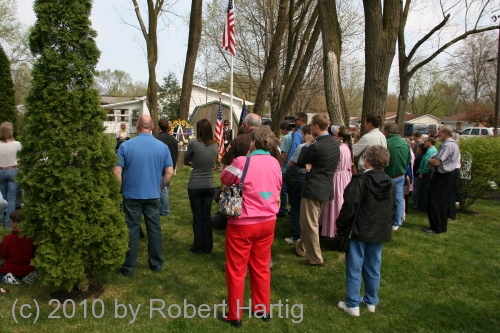
If you’ve been following this blog lately, then you’re well aware that yesterday was the 45th anniversary of the 1965 Palm Sunday Tornado Outbreak. The commemoration held at the Tornado Memorial Park in Dunlap, Indiana, came together beautifully thanks to the hard work of my friend Debbie Watters, who owns the park. To say that it was a memorable event understates some of the truly amazing things that transpired.

Dan McCarthy, the meteorologist in charge at KIND in Indianapolis, was the keynote speaker. Dan did a superb job describing the strides that severe weather forecasting and the warning system have taken since 1965, and explaining how the Palm Sunday Outbreak served as a catalyst for those changes. If there is any comfort to hearts that still ache over the loss of loved ones in the storms, Dan suggested that at least part of it may lie in knowing that a tornado catastrophe of such magnitude is unlikely to ever happen again.

Several other speakers followed Dan. Last of all was Debbie. I think one reason she does so well behind a microphone is that she pours her heart out toward her listeners. At a gathering of tornado survivors and their families, the needs may not be readily apparent; but Debbie, having lost her brother Stevie in the Dunlap F5, knows what lies below the surface. It had to have taken some courage to address the subject of survivor guilt as honestly and

straightforwardly as Debbie did, but it’s only in shining light on such a painful issue that its grip can perhaps be broken on people who, over four decades later, still wonder why they lived while their loved one died

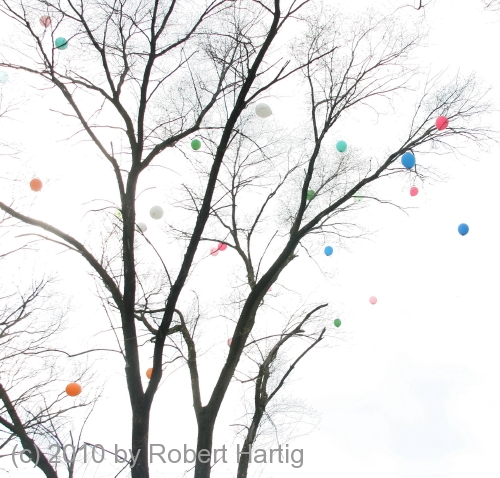
At the end of the service, there was a balloon launch in loving memory of the Elkhart County tornado victims. It was a poignant moment, watching those bright, merry balloons soar skyward into the blue.

But it was the behind-the-scenes happenings, the interpersonal connections, that will live on in my mind. There were some heartwarming moments, and a few that were just plain incredible. Debbie had always wondered who the stranger was who saved her mother’s life after the tornado, and who sheltered the two of them in his car until an ambulance arrived. Yesterday, a woman introduced herself to Debbie as the man’s wife. You can imagine what a powerful meeting that was for both women.

Among the roughly 150 attendees, I was delighted to see Paul and Elizabeth Huffman. Paul is the retired Elkhart Truth photographer who took the famous image of twin funnels straddling US 33 south of Dunlap, destroying the Midway Trailer Court. That photo, one of six in a sequence, is arguably the most famous and dramatic tornado photograph of all time, and one that has inspired more than one young kid to pursue meteorology as a career.

Now in his eighties, Paul is a peppery and humorous personality, and his wife, Elizabeth, is a sweetheart. It was fascinating, in talking with them, to get insights into how things played out that day. Paul wasn’t even aware of the twin-funnel structure when he snapped the photo; in his viewfinder he saw just the rightmost funnel. It was only when the startling image of “The Twins” emerged in development that Paul realized he had captured something extraordinary on film.

I was particularly pleased when one of the speakers, Brian Beaver–an award-winning radio correspondent formerly with IPR–took time to publicly recognize Paul and honor him for his achievement.

My friend Pat Bowman and her brother John were also present. But of course they would be–Pat is integrally knit into these events. She and Deb are my two “tornado ladies,” dear to each other and to me. The way that the three of us connected is a pretty incredible story in its own right, and it all started with Pat. Actually, it started long before, with a newspaper account of a young couple’s tragic loss of their child, and of a small boy’s prayers for them in response. There is a reason that Pat is very special to me. But that story is for another time.

The last photo on this page is one I will always treasure. That’s Elizabeth and Paul Huffman on the left. Debbie is the blonde, and that’s Pat on the right. God gifts us with people, and it was a blessing to me to see these four together. The threads of events that connect them are intricate and remarkable, and I feel privileged to see the connections continue to unfold in their lives and in mine.

Looking Back: A 45-Year Retrospective on the 1965 Palm Sunday Tornadoes

Today marks the 45th anniversary of the Palm Sunday Tornadoes, the second worst tornado outbreak in Midwest history. Between the time that the first funnel dropped in eastern Iowa shortly before 2:00 EST and the time when the last one dematerialized in the night sky over Ohio eleven hours later, tornadoes took 272 lives in six Great Lakes states.

This April 11 also happens to be a Sunday, but while it is a moody day, it holds no threat of violent weather. I’m sure we’ll see our share of that this spring, but not today. At the moment, I’m sipping on my morning cup of coffee; then I’ll shower up and head down to the historical museum in Bristol, and then to the tornado memorial park in Dunlap, Indiana, where my friend, Debbie Watters, has organized her commemorative event. If you’re interested in attending, click here for details and a map.

It is strange how something that happened over four decades ago, and in which I was not directly involved, has remained with me all these years. But the ripples of that long-ago Palm Sunday evening have extended into many lives. Today’s event will draw not only survivors, many of whom are now well advanced in years, but also their children, their nieces and nephews, their grandchildren. The wind’s roar still echoes through a broad patchwork of lives, young and old.

The Palm Sunday Tornadoes were formative not just in family histories and individual lives; they were also a seminal event in severe weather meteorology and operational forecasting. Out of that disaster came a remarkable paper by Dr. Theodore Fujita, published in the “Monthly Weather Review,” which presented the first truly in-depth analysis of a tornado outbreak. For the first time, you can see a system for tracking tornado families and their members. You’ll find Fujita’s evidence for multiple vortices, a now well-established phenomenon which was unknown at the time.

It was out of the Palm Sunday Tornado Outbreak that Skywarn evolved in the interest of enhancing public safety during severe weather events. The Weather Bureau’s communication infrastructure, which suffered some fatal breakdowns during the outbreak, was scrutinized for improvement. Civil defense sirens, hitherto unused to alert Great Lakes residents of approaching tornadoes, were harnessed as part of the public alert system. And the very language of severe weather warnings was changed. “Tornado forecasts” became “tornado watches” to help the public better distinguish between a watch, issued when conditions are favorable for tornadoes to develop, and a warning, when a tornado has actually been detected, whether by radar or actual visual confirmation.

I’ll have more to report when I return from today’s doings. Right now, I need to finish my coffee and hit the shower and then the road.

The Cap Won

I don’t know why so many storm chasers decided to chase in northern Missouri this last Monday. I could have told folks it had “cap bust” written all over it–didn’t fool me for a minute, as you can see by reading my post written the day before.

Ahem…right, so I got snookered too. The GFS was spot on about the cap, and the NAM way underforecast it. As a result, Missouri chasers wound up sitting under relentlessly empty skies waiting for convection to fire. It finally did in northeast Kansas–after dark. Storms ignited along a boundary (the warm front? ) and a couple went supercellular and even tornado-warned for a heartbeat before the cap re-exerted itself and squenched them.

The real action, ironically, took place in central Illinois and Indiana, well east of where most folks–including me–had expected. Supercells cut a swath along the warm front through Terre Haute, Indianopolis, and parts east and southeast into Kentucky, and a number of purple boxes lit up the radar screen. Nevertheless, SPC storm reports list only one confirmed tornado that touched down near Hillsboro, Illinois, northeast of Saint Louis.

Them’s the breaks. I didn’t chase that day, and I’m glad that I didn’t because I’d almost certainly have gotten skunked in Missouri when I could have driven straight south down US 41 to Terre Haute, not even having to mess with Chicago traffic, and waltzed on into the sweet zone.

Ah, well. I chased today–if chasing is what you can call a guaranteed grunge fest–down toward a warm front by the Michigan border. The trip was my compensation prize for not heading out when it really counted these past few days. The SPC had outlooked a five percent tornado risk this afternoon, and supercells were making their way northeast across Illinois toward Indiana. I figured that if they held together, I might catch them, but not surprisingly, they mushed out.

That was okay. I was chasing blind, with no radar and few expectations other than the hope that I’d at least see some lightning. I did, and called it good. The main storm season is still on the way, and there’s no need to fret over spilled milk when the cow is just priming its udder. It won’t be long now.

First Supercell of 2010 in Michigan

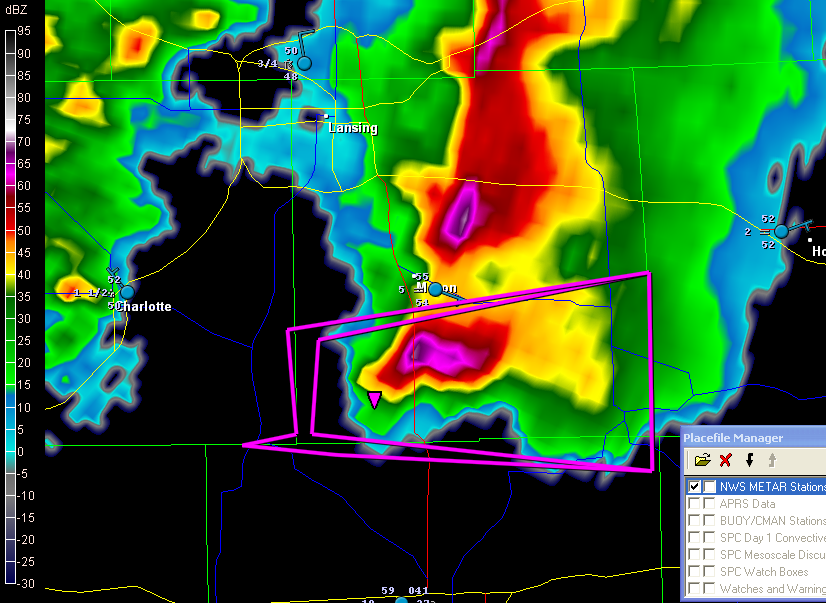
Michigan’s first supercell of the year rolled through southern Michigan this morning, prompting our state’s first tornado warning for 2010. The cell was a sweet little tail-end Charlie that showed bursts of decent rotation and triggered a series of TVSs. It is presently getting set to exit the state near Mount Clemens, leaving behind it a series of hail reports up to an inch but nothing more. It’s what one would expect given the cool temperatures, low dewpoints, and weak-to-borderline low-level helicity.

Here’s a GR3 radar grab of the storm as it was crossing US 127 south of Mason; click on it to enlarge it. A scan or two prior the cell had a nice hook to it, and you can still see the suggestion of a weak echo region with inflow coming in from the east.

Caledonia got nailed by the northern part of the line earlier. At 10:20 a.m., the sky was as dark as a black cat’s belly and the parking lot lights were on. There were one-inch hail reports in the area; my friend Kurt Hulst called to tell me that he had gotten marbles over at his apartment and wondered whether any of that had come my way. It hadn’t, but we got a truly massive downpour, really something to see. It’s going to bring a lot of green to an already nicely greening landscape.

More storms in the forecast for today. Yeah! Bring ’em on!