Severe Weather Potential Monday in the Western Great Lakes

A couple days ago, Lisa informed me that Dr. Greg Forbes was forecasting severe storms Monday in eastern Iowa and northern Illinois. I thought, hmmm…a bit far out to be definitive, but maybe I ought to take a look. I’ve been following the models since, and after this morning’s 6Z runs, it looks like Forbes is onto something.

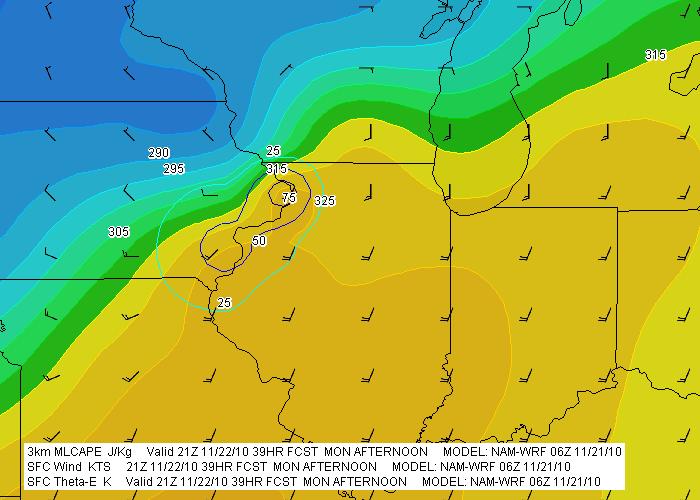
Both the NAM and GFS suggest that an area from far eastern Iowa through northern Illinois and southern Wisconsin may be under the gun in the afternoon or evening. Here are a couple of NAM maps that will give you an idea why (click on maps to enlarge). The bottom line is that a low pressure system is cranking unseasonably warm temperatures and dewpoints in the mid-50s or higher into the Great Lakes region. The potential exists for weak instability to coincide with stiff 850 and 500 mb jet cores.
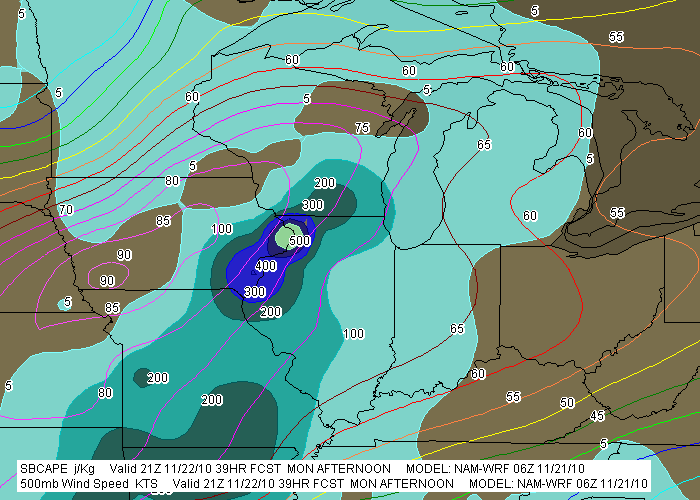
The GFS paints a somewhat more aggressive picture than the NAM and wants to clip things along a few hours faster. If that pans out, then north-central Illinois and south-central Wisconsin may see the best play. But both models are calling for essentially the same thing. Note the bullseye of 500 SBCAPE and 75 J/kg 3km MLCAPE at Clinton, Iowa, coincident with a nose of Theta-E bulging into the area. The GFS depicts the same scenario, albeit at 18Z rather than 21Z.

Today, Sunday, temps are forecast to rise into the 50s here in Grand Rapids, and tomorrow they should make it into the low 60s along with a significant increase in moisture. We stand a chance for a few thunderstorms of our own, particularly when the cold front moves in Monday night. As the KGRR forecast discussion puts it, “GIVEN TEMPS IN THE LOWER 60S…IT MAY ACTUALLY FEEL A BIT HUMID MONDAY AFTERNOON. THE CURRENT MENTION OF SLGHT CHC TSRA STILL LOOKS GOOD.” The SPC day 2 outlook has even thrown in mention of isolated tornadoes from southern Michigan southward, but tomorrow’s models will give a better sense of whether that’s any real concern. Helicity should be adequate, but instability is weak, and a November night-time squall line in Michigan is not your typical tornado machine.

Right now, the bottom line looks like warmer-than-usual weather in our area today and especially tomorrow, with storms in the offing in northern Illinois and nearby areas. And behind that, setting the tone for Thanksgiving, colder weather. So enjoy this last spate of warmth, because winter is waiting in the wings.
Leave Your Car and Take Shelter in a Ditch? Not So Fast!

You’ve heard it repeated often over the years during tornado warnings: If a tornado approaches you while you’re driving, abandon your vehicle and seek shelter in a ditch. For several decades that instruction has been disseminated as if it were gospel truth. But is it a proven life-saver or, like, some other popular tornado safety myths (hide under an overpass, open the windows of your house, head for the southwest corner of the basement) bad advice that could get you hurt or killed?

In my opinion, it depends. While the National Weather Service has historically recommended the ditch, recently at least some weather stations have been modifying that advice, and a lot of experienced storm chasers disagree with it vehemently. Among the excellent reasons why they would prefer to take their chances in a vehicle rather than in a ditch, they cite the following:

◊ Flooding. A ditch is a poor escape option if it’s rapidly filling with water. There’s no point in surviving a tornado only to drown in a flash flood.

◊ Debris. All kinds of material can get pitched into a ditch with lethal force during a tornado. This is no idle concern; ditches regularly fill with tornado debris.

◊ Electrocution. There you are hiding in your nice, flooding ditch, and down comes a power line smack into the water. Fzzztttt! You’re a crispy critter.

◊ Snakes. Depending on where in the country you live, you could find yourself keeping company with rattlesnakes, copperheads, and water moccasins.

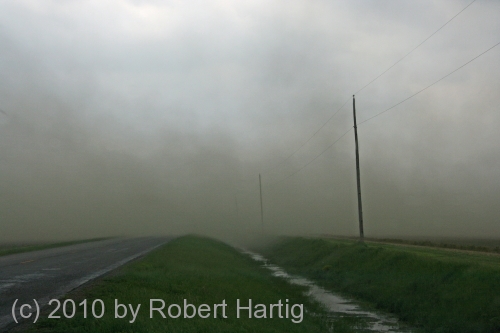
All of the above are reasons commonly given by chasers why they will never abandon their vehicles in favor of a ditch. I’ll add one of my own: Unless a ditch is sufficiently deep, chances are good that the wind will just scoop you right out of it and blow you away. Take a look at this photo of a rear-flank downdraft (a type of strong, straight-line wind from a severe thunderstorm) and note how the dust fills the shallow ditch on the right. The RFD jet was crossing the road about 100 feet in front of our car when I snapped the photo, and it was easy to see that the wind wasn’t merely blowing over the ditch–it was blowing into it. There’s no reason why tornado winds won’t do exactly the same thing, only a lot more intensely. (Note as well the rainwater in the ditch and the power lines hanging overhead.)

Still not convinced? Check out this up-close video of a small but intense tornado traveling along a roadside ditch in Minnesota and consider how you would have fared had you been taking shelter there.

And then there’s the obvious.

Why on earth would you want to abandon your best means of escaping the tornado altogether, not to mention the added protection your vehicle affords, in order to expose your soft, pink body fully to the elements?

Contrary to what you may believe, you can outmaneuver a tornado. Storm chasers do it all the time. Tornadoes move at roughly the same speed as their parent storm. True, some can rip along at 60 mph or more, particularly in the early spring. But most tornadoes move at a much slower rate, generally between 25-45 mph. Given a decent road grid, unless you’re in an an urban area where traffic is congested, or unless your view of the tornado is impeded by terrain or precipitation, your most commonsense survival tactic is to get out of harm’s way. If you can see a tornado, you should be able to escape it unless it is nearly on top of you.

How to outmaneuver a tornado: advice for the average Jane or Joe.

Those of you who are storm chasers can skip this section. You’re already quite familiar with approach and escape tactics, or at least, you should be. (Of course, you’re more than welcome to share your own wisdom in the comments section, and I hope you will.) The following is written for the saner 99.9 percent of the population who don’t go gallivanting across the vast American heartland in the hopes of encountering massive wind funnels filled with debris, but who would like to know what to do when they see one approaching while they’re out driving in their cars.

Let’s say you find yourself in just such a situation. Your most obvious first step is to determine whether the tornado is moving toward you. Chances are it will simply miss you. If you’re north of its path, you may want to park under a shelter, because if you’re not already getting clobbered by hail, you probably will be shortly. If you’re south of the tornado, you might want to head a little more south yet just to be on the safe side. Then pull of the road and enjoy the spectacle, because it’s not one you’ll see every day.

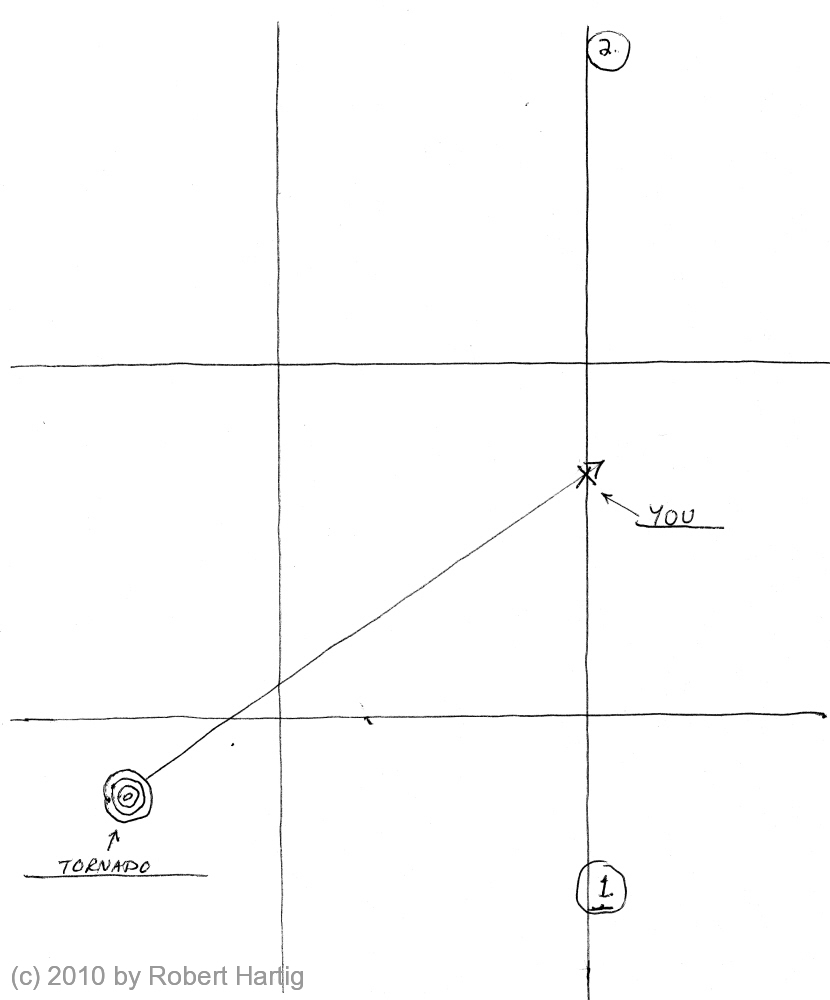
If the tornado is in fact heading your way–if it appears to be growing larger without apparently moving–then you need to take action. Assuming that it’s approaching from the west or southwest, as will be the case in most (though by no means all) situations, your best bet is to head south.

In the map to your right (click to enlarge), the tornado is moving northeast directly toward you. Note the location of the number 1. That’s the general direction you want to head in for reasons you can easily see. If south isn’t an immediate option, then drive east and bail south at your first opportunity. Depending on how near you are to the tornado as it passes north of you, you may get slammed with vicious straight-line winds wrapping in from the storm’s rear flank, but that’s better than getting munched by the tornado itself.

The overall point is to sidestep the tornado by moving at a right angle to its path. (Situation: You’re standing in the middle of a railroad track and a train is coming. What’s the smart thing to do? Answer: Right–step off the tracks!)

Heading north toward location 2 is also an option, but it’s one you’re better off avoiding if you can. While you’ll escape the tornado, you will very likely find yourself in the storm’s hail core. As a general rule, heading south will take you away from the big hail and blinding rain. Of course, if you think the tornado is likely to pass south of your location and you’re concerned about crossing its path, then use common sense and either stay where you are or else move north.  Better to risk losing your windshield than your life.

Let’s say, though, that you’re in a worst-case scenario. There’s no fleeing. Many chasers, probably most, would still prefer to ride out a tornado in their vehicle rather than in a ditch. Granted, neither option is a good one. There’s no question that the more violent tornadoes can do horrible things to an automobile; pictures abound of cars and trucks crumpled into balls of metal, or wrapped around trees, or filled with lethal debris. But at least your vehicle provides a layer of protection that you wouldn’t have in a ditch.

So is a ditch ever a good option?

This is a good place to mention that the ideas shared in this article are my opinion. They are not the result of scientific research. Then again, neither is the decades-old advice to abandon your vehicle for a ditch. It started as someone’s reasonable-sounding idea that gained authority through repetition rather than actual proof. Still, it does make sense to get as low as possible during a tornado, and I personally think there are occasions when a ditch could offer viable protection.

It’s a matter of situational awareness. Is the ditch deep, deep enough that it could minimize your exposure to the wind? If it were me, that would be my first question. Assuming that the answer was yes, my next concern would be with my surroundings. I would feel much more hopeful about sheltering in a ditch in the open countryside, with little in the way of trees and other large debris to get chucked at me, than I would in an area full of structures all strung together with power lines. And what about vehicles? I would certainly want to get far enough away from my own car that it wouldn’t be likely to roll over on top of me.

Flash flooding? Snakes? Those issues are of greater concern in some parts of the country than others. The best I can say is, know the environmental hazards of your territory and make your choices accordingly.

Again, the best way to survive a tornado is to get out of its path. Since most tornadoes are only a few hundred feet wide, avoiding them in a vehicle is quite easy given decent visibility, good roads, and ample lead time. If you’re in your car and you spot a tornado approaching in the distance, don’t take the fatalistic view that you can’t outrun it. It’s probably not heading directly at you in the first place. Determine where it is heading and do what you need to in order to position yourself elsewhere.

However, if it appears to be growing larger without moving to either the right or left, then you need to either skedaddle or else find adequate shelter. Ditches rarely qualify. In most circumstances, you should consider a ditch as only a last-ditch option.

MetEd: A Fantastic Self-Educational Approach for Learning Weather Forecasting

When I first began turning my lifelong fascination with tornadoes into an active passion for storm chasing over 14 years ago, I started with the essentials of storm structure. Then I began learning such arcane terms as CAPE, shear, dewpoints, helicity, and so forth, over time piecing together how the different ingredients interact. Bit by bit, the alchemy of the atmosphere–depicted by surface maps, forecast models, skew-T/log-P diagrams, hodographs, station obs, satellite, radar, and other mystifying tools of the trade–began to make sense to me. Tremblingly, nervously, with a deep sense of my woeful lack of knowledge, I began to try my hand at forecasting–and darned if I didn’t start to make some good calls.

Slowly I learned, and I’m still learning. There’s so much to know, and I want to know as much as I can in order to more accurately determine whether there will be tornadoes, and where, and at what time, and whether a weather scenario will be significant enough to warrant the long drive from Michigan to wherever the storms will be firing.

I wish I’d had a mentor to help me learn this stuff. Thank goodness for the community on Stormtrack–for the many experienced chasers and meteorologists who have generously answered my questions and shared their knowledge over the years! Fortunately for new chasers, a wealth of educational resources exists today that can make the learning curve quicker and less frustrating.

And that brings me to MetEd

I just completed a MetEd satellite interpretation module on vorticity maximas and comma clouds. The material has both enlightened me and kicked my butt. I’ve learned enough to know that I’ve got a lot to learn, but also enough to make better use of water vapor imagery. Now I’m moving on to vorticity minimas, but after finishing the first module I had to just back away for the evening and take a breather. This stuff may seem simple to some, but it makes me want to find a nice hard surface and bonk my head against it. I get the concepts, but working them out in real-life case studies is something else. What gives me incentive is the payoff of becoming a better forecaster. MetEd offers some fantastic tools for pursuing that goal.

Short of a formal education in meteorology, MetEd online courses are probably the best thing going for those who want to acquire basic forecasting skills or expand the skills they’ve already got. I recommend them highly. A program of UCAR (University Corporation for Atmospheric Research), MetEd is no lightweight survey. It’s a constantly growing and evolving suite of vanguard educational products covering a broad sweep of meteorological topics, and it is used by scores of operational forecasters to help them sharpen their blades. Predictably, some of what it offers is well beyond the grasp of most lay persons. Yet a fair amount is accessible to the motivated self-educator, and well worth the time it takes to absorb the material.

The course I’m working on, Dynamic Feature Identification: The Satellite Palette, is a good example. Its interactive format lets you get your hands dirty with actual application as you learn about vort maxes, vort minimas, comma clouds, deformation zones, blocking patterns, and more. Once I’ve completed the full course, while I’ll assuredly be no expert at interpreting water vapor imagery, I’ll nevertheless have gained some knowledge that will serve me well–stuff I’ll be able to use next spring when Big Weather returns to the Great Plains.

If you want to bone up on weather forecasting of any kind, from severe thunderstorms to winter weather and more, you owe it to yourself to check out MetEd. Do it now and you can thank me later for sending you. MetEd is a great way to hone your skills during the long stretch between now and Storm Season 2011.

Guest Post: Robert Edmonds on Multiple Vortices

The following is an unexpected and interesting guest post from fellow storm chaser and atmospheric modeler Robert Edmonds. Earlier this week I got a note from Robert, and, recalling some of his very cool vortex models that he had posted on Stormtrack, I invited him to submit a guest post. At my suggestion–because Stormhorn.com is written on a popular rather than a scientific level–Robert has taken a concept that I’m certain can be expanded upon to incredible complexity and offered some essential thoughts on it which I think just about anyone can understand.

A bit on Robert’s background. A weather modeler for Mars who works frequently with NASA, Robert possesses a BS in astrophysics and a minor in mathematics, and is currently pursuing a Ph.D. With nine years experience chasing storms, he operates his own business as a storm chasing tour guide.

Without further ado, I give you Robert Edmonds sharing his insights on

Multiple Vortices: Stable and Unstable Configurations

Bob Hartig recently wrote an article titled  “Multiple Vortices: How Deep Do They Go?” Being both a storm chaser and an atmospheric modeler for Mars, I thought I might share some interesting insights about multiple vortices. There is a lot of fascinating physics going on inside multi-vortex tornadoes.

First, however, it might be good to understand the difference between vorticity and circulation. Imagine a boat in the ocean. Let’s say that in this ocean is a giant whirlpool. The boat is circulating about this whirlpool; however, the nose of the boat keeps pointing in the same direction–let’s say, north. Clearly there is circulation because the boat is going around and around the whirlpool, but in the water immediately surrounding the boat there is no vorticity.

Now let’s move the boat closer and closer to the center of the whirlpool while keeping the boat’s nose still pointed north. There is still no vorticity in the water immediately surrounding the boat.

Only when we find the nose of the boat turning is there vorticity in the water immediately surrounding the boat. The boat is now experiencing not only circulation, but also vorticity.

At the following link you will find an applet with two windows: https://stormchaseguide.com/blog.html. The black dots represent locations of concentrated vorticity (places where the boat’s nose would turn). You can think of these dots as multiple vortices within a larger tornadic circulation. What I want to show you is that certain vortex configurations are stable.

First, uncheck the two boxes next to “Running.” This will freeze the motions of the vortices.  Next: In each window there are vortices in a circular configuration. Drag one black dot in each window at most half a mouse cursor length (click and hold). When you’re done, go ahead and click the boxes next to “Running.”

You should find that in the panel with six vortices, the shape or configuration of the dots remains generally the same. However, in the panel with seven vortices the configuration eventually breaks down. This is because circular, evenly spaced configurations with more than six vortices are unstable.

This little demonstration touches on many aspects of weather, not just multi-vortex tornadoes. The chaotic behavior in the panel with seven or more vortices demonstrates why no weather forecast will ever be perfect. The air around us can be thought of as composed of billions, even trillions, of little vortices, all interacting in seemingly random fashion. As you’ve just seen for yourself in the very simplified model, small changes in the atmosphere can produce drastic differences over time–true of both tornadoes and of the larger weather systems that spawn them.

Chasing the Great Lakes Superbomb of 2010

Until early yesterday morning, I was pretty certain that I wasn’t going to be chasing yesterday’s squall line associated with the record-breaking low pressure system that’s moving across the Great Lakes. With storms ripping along at 60 knots, what kind of chasing is a person going to do?

Then came the 7:00 a.m. phone call from my chase partner, Bill Oosterbaan, informing me that the Storm Prediction Center had issued a high risk for the area just across the border in Indiana and Ohio. With the rapidly advancing cold front still west of Chicago, we’d have ample time to position ourselves more optimally. This would be an early-day storm chase. It would also almost surely be our last chase for the next four or five months. What did we have to lose?

I hooked up with Bill at the gas station at 100th St. and US-131, and off we went. The storms had moved into Chicago by then, and as we dropped south, it became apparent that we would also need to break east and then stairstep down into Ohio, buying time in order to let the line develop with daytime heating. Satellite showed some clearing in Ohio,

suggesting a better chance for instability to build. Catching I-94 in Kalamazoo, we headed east toward I-75, with the Findlay area as our target.

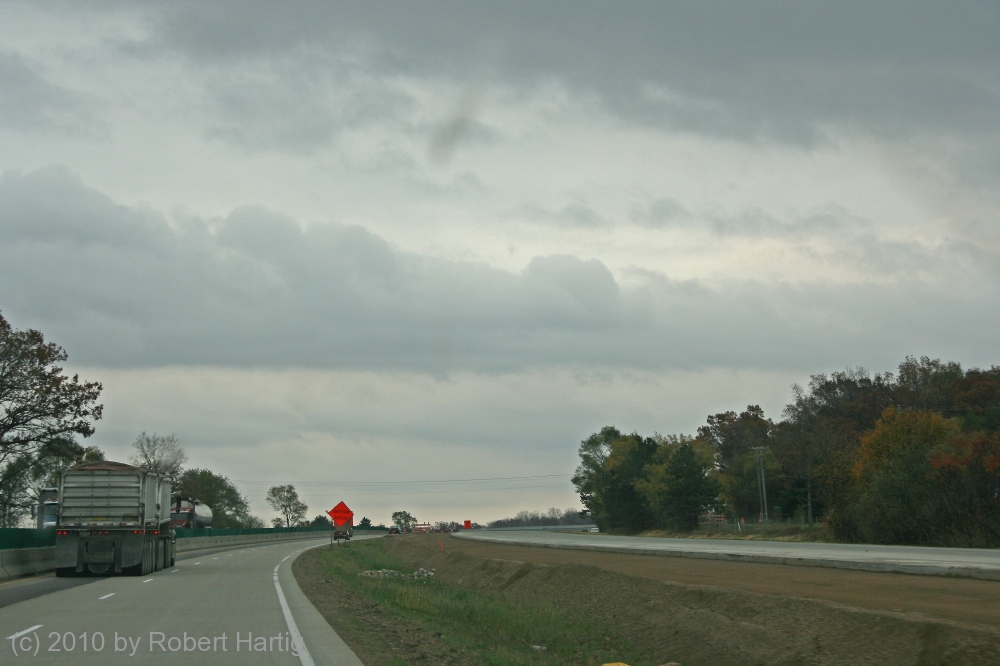
Off to the northwest in Minnesota, the low was deepening toward an unprecedented sub-955 millibar level, sucking in winds from hundreds of miles around like the vortex in an enormous bathtub drain. Transverse rolls of stratocumulus streamed overhead toward the north, indicating substantial wind shear. (Click on image to enlarge.)

By the time we crossed the border into Ohio, tornado reports were already coming in from the west as the squall line intensified. Soon much of the line was tornado warned. However, while the warnings were no doubt a godsend for a few communities that sustained tornado damage yesterday, they weren’t much help to Bill and me. Chasing a squall line is different from chasing discrete supercells.

We had in fact hoped that a few discrete cells would fire ahead of the line. But the forecast CAPE never materialized to make that happen, and we were left with just the line. In that widely forced environment, tornadoes were likely to occur as quick, rain-wrapped spinups rather than as the products of long-lived mesocyclones. Even with GR3, the likelihood of our intercepting a tornado would require a high degree of luck. It was harder to identify areas of circulation with certainty; I found myself using base velocity as much as storm relative velocity on the radar, and comparing suspect areas not with easy-to-see hook echoes in the reflectivity mode, but with kinks in the line. It was pretty much a game of meteorological “Pin the Tail on the Donkey.”

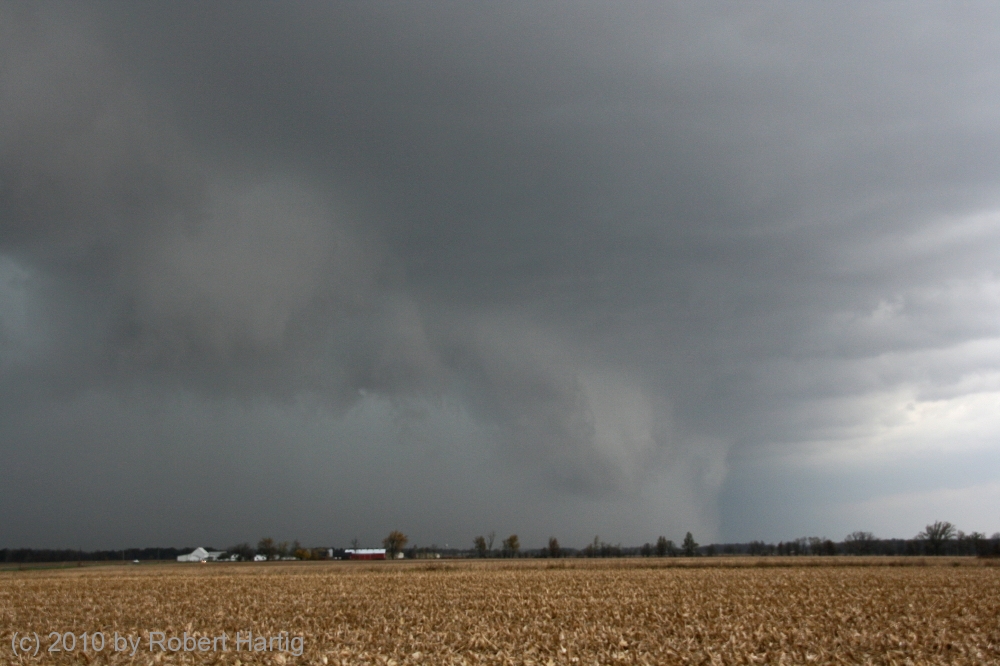
North of Kenton, we headed west and got our first view of the squall line. For all the hooplah that had preceded the thing, it didn’t appear very impressive. Just your average storm front–much windier than most, but also a bit anemic-looking compared to some of the shelf clouds I’ve seen. Still, it was a lovely sight, watching those glowering clouds grope their way across the late-October farmlands.

.

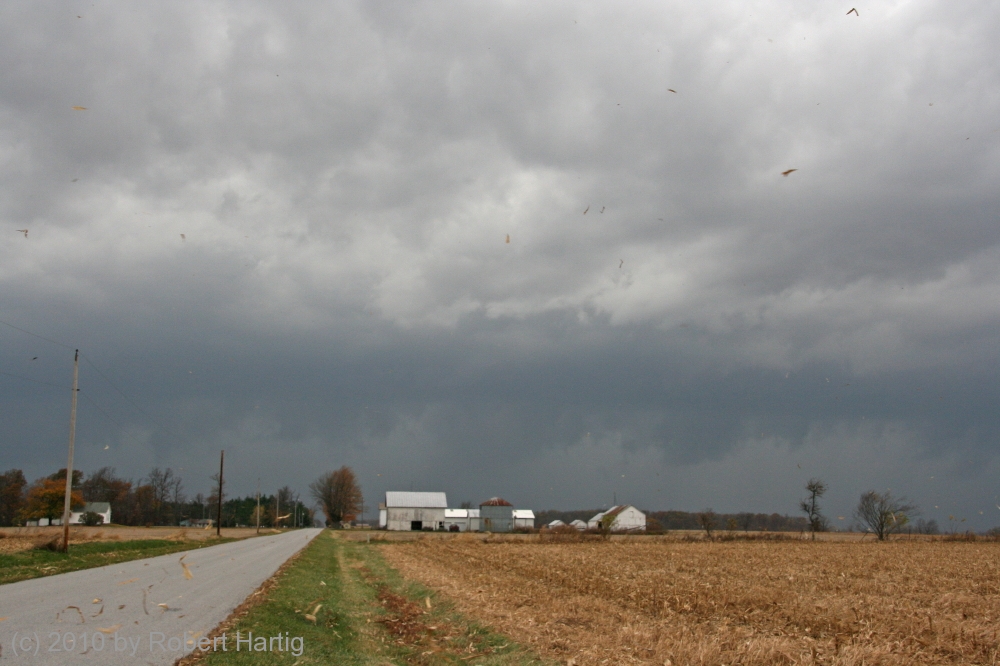
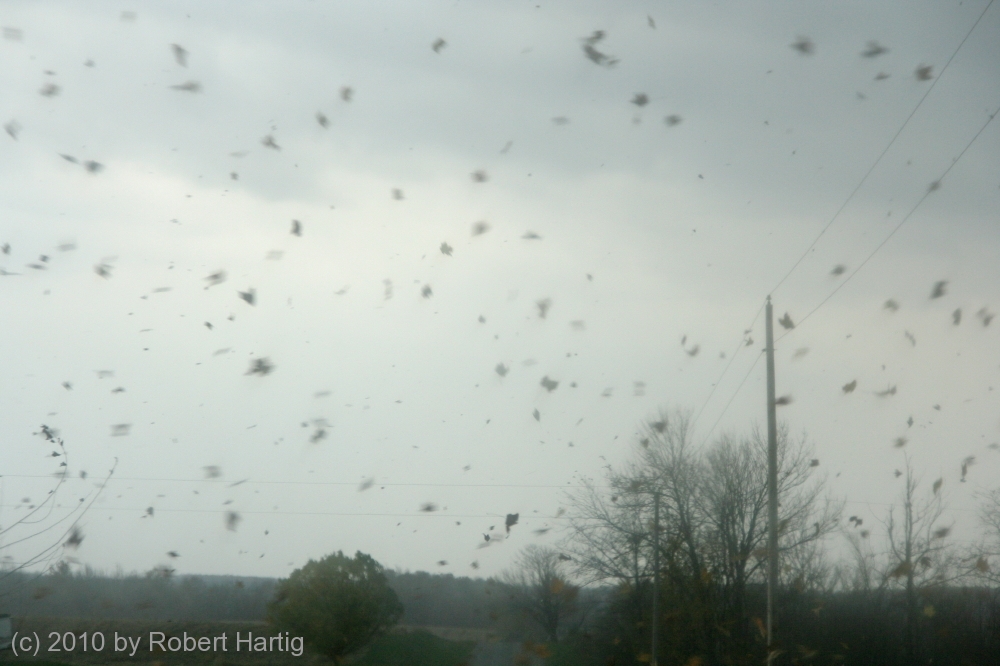
Neither of us was quite ready to end the chase, so with the storm rapidly closing in, we scrambled back into the car and stairstepped to the southeast in the hope of intercepting a likely-looking reflectivity knot that had gone tornado-warned. It was fun playing tag with the storm, driving through swirls of leaves spun up by the outflow. But there really wasn’t much incentive for us to continue the game indefinitely. Eventually we turned back west and drove into the mouth of the beast.

For a few minutes, we got socked with torrential rain and some impressive blasts of wind (and, I should add, absolutely no lightning or thunder whatever). Then it was over. Time to head home.

In Kenton, we grabbed dinner at a small restaurant. Then we headed toward Cridersville, 28 miles straight to the west next to I-75, where there had been a report of “major structural damage” from a tornado. The report was accurate. A small but effective tornado had torn through the community, uprooting and snapping off large trees, taking off roofs, and demolishing at least one garage that I could see. Of course we couldn’t get into the heart of the damage path, but a few passing glimpses suggested that some of the damage may have been fairly severe.

As I said at the beginning, this chase will likely have been my last of the year. I never know for sure until the snows fly, but it seems like a pretty safe bet that I won’t be heading out again after storms until March or April. It’s hard to call this chase a bust since our expectations weren’t all that high to begin with. Plus, tornadoes or no tornadoes, it was an opportunity to engage with a historical weather system. Like other significant weather events such as the Armistice Day Storm and the 1974 Super Outbreak, this one will be given a name in the annals of meteorology. Me, I’m calling it the Great Lakes Superbomb of 2010. In a number of ways, it hasn’t proved to be as impactful as was forecast, but it’s not over yet. And regardless, I’m glad I got the chance to get out and enjoy a final taste of synoptic mayhem.

Iowa and Northern Missouri in the Convective Crosshairs

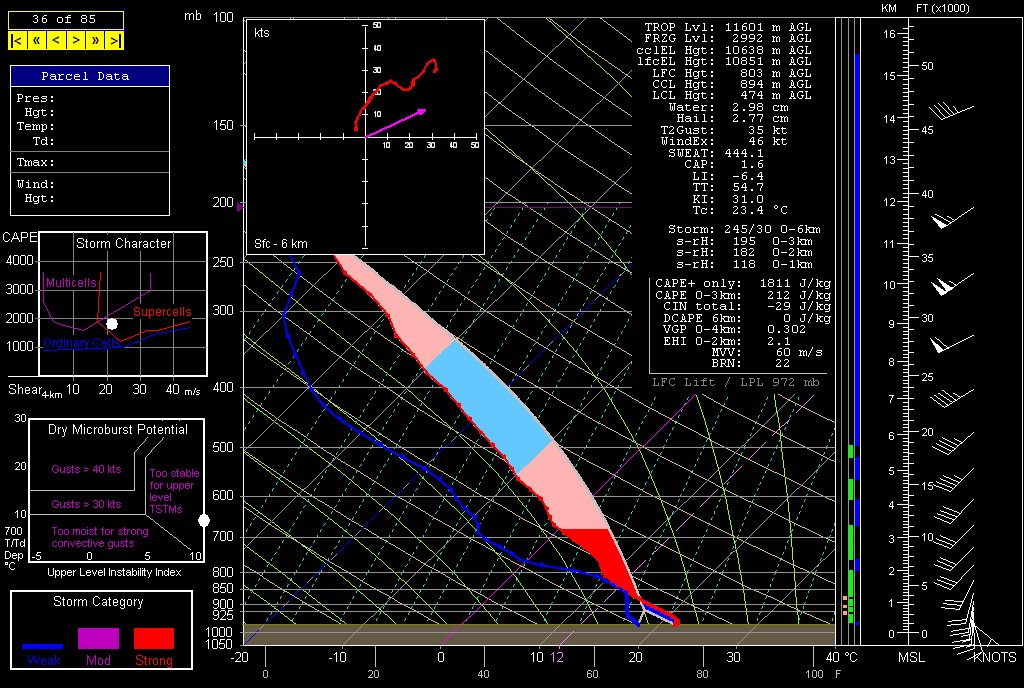
I had reconciled myself with the thought that this autumn’s storm season would be a no-show in the Great Lakes and Corn Belt. Leave it to the atmosphere to prove me wrong, but I’m not complaining. How’s this for a NAM forecast sounding for October 23 in Des Moines, Iowa (click on image to enlarge)?

Maybe not the sexiest hodograph, but I won’t kick it out of bed for eating crackers, and you’ve got to love that 1,811 J/kg SBCAPE. Storm-relative helicity could be better, but still, you got yer 0-2 km EHI of 2.1, yer -6.4 LI, 4 km VGP of .3, nice influx of moisture, good upper level support…what more do you want this time of year? Eggs in your beer?

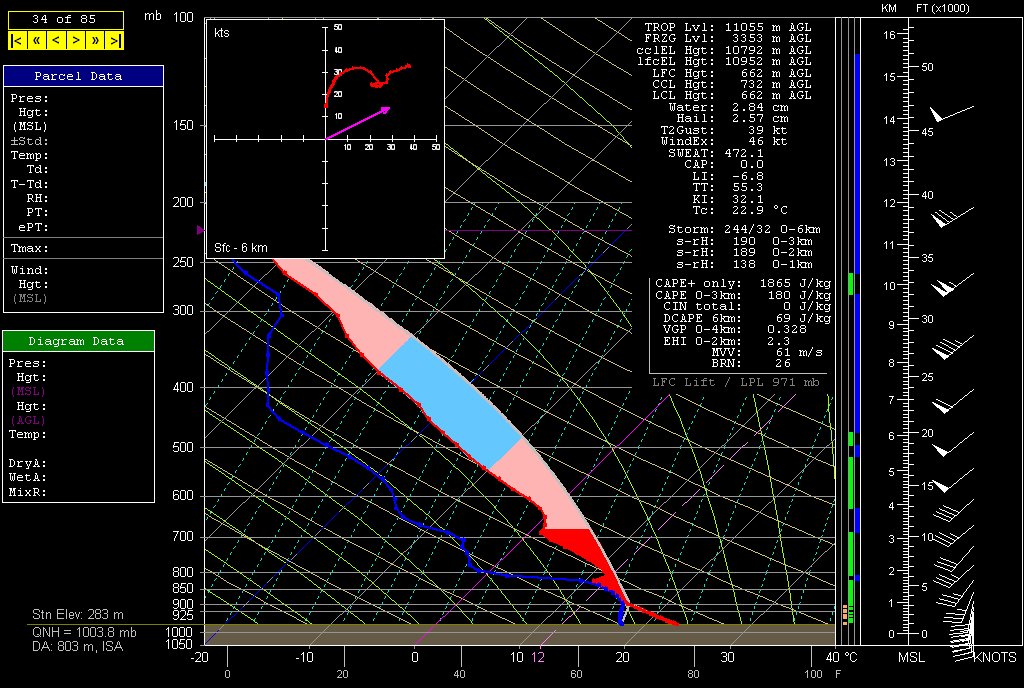
Sixty-five miles southeast of Des Moines in Moravia, the sounding for 21Z looks even better with slightly bigger CAPE, -6.8 LI, a curvier hodograph, a southwesterly H5 cruising along at a stout 50 knots, BRN of 26, and better 0-6 km shear. Bulk shear is actually a bit of a concern–the NAM sounding gives a less optimistic view of it than does the map–but we’ll see how that plays out in future runs. I have a hard time believing that shear won’t be adequate.

I’m seriously contemplating going after this scenario. And it’s just a forerunner; another, stronger system looks to be moving through the Great Lakes in the Monday/Tuesday time frame, with backing surface winds pumping a nice plume of moisture into the region.

All in all, those of us up here in the great north woods may get one or two last whacks at some decent storm chasing and maybe even a few tornadoes before the snows fly. I’m keeping a close eye on this setup and crossing my fingers.

Multiple Vortices: How Deep Do They Go?

In a recent thread on Stormtrack, storm chaser Shane Adams speculated that all tornadoes exhibit some degree of multi-vorticity. He opened up a topic that has intrigued me for a while.

Just how deep does multiple vorticity extend into a tornado? It may go deeper than most of us chasers imagine. We all understand that many tornadoes display multiple vortices, and a lot of us have witnessed the phenomenon firsthand. It’s possible, though, that the process we call a tornado is a actually an entire complex of vorticity consisting of rotations within rotations. It’s no secret that circulation ranges downward from synoptic scale to mesoscale to microscale; why shouldn’t it continue to do so on increasingly smaller scales? Maybe this concept is nothing new to tornado researchers, but I haven’t heard it discussed to any degree in the general storm chasing community.

While I used to associate multiple vortices with larger tornadoes, it’s the smaller ones that in recent years have intrigued me as I’ve taken a closer look. Some of the more transparent tornadoes have revealed fascinating inner structures, including a sheath-like outer wall cloaking a vigorous center, and a sort of braided appearance that has made me think of the strands that weave together to compose a rope. The 2007 Elie, Manitoba, F5 drillpress is a good example. Check out this video and I think you’ll see at least some of what I’m talking about, particularly around 4:17 into the clip.

Another video of this same tornado, shot at a closer location, offers an excellent front-row view of the tornado as it dissipates. Unfortunately, I can no longer locate that video on YouTube, and I really wish I could, because as I recall, the close-up of the tornado in its last couple of seconds amazed me. The funnel appeared to unravel; for a brief moment, you could see it separate into what I’m going to call vortex strands as its energy abruptly gave out, following which it simply vanished. As striking as how quickly the tornado transformed from a town-wrecker into nothingness was the manner in which it did so.

More recently, I finally got a good firsthand look at extensive, small-scale vortices on May 22 this year in South Dakota. The much smaller, highly photogenic tornado that followed the massive and violent Bowdle wedge was a shape-shifter that went through some fascinating transitions. Parking itself in a field a mile northwest of our vantage point, unobscured by rain, it was beautifully visible and offered a study in multiple vorticity throughout its life. For me, the high point was when the funnel assumed the form of a truncated tube, with delicate tendrils of condensation circulating underneath it one after the other like horses on a merry-go-round. (My thinking is that a pocket of drier low-level air stripped out condensation except in the places where the vortex strands rendered the pressure low enough to make themselves visible.)

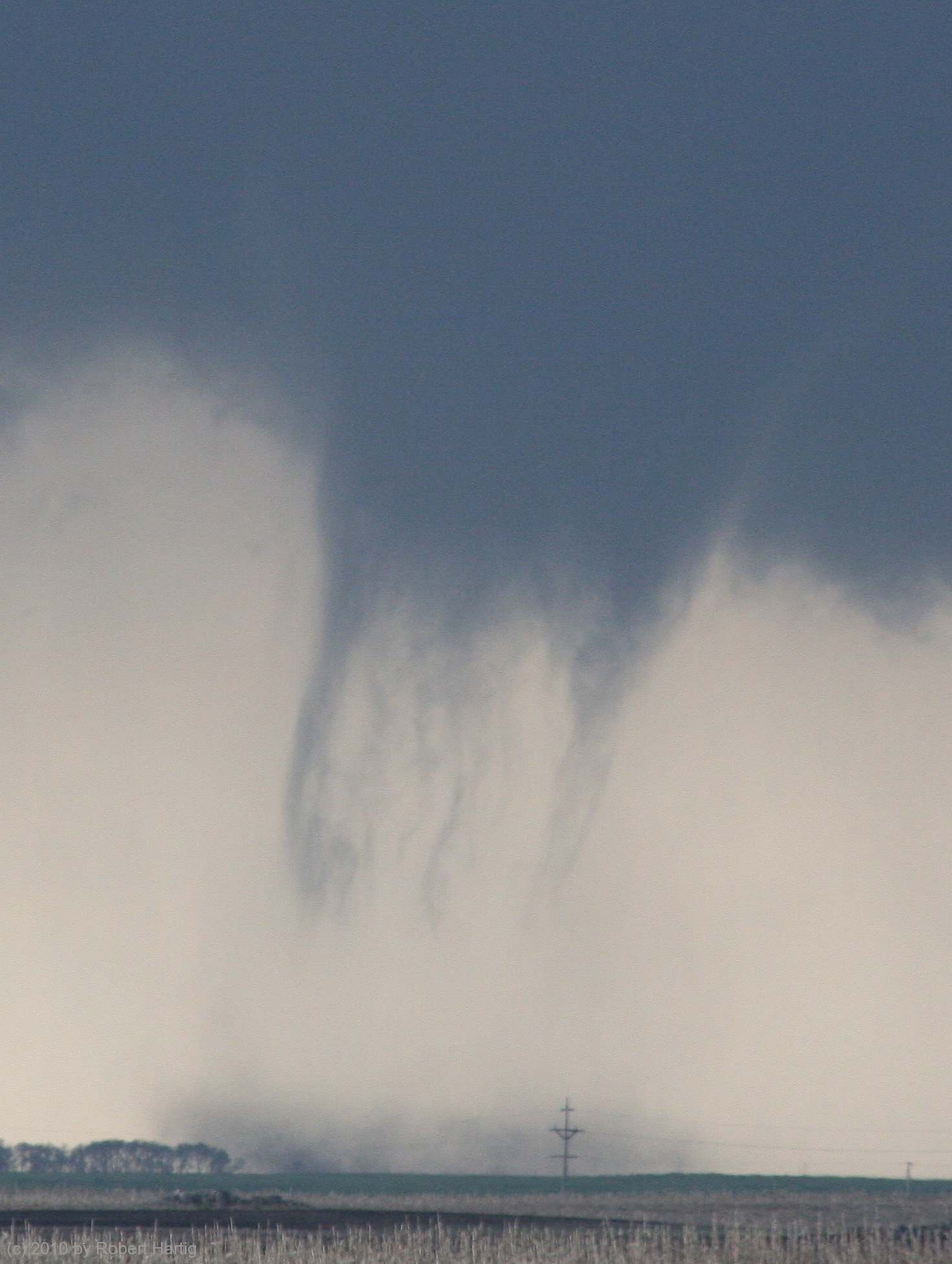
In the photo (click on the image to enlarge it), some of the vortices are apparent, but if you look closely, you’ll notice that some of the larger vortices actually appear to be made up of more than one vortex strand. You’ll also see a tendril or two appear to branch off. In all, I’m able to make out eleven strands, ranging from the obvious to the nearly undetectable. Granted, I may be pushing things; my point is that the circulations in this tornado were numerous, varied in scale, and complex. I suspect that there were even more vortices present than meets the eye, but I’m not going to force the issue because I’m no scientist, just a thoughtful observer with an aversion to crackpotism.

If there’s any recent weather-related post on this blog that I hope will draw some solid, informed comments, it’s this one. I’d love to get the opinions of others in the storm chasing community; and while I don’t expect that it will happen, I’d be extremely interested in hearing from those who are actually involved in tornado research.

No Second Season? Please Say It Ain’t So!

I’d been looking forward to the shift in weather with fall’s arrival, but now that autumn is officially here,  I dunno, boys and girls. I’m beginning to suspect that the mythical “second season” may not materialize for storm chasers this year–not in the Great Lakes, anyway. You folks out west will no doubt get your little romp, but up here in the tundra land of Michigan instability appears to be a thing of the past. I have to remind myself that it’s been only a week since one heck of a squall line blew through and caused extensive tree damage in my area. A couple of days later, though, as the system lifted out of the region, the moisture gave way to the relentlessly dry, crystal-blue skies of autumn, and I have the unsettling feeling that the die has been cast for the remainder of the year.

Today’s 4-8 day outlook from the SPC doesn’t make me feel any better about our immediate prospects:

 VALID 021200Z - 071200Z

   ...DISCUSSION...
   MODELS ARE IN GOOD AGREEMENT WITH THE PATTERN EVOLUTION THROUGH
   ABOUT SUN/D5 WITH LARGE TROUGH AMPLIFYING ACROSS THE GREAT LAKES AND
   ERN STATES AND AN UPPER RIDGE OVER THE ROCKIES. THIS PATTERN WILL
   RESULT IN A LACK OF INSTABILITY E OF THE ROCKIES WITH HIGH PRESSURE
   AT THE SURFACE. 

   WHILE THE TROUGH IS FORECAST TO LINGER IN SOME FORM OVER THE ERN
   CONUS...THERE IS MUCH DIFFERENCE ASSOCIATED WITH THE BREAKDOWN OF
   THE RIDGE AS A NEW TROUGH AFFECTS EITHER THE PACIFIC NW/GFS
   SOLUTION/ OR THE ENTIRE W COAST/ECMWF SOLUTION/.  REGARDLESS...THERE
   IS LITTLE CHANCE OF SEVERE WEATHER GIVEN MEAGER MOISTURE AND
   INSTABILITY.

   ..JEWELL.. 09/29/2010

“Lack of instability..little chance of severe weather…meager moisture…”–mmmph, doesn’t sound very promising, does it? I console myself with the thought that autumn has barely begun, and a nice fetch of moisture can still come chugging northward on the leading edge of some great dynamics to make life interesting. It happened as late as November 10, 2002, in Van Wert, Ohio. It happened just three years ago on October 18, 2007, across the Midwest, including here in Michigan. So my rule of thumb is, don’t pack away the laptop until the snows fly.

Still, as daytime temperatures retreat into the mid 60s and dewpoints drop to 50 degrees and below, it’s kind of hard to believe that the end of the parade isn’t long gone, and that last week’s wind event wasn’t just the cleanup crew. Good thing that this season’s “Storm Chasers” series will be airing soon and letting us all relive the glory days of 2010. After that, though…man, it sure is a long stretch from here to next March.

Review: “Bullseye Bowdle” DVD

It all came back to me yesterday evening, just as if I was once again sitting in the front seat of Mike Kovalchick’s Subaru Outback blasting east down US 12 in South Dakota. There it was–the Bowdle wedge, seething like a boiling, black cauldron in the field north of our vehicle.  Thanks to a beautifully produced new DVD, my buddies Tom, Bill, and I relived what was unquestionably our most unforgettable chase of the year.

To the guys at Convective Addition: Bravo, gentlemen! “Bullseye Bowdle” is a superb chronicle of the amazing May 22 north-central South Dakota cyclical supercell. From the first tornado of the day, to the massive, violent Bowdle wedge, to the infamous “farmer’s field” debacle, this video provides those who chased that day with an opportunity to relive its events, and those who didn’t with the chance to drool over what they missed.

I spotted our Michigan contingent–consisting of Bill and Tom Oosterbaan, Mike Kovalchick, and me–in a number of scenes. Hey, now we’re stars! Or just walk-ins, I suppose. Getting filmed on various chase videos that day seemed almost inevitable, since everyone out there was tracking the same slow-moving storm, albeit approaching it from different angles. “Bullseye Bowdle” does a splendid job of presenting multiple perspectives on each tornado.

The storm structure that day ranged from breathtaking to unbelievable, and this video captures it all, from storm initiation to the phenomenal, bell-shaped meso with an immense cone/quasi-wedge beneath it west of Bowdle, and plenty more. Of course, the powerful Bowdle EF-4 wedge is the show’s main act. But the graceful, highly photogenic tornado that formed northeast of Bowdle after the wedge dissipated is also spotlighted, and deservedly so. If you want to get a good look at multi-vorticity, check out the braided appearance of this tornado. During its truncated tube phase, it looks as if it were literally woven out of delicate, pirouetting vortices, like a strand of yarn in which you can see all the individual threads–simply amazing, not to mention quite beautiful.

And then, yes, there is the farmer’s field. Those of us who were there will never forget it: our narrow escape from disaster, and the craziness that followed. Having survived both the tornadoes and the ensuing lunacy, each one of us has a story to tell, and it’s nice to see part of that story dramatized on film. I love the footage of the drill-press tornado! But for me, the most jaw-dropping part is Adam Lucio’s segment of a tornado forming right by the vehicles, not more than 30 feet from one of them. I failed to witness that spectacle when we were actually sitting out there in the middle of the South Dakota prairie, but the video shows it clearly. It was a moment worthy of every expletive under the sun, or in this case, the mesocyclone.

My favorite comment in the video occurs as two sets of headlights appear on the horizon, heading toward us through the darkness. Adam Lucio: “Off in the distance we can see help is on the way.” Ha! Not quite. Swap out the “P” in “help” for a second “L” and that assessment would have been spot-on. I can’t make a blanket indictment of the locals since some of them were decent folks, sympathetic, and extremely helpful, and the land owner’s initial anger was understandable; but there were others who in my opinion behaved–how shall I put this? I’ll say it delicately–like wholesale, unmitigated, gold-gilded, rhinestone-encrusted, butt-drunken, power-abusing, 24-karat jerks.

Okay, I got that out of my system. Moving right along: The Convective Addiction crew have thoughtfully included a section featuring a time-lapse chronology of the storm as it busted the cap and began spitting out tornadoes. The value of this section, besides the fact that it’s just plain fun, lies in how the faster motion highlights aspects of the storm that I normally wouldn’t have noticed. It’s fascinating, for example, to watch the dramatic, cascading interaction between the flanged meso and an adjacent inflow band as the RFD carves a clear slot between them.

The video concludes with a well-presented synoptic and mesoscale overview of May 22, 2010 which does a good job of describing the setup. I don’t recall (and can’t check, not owning my own BlueRay player) whether it discussed the cap, which was the big forecasting question mark for that day. But the cap obviously blew, and the meteorological analysis does a good job of showing the ingredients which combined to make May 22 such a dramatic chase.

Besides some fantastic footage, Convective Addiction has also selected some tasty music for their sound track. However–and this is something I appreciate–they use the music judiciously, not to the point of overkill. In a chase video, I want to hear the reactions and interactions of the chasers; the sound of the wind, the rain, the passing traffic, and hail pelting the windshield; the real-life environmental stuff. That’s part of what puts me in the picture, and the storm chasers who produced this video clearly feel the same way. I know these guys like their jams, but in “Bullseye Bowdle” they wisely focus on the storm, the tornadoes, and the human element of the chase.

If I have any critique to offer, it would be that in their next video–and I hope there will be a next, and many more to follow–the editors of Convective Addiction might consider offering a brief wrap-up where appropriate in order to avoid the somewhat jarring effect when a video segment ends abruptly.

Bottom line: If you’re a storm chaser or just enjoy watching storm chasing videos, then “Bullseye Bowdle” is a must for your DVD collection. It’s available in both standard resolution and BlueRay at Convective Addiction.

——————–

For the sake of complying with new federal regulations, whether real or imagined: This review is not a paid review. I’ll gladly write reviews for pay. In this case, though, I bought the DVD with my own sweet shekels and I’m writing purely because I like “Bullseye Bowdle” and think you will too.

Great Lakes Waterspout Season Is at Hand

Now is the time of year when waterspouts start putting in an appearance on the Great Lakes. I had largely forgotten about spouts until a few days ago when my friend and fellow weather weenie Mike Kovalchick mentioned them in an email. Bing! A light blinked on in my head: That’s right! Waterspouts!

I’ve never seen a waterspout. But then, until last year about this time with my buddy Kurt Hulst, I’d never made a point of going out after them. Kurt and I busted that day, but maybe this year I’ll get lucky, provided I increase my chances by taking more opportunities to chase spouts.

I have zero experience forecasting waterspouts. Thankfully, there’s a snappy little graph called the Waterspout Nomogram that simplifies the process. Developed by Wade Szilagyi of the Meteorological Service of Canada, the Waterspout Nomogram provides a quick visual aid for determining when certain critical parameters are in place for four different classifications of waterspout: tornadic, upper low, land breeze, and winter.

The tornadic variety is self-explanatory, and any storm chaser with some experience making his or her own forecasts should have a good feel for when that kind of waterspout is likely. Mike favors the 500 mb cold-core, closed low setup, which to my thinking may be a variant of the first in producing low-top supercells. The remaining two, land breeze and winter, seem to involve different dynamics. For all the waterspout categories, one of the constraints is that for spouts to occur, winds at 850 mbs have to be less than 40 knots, something I find particularly interesting in the case of supercell-based waterspouts.

In any event, I’m hoping that this year is my year to finally witness a spout or two. Michigan chasers and weather weenies, it’s time to pay attention to the marine forecasts. The “second season” can include action right along the lakeshore even when nothing’s popping anywhere else. Make sure you bring your shotgun just in case a waterspout gets too close for comfort (written with a wink and a grin).