YAAAAYYYYY!!!!! Life in Stormhorn Land Is Lookin’ Up!

What I thought was going to take several weeks of work, maybe a month or more, manually restoring my blog images and broken links one by one now has been drastically reduced to a much more manageable project.

My sweetheart, Lisa, is the absolute Bomb, and today her inner geek came through like a champion–with, I might add, considerable patience and supportiveness for technically challenged me. That combination of her knowledge, helpfulness, and gracious attitude has made a huge difference today, on a morning when I woke up feeling depressed about life in general and Stormhorn.com in particular.

I still have my work cut out for me, but the amount of it has been reduced astronomically, and a big, biiiig, what appeared to be majorly headachy part of it is already taken care of with the complete reinstatement of my NexGen image galleries and a simple correction that has fixed a bazillion broken internal links just like that. Within a few hours this morning, this site has gone from a basket case to well on the road to recovery.

On the reader side, though, Stormhorn.com may still appear to be pathetically busted. You still can’t access most of the images, whether solo transcriptions and jazz patterns or radar grabs and weather maps. You may notice that I’ve even removed my CopyFox page from public view. I mean, who’s going to hire a copywriter whose own business site resembles the victim of a shark attack?

Relax, though. I can say, with confidence and a good deal of relief, that everything will be back soon and once again chugging merrily along.

Here’s What Needs to Be Done

I need to reorganize my NexGen image gallery, which won’t take terribly long. Then I need to go into my posts and pages, one by one, and replace bad image links with good ones. That will takes some time, but you should start seeing the beginnings of the restoration today. I’ll be starting with my most recent posts and working back from there into my older posts until everything is as it should be.

Some other, less pressing details also need attention, but all in good time. What I’ve described above is my first priority. It’s now largely a matter of grunt work, but as I’ve said, the workload has been greatly reduced and I feel far better about things than I did last night.

Thanks so much for your help, Lis! You’re awesome, babe!

ADDENDUM: Yes, I Know That Lots of the Images Are Wrong!

Again, I’ve got some messed-up links to correct. So if you find yourself looking at a weather map where a musical exercise ought to be, take it in stride. It’ll all get sorted out in due time.

It Was a Dark and Stormy Night, But the Band Played On

Happy New Year! Last year was tough but we made it through, didn’t we. I hope that 2011 will be a good year for you, for me, for us all.

Yeesh, I’m starting to talk like Tiny Tim. I’d better get on with this post, which is a summary of yesterday. Weatherwise, the last day of 2010 was a humdinger for convective connoisseurs, and jazz-wise, it was a fun evening for yours truly. While the two topics may seem unrelated, they are in fact integrally connected. It’s a well-known fact among my storm chasing buddies that any time I commit myself to a gig and am therefore unable to chase, tornadoes will drop out of the sky like confetti at a gala event. It’s a gift I have. Statistically, my powers hit their zenith the weekend of the Grand Rapids Festival of the Arts in early June. But anytime of the year, all hell is liable to break loose when I’m booked to play somewhere.

Yesterday was a prime case in point. While Steve Durst and I played a thoroughly enjoyable piano-sax gig for the dinner crowd at the Cobblestone Bistro here in Caledonia, tornadoes mowed across Missouri, Illinois, and Mississippi. You could see the event shaping up earlier in the week, with forecast models depicting a potent longwave trough digging deep into the nation’s midsection on Friday; a surface low working its way northward through Missouri and Iowa; high-velocity mid- and upper-level jets generating massive shear; and, critically, a long and broad plume of unseasonably rich moisture juicing the atmosphere up into Illinois ahead of an advancing cold front.

If you want to get some great insights into yesterday’s setup compared with two other similar wintertime severe weather events, check out this superb article by Adam Lucio in Convective Addiction. Adam’s analysis was spot-on. Tornadoes began spinning up early yesterday morning in Oklahoma and Arkansas and continued on through the day in Missouri and Illinois, surprisingly far north. Rolla and Saint Louis, Missouri, got whacked pretty solidly. Later, as expected, the action shifted south, with severe storms firing in Louisiana and a batch of night-time tornadoes gnawing their way across central Mississippi. Yazoo City found itself in the crosshairs for the third time this year as a strong radar couplet grazed past it, but, mercifully, this time the town appears to have escaped yet another direct hit.

With yesterday’s dust finally settled, the SPC’s present tally shows 40 preliminary tornado reports. Sadly, there were some fatalities, not all of which the reports show. What an awful way for the families affected to end a year that has already been difficult enough for so many people.

And the show isn’t quite over. Today, on the first day of 2011, Tornado Watch #3 is in effect for the Florida panhandle and southern Alabama. If that’s any kind of augur for this year’s severe weather season, April through June could be an interesting time for storm chasers.

But enough about the weather already. Let’s talk about jazz.

The Cobblestone Bistro is a beautiful place to play. I can’t believe that something like it exists in Caledonia, a community not exactly renowned as either a jazz hot spot or a north star of destination dining. But here the bistro is, fully operational now that a long-forthcoming liquor license has put its winsome and comfortable bar in business, and with an owner who appreciates and supports live jazz.

Last night I played my first gig at the Cobblestone for the New Years Eve dinner crowd from 6:00-10:00 p.m. Steve Durst joined me on the keyboards, and we spent an enjoyable four hours playing jazz standards in as elegant and ambiance-rich a setting as you could hope to find.

In a restaurant, particularly in a smaller room, it’s important not to play too loudly. People want to talk, and the music needs to add to the mood, not subtract from it by being too intrusive. That can be tricky for a sax player. A saxophone is not by nature a shy, quiet instrument, and a lot of energy is required to play it softly. But with three tables positioned directly in front of Steve and me, both of us absolutely had to reign in our volume.

Evidently we succeeded. We got no complaints of playing too loudly, but we did get some very nice compliments on our sound.

I’ll be playing at the Cobblestone again next Saturday, January 8, from 6:30-9:30 p.m. with Dave DeVos on bass and Paul Lesinski on keyboards. The trio will be playing as well on the 15th and 22nd, with Steve occupying the keyboard seat on the 15th. If you’re looking for a great night out in a beautiful setting, come and check us out.

And with that, I’m signing off and getting this first afternoon of a brand new year underway. I wish you a very happy and prosperous 2011.

–Storm (aka Bob)

New Years Eve Severe Weather

new-years-eveHere’s something you don’t see very often on the morning of December 31. (Click on thumbnail to enlarge it.) It’s 10 a.m. and for the last half-hour I’ve been watching lightning flicker outside my window and listening to thunder rumble.

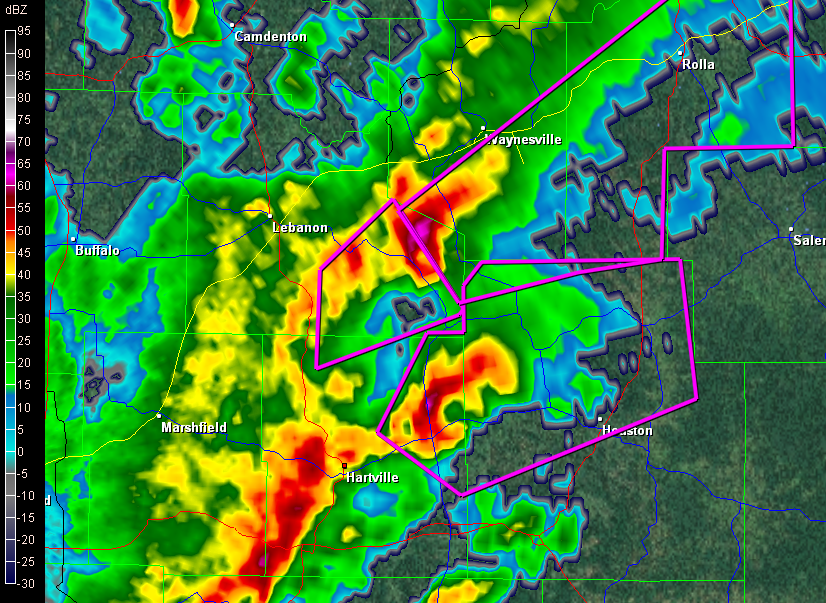
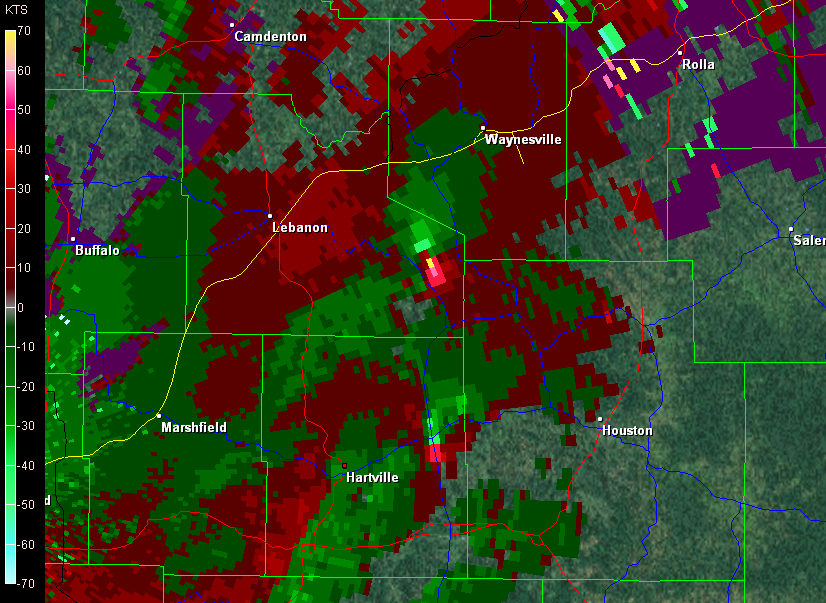
But that’s nothing compared to what’s going on farther south. Already three fatalities have been reported in Arkansas, and tornado warned storms are scraping across the region. As I write, there are two strong SRV couplets in Missouri southwest of Waynesville and west of Houston–potent little supercells fueled by dewpoints in the upper 50s. It’s new-years-eve-mo-srvcertainly not what you’d expect this time of year, but this event has been shaping up for several days.

I’ve got a gig this evening–it’s New Years, after all–so my extent of involvement in this weather scenario will be to watch it unfold to the south of me on radar and enjoy its occasional outbursts of lightning and thunder here in my own Michigan backyard. Later today Louisiana and Mississippi could get hammered, but right now the action is farther north, where buckets of shear are organizing the storms and driving them along at 50 new-years-eve-mo-refmiles an hour. If that little bugger south of Waynesville holds together, Rolla is going to get whacked within the next half hour.

Enough writing. I’m going to upload some radar images for this post and then watch this event unfold.

A Stormy New Years Eve in the South?

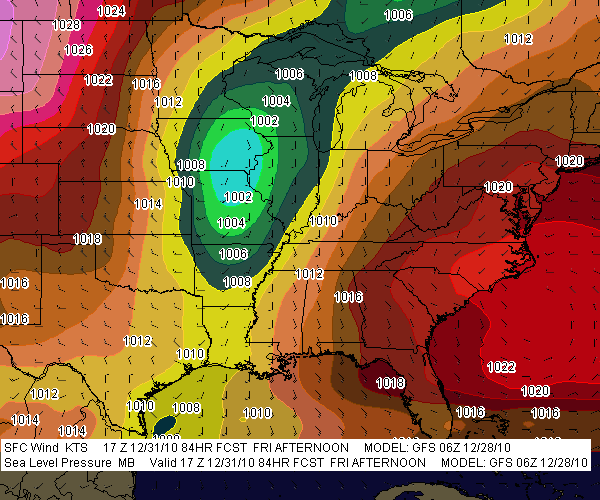
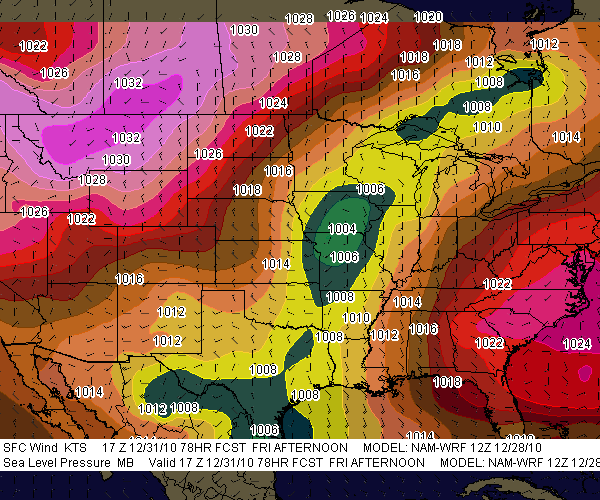
slp-gfs-123110slp-nam-123110Could be. If the GFS is right, the chance of severe weather in the Gulf states looks good. The NAM too, having leaned in with its 12Z run, also points to the possibility of a New Years Eve episode down in Dixie Alley, though it wants to nudge the ingredients slightly to the west and north.

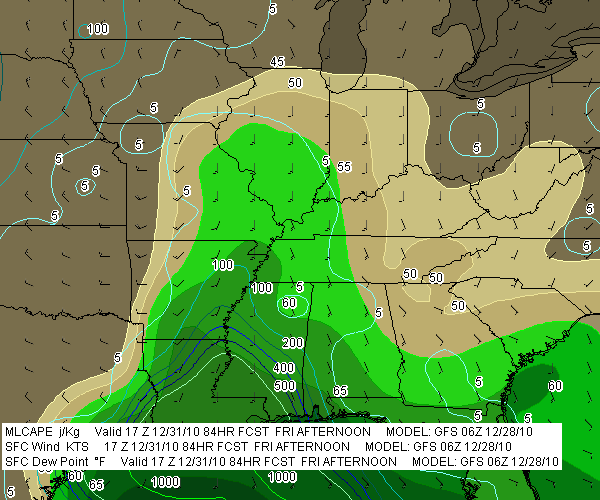
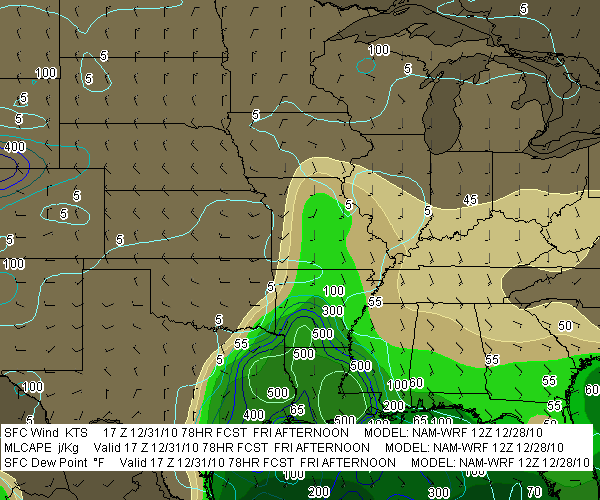
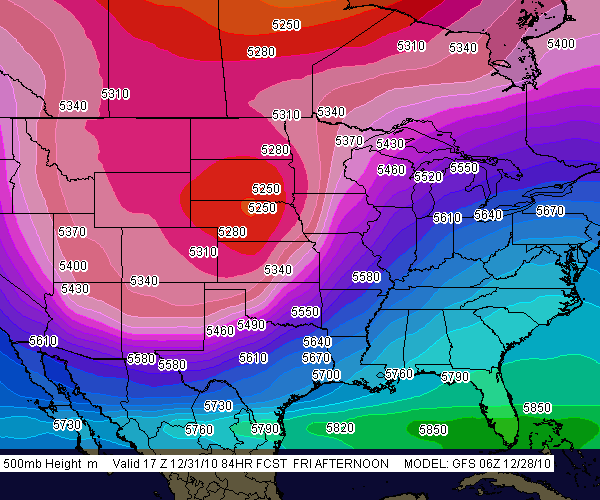
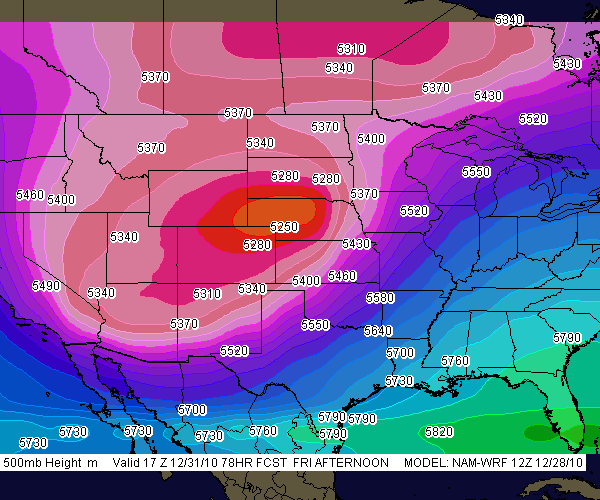
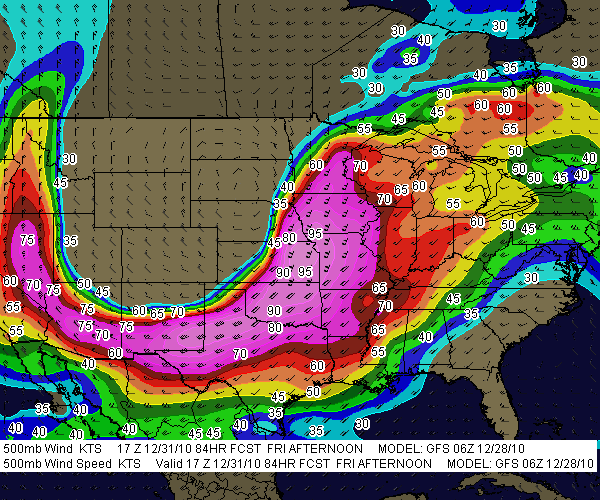
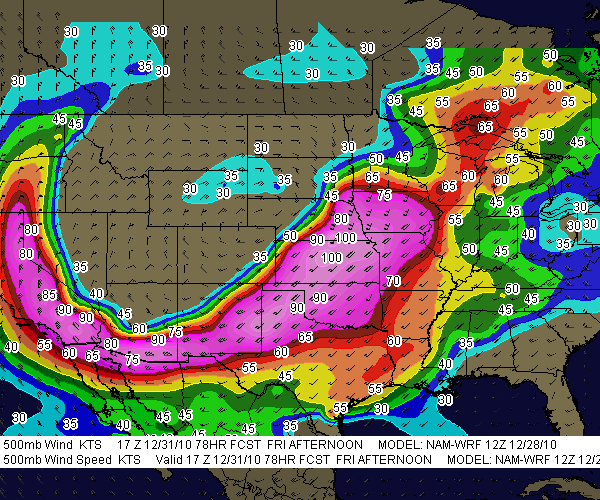
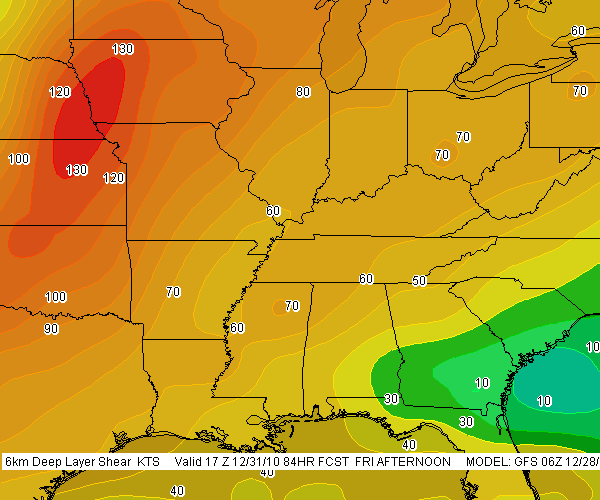
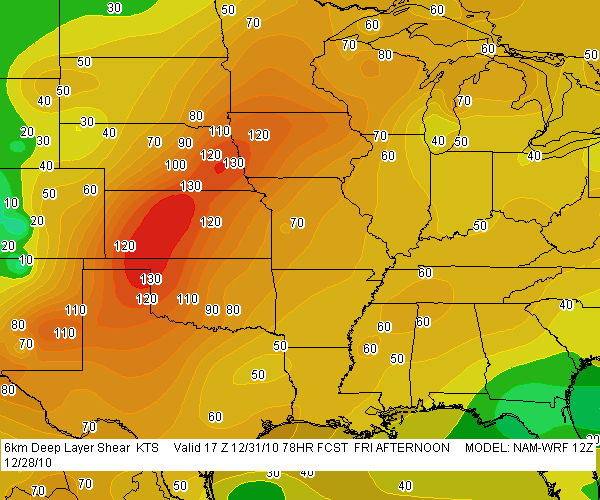
sfc-tds_mlcape-gfs-123110sfc-tds_mlcape-nam-123110So far the SPC appears to believe that severe weather is likely in the South on Friday, but while they’ve mentioned the T-word, tornadoes, they’ve been reluctant to say anything emphatically. Of course, we’re still four days out, and hitherto the forecast models evidently haven’t jibed (I haven’t followed the trends till now). But between this 500mb-heights-gfs-123110500mb-heights-nam-123110morning’s GFS and NAM, it looks like a pretty decent intrusion of moisture will lick inland from east Texas eastward to Florida, with 500 J/kg MLCAPE overlaid by ample shear as a large mid-level trough digs into the nation’s midsection. From the looks of things, Louisiana, Arkansas, and Mississippi could be in the crosshairs, and eventually, 500mb-winds-gfs-123110500mb-winds-nam-123110perhaps Alabama and the Florida panhandle.

Here are some GFS and NAM models for you to compare. Left-click on the thumbnails to enlarge them. I’ve used the model runs available to me at this writing on F5 Data–6Z for 6km-shear-gfs-1231106km-shear-nam-123110GFS and 12Z for NAM. The valid times should read 18Z, not 17Z.

.


The Field, Final Chapter: Tornado Heart

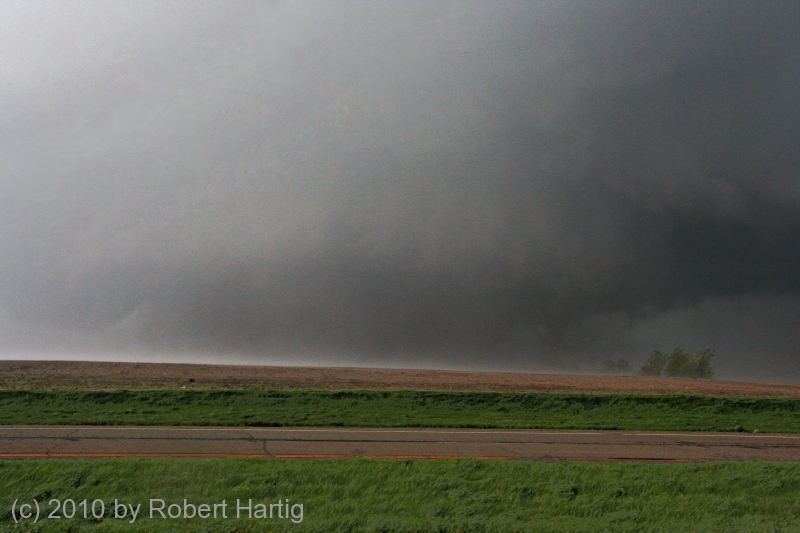
This is the last installment of my account of the drama that unfolded for a number of storm chasers, including my group of four, on May 22, 2010, in northeast South Dakota. I’ve waited to share this part because it’s personal–not a deep, dark secret, but something which until now I’ve kept to myself and a few friends. It is, however, an incident I’ve wanted to write about, and with seven months passed and Christmas just a few days away, now seems like an appropriate time to do so.

If you were one of those who were out there in the field that day, you’ll agree that we were fortunate to have escaped without injury when the outcome could easily have been quite different. Perhaps the greatest gift we have this Christmas is the fact that we’re all here to talk about our experience. You were there; you know how it was. It was a hell of a ride that has made for a story we’ll probably tell and retell the rest of our lives, but at the time there was reason to wonder just how much longer our lives would last.

For the rest of my readers, you can read my detailed account including photos here. I’ll summarize by saying that a routine move to reposition east of a violently tornadic supercell near Roscoe turned into a trap when the road–which showed as a through-road on our mapping software–dead-ended where a farmer had recently plowed it over. As tornadoes began to spin up just west of our contingent and head directly toward us, all seven or eight vehicles drove madly south along a fenceline in a desperate attempt to outmaneuver the worst part of the storm. A quarter-mile down, blocked by ponding, we turned into the field and drove another hundred yards or so until we could drive no farther. Then we parked, braced ourselves, and hoped for the best. And those who believed in a loving, watchful God, prayed. I was one of them.

I’m writing this post to thank my heavenly Father for not only responding to those prayers, but also, as I have intimated above, for letting me know in a personal and moving way that He was there with us in that field, present and protecting us all.

Spiritual topics trigger different things in different people. So let me make something plain. I write as a disciple of Jesus; I do NOT write as an emissary of contemporary Churchianity. Jesus I love, but I don’t care for much of religious culture, any more than I care for boxes of any kind. So whether you’re a Christian or a non-Christian, kindly resist the urge to stick me into a nice, tidy category that would likely say more about you than about me. I know the questions that arise surrounding answered–and unanwered–prayer. I also know the conclusions people easily arrive at, both pro and con. My purpose isn’t to address any of that in this post; rather, I am here to tell you a story and let you make of it what you will.

As Mike’s Subaru Outback bounced along the fenceline behind the vehicle in front of us, grinding its way into and out of muddy potholes, I had a good view to the west from the passenger’s seat. Rain bands spiraled and braided, hinting at unseen vortices. At one point, to my considerable consternation, I saw twin funnels wrapping around each other like a pair of dancing snakes, moving straight at us. They reminded me–I kid you not, so please don’t shoot me for saying this–of the “sisters” in the movie “Twister.” I’d estimate that their distance from us was around 150 yards. My buddy Bill Oosterbaan saw them too.

That was the moment when I realized we were not going to outmaneuver the storm, and the words “seriously screwed” took on a whole new dimension. It dawned on me that now would be an excellent time to pray, and I did, earnestly. I don’t remember my exact words, but the gist of them was that I asked God to protect us, all of us. The scenario was bathed in a strange sense of unreality, and it seemed incredible to think that I was praying for my life. But that was in fact what I was doing.

Whatever happened to those serpentine vortices I don’t know. Evidently they dissipated before they reached the fenceline. But their image lodged in my mind, and it got called back the following day in an unusual way, as you will see.

At length our caravan’s flight for safety ended in the manner I’ve already described above, and the storm descended on us in full fury. On Stormtrack, a chaser recently shared some radar images of that phase of the storm, and in one of them, you can plainly make out not just one, but two eye-like features passing directly over and just north of our location. Suffice it to say that the rotation above us was complex and broad. I remember a fierce wind that seemed to constantly switch direction, and mist driving along the ground at high velocities along with the rain. A tornado spun up briefly about a hundred feet from one of the vehicles; I didn’t see it, but Adam Lucio captured it on video* and my eyes just about popped out of my skull when I saw the clip. Daaaaamn! Any closer and…well, who knows, but it probably wouldn’t have been a pretty picture.

Fast forward past the rest of the storm and the miserable drama that ensued. It was the following day and I was sitting in a hotel room in Aberdeen. I fired up my laptop, logged into my email, and…hey, what was this? A message from my friend Brad Doll. Hmmm, cool! Brad and I rarely email each other. Curious, I opened his note.

I wish I had saved it–I thought I did, but I can’t locate it. Otherwise, I’d quote it exactly. But it’s easy enough to recreate the essence of it: “Hey, brother, just thinking of you and your love for tornadoes and thought I’d share this picture with you.–Brad”

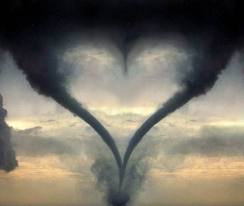
I opened the attached file. It contained the obviously Photoshopped picture you see here of two mirror-image, snaky-looking tornadoes with a funnel dividing the clouds between them, forming a heart. You can find the image without much trouble on the Internet, but I had never seen it before. As I looked at it, the snaky double-funnels I had seen yesterday popped into my mind. The similarity was weird–not that the previous day’s very real tornado resembled a heart; the only thing it looked like was scary as hell. No, it was the overall shape of its twin vortices and the way they had appeared in relation to each other that struck me.

Then it hit me. Brad didn’t have a clue where I was. He had no idea what I’d just been through. And he had never emailed me an image file before. Not only was the communication in itself unusual, but the timing of it was…well, it was incredible.

I could feel the tears coming to my eyes as the realization sank in. This email wasn’t from Brad. Not really. Brad was just a humble and available scribe; the message was from my Father, my wonderful heavenly Father. It was His way of saying, in a simple but powerful way, “Bob, I love you!”

What I’ve just written is something I believe with all my heart. God knows us through and through. He knows what makes you, you, and me, me; and He knows how to speak to each of us intimately, in ways that touch us in deep places if we have ears to hear. Here is what I believe He was saying to me:

“Bob, when you, Tom, Bill, Mike, and the rest of the guys were fleeing along that fenceline like scared rabbits, I saw you. I heard your prayer and the prayers of all who called on Me. And I was with you. My hand covered you and my presence protected you all–because I love you all, every last man of you who was there. Today, Bob, I’m letting you know that I truly was there–that yes, it was Me–and that I carry you in my heart.”

I am not one who calls every unusual thing that happens a miracle. I believe that genuine miracles are rare, and I dislike devaluing their reality by sloppily misapplying the word. But I also believe in grace, and from time to time I have witnessed extraordinary examples of what it can do. After receiving the email from Brad, I am convinced that what happened in the field on May 22 was one of those occasions. Things could easily have turned out far worse for those of us who were there. Instead of a joyous Christmas, this year could have been one of great sadness for our loved ones, and of an empty chair at the dinner table–a chair that once was ours. But this Christmas will not be that way. We will sit down once again with our families, and we will eat, and we will exchange gifts. We will get on with the rest of winter after the holidays. And we will return to the Great Plains this coming spring to enjoy another season of chasing the storms that we love.

Just about anything can be written off as coincidence, just as almost anything unusual can be written in as a direct act of God when it wasn’t necessarily so. It’s a matter of one’s worldview. If, having read my account, you’re inclined to consider my experience just a peculiar fluke, perhaps not even all that strange, then so be it. I can’t prove differently to you and I don’t feel that I need to try. But I most definitely believe otherwise, as does my friend Brad, and Tom, and Bill, and, I am sure, at least a few others who were there in the field.

It takes faith to see God’s kingdom, and faith is perhaps best described as an extra faculty, a sixth sense that augments the first five senses. It perceives and understands differently, and sees a different and higher reality behind the stuff of our lives. It is believing, but it is also a kind of knowing that I’ve never been able to describe satisfactorily. Like the color blue, once you’ve seen it, you know what it is; but whether you’ve experienced it or not, blue is blue, and so it is with the kingdom of heaven. However accurately or inaccurately, faith is the eye that sees it.

To my wonderful Lord, Brother, and Forever Friend, Jesus, whose birth I gratefully celebrate this season: Thank you–for so much more than I can begin to tell. And to my friends and fellow storm chasers, brothers and sisters of the skies, saints, sinners, seekers, wherever your worldview stands: May your Christmas be marked by grace. And may there be great steak and good beer in store for all of us this coming year.

Merry Christmas,

Bob

__________________

* You can see Adam’s clip along with more footage from the field, plus a whole lot more, on the DVD “Bullseye Bowdle,” produced by the lads at Convective Addiction. If you enjoy storm chasing videos, this one’s the real deal–and no, the guys haven’t paid me a solitary cent to plug it here.

So You Want to Be a Storm Chaser

The long months are here for storm chasers. Winter, the season of convective inactivity. The time some of us love but most of us simply endure. Three months–four, really–lie between now and our favorite time of year when the spring storm season begins to ramp up.

These are not idle months, though, or at least, they shouldn’t be. Now is the time for chasers to be cracking the books, reading papers, doing what they can to hone their forecasting skills. One great tool for achieving that objective has been the chase cases on Stormtrack.

For those not familiar with them, the chase cases are a user-based initiative in which, for a given case, a forum member volunteers to supply suites of data commonly used by chasers to pinpoint their targets. The data is typically gleaned from NOAA archives of actual weather events, with the first batch of maps, soundings, radar, satellite images, and SPC text products usually time-stamped 00Z on the night before the event. Chasers consult the data and determine their initial staging areas, then adjust their positions as subsequent forecast suites are released over time. A typical chase case can take three days or more to complete, depending on how busy the person supplying the data is.

At the end of it all, the players get to check their positions with the final radar images and storm reports and determine how they fared. Since these virtual scenarios are based on actual severe weather events that include verified tornadoes, the value of the chase cases is obvious. Besides being just plain fun, they allow participants to compare notes with what others are noticing in the forecasting tools and how they’re interpreting that information. They really help a person sharpen the razor during the snowy season.

Chase case number 5 ended last night. A northwest flow event, it was a tough nut to crack, and a lot of people busted, including me. At one point, six of us selected Woodward, Oklahoma, as a place to hang out under a boundary. It was a virtual chaser convergence, one of several that occurred on this case, and it got me to thinking. Forty-four people participated in case number 5–not many, given the vastness of the territory actually involved; yet many of us wound up clustering in the same places and wound up on the same storms. My question: What fraction of actual chasers out on a real chase day did we represent? In real life, given a major chase event, you can bet that the number of people pursuing storms would far outstrip forty-four.

It’s no secret that the hordes are increasing rapidly every year. Thanks to media shows such as Discovery Channel’s highly popular Storm Chasers series, what used to be a pretty solitary activity practiced by a relative handful has spiraled into a circus out on the Great Plains. Today it seems like everybody under the age of 30 wants to be a storm chaser, or at least, they think they do.

Far be it from me to separate between a host of yahoos who mistake opportunistic lunacy for the art and science of chasing storms, versus the far fewer individuals whose interest is rooted in something more trustworthy than reality TV. It’s your right to chase storms if you want to, and everybody has to start somewhere. Shoot, I’ve been chasing for coming up on 15 years now, and I still consider myself rather green. Number of years doesn’t automatically translate into expertise. Nevertheless, I’ve seen enough to have formed some opinions about where storm chasing seems to be headed as more and more new blood flocks to Tornado Alley. To those of you who, inspired by what you’ve seen on television, plan on heading to the Plains for the first time this coming spring, I have this to say:

Don’t be an idiot.

I mean it. I’m not saying don’t go. I’m saying, before you go, learn about what it is that you’re getting into. There’s more to it than you realize, and if your knowledge thus far comes from watching a TV series or a handful of YouTube videos, then honestly, you don’t know jack.

Start with this thought: Storm chasing is not about getting as close as you can to a tornado. “Extreme chasing” is a fairly new phenomenon that has been glorified by the media to the point where it has, in impressionable minds, set a new and dangerous standard. But it’s not the historical norm. The reality is, most veteran chasers have generally maintained a safe distance from tornadoes. So banish any images of driving to within 100 feet of a tornado. Hello? It’s a freaking TORNADO. And you’re not Reed Timmer or Tim Samaras. Those guys have knowledge and experience you can’t even imagine, and what you’ve seen of them on TV has been just one highly condensed, scripted, edited, incomplete, and not altogether accurate part of a much bigger picture. Trying to shortcut what is in fact a pretty involved learning curve could easily get you killed or maimed for life.

Getting close to tornadoes is just one style of chasing. I have friends who practice it; it’s a choice they make based on their level of experience and situational awareness, which I respect, and I’m not going to knock them for it. They know the risks. For that matter, I’ve been pretty close myself on a few occasions, not always by choice. Every storm is different. In general, though, keeping a good mile or more between you and a tornado isn’t wimpy, it’s smart.

Enough about that. Here’s my next bit of advice: Respect others who are on the road, and respect locals whose lives can be impacted both by the weather and by your own actions. Chasing a storm doesn’t accord you some sort of elite status to which traffic laws don’t apply. Parking your car in the middle of a traffic lane in order to take pictures of a storm is selfish, inexcusable behavior; either find a damn turnoff or else keep moving until you locate a place where you can pull over onto the shoulder. And driving 30 miles an hour over the speed limit endangers not only you, but others as well, particularly in a rainy storm environment where hydroplaning is a real danger. Last May in South Dakota a bunch of chasers, including me, had to deal with a very pissed-off sheriff whose attitude toward us had been provoked several hours prior by a chaser who blasted past him at 90 miles an hour. The sheriff was preoccupied at the time; otherwise he’d have busted the guy. As it stood, one thoughtless driver gave that LEO a bad impression of chasers in general, and he took his anger out on us. So remember, you don’t own the road. And no, being a rugged, individualistic American citizen doesn’t give you the right to conduct yourself in ways that negatively affect other people.

I could probably have lumped both of my preceding points together by saying, educate yourself and use common sense. First and foremost, learn about storm structure and morphology. Discard any high-octane media images you may have of storm chasing and instead find out what it takes to chase safely and successfully. I highly recommend West Texas storm chaser Jason Boggs’ educational resource site–it’s a gold mine of information. So are severe weather forecasting guru Tim Vasquez’s books, available through his business, Weather Graphics. If you can only afford one book, get The Storm Chasing Handbook. It’s a great introduction to the nuts and bolts of chasing storms.

Storm chasing is an incredible avocation with rewards that extend beyond the beauty and drama of the atmosphere to other dimensions, aesthetic, intellectual, interpersonal, and spiritual. But by its very nature, chasing storms is also a potentially dangerous activity. If you’re going to take it up, the smartest way to go about it is to exercise humility and restraint, and to make learning your priority rather than an adrenaline rush. Pursue that first objective and the second will come in due time.

Be safe. Be smart. Be courteous. The Plains have gotten smaller and more crowded in recent years. How you conduct yourself on them, and the attitude you display, makes a difference for everyone.

First Day of Meteorological Winter

Some of you will greet the news with glee, others with a groan, but either way, today is the first day of meteorological winter. Right, we’ve still got another three weeks before the winter solstice, when the year’s shortest period between sunrise and sunset marks the arrival of astronomical winter in the northern hemisphere. But it sure looks like winter right now to me, and that’s what matters to meteorologists. For them, winter begins December 1, just as each of the other three seasons commences on the first day of its three-month block. Why? Because that arrangement corresponds better with how we experience seasonal weather in real life. Here in Michigan, we often get a pretty good hammering of snow in November, and by winter solstice on December 21 (or sometimes 22), we’re already usually pretty well socked in. It seems almost laughable when someone announces on solstice that it’s the first day of winter. Really? Could’a fooled us. We thought it began a month ago.

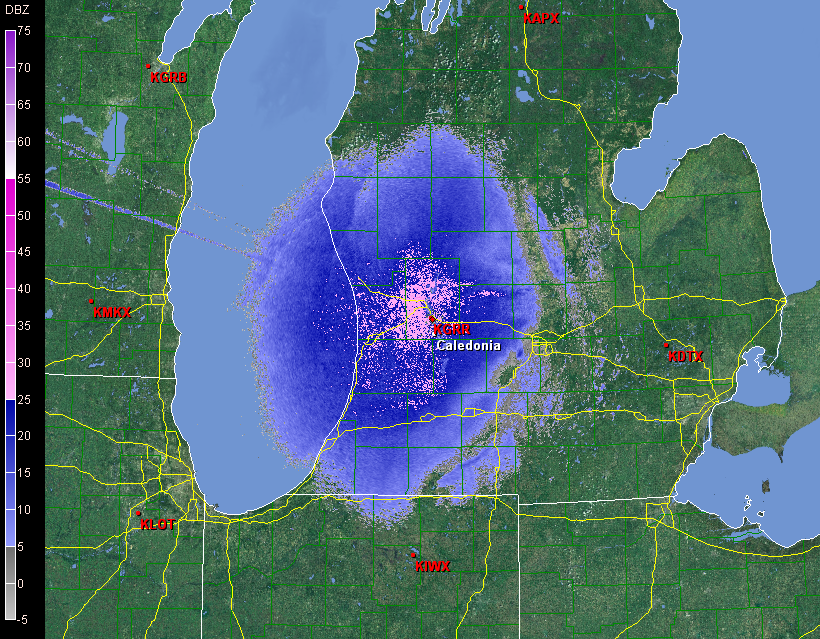
I woke up this morning to be greeted, very appropriately, by the year’s first snow accumulation. Yesterday temperatures opened in the low fifties, but they began dropping and the afternoon grew downright chilly. Today snow is falling, and out in the parking lot a woman is brushing the white stuff off of her car. It’s almost like winter has been consulting its watch, waiting in the wings and then entering the stage exactly on cue with a bucketload of lake effect. The snow will be with us for a few days, now, and the radar will continue to look a lot like the image on this page. Click on it to enlarge it, and get used to it, because you’ll be seeing a lot of similar pictures from now until meteorological spring arrives on March 1, 2011.

Yazoo City Tornado Number Two: A Stormy Night in Mississippi

Last night’s tornado in Yazoo City, Mississippi, thankfully appears to have been not nearly as bad as its monstrous EF-4 predecessor back in April, but it was bad enough. It was one in a round of tornadoes that trampled across the South yesterday afternoon on into the night. Fed by ample moisture and energized by bulk shear exceeding 60 kts and 1km helicity exceeding 300, supercells had no problem firing up and dropping tornadoes. At the time of this post, seven tornado reports have been logged for Dixie Alley–one in Louisiana and six in Mississippi. (A tornado was also reported in northwest Missouri, but that’s far removed from the southern storms and was a separate situation.)

I watched my GR2AE radar screen in disbelief last night, shortly before 9 p.m. EST, as strong circulation progressed from the southwest toward Yazoo City. “No way,” I thought. “No freeking way.” How could the same small town get clobbered by a tornado twice in the same year? It wasn’t going to happen. It just couldn’t. But it did.

At 8:18 CST a tornado warning was issued–a continuation of a previous warning–which contained the following statement: AT 816 PM CST…LOCAL LAW ENFORCEMENT REPORTED DAMAGE FROM A TORNADO JUST PASSING THROUGH THE CITY. THIS TORNADO WAS LOCATED 6 MILES SOUTH OF EDEN MOVING NORTHEAST AT 50 MPH. At that point I could see the potent SRV couplet moving right through what appeared to be the south edge of the town. According to reports this tornado crossed the path of the April storm, like a letter X. Fortunately, it appears to have been nowhere nearly as large or violent, and a scan or two later showed the mesocyclone weakening considerably as it left the city. Here is the string of reports from the National Weather Service at Jackson:

0800 PM     TORNADO          5 SW YAZOO CITY         32.81N 90.47W
11/29/2010                   YAZOO              MS   AMATEUR RADIO

            3-4 MILE LONG PATH OF DAMAGE ALONG EAGLE BEND ROAD.
            LIKELY TORNADO DAMAGE. UPDATED...VEHICLE
            OVERTURNED...STRUCTURAL DAMAGE...SHOP DESTROYED. NEAR THE
            NORTHERN INTERSECTION OF EAGLE BEND ROAD AND HWY 3.

0808 PM     TORNADO          YAZOO CITY              32.86N 90.41W
11/29/2010                   YAZOO              MS   AMATEUR RADIO

            DAMAGE TO THE COURTHOUSE ROOF IN DOWNTOWN AND A LARGE
            TREE DOWN NEXT TO THE COURTHOUSE. WIDESPREAD DEBRIS IN
            THE AREA.

0810 PM     TORNADO          YAZOO CITY              32.86N 90.41W
11/29/2010                   YAZOO              MS   AMATEUR RADIO

            ADDITIONAL STRUCURAL DAMAGE REPORTED IN YAZOO CITY WITH
            NUMEROUS LARGE OAK TREES SNAPPED AND UPROOTED. POWER
            LINES ALSO REPORTED DOWN ALONG CENTER RIDGE ROAD.

0810 PM     TORNADO          YAZOO CITY              32.86N 90.41W
11/29/2010                   YAZOO              MS   EMERGENCY MNGR

            MAJOR STRUCTURAL DAMAGE REPORTED TO AT LEAST 18
            BUSINESSES...MINOR DAMAGE TO AT LEAST 3 WOODEN FRAME
            HOUSES. ENTIRE FACADE OF ONE DOWTWON BUILDING HAD ALL
            WINDOWS BLOWN OUT. 30 PERCENT OF YAZOO CITY REMAINS
            WITHOUT POWER.

0810 PM     TORNADO          YAZOO CITY              32.86N 90.41W
11/29/2010                   YAZOO              MS   AMATEUR RADIO

            POWER LINES...TREES...AND WIDESPREAD POWER OUTAGES ARE
            REPORTED WITHIN YAZOO CITY. WILL UPDATE FURTHER WITH
            ADDITIONAL INFORMATION.
.

While Yazoo City stands out by virtue of having gotten hit twice this year, other communities also sustained damage. The show began in the afternoon and evidently continued through the night, because when I woke up this morning and fired up my computer, I saw a tornado warning in Alabama. Tornado watches are currently in effect for the southeast, and the SPC shows a slight risk extending north as far as southeastern Pennsylvania, with a 10 percent hatched area reaching from South Carolina into Virginia.

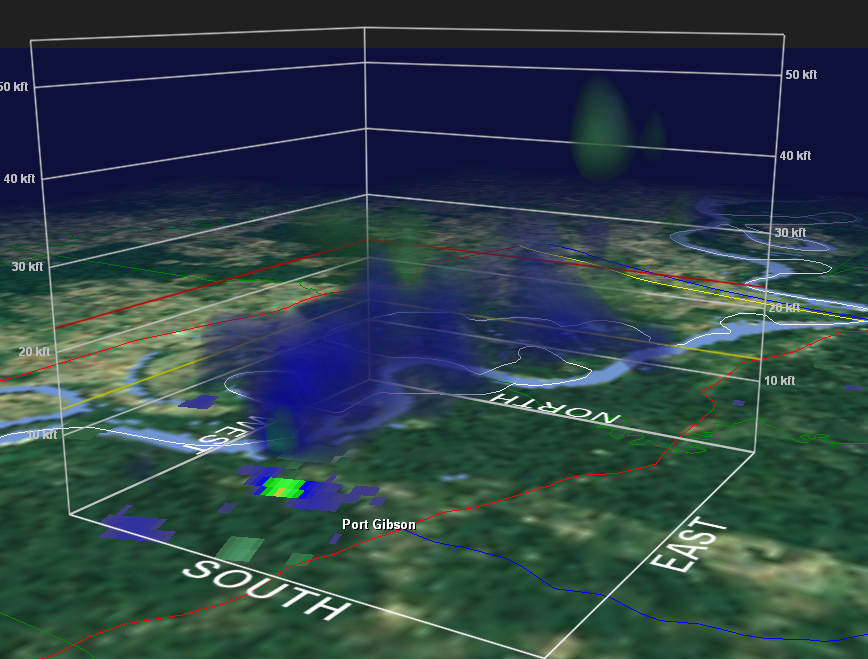
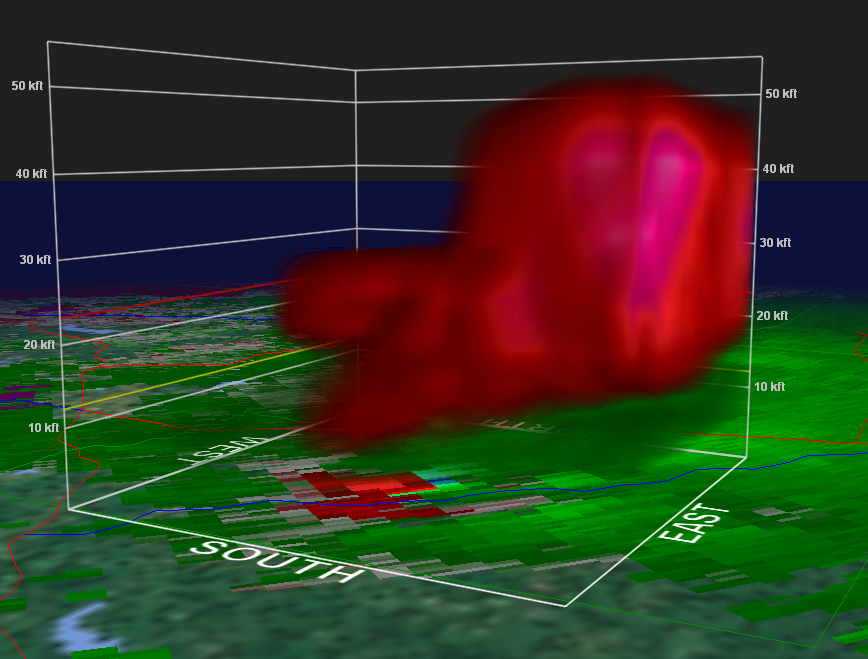
The images on this page are GR2AE volume scans of the next supercell southwest of the Yazoo City storm, heading on a trajectory just west and north of Port Gibson. Click on the images to enlarge them. The time was 0232Z, or just a couple minutes after 8:30 CST. The topmost frame shows a hook and correlated structure above it, with the suggestion of a pretty healthy BWER. The bottom frame depicts vigorous rotation.

Dixie Alley Severe Update: Yazoo City

Unbelievable. Yazoo City, Mississippi, which sustained a massive and deadly EF-4 tornado back on April 24 of this year, got hit by another tornado just a couple hours ago. A tornado warning issued at 8:18 CST reads as follows:

AT 816 PM CST…LOCAL LAW ENFORCEMENT REPORTED DAMAGE FROM A TORNADO
JUST PASSING THROUGH THE CITY. THIS TORNADO WAS LOCATED 6 MILES
SOUTH OF EDEN MOVING NORTHEAST AT 50 MPH.

A line of tornadic supercells continue to rake across Mississippi. As I write, at 9:19 CST, the most robust circulation is west of Raymond; however, weaker circulation is passing just to the north of Port Gibson. Oops, new scan in, and that circulation appears to have intensified. And there are other tornado-warned storms in progress as well.

This will be a nasty night for Dixie Alley dwellers. I’ll have more to write tomorrow, along with a couple volume scans to share from GR2AE. Let’s hope and pray that no fatalities result from this round of severe weather. Night time storms are killers.

Dixie Alley Lights Up

Severe storms have been pushing through Dixie Alley this afternoon and evening, fed by dewpoints in the mid 60s to lower 70s and propped by bulk shear in the 60-70kt range. The action has been largely in Louisiana, where tornado warnings have been ongoing for several hours and tornado damage has been reported northwest of Atlanta.

Typical of southeastern storms, these ones look pretty HP-ish, real drenchers. They’ve waned in intensity from earlier, but they’re still dangerous storms, and one of them  in East Carroll County is presently tornado-warned.

Here’s a GR2AE volume scan from the Shreveport radar depicting storm-relative velocity at 2107Z. Click on the image to enlarge it. You can see a pronounced couplet, indicating strong base-level rotation. I believe this was in fact the storm responsible for the tornado report, although two others in the same region displayed potent mesocyclones. More tornado reports may turn up from that part of Louisiana before the night is through.