GRLevelXStuff Has Returned!

Users of GR3 and other Gibson Ridge radar products, rejoice! GRLevelXStuff.com has returned!

A couple months after the site’s disastrous crash, I had pretty much concluded that Aaron et al had given up on it as too time-consuming and costly to resurrect. But tonight, just on a whim, I clicked on their bookmark, and lo and behold, there was ‘Stuff in all its glory.

If you’re already familiar with GRLevelXStuff, this should be good news indeed. If you’re not in the know about it and you use GR3, GR2, or GR2AE, then you definitely need to get acquainted with the site. In its past incarnation, before the disastrous crash that wiped out the entire database, barring the stuff that Aaron had saved on his hard drive, ‘Stuff was the premier support forum for Gibson Ridge users. It was a massively helpful resource in terms of both knowledge and applications. The color table section alone was enormous, and the background section of topo maps couldn’t be beat.

So this is my plug for the reborn GRLevelXStuff. Aaron and his team are hard at work rebuilding it, and such a project requires a community effort. If you use a GRL product, I urge you to visit the site, give the lads a well-deserved thumbs-up, and get involved. Registration–or re-registration, if you were a member of the pre-crash site–takes just a second.

One other thing: if you can afford to, please make a donation. It’s very easy to do so, and every dollar will help. GRLevelXStuff provides a terrific service, and it’s well worth getting behind with your dollars as well as your goodwill. Aaron has been upfront about the costs involved in recreating and maintaining the site, and the need for financial assistance. I just dropped my farthing in the collection basket, and I hope you will, too, if at all possible. Let’s do our best to help make the new ‘Stuff better than ever.
Highlights from the 2009 COD Severe Weather Conference

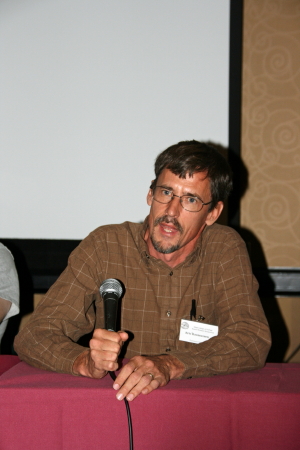
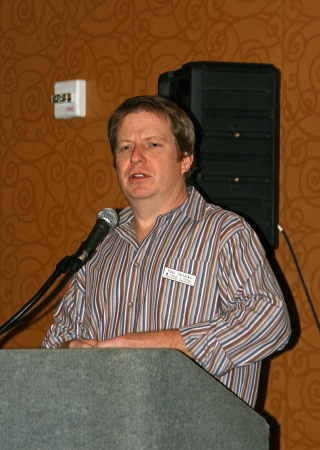
Paul Sirvatka of COD, conference organizer

Paul Sirvatka of COD, conference organizer

The 2009 College of DuPage Severe Weather Symposium is now behind me, and in the light of it, it seems a bit weird to think that the day after, I headed over to my buddy Bill’s to watch the next episode of the Storm Chasers series on Discovery Channel. It feels like two different worlds, like boarding a bus in Grand Rapids and getting off on Mars. But the difference is superficial, a matter of editorial slant; the raw material remains the same, and however it gets spun on television, it’s nevertheless the stuff of research. In reality, people really, truly are going out there and surrounding supercells with an armada of mobile radars and other devices, including manned probe vehicles, all in the interest of collecting data that can increase our understanding of, in a nutshell, what makes tornadoes happen.

The conference featured some of the most knowledgeable and revered names in severe weather research, operational forecasting, and storm chasing: Eric Rasmussen. Chuck Doswell. Roger Edwards. Roger Wakimoto. Josh Wurman. The list goes on, but the point is, a lot of very knowledgeable heads were present in the Double Tree Hotel’s conference room this past week, and some of the insights they shared were fascinating.

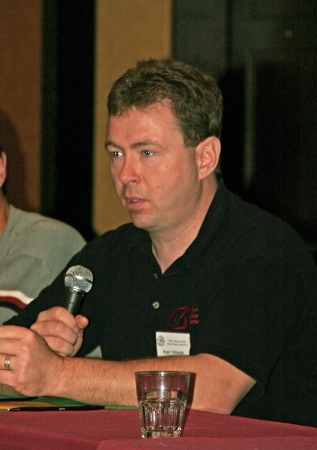
Taylor and Carlsen of Environment Canada

Taylor and Carlsen of Environment Canada

Some of the coolest stuff didn’t even come out of the United States. Neil Taylor and Dave Carlsen of Environment Canada shared a photogrammetric analysis of the Elie, Manitoba, F5 tornado, and preliminary findings from the 2008 UNSTABLE team’s exploration of a well-known but hitherto unresearched dryline phenomenon in Alberta. The latter featured EC’s own mobile mesonet, complete with a Doppler-equipped airlplane.

Here are just a few, representative snapshots of the many other topical materials covered:

* Adam Houston talked about the effects of entrainment on unstable parcels, and suggested that the important issue for storm formation isn’t whether a parcel is merely unstable, but whether it is “supercritical”–i.e., possesses enough CAPE to overcome the effect of entrainment.

Eric Rasmussen

Eric Rasmussen

* Eric Rasmussen shared some of the prelimary findings of VORTEX2, describing the interaction of the RFD with horizontal vortex rings in tornadogenesis.

* Roger Edwards discussed the forecast funnel and the pros and cons of numerical models in operational forecasting.

* Al Pietrycha offered an operational forecasting perspective on non-mesocyclone tornadoes, and more specifically, on landspouts.

* For his dinner presentation Saturday night, Chuck Doswell gave an overview of the history of severe weather forecasting and research, and shared his outlook on things to come.

The shape of the future was in fact a topic of concern for a number of the speakers, notably Doswell and Edwards. Amid the influx of information from the research community on misocyclones, vorticity arches, moisture

Roger Edwards

Roger Edwards

convergence, and so on, those on the operational side focused on a more pragmatic matter: the widespread over-reliance on numerical models versus hand analysis.

Will forecast models replace human forecasters? According to Doswell and Edwards, yes, at least for most forecasting scenarios. Edwards emphasized that when it comes to severe weather events–the most difficult to forecast, and the costliest in terms of lives and property–humans will still play an important role. But both men deplored the degree to which forecasters have abdicated hand analysis to the models, which continue to make advances in accuracy at the expense of human development. In a word, the attention and the money are being invested in building better technology, not better forecasters.

Doswell’s message to meteorology students was blunt: either soak in as much information as possible, and commit to becoming experts at hand analysis and motivated self-educators, or else find a different career. Chuck, who is not known for being shy about sharing his viewpoints, wasn’t being nasty, just extremely forthright.

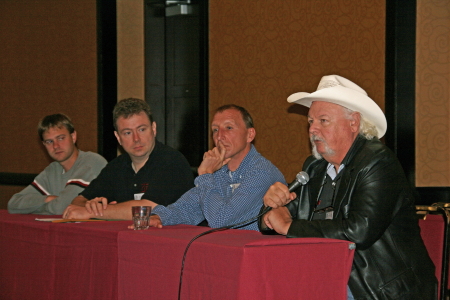
Chuck Doswell speaks

Chuck Doswell speaks

The mets from Environment Canada, Carlsen and Taylor, were clearly shocked to learn how dependent United States WFOs have become on forecast models. The Canadian meteorologists take hand analysis as a given part of their jobs, and couldn’t imagine not rolling up their sleeves and interacting with the surface and upper-level charts firsthand.

If there was a primary take-away value for me from this conference, I guess that’s it: the importance of getting my arms around hand analysis. Practically speaking, while I found the other material fascinating and enriching, much of it was not particularly applicable to my needs as a storm chaser. The first priority is to get to the right storms. Everything else falls into place from there.

The Severe Weather Symposium Is Finally Here

The event I’ve been so looking forward to is here at last: College of Du Page’s 2009 Severe Weather Symposium.

Tomorrow at 1:00 p.m. kicks off with Adam Houston speaking on “Principles of Deep Convection.” I’m not sure how much of his material will be an overview of mesoscale basics and how much will introduce new knowledge, but from my perspective, revisiting the essentials can never hurt, particularly since the rest of the first day will all focus on thunderstorm initiation.

Based on my two previous experiences with COD’s severe weather conferences and on the contents of the present agenda, I have high expectations for this conference. It should be an informational gold mine, and I anticipate leaving it Saturday enriched with some extremely useful insights–many of them cutting-edge– that should enhance my forecasting skills during the 2010 storm chasing season.

The goal is, of course, improved targeting, with fewer busts and more tornado intercepts. But deepening one’s knowledge is a reward in itself, and the payoffs can’t always be predicted with pinpoint accuracy any more than the weather can. For now, it’s enough to say that I’m very excited about this conference. The lineup of speakers is impressive, the subject material sounds like everything I could ever hope for, and I look forward to finally connecting with a few people whom I’m familiar with from Stormtrack, but whom I’ve never met in person.

My storm chasing partner, Bill Oosterbaan, will also be attending, naturally–he’s as gonzo about this stuff as I am. We’ll be rooming together. Wish his bro, Tom, could make it as well, and my good friend, Kurt Hulst, but both of them have commitments and financial constraints. Tough break. We’ll miss you guys! And we’ll take good notes–promise.

I might add that I’ll be bringing my saxophone. Since the event is being held at the Double Tree Hotel in the Chicago area, the chance of finding some live jazz in the area isn’t out of the question, maybe even in the hotel restaurant. Should the opportunity arise, it would be fun to sit in with a band, and in any case, I can at least get in a little practice. Wherever I go, I take my saxophone with me. Everywhere, including storm chases. It pays to be prepared.

An October Great Lakes Wind Machine

Geeze, is it ever blowing out there! The low pressure system that I’ve been harping about this past week has been moving through the Great Lakes, bringing with it temperatures in the low 70s, rich dewpoints, heavy rain, and wind gusts as high as 48 miles an hour.

Here’s a grab of the current conditions at 9:15 eastern time. Click to enlarge.

The 980 mb low has nudged off the Minnesota border into Ontario and continues to deepen rapidly as it heads east. You can see the line of storms firing along the cold front all the way down into the Gulf. Mississippi and Alabama got hammered earlier with an outbreak of supercells, but that action seems to have died down now. Not so the wind here in Grand Rapids, Michigan. It began picking up from the south in the afternoon, but it has now veered to the southwest with the passage of the cold front.

Temperatures have dropped over ten degrees over the past hour or so. The KGRR station ob says 58 degrees, but just 60 miles to my east, KLAN is registering 70 degrees.

There won’t be much left of the leaves come tomorrow morning. This system has been typical of a Michigan October–a wind machine that denudes the trees, delivering the coup de grace to the warm season and requiring those of us who live in the Great Lakes to gird our minds for winter. Ugh! These next five months won’t be fun.

The Farmers’ Almanac Secret Weather Formula: Even Eric Rasmussen Doesn’t Know It–But One Man Does

In a recent post, I poked a bit of gentle fun at the Farmers’ Almanac’s long-range forecasts, speculating that the Almanac’s weather sages were consulting woolly bear caterpillars to determine the nature of the coming winter.

Writing the article was good for a grin, but doing so got me to wondering: How the heck do those folks over at Farmers’ Almanac go about making such perilously far-out weather predictions, anyway? Surely they must have a few highly knowledgeable weather heads on staff with access to some extremely sophisticated technology, along with a formidable understanding of global climatology, oceanography, and whatnot.

So I posed the question on Stormtrack, and Lansing meteorologist Rob Dale responded with a link back to the Almanac which answered my question beautifully. Turns out the Farmers’ Almanac is far more advanced than I ever dreamed.

What’s their secret? A roomful of meteorologists hunched over sophisticated computers? A database brimming with decades worth of climatological statistics?

Nope. The Farmer’s Alamanac doesn’t need computers, and it doesn’t need no stinkin’ mets, climatologists, or databases. No, they’ve got something better: a solitary “calculator” named Caleb Weatherby and a nearly 200-year-old, proprietary formula developed by the Almanac’s founder, David Young, which allows Weatherby to calculate the Almanac’s forecasts several years in advance.

Did you get that? Several years. We are no longer talking weather forecasting here, we are talking prophecy. But perhaps prophecy is one of the secret ingredients blended into Young’s incredible formula.

According to the Almanac, “Since 1818, this carefully guarded formula has been passed along from calculator to calculator and has never been revealed*.” No one else besides Caleb Weatherby knows it. Not the SPC, not NASA, not the CIA, not Chuck Doswell, not even your mother.

While the formula eludes even the lofty craniums at NOAA, who must resort to more primitive devices such as GOES, Doppler radar, atmospheric soundings, numerical models, and a fleet of high-tech computers, the Almanac assures us that their formula “considers many factors, such as sunspots, moon phases, and other astronomical and atmospheric factors and conditions.” They forgot to mention eye of newt, but I suppose that would be giving away too much.

Just in case you’re doubtful, the Almanac furnishes a long list of their forecasting triumphs. I have to tell you, though–and I don’t wish to shock you, but confession is good for the heart–that I’m nevertheless a bit skeptical. Spin is spin, and a lot of things can be spun, including the conclusions extrapolated from weather statistics and meteorological crapshoots.

To be fair, the Almanac admits that “weather forecasting still remains an inexact science. Therefore, our forecasts may sometimes be imperfect. If you are planning an outdoor event, we recommend that you also check forecasts from local sources.”

That last, modest caveat is a bit of good advice, and if you’re a fan of Farmers’ Almanac forecasts, you’d do well to take heed. Go ahead and plan your family reunion picnic at the park six months in advance based on what the Almanac says; but if I were you, when it comes down to the week of, I’d place a whole lot more faith in the predictive expertise of your local WFO than in something generated by the Almanac’s calculator several years prior. I mean, you never know–ol’ Caleb might have been missing a few essential chicken bones from his rattle when he was doing his forecasting dance for that day.

Now, please, please, please…if you’re a die-hard devotee of the Farmers’ Almanac, don’t take me too seriously. I’m just having fun, but I really think fondly of the Almanac. It’s a beloved and revered slice of Americana that bears a torch of genuine, irreplaceable folk wisdom, and if you swear by its forecasts, great. Continue to swear by them (or at them, when they don’t pan out quite the way you expected). I’ve personally enjoyed reading them, and they’re harmless enough. The world would be a poorer place without them, and certainly less amusing.

But when it comes to chasing storms or going camping, I’ll probably look elsewhere for my weather information. Punxatawney Phil, for instance. He’d make a great chase mascot, and I’ll bet he’s  a whiz at pinpointing storm initiation.

______________________

* All quotes excerpted from the Farmers’ Almanac article, “How does the Farmers’ Almanac Predict the Weather? [sic]” Article’s web page address at the time of this blog post: https://www.farmersalmanac.com/farmers-almanac-forecasts

Friday’s Outlook: A Real October Leaf-Stripper

Whichever model gives the more accurate picture–the GFS or the WRF-NMM–one thing is sure: we Michiganians can say good-bye to the leaves. This Friday’s weather system promises to be a real October leaf-stripper, with a formidable low-pressure center deepening rapidly as it moves through Ontario.

The two forecast models continue to differ in timing, with the GFS moving the cold front rapidly through the state’s mid-section by 18Z, while the NAM plays it more conservatively and backs the surface winds considerably more. The NAM is also much more aggressive with 850 mb winds, with the 12Z run calling for 75 knots (!!!), while the GFS dribbles out a paltry 55-knot LLJ.

I have a hunch that the GFS is closer to the truth, though of course, time will tell.

Both models agree that instability will be non-existent. Not much there to gladden the heart of a storm chaser. But by golly, we’ll be seeing some wind. Bye-bye leaves!

For the sake of comparison, I took a sampler of 6Z model soundings for both the GFS and the NAM for Jackson, Michigan–a nice, central location that should offer a good compromise between both models. The differences are striking. Click on the images to enlarge them. For 21Z, I’ve shown only the NAM; by that time, the GFS has the winds lined out.

Forecast hours for Friday, October 30

15Z

GFS

NAM

18Z

GFS

NAM

21Z

NAM

Storm System Poised to Hit the Great Lakes on Friday

Looks like one heck of a storm system will be moving into the Great Lakes this Friday. Today’s 18Z GFS shows a potent, 976 mb low centered on the Minnesota/Canada border on the 30th at 18Z, deepening to 972 mb as it moves northeast into Ontario by 00Z. The ECMWF is less aggressive in its timing, and I hope it’s the more accurate of the two long-range models, since I think it offers better potential for more than just straight-line winds.

While they may not be perfectly in sync, both models agree that we’ll be seeing some heavy weather on the 30th. It’s not exactly a storm chaser’s dream scenario, with little in the way of directional shear and with storm motions in the warp speed range. I see “linear” written all over this event. But this time of year, I’ll take whatever I can get and be grateful.

Positives: dewpoints in the 60s reaching into Michigan, at least a semblance of CAPE at around 500 j/kg, and certainly no lack of bulk shear. Judging by the size of the system and the tightness of the isobars, we are in for a real October leaf-stripper.

And here comes the old disclaimer we all know and love: we’ll see what further model runs reveal. The NAM will be adding its paint to the picture shortly. I wish it would agree with the Euro in slowing the system down, giving Indiana and Michigan a good dose of moisture along with backed surface winds. Fingers crossed and hoping for a gift, because this will very likely be my last shot at anything resembling severe convection until March or April, 2010.

The Farmers’ Almanac, Woolly Bears, and Government Cover-Ups

Given the unreliability of long-range forecast models, there’s a lot of justifiable skepticism in the storm chasing community when someone (like me, for instance) talks about an event that’s 120 or more hours out. Beyond maybe three days, trying to forecast weather events becomes increasingly like reading tea leaves. We watch the ECMWF and GFS for signs of agreement and consistency, and if they start showing up, we cross our fingers, knowing that a lot can happen between now and payday.

So I’m not sure what to think when the revered Farmers’ Alamanac gazes into its crystal ball and issues with serene confidence the following prognostication for the Great Lakes region:

November 2009
1st-3rd. Sunny, with increasing clouds. 4th-7th. Rain spreads in from the west. Turning clear and frosty. 8th-11th. Rapid temperature changes. Storm moves east, with heavy rain or wet snow. Frigid cold air follows. 12th-15th. New storm moves into Great Lakes. Heavy rain and/or wet snow. Then clearing and very cold. 16th-19th. Storm sweeps across the area, followed by very cold air. Fast-moving storm, reaching the region by the 19th. Heavy snow, followed by colder air. 20th-23rd. Cold Canadian front brings rain and thunderstorms for the Great Lakes region. 24th-27th. A wet Thanksgiving.  28th-30th. Few rain or wet snow showers. Turning colder.

December 2009
1st-3rd. Rain and wet snow shift into the Great Lakes, south to Kentucky, followed by clear and cold weather. 4th-7th. Storm Ohio River Basin deposits heavy rain and wet snow. Very cold air follows. 8th-11th. A “winterlude” for Great Lakes and the Ohio River Basin. Temperatures still well below seasonal norms. 12th-15th. Scattered snow showers and flurries. 16th-19th. Considerable cloudiness over most areas, but little precipitation. Nights are seasonably cold, days are mild. 20th-23rd. Rain and/or snow.

Not being a climatologist, I’m unaware of what sophisticated meteorological resources the Farmers’ Almanac may be tapping into. Possibly they’ve been consulting woolly bear caterpillars. According to folklore, you can tell how severe the winter will be by the ratio of brown to black banding on the woolly bears. Plenty of brown means a mild winter; wide black bands with little brown points to a nasty snow season. A few weeks ago, I found an all-black woolly bear. I knew that couldn’t be good.

If only we could get the woolly bears to cooperate when storm chasing season is underway. But the little critters have other things on their minds by then, namely, pupating and becoming Isabella tiger moths. So I guess we’re stuck with the Euro and the GFS. Or sacrificing chickens, though the research supporting the link between chicken sacrifice and improved storm intercepts is slim.

No doubt the government is covering up the information, just like they do everything that’s related to severe weather. They want us to remain ignorant, unsuspecting guinea pigs while the weather gods at Norman conduct their insidious experiments, using their array of antennas and radars to generate monster tornadoes 400 miles away and then guide them unerringly through populated areas. Take the May 13 Kirksville, Missouri, tornado, for instance. That one had Government Issue written all over it. The lack of a single shred of substantiating evidence just goes to show how expert Big Brother is at keeping the truth hidden.*

That’s why you’ll find no NOAA papers correlating tornado outbreaks and chicken sacrifice. Same with woolly bears and long, hard winters–though the Farmers’ Alamanac folks, bless their hearts, have obviously made the connection, and hence, they have the weather for November and December pretty well locked in. I call that kind of forecasting ability reassuring.

As for the rest of us, well, we’ve got the ECMWF, the GFS, and tea leaves. How do you like your tea?

_______

* The following disclaimer is intended only for those who take me seriously: I’M JUST KIDDING! Sad that I’ve even got to say it, but the truth is, some folks out there do in fact believe some damn crazy things about the government’s ability to manipulate the weather. I’m not one of them, and I wouldn’t want to be mistaken for such.

That being said, I would love to see the SPC’s research on chicken sacrifice and tornadogenesis.

COD Severe Weather Symposium: Are You Going?

It’s drawing closer, and I’m getting excited. I’m talking about the College of DuPage’s upcoming Severe Weather Symposium, which will be held November 5-7. With a lineup of presenters that features some of the foremost luminaries in severe thunderstorm research, the event promises to be stellar.

I’m surprised I haven’t seen more talk about it on Stormtrack, but maybe that’s because the symposium is being held in Chicago rather than out in the Great Plains. Or perhaps it’s because the midweek timing puts a crimp on people who have to work.

But while proximity may be an issue for some and scheduling for others, the content is compelling enough that if you’re anywhere within a couple hundred miles, it will truly be your loss if you don’t make time for this event. Looking over the agenda, here’s what I see:

* All of Thursday afternoon is devoted to various aspects of convective initiation. If you want to improve your targeting skills with the latest information, this day alone ought to be worth its weight in gold.

* Day two focuses largely on tornadogenesis, but includes other topics such as a photogrammetric analysis of the Elie, Manitoba, F5 tornado, and issues in severe weather warnings. The latter presentation will no doubt address the hotly contended use of the enhanced “tornado emergency” wording.

* Day three will…well, look, here’s the complete agenda. You can read it for yourself, and conclude, as I did, that this is going to be a standout event for storm chasers.

I’ve been waiting for a long time for another severe weather conference courtesy of Paul Sirvatka and the College of DuPage. I attended two of their symposiums some years ago, back when my storm chasing skills were still very formative, and each one was time well spent. This one looks to be the best yet. Poised between the end of a stormless autumn and the long, desperate, SDS-riddled winter months, it will provide a welcome immersion into the world of tornado research and operational forecasting that ought to bear dividends when the Gulf reopens for business again next spring.

RAOB and Other Weather Widgets

Some storm chasers pride themselves in being minimalists who have a knack for intercepting tornadoes without much in the way of gadgetry. Others are techies whose vehicles are tricked out with mobile weather stations and light bars. It’s all part of the culture of storm chasing, but the bottom line remains getting to the storms.

To my surprise, while I draw the line at gaudy externals, I’ve discovered that I lean toward the techie side. For me, storm chasing is a lot like fishing. Once you’ve bought your first rod and reel and gotten yourself a tackle box, you find that there’s no such thing as having enough lures, widgets, and whizbangs. You can take the parallels as deep as you want to. Radar software is your fish finder. F5 Data, Digital Atmosphere, and all the gazillion free, online weather maps from NOAA, UCAR, COD, TwisterData, and other sources are your topos. And so it goes.

A couple years ago I spent $300 on a Kestrel 4500 weather meter. It’s a compact little unit that I wear on a lanyard when I’m chasing. It weighs maybe twice as much as a bluebird feather, but it will give me temperature, dewpoint, wind speed, headwinds, crosswinds, wind direction, relative humidity, wet bulb temperature, barometric pressure, heat index, wind chill, altitude, and more, and will record trends of all of the above.

I use it mostly to measure the dewpoint and temperature.

Could I have gotten a different Kestrel model that would give me that same basic information for a third of the cost, minus all the other features that I rarely or never use? Heck yes. Nevertheless, I need to have the rest of that data handy. Why? Never mind. I just do, okay? I need it for the same reason that an elderly, retired CEO needs a Ferrari in order to drive 55 miles an hour for thirty miles in the passing lane of an interstate highway. I just never know when I might need the extra informational muscle–when, for instance, knowing the speed of crosswinds might become crucial for pinpointing storm initiation.

If I lived on the Great Plains, with Tornado Alley as my backyard, I might feel differently. But here in Michigan, I can’t afford to head out after every slight-risk day in Oklahoma. Selectivity is important. I guess that’s my rationale for my preoccupation with weather forecasting tools, along with a certain vicarious impulse that wants to at least be involved with the weather three states away even when I can’t chase it. Maybe I can’t always learn directly from the environment, but I can sharpen my skills in other ways.

Does having all this stuff make me a better storm chaser? No, of course not. Knowledge and experience are what make a good storm chaser, and no amount of technology can replace them. Put a $300 Loomis rod in the hands of a novice fisherman and chances are he’ll still come home empty-handed; put a cane pole in the hands of a bass master and he’ll return with a stringer full of fish. On the other hand, there’s something to be said for that same Loomis rod in the hands of a pro, and it’s not going to damage a beginner, even if he’s not capable of understanding and harnessing its full potential. Moreover, somewhere along the learning curve between rookie and veteran, the powers of the Loomis begin to become apparent and increasingly useful.

Now, I said all of that so I can brag to you about my latest addition to my forecasting tackle box: RAOB (RAwinsonde OBservation program). This neat little piece of software is to atmospheric soundings what LASIK is to eye glasses. The only thing I’ve seen that approaches it is the venerable BUFKIT, and in fact, the basic RAOB program is able to process BUFKIT data. But I find BUFKIT difficult to use to the point of impracticality, while RAOB is much easier in application, and, once you start adding on its various modules, it offers so much more.

RAOB is the world’s most powerful and innovative sounding software. Automatically decodes data from 35 different formats and plots data on 10 interactive displays including skew-Ts, hodographs, & cross-sections. Produces displays of over 100 atmospheric parameters including icing, turbulence, wind shear, clouds, inversions and much more. Its modular design permits tailored functionality to customers from 60 countries. Vista compatible.

–From the RAOB home page

The basic RAOB software arrived in my box a couple weeks ago courtesy of Weather Graphics. It cost me $99.95 and included everything needed to customize a graphic display of sounding data from all over the world.

I quickly realized, though, that in order to get the kind of information I want for storm chasing, I would also need to purchase the analytic module. Another $50 bought me the file, sent via email directly from RAOB. I downloaded it last night, and I have to say, I am absolutely thrilled with the information that is now at my disposal.

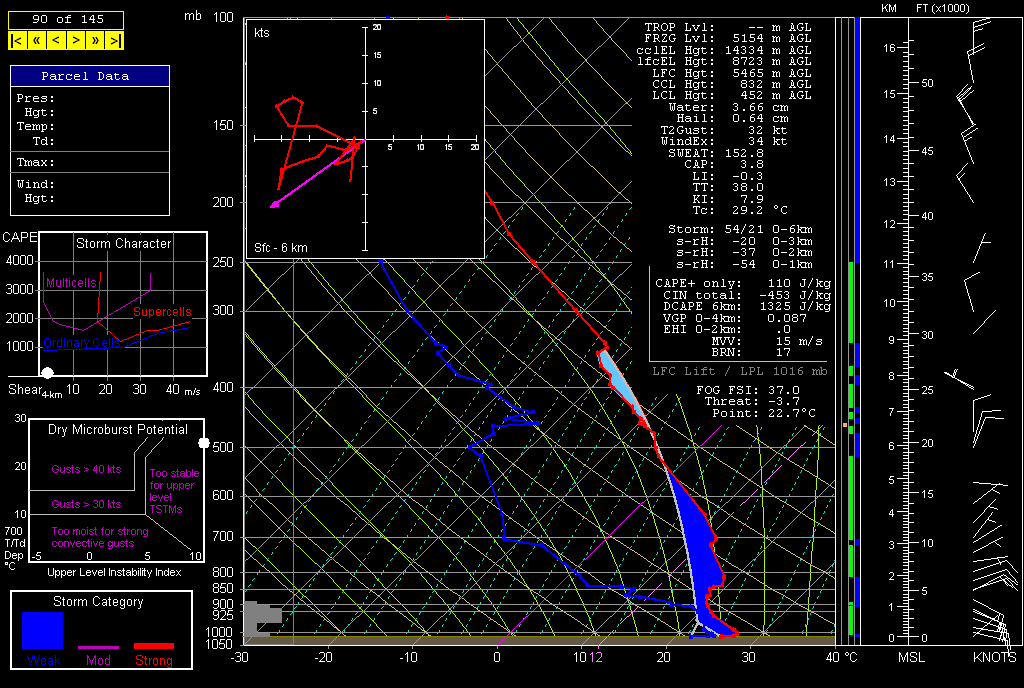
Here is an example of the RAOB display, including skew-T/log-P diagram with lifted parcel, cloud layers, hodograph, and tables containing ancillary information. Click on the image to enlarge it. The display shown is the severe weather mode, with the graphs on the left depicting storm character, dry microburst potential, and storm category. (UPDATE: Also see the more recent example at the end of this article.)

The sounding shown is the October 13, 2009, 12Z for Miami, Florida–a place that’s not exactly the Zion of storm chasing, but it will do for an example. Note that the negative area–that is, the CIN–is shaded in dark blue. The light blue shading depicts the region most conducive to hail formation. Both are among the many available functions of the analytic module.

The black background was my choice. RAOB is hugely customizable, and its impressive suite of modules lets you tailor-make a sounding program that will fit your needs beautifully. Storm chasers will want to start with the basic and analytic modules. With that setup, your $150 gets you a wealth of sounding data on an easy-to-use graphic interface. It’s probably all you’ll ever need and more–though if you’re like me, at some point you’ll no doubt want to add on the interactive and hodo module.

And the special data decoders module.

Oh yeah, and the turbulence and mountain wave module. Gotta have that one.

Why?

Never mind. You just do, okay?

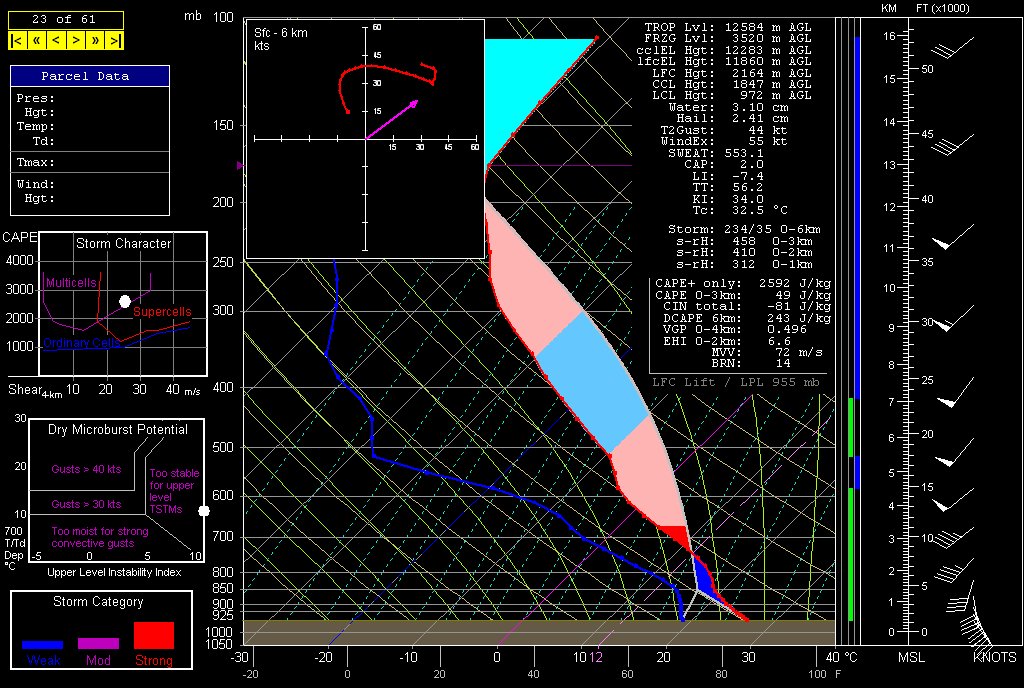
ADDENDUM: With a couple storm seasons gone by since I wrote the above review, I thought I’d update it with this more timely image. If you’re a storm chaser, you’ll probably find that what the atmosphere looked like in May in Enid, Oklahoma, is more relevant to your interest than what it looked like in Miami in October.