Finding Jazz in the World Around Us

My sweet lady, Lisa, and I took a trip to Meijer Gardens earlier this week. Today, sifting through the photos I took as our tram ride wound along the curvy path through the world-class outdoor sculpture garden, and afterward as we strolled through the remarkable plantings in the children’s garden, I’m struck–as I often am–at how the elements of music are woven into the very fabric of our world.

Jazz is all around us. Form, space, unity, diversity, rhythm, dynamics, improvisation, color, texture, contrast, creativity–whether in music, nature, speech, literature, art, human relationships, or above all, our relationship with God, you’ll find the same qualities working together to create beauty and interest.

Consider the qualities of space and contrast. In a jazz solo, the notes you don’t play are as important as the ones you do. Too much clutter, too many notes in endless procession, ceases to communicate. As in writing and conversation, well-placed punctuation–held notes, brief pauses, and longer rests–helps to shape musical ideas and gives them breathing room. Yet the furious density of artfully placed double-time passages creates another form of color. Both space and density can be overdone; it’s the contrast between the two that helps raise a solo from the doldrums to vitality.

The massive red iron piece titled “Aria” is a great visual representation of the interrelationship between music and art. The piece has a rhythm to it, shape, space, contrast–all the aspects of a well-crafted jazz improvisation.
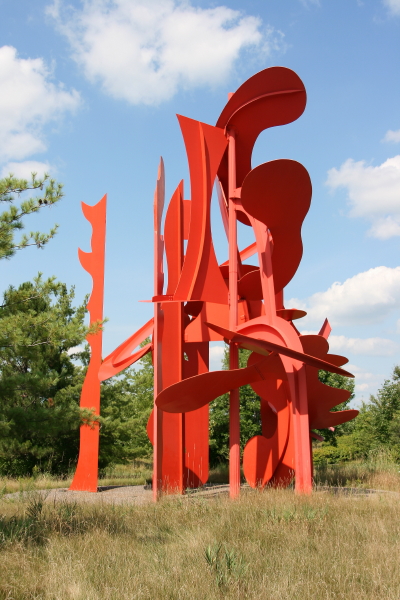
Aria: like a jazz solo cast in metal.

Aria: like a jazz solo cast in metal.

Here are a few more images from the sculpture garden and children’s garden that remind me of music and jazz.
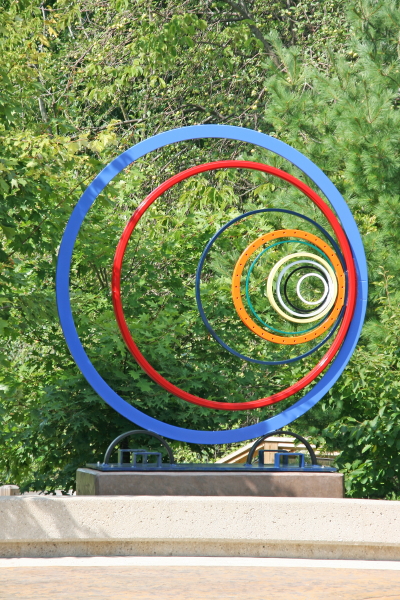
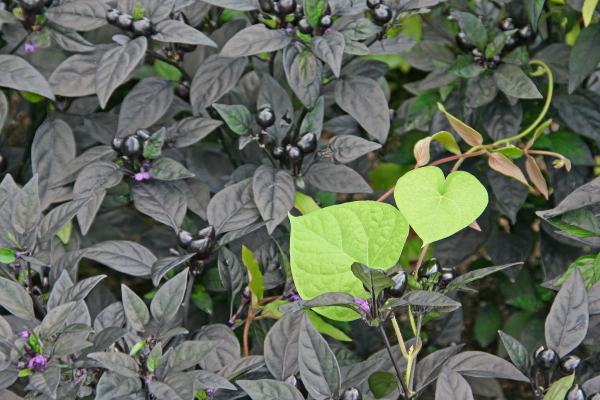
What musical elements can you detect? Space? Sequence? Color? Dynamics?
What musical elements can you detect? Space? Sequence? Color? Dynamics?

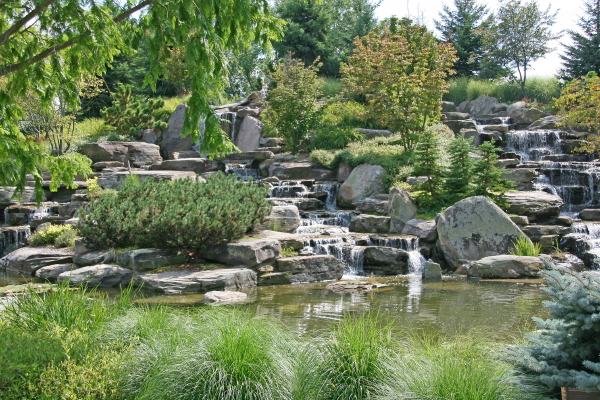
This landscape sculpture creates unity out of contrast and serenity out of movement.
This landscape sculpture creates unity out of contrast and serenity out of movement.

If only I could play a solo as creative, spontaneous, and cohesive as this!
If only I could play a solo as creative, spontaneous, and cohesive as this!

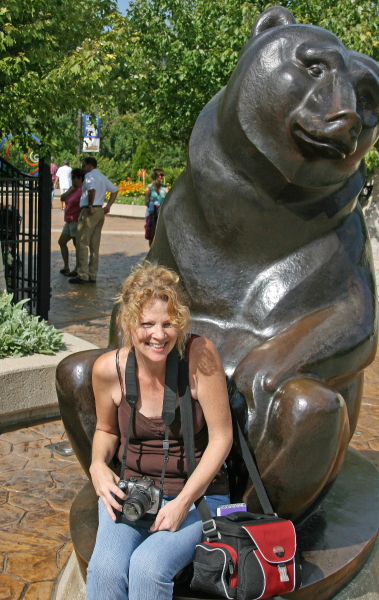
Lisa: the beautiful song God has brought to my life!
Lisa: the beautiful song God has brought to my life!
August Lightning

Kurt Hulst and I got together to chase a little lightning last Sunday, August 9.  With dewpoints in the low to mid 70s, temps in the low 90s, and CAPE around 3,000, there was plenty enough gas in the convective tank. Borderline bulk shear and unidirectional winds meant that tornadoes wouldn’t be the order du jour, but it was nice to just get out and watch some storms.

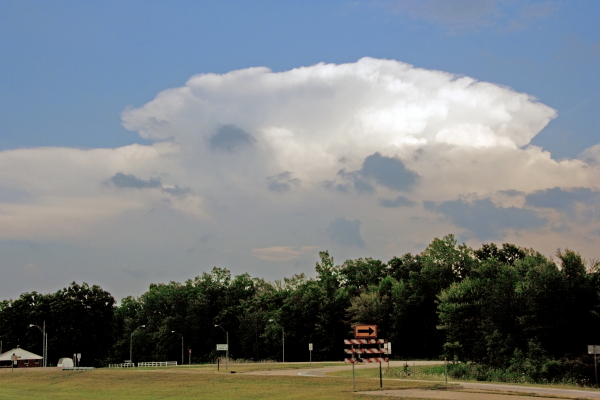
Strong thunderstorm south of Lansing.

Strong thunderstorm near Lansing.

Strangely, even though Kurt and I both knew that it probably didn’t make much difference where we went, north or south–there were a lot of storms to choose from–we had a hard time choosing where we wanted to go. I guess there’s always something that lurks in the back of my head that thinks, I know there won’t be any tornadoes, but just in case, where would one be likeliest to form? It’s dumb, but it’s what goes on in my head and probably what goes on in Kurt’s too, and it tends to needlessly complicate simple choices.

Anyway, we opted to head north and wound up near Saint Johns, where we parked and let a gust front munch us with high winds, spotty but heavy rain, and infrequent lightning.

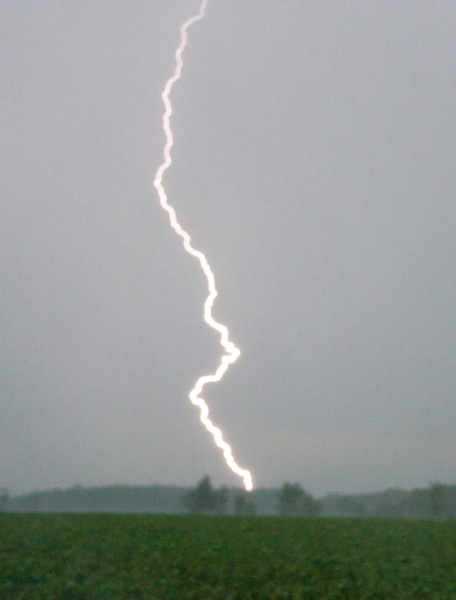
A lightning bolt strikes outside of Saint Johns, Michigan.

A lightning bolt strikes outside of Saint Johns, Michigan.

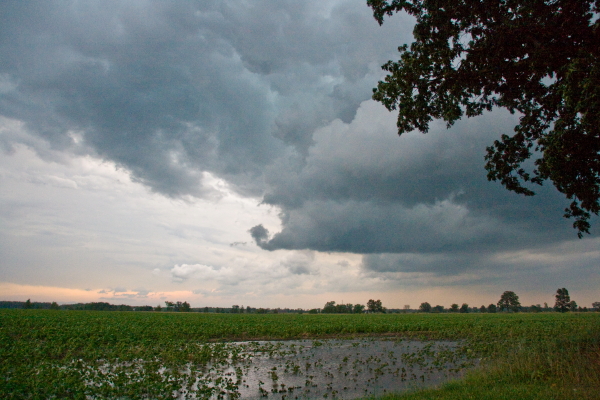
Evening colors tinge receding storm clouds.

Evening colors tinge receding storm clouds.

Afterward, we dropped south on I-69 to Charlotte and caught another cell moving in. Kurt got at least one nice lightning shot. I didn’t get anything at that location, but I didn’t mind. The sunset was extraordinarily beautiful, with melon-colored light filtering through wandering rainshafts and turning the sky to a patchwork of clouds, some catching the sunset rays and others concealing them, like a wardrobe filled with glowing garments and gray rags.

Later that night, a second batch of storms blew through Caledonia, and these ones were most sincere. The lightning was nonstop, but the time was late, I was in bed, and I decided to forgo trying to shoot lightning from my balcony and simply lie there and enjoy the show.

Cool-Weather Wall Clouds

So there I was, driving down I-96 toward my mother and sister’s house in Grand Rapids this afternoon, when I saw what at first glance looked like a wall cloud. It looked like one at second glance, too, and third, hanging off of a cumulus tower in the distance.

Severe weather wasn’t in the outlook today, and in fact, the afternoon was coolish and not particularly moist, with spotty showers but no thunder or lightning. I was unaware of any reason to be on the lookout for abnormal weather, though the extent of the vertical development in the cumulus clouds coupled with their nicely sheared look would have been a tip-off under more propitious circumstances.

Anyway, I was intrigued by the cloud formation, but not quite prepared to call it anything more than a lowering at that point. It was falling apart over Grand Rapids by the time I turned north onto the East Beltline. But the show was far from over. Another large towering cumulus several miles to my northwest was exhibiting an even larger, blocky lowering which wasn’t showing any signs of dissipating.

That did it. It was time to get close enough to this thing to see just exactly what it was. This was a simple matter. The cloud was drifting quite slowly, and intercepting it involved nothing more elaborate than continuing north up the Beltline past 7 Mile Road, then pulling into a small turn-in, where I had an unobstructed view from maybe half a mile away.

The cloud was indeed a wall cloud. I could see a weak updraft dragging scud up into it, and even a hint of an RFD. More important, the cloud was circulating–very slowly, to be sure, but unmistakably. As it moved closer, I even observed a small, anticyclonic vortex spinning almost directly overhead. There was obviously enough shear and helicity in the atmosphere to create some interest, and I had a nice front-row seat. Just wish I’d had my camera with me, but as I said, I wasn’t expecting anything weatherwise today that would have made me think to grab it.

What I was seeing struck me as more fascinating than threatening, but I decided to call KGRR and report it anyway, just for the record. The met who took my information said he wasn’t surprised. He told me that the office had already received several reports of waterspouts out on Lake Michigan, plus other reports of funnel clouds. Sounded like a cold air funnel outbreak.

My buddy Kurt Hulst called later to tell me that he, too, had seen a wall cloud over Caledonia from where he lives in Kentwood. If I’d been home, it would have been a front door delivery, but of course I wasn’t. Seems to me, though, that Kurt said he got some photos. I hope so, because I’d like to see what I missed.

Days like today just go to show that the weather does what it wants, when it wants. Maybe the local WFO will offer an analysis of today’s conditions. That would be cool.

Lesson learned: take my camera with me wherever I go.

Midweek Severe Weather Potential for the Midwest

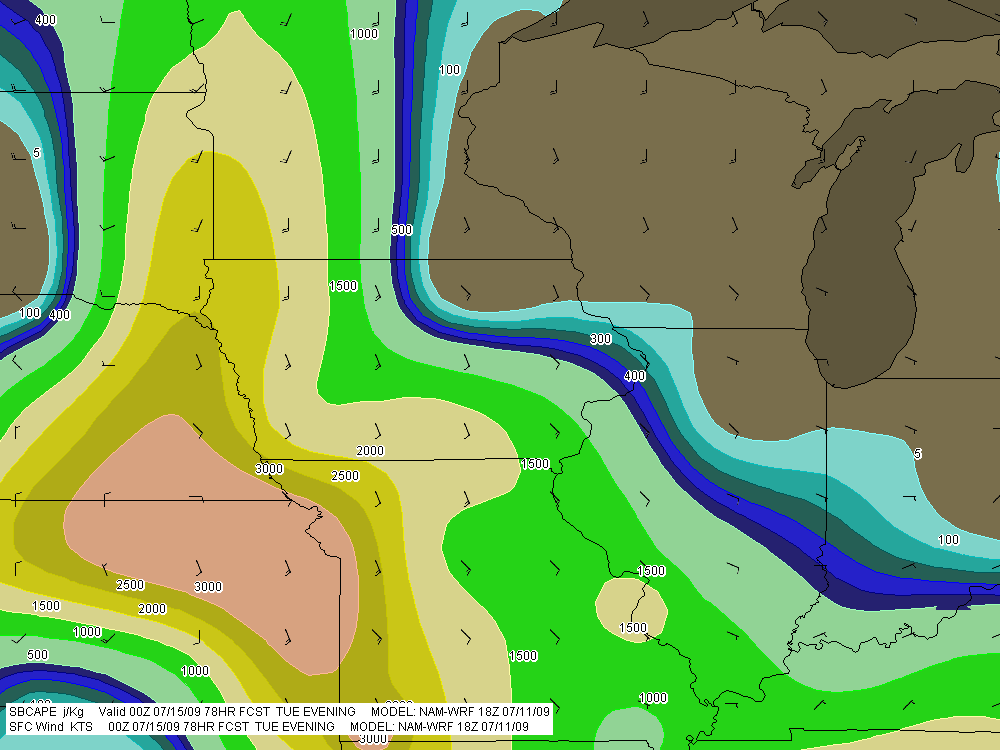
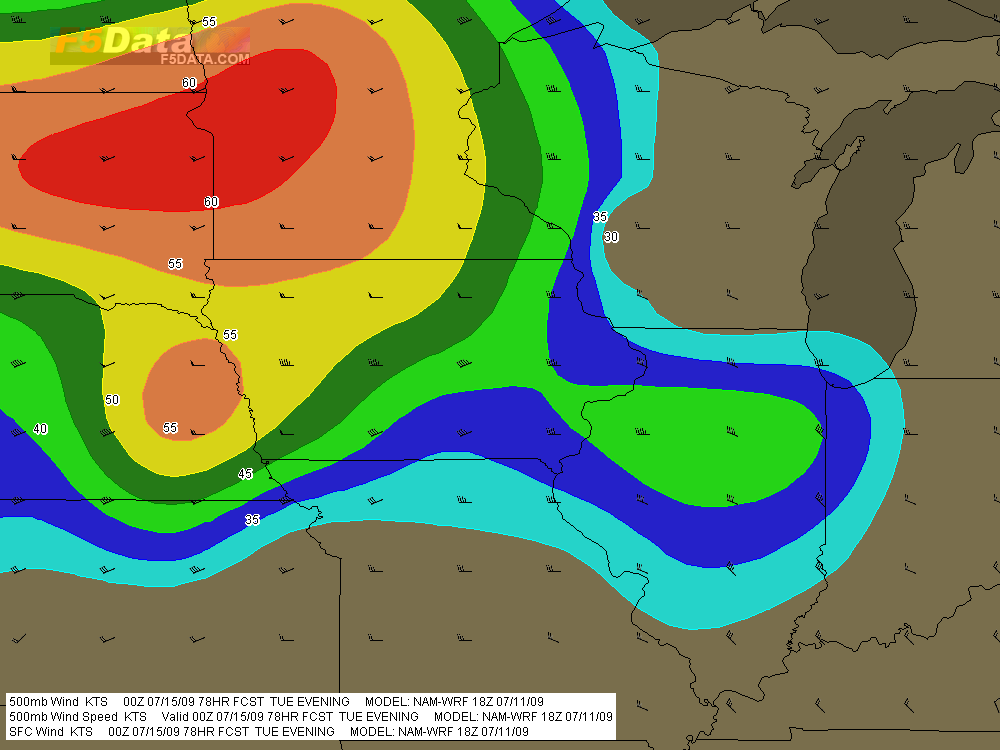
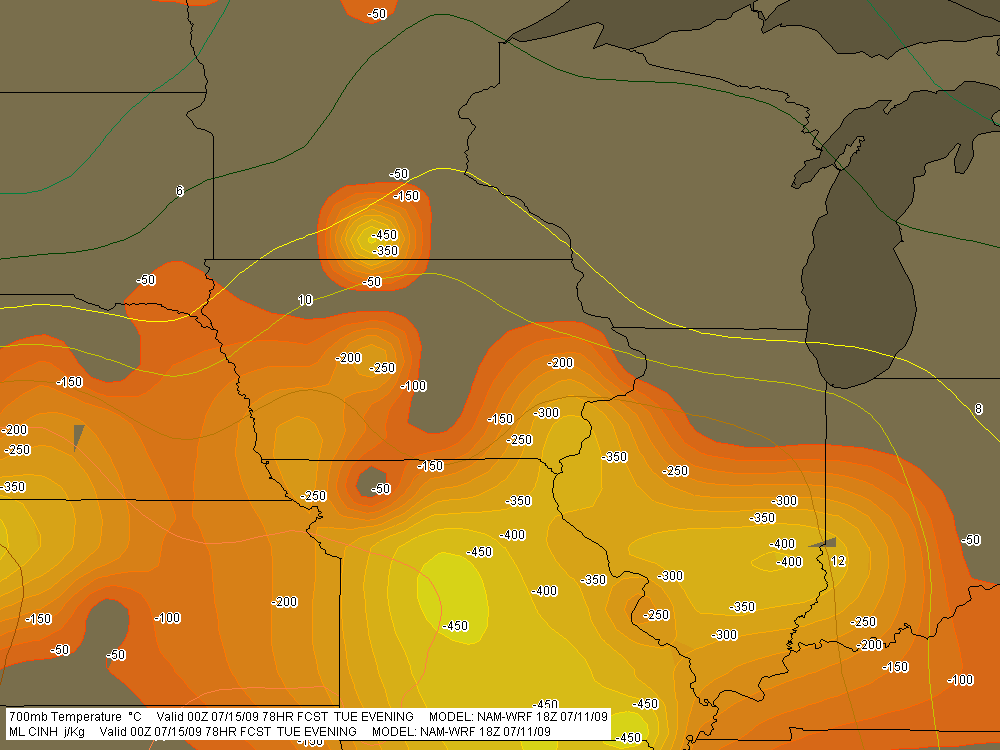
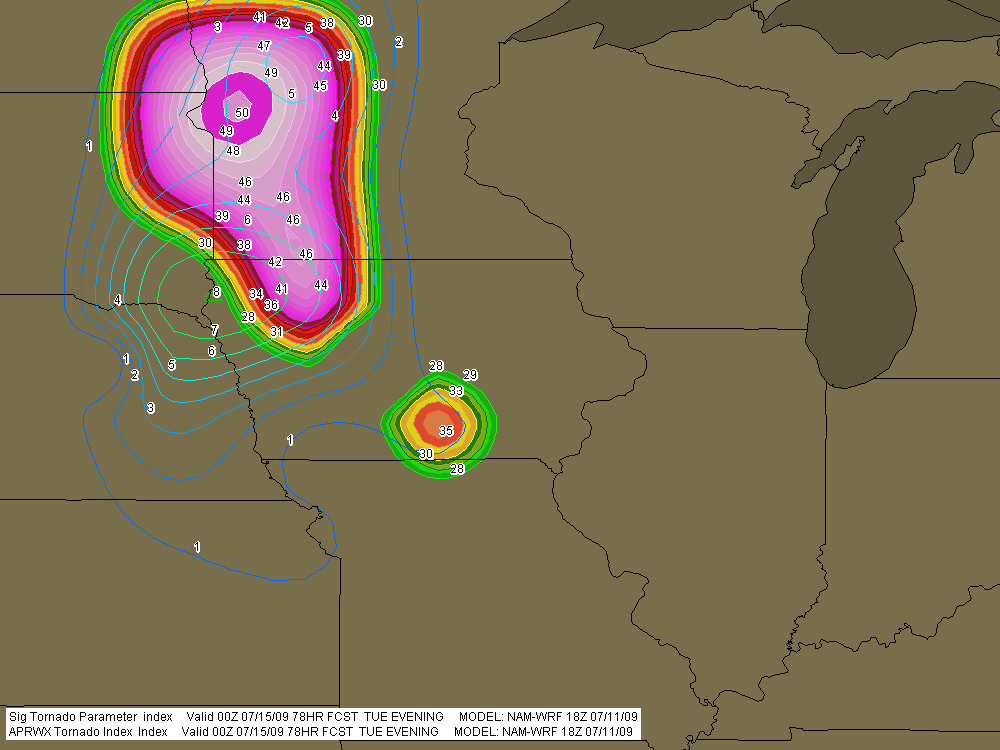
A significant weather event appears to be shaping up for the northern plains and cornbelt this coming Tuesday. For all you weather buffs and storm chasers, here are a few maps from the 18Z NAM-WRF run for 7 p.m. CT Tuesday night (technically, 00Z Wednesday), courtesy of F5 Data.

A couple items of note:

* The NAM-WRF is much less aggressive with capping than the GFS.  The dark green 700mb isotherm that stretches diagonally through central Minnesota marks the 6 C contour, and the yellow line to its south is the 8 C isotherm.

* The F5 Data proprietary APRWX Tornado Index shows a bullseye of 50, which is quite high (“Armageddon,” as F5 software creator Andy Revering puts it). The Significant Tornado Parameter is also pretty high, showing a  tiny bullseye of 8 in extreme northwest Iowa by the Missouri River.

Obviously, all this will change from run to run. For now, it’s enough to say that there may be a chase opportunity shaping up for Tuesday.

As for Wednesday, well, we’ll see. The 12Z GFS earlier today showed good CAPE moving into the southern Great Lakes, but the surface winds were from the west, suggesting the usual linear junk we’re so used to. We’ve still got a few days, though, and anything can happen in that time.

SBCAPE in excess of 3,000 j/kg with nicely backed surface winds throughout much of region.

SBCAPE in excess of 3,000 j/kg with nicely backed surface winds throughout much of region.

500mb winds with wind barbs.

500mb winds with wind barbs.

MLCINH (shaded) and 700mb temperatures (contours).

MLCINH (shaded) and 700mb temperatures (contours).

APRWX Tornado Index (shaded) and STP (contours). Note exceedingly high APRWX bullseye.

APRWX Tornado Index (shaded) and STP (contours). Note the exceedingly high APRWX bullseye.

Of Camp and Cacti: Photos from 4th of July Week

Among the many interests that my sweetheart, Lisa, and I share is a love for photography. This last week we’ve poked around together in the outdoors with our Canon cameras and harvested a variety of images. So rather than write a lot of words, I thought I’d share a few photos with you. They’re about neither jazz nor storm chasing; they’re just odds and ends from nature and life at large.

Last weekend Lis and I headed up to Camp Henry, a Christian camp located on Kimball Lake north of Newaygo, to spend the Fourth of July with our close friend and dear sister in Christ, Kimberly Dunn. Kimber lives in Redding, California, but has been doing a summer internship here in Michigan at the camp. It was great to see her, and during our visit, Lisa and I naturally took a lot of photos.

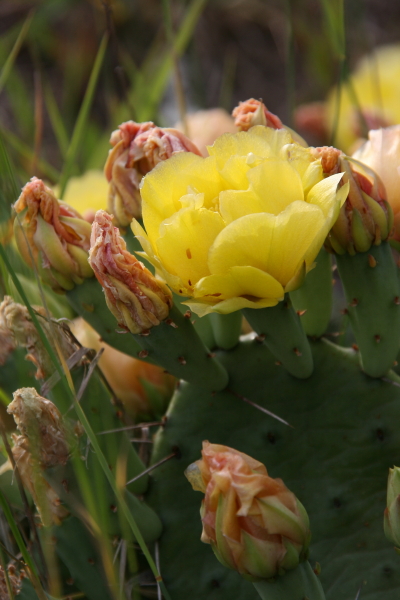
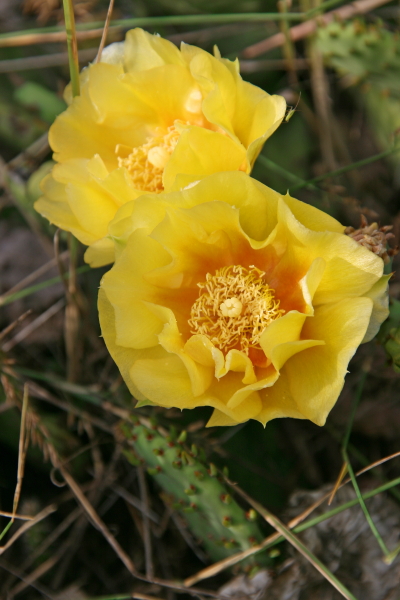
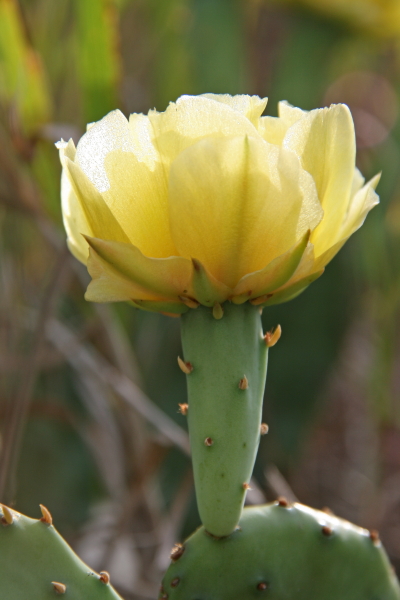
Then yesterday, we went out on a photo expedition to capture prickly pear cacti in bloom. There is at least one species that is native to Michigan, the eastern prickly pear, Opuntia humifusa, also known as devil’s tongue. The blooming season for it is winding down, but there are still plenty of bright, butter-yellow blossoms available to fill a camera viewfinder.

With many photos to choose from, I’ve opted for images from nature and the outdoors, subjects that Lisa and I both gravitate toward more than anything else. I hope you enjoy the selection.

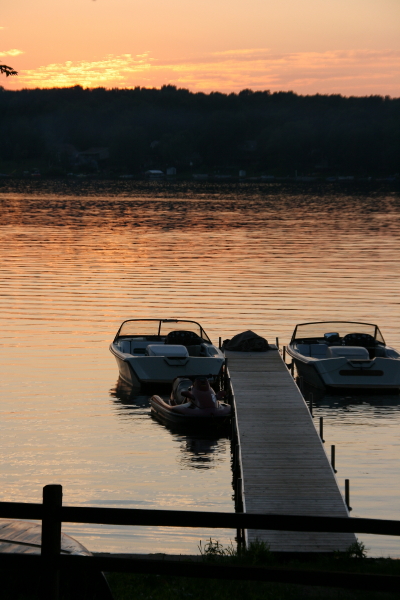
Sunset at Camp Henry

Sunset at Camp Henry

Swimming Buoy at Sunset, Camp Henry

Swimming Buoy at Sunset, Camp Henry

Monarch Butterfly Caterpillar on Milkweed

Monarch Butterfly Caterpillar on Milkweed

Loosestrife Flowers. These are a native species, not the highly destructive exotic, purple loosestrife, which takes over wetlands.

Loosestrife Flowers. These are a native species, not the highly destructive exotic, purple loosestrife, which takes over wetlands.

Eastern Prickly Pear

Eastern Prickly Pear

Also Known as Devil's Tongue

Also Known as Devil's Tongue

Opuntia Humifusa in Flower

Opuntia Humifusa in Flower

VORTEX 2 in Northwest Missouri

After years of planning and digging for research dollars, VORTEX 2 finally hit the pavement this spring, only to be met with a severe weather famine. It had to have been heartbreaking for the team, watching that merciless, unending ridge stretch from day to day and week to week, knowing that the clock was ticking on their window for gathering data.

Thankfully, tornadic storms hit the Plains before the window closed, and the team got what they needed. I wish it had gone as well for me. My tally for this season has been one tornado. But I did at least get the compensation of catching some nice storms with cool structure, including the June 7 supercell in northwest Missouri that every chaser in the country seemed to be after–including, of course, the VORTEX 2 armada.

Just for kicks, here is a shot of one of the DOW trucks–the new one with the square radar rig. I believe I took this shot south of Forest City. The DOW is parked to the left in the photo, and I’m looking at it head-on. Viewed from that angle, the radar unit looks like the front end of a tractor trailer.

One of the DOW (Doppler On Wheels) trucks collecting data.

One of the DOW (Doppler On Wheels) trucks collecting data.

Sure does bring back memories. I hope I’ll get a chance to make a few more before the chase year closes. Prime storm season is over, but it’s still a long time yet before the snows fly.

Sax on the Beach

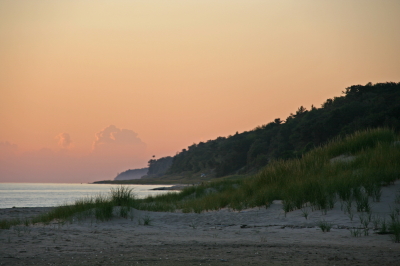
Looking north along the Lake Michigan coast at sunset.

Looking north along the Lake Michigan coast at sunset.

Sax anywhere is great, but sax on the beach is fantastic.

Take a Squeegee to your naughty mind. I’m talking about playing the saxophone, thank you, and about one of the places where I particularly enjoy playing it. There’s something very special about heading out to the lakeshore and practicing my saxophone accompanied by the sound of the waves and the cry of the seagulls.

If you follow the jazz side of this blog, then you know that I love to play my horn outdoors. My practice habits are fairly eccentric in that regard. Many years of apartment dwelling, which include neighbors whom I haven”t wished to disturb, have taught me that my woodshed is wherever I choose to make it. The state parks. The cow pasture at the edge of town. Most often my own car, parked by the railroad tracks out in the countryside.

But there’s no place quite like the shores of Lake Michigan.

It’s been a long time since I’ve taken my horn out there, but yesterday provided a reminder of what I’ve been missing. Regretfully, I didn’t have my saxophone with me, but I did have my sweetheart and best friend, Lisa. From our little outing in Muskegon State Park, I thought I’d share a few images with you of…

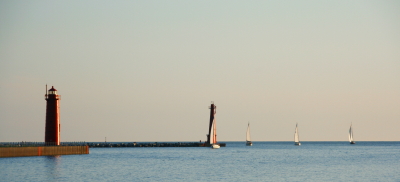
sailboats out on the waters…

sailboats1

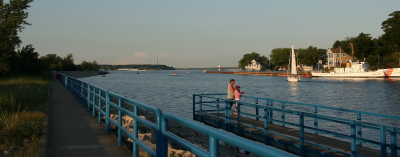
…the north boardwalk along the Muskegon channel…

muskegonboardwalk

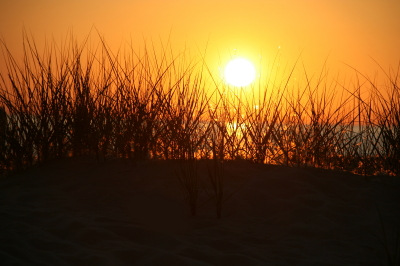
…dune grass silhoutted by the setting sun…

marramsilhouette

As for the great sand dunes that are one of the hallmarks of this beautiful state, I’ve already given you a glimpse of them up at the top of the page, but the really imposing dunes lie in the northern and southern ends of the Lower Peninsula. Perhaps in another post I’ll include some shots of Sleeping Bear, Warren Dunes, P. J. Hoffmaster Park, and Nordhouse dunes–vast tracts of sand, marram grass, and wooded dunes that reflect the wild beauty of the Michigan outdoors. It is a wide open sublimity that speaks to something deep inside me, and that has colored the music I play for many years.

One of these days soon, I will visit the lakeshore again–this time with my saxophone, to serenade the gulls, the waves, the far-stretching sands, and the setting sun.

The Lake Breeze Zone and Severe Weather

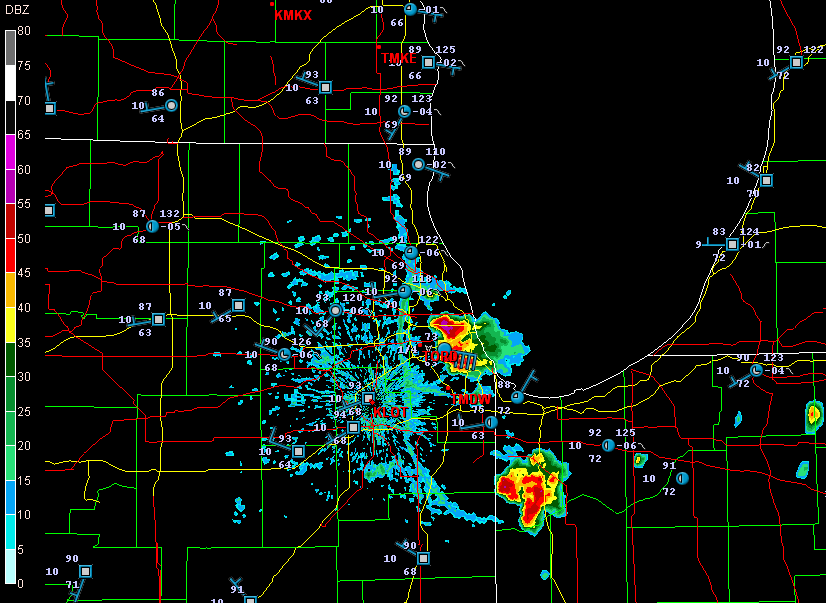
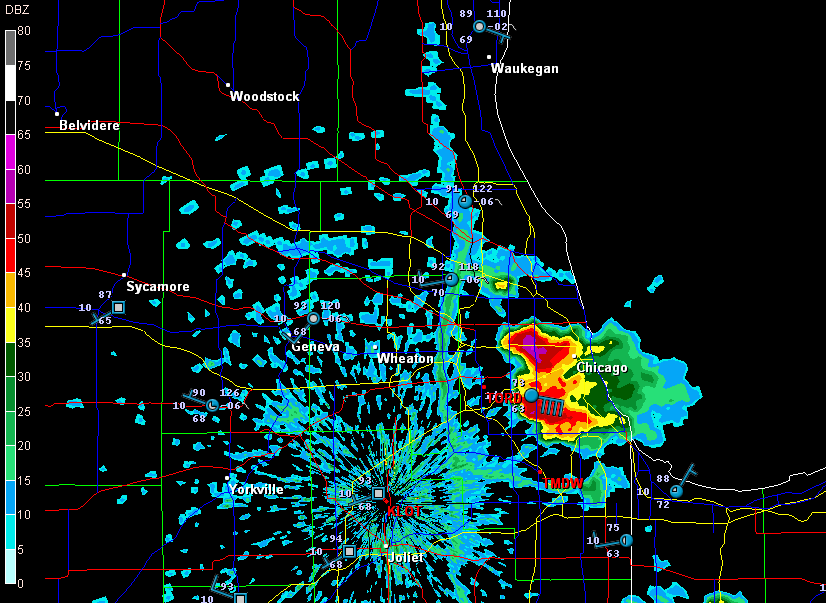
Earlier today, I opened up GR3 just out of curiosity and noticed some blobs of convection along the Lake Michigan shore by Chicago. Here are a couple radar grabs.

lake-breeze

lake-breeze1

These images interest me for several reasons, all of which have to do with a Great Lakes phenomenon called the lake breeze zone. The lake breeze zone is not a fixed area. Its boundaries are atmospheric, not geographic.

And boundaries truly are what it’s all about. Probably the most immediately noticeable feature on these radar images, besides the obvious storms, is the north-south boundary set up by the onshore breeze. It’s a great point of convergence where overall westerly surface winds butt up against backing winds from off the big lake. You can see how outflow from the storms that have fired up within the lake breeze zone interacts with the lake breeze boundary.

Another less immediately obvious by-product of the lake breeze zone is helicity. Notice how the wind barbs farther inland are all westerly, but inside the lake breeze zone, they’re easterly. Now, I’m no expert on this stuff, but I know enough to recognize the potential for localized helicity to occur even when the large-scale flow is unidirectional. During the day, strong thunderstorms can go tornadic when they encounter a backing onshore breeze near Chicago, along the Wisconsin shoreline, and along the Lake Huron and Lake Erie shores of eastern Michigan. The same can happen in the evening along Michigan’s western coast as the land cools and an offshore breeze prevails. Many times I’ve noticed the NAM and RUC showing a small sigtor centerered over Berrien County when there are no sigtors anywhere else in the region, and I’m sure this phenomenon is largely due to the lake breeze in that area.

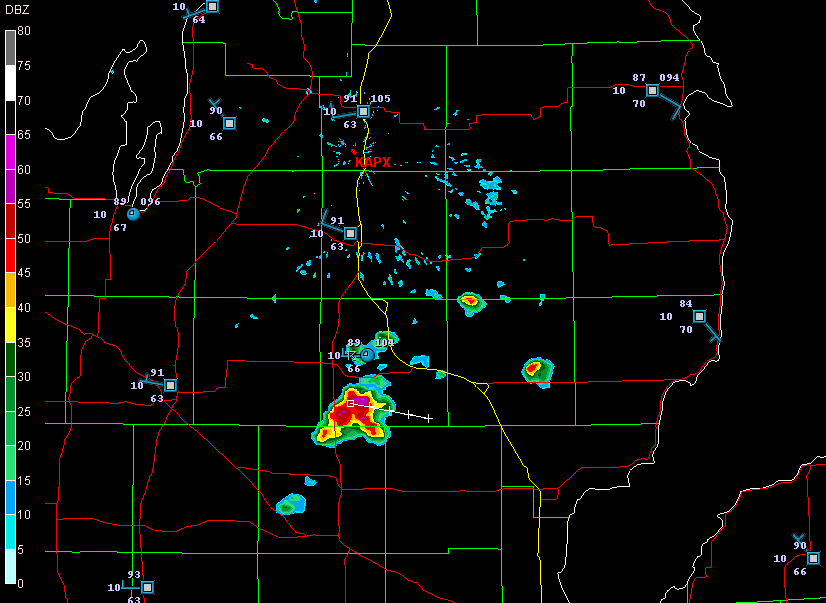
Right now I see storms firing up farther north around Gladwin and Roscommon.

storms

A glance at the Gaylord VWP shows west winds neatly stacked from the surface on up. But look at the METARs along Lake Huron. Without much in the way of bulk shear, the storms are subsevere, just little popcorn cells. But it will nevertheless be interesting to see what comes of them as they work their way into those backed shoreline winds. You just never know.

The Summer Pattern Is Setting In

The SPC has placed Michigan and the Great Lakes in a slight risk area for tomorrow. But tornadoes aren’t in the picture. The summer pattern appears to be setting in, with the jet stream moving its headquarters to the US/Canadian border. As far as Michigan is concerned, that’s close enough that we can still expect some decent kinematics here and there. But what we get tends to result in linear MCSs more than supercells and the like.

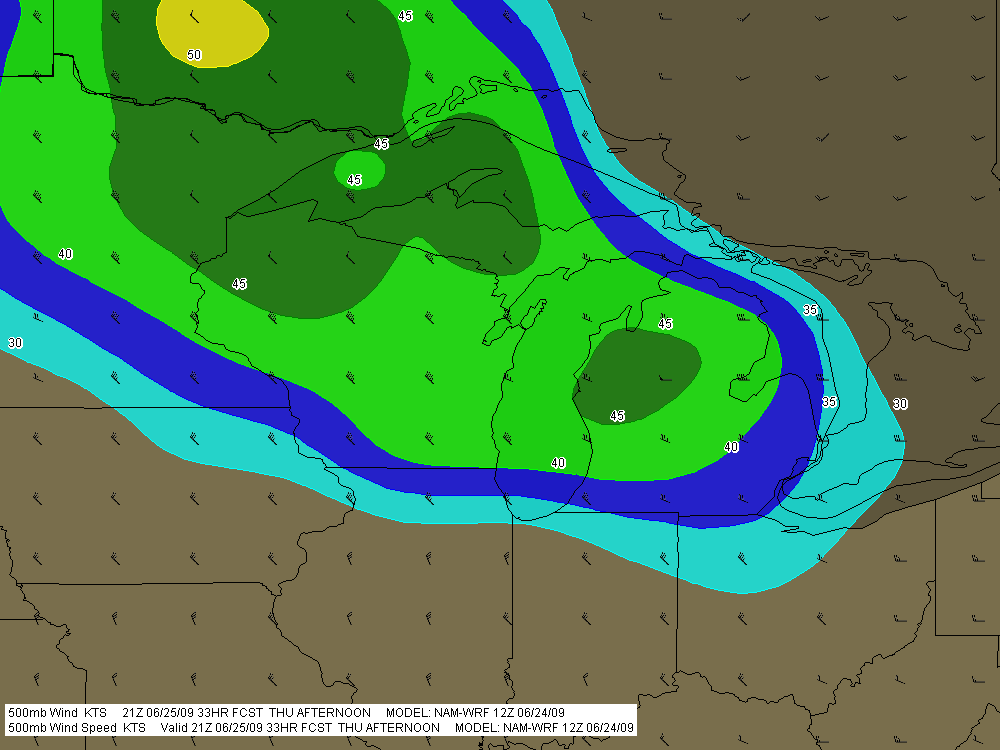
Tomorrow’s SBCAPE should settle in between 2,500 and 3,000 j/kg, with dewpoints in the 70s. That’s certainly an ample supply of convective fuel. And F5 Data shows this for H5 wind speeds at 21Z:

If you can live with northwest flow, that’s not bad. But of course, the underlying winds are all westerly. Once again, Michigan’s energy will get sabotaged by unidirectional winds. How pathetically par for the course! Maybe we’ll get some supercells, but we’re unlikely to see the low-level helicity needed to make them tornado producers. Probably better knock on wood when I say that, because the lake breeze zone can do some funny things with locally backed winds. Overall, though, I think the order of the day will be some nice, burly, ouflowish thunderstorms.

What do I know, though? I’m still pretty green as a forecaster, and I recall a couple years ago when the models showed a unidirectional setup with nothing in the way of helicities, and an F3 tornado ripped through Potterville.

One of the nice things about living in Michigan this time of year–among the many wonderful advantages of this beautiful state–is that we’re prone to get a couple supercellular events when the traditional Tornado Alley of the Great Plains simmers under a titanium cap. Those occasions aren’t anything you can count on, but it’s nice when they happen–for me and my fellow storm chasers, anyway. I suppose other folks here might see things a bit differently.

June 8: Mini-Supercell in Northern Illinois and Severe Squall Line on the Lake Michigan Shoreline

This is really part two of the previous post. After chasing a potent, monster hailer of a supercell north of Saint Joseph, Missouri, I overnighted at a hotel outside of Des Moines, Iowa. When I stepped outside the next morning, the air was much cooler and drier, a stable atmosphere that wouldn’t produce so much as a sneeze, let alone a tornado.

But I knew that the SPC had outlooked the area to my east across northern Illinois, and for several days I myself had been eyeballing my home state of Michigan, where the NAM-WRF had been consistently indicating the possibility of tornadoes. With a little luck, I hoped to make it back in time to chase whatever convection might pop up along the warm front.

As I approached Davenport, I observed  towering cumulus muscling up through the troposphere. However, I didn’t pay them any attention–that is, until Bill Oosterbaan called to inform me that the SPC had just issued a mesoscale discussion for the area just east of me. Even as we talked, I noticed a lowering on a cumulus tower a mile or two to my northeast. When it continued to develop, I decided to investigate. Leaving I-80, I parked across from a truck stop at the Atkinson exit to watch.

The next cell to my west quickly grabbed my attention. It had a nice rain-free base, and as I watched, scud began to form and ascend in an obvious updraft, coalescing into a small, ragged wall cloud. Grabbing my camera and getting out of my car, I noticed right away that the air was very different from back in Des Moines–considerably warmer and with plenty of moisture. The wall cloud fell apart before I could get a pic, but the overall structure remained interesting.

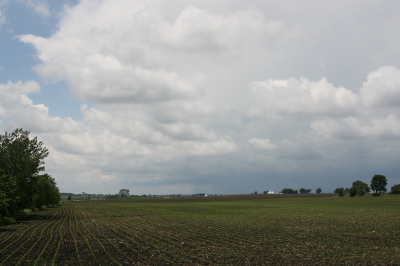
A mini-supercell approaches Atkinson, Illinois, just north of I-80.

A mini-supercell approaches Atkinson, Illinois, just north of I-80.

More brief, non-rotating wall clouds formed and dissipated one by one, so I figured I’d head north of town and observe. With surface winds veering and the overall flow unidirectional, I had no expectation of seeing tornadoes, but the mini-supercell made for some fun and interesting viewing.

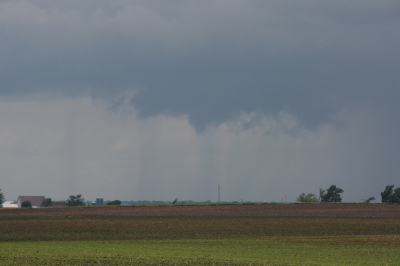
Ragged, non-rotating wall cloud.

Ragged, non-rotating wall cloud.

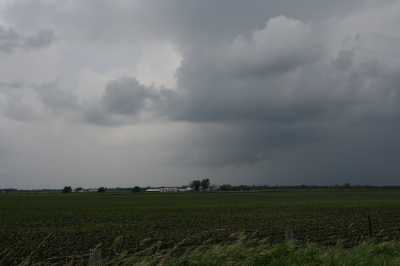
Distant wall cloud and back side of main updraft tower.

Distant wall cloud and glimpse of updraft tower.

I was tempted to follow the storm, but decided it was a red herring. If at all possible, I wanted to make it back to Michigan in enough time to chase the setup there, and that left me no time to play around on the western Illinois backroads. So I headed back to I-80 and busted east.

The first Michigan supercell fired up earlier than I’d hoped, and I bit my lip as I followed its progress on GR3 and watched it hit Lansing. If only I had driven east last night for two more hours, or left in the morning two hours earlier… But the previous day’s chase had left me exhausted. And you know, one of the downsides of being a Michigan-based storm chaser is, you just don’t have very high expectations when it comes to your home state. I mean, it’s Michigan. Home of convective table scraps, squall lines, and embedded supercells that don’t produce squat.

As it was, I watched several more storms fire up and develop rotation along the warm front that stretched across mid-Michigan. I was making decent progress and still had hopes of catching up with some of the southernmost cells. But by the time I crossed the state line, the action all had shifted well to the east, and it became clear that I wasn’t going to see any of it.

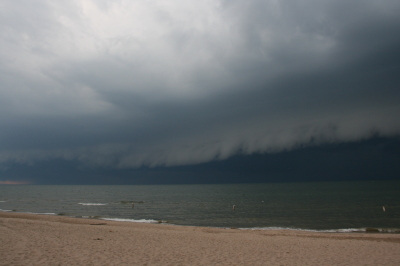
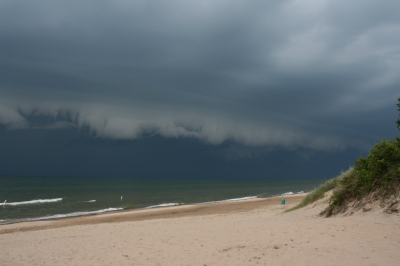
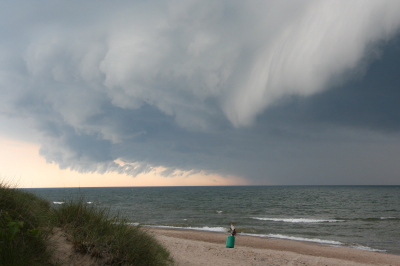
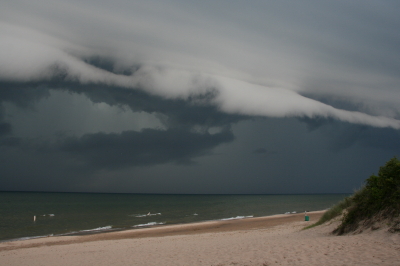
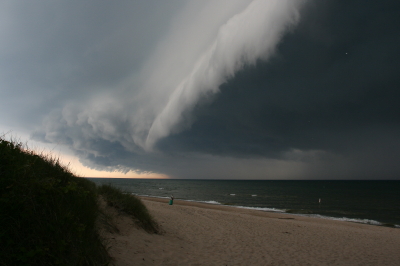
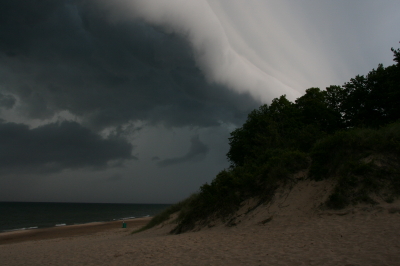
Instead, taking fellow chaser Mike Kovalchick’s suggestion, I headed toward the lakeshore at Allegan Beach to intercept a short but potent squall line. I’m glad I did. The backdrop of Lake Michigan and its dunescapes lends a breathtaking drama to incoming storms. The following photos depict the progress of the arcus cloud moving in across the waters. What these images can’t convey is the full, awe-inspiring sweep of cloud, big lake, and shoreline; of the solemn foreboding of some great event about to unleash itself upon a landscape cloaked in storm shadow; of the shelf cloud moving silently overhead like the furrowed eyebrow of a dark, scowling giant; and of sand spray blowing and trees thrashing in the wind as the gust front arrived.

I’ll let the photos tell their story as best they can, and leave the rest to your imagination.

An arcus cloud advances toward the Lake Michigan shoreline at Allegan Beach.

An arcus cloud advances toward the Lake Michigan shoreline at Allegan Beach.

View to the north.

View to the north.

Looking south...the storm closes in.

Looking south...the storm closes in.

Looking north...closer still.

Looking north...closer still.

Almost overhead.

Almost overhead.

One last shot to the north, then it's time to make a dash for the car.

One last shot to the north, then it's time to make a dash for the car.