May 22 South Dakota Tornadoes: Part 3

There’s nothing funny about finding yourself trapped at the end of a dead-end road with multiple tornadoes bearing down on you. It’s not a scenario one anticipates when heading out on a chase, but it’s the one my chase partners Bill and Tom Oosterbaan, Mike Kovalchick, and I found ourselves in, along with seven other vehicles full of chasers, last Saturday in South Dakota.

Up until the moment when the road we were on ended abruptly at the edge of a farmer’s field, we were simply performing a routine maneuver: select an escape route and take it when the storm draws near. We and the other chasers had chosen 130th Street east of CR9 as our best eastbound option. It looked good on both DeLorme Street Atlas and Microsoft Streets & Trips: a nice through road connecting with 353rd Avenue three miles away. It was a perfectly logical choice, and things would have proceeded without incident had the maps been accurate.

What the maps didn’t show was that a farmer had recently plowed over the road, converting it to a field. We made that delightful discovery two miles down. The road had already begun to degrade, presenting us with a couple mudholes which Mike’s Subaru Outback plowed through without a problem. But the field was a show stopper. Suddenly, poof! No road. On an ordinary day, this discovery would have been an inconvenience. With tornadoes breathing down our neck, it was horrifying.

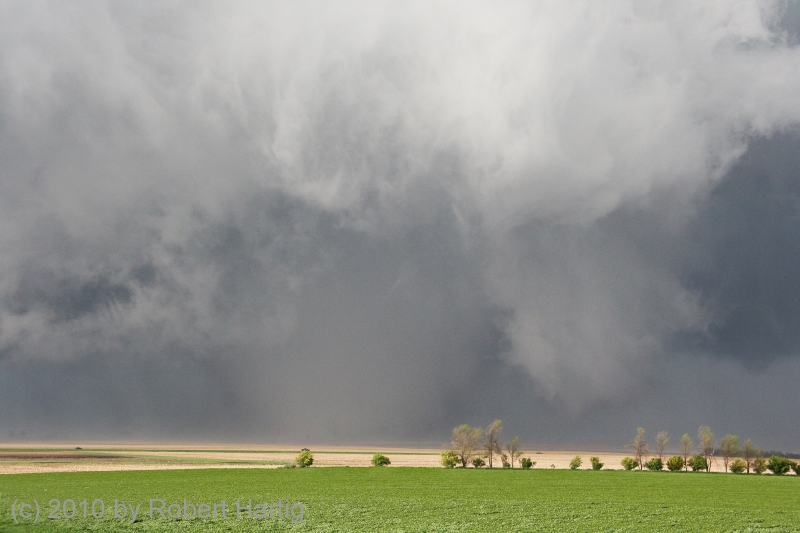
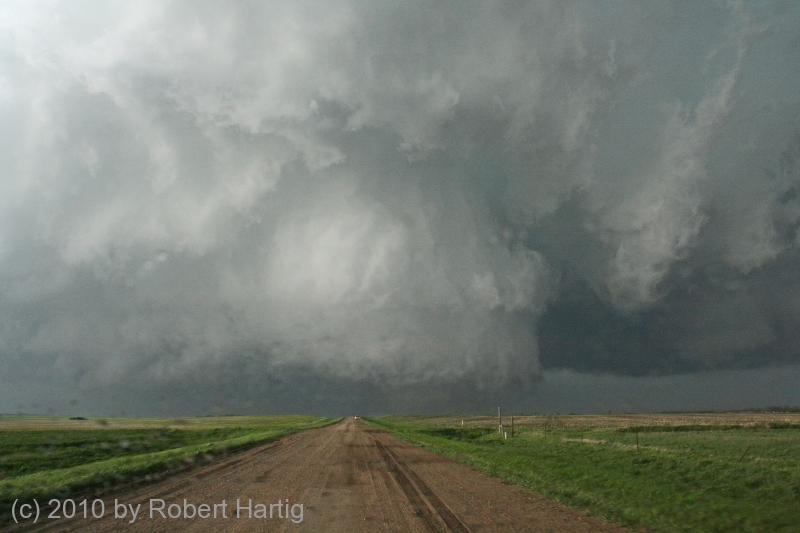
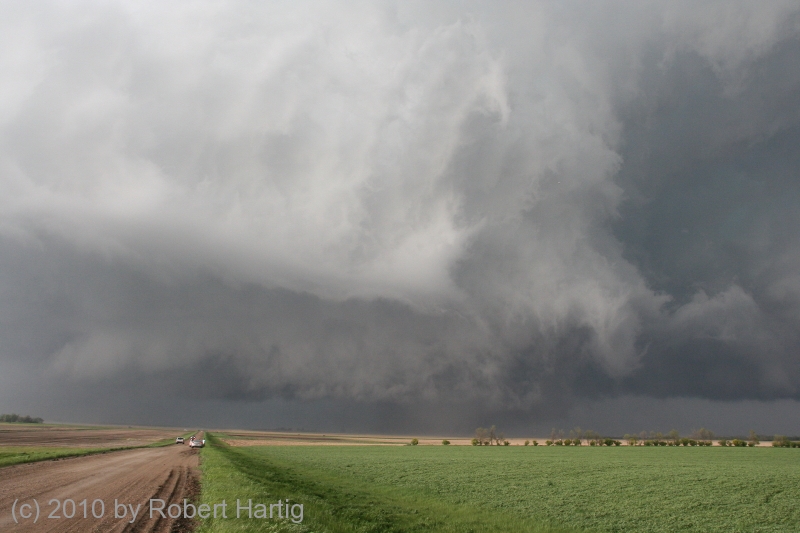
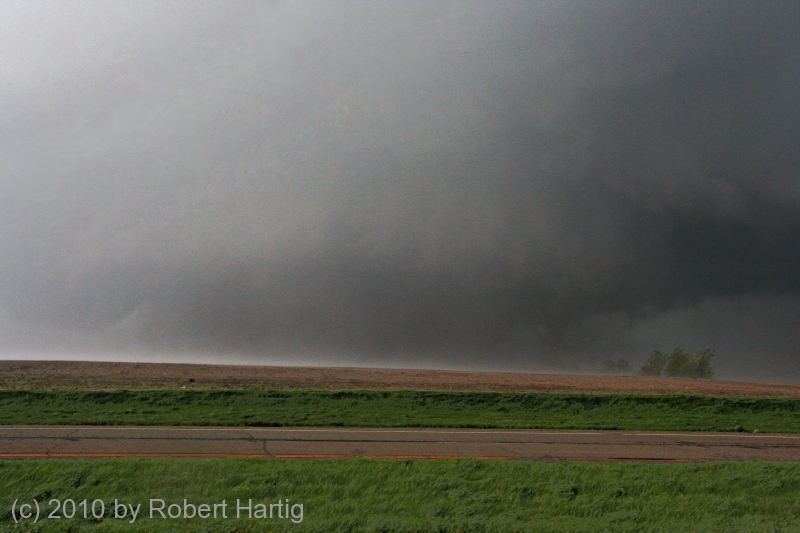
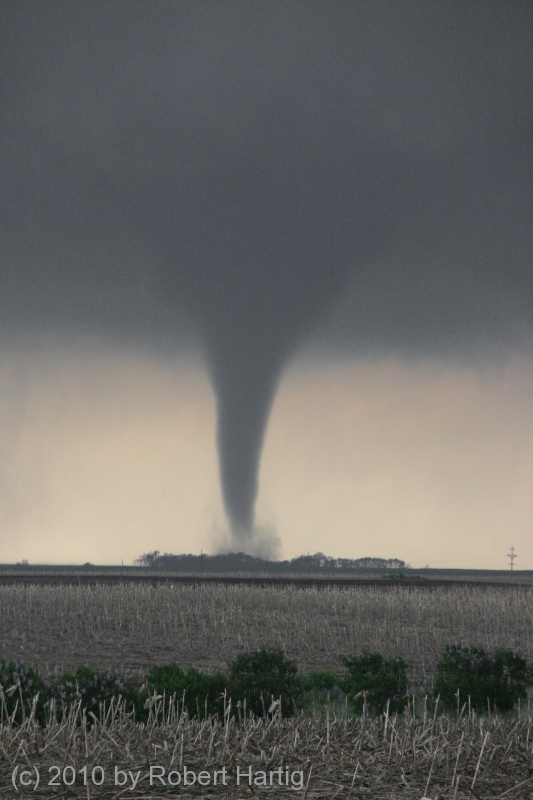
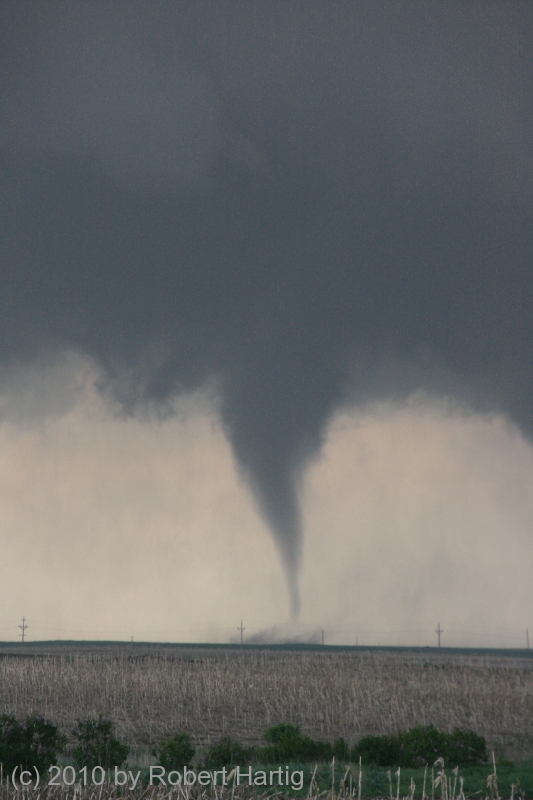
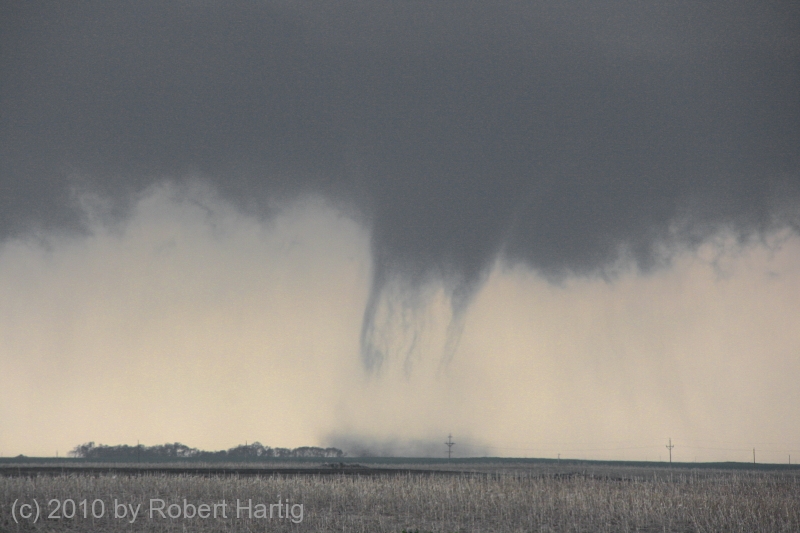
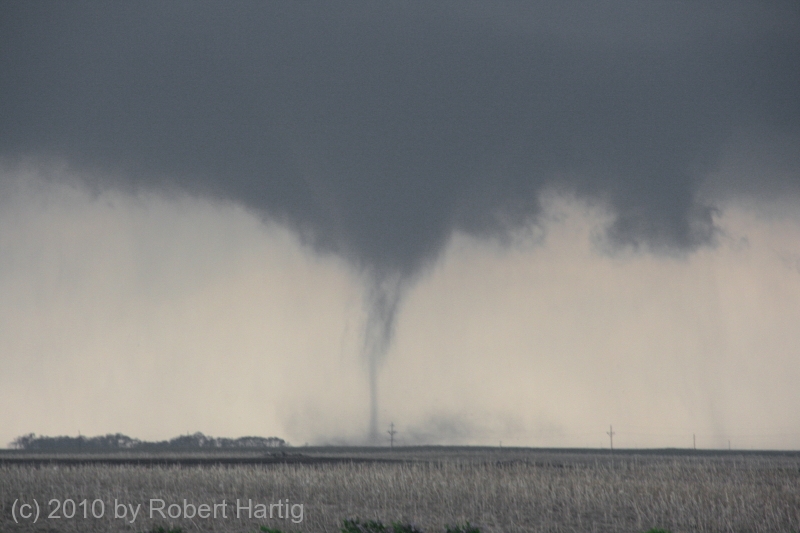
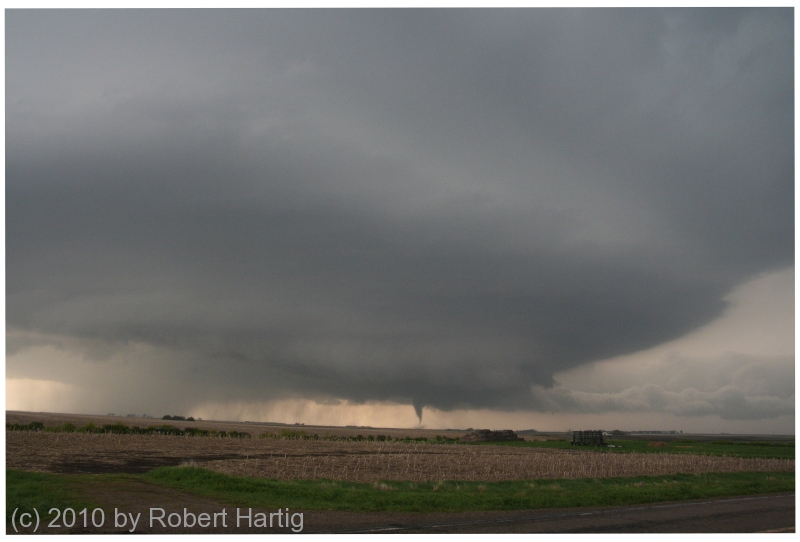
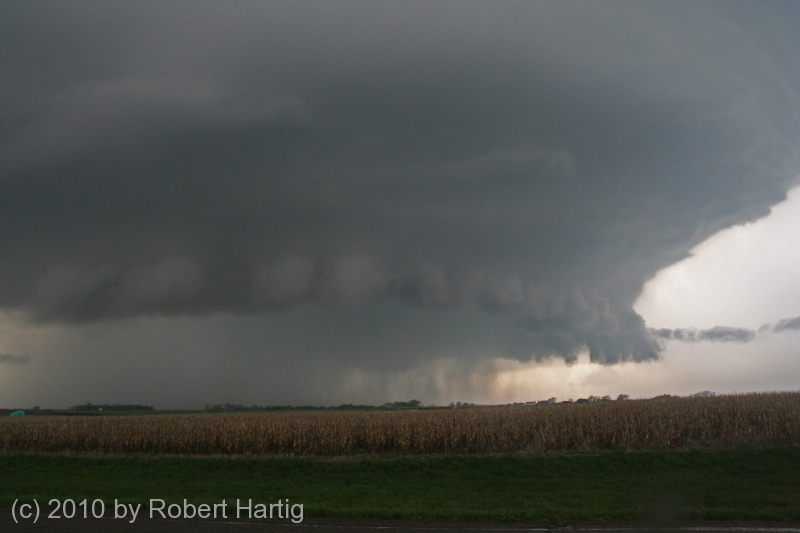
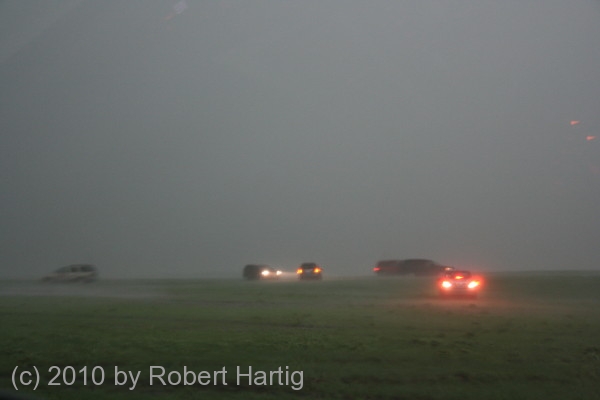
But I’m getting ahead of myself. Let me backpedal a bit to set the stage. After stopping to enjoy the eminently photogenic fourth tornado that followed the beastly Bowdle wedge (see previous post), the four of us headed north to CR2/125th St., then turned east. The storm was morphing into a high precipitation supercell (photo at top of page). We watched it drop a couple more
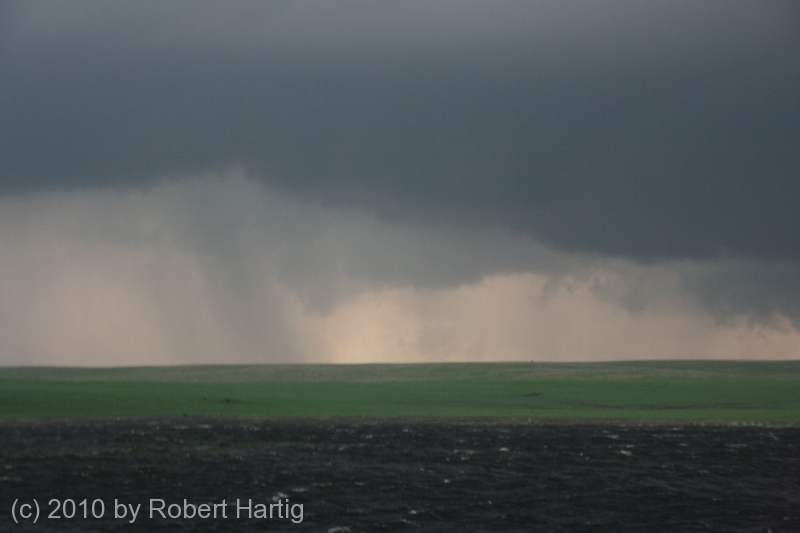
rain-wrapped tornadoes. Then it pulsed, catching its breath and gathering energy for the next round.

Dropping south down CR9, we pulled aside by a roadside pond to grab a few photos. The updraft area was a couple miles to our west, and while it didn’t presently seem to be tornadic, appearance can be deceptive. The cloud base was low, nearly dragging on the ground, with suspicious lowerings forming and dissipating. It looked like it could drop something at any time, and chances are it was even then producing random, momentary spinups.
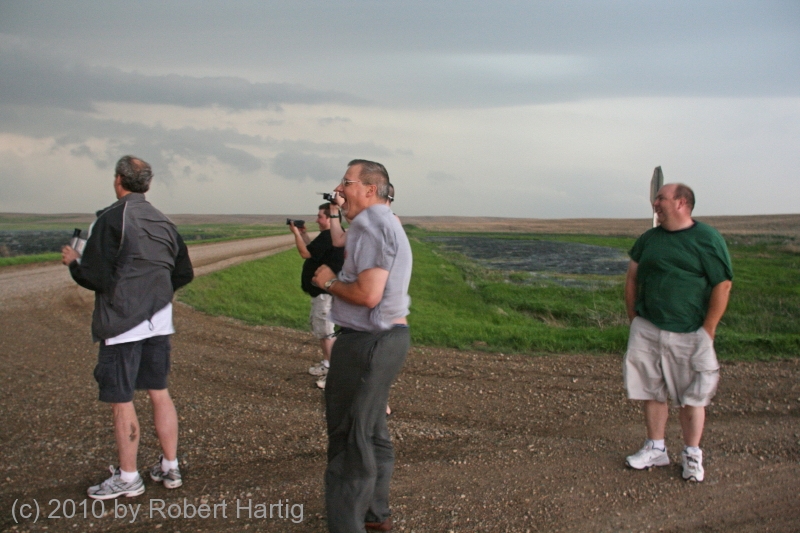
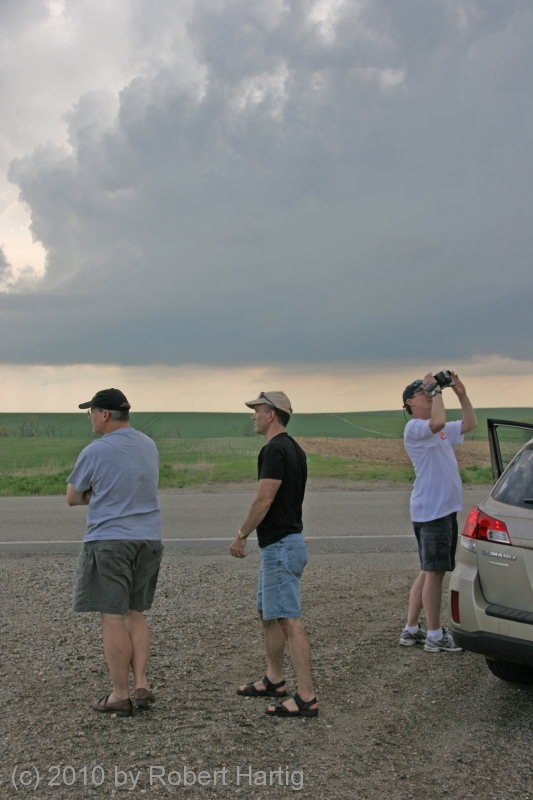
Hopping back into our vehicle, we proceeded farther south to the corner of 130th Street, where we once again parked. Here, we bumped into chasers Ben Holcomb, Adam Lucio, Danny Neal, and Scott Bennett. We had last seen these guys at a truck stop in Murdo; now here they were again, along with several other vehicles, all converging out ahead of the meso in the middle of nowhere. In the photo, left to right: Tom, Ben, Bill, and Scott.

As the storm drew closer, Tom pointed out that rotation was beginning to organize overhead. It was time to skedaddle. Back into Mike’s Outback we clambered, with Tom at the wheel, and headed east down 130th Street.

At this point, it’s important to bear in mind that every vehicle that showed up at our location had independently pre-selected 130th Street as a valid escape route. What followed did not begin as a desperate dash for safety, but as a calculated, run-of-the-mill tactical maneuver informed by commonly used mapping software. Most of the people involved were experienced chasers, some of them veterans. The reasoning behind our road choice was sound. Unfortunately, the information we based it on was not.

Thus it was was that two miles down the road, suddenly there was no road. At the front of a string of other chase vehicles, we were the first to make that
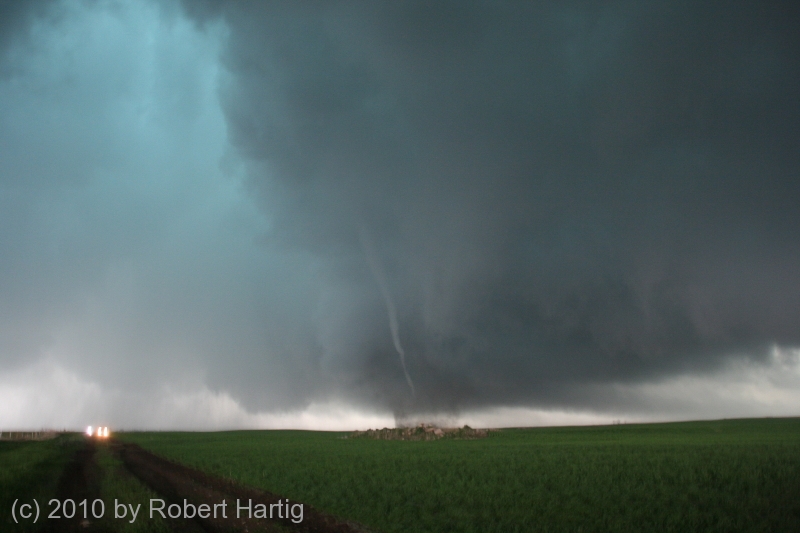
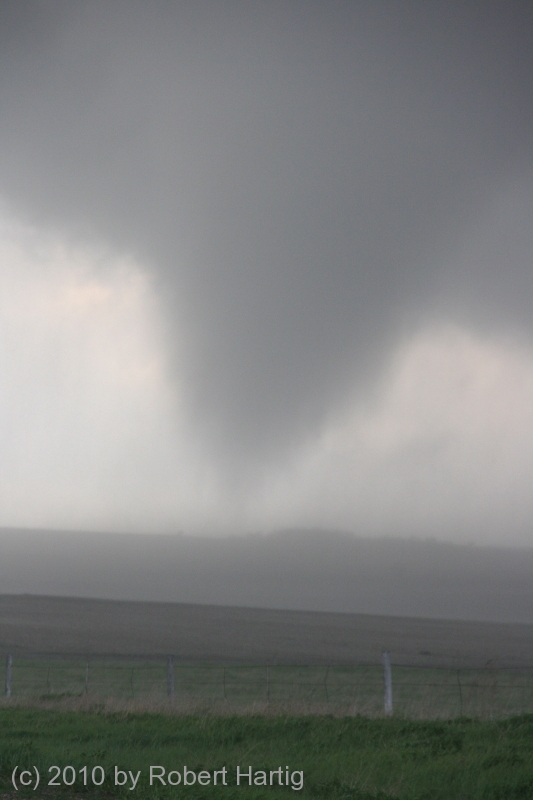
discovery. Tom turned around and started heading back, yelling to the next vehicles that the road was out. It was then that a tornado suddenly materialized in the field maybe half a mile to our west, just south of the road. It was a regular drill press, spinning furiously as it made its way toward us. It finally crossed the road and headed east-northeast a few hundred feet away, but even as it did so, another, thicker funnel snaked to the ground at roughly the same place where the first one had formed. I don’t think most people saw this second tornado; it moved toward us briefly, kicking up dirt, then dissipated, though I could still see swirling motions in the rain bands where it had been.

In the photo, besides the rope tornado, notice the lowerings farther back. These meant business. We were at the eastern edge of a broad area of rotation that was dropping not suction vortices, but multiple tornadoes of various sizes, intensities, and behaviors. In my observation, these were NOT moving in cyclonic fashion around a common center, but east with the parent storm–and straight at us.

A large cone appeared to the west, which, gathering strength, moved through the field to our north. By this time, it was clear that we were in a truly lethal situation, cut off to the east by a dead-end road and to the west by tornadoes.

Windy? Hell yes it was windy. The inflow was cranking like a sumbitch, and from the looks of things, it was only going to get worse. I looked around for a ditch, but there was absolutely nothing that could have offered protection. I noticed a stout post a few yards away and contemplated lying flat and wrapping my arms around it. Tom had the same idea. Mike was eyeballing a large pile of stones a hundred yards away, thinking it might provide some shelter, but it was too far a dash with no time left to make it in.

It was at this point that UK chaser Nathan Edwards drove off the road and began heading south into the field. He told me later that he was simply attempting to clear some room for other vehicles to move forward, hopefully edging just a little bit closer to out of harm’s way, but Nate’s move prompted the rest of us to follow. In a last-ditch gamble, the entire entourage of chase vehicles began fleeing south along the fence boundary.

The tornadoes were close. Really, they were on top of us. I watched as two funnels formed a hundred yards west of our vehicle, twisting around each other and moving toward us like the “sisters” in the movie “Twister.” The rain curtain was full of swirls and braids. And what was particularly unsettling was that, as we dashed across the farmland, the business part of the storm seemed to be expanding, reaching out after us. For a mindless force of nature, this storm was displaying as close as you can get to malevolent intent.

It dawned on me that if ever there was a time to pray, and pray hard, this was it. I’m a Christian–a bit of an iconoclast in that I don’t buy into a lot of Western church culture, but I love Jesus, I’m serious about following him, and conversing with God comes naturally to me. I don’t mean just in a pinch, but as a lifestyle. You can bet that at this point, I began praying most intensely.

A couple hundred yards in, we encountered a wet area and ponding and were forced to forge our way into the cultivated field. It was there that the storm caught up with us in earnest. End of the road for real. There was nothing left to do now but hunker down, pray, and hope.

Obviously I’m here to tell the story. All of us are, every last person. That none of us were killed or seriously injured, or for that matter sustained  so much as a scratch, is in my book God’s love and mercy, pure and simple. A video clip by Adam Lucio shows a tornado forming right in our midst, not ten yards from one of the vehicles. I never saw it, but Adam’s video is conclusive and sobering. We came so close, so very close. The rear flank downdraft alone had to have been in the order of 100 miles an hour. Yet nothing truly bad happened to any of us.

Some may call that a lucky draw; I call it answered prayer. Believe what you will, but there’s more to the story, an experience uniquely mine that I’ve shared with only a couple people so far. Look for it in my upcoming, final post concerning this incident. Whatever you make of it, I think you’ll agree that it’s uncanny.
That’s it for now, but this story continues. What followed with the farmer who owned the field, the sheriff and police, and other locals is for another episode, and it’s still not entirely resolved.

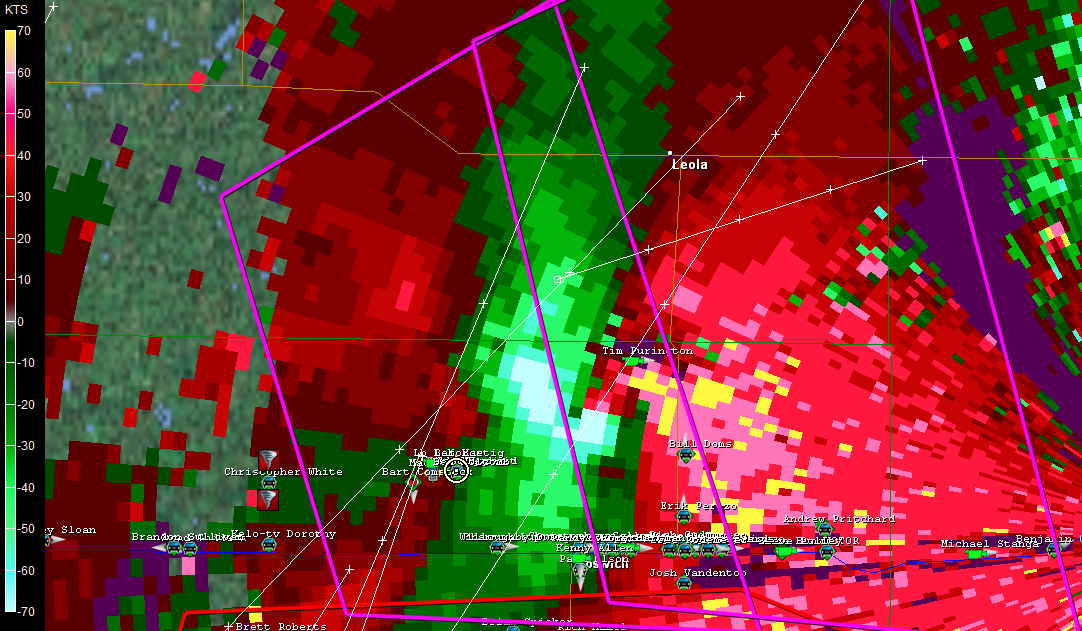
I’ll leave you with two images, both taken when the worst of the storm had just moved past us. One shows some of the vehicles getting slammed by the still-hellacious RFD. The other is a GR3 radar grab of the rotation and our location relative to it, shown by the circular GPS marker.

With that, I’ll sign off. Keep an eye out for parts four and five.
May 22, 2010, South Dakota Chase: On the Road

After catching breakfast in Chamberlain, South Dakota, we–Mike Kovalchick, Bill and Tom Oosterbaan, and I–are heading west along I-90. We have plenty of time to determine where we want to camp out this afternoon until storms start firing later today.

If you’ve kept track of the present weather system, then you know that it has had a number of serious detractors, the chief one being a nasty cap. To complicate things, the NAM and GFS were initially wildly at odds. But Thursday night the GFS began to agree with the NAM on opening up an uncapped corridor from Nebraska into South Dakota, and from there the model forecasts became progressively more promising. The SPC Day One Convective Outlook now shows a 10 percent  possibility of tornadoes extending from the Nebraska border north through the Dakotas. The hub of the activity will most likely be in South Dakota, which means that we are sitting in the catbird seat.

It feels great to finally get back out on the road and chase the Plains again. I’ve missed the big action so far this spring. This setup may not be the year’s big event, but it shows promise, and it coincides with a time when I’ve got the funds to go after it. Whether or not we see a tornado today–and tomorrow, and maybe Monday, as we follow this system’s evolution–we’ll at least see some nice storms. And, I might add, some beautiful countryside. It’s been a few years since I’ve been in South Dakota. It’s good to be back!

Back Yard Chase with Possible Wall Cloud

I hadn’t planned to chase storms today, but Kurt Hulst made me an offer too good to turn down, and off we went. For all the hoopla, with a tornado watch covering most of Indiana and Ohio and a 10 percent tornado risk outlined in exactly the same area south of the Michigan border as last week, the storms nevertheless turned out to be pretty garden variety.

In fact, nothing materialized south of us where we expected it to. Instead, Kurt and I got pleasantly surprised when a couple of cells fired up to our west near Plainwell and almost immediately took on supercellular characteristics. A southwest-northeast-oriented outflow boundary was working its way east, and it provided convergence that fired up a slowly growing line of storms in the weakly unstable warm sector.

We locked onto a promising-looking cell in central Michigan whose top, at between 40-45,000 feet, was the highest of the day. Base level SRV showed on-again/off-again weak circulation for this storm, and reflectivity had it

hooking nicely at different times. It was no monster supercell, but it had its moments. I took photos of a nice lowering while parked just south of the intersection of R Drive and 23 Mile Road 12 miles south of Charlotte. I’d call the feature a wall cloud. While I couldn’t verify rotation, the vertical motion and the position of the lowering just south of the rain shaft under the updraft base were pretty suggestive.
What you see was as good as it got. I reported the lowering to KGRR after taking the photos, but the storm began to crap out on us even as I was talking with the meteorologist. We dropped it a few minutes later and headed south to catch a new, developing cell. We’d probably have done better to stick with what we had, as it appeared to strengthen again briefly on radar while the new one went linear right away.

Chases in Michigan more often than not prove to be just entertaining diversions–fun, but it ain’t Kansas, Toto. This one fit that description. It was good to get out with Kurt, and also good to get home without having spent too many miles chasing nothing of any consequence.

Another Lower Great Lakes Storm System

The eastern Great Lakes looks to be once again under the gun for severe weather, with a setup that looks reminiscent of last week’s, albeit with some variations. The low is weaker but there’s juicier moisture, helicities may integrate a little better with instability, and it seems to me that the 500 mb jet is better positioned. Once again, though, surface winds veer rapidly south of the warm front, so while the mechanism for another batch of supercells is in place, the tornado potential is less certain. The SPC convective outlook shows a 5% tornado risk. That seems about right, though maybe part of the area will get upgraded this afternoon.

After looking at the morning NAM and RUC, I once again like the area south of Toledo. Bowling Green was my initial target last week, and I’d pick it again this week if I wanted to drive that far. If I chase storms at all today, I may just wind up dropping south down 131 toward the warm front, depending.

By the way, I haven’t posted a thing about Monday’s tornado fest in Oklahoma and I probably should. I wasn’t there to experience it, but my buddies Kurt Hulst and Bill Oosterbaan teamed up for it, and Ben Holcomb made it down there as well, and everyone scored. Bill tells me that he and Kurt saw seven confirmed tornadoes.

Me, I watched the outbreak unfold on the radar and ate my heart out. It really was a heck of a thing to observe. The SRVs were jaw-dropping, and I saw one low-level Delta velocity of 177 knots. Those storms were the real deal, and a huge contingent of chasers was on them. Among the highlights was the Wakita, OK, multi-vortex that a number of chasers captured on video. The clips I’ve seen show what looks like a basketful of snakes dancing.

Unfortunately, five people died in the storms. If there’s anything positive that can be said about the loss of life, it’s that the paths of the storms through mostly rural areas no doubt kept casualties lower than they could have been. One supercell dropped tornadoes in Oklahoma City, and all it takes is one. But that’s better than multiple population centers getting hit by storms the intensity of Monday’s storms.
Monday’s Southern Plains Event

Lacking the cash to head west for tomorrow’s setup, the best I’m going to be able to do is gaze forlornly at the radar, gnash my teeth, and hope my buddies Bill, Kurt, and Mike are catching tornadoes and staying safe.

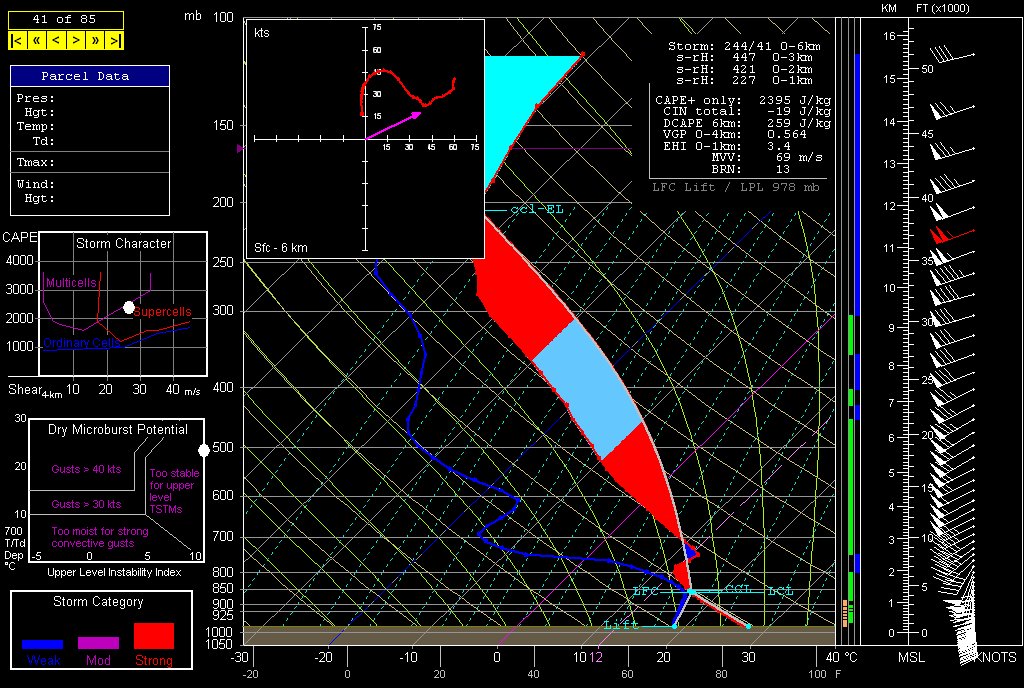
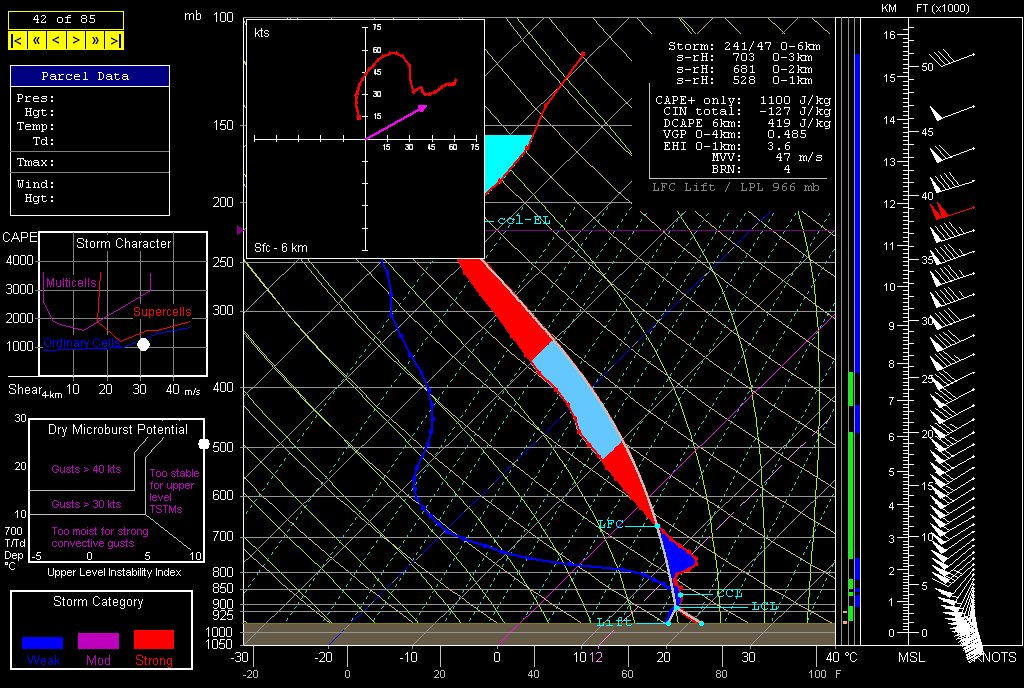
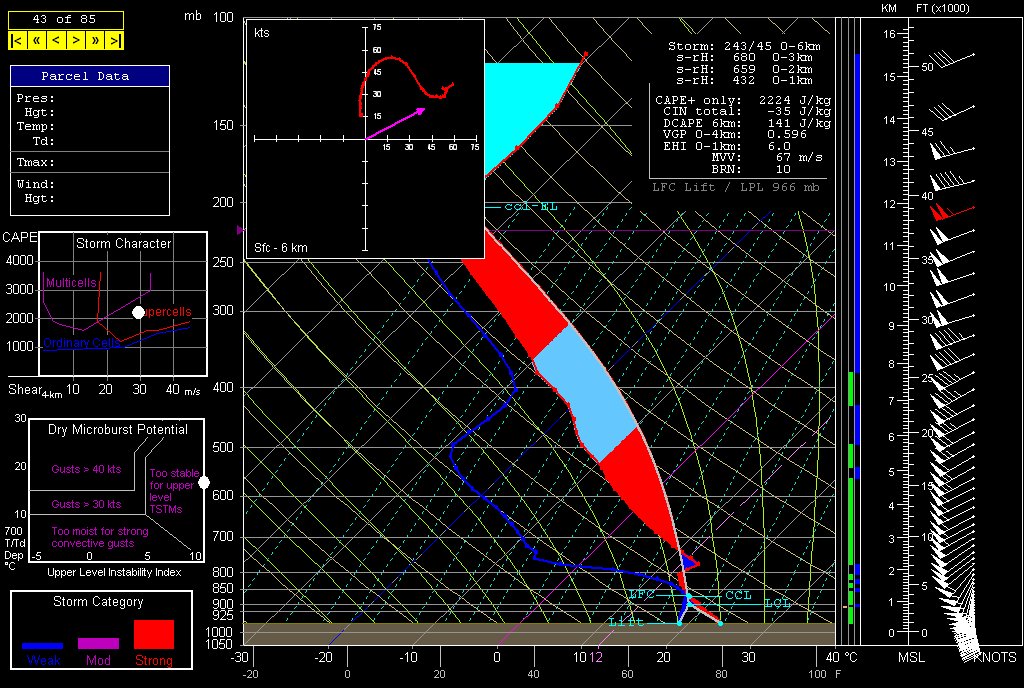
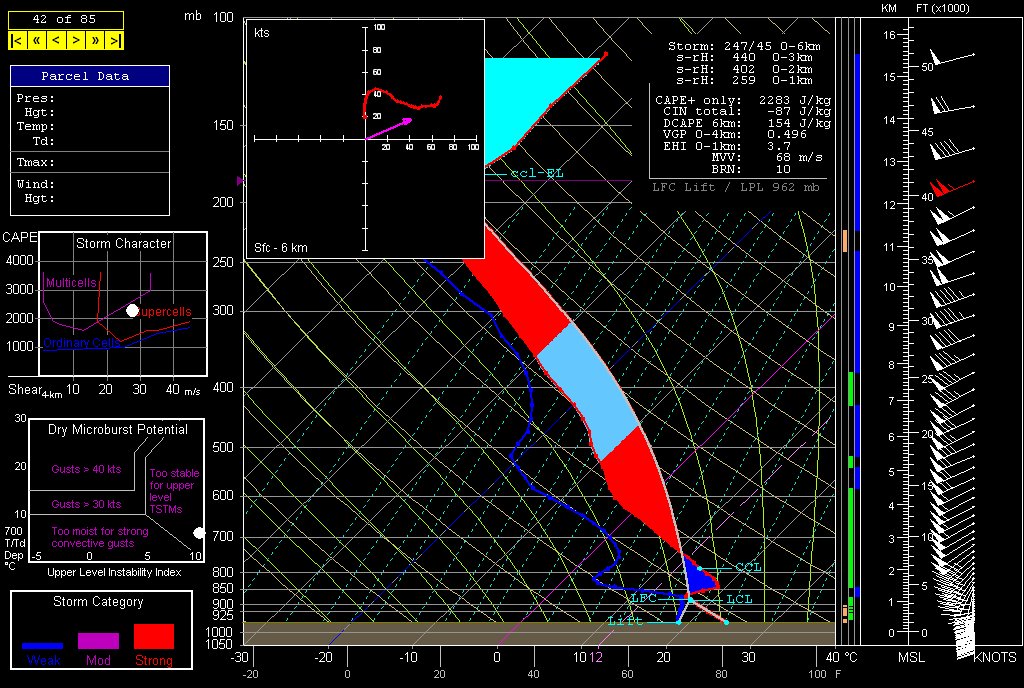
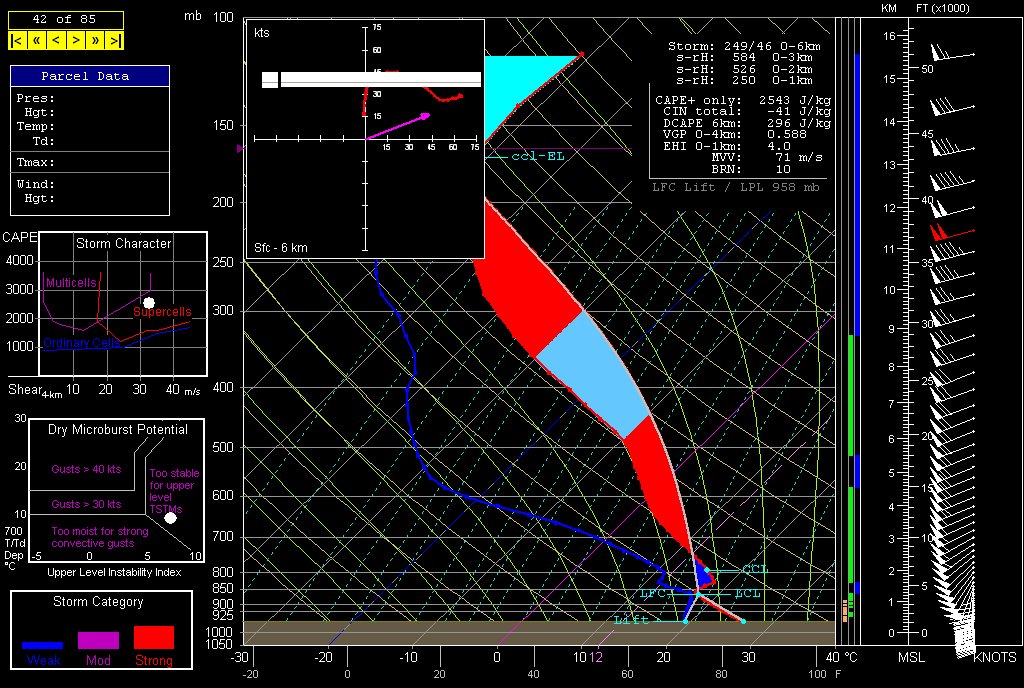
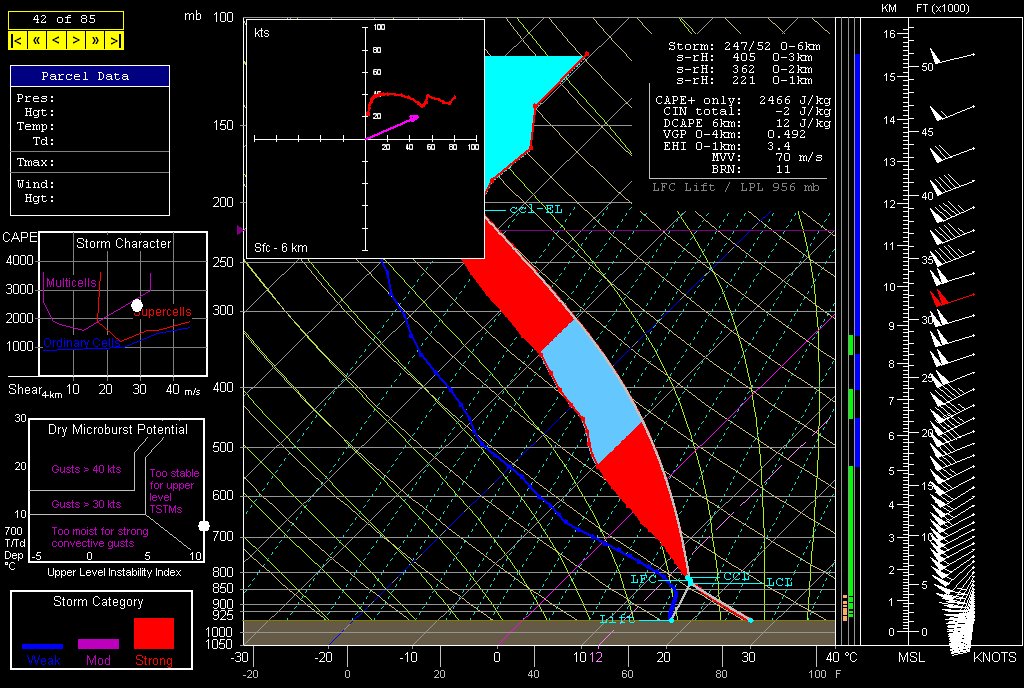
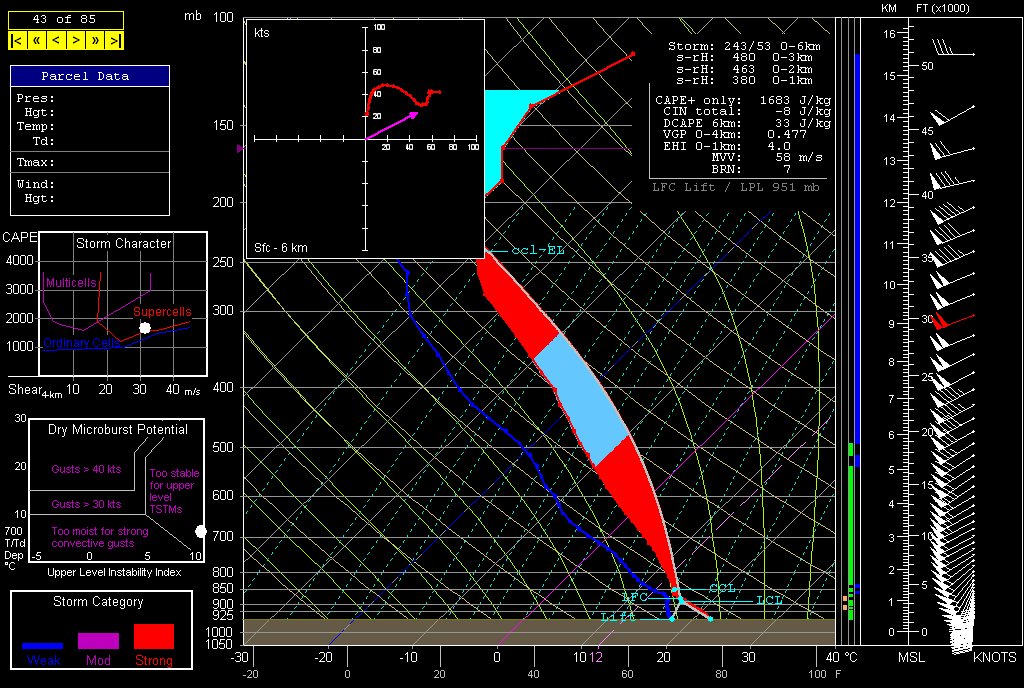
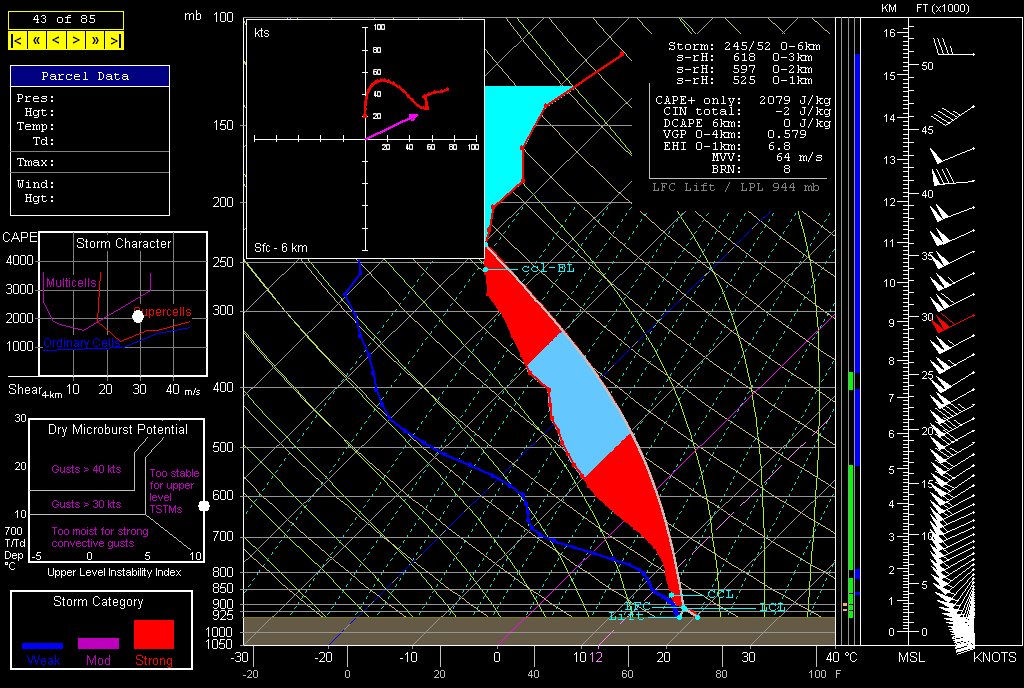
I’d be smart to not even look at the models, but a perverse part of human nature makes it hard for me not to. Out of curiosity, I’ve interrogated a few NAM 6Z forecast soundings from around southeast Kansas and northeast Oklahoma. I suppose the results are nothing new: plenty of moisture and CAPE, great shear and helicity, and a stout cap that lingers till evening, at which point the atmosphere looks primed for discrete, tornadic supercells to explode.

Most of the soundings shown here are for 23Z, but the one for Tulsa, shown above, is for 22Z, since the cap looks to minimize earlier there (21Z, not shown, also looks decent, with -46 J/kg CINH, up from -198 the previous hour). For KCNU (Chanute, KS), I’ve also shown the 00Z so you can compare the difference; and for Hutchinson, which at 525 1km SRH has the highest helicity value of the different soundings, and for Wichita, I’ve shown only the 00Z, since prior to that the cap looks pretty stout. Look below for all the soundings except Tulsa, and make sure you click on the images to enlarge them.

Beyond this, I’m not going to comment. To those who are out there on the Plains waiting for this setup to arrive and ripen, I wish you success and safety.

May 7, 2010, Northwest Ohio Supercells

Yesterday’s outbreak of supercells in the southeastern Great Lakes was no tornado breeder, but it made for an enjoyable chase. I left Caledonia around 10:30 with Bowling Green in mind as a target, noting that the SPC had outlooked a narrow, northern swath of northeast Indiana and northern Ohio with a 10 percent tornado risk.

I wound up rendezvousing with my long-time chase buddy Bill Oosterbaan in Ashton, Indiana, where Mike Kovalchick also joined us. (Note to self: that Baptist church parking lot on the west edge of town has a fantastic hilltop view to the west.) We dropped south to Waterloo, where I parked my car at a convenience store, then hopped in Bill’s vehicle, and we headed east, watching as a cumulus field began forming overhead. The warm front was moving in, and when we left Ashton, the chilly temps were already rising and bringing the dewpoints with them.

Farther to the east, we hooked up with Ben and Mike Holcomb, and CMU meteorology students Aric Cylkowski and Cort Scholten. Our contingent of four vehicles at the Sonic drive-in made up what was probably the first chaser convergence that Bryan, Ohio, has ever experienced, and probably the last.

From there, we dropped south toward the warm front, which had stalled over the area. Temps had been in the lower 70s in Bryan, with east-northeasterly winds and dewpoints around 59 degrees; farther down the road, at our new location in a parking lot next to a cemetery, we gained another degree of dewpoint and the surface winds veered. On the radar, one discrete cell to our southwest began to take on supercellular  characteristics. We decided to intercept it, and the chase was on.

But another cell formed southwest of our storm, and in its tail-end position, it rapidly evolved into the main player of the day. So we left the storm we were on and headed toward the new one, which was hooking nicely. A couple miles south of the town of Paulding, we encountered one of the most flat-out beautiful hailstorms I’ve ever seen. It moved toward us in shifting, pearly strands across the fields. I tinkered frantically with the settings on my camera in order to get a fast enough shutter speed for snapping pics from our moving vehicle–there was no shoulder to the road, and no stopping–but by the time I finally had what I needed and Bill had found a turn-off, the amazing nuances and texture of the hail shaft had blended into a homogeneous sheet (click image to enlarge). I took a couple quick photos which nowhere near capture the essence of what we had seen just a minute or two prior; then, with maybe thirty seconds to spare from getting cored, we beat a hasty retreat.

Out in the field just to our southwest, we could see a crapload of dust being kicked up by the rear flank downdraft. We pulled aside and let it pass 100 feet or so in front of us. In the photo, notice how the dust fills the ditch to the right. I’ve read some discussions about the wisdom of the longstanding advice to abandon one’s car during a tornado and seek shelter in a ditch. Maybe that’s a best option in a worst-case scenario, but judging from the photo, it looks to me like the wind is doing a pretty good job of invading the ditch. Depending on the depth of a given ditch, tornado-force winds could conceivably just scoop a person up and launch them into the main air stream.

But I digress. The hail and RFD were the highlights of the day. From then on, it truly was a storm chase, and a futile one. With the storm rocketing to the east-northeast at 70 mph, we had a choice of barreling eastward and losing the storm to the north, or northward and watching it vanish to the east. We pursued it longer than we should have, but we had a fun time of it. The roads in that part of Ohio are great, the countryside is flat and open, and overall, the territory is fabulous for chasing. But when storms are moving at such breakneck speeds, the best road grids in the country–and these probably qualify–can’t compensate.

I managed to get a few shots of a cool, bell-shaped wall cloud as the storm moved away from us. Eventually, though, we called the chase off and started on our way back. West of Paulding, we encountered significant wind damage–large trees snapped off at their bases and pieces of outbuildings scattered across the fields at a couple farms. Could have been weak tornado damage, but it was likelier the work of straight-line winds.

I should probably mention the rope funnel that hung down from a small storm as we headed back toward Waterloo. Okay, it wasn’t really a funnel, just evidence of what wishful thinking can do with a snaky-looking cloud.

Back in Waterloo, I picked up my car, hit I-69 north, and headed home.

I noticed that Illinois-based storm chaser Adam Lucio was also on these storms, and appreciated his Facebook comment that you don’t need tornadoes in order to have an enjoyable chase. I wholeheartedly agree. Yesterday was a great chase, particularly for the Great Lakes, and that hail shaft near Paulding alone made my day.

Of course, everyone has been rumbling about the big event shaping up for Monday in the Plains. Wish I could go, but it’s not in the budget. Best wishes to everyone who heads out. Stay safe, get good photos and video, and have fun.

A Glance at Friday: Severe Weather in the Great Lakes

It now seems a sure bet that the eastern Great Lakes is due for a spate of severe weather. The SPC is presently making it out to be a linear event, as is typical of cold fronts sweeping through our region, but the wind profiles suggest the possibility of supercells and tornadoes.

If you go by the present, 12Z NAM run, central Ohio appears to be the sweet spot, with a variety of parameters converging over or near a bullseye of 2,000 j/kg SBCAPE. Here are a few maps for forecast hour 21Z to give you an idea. Click on the images to enlarge them. The first shows the aforementioned SBCAPE (shaded), sea level pressure (contours), and surface wind barbs. Not a bad bit of instability if this scenario pans out.

In the second image, you can see a nice overlay of 55-60 kt 500 mb winds (shaded) over 35-40 kt 850 mb winds (contours). The wind barbs are for the 850 mb level. The H5 winds veer still further to the west. I think it’s safe to say that shear won’t be an issue, and 1 km VGP, not shown, is as high as 0.4 in the area of heightened instability. Helicity maxes are well to the north, but I wonder what kind of effective SRH we’ll wind up with where it counts.

The third map shows a Theta-e lobe pushing up into northern Ohio with a surface lifted index between -4 and -6 perched squarely over the axis. That should get the job done.

In the last map, three different significant tornado parameters–the well-known STP, the APRWX tornado index, and the Stensrud tornado risk–all converge nicely over the same spot near Newark, Ohio. Three overlays can be a bit difficult to decipher, so let me help: the STP is shaded, the APRWX is tightly contoured like an onion, and the Stensrud has broader

contours, with its highest value circling the APRWX in a yellow ring.

All this to say, Friday may have some potential. I don’t get too excited about cold front events around here–not that we have many options in the Great Lakes, but a steady diet of squall lines has a way of lowering a person’s expectations. Of course, as soon as you let down your guard, along comes the exception to prove that storms in our area can and do deliver. Maybe this round will prove to one of those occasions. We’ll find out two days hence.

April 22-23 TX-OK-KS Storm Chase

As I begin this post, the first major tornado-producing storm system of 2010 is moving to the east after taking 10 lives in the South yesterday. Already a tornado-breeder, the system matured yesterday into a wide-scale outbreak driven by hefty bulk shear, massive low-level helicities in the order of 600 and above, and CAPE values up to 2,500. Yazoo City, MS, was hit hard by a powerful, rain-wrapped wedge. The verdict remains open as to whether this was a single, long-lived tornado that traveled as much as 200 miles, or one in a series, which seems likelier.

Sorry, I can’t offer a write-up on yesterday’s storms. I was home sleeping, and I have no regrets that I missed anything. With the models suggesting rain-wrapped, low-visibility tornadoes rocketing along at 50 mph or more; with the potential for hydroplaning while driving at gonzo speeds in order to keep on top of fast-moving, rapidly morphing storms and avoid having them get on top of us; and with the logistical madness of three sleep-deprived chasers–Bill Oosterbaan, Mike Kovalchick, and me–having to backtrack afterward to Saint Louis where my car was parked and then drive 450 miles back to Grand Rapids, the negatives of chasing this big, messy, and dangerous tornado outbreak seemed to easily outweigh the potential payoffs.

So Bill, who was determined to catch the action, made arrangements to hook up with Kurt Hulst and Bill’s brother, Tom Oosterbaan, in Illinois, and then he dropped Mike and me off at my car. The two of us headed home, and I can tell you, it felt mighty good to crawl under the covers upon my return and sleep until 1:00 in the afternoon. After talking with Tom yesterday evening, I’m glad I chose as I did.

I may have more thoughts to share about yesterday’s scenario, but I’ll save them for another post. The previous two days in Texas and Kansas deserve some attention in their own right, and not just as the prequel to the big, day 3

outbreak. They may have been a bust for me tornado-wise, but they were nevertheless the first decent system of the year and my first chase out on the Plains. It was a blessing to get out on the road once again and see the vast, textured expanses of the Texas and Oklahoma panhandles.

Naturally, the landscape included the TIV2, which at this point should be designated a mobile national monument of the Great Plains. Back in 2008 we had bumped into its predecessor in Nebraska; this Thursday, we pulled into a gas station in Pampa, gassed and Rain-Xed up, then drove around to the other side of the station, and surprise! There it was–the Tank and its entourage. Cool! Who can resist taking a few photos? Not me.

As for chasing storms, Thursday was a should’a. We should’a either listened to Mike and headed for western Kansas, where most of the tornadoes occurred later in the day, or else gone with Bill’s and my initial impulse to chase the bigger CAPE, albeit forecasted low helicities, near Childress, Texas. For that matter, if we had endured the initial grunge in Wheeler, or better yet, just parked along US 60 east of Pampa–in other words, if we had just sat and waited–we’d have been golden. Instead, we sacrificed an opportune position and went after some cells that fired to our northwest along the dryline. Doing so made a certain amount of sense, as those storms were already looking supercellular and were moving toward the warm front and better helicities, while the cells popping up to our south in advance of the dryline seemed to just sit there and languish. So after the northern storms we went.

Bad decision. One of the southern cells developed steam shortly after we made our move. We could still have turned around at that point, but we chose to commit to our decision and wound up betwixt and between the vortex breeding grounds to our south and north. As a result, we found ourselves looking forlornly at the radar as the southern cell shaped up beautifully and began churning out tornadoes, while our storms struggled valiantly but

never quite got their act together. If there’s a lesson to be learned, it’s that good things come to those who wait. And, I might add, that model SRH is nice if you can get it to cooperate, but it can be deceptive. Helicity is prone to change with the storm environment in ways that forecast models don’t anticipate. If CAPE and 0-6 km shear are sufficient, storms may just generate their own low-level helicity.

Anyway, we chased the dryline storms and busted. Our storms tried hard to tornado, but they just couldn’t quite manage to produce. So instead of the blue ribbon, we wound up with honorable mention: some decent structure, including cool-looking wall clouds, a few funnels, and–as tail-end Charlie went high-precip in the Oklahoma panhandle–a nice, banded-looking storm with a formidable shelf cloud.

As for Friday, we picked exactly the right target up in northeast Kansas along US 75 just south of the Nebraska border. We were smack in the axis of a nice moisture plume. But nothing happened. As the afternoon progressed, the cumulus field we were sitting under began to generate towering cumuli, but these turkey towered and busted against a mid-level cap that just wouldn’t erode. So that was that. Looks like a lot of other chasers got disappointed as well by the northern play. It happens. We finally cut our losses around 7 p.m. and headed back east toward Saint Louis and a band of storms that was moving toward I-70. Ironically, one of these produced a series of tornadoes. If Thursday had been a should’a, Friday was an if-only. If only we’d targeted northeast Missouri…but there had been no reason to do so that we could see.

Now another storm system looks to be moving into the Midwest later this coming week. The action could be closer to home, but I’ll think about that in a day or two. Right now, it’s time to make this post, rest up, and get on with the rest of life.

Chase Time! Bound for the Panhandle

Finally! First Great Plains storm chase of the year! As I write, Bill Oosterbaan, Mike Kovalchick, and I are headed west down I-70. In another 30 miles we’ll reach Kansas City; then it’s onward to Wichita, where we’ll overnight. Tomorrow morning we’ll take a look at the models, and then most likely make our way toward familiar territory in the northern Texas panhandle. It has been a couple years since I’ve been there; I can’t wait to see big storms moving over that landscape again.

I’m not going to write much tonight. I’m tired. Last night I got only got three or four hours of sleep, having stayed up till 3:00 a.m. to complete a writing project for a client. My updates will probably brief until I return Sunday. Tomorrow, Friday, and possibly Saturday will be pretty filled with chasing storms and all the pertaineth thereto. When I finally get back home, I hope to have a few great tornado and storm photos to share and an outstanding chase report to post. So stay tuned, campers. This is the first decent chase scenario of the year, and I am geeked to be going after it. Tornadoes, here I come!