Using Sequence in Jazz Solos: Some Exercises

Howdy, campers. As promised, I’m back with a few exercises on sequences that you can actually wrap your fingers around.

Before you proceed further, please take a moment to read my introductory post on this topic, written a couple days ago.

And now, assuming that you’ve done as I requested and acquired a foundational grasp of what sequence is and why it’s such a handy tool for the jazz musician, here’s the first exercise. It illustrates the concept of diatonic sequence. The sequence happens to move up by thirds starting on the chord tones of a C major 7, but it could just as easily move up or down by seconds, or fourths, or up and down at random intervals.

Diatonic Sequence

You could use the same pattern over a C7 by changing the note B to a Bb. But my point isn’t to show you how to outline a chord. It’s to demonstrate how the use of diatonic sequence provides a sense of logic and cohesiveness which you can use to advantage in improvising a jazz solo.

Sequence does such a good job at “making sense” of an idea that you don’t even have to play in key to sound good. In fact, “wrong notes” can sound very cool when you play them as part of a sequence. The temporary harmonic clash creates color and interest.

Sequentially mirroring an idea exactly, interval for interval, is one way to quickly slip out of key, letting the weight of the sequence rather than harmonic agreement justify the use of individually questionable tones. In the following example, root movement descends by major thirds.

Notice that the idea resolves to a chord tone. It’s cool to take your listeners for a temporary excursion into outer space, but you generally want to bring them back to planet earth again with a healthy dose of consonance.

Exact Repetion

Again, the movement downward by major thirds is just one possibility.

You can add further interest by shifting the rhythm of a sequence. The following shows the same sequence as above, but the six-note pattern is now imposed on a 4/4 setting rather than 3/4. I’ve marked the separations between each group of notes in the sequence.

Exact Repetition with Syncopation

Note that I’ve used the sequence over a different chord, an F#+7(#9), another nice application for the augmented sound implied by the major third root movement.

Finally, here is a twelve-bar blues to illustrate the use of sequence in an actual jazz solo. The ideas may seem a bit forced, but they give you a feel for how both diatonic sequence and exact repetition might be applied in an improvisation.
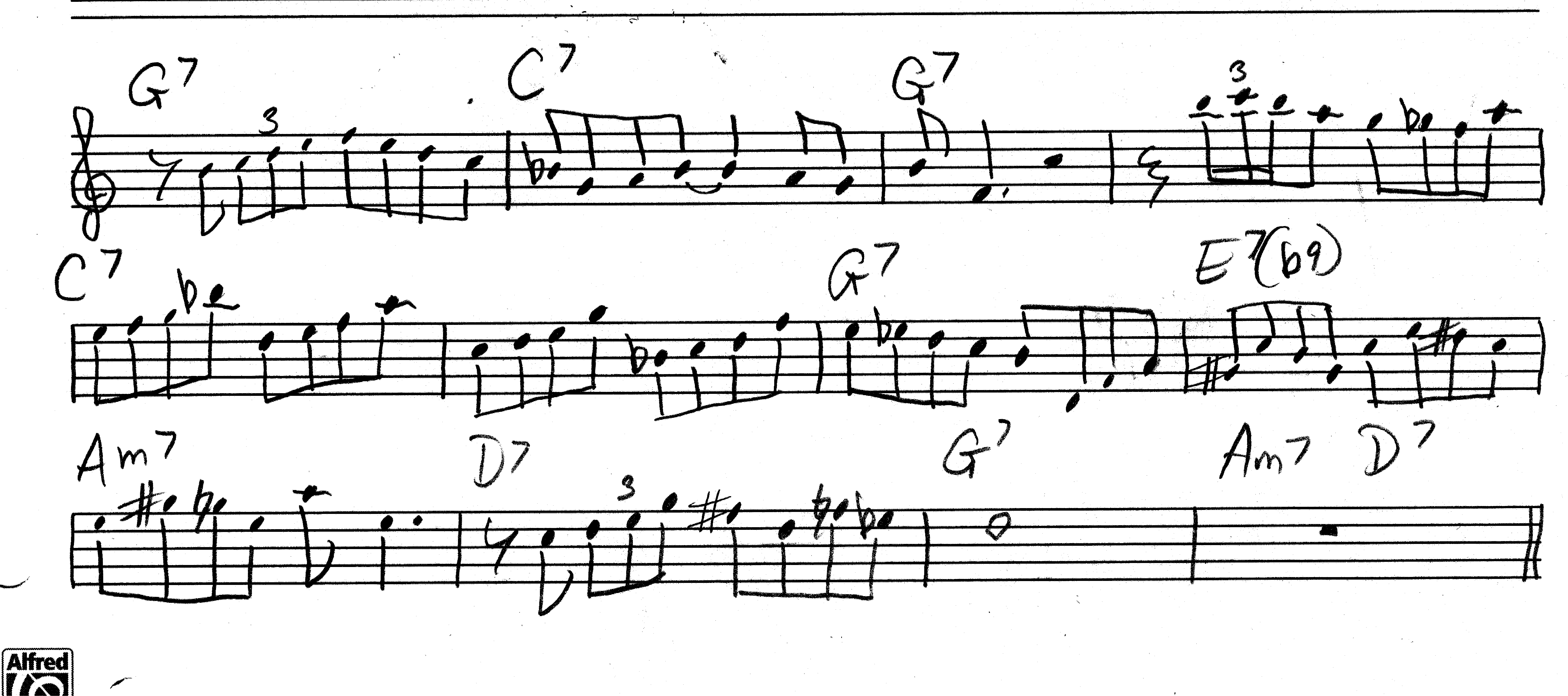
sequenceblues

The above illustrations just touch on the myriad creative and highly personal ways that sequence can be used in jazz solos. To recap: sequence can help you organize musical material in a way that creates cohesiveness and momentum, and that gives “wrong notes” a powerful sense of rightness when you want to play outside the changes.

Like any other component of music, sequence needs to be used judiciously. The right amount adds spice; too much just sounds overdone and even boring. Listen to how the greats of jazz use sequence, work with it yourself, take risks, and let your ear be the judge. And need I say…have fun!
The Last Snows of Winter

As I begin this post, it’s snowing outside.

Spring has sprung, and it’s snowing.

All irony aside, there’s nothing particularly unusual about that this time of year. Late March through mid-April are prone to the residual effects of winter. Fuzzy catkins may cover the pussy willows in the marshes, skunk cabbages bloom in the swamps and wet woods, and robins pogo across the lawns in search of earthworms, but that doesn’t mean the snows are entirely done with us.

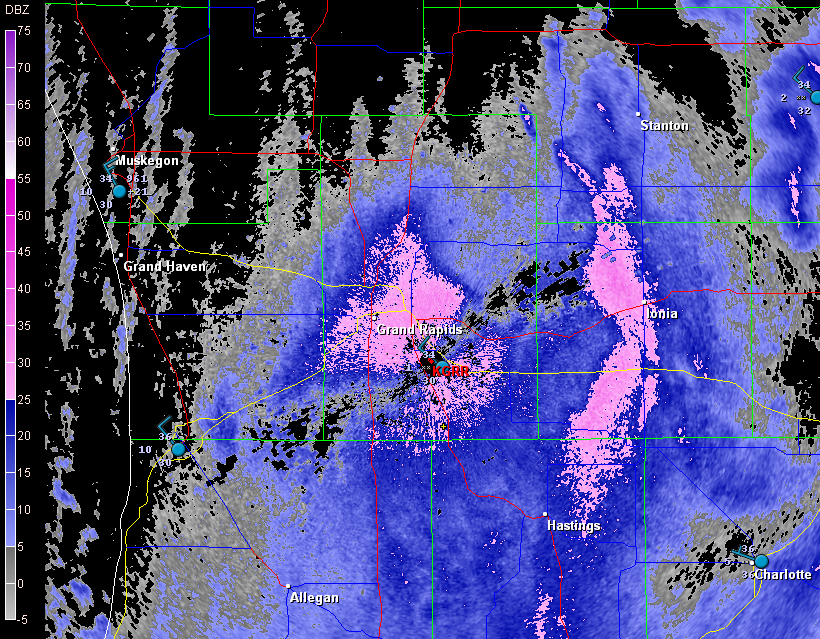
See for yourself. Here’s the radar for my area from just a few minutes ago.

GR2 radar scan shows a snowy afternoon in West Michigan.

GR2 radar scan shows a snowy afternoon in West Michigan.

I don’t mind. Even though the forecast through the week calls for colder temperatures and an occasional dusting of the white stuff, I know it’s all just transitory. We’ve already seen 70 degree temperatures and had our first lightning storm. Today is just winter being a poor loser.

Me, I’m looking ahead. The wildflowers and the weather systems are waking up together, and with the year’s first, shakedown storm chase in Tornado Alley already under my belt, I’m content in knowing that the main action is now mere weeks away.

Bring it on. I’m ready!

Using Sequence in Jazz Improvisation

Okay, campers, listen up: it’s time to talk about…

SEQUENCE.

Yes, sequence. A fundamental building block of music, and a very handy device in the improviser’s toolkit.

What is sequence? There’s nothing mysterious about it. Sequence is simply the repetition of a melodic idea beginning with different tones. Sequence can be diatonic within a key, and many scale exercises consist of scale material organized sequentially. Sequence can also be an exact, interval-for-interval repetition of a motif (or lick), which often–indeed, almost inevitably–will take you out of key.

The beauty of sequence lies in the coherency it brings to a solo. Sequence is a means of organizing melodic material in a way that the listener can immediately relate to. In the midst of a free-form flow of melody, sequence provides a sense of logic, a momentary theme for the ear to latch onto and follow through one or more permutations.

In its simple, diatonic form, sequence creates interest as you navigate your way through a single scale, chord, or ii-V7-I cadence. But sequence can also be used to take you out of key The strength of repetition has a way of making “wrong” notes sound right–a quality that becomes increasingly important when you’re playing tunes with little in the way of harmonic interest. When you’re in the midst of a two-chord jam, diatonic scales get boring pretty quickly. You’ve got to create energy. How? By using chromaticism–tones outside the key center that add color. Sequence is a great way to do so in an organized fashion.

Now, one picture is worth a thousand words, right? “Don’t tell me, show me,” is what you’re thinking. Relax. I’m not going to leave you hanging without a few examples. I’ll provide some material you can practice in an upcoming post. Right now, I just want to introduce the concept of sequence and whet your eagerness to get a few exercises under your fingers.

“But I want to start noooowwww!!!

Patience, Grasshopper. It’s Saturday afternoon, it’s spring, and I want to get out and enjoy the day. Stay tuned, though. I’ll be back with a few goodies. Promise.

A Tornado Ghost Town

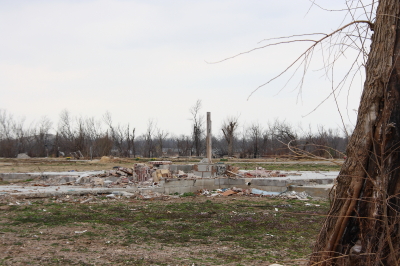
Two years after being completely leveled by a 1.7-mile-wide tornado, the town of Greensburg, Kansas, is  far down the road to recovery and has become a shining emblem of Green America. Not so with Picher, Oklahoma. One year after its visitation by an EF-4 monster, half of the small mining town is worse than gone, and the other half appears just a shadow’s breath away from becoming a ghost town

neighborhood1

Picher, Oklahoma

The town’s demise is not due strictly to the tornado; the storm simply drove the last, very large nail into the coffin. Driving into the community from any direction, you’ll inevitably see the true culprits: vast piles of tailings tainted with the toxic residues of zinc and lead mining operations. Ironically, the same industry that at one time formed the town’s economic backbone has also spelled its doom. Unlike Greensburg, Kansas, which went green and found its salvation in  national attention and an influx of funds, poor little Picher is blighted beyond redemption.

According to the Washington Post, “The mines were shut down in the 1970s, and all that is left in and around Picher are about 1,000 people and giant gray piles of mining waste, known locally as ‘chat,’ some hundreds of feet tall and acres wide, that loom over abandoned storefronts and empty lots.

“The piles are loaded with heavy metals that have contaminated the air and the groundwater and placed the northeastern Oklahoma town in the middle of the Tar Creek Superfund Site, the largest and one of the most polluted in the country. To add to Picher’s misery, a federal study released in January determined that the abandoned mines beneath the city could cause cave-ins without warning.”

That was back in January, 2007, before the tornado. There certainly are no thousand souls left in Picher today. I doubt there are one hundred. It’s a depressing, ugly, desolate place. Yet there are people who remember and love it as home, and a handful who still call it so.

Nothing Left

Nothing Left

Last Saturday, my buddy Bill Oosterbaan and I began our chase day with a visit to Picher. The northern part of the town is just a town, though with its empty streets, it reminded me of the set for a spaghetti Western. As for the southern part, it’s blown to smithereens.

bike-in2

Bike in Tree

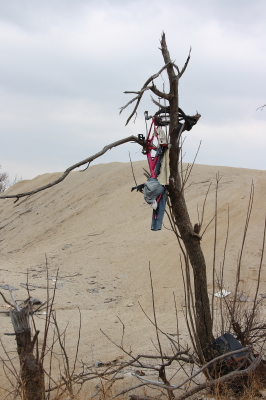
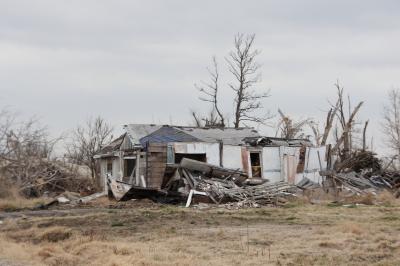
Many of the homes have been cleared away, leaving only cement slabs where neighborhoods once stood. Other battered structures remain, their siding stripped away, roofs missing, walls torn out, twisted window frames gazing vacantly at a landscape of tortured trees, tornado trash, lethal chat hills, and toxic lagoons. Debris litters the fields, and sheets of tin and other objects wrap and twist around the treetops. No one is in a hurry to clean any of it up. There’s no need to. No one is coming back.

What's Left of a House

What's Left of a House

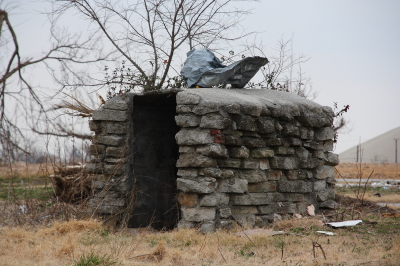
On the north end of the damage track stands an old storm cellar. Presumably, in a tornado that claimed seven lives, the cellar saved a few when the time came for it to serve its purpose. Once a house stood nearby; today, the rough-hewn block shelter stands alone, much like the rest of what is left of Picher, Oklahoma. The cellar resembles a crypt, and in a way, I suppose it is–a memorial marker for a town that is no more.

Storm Cellar

Storm Cellar

First Storm Chase, 2009

What a memorable way to kick off storm season 2009! Yesterday, I chased supercells in Kansas with my buddy, Bill Oosterbaan, and today we attended Tim Vasquez’s severe weather forecasting workshop in Norman, Oklahoma. I’m writing this post from a Best Western Hotel maybe a mile north of where the 1999 Moore tornado crossed I-35. All in all, not a bad past couple of days for a lad from Michigan.

Yesterday’s chase began with a visit to Picher, Oklahoma. The southern portion of this tiny town got wiped out last spring by an EF-4 tornado. Today, a year later, that desolate landscape shows scant chance of recovery. It’s a sobering place to visit.

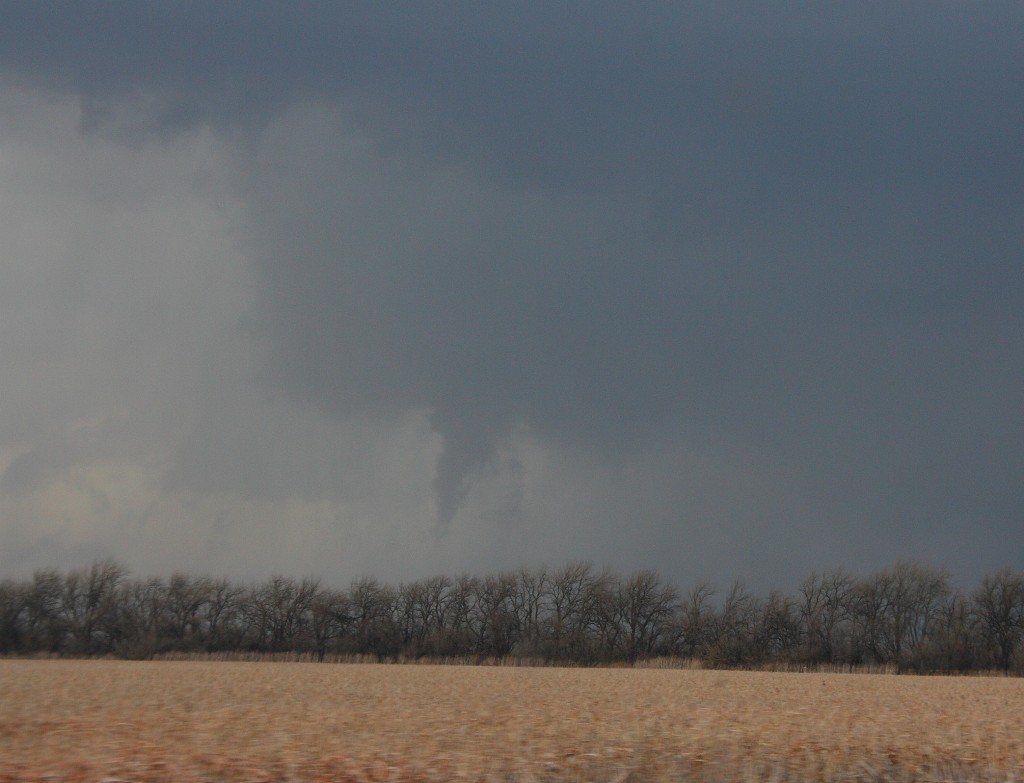
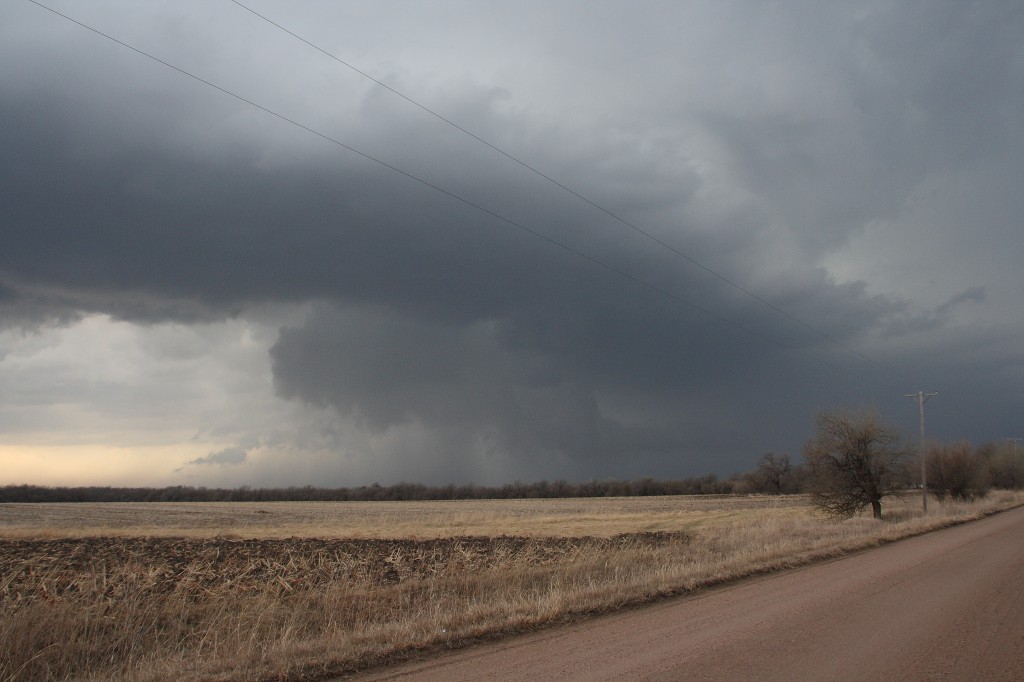
But that’s another story for a different post. Right now, I just want to share a couple images from yesterday’s chase. The moisture was marginal, with dewpoints averaging around 55 degrees up toward the warm front north of Wichita. That’s where we headed, in search of the better helicities. A lot of folks questioned the setup, but it produced. The storm we intercepted put out four tornadoes, though those occurred before we caught up with it. We still saw some nice structure, including a nice wall cloud and a funnel. Check ’em out.

Funnel Cloud

Funnel Cloud

Nice Structure!

Nice Structure!

Severe Weather Forecasting Workshop and Southern Plains Drought

It’s Thursday, and I’m in Louisville, Kentucky, with my buddy Bill. He’s got business here, and I’m taking care of business here on my laptop, and then we head to Norman, Oklahoma, for a severe weather forecasting workshop with Tim Vasquez. At times like this, I’m grateful for the freedom and mobility that come with being a freelance writer. As long as there’s work for me to do, I can do it pretty much anywhere provided I have my laptop and Internet access.

I’ve been hoping to catch a little early-season convective excitement this Saturday. Not sure that’s going to happen, though. The wild card seems to be moisture, but capping may also be a problem. It would be a shame to make the journey to Oklahoma and not see a little decent, Great Plains weather. Of course, that’s not the focus of the trip–the forecasting workshop is–but still, a supercell or two would be nice. Unfortunately, it looks like a cold front will provide the lift that finally busts the cap, and that suggests “linear.”

Sunday is the workshop, so I don’t much care what the weather does that day. I’ll be in class.

Monday may offer another crack at things, and it may be our best opportunity. It’s too far out to say (for that matter, Saturday is still a bit too far off yet to feel either good or bad about it), but assuming that the southern Plains at least get a bit of rain to relieve their dry spell and give the ground a good soaking, moisture may not be the question mark that it is for Saturday’s setup.

Frankly, the current forecast discussion on Stormtrack is the first time I’ve given serious thought to the effect of soil conditions on convection. I had always thought of ground moisture and evapotranspiration as just enhancements to the return flow, not potential deal-breakers. To my mind, a nice, deep low pulling in rich dewpoints from the Gulf of Mexico would more than compensate for dry regional conditions. But more than one seasoned Great Plains storm chaser has looked at the current drought conditions in Texas and Oklahoma and opined skeptically about the chances for 2009 being a good chase year in the West unless the region sees some rain.

Ah, well. The season hasn’t even begun yet, so I’ll take what I can get and hope for better as we move into May and June. Right now, it’s nice to simply see the sun shine, feel fifty-degree temperatures, and know that winter is drawing to a close.

Monte Montgomery Concert Tomorrow Night

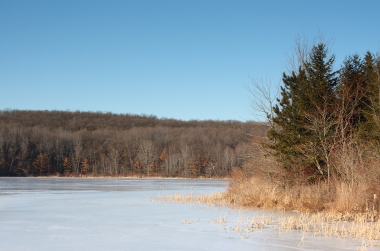
Whew, I have let waaaay too much time elapse since the last time I posted an entry in this blog. Let me mollify you with a nice, bright, sunny image from this cold, early March day. The following photo is one of a number that I took out at Pickerel Lake near Grattan Township in east-central Kent County. It’s a beautiful area, and with spring rapidly rolling in, today was a great day to capture the beauty of the icy landscape while I still can.

Pickerel Lake

Pickerel Lake

Cold as this day has been, there’s no question that warmer weather is moving in. By Thursday, temperatures here in the Grand Rapids area should be in the forties. But I won’t be here. I’ll be with my storm chasing buddy Bill down in Louisville, Kentucky, where he’ll be meeting with some of his clients while I do my own business on my laptop. Then from Louisville, we head out to Norman, Oklahoma, for an all-day severe weather forecasting workshop with Tim Vasquez on Sunday. I’m really looking forward to it!

On the way out there, I hope to catch some early season action. The GFS is calling for a low to be positioned in Colorado or somewhere out there, and with a little luck, we’ll see the right combination of moisture, lift, and kinematics to make life interesting somewhere between Louisville and Norman. Arkansas looks likely. We’ll see.

More immediately, and on the musical side of things, tomorrow night is the Monte Montgomery concert at the Intersection in downtown Grand Rapids. The concert got rescheduled from its original date last September due to illness, and now the time has arrived.

I’ll be playing with the Ed Englerth band as the opening act for Monte.  We rehearsed last night and sounded tight, and today I took my horn to the shop and got a leak tightened down, so all in all, I feel good about playing tomorrow.

If you’re in the neighborhood, come on out to the concert. Ed’s material is strong, and if you’ve never heard Monte, prepare to be stunned. The man is a brilliant guitar player, rated one of the all-time top 50 by Guitar Player magazine. The show starts at 7:00 p.m. Admission is $10 (cheap!),  and worth every penny. See my events calendar for more details.

Preparing for Storm Season 2009

Out of curiosity, I just ran the GFS down to 384 hours. The SPC has posted a light risk for parts of the South on Wednesday, but that may be just a foretaste of an upcoming active period. Did I already write about this recently? Not sure, but if so, I’m writing again.

Long-range prognostication is something like reading tea leaves, but consulting the numerical models still beats going to a groundhog for your two-week weather forecast. At around 204 hours, a nice surge of moisture appears to unlock the the Gulf of Mexico for several days, with 55 degree  dewpoints extending as far north as Missouri, southern Illinois, and Indiana.

Am I hanging my hat on this? Heck no. I’m just thinking, quite wistfully, how nice it would be if what I just saw bore some resemblance to how things actually play out nine days hence. In February, one dreams if he’s a northerner and shudders if he’s a resident of Dixie Alley.

I’m anxious to to see some great storms this year. Last year was fabulous, but I blew some great photo ops because I didn’t know how to use my camera. This year I think I’ve overcome that concern. Now if only the weather and my finances will cooperate.

Meanwhile, I’ve decided to make the best of the holding pattern by signing up for Tim Vasquez’s severe weather forecasting class. It’s a small group setting that will be held on Sunday, March 8, in Norman, Oklahoma. I just shelled out my hundred bucks today and am really looking forward to attending this thing. My chase partner, Bill Oosterbaan, will be joining me. This ought to be a perfect way to really tighten down our forecasting skills for storm chasing season 2009 by learning from one of the foremost gurus of the field. I own nearly all of Tim’s books, and also his Forecast Laboratory software. It’ll be cool to finally pick his brain for eight hours in a focused, fairly personal setting.

More immediately, though, this evening the sun set at 6:17 here in Caledonia, and tomorrow the temperature is supposed to spike to a sweltering 36 degrees. I’ll take that and like it for now. It presages good things to come.

Blowing Strong: National Storm Chaser Convention and a Great Gig with Francesca

What a fun and interesting weekend this has been! I had the rare pleasure of indulging both of my two main passions in life, storm chasing and playing jazz.

Fellow chasers Bill Oosterbaan, Kurt Hulst, and I got together Saturday at Bill’s house and spent the day watching live, streaming video of the eleventh annual National Storm Chaser Convention in Denver, courtesy of SevereStudios.com. When 6:30 rolled around, I broke away and played a gig at One Trick Pony in downtown Grand Rapids with Francesca Amari. The engagement was a blast and we were well received; tunes included a vocals-sax duet on “Good Morning, Heartache,” as performed on Francesca’s new CD, Better Days. Then this morning, I got together with Bill again and we watched the rest of the conference.

The entire conference was great, but from my perspective, the last part was the best. This included talks by Dr. Greg Forbes, Jon Davies, and Rich Thompson on forecasting and mesoscale analysis. I learned a couple things that will definitely be helpful for this coming chase season, which is just around the corner.

All in all, a most enjoyable couple of days. I finished by spending an hour or so practicing my saxophone, which is performing beautifully for me after coming back from the repair man.

Another point of interest: I’ve been invited to put together a little unit to play for the Thornapple Jazz Festival on April 17, hosted by the Thornapple Arts Council of Barry County. I’m excited about this, and pleased that the festival coordinator, my friend and fellow jazz musician Joe LaJoye, thought to ask me. I’ve already got two standout players lined up for my rhythm section, and am considering whom I’ll use for the last one.

Lots going on, and much of it good. Today it snowed, but with temperatures in the thirties, even the cold weather is warmer than it was a few weeks ago. From storm chasing conferences to jazz festival invitations, there are signs that spring is on the way.

The Wisdom of Not Chasing Storms in February (or, Gee, I’m Glad I Practiced My Sax Instead!)

When it comes to chasing early-season severe systems, I’m getting better about reining myself in. Today was the big test. With a whopper of an H5 jet max–upwards of 120 knots–pushing through northern Kentucky into southern Indiana and Ohio, it was tempting to make the drive down to Xenia and parts thereabouts. True, the whole thing looked to be a massive straight-line wind event, but you never know, right? Particularly when you’ve been cooped up all winter with a nasty case of SDS (Supercell Deficiency Syndrome).

I’m patting myself on the back for not going. In fact, I didn’t chase squat today, not even the grunge that was drifting north from the border and offered at least the possibility of a little lightning. That would have been nice to see in February, but I just couldn’t muster the enthusiasm, and now I’m congratulating myself for my restraint.  The wind event did in fact materialize, but way to the south, down in southern Ohio, Kentucky, Tennessee, and on to the east, and not a solitary tornado report do I see in the whole batch of SPC storm reports. So I’m very glad I managed to ward off the temptation to grasp at straws. Not only am I not presently driving the long 350 miles home, wondering what on earth I was thinking that brought me down there in the first place, but I invested my time into practicing my saxophone, a much more profitable activity.

I worked with my new copy of Emile and Laura De Cosmo’s book The Diatonic Cycle, which arrived today in the mail. It’s fun to work with a practice book again. These days, I do so much of my practicing straight out of my head, and the De Cosmos‘ well-conceived, organized, and interesting approach comes as a welcome new way to work on my scales and keys. It should keep me occupied for a few months as I work my way through all twenty-four major and harmonic minor scales as presented in the book.

Opting for practicing my horn over chasing storms was a smart move today. Yesterday, on the other hand…well, if I lived 500 miles closer to Oklahoma, I’d have been all over yesterday’s severe weather. Sadly, that weather marked the year’s first tornado fatalities. It appears that the sirens weren’t working as a large, violent wedge rototilled the town of Lone Grove, Oklahoma, west of Ardmore, doing EF4 damage and taking fifteen lives. According to reports, some people were caught out in a parking lot. How awful. February is not a time when folks in the Great Plains expect such things, and I’d imagine that many people were caught off guard.

Looking ahead, the Gulf of Mexico appears to be opening up for business in Dixie Alley, but we won’t be seeing any of that moisture this far north again in the foreseeable future.  Tonight we plunge back into snowy conditions. This is, after all, February in Michigan.