On the Road to Oklahoma

The southerly breeze blowing from across the field behind me into this shady little park is just enough to render an otherwise hot and somewhat humid noon hour pleasant to perfection. If bathwater could be turned into air and made to blow around me, this is how it would feel, the quintessence of balmy.

I’m sitting at a picnic table surrounded by stately maples robed in the fresh green of May. From every direction comes the chatter and song of birds. A stone’s throw to my right, three fat robins on worm patrol navigate the grass with great singleness of purpose, and somewhere not far away I can hear the whirring call of a woodpecker. I couldn’t ask for a better setting to while away a couple of hours while my buddy Bill lunches with clients at a nearby plant.

Ah, spring! Ah, Iowa! Here in this tiny park in this small town nestled in America’s gently rolling heartland, for a little while I find myself retreating from how life is to how it can be. Quietude is not necessarily quiet, for the air is filled with sounds. But they are subtle sounds, background sounds, sounds of wind and birds that unwind the mainspring of my all-too-preoccupied soul.

Tomorrow I will wake up in Enid, Oklahoma, which looks like a prime base of operations for chasing storms that bump off the dryline. I’ve had my eye on Enid for a couple of days, now, and this morning the SPC issued a moderate risk for tomorrow with Enid smack in its midsection. That bodes well. It’s time at last for a chase in the Southern Plains.

I still have some concerns with this system. But they’re outweighed by the fact that the right stuff is coming together for tomorrow. Even more importantly, it’s May in Oklahoma. An ant can fart and spin up a tornado. And I’ll be there to watch it and experience the drama, beauty, and adrenaline of the atmosphere with my good friend and chaser partner of 15 years, Bill.

Speaking of whom, here he is. Looks like his business meeting is over. Time to pack up, hop in the car, and head west. Adieu, Victor, Iowa. Thanks for providing unknowing hospitality to a stranger in this jewel-like little park beneath the unfolding leaves of spring.
First Great Plains Chase of 2011 This Wednesday

At last, the setup I’ve been waiting for–one that warrants dipping into my tight finances in order to make the 1,000-mile drive to the Southern Plains. To date, this present system has been a miserable disconnect between upper-level support and instability, with a nasty cap clamping down on the whole shebang. Last night it managed to cough up a solitary tornado in South Dakota. That was it. I’m not sure what today holds, but I haven’t seen anything to excite me about it or tomorrow.

But Wednesday…ah, now we’re talking! The SPC places a large section of the Great Plains under a slight risk, and their discussions have been fairly bullish about the potential for a wide-scale event. At first I couldn’t see why. My mistake–I was looking at the NAM, which with straight southerly H5 winds has not provided the best PR for Wednesday’s setup. But once I glommed the GFS, I got a whole ‘nother picture, one which the SREF and Euro corroborated.

That was last night. I haven’t looked at today’s SREF, and the new ECMWF gives me a slight pause as its now somewhat negative tilt has slightly backed the mid-levels from the previous run. But only slightly. The H5 winds still have a nice southwesterly flow, and taking the three models together, everything you could ask for is lining up beautifully for tornadoes in the plains.

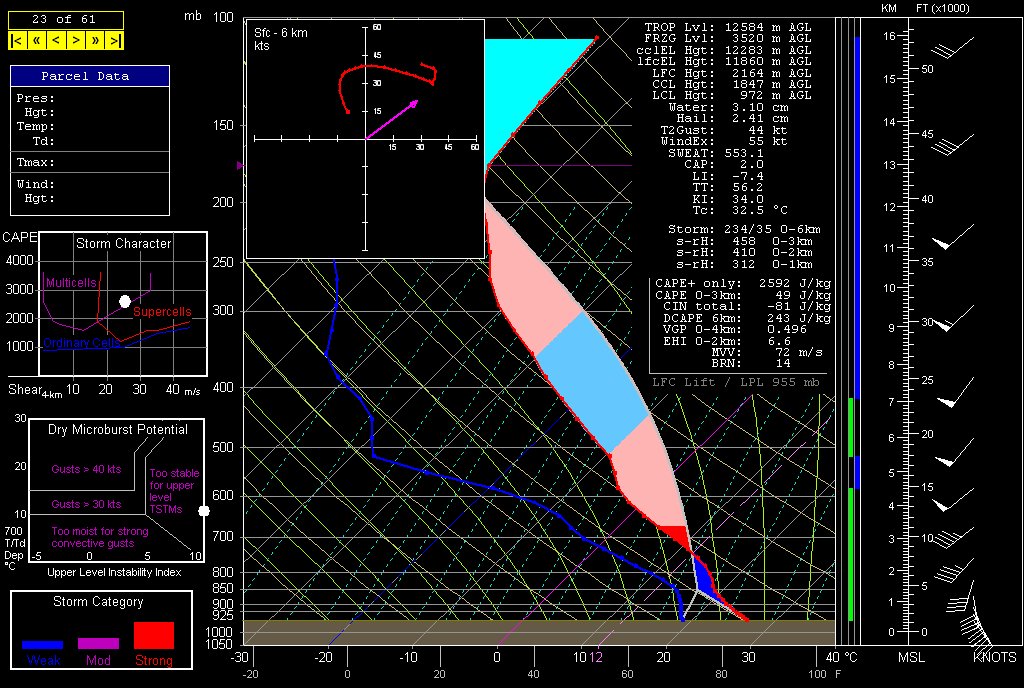
The event promises to be widespread, with a robust dryline stretching from a triple point in southwest Kansas south through Oklahoma and Texas. Positioned near a dryline bulge, Enid, Oklahoma has drawn my attention for the last couple of GFS runs. Check out this model sounding for 00Z and tell me what’s not to like about it. Everything is there, including a voluptuous hodograph and 1 km SRH in excess of 300 m^2/s^2.

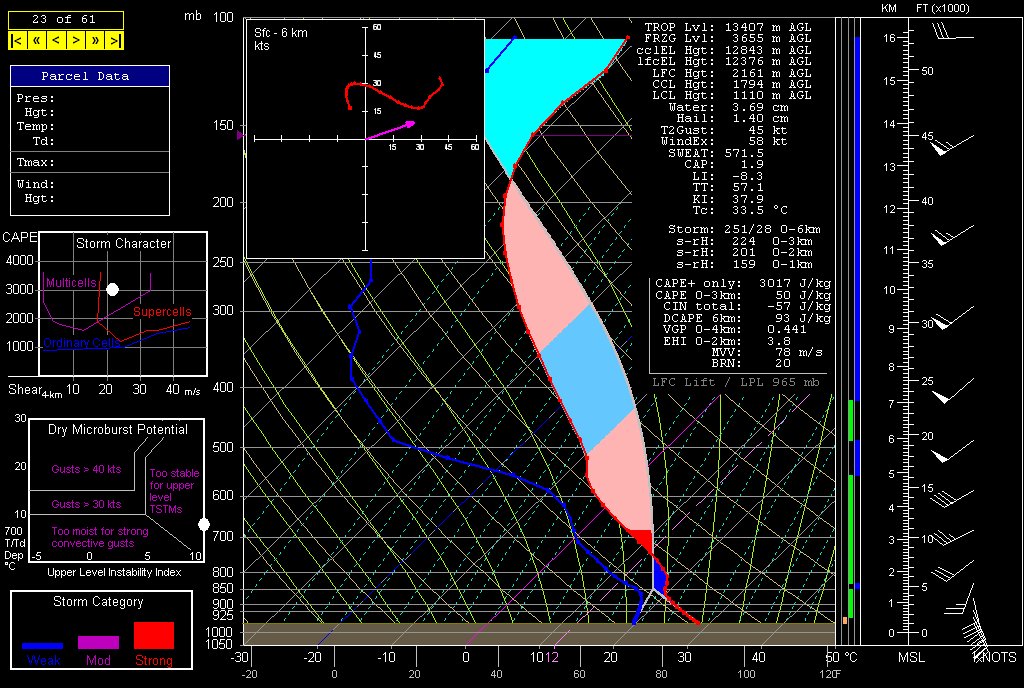
Other places in the region also look good, though. Farther south in Texas, Wichita Falls shows potential. Helicity isn’t as persuasive as Enid, but the CAPE tops 3,000 J/kg and there’s less

convective inhibition. Here’s the sounding for you to compare with Enid.

I haven’t been as drawn to Kansas so far, but with the triple point perched there, storms are bound to fire up just fine in the Sunflower State. The details will work themselves out between now and Wednesday evening. Significantly, the tyrannical cap of the previous few days no longer appears to be an issue.
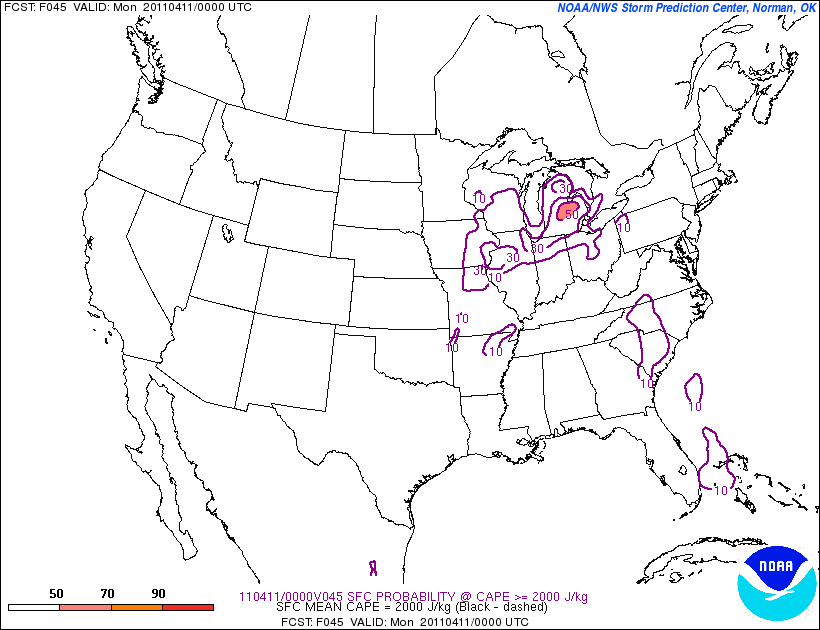
The bottom line is–it’s time to head West! This evening I’m taking off for the plains with my long-time chase buddy Bill. At last! Time to sample what the dryline has to offer, and–now that I’m equipped with a great HD camcorder–finally get some quality footage of a tornado or two.

There’s no place like the Great Plains! YeeeeHAW!!!!!

Misuse of the EF-Scale: Just the Facts, Please

Would the media and storm spotters PLEASE stop rating tornadoes before the official National Weather Service survey teams do!

A couple Fridays ago a radio announcer in Saint Louis assigned a tornado an EF-3 rating while the storm was still in progress, chewing through the city. More recently I read a news writeup in which the April 27 Tuscaloosa–Birmingham, Alabama, tornado was described as an EF-5, as though that rating were a done deal. At the time, the matter had yet to be determined by damage assessment professionals.

Both the Tuscaloosa and Saint Louis tornadoes were in fact officially rated EF-4. In one case the news medium underestimated the damage rating; in the other, it overestimated; and in both cases the media overstepped their bounds.

“EF-5 in Progress!”

It appears that a good number of reporters and storm spotters are prone to the same error that many storm chasers make: linking their impression of a tornado’s strength based on appearance–whether visually or on the radar–to an Enhanced Fujita scale (EF-scale) rating. Doing so demonstrates ignorance of what the EF-scale actually is: a tool that assesses and rates tornado damage, and from it extrapolates potential wind speeds. By its very nature, the EF-scale cannot be used to describe a tornado in progress; it was developed for use in post-mortem assessments of tornado events.
Expanding on the original F-scale criteria developed by pioneer tornado scientist Dr. Theodore Fujita, the EF-scale considers 28 Damage Indicators (DIs)–small barns or farm outbuildings, one- or two-family residences, strip malls, hardwood trees, and more–in rating tornadoes. Each DI is scrutinized according to its makeup, its circumstances, and the Degree of Damage (DOD) it received. For instance, did a hardwood tree sustain broken branches? How big were the branches? Was the tree uprooted? Snapped? Debarked, with only a stub of trunk left standing?

In its 95-page recommendation for an Enhanced Fujita scale that it submitted to the National Weather Service in June, 2004, the Wind Science and Engineering Department at Texas Tech University said:

Ideally the recommended approach for assigning an EF-Scale rating to a tornado event
involves the following steps:
• Conduct an aerial survey of damage path to identify applicable damage indicators and
define the extent of the damage path
• Identify several DIs that tend to indicate the highest wind speed within the damage
path
• Locate those DIs within the damage path
• Conduct a ground survey and carefully examine the DIs of interest
• Follow the steps outlined for assigning EF-Scale rating to individual DIs and
document the results
• Consider the ratings of several DIs, if available, and arrive at an integrated EF-Scale
rating for the tornado event
• Record the basis for assigning an EF-Scale rating to the tornado event
• Record other pertinent data relating to the tornado event.

Obviously this kind of information isn’t snap-judgment material. Making such assessments requires training and resources of a kind that most media personalities–and, for that matter, most storm chasers–don’t have.

The bottom line is this: It’s just flat-out wrong to rate a tornado in progress based on its appearance using the EF-scale. Also, while there’s nothing wrong with personally speculating about the nature of the damage you’ve observed in a tornado’s aftermath, remember that your opinion is unofficial.

Bear these things in mind the next time you hear someone say, “That’s got to be an EF-4!”–or the next time you’re tempted to say it yourself. Particularly if you’re a journalist. When you broadcast or publish as definitive what is in reality nothing more than your own or some spotter’s or chaser’s subjective opinion, you are misinforming the public. Your hunch might eventually be proved right, but it could also easily be proved wrong. Why create such confusion? It costs you nothing but sensationalism to refrain from presenting uninformed impressions as if they were fact. Leave EF-scale ratings out of the picture until the NWS has completed its investigation of an event and assigned official ratings.
So What CAN You Say?

You can describe a tornado that you are observing as weak, strong, or violent.

You can describe its size and/or appearance using subjective terms that are commonly understood by storm chasers and meteorologists. Small and large are good, as are wedge, cone, rope, stove pipe, and multiple vortex.

It’s correct to say, “That’s a small but strong tornado,” or, “There’s a large, violent, multi-vortex tornado in progress.” It’s incorrect to say, “Oh my gosh! EF-5 tornado!” or “A trained spotter has reported an EF-3 tornado moving toward the town of Pleasantville.” (A properly informed spotter won’t use such language.)

As for reporting tornado damage, most people–including me–aren’t intimately familiar with the nuances and complexities of the Enhanced Fujita scale. So leave it alone. Better to just describe the damage in general terms as light, significant, severe, homes completely swept away, trees uprooted, complete devastation, and so forth. Or if you want to speculate on the EF potential, make it clear that what you’re sharing is only your opinion. Saying, “This looks like it could receive an EF-2 rating,” or, “I’m guessing EF-3 damage here, but we’ll wait for the National Weather Office to make an official determination,” is different from stating definitively that “We’ve got EF-4 damage.” How do you know? Unless you’re a NWS damage assessment expert, you don’t. Your guess may prove to be true, but leave it out of print or off the airwaves until it has been established as fact.

The Bottom Line

It’s human nature to speculate on the strength and effects of something as singular, violent, visually striking, and impactful on a community as a tornado. Moreover, there’s nothing wrong with forming your personal opinion regarding which EF-scale rating a tornado might deserve, bearing in mind that you could very well be wrong. But if you’re a broadcast personality, reporter, or storm spotter, hold your thoughts to yourself. When it comes to information that’s relevant and truly helpful to the public, you’ll do well to heed the advice of Sergeant Friday in the old Dragnet TV series: The facts, please. Just give us the facts.

April 27, 2011, Southern Outbreak: When a Nightmare Becomes Reality

The death toll from yesterday’s tornadoes in the South presently stands at 231,* and it continues to climb. In the battered town of Tuscaloosa, Alabama, 36 people are dead; in Birmingham, at least 30 more.** From

Mississippi to as far north as upstate New York, the worst tornado outbreak in 37 years has left communities sifting through a battleground of leveled buildings, crumpled automobiles, downed power lines, tortured trees, and a horrifying number of casualties. This has been no mere tornado outbreak; it has been a tornado nightmare.

“You’re talking about whole neighborhoods of housing just completely gone,” said Birmingham Mayor William Bell in an NPR interview. “Churches, gone. Businesses, gone. I’m not talking about just roofs being blown off, but just completely gone.”**

I knew that a dangerous weather event was brewing in the South yesterday. But with my mother undergoing a knee replacement, I spent most of the day at Blodgett Hospital here in Grand Rapids, Michigan. I knew nothing of what was transpiring down in Mississippi, Tennessee, and the epicenter of the outbreak, Alabama, until later in the evening, when I finally left the hospital, fired up my laptop, and got my first look at the radar.

There it was, spread out before me: a blitzkrieg of intense supercells swarming across Alabama and Tennesse, attended by so many tornado reports that they obscured parts of the map. My heart dropped into my gut. I didn’t need any news reports to tell me that something awful was happening and people were getting killed.

Immediately I thought of my long-time friend and storm chasing partner, Bill Oosterbaan. He was down there somewhere in Alabama. I had no question that he’d seen tornadoes, but was he safe? I couldn’t reach him at first on his cell phone, but eventually we connected and Bill shared his story. He had been about a quarter-mile behind a tornado that hit Huntsville and gotten rained on by debris. It sounded bad, but Bill was okay, had witnessed five tornadoes, and had gotten video footage.

After talking with Bill, I began searching for news on Facebook and the Internet. The first video I saw was Chris England’s footage of the Tuscaloosa tornado as it chewed through the city. “Andover!” I thought. “It looks like the Andover tornado.” (An F5 monster that struck Andover, Kansas, on April 26, 1991.) More YouTube videos followed: Mind-boggling views of the Tuscaloosa storm. TWC footage of a violent, mile-wide wedge moving through Birmingham. An intense tornado striking Cullman. It was horrible. The storms were ongoing even as I watched, and it dawned on me that, overworked as the word “epic” has become, here was a situation where it applied.

I am appalled by the news and deeply saddened. As good as today’s weather warning system is, nevertheless the death toll is mind-numbing. I frankly expected a few score fatalities, and that in itself would have been too many. Lives are lives. But this many lives…it is just sickening. Were it not for the unswerving vigilance of the Storm Prediction Center and the National Weather Service; and were it not for today’s NEXRAD system that blankets the nation with Doppler radar to provide coverage that far outstrips what existed during the historic 1974 Super Outbreak and 1965 Palm Sunday Outbreak; were it not for these things, then the death toll from yesterday would have been apocalyptic. As it stands, it is horrifying, and the number continues to grow.

My writing on this event is finished for now. There is simply too much to say and too much news that is yet breaking, along with countless hearts. The story has just begun, and more can be told only as it becomes known. My thoughts and prayers go out, with those of countless other storm chasers, to the survivors of this terrible disaster.

————————————

* From CNN’s live blog.

** From NPR’s news blog, “The Two-Way.”

Sax and Wedge: Maybe This Year

This afternoon I have a gig with Paul Lesinski at the Amway Grand. I’m looking forward to it, but it indisposes me to chase what could be Michigan’s first round of severe weather this afternoon. Practically speaking, the “storm” and “horn” parts of Stormhorn sometimes conflict with each other. I can’t do two things at once; I can’t play a gig and chase storms, and when I post here about one subject, then the other half of my readership gets left out.

Yet I view the two interests as connected in spirit, to such an extent that one of my life goals is to get some footage and/or photos of me playing my sax out on the Plains with a big wedge churning in the background. Given how active this April has been, maybe 2011 will be the year when I fulfill that ambition. I almost always bring my horn with me on my long-distance chases for just that reason (plus, yeah, I like to get in some sax practice when I can). The one notable occasion when I left it home last year was on May 22, a milemarker in my chase career. Unfortunately, the vehicle was so packed that there was no room for the horn, and given how events unfolded out there by Roscoe, it was probably just as well.

Today my buddy Bill is chasing down in Arkansas. Yesterday he filmed a large, violent wedge that hit the town of Vilonia. Round two today looks to be at least as bad, and I hope Bill stays safe. I don’t have a good feeling about what lies in store for the folks in that region. But I won’t be following any of the developments because I’ll be doing the other thing I love as much as storm chasing: playing my saxophone. This time of year the storm chaser in me has the edge over the musician, but once I’ve got my horn in my hands I forget everything else and just go with the flow of the music. Playing jazz is one of the most in-the-moment experiences a person can have, and I get tremendous satisfaction out of being a practitioner.

Afterwards maybe I’ll still get a crack at whatever weather shapes up. Probably not; today, such as it is, looks like it’ll play out on the eastern side of the state.  But I’ll take my gear with me to the gig just in case.

April 22, 2011, Saint Louis “Good Friday” Tornado

Saint Louis, Missouri, has been hit a number of times  by tornadoes over the years, most notably on May 27, 1896, when a violent tornado claimed 255 lives. Last Friday my friends Bill Oosterbaan, Kurt Hulst, Mike Kovalchik, and I witnessed the first EF4 tornado to strike the metro area in 44 years.

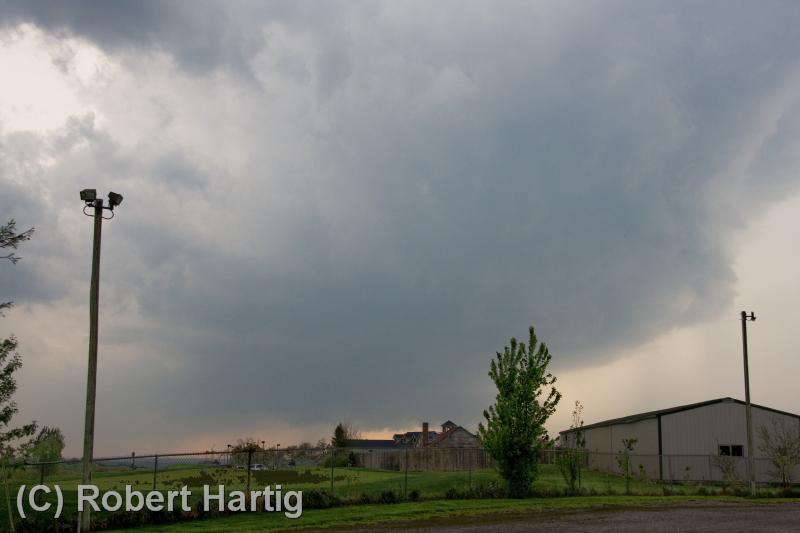
I use the word “witnessed” loosely as we really didn’t see much of anything. Bill observed wrapping rain curtains just to our west, Kurt and Mike saw a couple power flashes, and I captured a feature on video that may have been the funnel cloud, but mostly what we saw was a whole lot of blowing rain and brilliant, nonstop lightning. Judging from the lack of any other videos that show a clearly defined tornado, our experience was typical. If anyone was in a good position to see the condensation funnel, it was us, and perhaps we would have seen it had the storm struck an hour earlier. But I suspect the thing was too rain-wrapped for good viewing even in broad daylight.

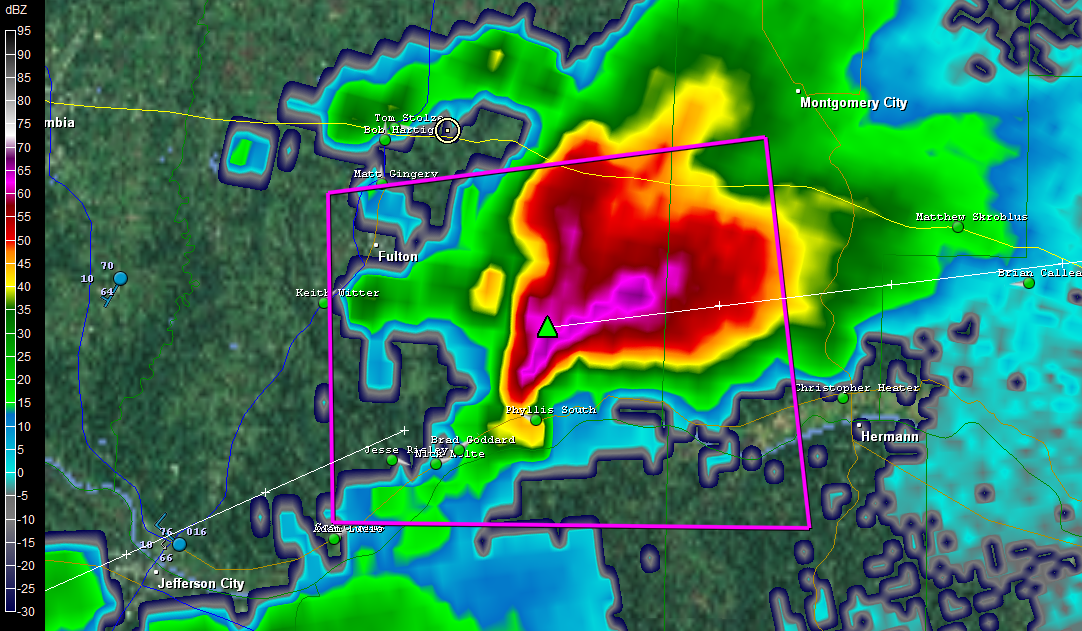
The storm initiated southeast of Kansas City near the triple point of an advancing low. Poised at the northernmost end a broken line that backbuilt southwest  into Oklahoma, the incipient cell split and the right split grazed eastward along a warm front draped over the I-70 corridor.

We first intercepted the storm south of Columbia outside the town of Ashland. At that point it was getting its act together and was already tornado warned. The sirens sounded right next to us as we stood and filmed, but the storm had a ways to go before it finally went tornadic. Where we stood southeast of the updraft base, the air was dead calm–not even a breath of inflow, nothing but the year’s first mosquitoes to remind us that spring was well underway south of our home state of Michigan.

Keeping up with this storm would likely have been much easier had we not chosen to head back to I-70, where eastbound slowdowns hung us up and golfball hail on the north end of the supercell clobbered us. The storm organized beautifully for a while on the radar, but there wasn’t a thing we could do about it with traffic crawling along. Thanks to Bill’s great driving, we eventually did get clear, but by then the storm appeared to have turned to junk.

Just goes to show how deceptive appearances can be. Shortly after we had written the storm off, the radio announced the first reports of tornado damage in New Melle, and from then on, the reports continued. As fellow Michigan-based storm chaser L. B. LaForce put it, “I got a good look at the base just south of Innsbrook and it looked like crap. It tightened up shortly thereafter.”

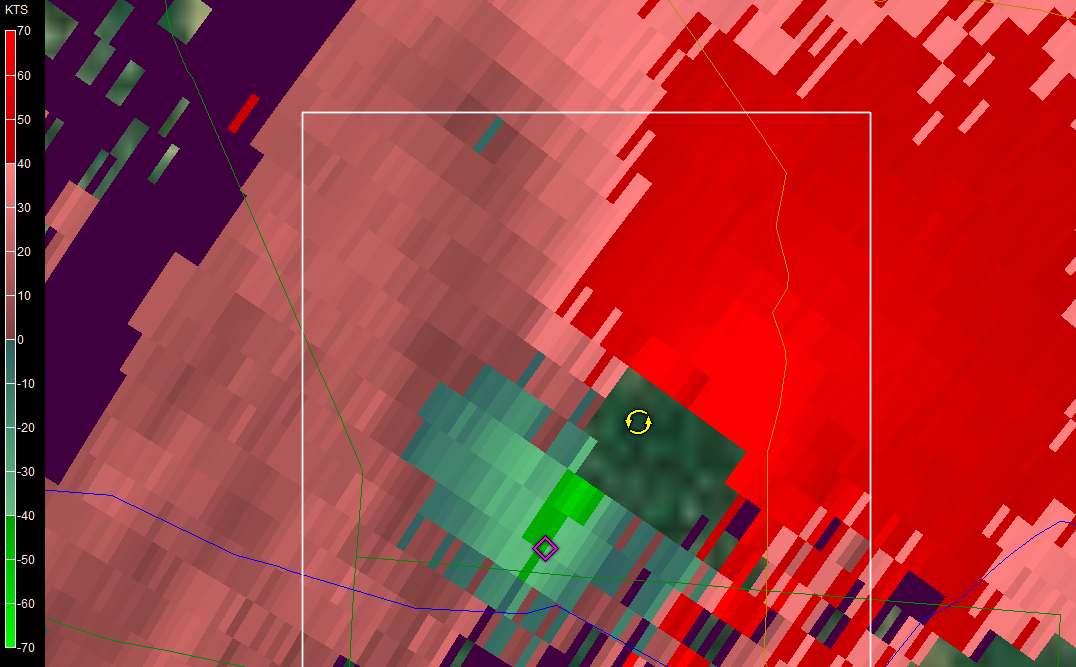
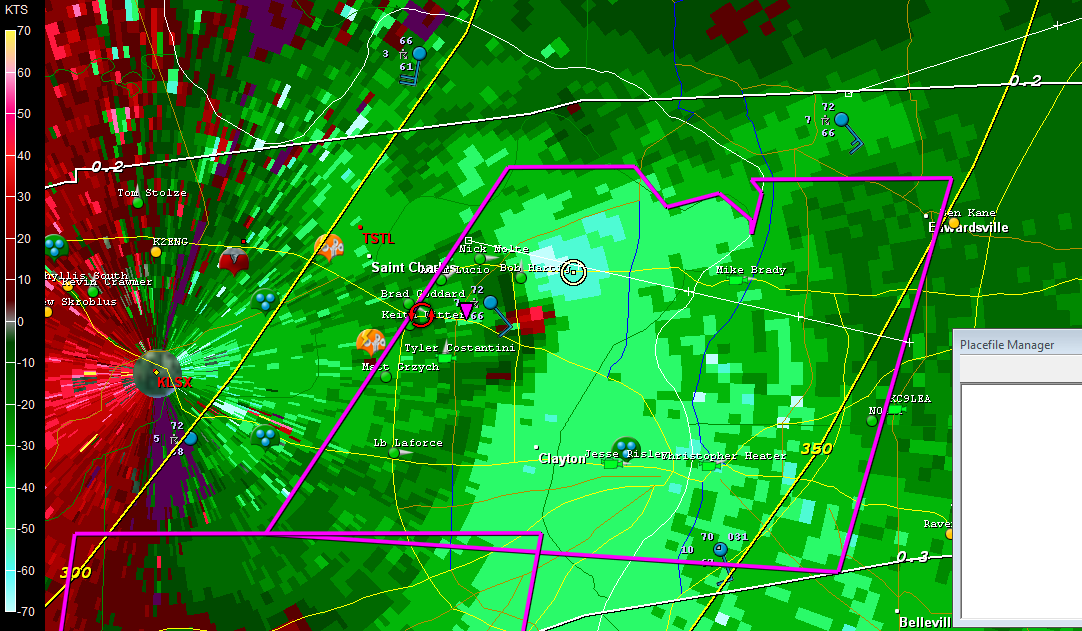
Indeed it did, as strong and continuing radar couplets bore out. Dropping south on US 40 to get a better view of the storm, we parked by a cemetery and  finally got a good look at the action area to our southwest. Against the dirty orange backlight of the fading sunset, a conveyor of low clouds flowed from the north into an area of murky blackness bristling with lightning. Unquestionably this beast  meant business and intended to transact it along the worst possible path: right through the heart of  northern Saint Louis.

Along its 22-mile path, the tornado inflicted its most widely reported damage at the Lambert–Saint Louis International Airport. It’s a miracle that no one was killed or seriously injured at this location. That may very well include us. We had exited I-70 in order to get a look at the storm, or at least try to, and by the time we were back on the highway the radar showed that we had compromised our safety and needed to git, fast. It was at this point that Bill thought he saw the rain curtains swirling, and Kurt and Mike observed what looked like power flashes. Hard to say, given the intensity of the lightning. What’s certain is that we missed the tornado by the skin of our teeth, because the radio announced only minutes later that Lambert Field had been hit. The bear had been breathing down our necks. Funny thing is, I’ve driven through much worse conditions at night. But conditions can change in a heartbeat, and in this case they wouldn’t have changed for the better.

The seriousness of the damage inflicted by this tornado didn’t sink in until a while later when reports, photos, and YouTube videos began to filter in. EF4 damage occurred about a mile-and-a-half west of the airport. At Lambert, the damage was rated EF2 and resulted in closure of the airport. A photo of a passenger bus hoisted up onto the roof of an airport building demonstrated the power of the winds.

The Saint Louis NWS report on this event lists two tornadoes, the first a brief EF1 that did damage in New Melle, followed by the long-track, EF4 monster that chewed through Saint Louis proper, beginning along Creve Coeur Mill Road near Griers Lane and dissipating across the Mississippi River south of I-270 and west of Pontoon Beach, Illinois.

Why did the storm wait until it was just west of Saint Louis to begin spinning up tornadoes? The best explanation I’ve heard is one that was offered on Stormtrack. Evidently the warm front had moved north of I-70 on its western side, where the low initially lifted through Kansas City. But farther east, the front sagged southward through Saint Louis, backing the surface winds. The storm, moving eastward through the warm sector just south of the warm front toward an inevitable intersection, finally interacted with the front itself and began to ingest the enhanced helicities. Suddenly, boom! Tornadoes.

Farther east into Illinois, although it continued to be tornado warned, the storm gradually weakened and lined out, leaving Bill, Kurt, Mike, and me to enjoy a spectacular light show for much of the ride home. I finally clambered into bed around 5:00 a.m.

The stormy weather continues unabated down south. As I write, Bill is chasing down in Arkansas north of Little Rock. Judging by his position on Spotter Network, it looks like he may have bagged a tornado. Guess I’ll find out in a while. I wish I was there too, but this week is spoken for. I have a gig tomorrow afternoon, and then Mom goes in for knee surgery on Wednesday. So I won’t be chasing through the weekend. After that, we’ll see what the weather holds. This has become an active April, and now we’re coming up on May. I can’t wait to hit the road again!

April 14-16 Southeast Tornado Outbreak: Thoughts and Images

There are times when the sight of a high risk sickens rather than excites me, and Saturday was one of those days. It’s one thing when severe storms occur in the Great Plains where the population is sparse, but when a swarm of tornadoes roars across an area punctuated with cities and towns, all I can think is, “Oh no. All those people!” Such was the case with last week’s horrendous three-day tornado outbreak across the South and East.

The outbreak commenced Thursday in Oklahoma, Kansas, and Arkansas, with a preliminary figure of 27 tornadoes reported.* The action ramped up Friday in Louisiana, Kentucky, Missouri, Illinois, Mississippi, Alabama, and Georgia, with an initial tally of 120 tornadoes. Day three was the worst of all, with yet another 120 reported tornadoes slashing across the populous, densely forested Southeast and East from South Carolina to as far north as Pennsylvania. Hardest hit was North Carolina, where large and powerful tornadoes ripped through Raleigh and other communities. Twenty-two lives were lost, 11 of them when a three-quarter-mile-wide, EF3 monster carved a 19-mile path across Bertie County. Another six died in Virginia. And in its previous two days, the outbreak claimed seven lives in Arkansas, seven in Alabama, two in Oklahoma, and one in Mississippi.

In all, Saturday’s tornadoes were North Carolina’s most lethal since 1984, when 42 died. And regionally, Friday and Saturday were the worst tornado outbreak in the Southeast since the Super Tuesday Outbreak of February 5–6, 2008, when 87 tornadoes killed 57 people in four Dixie Alley states.

But my point in writing this article isn’t to provide yet another news story on the disaster. Rather, it’s to share my feelings as I watched it unfold. With some truly amazing video coming in from chasers in Oklahoma, the first day was fascinating. Day two, watching tornadic supercells crawl across Mississippi and Alabama on the radar was unnerving; I hoped nothing bad would happen down there in the South, but I knew better. On day three, when I saw the high risk go up in North Carolina, my heart sank.

When it comes to armchair chasing, I’m moderate in my habits. If I can’t actually be out chasing, I often opt for a more constructive use of my time than watching the radar and gnawing my knuckles. This time, though, I couldn’t help watching. At first the line of storms looked mean but not terribly alarming. As the storms headed east, though, they began to organize and strengthen, and circulations began to show on radar. Strong circulations, a whole line of them, stretching from northern South Carolina up into Maryland and Virginia. And the tornado reports began filtering in. These storms didn’t merely appear to be impacting towns–they were.

I watched one monster chew through Raleigh, thinking, “No way!” Then came the videos on YouTube, one of them by chasers at unnervinglyclose range, and I knew. No one was dodging the bullet this time. Neighborhoods were being pulverized and people were dying.

With fiscal conservatives recently wanting to slash the budget of the National Weather Service, all one has to do is witness a scenario like last weekend’s in order to realize the supreme lunacy of such a move. Tornado season is just getting started. More is on the way. Bad as last week was, we could yet see worse. How smart is it to pull the rug out from under our national weather warning system at precisely the time of year when its optimal service is most needed?

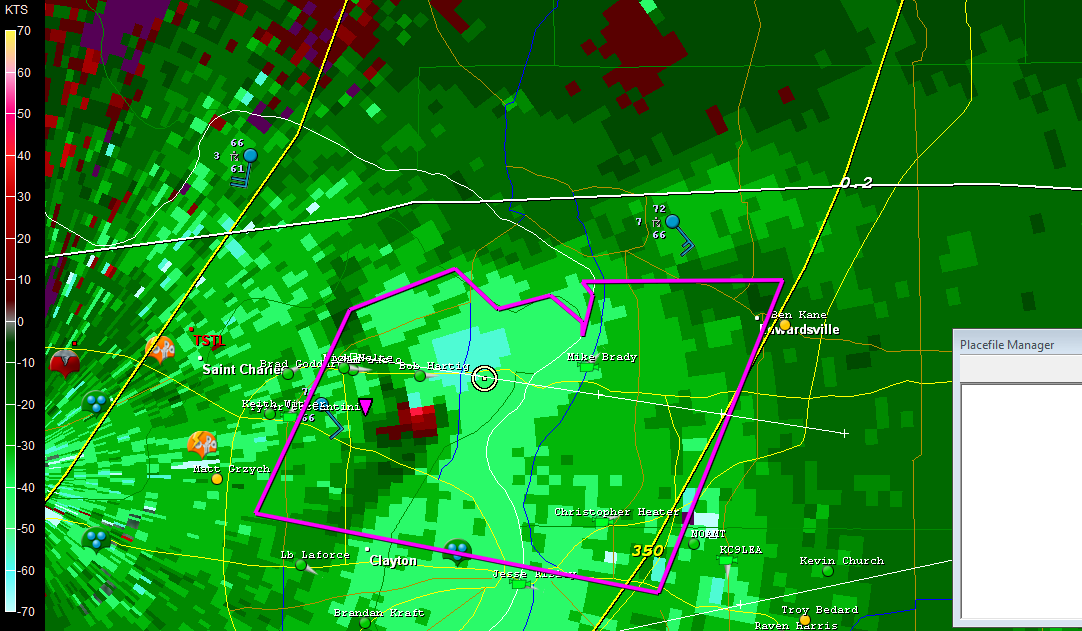
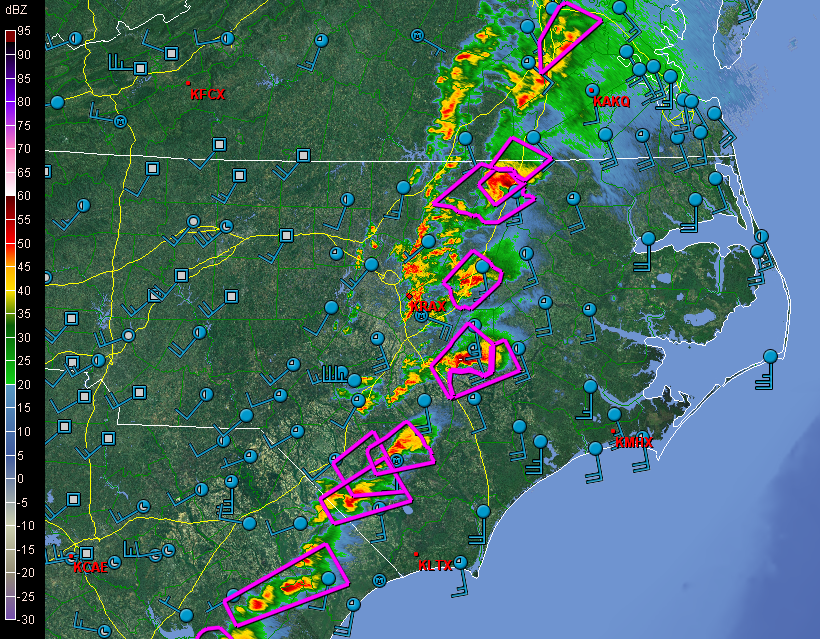
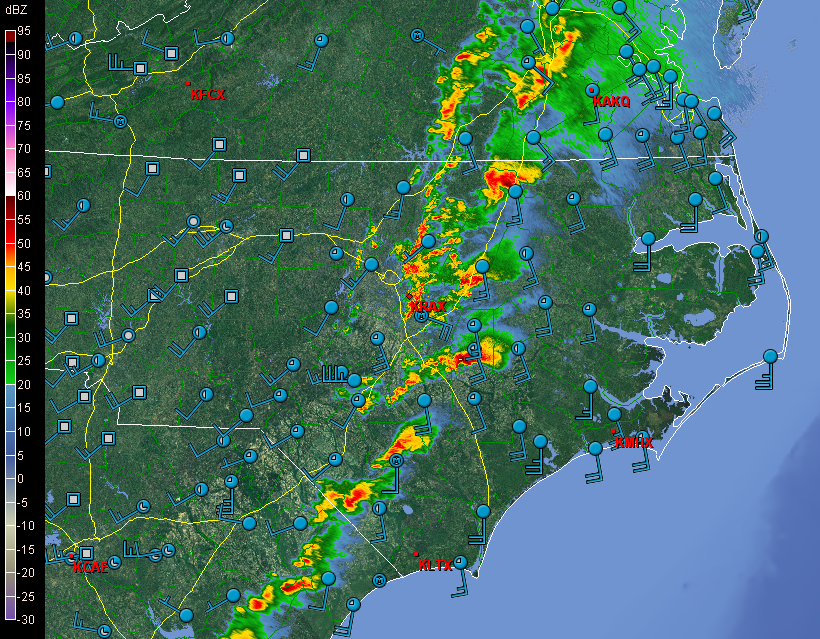
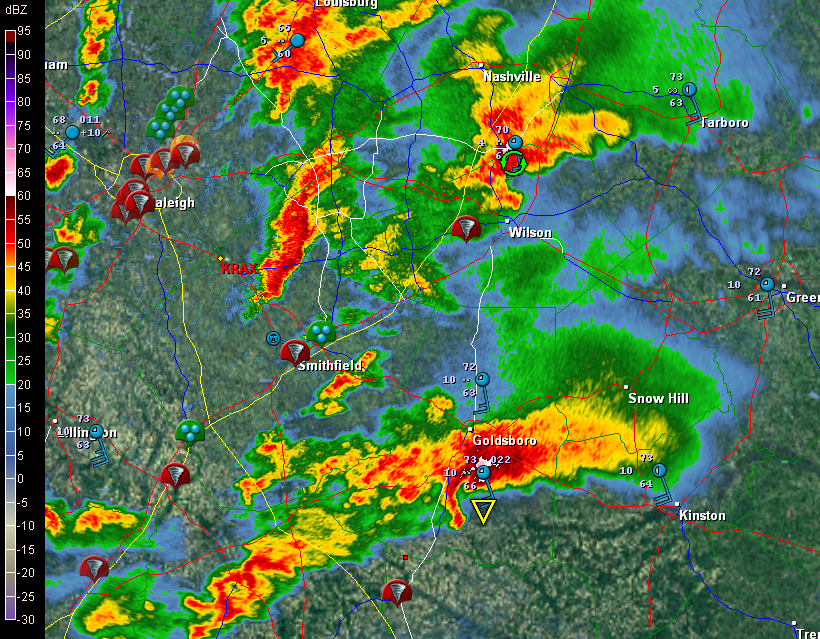
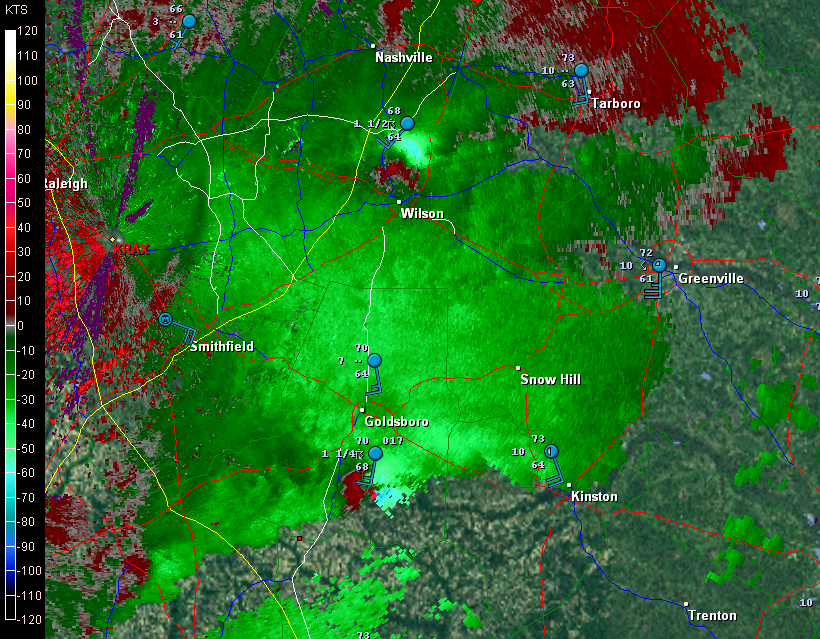
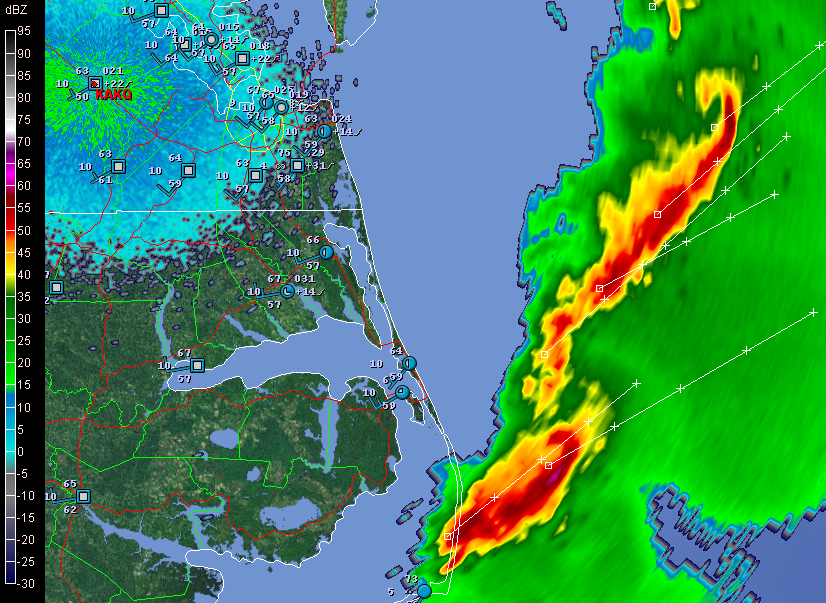
But I digress. Here are a few GR2AE radar grabs of the North Carolina supercells. Storm motions were to the northeast. The rest tells its own story if you know what you’re looking at.

First, here’s are a couple macroscopic views.

Next, I’ve zoomed in on the Raleigh radar to  cross-check reflectivity and storm-relative velocity on a couple supercells.

The final image was taken after the storms had moved out to sea. It shows a couple of northern line-end vortices that I found interesting and thought you might too.

____________________
* All numbers reflect preliminary reports at the time of this post’s publication. Final statistics will likely be different.

Tornado Video Resembles Paul Huffman’s Famous Twin-Funnels Photo from the 1965 Palm Sunday Outbreak

On April 11, 1965, Elkhart Truth photographer Paul Huffman parked his vehicle by the side of US 33 northwest of Goshen, Indiana, and began snapping pictures of a tornado passing within a half-mile of him. One of those images, captured as the twister was in the process of devastating the Midway Trailer Park, became what is probably the most famous tornado photograph ever taken, and the icon of the nation’s second deadliest large-scale tornado outbreak. Paul’s image of twin funnels straddling the highway is instantly recognizable to anyone familiar with the 1965 Palm Sunday Outbreak.

Like countless weather weenies, I’ve been fascinated with Paul’s photo. As a storm chaser, I’m familiar with multiple-vortex tornadoes. Today meteorologists understand that they’re fairly common. Yet multiple vortices take all shapes, sizes, and behaviors, and I’ve always been on the lookout for something that seemed to approximate what was probably happening in Paul’s photograph (really his series of photographs depicting a single funnel undergoing vortex breakdown into the infamous “twins”).

Just a few minutes ago, I came across a new YouTube video that is the closest I’ve ever seen to what the Midway tornado–and very likely the one that hit Dunlap 45 minutes later–may have been like. I don’t normally feature YouTube videos in this blog because I hate discovering that the video I had included in a post a year ago no longer exists. But besides being truly impressive, this clip is just too strikingly reminiscent of Paul’s historic photo to pass by.

The video was shot just yesterday in southeast Oklahoma by storm chasers Marc Austin, Robert McIntyre, and Gabe Garfield. At 1:08 into their clip, you can see two large twin funnels embedded in the parent circulation. It’s a spectacular display, and my hat is off to these guys for catching the storm of the day. Tragically, the tornado killed at least one person and caused significant damage in the towns of Tushka and Atoka.

The system that produced the Tushka/Atoka tornado and a number of others yesterday is moving east today. Mississippi and Alabama lie within a moderate risk, with a good possibility of strong to violent tornadoes. The storms are ongoing this morning as I write, and a whole day lies ahead of them for moisture and instability to build across Dixie Alley. It’s not a pleasant prospect. Let’s hope that the damage will be minimal and no more lives will be lost.

Highway Work during Tornado Watches and Warnings

Last Sunday, April 10, 2011, while chasing storms across central Wisconsin on a moderate risk day, my three teammates and I found ourselves stranded in a traffic bottleneck on eastbound I-90 just west of Oakdale. Ordinarily I would have viewed the situation as merely an inconvenience, but with a tornado-warned supercell bearing down on us, and with the radar showing pronounced rotation making a beeline for our location, the matter elicited somewhat greater concern. We could see what appeared to be the mesocyclone advancing over the hilltops. But we couldn’t do a thing about it, nor could any of the several hundred other vehicles that were backed up for a mile or two in both directions, courtesy of the Wisconsin Department of Transportation.

Fortunately, nothing tragic happened. But it could have. The storm wasn’t merely Doppler-warned–it produced a number of tornadoes. We encountered some of its handiwork later on in Arkdale, consisting of a good quarter-mile-wide swath of shredded trees and badly damaged houses. Had the storm gone tornadic a few miles prior, it would have gobbled up helpless motorists like a giant Pac Man in an M&M plant.

What highway department contractor made the outrageous decision to hold up traffic in a way that put hundreds of people directly in harm’s way with no escape? The storms didn’t form in an information vacuum. Three days prior, the Storm Prediction Center had already outlooked the area as a moderate risk. Forecasters had been consistently harping about the possibility of strong, long-lived tornadoes. The weather was hardly a surprise that caught road repair team leaders unaware. So my inevitable conclusion is that some boneheaded foreman was so hell-bent on getting the job done at all costs that he or she willfully exposed hundreds of drivers to a potentially deadly weather event.

Such action is worse than irresponsible; it borders on criminal. I do not want the highway department making dispassionate decisions that risk my life and a multitude of others on behalf of a DOT schedule. How much time would have been lost rather than saved had the worst happened and the focus shifted from road work to emergency response? With scores of crumpled vehicles strewn along the highway and scattered across the field, how would the Department of Transportation have explained a common-sense-be-damned approach that resulted in multiple deaths and injuries?

The incident I’ve cited is just one of innumerable highway closures that occur all across the Midwest due to road work that continues despite tornado watches and warnings. It’s not the first time I’ve encountered the practice, just the most infuriating, and yes, the scariest because of the immediacy of the storm. I doubt anything I say here is going to change the mindset responsible for such scenarios, but it deserves to be called out for its life-endangering lunacy, and this is as good a place as any to do so. It’s my blog, and right now I feel like using it to rant.

WisDOT, what on earth were you thinking, assuming that you were thinking at all? Get a clue: Public safety trumps your deadlines. Evidently someone in your ranks felt differently last Sunday, choosing to put hundreds of motorists in jeopardy rather than suspend road work on account of a tornado warning. Does that kind of decision accurately reflect your policy? If so, then those of you in charge ought to be flogged at noon in the middle of the town square.

However, a more constructive alternative would be for you to re-examine your guidelines for road work during severe weather, and to make whatever changes are necessary in order to put the public’s interests ahead of your own.

April 10, 2011, Upper Midwest Chase Shaping Up

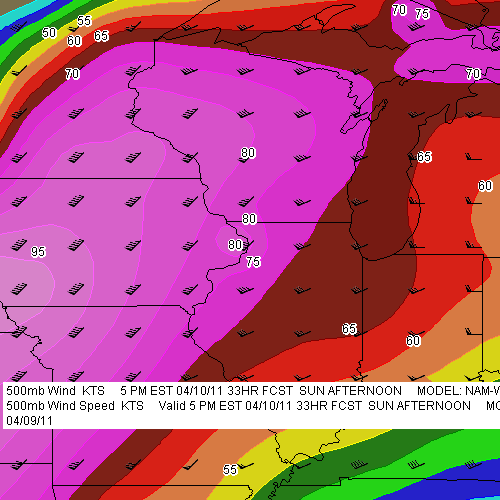
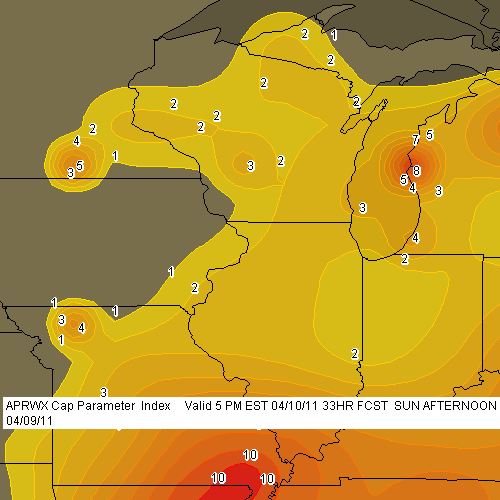
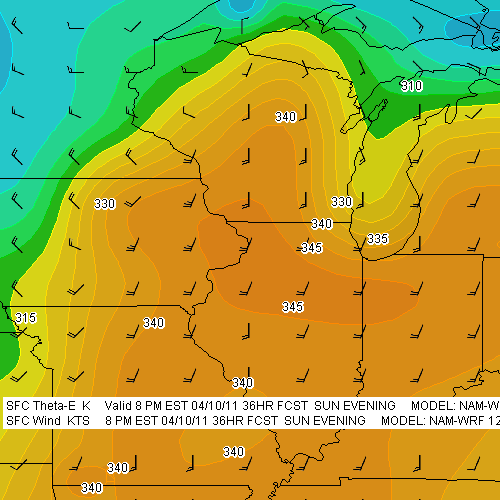
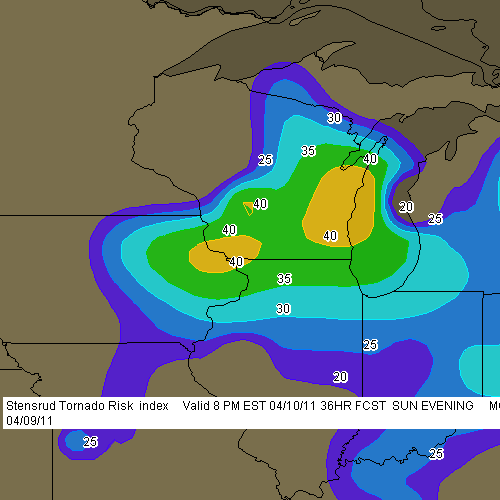
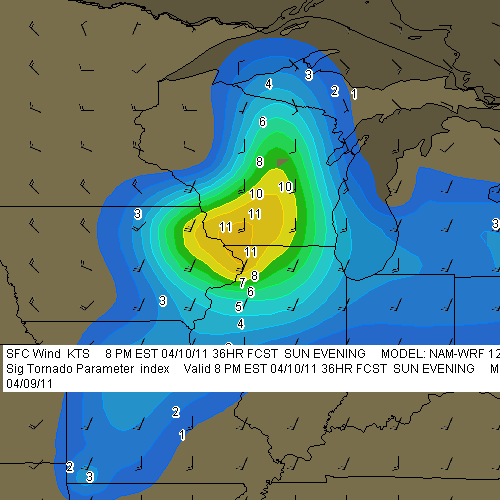
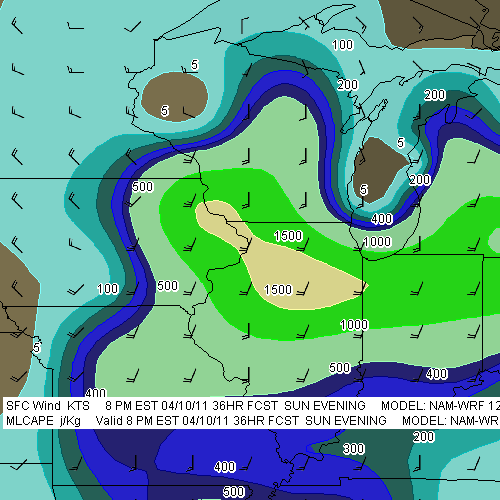
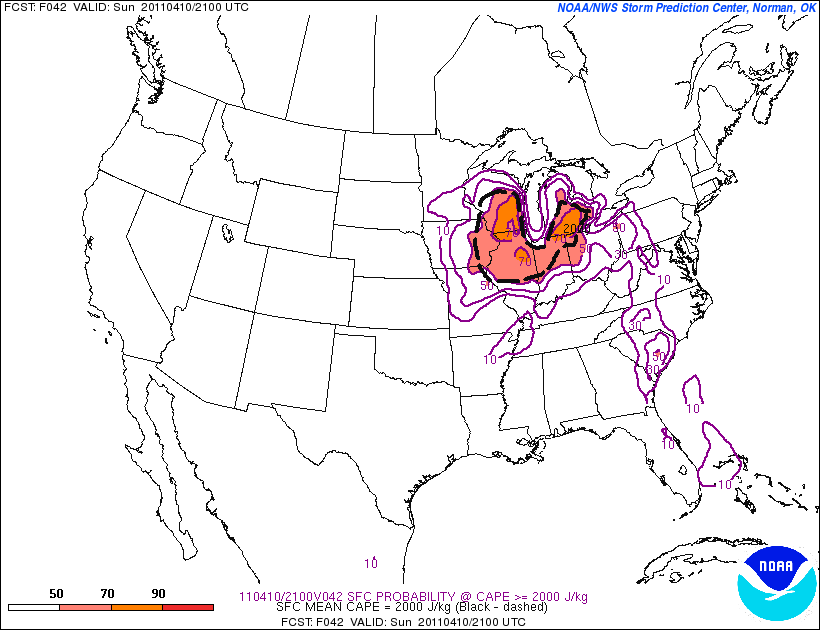
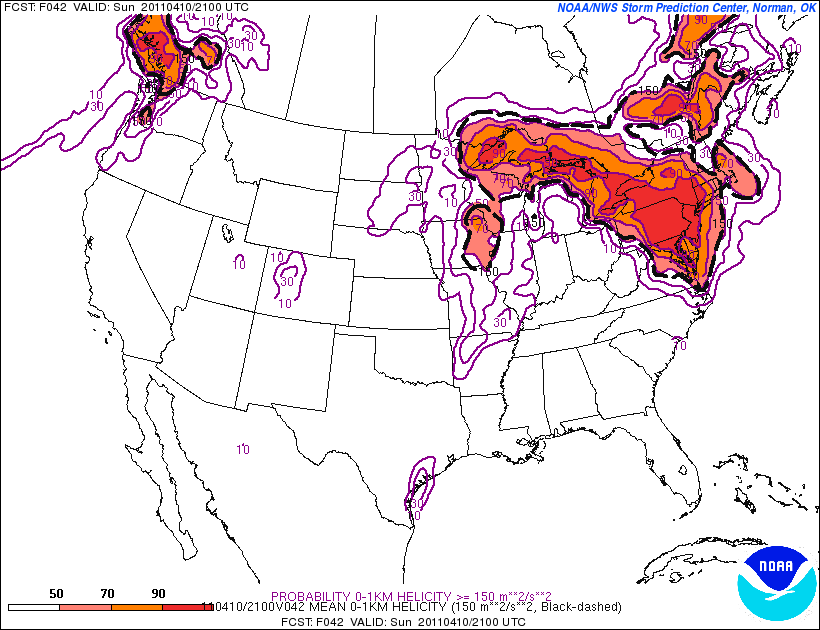
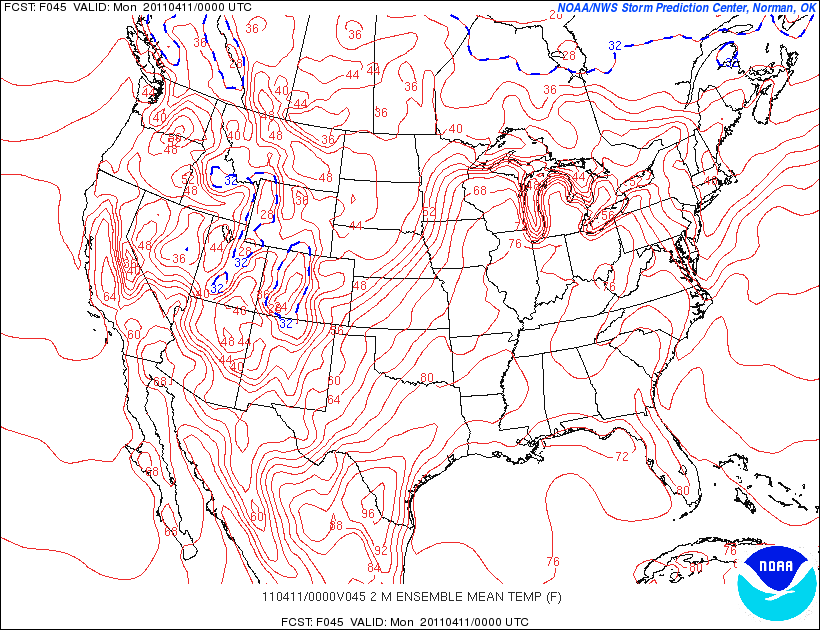
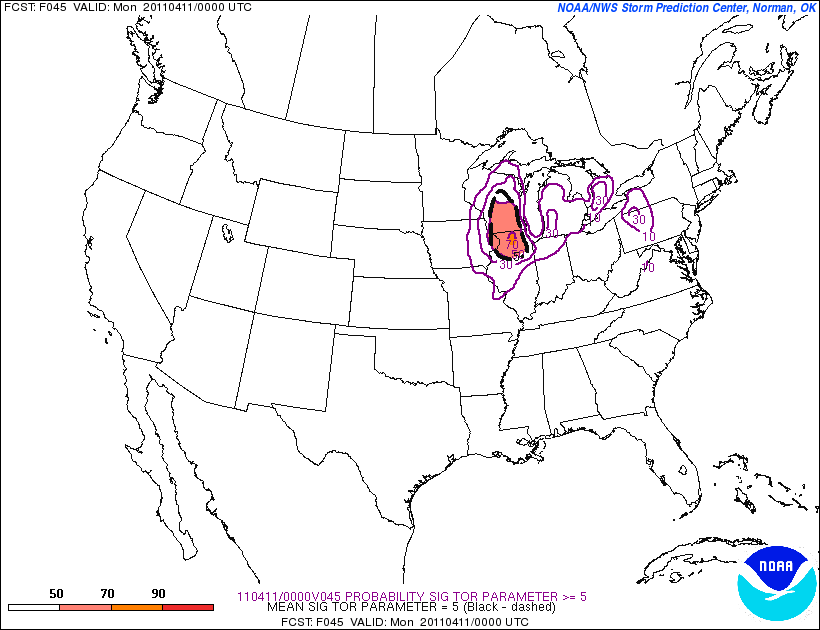
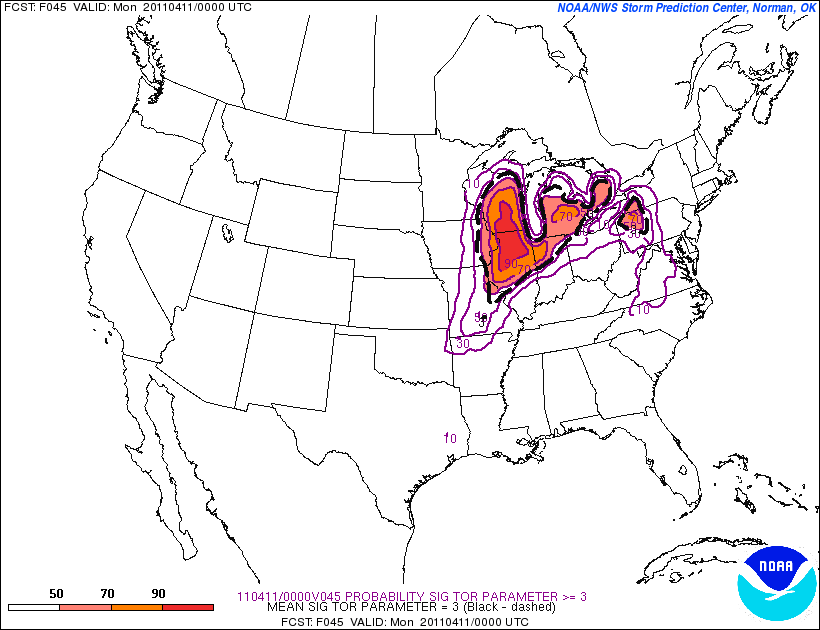
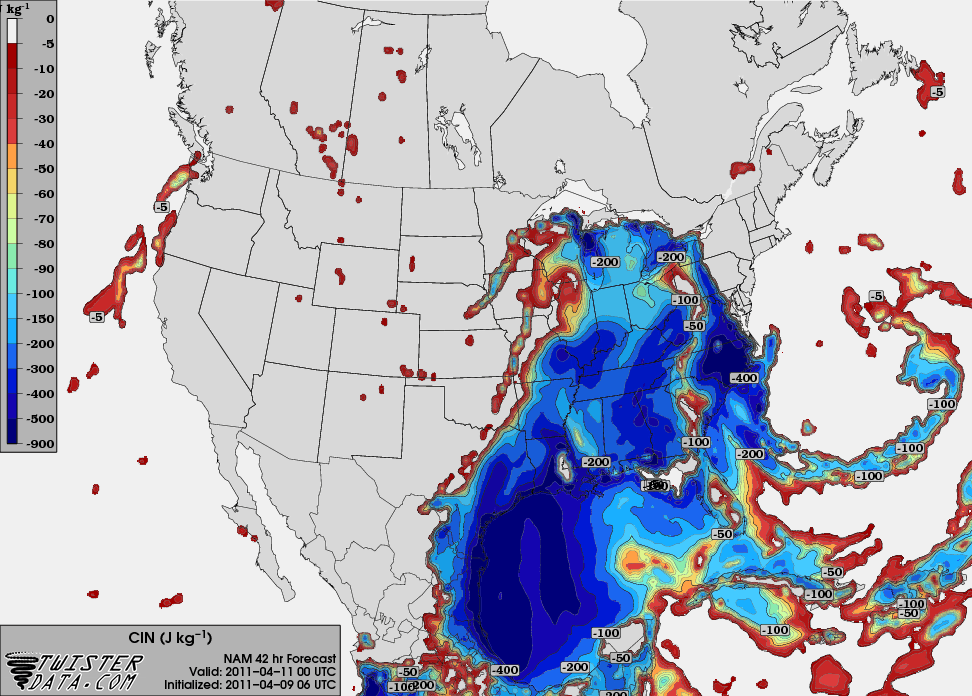
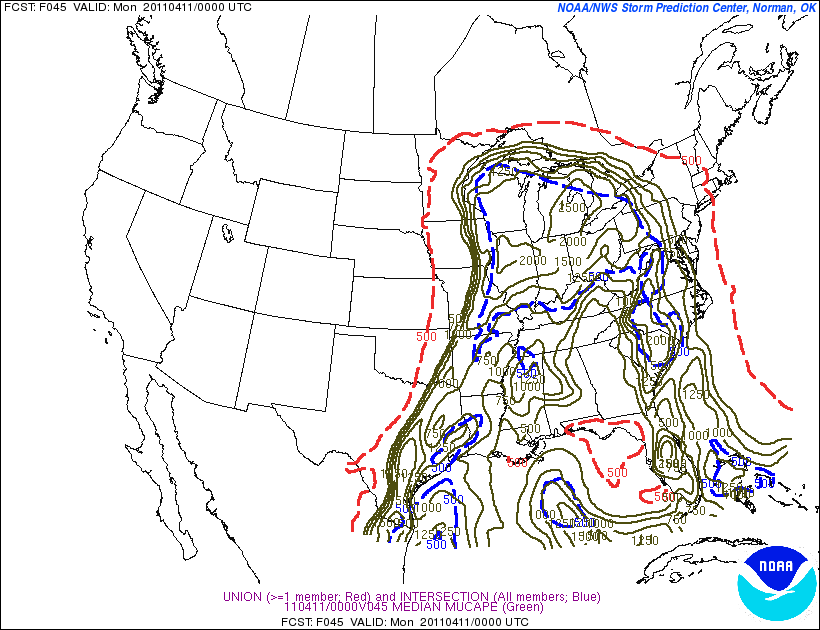
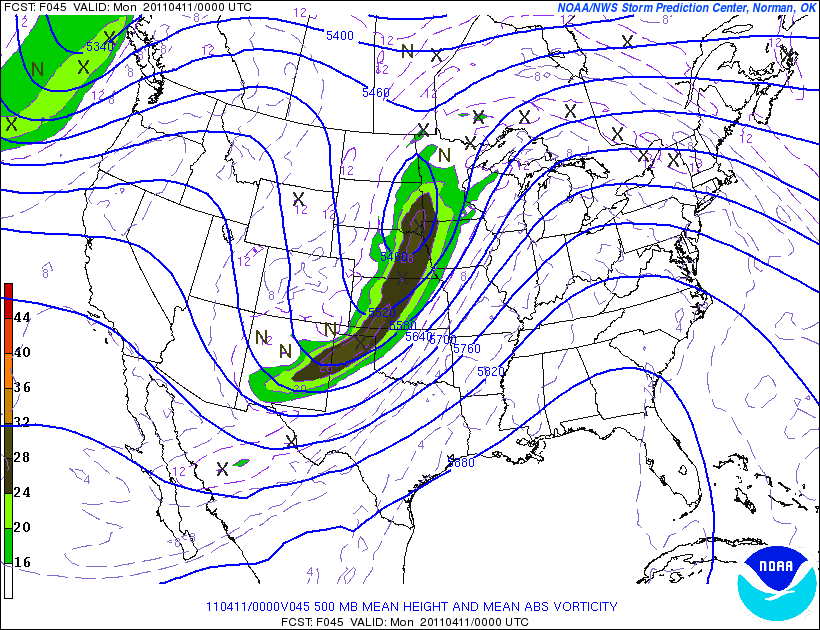
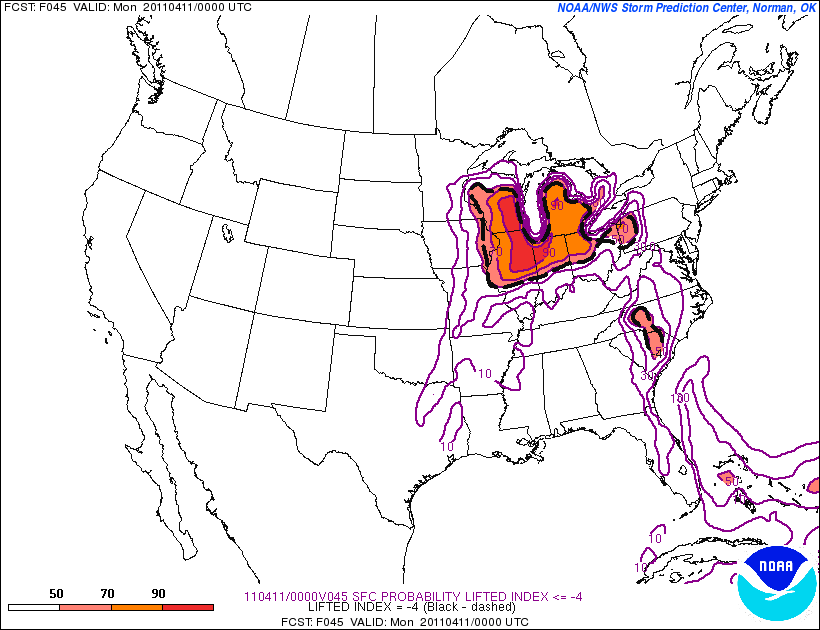
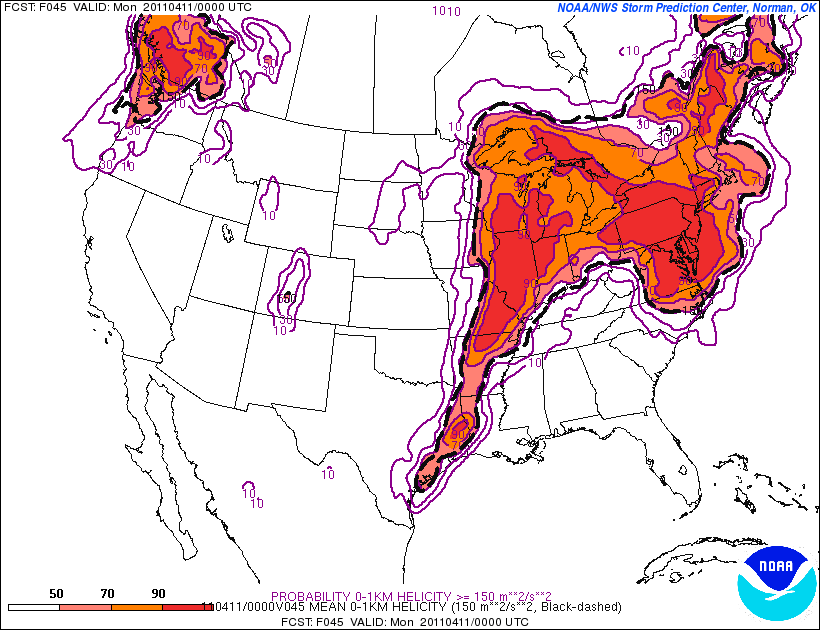
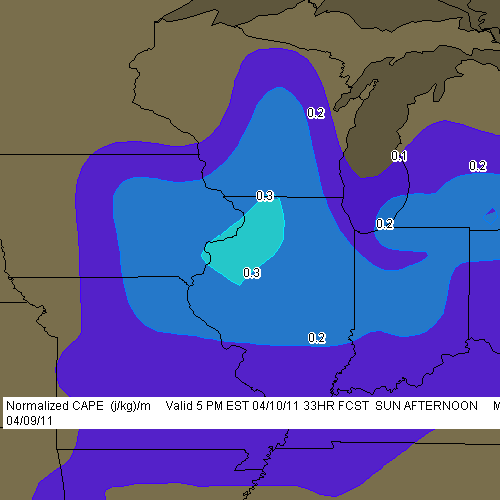
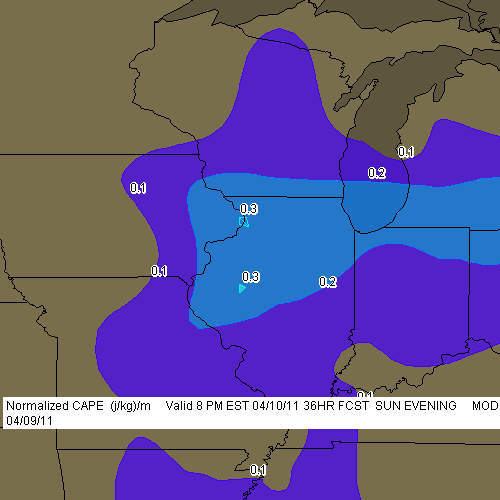
Tomorrow looks to be a big severe weather day in the upper Midwest and Great Lakes. It will also be my first storm chase of 2011, and with departure time less than 24 hours away, I’ve been scrutinizing the forecast maps, mainly the SREF and NAM.

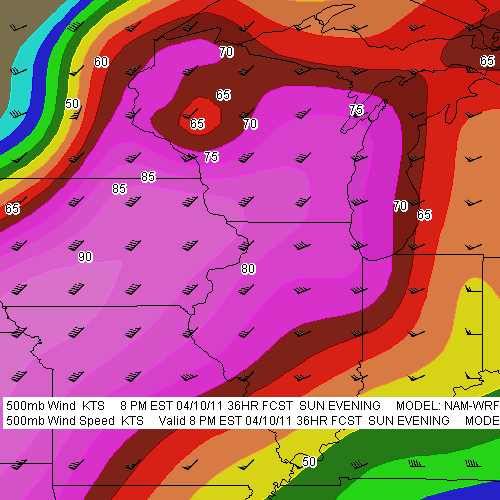
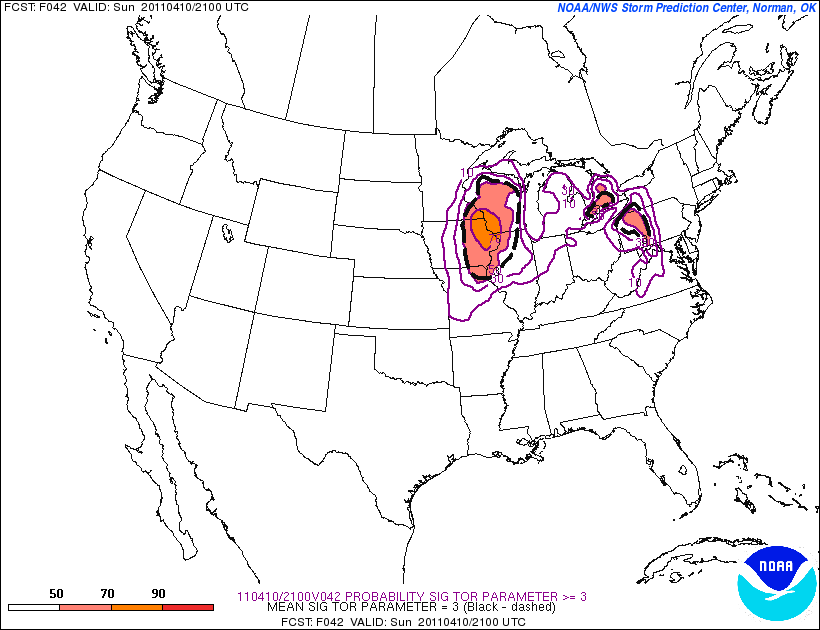
Whew! There are some formidable parameters coming into place for southeast Minnesota, northeast Iowa, much of Wisconsin, and northern Illinois. The SPC has outlooked this area for a moderate risk, with a mentioned of strong, long-lived tornadoes, and it’s not hard to see why. The one thing that bothers me is the marginally veered ambient surface winds overlaid by 500 mb winds from the southwest. Backing shows up way to the north in Wisconsin, in horrible territory for chasing.

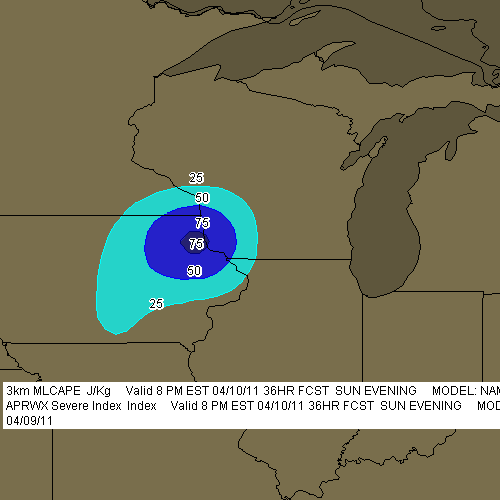
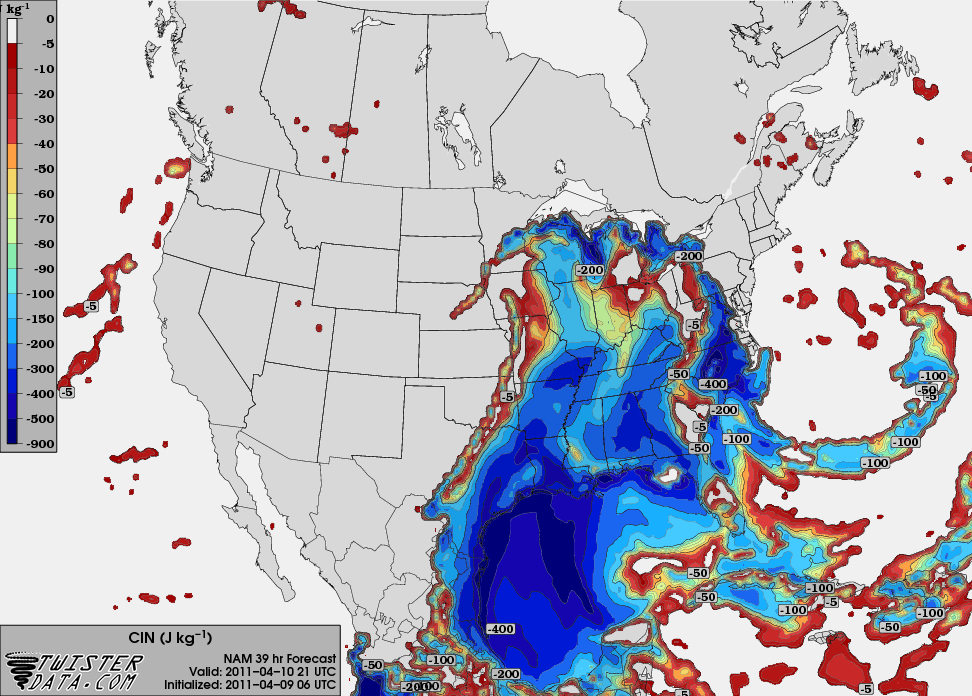
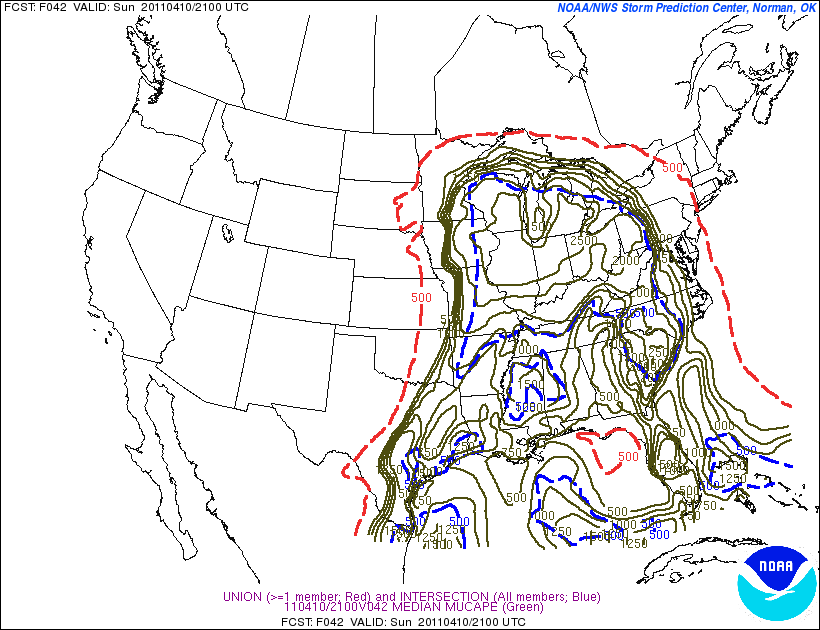
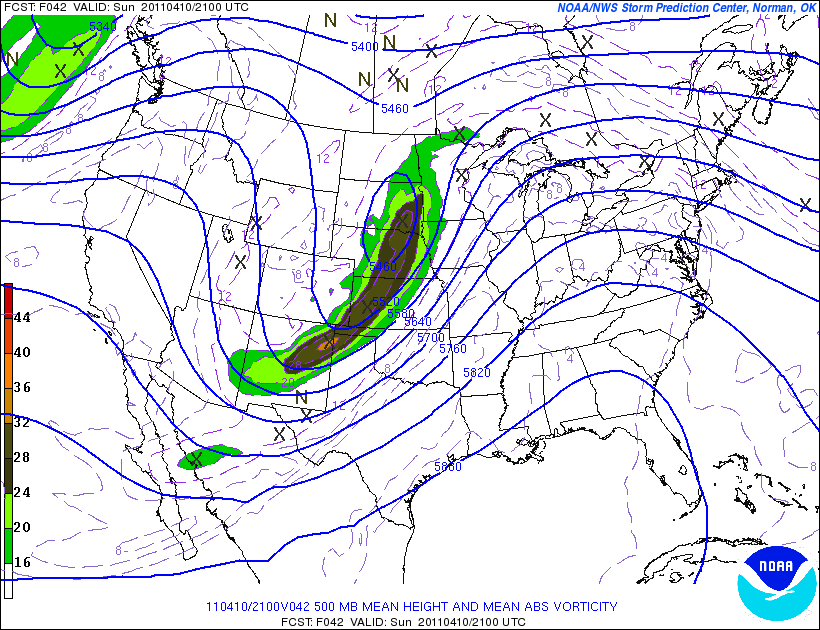
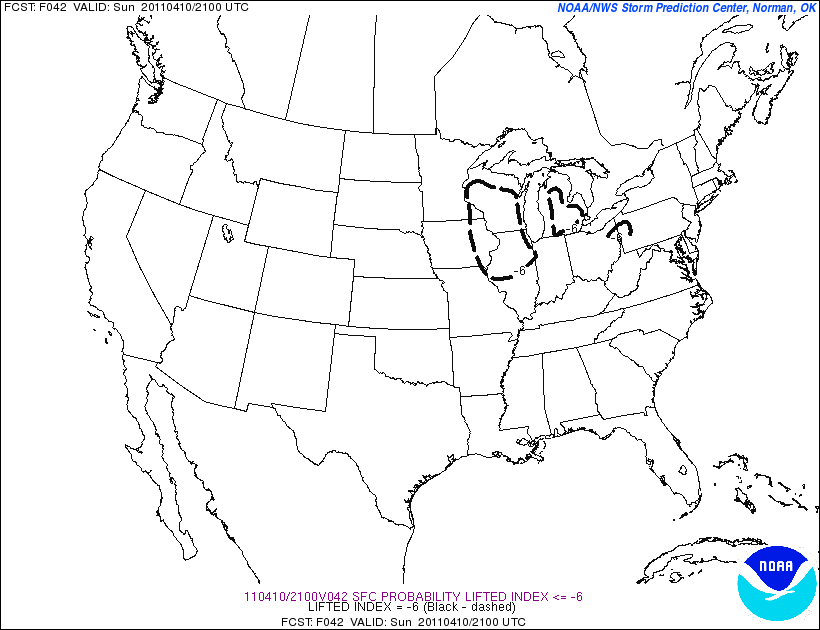
So my present choice for a target is Dubuque, Iowa. According to the NAM, the jet core is aimed in that direction. CINH wants to erode there, MLCAPE looks great, there’s a nearby 3 km MLCAPE max of 75 J/kg (forecast soundings may show better than that–haven’t looked yet), and…well, look down below at the maps I’ve been perusing and judge for yourself. There are a lot of them. In many cases, I’ve shown both 21Z and 00Z so you can see the progression of dynamics.

With height falls and vorticity moving in from the northwest, it may take a bit of will power not to get lured in that direction where the first storms will likely fire in Minnesota and start putting down tornadoes. They’ll be rocketing northeast along the warm front into rough territory, and patience will be the key to remaining in an area where the roads are decent and the prospects of seeing tornadoes instead of trees is better. I think our best play will be from northeast Iowa through northern Illinois. But I’ve got three other team mates with a vote, and I’m not the guy who’s driving. Plus, the best dynamics may have changed by tomorrow. This post just lays out what I’m seeing right now.

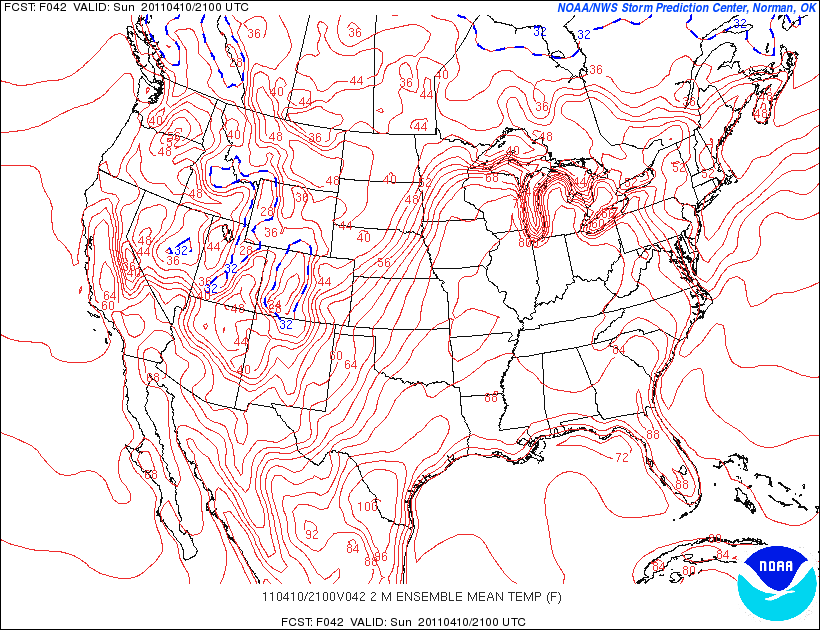
And now I give you the maps I’ve been looking at. Click on them to enlarge them. Please forgive the lack of organization. I added the 12Z F5 NAM maps to the gallery after I processed the others,  which makes for a lot of maps. I just don’t want to take the time to get them all in order. The SREF maps are no doubt already dated as I hit the publish button, and I think it’s important for me to keep the data as current as I can. I figure that if you’re savvy enough to make sense of these models, then you’re smart enough to know how to compare them!

Good luck and safe chasing to all of you who head out tomorrow.