The Historic 2011 Tornado Season in Review: A Video Interview with Storm Chaser Bill Oosterbaan, Part 1

Just about any way you look at it, the 2011 tornado season has been exceptional, disastrous, spectacular, and heartbreaking. On April 25–28, the largest tornado outbreak in United States history claimed over 340 lives over a span of 78 1/2 hours. Hardest hit was northern Alabama, where 239 of the fatalities occurred. Of the 335 confirmed tornadoes that drilled across 21 states from Texas and Oklahoma to as far north as upstate New York, four received an EF-5 rating, a figure surpassed only by the 1974 Super Outbreak. In other ways, what is now known as the 2011 Super Outbreak rivaled its infamous predecessor of 37 years ago. There were more tornadoes. And, in an age when warning technology and communications far outstrips what existed on April 3–4, 1974, there were nevertheless more deaths.

The 2011 Super Outbreak alone would have set the year apart as a mile marker in weather history. But less than a month later, on May 22, another longstanding record got broken–and tornado records are rarely anything one hopes to see beaten. In this case, a mile-wide EF-5 wedge that leveled Joplin, Missouri, became not only the first single tornado since the 1953 Flint–Beecher, Michigan, tornado to kill over 100 people, but also, with a death toll of 153, the deadliest US tornado since the Woodward, Oklahoma, tornado of 1943.

This has been a year when large cities have gotten smeared, churned into toothpicks and spit out at 200 mph. Tusacaloosa, Birmingham, Huntsville, Joplin…if you survived the storms that trashed these towns, you were blessed. And chances are, you know people who weren’t so fortunate.

Rarely has the dark side of the storms that storm chasers so passionately pursue been on such grim and devastating display. This has been an awful tornado season, and that’s the truth. It has also been a spectacular one, and if many of the storms were man eaters, yet many others spun out their violent beauty harmlessly out on the open plains. Chasers this year have witnessed the full gamut, from April’s deadly monsters that raced across Dixie Alley to slow-moving, late-season funnels that meandered grandly over the grasslands.

For me, the season has largely been a washout. Family and economic constraints kept me mostly benched this spring, and the few times when I made it out west to chase were unproductive.

Not so, however, with my friend and chase partner of 15 years, Bill Oosterbaan. Bill has had a spectacular and a sobering season–and in this first-ever Stormhorn.com video interview, he’s here to talk about it.

The 40-minute length of this video requires that it be broken into four sections in order to fit YouTube requirements. It’s a lengthy process, and me being a novice at video editing–particularly with high definition–it has taken me a while to figure out how to make it work. This evening I finally had a breakthrough, and now I’m pleased to say that Part 1 is available for viewing. I will be working on the remaining three parts tomorrow, and I hope to have them available in their entirety on YouTube by Wednesday. [UPDATE: Parts 2–4 are now available for viewing.]

For now, by way of a teaser with some substance to it, here is the first part.
No, Storm Geeks, I Haven’t Forgotten You!

Earlier this year I felt obliged to offer the above reassurance to my jazz saxophone readers, who got a bit lost in the shuffle of severe weather season. Now that the summer pattern has set in and my attention oscillates back toward music, I want to say to my fellow storm chasers and convective fanatics, don’t worry. You won’t be forgotten.

In fact, I’m cooking up a special surprise for you. And just to whet your curiosity, here’s a teaser: It involves my first-ever attempt at a video interview. I’m very pleased with the results and expect to share them with you here on Stormhorn.com. Just give me a day or two to edit and upload the material to YouTube. In the words of the blind broadcaster in O Brother, Where Art Thou?, I predict you’re gonna enjoy it thoroughly.

My Great 1,600 Mile Chase Bust

Monday and Tuesday this week were the storm chase from hell. It you’re looking for a nice, upbeat post about chasing, you’d best skip this one. My feelings about my fiasco in Nebraska may have mellowed down enough for me not to unleash a full-bore rant anymore, but I’ve still got enough gunpowder left to blow off a few firecrackers. That’s the result when impediment piles upon impediment and frustration upon frustration.

With my sights Sunday night fixed on western Iowa and eastern Nebraska the next evening, I set my alarm clock for 4:30 a.m. and hit the sack. I was awakened by early morning light filtering through the window. Light? I glanced at the clock. It said 6:30. My alarm hadn’t sounded and I was running late.

Nuts. But okay, no problem. After a fast shower, I kissed Lisa good-bye, threw my gear into the car, and hit the road. I still had plenty of time to make

eastern Nebraska, and that was a good thing because the SPC had bumped the focal point for tornadoes west. No time to analyze models–I just had to trust the Norman weather pros and hope for the best. Off I went.

Thirty miles down the road in Zeeland I made a delightful discovery: I had left my debit card in my other pants pocket. This was the beginning of woes. Self-possessed person that I am, I responded calmly and maturely by protruding my eyeballs, depressurizing my feelings constructively using the special vocabulary that I reserve for just such occasions, and, a cat of nine tails not being handy, by rapidly banging my fist on the steering wheel in lieu of self-flagellation.

Retrieving my debit card meant losing over an hour. I now was pushing the envelope, but I could still make eastern Nebraska by late afternoon. This being probably my last crack at a good setup in a record storm season during which I’ve been miserably sidelined, I was determined to try. So off I went again.

I wasn’t far south of Holland, Michigan, when the disquiet in my stomach became a bubbling, and the bubbling escalated into the kind of tar-pit-like seething that tells you a quick trip to a bathroom will be required in the near future. Between southern Michigan and east of Chicago, I made three pit stops. Another 45 minutes, literally gone down the toilet before I finally popped some Immodium and put an end to the rumblings.

By the time I drew near to Omaha, the show was underway. A tornadic supercell was moving up out of Kansas into Nebraska toward the center of the surface low. My friend and long-time chase partner Bill Oosterbaan, who had called me as we both were initially approaching Zeeland and just as my debit card fiasco was commencing, was now far ahead of me and positioning himself for the next storm down. That storm went spectacularly tornadic and Bill got some great footage, probably the best he’s gotten so far.

But there was no way I could make it that far west in time to catch tornadoes. My show was clearly going to be the pair of cells to my southwest that were heading toward Lincoln. They were my one chance. But they were south of the warm front, and while surface winds were southeasterly, the storms were moving north-northeast. The low-level helicity required for tornadoes was lacking. My hope was that as the storms headed north they would tap into increasingly backed winds.

But all they did was backbuild and congeal into a nasty squall line. My hopes were still up as I approached Lincoln; however, as I finally drew near to the northernmost cell along US 77 west of Roca, I could see that I was screwed. The cells had congealed into a pile of linear junk. I had driven over 750 miles to chase a shelf cloud, and it wasn’t even a particularly photogenic shelf cloud. True, it had the local media in Omaha screaming about 75 mph winds and flash flooding, but I’ve seen plenty better right here in Michigan. Linear mess-oscale convective systems are our state storm.

No point in prolonging the pain. I started heading home, my idea being to get far enough east that I’d have time to chew on the system’s leftovers back in Michigan the next day. Bill had business in Iowa and was overnighting at the Hilton in Marshalltown, so I bunked with him there. He’d gotten four tornadoes in Polk County, and we reviewed his footage. Very nice stuff! He’d gotten close enough to a large tornado to capture the roar. Here’s his YouTube clip.

Sigh. So near and yet so far. An arcus cloud isn’t much of a compensation prize compared to a tornado. Of course there was still tomorrow back home. A warm front looked poised to drape right across Grand Rapids with SBCAPE in the order of 4,500 J/kg–an optimal setup for Michigan, except that the models consistently depicted the 500 mb jet hanging back just to the west in northern Illinois and Wisconsin.

Bill and I in fact hooked up again the next day after his business meeting and briefly discussed chasing the low in Wisconsin. But that area is some of the worst chase terrain imaginable, so we scrapped the idea and went our ways.

Somewhere around Davenport, out of idle curiosity, I checked out the SPC’s mesoanalysis graphics and noticed that the mid-level energy appeared to be nudging eastward toward Michigan. Hmmm…maybe there might be a bit of a show after all. I gave Kurt Hulst a call. He had hung back in town and was planning to chase today, not expecting much but thinking that the big CAPE could compensate somewhat for poor upper air support. I agreed, particularly now that it looked like 500 mb and higher winds might reach the threshold for storm organization.

Later VAD wind profiles at GRR showed nice veering with height along with 30 kt winds at 18,000 feet. Not a setup to die for, but it might just work. And it did. A beautiful supercell fired up along the warm front, and Kurt was on it in a heartbeat. He got in some nice chasing on several storms, witnessed rotating wall clouds and a funnel extending halfway down, and did some call-ins for WOOD TV8. Good work, Kurt!

As for me, I got delayed by a traffic bottleneck in Joliet, Illinois, and attempting to find a detour proved to be a huge, time-consuming mistake. I finally arrived in Michigan in time to chase storms, but not the ones on the warm front. Once again I had to settle for what I could get as I belted east down I-94 and punched through the line near Marshall. By then the mid-level winds had backed off and I was left with the usual, disorganized Michigan crap-ola. There was a lot of that, though. The warm sector was remarkably juicy, and more storms kept popping up behind the main line.

Heading back through Battle Creek, I parked in a lot across from the old Kellogg Museum and watched a couple of cells south and west of me detonate their munitions. I’ll say this: The lightning this day was intense, lots of brilliant, high-voltage positive strokes, many of which struck close by. It was an impressive, beautiful, and exciting pyrotechnic display.

But now that it’s all behind me, my tornado tally for this year remains zero. Between Monday and Tuesday I drove over 1,600 miles and blew through around $200 worth of gas to see nothing that I couldn’t have seen by simply sitting in my apartment and looking out the window. It’s frankly a bit humiliating, considering what a benchmark season this has been for storm chasers. Family comes first, though, and tight finances in a rotten economy have been a potent regulator. Sometimes all a body can do is choose his attitude. I confess that mine wasn’t all that great these last couple of days, but I talk with the Lord about such things. It’s the best I can do: put my feelings before Him honestly, then do what I can to adopt a more positive spirit and move on.

Still…it sure would be nice to see a tornado yet this year. Just one. I don’t think that’s too much to hope for. Sigh. Maybe this fall.

Here Comes the Summer Pattern

Sumer is icumen in,
Loudly sing, cuckoo!
Grows the seed and blows the mead,
And springs the wood anew;
Sing, cuckoo!
Ewe bleats harshly after lamb,
Cows after calves make moo;
Bullock stamps and deer champs,
Now shrilly sing, cuckoo!
Cuckoo, cuckoo
Wild bird are you;
Be never still, cuckoo!

Right. It looks like we’re about to have our hands full, what with bleating ewes, cows making moo, and so on. There are, however, some things that the old folk song fails to mention. The polar jet lifting north, for instance. Weakening mid-level winds. Temperatures at 700 mb heating up, with the 12 degree centigrade threshold expanding across the southern and central plains and ushering in the era of capping. I don’t know why the ancient songwriter didn’t address these matters. They’re as much a part of sumer–that is to say, summer–as stamping bullocks.

Here in Caledonia, yesterday was hot and today promises to be even hotter, around 95 degrees, before a cold front blows through tonight and brings relief. After that, we look to be in for a bout of unsettled weather. I’ll take it, even though it may inconvenience at least one outdoor gig I’ll be playing this weekend.

The summer weather pattern is on the way, putting the damper on storm chasing in the southern and central plains. Considering how devastatingly active this spring has been, that’s probably a good thing. I doubt that the people in towns such as Joplin, Missouri, will lament this season’s passing. As for those who chased storms in Dixie Alley and the southern plains–and there were more chasers than ever this year–you certainly got your fill of action, and some of you saw far more than you cared to. There are some amazing stories that have come out of the storm chasing community, and my hat is off to those of you who stepped in to help in tornado-stricken areas.

This was the worst of all seasons to be sidelined due to financial constraints, but that’s how it has been with me and with others who have taken a hit in the pocketbook from this rotten economy. I’m frankly happy to see the crest of storm season 2011 passing; I much prefer to occupy my mind with more productive thoughts than fretting over what I’m missing.

In any event, the playground is shifting northward. It’s not there quite yet, but it’s on the way. Troughs that had been digging deep into the southern plains are now beginning to ripple across the northern tier and Canada, and lately, mesoscale convective systems have been cropping up regularly in the SPC discussions. Those are the specialty of the state where I live.

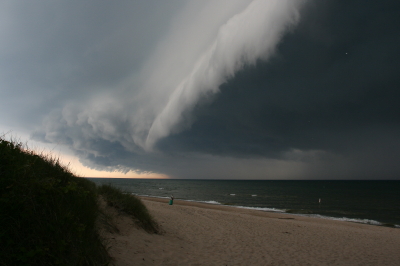
If there’s any advantage to living in the Great Lakes, it’s that we’re close enough to the summer jet stream that it can still dip down out of Canada into our neck of the woods. And while northwest flow isn’t exactly your classic chase scenario, it can deliver some occasional surprises. Illinois in particular has gotten some whopping summer tornadoes–and for those of you who don’t chase east of the Mississippi, I don’t mind telling you that central and northern Illinois is fabulous chase territory. Also, closer to home, even garden variety arcus clouds are sublime to watch sweeping in at the Lake Michigan shoreline.
For better or worse, sumer is icumen in and storm season is winding down. Most people aren’t sorry for the change. But most people don’t view storms the way that storm chasers do. I guess we’re a bit cuckoo.

May 29, 2011, Battle Creek Straight-Line Winds

The summary follow-up to  my previous post is, I busted with L. B. LaForce during last Wednesday’s high-risk day in Illinois. Tornadoes occurred that day, but overall the scenario was a disappointing one for us. If anything, it was a lesson to trust my initial gut instinct, which told me to stick close to Indiana, where a moisture plume and 500 mb jet were moving in. Nice, discrete supercells eventually fired up south of Indianapolis while L. B. and I putzed around fruitlessly with the crapvection northeast of Saint Louis. And that’s all I’ll say about that–not that I couldn’t say more, but I want to talk about yesterday’s far more potent event in southern Michigan.

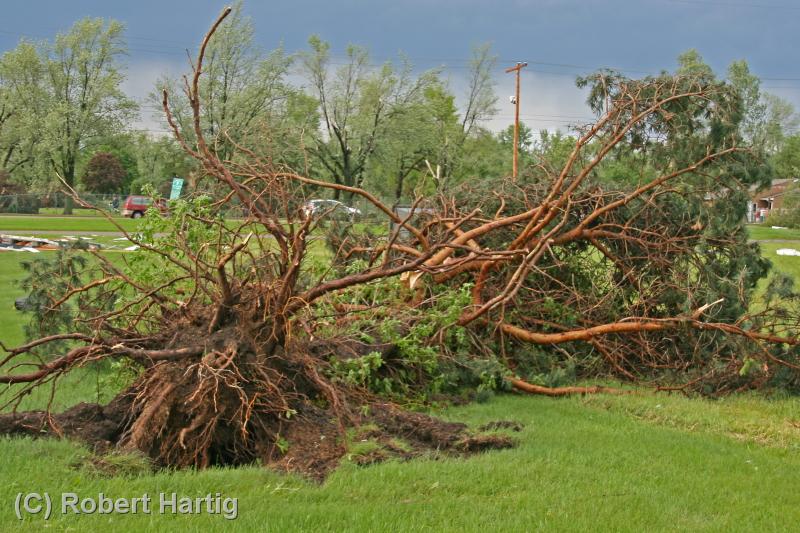
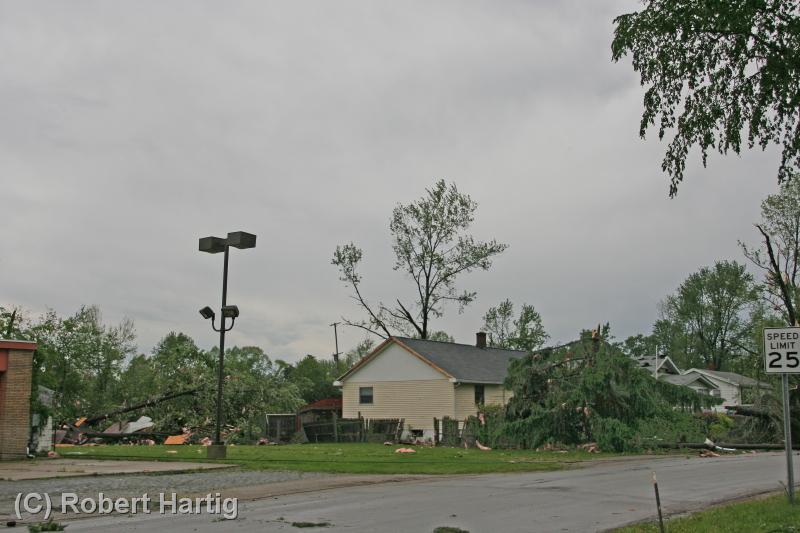
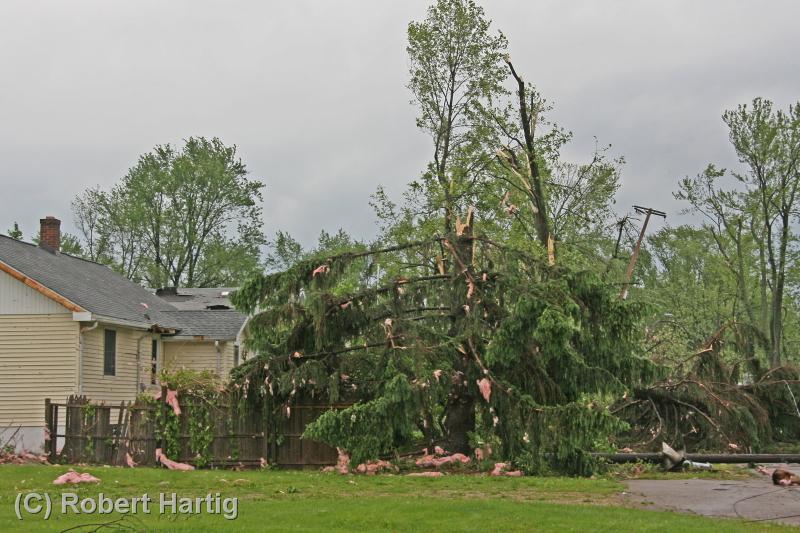
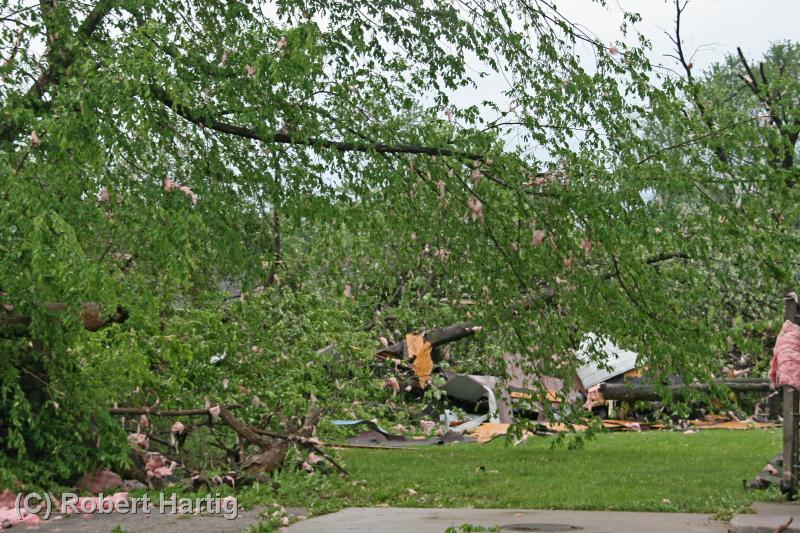
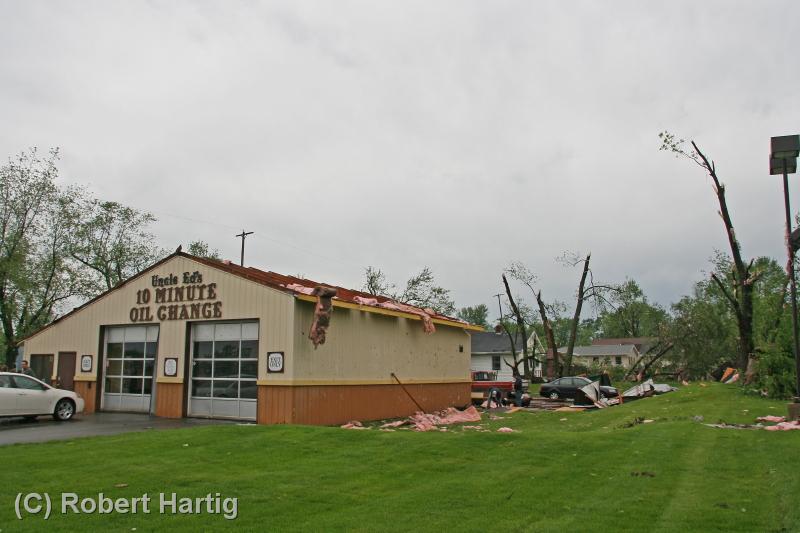
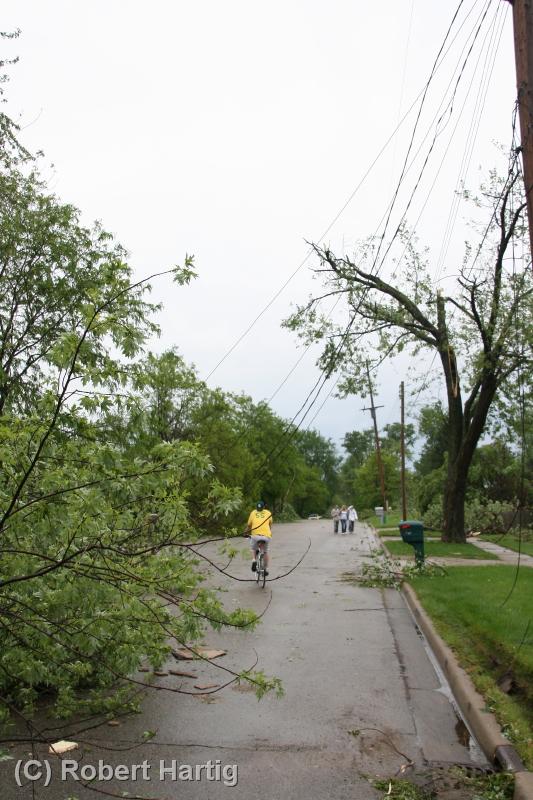
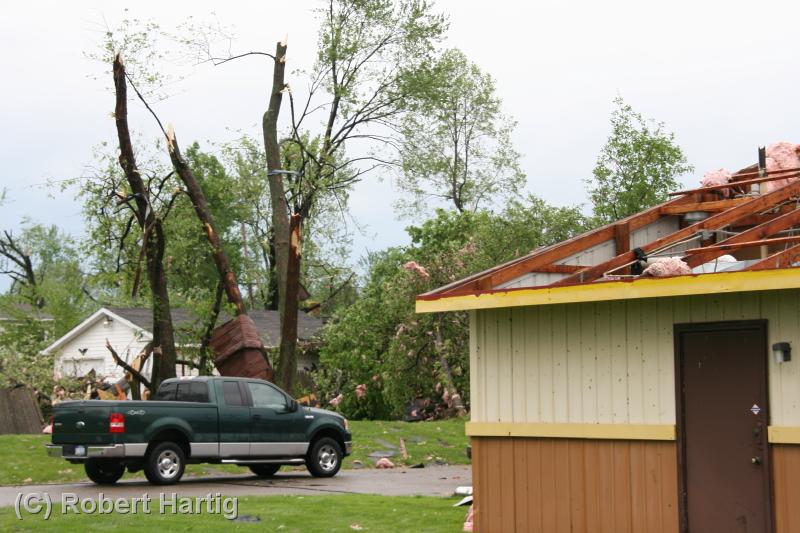
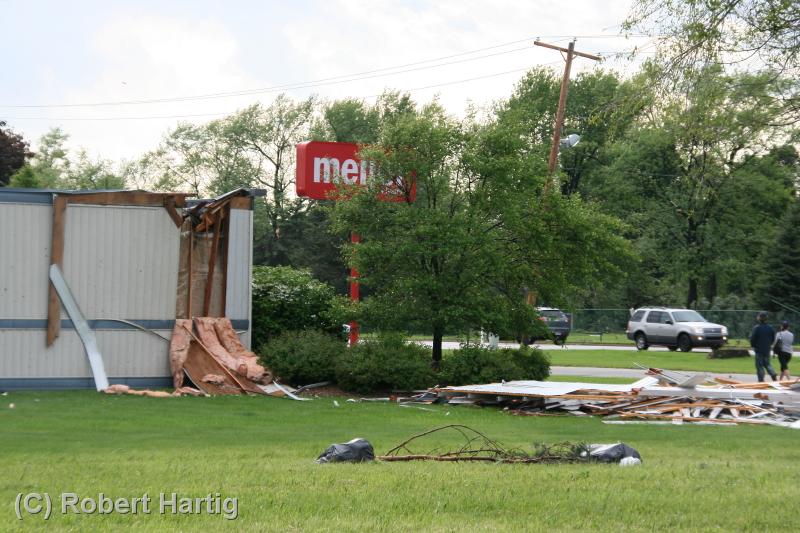
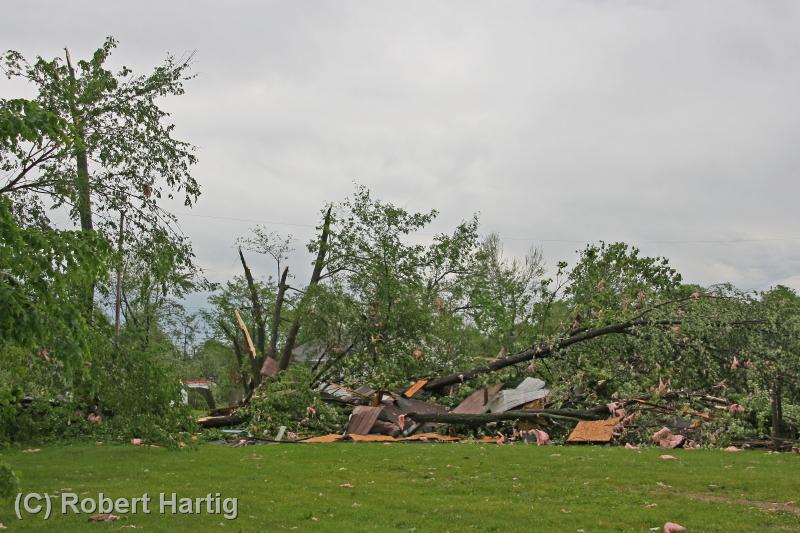
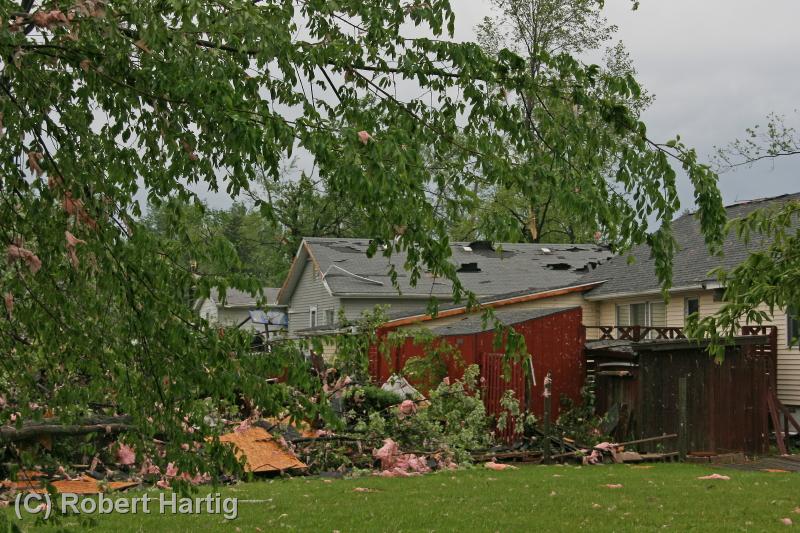
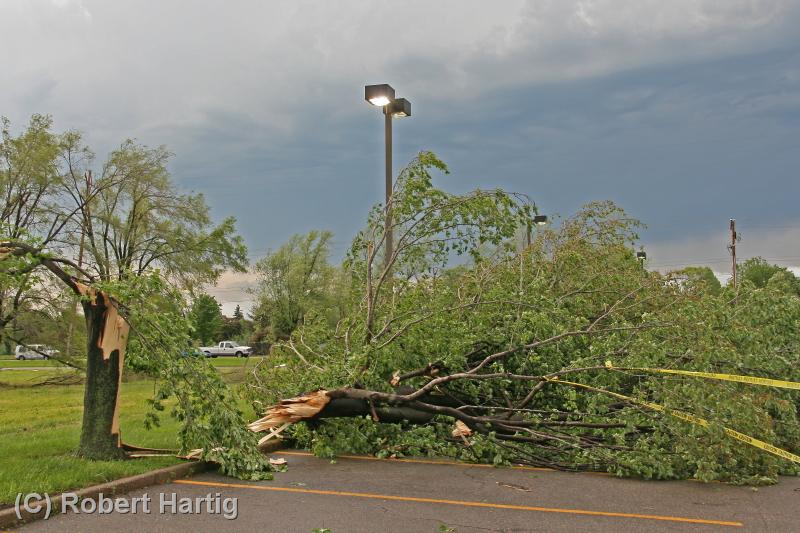
You don’t need a tornado in order to make a neighborhood look like one went through it. That axiom was amply demonstrated yesterday in Calhoun County, where straight-line winds wrought havoc the likes of which I don’t recall having ever seen here in Michigan. We’ve had a couple doozey derechoes over the past few decades, but I don’t think they created such intense damage on as widespread a scale as what I witnessed yesterday. Northeast of Helmer Brook Road and Columbia Avenue in Battle Creek, across from the airport, the neighborhood looked like it had been fed through a massive shredder. We’re talking hundreds of large trees uprooted or simply snapped, roofs ripped off of buildings, walls caved in, road signs blown down, trees festooned with pink insulation and pieces of sheet metal, yards littered with debris, power lines down everywhere…it was just unbelievable. Not in the EF-3 or EF -4 league, maybe, but nothing to make light of.

Yesterday was the first decent setup to visit Michigan so far this year. Of course I went chasing, not expecting to see tornadoes–although that possibility did exist–but hoping to catch whatever kind of action evolved out of the storms as they forged eastward. It being my first time doing live-streaming video and phone-ins for WOOD TV 8 made things all the more interesting. As it turns out, I was in the right place at the right time.

When I first intercepted the storms by the Martin exit on US 131, I wasn’t sure they would amount to much.  Huh, no worries there. As I drove east and south to reposition myself after my initial encounter, the storms intensified and a tornado warning went up for Kalamazoo County just to my south.

Dropping down into Richland, I got slammed with heavy, driving rain. The leading edge of the storm had caught up with me. I wanted to get ahead of it and then proceed south toward the direction of the rotation that had been reported in Kalamazoo. Fortunately, M-89 was right at hand, and I belted east on it toward Battle Creek.

On the west side of Battle Creek, I turned south on M-37, known locally as Helmer Brook Road. GR3 radar indicated that I was just grazing the northern edge of a couplet of intense winds. It didn’t look to me like rotation; more likely divergence, a downburst. As I continued south down Helmer Brook toward the airport, the west winds intensified suddenly and dramatically, lashing a Niagara of rain and mist in front of me and rendering visibility near-zero. I wasn’t frightened, but I probably should have been. Glancing at my laptop, I noticed that a TVS and meso marker had popped up on the radar–smack on top of my GPS marker.

Great, just great. So that couplet I thought was a downburst had rotation in it of some kind. Well, there was nothing I could do but proceed slowly and cautiously and hope that the wind didn’t suddenly shift. It didn’t, and as I drew closer to the airport, it started to ease up, visibility improved and the storm moved off to the east.

That was when I began to see damage. In the cemetery across from the airport, trees were down. Big trees, and lots of them. Blown down. Snapped off. I grabbed my camcorder and started videotaping. But the full effects of the wind didn’t become apparent until I turned east onto Columbia Avenue near the Meijer store.

My first thought was that a tornado had indeed gone through the area. But with most of the trees pointing consistently in a northeasterly direction, the most logical culprit was powerful straight-line winds. Parking near a newly roofless oil change business, I proceeded to shoot video and snap photos. I’ll let the following images tell the rest of the story.

Storm Chasing in Illinois on Wednesday

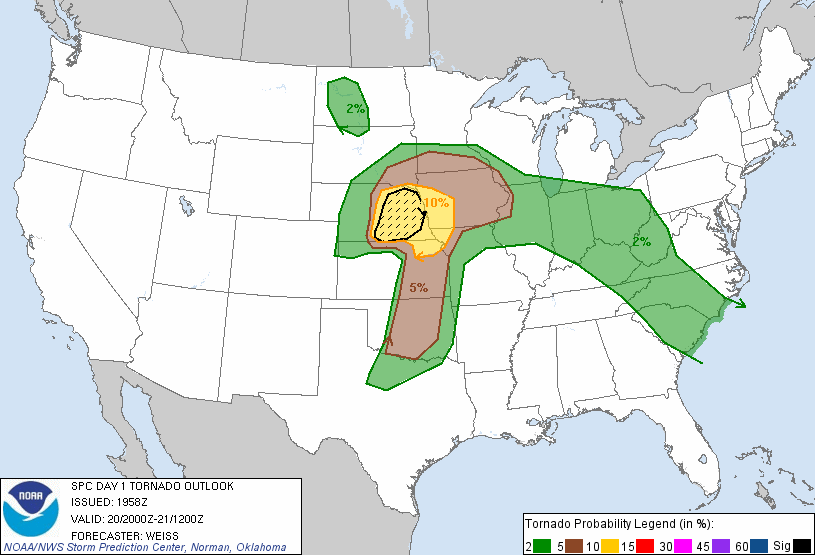
The formidable system that ground out large, violent tornadoes in Kansas, Oklahoma, and Texas on Tuesday will move east on Wednesday to bring another round of severe weather to southeast

Missouri, Illinois, and Indiana. And finally–finally!–I’m in a position to do some storm chasing. Financial constraints have majorly crimped my expeditions so far this season, but no way am I missing tomorrow.

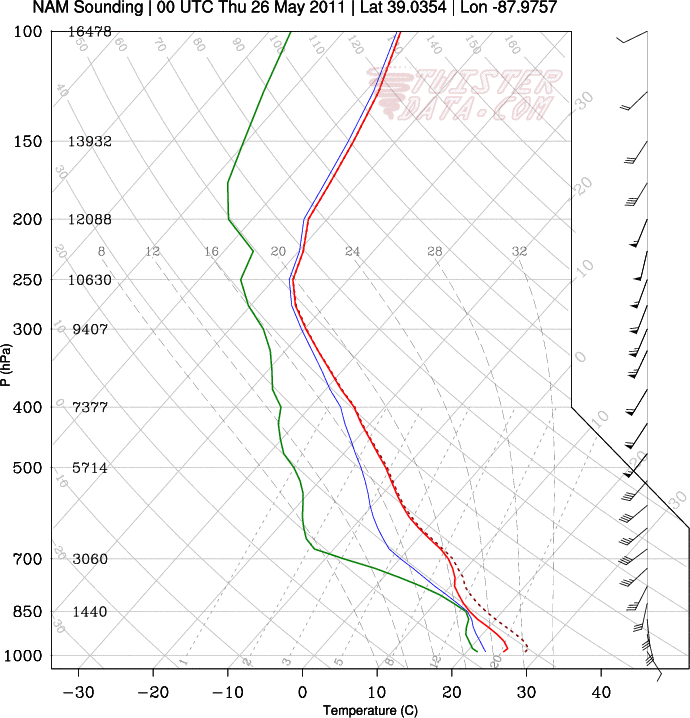
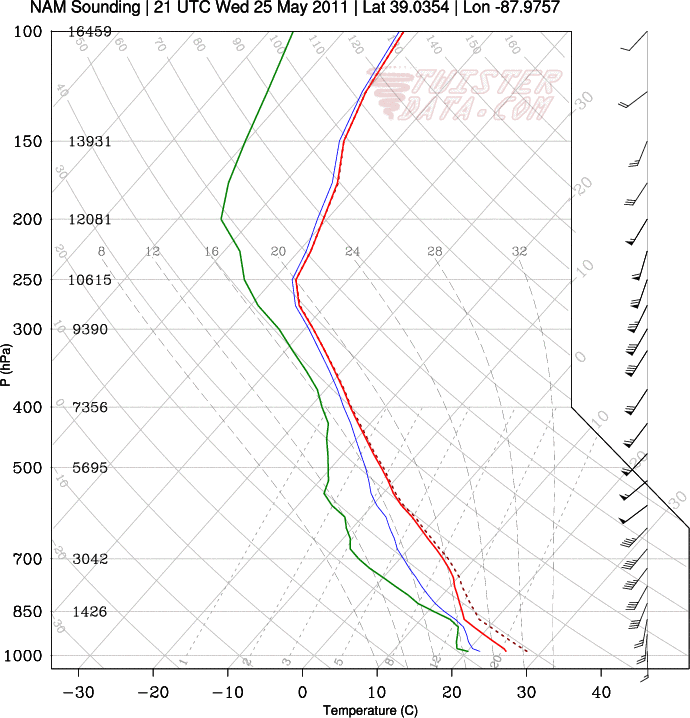
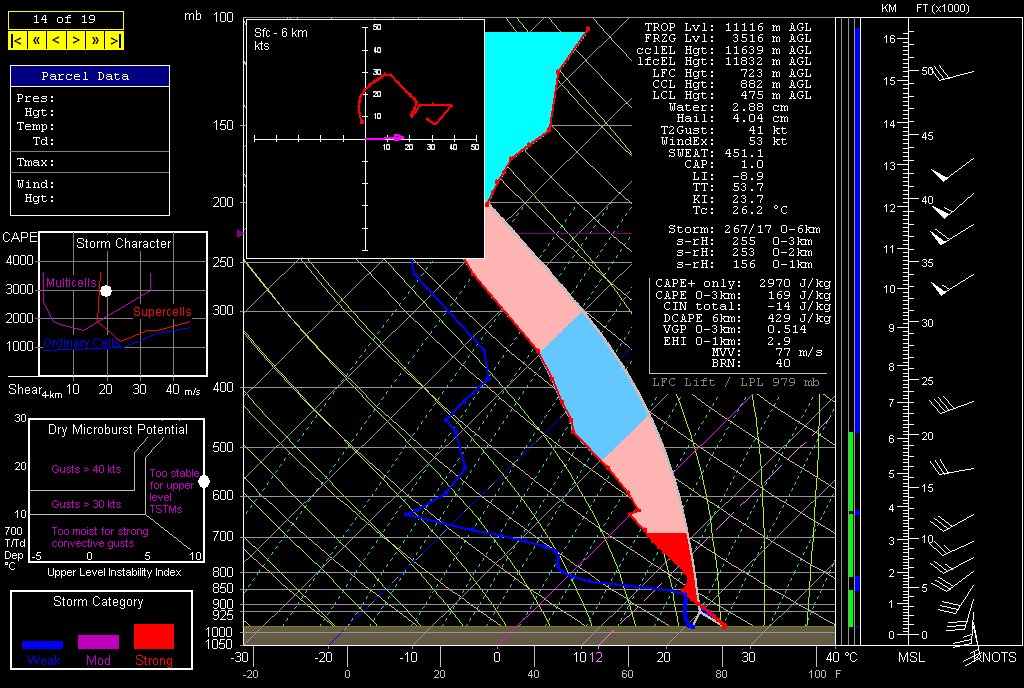
Based on Tuesday morning’s NAM run, I’d been eyeballing Effingham, Illinois, as a preliminary target for trolling the I-70 corridor. The sounding for that area looked mighty pretty, as you can plainly see.

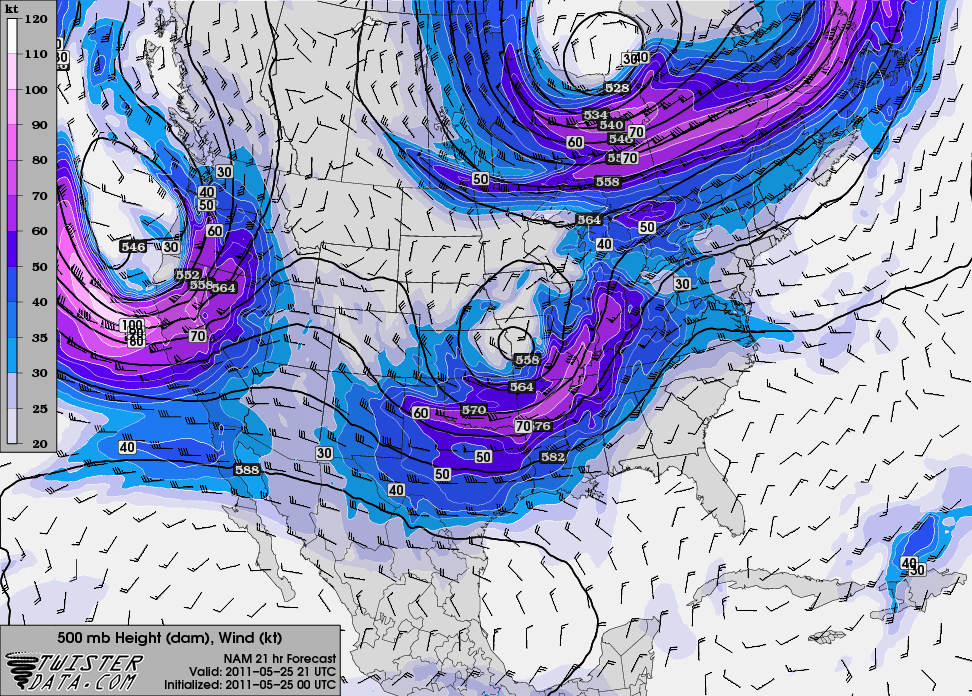
Now, however, with the 00Z runs in, I’m inclined to shift farther east near Terre Haute. Here’s another model sounding, courtesy of TwisterData, for near Oblong, Illinois. Maybe not quite as sexily backed at the surface as the Effingham sounding, but with stronger low-level winds and definitely quite functional. Maps of 500 mb winds and SBCAPE (see below) paint in a little more detail and suggest that near the Illinois/Indiana border is a good choice.

Tomorrow morning’s data will tell all. Meanwhile, it’s time for me to get my ugly-rest. I am so excited about the prospect of finally getting out and feeling the moisture, watching cumulus towers erupt and organize into glowering supercells, and hopefully videotaping some tornadoes out on the flat, wide-open Illinois prairie! A good night’s sleep and then I’m off in the morning.

Tornado Disaster in Joplin

Anything else I could write about today is overshadowed by yesterday’s horrible tragedy in Joplin, Missouri. A large, violent tornado carved a path through the heart of the city, throwing semis off of I-44, utterly destroying the hospital, and completely leveling the business section and surrounding neighborhoods.

The present death toll stands at 89. I am sure that the number of fatalities will continue to grow as rescue workers sift through the wreckage. Honor and appreciation to the numerous storm chasers who ended their chases yesterday and assisted in rescue operations and emergency medical care.

What a horrible event. Last month’s devastating outbreak across the southeast was more than enough, and now this–another large town hit by a violent wedge. It is just beyond belief, and sickening, and heartbreaking. The year 2011 will go down in weather history as the year of urban tornado disasters. My heart goes out to the people of Joplin, Missouri.

How It Feels to Not Be Chasing

Right now my buddies are out west chasing this latest storm system. I’m not with them because I can’t afford it. Money has been extremely tight and what I take in has got to go toward paying the bills and putting food on the table for Lisa and me. That’s the reality of life. I’ve been on a couple of unproductive chases so far this year, and now that a decent system is finally in play out west, I’ve got to pass it up. I can’t even chase what promises to be a fabulous day today in Illinois. Once again I’ll be picking over the scraps later on here in Michigan. It’ll be nice to get some lightning, but it just isn’t the same.

Armchair chasers are typically regarded as off on the sidelines of storm chasing. But there’s a difference when you’ve been in the game and find yourself benched. You know what you’re missing. You’ve been looking forward to it all year with intense eagerness, like a kid looks forward to Christmas. So when you can’t do a thing about it unless it lands right in your lap–which in Michigan, land of cold fronts and veered surface winds, doesn’t happen often–it is extremely frustrating. SDS is one thing, but this is something else.

Armchair chasing? Nuts. I get to where I don’t even want to go near a radar. But I do anyway. I can’t seem to help myself. I want to see what’s happening with my friends, what storms they’re on. I look at the forecast models, too, hoping against hope that they’ll stop sticking their stupid tongues out at me and smile at me for once.

Today the RUC actually seems to do so. Here’s the 10Z KGRR sounding for 23Z this evening. Not bad. I just wish I believed that those surface winds and helicities were accurate, but I don’t, not with other models (NAM, GFS, and SREF) shouting them down. Besides, the HRRR composite reflectivity hates me. I can’t stand looking at it. Again, though, as with the radar, I do anyway. Storms progged to fire in northern Illinois and even south along the Michigan border…all I’d have to do is hop in my car, head west along I-80 and maybe down toward Peoria, or even just 80 miles south down US 131 toward the state line as a compensation prize, and I’d be in the sweet zone. But it ain’t gonna happen.

Rant, rant, rant. On this date last year I was on the most unforgettable chase of my life in northern South Dakota. Today, I wish this present system would just get on with it and get it over with so I can forget about weather, forget about the fact that I call myself a storm chaser when I’m not chasing storms. What a laugh. True, I’ll be chasing this evening locally for the first time for WOOD TV8. That I can at least afford, and it’s a nice way to work with the storms that we do get and possibly provide a bit of public service. But I don’t have high expectations. That’s a good thing here in populous West Michigan, but it doesn’t satisfy a convective jones. I just hope this season doesn’t drift into the summer pattern before I can get out and see at least one good tornadic supercell.

Okay, enough of this self-indulgent, babyish whining. I just had to get it out of my system, because in all seriousness, missing out on the action bothers me a lot, an awful lot, more than I can describe. It’s an absolutely miserable feeling. But it’s how things are, and life goes on.

Good luck out there in the Plains, Bill, Tom, and Mike–and Ben and Nick, though I know you guys are chasing separately. I hope you bag some great tornadoes today and over the next few days. As for me, it’s time to shower up, head to church, and remind myself that there’s more to life than this.

Low-Topped Supercell Images from Last Wednesday

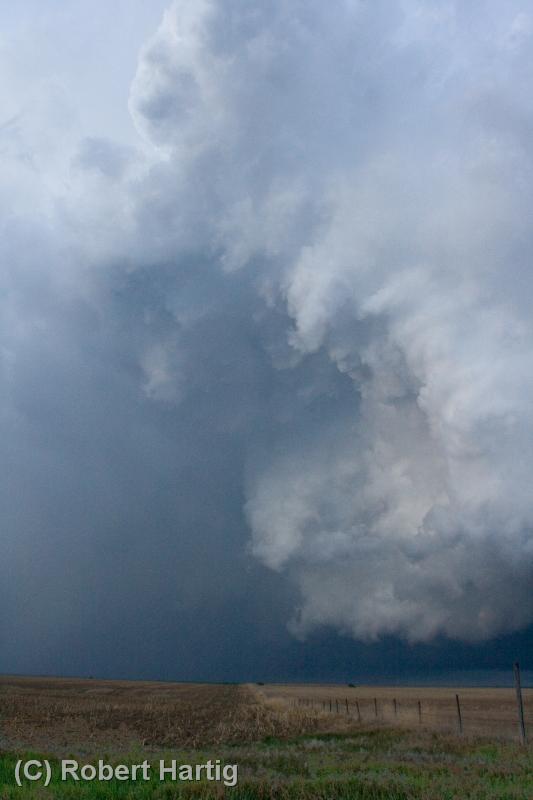
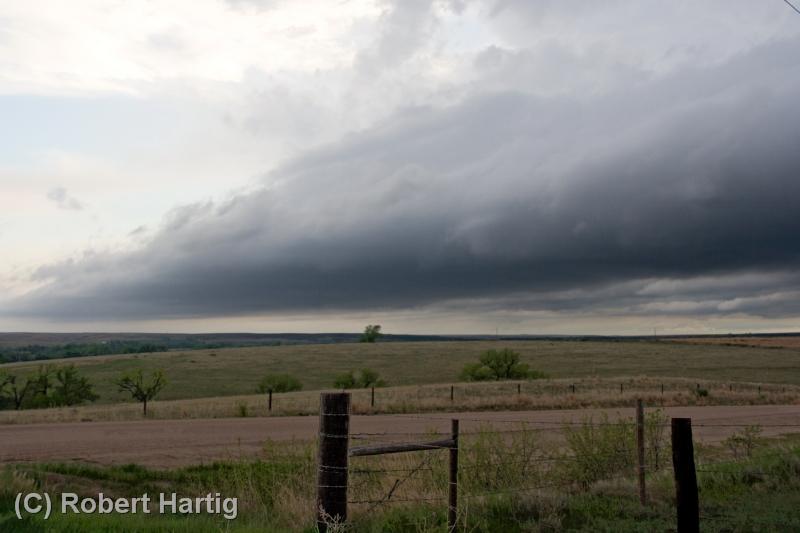
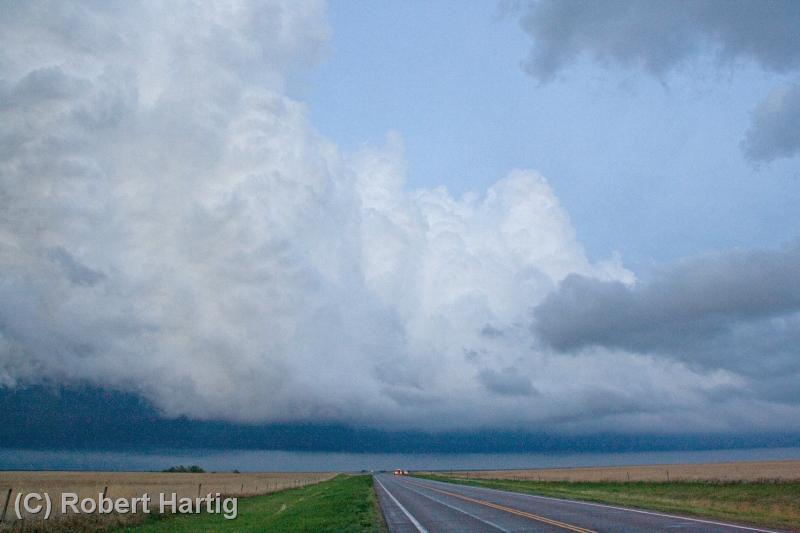
Last Wednesday, May 11, in northwest Kansas was a bust chase as far as tornadoes were concerned. But the prairie sky offers compensations that are blue-ribbon prizes in their own right if you’ve got an eye for beauty.

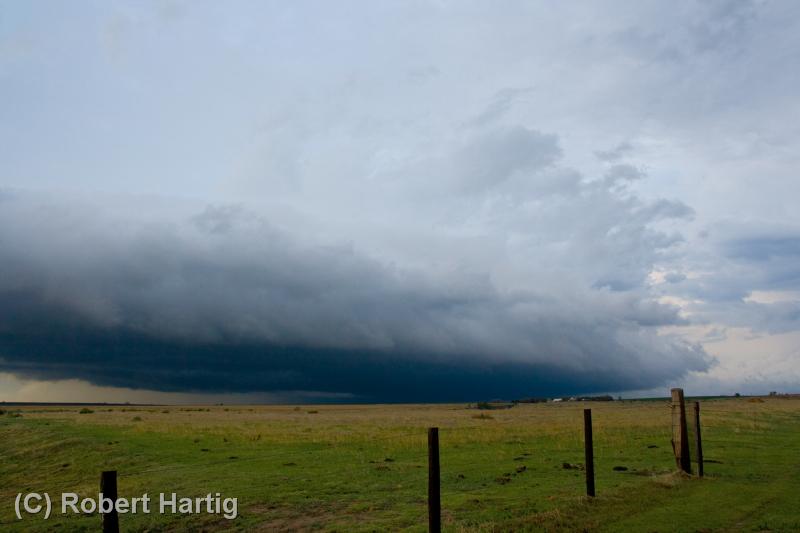
Here are some shots of a couple of low-topped supercells taken in the Atwood/Oberlin area. These storms dumped some marble-sized hail and exhibited visible, though not strong, rotation. They were lovely to behold, sculptures of moisture shaped by the wind and lit by the light of the waning evening. Atmospheric dramas such as these are the true panorama of the Great Plains. Like a run-on sentence, the treeless landscape stretches off into limitless sameness, leaving the sky to provide punctuation, energy, and color.

Quick Summary of Wednesday’s and Thursday’s Chases

Five days and nearly 3,000 miles later, I’m back from out west. This storm system proved to be a disappointment, but it did have its moments. Bill Oosterbaan and I intercepted a nice low-topped supercell in northeast Kansas on Wednesday night, and it’s possible that we witnessed a brief tornado. I need to scrutinize the brief footage I got of the storm feature in question. What was unmistakable was the broader circulation of the storm. It seemed weird to be chasing a north-moving storm with inflow from the northeast, but that’s how it was with storms that moved along a warm front–apparently across it–near a low center with a 500 mb closed low in the vicinity.

Yesterday was a more typical setup. We targeted the Muskogee, Oklahoma, area, which the SREF and RUC pointed to as offering the best overlay of instability and mid-level support, with the H5 jet core nosing into the region.

We were right on the first storms as they initiated, but they were feeble things that just couldn’t seem to get their acts together. With a long drive home lying ahead of us, we concluded to start heading north and settle for a nice lightning show on the way home.

But our prospects improved as the 500 mb jet began to strengthen. A couple of cells to our west and northwest intensified and began to take on a telltale appearance on the radar. A handful of scans later, rotation started to manifest on SRV. By this time we were on US 59 north of the Grand Lake of the Cherokee, east of Vinita and directly in the path of the southernmost cell. At a side road, we pulled aside and I tripoded my camcorder and videotaped some nice storm features: pronounced beaver tail, tail cloud, a nasty-looking wall cloud, and a wet RFD notch.

Beginning as a classic supercell, the storm looked for a while like a tornado breeder. But after predictably morphing into an HP, it eventually lined out and got absorbed into the wad of convection springing up to its south. Lack of adequate helicity is probably what kept this and other storms non-tornadic. METARs showed backed surface winds in the vicinity of the storms, but from what I observed, surface inflow was non-existent to weak. Hodograph curvature doesn’t matter much if boundary layer wind speeds are puny.

I have a few photos to process that I’ll slap up in a day or two, possibly along with a radar grab or two. Right now, though, I’ve got some work I need to accomplish before the work week ends, so here’s where I sign off.