Chasing the Great Lakes Superbomb of 2010

Until early yesterday morning, I was pretty certain that I wasn’t going to be chasing yesterday’s squall line associated with the record-breaking low pressure system that’s moving across the Great Lakes. With storms ripping along at 60 knots, what kind of chasing is a person going to do?

Then came the 7:00 a.m. phone call from my chase partner, Bill Oosterbaan, informing me that the Storm Prediction Center had issued a high risk for the area just across the border in Indiana and Ohio. With the rapidly advancing cold front still west of Chicago, we’d have ample time to position ourselves more optimally. This would be an early-day storm chase. It would also almost surely be our last chase for the next four or five months. What did we have to lose?

I hooked up with Bill at the gas station at 100th St. and US-131, and off we went. The storms had moved into Chicago by then, and as we dropped south, it became apparent that we would also need to break east and then stairstep down into Ohio, buying time in order to let the line develop with daytime heating. Satellite showed some clearing in Ohio,
suggesting a better chance for instability to build. Catching I-94 in Kalamazoo, we headed east toward I-75, with the Findlay area as our target.

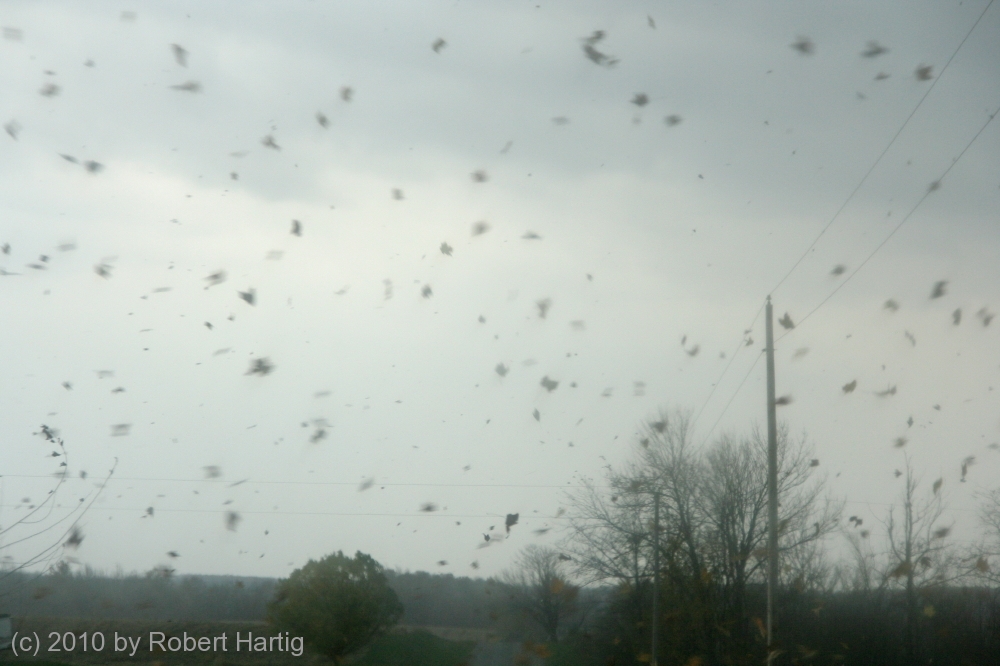
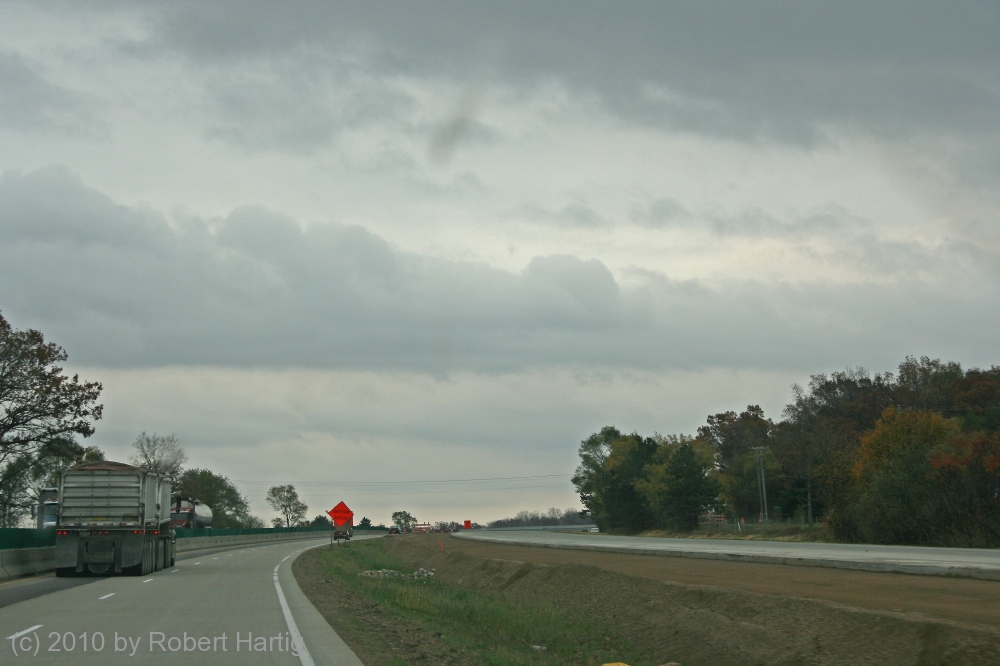
Off to the northwest in Minnesota, the low was deepening toward an unprecedented sub-955 millibar level, sucking in winds from hundreds of miles around like the vortex in an enormous bathtub drain. Transverse rolls of stratocumulus streamed overhead toward the north, indicating substantial wind shear. (Click on image to enlarge.)

By the time we crossed the border into Ohio, tornado reports were already coming in from the west as the squall line intensified. Soon much of the line was tornado warned. However, while the warnings were no doubt a godsend for a few communities that sustained tornado damage yesterday, they weren’t much help to Bill and me. Chasing a squall line is different from chasing discrete supercells.

We had in fact hoped that a few discrete cells would fire ahead of the line. But the forecast CAPE never materialized to make that happen, and we were left with just the line. In that widely forced environment, tornadoes were likely to occur as quick, rain-wrapped spinups rather than as the products of long-lived mesocyclones. Even with GR3, the likelihood of our intercepting a tornado would require a high degree of luck. It was harder to identify areas of circulation with certainty; I found myself using base velocity as much as storm relative velocity on the radar, and comparing suspect areas not with easy-to-see hook echoes in the reflectivity mode, but with kinks in the line. It was pretty much a game of meteorological “Pin the Tail on the Donkey.”
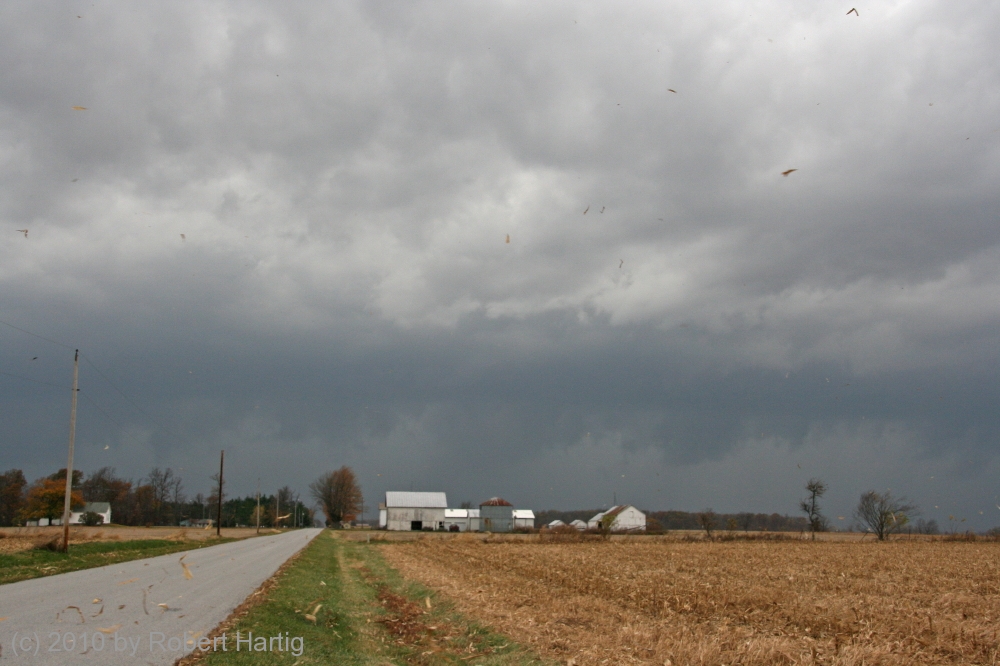
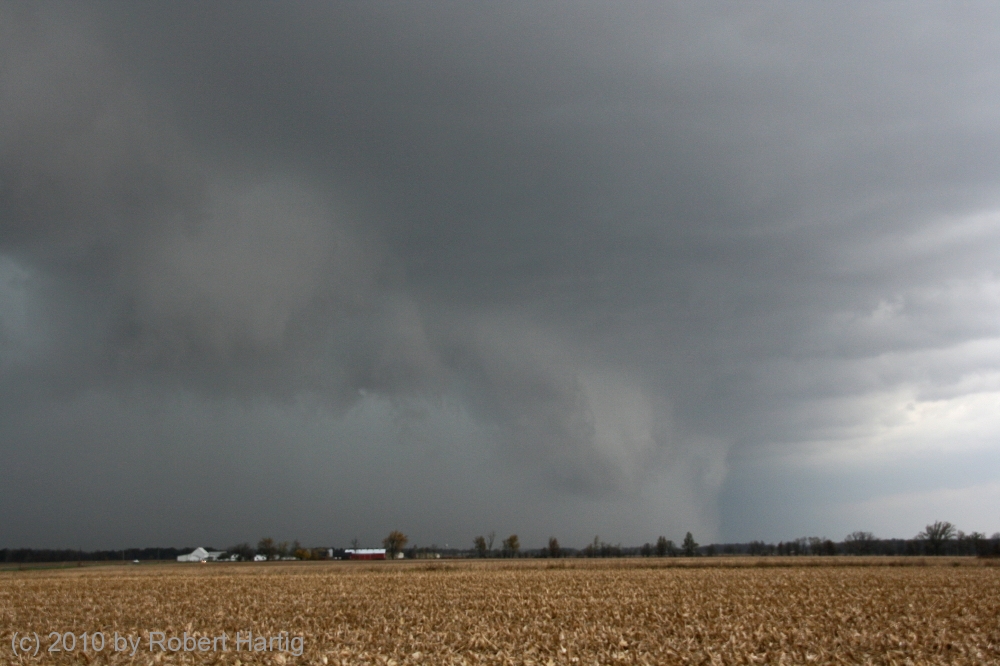
North of Kenton, we headed west and got our first view of the squall line. For all the hooplah that had preceded the thing, it didn’t appear very impressive. Just your average storm front–much windier than most, but also a bit anemic-looking compared to some of the shelf clouds I’ve seen. Still, it was a lovely sight, watching those glowering clouds grope their way across the late-October farmlands.

.

Neither of us was quite ready to end the chase, so with the storm rapidly closing in, we scrambled back into the car and stairstepped to the southeast in the hope of intercepting a likely-looking reflectivity knot that had gone tornado-warned. It was fun playing tag with the storm, driving through swirls of leaves spun up by the outflow. But there really wasn’t much incentive for us to continue the game indefinitely. Eventually we turned back west and drove into the mouth of the beast.

For a few minutes, we got socked with torrential rain and some impressive blasts of wind (and, I should add, absolutely no lightning or thunder whatever). Then it was over. Time to head home.

In Kenton, we grabbed dinner at a small restaurant. Then we headed toward Cridersville, 28 miles straight to the west next to I-75, where there had been a report of “major structural damage” from a tornado. The report was accurate. A small but effective tornado had torn through the community, uprooting and snapping off large trees, taking off roofs, and demolishing at least one garage that I could see. Of course we couldn’t get into the heart of the damage path, but a few passing glimpses suggested that some of the damage may have been fairly severe.

As I said at the beginning, this chase will likely have been my last of the year. I never know for sure until the snows fly, but it seems like a pretty safe bet that I won’t be heading out again after storms until March or April. It’s hard to call this chase a bust since our expectations weren’t all that high to begin with. Plus, tornadoes or no tornadoes, it was an opportunity to engage with a historical weather system. Like other significant weather events such as the Armistice Day Storm and the 1974 Super Outbreak, this one will be given a name in the annals of meteorology. Me, I’m calling it the Great Lakes Superbomb of 2010. In a number of ways, it hasn’t proved to be as impactful as was forecast, but it’s not over yet. And regardless, I’m glad I got the chance to get out and enjoy a final taste of synoptic mayhem.
Intense Autumn Storm System Arrives Tomorrow in the Great Lakes

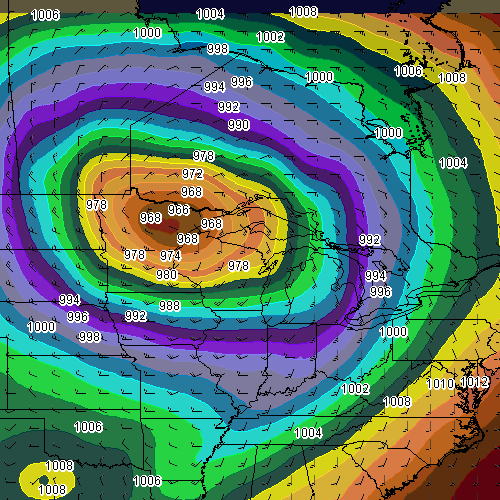
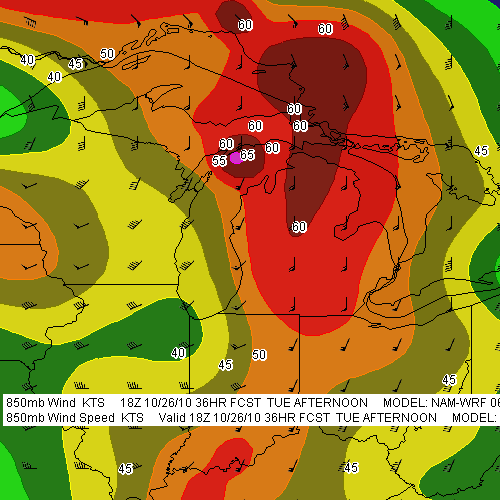
I’m not going to try to be particularly clever in writing this post. Instead, I’m going to throw a bunch of weather maps and a few soundings at you and let them tell the story.

I will say that the weather system that is shaping up for late tonight on into Wednesday for the Great Lakes has the potential to be of historic proportions. In terms of sea level pressure, I’ve seen a number of comparisons to the great Armistice Day Storm of November 11, 1940. However, there are two significant differences: this storm is a bit earlier in the year, and the forecast pressure has been consistently and significantly deeper. The Armistice Day storm dropped to 979 millibars; this one may be in the 960s. In other words, we may see a record-setting barometric pressure with this system.

The bottom line is, this thing will be a wind machine like few we’ve ever seen. Here’s the current forecast discussion from the weather forecast office in Grand Rapids, Michigan.

LOW PRESSURE IN THE SOUTHERN PLAINS WILL RACE NWD AND PHASE WITH A
LOW OVER THE DAKOTAS AND RAPIDLY DEEPEN AS THE UPPER TROUGH DIGS
ACROSS THE UPPER MS VALLEY. THIS WILL LEAD TO VERY STRONG DYNAMICS
ALONG THE TRAILING COLD FRONT LATE TONIGHT. EXPECT STRONG TO SEVERE
STORMS TO DEVELOP ALONG THE FRONT AND RACE EAST. A 70KT LLJ AND
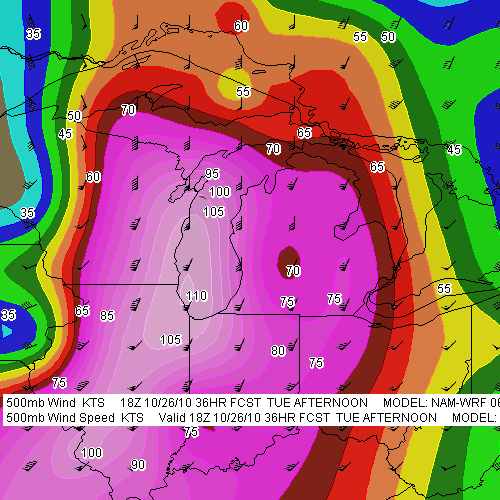
115KTS AT H5 INDICATE IT WON/T TAKE MUCH TO GET SVR WINDS WITH THIS
LINE OF STORMS LATE TONIGHT. A VERY STRONG PRESSURE COUPLET...ON THE
ORDER OF 6MB/3 HRS WILL FOLLOW THE COLD FRONT. THIS WILL LEAD TO
STRONG WINDS DEVELOPING BEHIND THE FRONT. BUFKIT WIND PROFILES SHOW
MIXING INTO THE 55-60KT LAYER AT 2K FT. IT IS LOOKING INCREASINGLY
LIKELY THAT WE/LL SEE SUSTAINED WINDS AROUND 35 MPH AND WIND GUSTS
OVER 50...AND CLOSER TO 60 ALONG THE LAKE SHORE. AS SUCH WE EXPANDED
THE HIGH WIND WATCH TO COVER THE ENTIRE CWA.

WINDS WILL DECREASE TUESDAY NIGHT AS MIXING WANES...BUT WILL
INCREASE CONSIDERABLY AGAIN WEDNESDAY. THIS IS A SLOW MOVING STORM
THAT WILL RESULT IN A PROLONGED WIND EVENT FOR THE CWA.

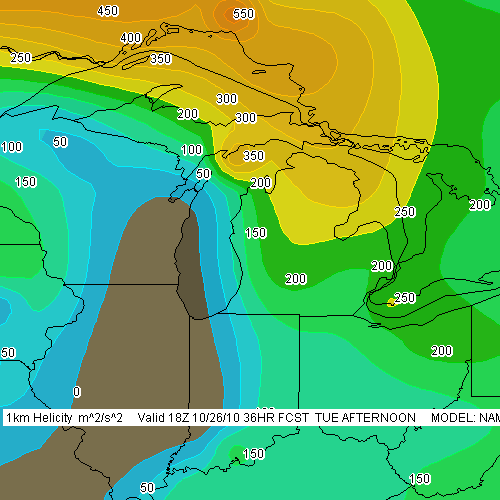
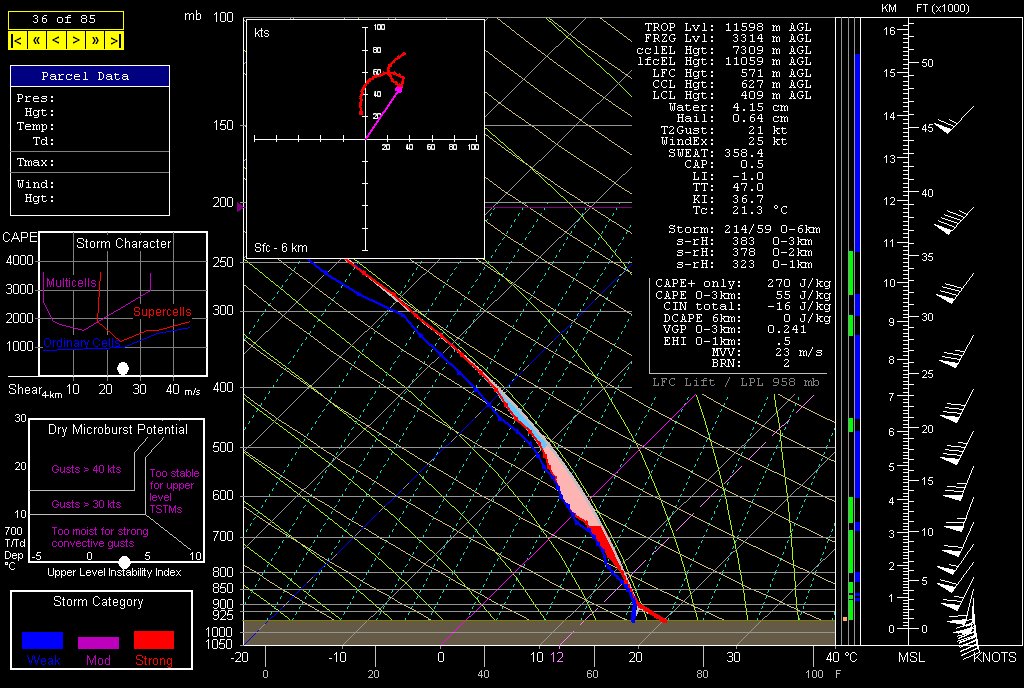
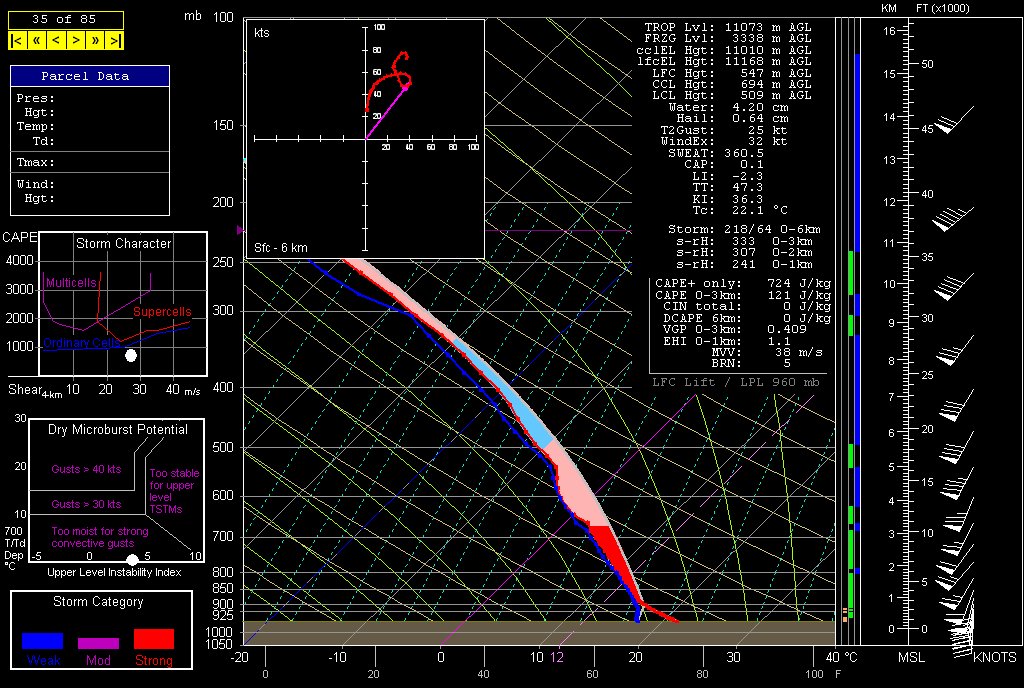
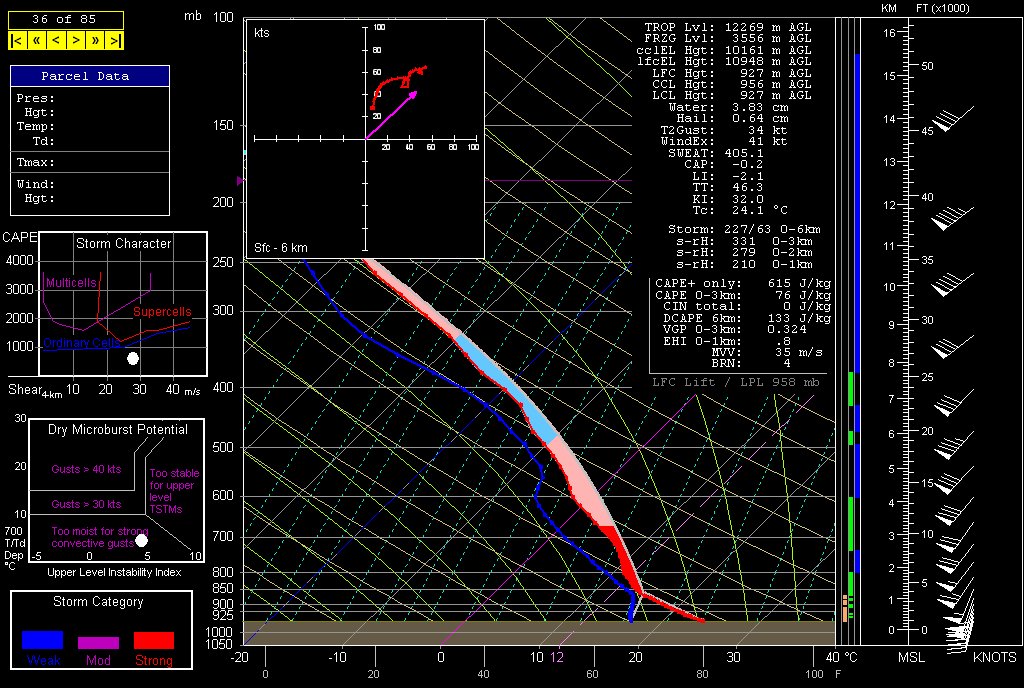
I’m not going to add a lot to that, but I do want to mention the possibility of tornadoes during a brief window of time. Hodographs preceding the front curve nicely, with 1 km storm-relative helicity exceeding 300 showing on this morning’s 6Z NAM sounding for Grand Rapids at 17Z tomorrow afternoon. If enough instability develops–and with winds like the ones we’re looking at, it won’t take much–then we could certainly see some spin-ups as the squall line blows through. And if there’s enough clearing to allow discrete storms to fire ahead of the front, chances for tornadoes increase all the more.

With storms rocketing along to the northeast at over 60 miles an hour, the thought of chasing them is laughable. Anyone out to intercept them will have to watch the radar, position as strategically as possible, and then hope for the best. Serendipity will be the name of the game. That game could begin as early as noon here in Michigan, and it looks to be over before 5:00 p.m.

Not the wind, though. That’ll be hanging around for a while.  Batten down the hatches, campers–we are in for one heck of a blast.

Without further ado, here are some weather maps and NAM forecast soundings from this morning’s 6Z run. Click on the images to enlarge them. Just look at that surface low! Pretty jaw-dropping, I’d say.

Forecast maps for 18Z Tuesday, October 26, 2010


Soundings

Grand Rapids, MI (forecast hour 17Z)

South Bend, IN (forecast hour 16Z)

Muncie, IN (forecast hour 17Z)

Sax Practice by the Airport–Now Verboten?

It seems that practicing the saxophone now poses a threat to homeland security.

Surprised? Not nearly as surprised as I was when I first found out last night.

I surely wasn’t aware of the risk I presented when I parked my car near the railroad tracks at the end of Kraft Avenue, a stone’s throw from the hurricane fence that circumscribes the perimeter of the Gerald R. Ford International Airport. I’ll grant you, it’s an unusual location for a person to hang out at, but it’s by no means anything new for me. I’ve been parking there with varying frequency for roughly 25 years, practicing my saxophone and watching the trains go by.

Of course I’ve been checked out numerous times by the police. I haven’t minded at all; rather, I’ve appreciated that the cops have been on their toes and diligent in doing their jobs. The officers, in turn, have invariably been courteous and usually friendly, and often enough I’ve enjoyed some pleasant conversations with them. Once they determined that I was eccentric but harmless, they always drove off and left me to practice my horn in peace. Over time, a number of them came to recognize me. (Cop, peering in at me: “Oh, it’s you. Enjoy your evening!” Heads back to car and drives away.)

I’ve never had any problems at that location. Not ever. Until last night, that is, when suddenly and inexplicably everything changed.

What I’m about to share is not a rant. I’m not angry, just sad. Maybe once I gain a better understanding of whatever federal laws and/or local ordinances I’m dealing with, I will feel angry at having been jerked around. Or maybe I’ll just have a better understanding of what happened. Right now, though, I have the sense that the policeman I encountered last night was simply doing what he believed was the right thing. He didn’t project a nasty, belligerent, or power-drunk attitude; he was simply adamant that I had to leave my practice spot by the railroad tracks and not practice there in the future.

Just like that. It’s kind of like being told that the old fishing hole where you’ve fished for a quarter of a century is suddenly off limits. You’re given a reason, but it doesn’t ring true, and you get the sense that something you value has been taken from you without your ever having a voice in the matter.

Why all of a sudden? If homeland security was really the issue, which is what I was told, then why did none of the scores of other police officers I’ve encountered in that location over the long years ever mention it to me? Even in the tense months following 9/11, no cop ever requested that I relocate due to security concerns. Not that security–albeit not homeland security that I’m aware–hasn’t always been an issue in that spot. Some of the cops told me that vandalism had sometimes been a problem, and on a couple of occasions I was able to answer questions by the police concerning other visitors at the site. I’d like to think that my presence there has proved, if anything, helpful at times rather than a liability.

So here’s what happened: I was hashing out the Charlie Parker solo to “Dewey Square” yesterday evening when a police car pulled up behind me and the spotlight appeared in my mirror. No sweat; as I’ve mentioned, I’m used to having law enforcement check me out. I set down my horn in the passenger seat, handed the officer my driver’s license upon his request, and then waited while he ran a background check on me. He returned to my vehicle in a couple of minutes and handed me back my license, and at that point I figured things were clear and I could get back to my practicing.

Not so. The cop informed me that I was trespassing (perhaps because I had pulled off the road closer to the tracks, where I could see the semaphore lights, but that had never been an issue before); that I was parked in a high-risk zone less than 100 feet from airport property; and that in order to avoid compromising homeland security, he needed me to move.

Say what?

I reiterated to the officer–I had already mentioned it to him when he first appeared at my window–that I had a long and trouble-free history of practicing at this site; that I was here because the place was convenient and I enjoyed watching the trains go by; that I had been checked out countless times by the police over the years and never experienced any problem; that some of the cops had become familiar with my unusual but harmless habit; that never once had any of them asked me to move; and that this was the first time anyone had ever mentioned the issue of homeland security.

The officer in turn suggested that I relocate to the airport viewing area on the far side of the airport, where I could watch the planes. I appreciated that he was trying to offer what to him seemed like a reasonable solution, but I repeated that I liked to watch the trains. Again he raised the security issue.

“Look,” I said, “I’m not out to argue with you. I’ll leave if you insist. But I’m trying to wrap my mind around what you’re telling me, because for as many years as I’ve been coming here, and as many times as the police have checked me out, this is the first time I’ve ever been told me to leave.”

The officer said he was sorry, but that I would have to find another place to practice. Henceforth I would have to consider this location off limits.

Wow. After 25 years, suddenly out of the clear blue somebody sticks a “No Fishing” sign right in front of my nose at the old fishing hole.

Very well; I had made my case, and it’s my policy not to argue with law enforcement officers. They are, after all, the embodiment of the law, and even when I don’t agree with them, I will comply with them. As I’ve already said, this cop didn’t come across as nasty, just inflexible, and I don’t know what realities he was dealing with. Perhaps a recent change in local ordinances, or even federal law, required him to deal with me differently than what I had experienced in the past.

Then again, maybe nothing at all had changed and the guy was just being a jerk. I don’t know–right now. But I will make a point of finding out. If I need to secure some form of permissions from CSX or the airport, I’ll pursue that avenue. I hate to have a convenient and enjoyable practice place that I’ve resorted to for so many years get suddenly and seemingly arbitrarily yanked out from under me.

Even more, though, I hate the erosion of freedom that such an event reflects.

Sandhill Cranes

The GFS continues to show hopeless ridging throughout most of October. I hardly pay any attention to the long-range forecast models these days, just mention this as a note of idle interest. A trough does finally seem to shape up around 300 hours out per the 6Z run, and it could make life interesting within reach of Great Lakes storm chasers on the 27th and/or 28th. But I don’t have the heart to wishcast that far out; I just don’t believe it’ll happen..

As for the saxophone, I’m extremely pleased with my personal progress. But while I’ve been practicing a lot, my sessions have involved material I’ve already covered in previous posts, and I’d imagine the results interest me far more than they would you.

Lacking anything of great import to write about concerning either jazz saxophone or storm chasing, my radar is scanning for a topic that’s at least conceivably related to either of those two interests. Yesterday’s earthquake in Norman, Oklahoma, would do well except I wasn’t there. I hear it was a loud one, but I’ll leave the reportage to those who actually experienced the shakeup. As for me, I need something closer to home. Like sandhill cranes.

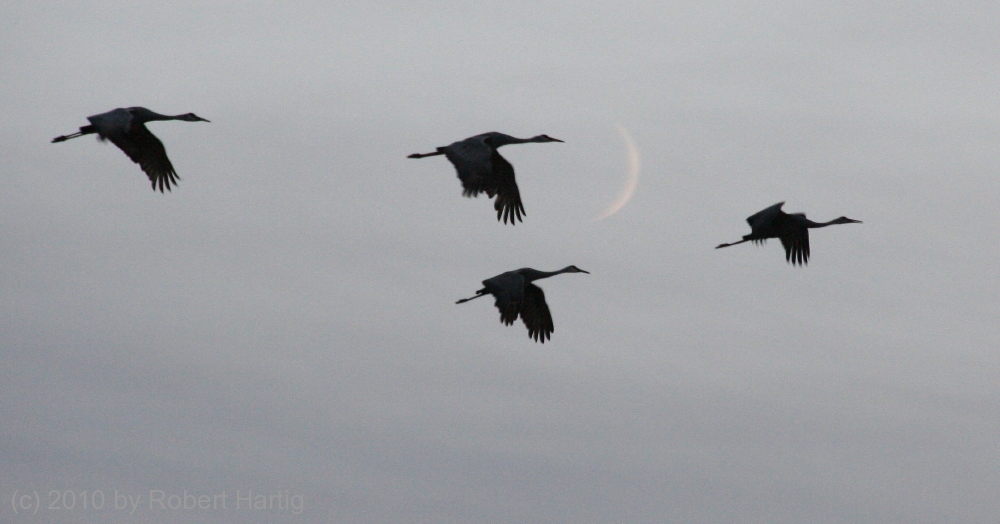
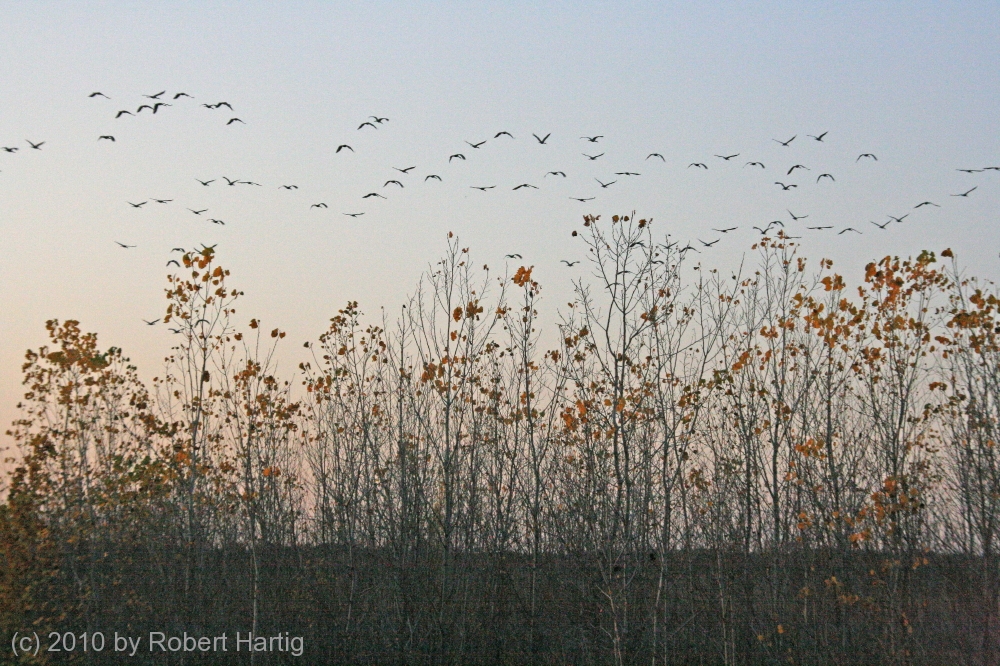
Here in Michigan, now into November is the time of year when the cranes congregate in great numbers in suitable locations that offer nearby sources of both food and cover. Sometime next month they’ll take off for warmer climes in southeastern Georgia and Florida. Meanwhile, this ridging that has quashed the so-called “second season” for storm chasers has provided glorious weather for the sandhill cranes and sandhill crane watchers. The Baker Sanctuary northeast of Battle Creek and the Phyllis Haehnle Memorial Sanctuary near Jackson are well-known staging areas for massive numbers of the birds. However, I’m fortunate to have a location much closer by where over 100 cranes hang out, foraging in a field across the road from a marsh where they shelter for the evening.

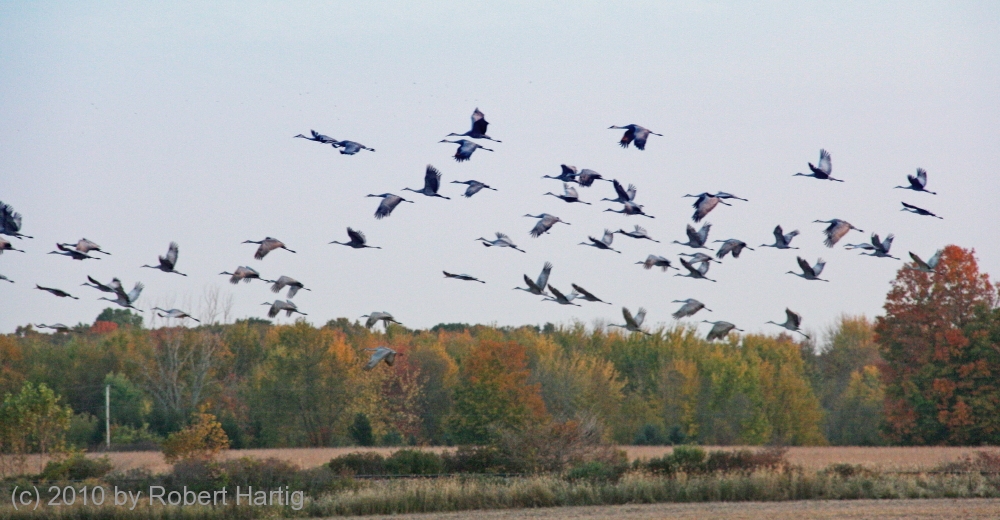
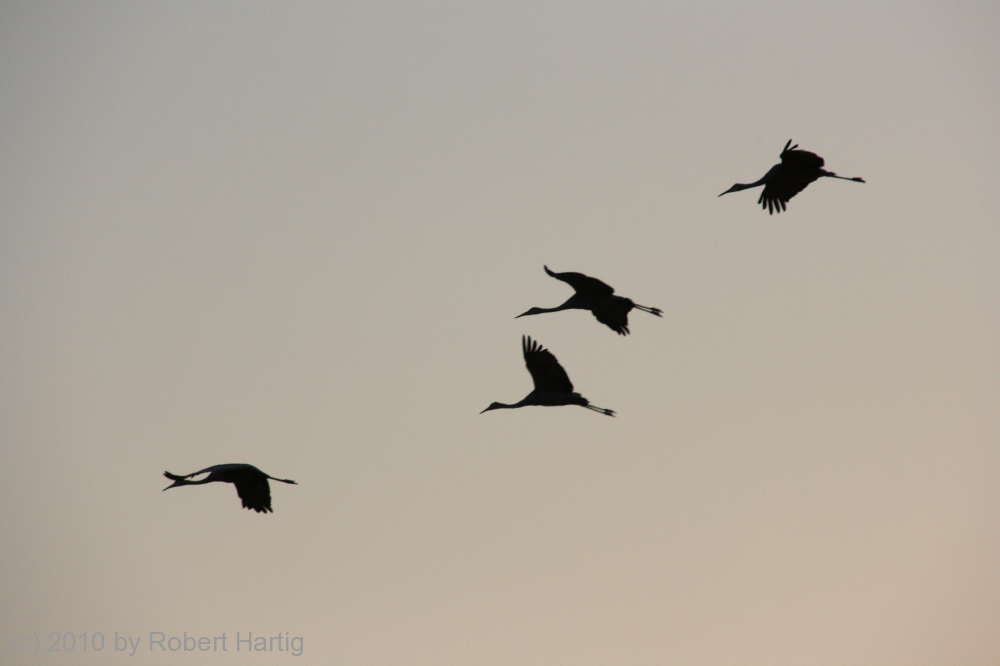
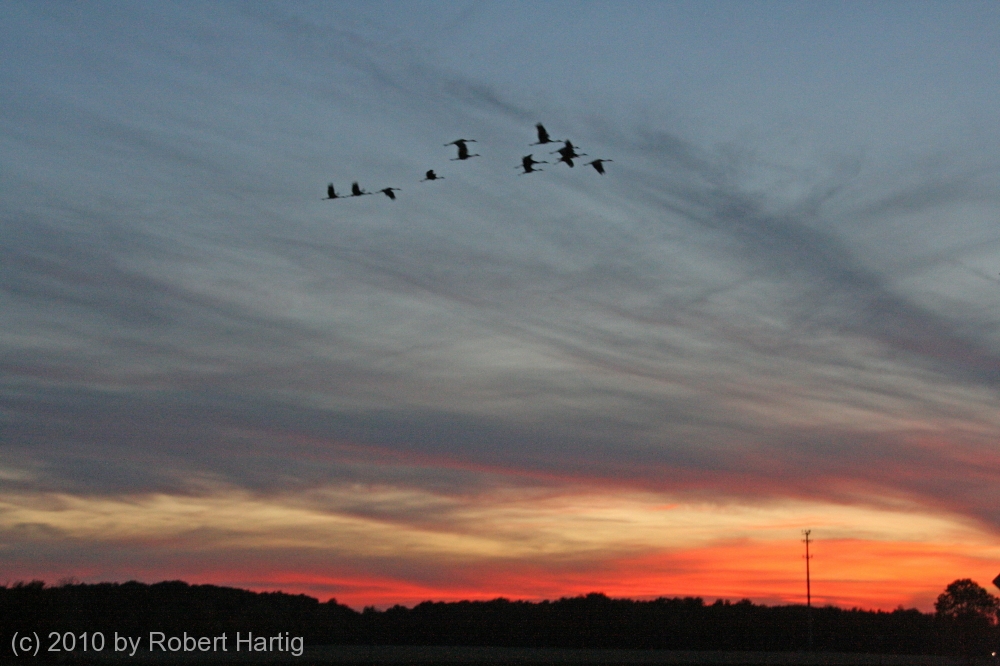
Mom and I went out there Sunday evening. It was a blessing to spend the time with my sweet 85-year-old mother, watching the sandhills feed; listening to their captivating, ratcheting calls; witnessing their sporadic, comical, hopping dances; and waiting for them to take off and fly overhead en-masse into the marsh at sundown. Here are a few photos for you to enjoy.

No Second Season? Please Say It Ain’t So!

I’d been looking forward to the shift in weather with fall’s arrival, but now that autumn is officially here,  I dunno, boys and girls. I’m beginning to suspect that the mythical “second season” may not materialize for storm chasers this year–not in the Great Lakes, anyway. You folks out west will no doubt get your little romp, but up here in the tundra land of Michigan instability appears to be a thing of the past. I have to remind myself that it’s been only a week since one heck of a squall line blew through and caused extensive tree damage in my area. A couple of days later, though, as the system lifted out of the region, the moisture gave way to the relentlessly dry, crystal-blue skies of autumn, and I have the unsettling feeling that the die has been cast for the remainder of the year.

Today’s 4-8 day outlook from the SPC doesn’t make me feel any better about our immediate prospects:

 VALID 021200Z - 071200Z

   ...DISCUSSION...
   MODELS ARE IN GOOD AGREEMENT WITH THE PATTERN EVOLUTION THROUGH
   ABOUT SUN/D5 WITH LARGE TROUGH AMPLIFYING ACROSS THE GREAT LAKES AND
   ERN STATES AND AN UPPER RIDGE OVER THE ROCKIES. THIS PATTERN WILL
   RESULT IN A LACK OF INSTABILITY E OF THE ROCKIES WITH HIGH PRESSURE
   AT THE SURFACE. 

   WHILE THE TROUGH IS FORECAST TO LINGER IN SOME FORM OVER THE ERN
   CONUS...THERE IS MUCH DIFFERENCE ASSOCIATED WITH THE BREAKDOWN OF
   THE RIDGE AS A NEW TROUGH AFFECTS EITHER THE PACIFIC NW/GFS
   SOLUTION/ OR THE ENTIRE W COAST/ECMWF SOLUTION/.  REGARDLESS...THERE
   IS LITTLE CHANCE OF SEVERE WEATHER GIVEN MEAGER MOISTURE AND
   INSTABILITY.

   ..JEWELL.. 09/29/2010

“Lack of instability..little chance of severe weather…meager moisture…”–mmmph, doesn’t sound very promising, does it? I console myself with the thought that autumn has barely begun, and a nice fetch of moisture can still come chugging northward on the leading edge of some great dynamics to make life interesting. It happened as late as November 10, 2002, in Van Wert, Ohio. It happened just three years ago on October 18, 2007, across the Midwest, including here in Michigan. So my rule of thumb is, don’t pack away the laptop until the snows fly.

Still, as daytime temperatures retreat into the mid 60s and dewpoints drop to 50 degrees and below, it’s kind of hard to believe that the end of the parade isn’t long gone, and that last week’s wind event wasn’t just the cleanup crew. Good thing that this season’s “Storm Chasers” series will be airing soon and letting us all relive the glory days of 2010. After that, though…man, it sure is a long stretch from here to next March.

A Real Michigan Squall Line

Man, what a great storm we got last night here in Caledonia! Though actually, I can’t say exactly how it was in Caledonia because I was in my car tracking with the squall line, belting eastward down 100th St in a frenzied attempt to catch up with and outpace the gust front.

I didn’t succeed. Just west of Alden Nash Avenue, a large tree blocked both lanes of the road. Pulling into a driveway, I phoned in a report to KGRR, then managed to squeeze around the treetop and continue on.

Just south of Alto on Alden Nash, traffic was stopped where another large tree had fallen. I turned around and headed east on 76th St only to encounter yet another good sized tree lying on the road. I slid past this one as well, and then, after phoning in another report, completed the big block back into Alto and fueled up at the gas station.

At this point, I had my buddy Bill Oosterbaan on the phone. He was down in Tennessee, but he was following the storm on radar. Since I was chasing sans laptop, I wondered where the line was now located. With I-96 just a couple miles north of me, I had a half-cocked notion that I might still have a chance of catching up with the front of the storm once I hit the Interstate. But Bill informed me that the storm was already halfway to Lansing.

No real surprise there, but nevertheless, nuts. End of chase. Still, there was plenty of lightning crawling the clouds to enjoy. So with my fuel tank replenished, I caught 68th St east and soon found myself once again having to grease my way past a downed tree. Nasty, scraping sound–ugh!

My thoughts turned to Ben Holcomb. Oh, he’d be having a picnic with this system, I thought. Why he ever left this storm chaser’s paradise called Michigan for Oklahoma City I’ll just never understand. Might as well rub some salt into the wound. So I gave him a call, and he told me that he, like Bill, had been tracking the storm front on radar. He informed me that he’d observed base level winds of 88.5 knots on GR2AE. Over 100 mph! Zounds! That, if you please, is one sweet little zephyr. I doubt winds reached quite that speed anywhere on the ground, but we most certainly got one heck of a blow. I’ve encountered my share of trees blocking roads, but I’ve never had my progress consistently blocked by them. Driving through the Alto area last night was like navigating a maze and hitting dead end after dead end.

More weather is on the way later today as a warm front lifts north through Michigan. With 0-6km shear around 55 knots forecast, things could once again get interesting.

Troughy Weather for Next Week

Here on the back end of a 996 mb low, dry Canadian air has dropped the moisture along with the heat in Caledonia, Michigan. We’re presently socked in with clouds, and temperatures are supposed to peak at just 65 degrees. It feels a lot like fall outside.

This latest cold front has meant business, and to me it signifies the arrival of autumn’s transitional weather pattern–a time when the upper atmosphere begins to cool and conditions become more conducive to bouts of severe storms.

Our next round of stormy weather may be arriving by next weekend. Granted, it’s pretty early to be looking so far ahead, but the SPC has been eyeballing the next trough in their long-range discussions with a good amount of confidence. Seems like a question not of whether something will happen, but when.

Not having access to many of the SPC’s forecasting tools, I have to go by what’s available to me. The GFS and Euro both depict a pretty deep trough. The GFS, typically, wants to move it along faster than the Euro, but both models agree that there will be something there to move. Both also show a robust surface low developing and drawing in dewpoints in the mid 60s. The northern plains may get hammered later this coming week. By the weekend, Michigan may get a crack at some severe storms. Or not. The crystal ball is murky this far out, and as always, the caveat is, we’ll find out when we find out.

Whatever happens, it’s nice to think that the weather machine may be lurching out of the summer doldrums and getting set to ramp up the action. September furnishes some nice opportunities for taking photos of squall lines blowing in at the lakeshore. Maybe this will be one such occasion. Maybe it’ll be even better than that. It’s not premature to cross our fingers.

Warmest West Michigan Summer in 55 Years

This summer of 2010 has been the warmest summer in West Michigan since 1955, according to WOOD TV meteorologist Bill Steffen. Temperatures in the 90s have predominated, with dewpoints in the upper 70s,  and Lake Michigan water temps–in the mid 70s this morning–have been as high as 80 degrees. That’s like swimming in bathwater, and I’m not even referring to the lake–I’m talking about just stepping outdoors.

We made it as high as 93 degrees yesterday, and it looks like hot temperatures are going to hang around for a few more days until a weak cold front modifies things a bit and hopefully brings a few storms to make life interesting. I’m all for hot and sticky under the right circumstances, but a glance at RAOB model soundings for RUC and NAM shows utterly placid conditions. Winds at 500 millibars are doddering along at a geriatric 10-15 knots, and the rest of the atmosphere is keeping pretty much the same pace.

The great storms of May and June are so far past that they seem like ancient history. Who all besides me is ready for a nice, deep trough to come sweeping across our area? Patience, patience, lads and lasses. The fall season is coming. This stifling heat and humidity will soon get stirred up with episodes of cooler air sweeping in from Canada, and the weather machine will kick into gear once again. Then we can all fire up our laptops and Rain-X our windshields for one last blast before the snows fly.

Great Lakes Waterspout Season Is at Hand

Now is the time of year when waterspouts start putting in an appearance on the Great Lakes. I had largely forgotten about spouts until a few days ago when my friend and fellow weather weenie Mike Kovalchick mentioned them in an email. Bing! A light blinked on in my head: That’s right! Waterspouts!

I’ve never seen a waterspout. But then, until last year about this time with my buddy Kurt Hulst, I’d never made a point of going out after them. Kurt and I busted that day, but maybe this year I’ll get lucky, provided I increase my chances by taking more opportunities to chase spouts.

I have zero experience forecasting waterspouts. Thankfully, there’s a snappy little graph called the Waterspout Nomogram that simplifies the process. Developed by Wade Szilagyi of the Meteorological Service of Canada, the Waterspout Nomogram provides a quick visual aid for determining when certain critical parameters are in place for four different classifications of waterspout: tornadic, upper low, land breeze, and winter.

The tornadic variety is self-explanatory, and any storm chaser with some experience making his or her own forecasts should have a good feel for when that kind of waterspout is likely. Mike favors the 500 mb cold-core, closed low setup, which to my thinking may be a variant of the first in producing low-top supercells. The remaining two, land breeze and winter, seem to involve different dynamics. For all the waterspout categories, one of the constraints is that for spouts to occur, winds at 850 mbs have to be less than 40 knots, something I find particularly interesting in the case of supercell-based waterspouts.

In any event, I’m hoping that this year is my year to finally witness a spout or two. Michigan chasers and weather weenies, it’s time to pay attention to the marine forecasts. The “second season” can include action right along the lakeshore even when nothing’s popping anywhere else. Make sure you bring your shotgun just in case a waterspout gets too close for comfort (written with a wink and a grin).

August Reminiscences: My First Successful Storm Chase

Ah, August. In its own way, it’s a lot like February: a month whose respective season of the year has settled in and ripened into predictability. Upper winds are weak and storms are often the pop-up type, providing a quick flash-and-bang along with localized rainfall before fizzling out. Yet on the horizon, like the first cirrus wisps of a fast-moving cold front, you can see change coming.

This morning I awakened to the distant grumble of thunder, and when I opened the drapes, the sky was an odd, fish-flesh paleness with darkness moving in. Oh, joy! Upon hearing me stir, Lisa stepped into the room with a smile and told me that a squall line was approaching. Now, that’s the way I like an August day to begin! I fired up the computer and consulted GR3. It was a skinny line, but the NWS was saying big things about it’s being quite the wind machine. Eight miles up the road, the KGRR station ob reported heavy rain; yet here in Caledonia, we got just a mild spray of precipitation, the lightning called it quits, and the line which had threatened to enter like a lion left like a lamb. Now it’s no longer even detectable on the radar.

More thunder is in the forecast for today, though, and for the next few days, as a weak warm front sloshes back and forth and as air mass storms generate more boundaries to fire up convection. It’ll be a bland but enjoyable show.

While my attitude toward August may seem patronizing, this month is capable of producing an occasional potent surprise. On August 24, 2007, I was sitting in the Hastings library when a line of storms formed just to the west and drifted directly overhead. I had my laptop with me with GR3 running, but my forecasting skills and overall experience were still pretty embryonic, and I dismissed some telltale signs, both radar and visual, because forecast models indicated a straight-line wind event.

The storms matured overhead, blasting Hastings with rain and lightning, and then moved to the east and steered an EF-3 tornado through the town of Potterville. I could have easily intercepted it if I had known what the heck I was doing. There it was, a perfect chase opportunity, gift-wrapped with a large ribbon and dropped smack into my lap, and I was too dumb to untie the bow. Aaargh! Four years later, I could still whap myself alongside the head.

But God showers his kindness even on the ignorant. My first successful chase was eleven years earlier, back in August of, I believe, 1996. I don’t remember the exact date, but I can assure you that in those days, cluelessness was a level of expertise I had yet to attain. However, I had at least learned a few things about storm structure and a few concepts such as shear and CAPE. So when the morning blossomed into an exceptionally sticky day–dewpoints had to have been in the mid-70s–and when I noticed clouds in the afternoon leaning over and curling at the tips, I sensed that something was up.

Around 4:30, I happened to glance out of one of the wrap-around windows at the place where I worked and did a double-take. A wall cloud was forming just a mile or so to my south. Hot dang! I watched it for a bit as it moved eastward, then decided to do something about it.

Leaving work early, I hopped into my little Nissan Sentra and blasted after the storm. I had no laptop, no radar, no weather radio, no experience, and very little knowledge. Instinctively I stayed to the south side of the storm. But as it neared Ionia, I could no longer make out cloud features. I wasn’t even certain that the storm still existed. I hit M-21 and traveled east a ways, then north, smack into the precip core. Yep, the storm was still there. But where was the wall cloud? Was there still a wall cloud?

Emerging from the rain, I headed back west, then south down M-66, effectively circling the supercell. As I approached Ionia from the north, the wall cloud came once again into view. Cool! The storm most definitely still had its teeth.

I tracked behind the storm down M-21, getting right to the rear edge of the circulation. Near Muir, a streak of white condensation shot suddenly out of the woods on the right side of the road half a mile in front of me. Was that a tornado? I wasn’t sure, but it looked mighty promising. Also a bit unnerving. I dropped back and put a little more distance between me and the updraft area.

A while later, somewhere in the open country around St. Johns, I parked and observed as the wall cloud reorganized east of me. While I didn’t realize it at the time, I was watching a classic supercell, as nicely structured and impressive as anything I’ve seen out in the Great Plains. It tightened up, with a nice inflow band feeding into it. Then, to my astonishment, a beautiful, slender white tube materialized underneath it a mile away. Extending fully to the ground, the ghost-like tube translated slowly to my right for a distance of probably no more than half a mile, then dissipated. I had just seen my first tornado!

At that point, the storm weakened. No doubt it was just pulsing, but I dropped it and headed for home. However, I soon discovered that another storm was right on the heels of the first one, making a beeline toward me down M-21.

What were the odds that it, too, would be a supercell? Plenty, of course, but to me at that time they seemed as remote as lightning striking twice in the same place. Nevertheless, something told me that I needed to exercise caution, a hunch that verified as I headed back into Muir. An evil-looking flying saucer meso was approaching the town. Hmmm…maybe it would be prudent of me to drop south.

A couple miles out of the path of the updraft, I parked, got out of the car, and stood on the roadside listening to the thunder grumble and watching as the mesocyclone drifted uneventfully over Muir and vanished off to the northeast. Then I climbed back into my vehicle and headed back to M-21, and west toward home.

I was stoked. I had witnessed my very first tornado! Wow! Thank you, Lord, thank you, thank you, thank you!

It was a milestone in my life so huge that hitting the deer just outside of Ada seemed like practically a non-event. Within a nanosecond, the yearling bounded out of the woods and into my path, driven by a powerful urge to bond with my radiator. Much to both of our chagrin, it succeeded.

But you know, I love a good story, and I recognized all the elements of a great one, a real red-letter day. Not only had I experienced my first successful storm chase, but to top it off, I had also collided with a whitetail and demolished my front end. It doesn’t get much better than that–or at least, it wouldn’t until fourteen years later on May 22, 2010, in South Dakota. That was the ultimate storm chasing experience. But that’s another story.

As for this story, all fun and excitement aside, I had learned a sobering lesson about the dangers of storm chasing. I had come face to face with the dark side of nature–with a force that, beautiful as it was, was also fearful, uncontrollable, and deadly, capable of wreaking havoc on a scale that beggars description. No question about it, deer are dangerous. I enjoy seeing them at a distance, just not up close.