The Bob Hartig Quartet Plays the Thornapple Jazz Festival

This past weekend I had the pleasure of fronting my own jazz quartet for two consecutive days as a part of the Thornapple Jazz Festival. Now in its sixth year, the festival has begun to expand its reach beyond Hastings to other, outlying communities in Barry County. This year included Delton and Middleville.

Thus, on Friday the lads and I took the stage at the MidVilla Inn on M-37 just north of Middleville. The turnout was modest, but not at all bad for a small town that isn’t known as a hotbed of jazz. As for a rhythm section, I couldn’t have asked for better players. Ric Troll is one of the tastiest drummers and all-around musicians I know, with tremendous musical sensitivity. Dave DeVos is a seasoned and solid bassist who, like me, has a relentless thirst to grow in the mastery of his instrument. And keyboard man Paul Lesinski is nothing short of fabulous, a player of great inventiveness and the technical excellence to pull off anything his fertile mind conceives.

Together, these guys are my musical dream team. They made it easy for me to pull off my allotted two sets with the kind of energy and spontaneity that are the soul of jazz. If all it takes is one bad player to make a good band sound lame, it’s also true that a great band can boot a decent soloist up to the next level. It takes a certain baseline of aptitude and experience for that to happen, but once you achieve that level, then players the caliber of Ric, Dave, and Paul can lift you out of the ordinary and inspire you to stretch, to push beyond your normal, self-imposed limits and explore new musical territory. That, at least, has been my experience as a jazz saxophonist.

I was very pleased with our performance at the Mid Villa, and again Saturday night at the Waldorf in downtown Hastings. The Waldorf is one of my favorite restaurants, with out-of-this world cooking and absolutely stellar, award-winning microbrews, and I’ve wanted to bring a straight-ahead jazz combo there for a long time. Mike, the owner, finally booked my quartet for the dinner crowd from 6:30-8:30, and we got our chance.

Our song list ran the spectrum from bebop to ballads to Latin to jazz/rock, and included such tunes as “Anthropology,” “Footprints,” “Triste,” “Stolen Moments,” “Have You Met Miss Jones?” and “Song for My Father.” We even played one of my own originals, a Latin-flavored ballad that I wrote several years ago called “Tracy” in honor of a love lost but fondly remembered.

It was a joy to participate in the Sixth Annual Thornapple Jazz Festival, and an honor to be invited by the event’s driving force and musical manager, my friend Joe LaJoye. Joe, if you happen to read this post, thank you! The guys and I had a blast. Maybe next time around you’ll be able to take a breather from all the responsibilities of “makin’ it happen” long enough to sit in with your trumpet for a tune or two, eh?
Highlights of the 1965 Palm Sunday Tornado Memorial in Bristol, Indiana

Yesterday I made the drive to the Elkhart County Historical Museum in Bristol, Indiana, to attend the forty-fourth memorial observance of the 1965 Palm Sunday Tornadoes. The occasion may have been low-key, but it was nevertheless remarkable. A couple of the factors that made it so were purely personal. I finally got to meet my long-distance friend and owner of the Tornado Memorial Park in nearby Dunlap, Debbie Watters. We’ve connected so well across the miles via email that when we finally got to talk person to person, it was as natural as if we’d hung out together forever. It was a double pleasure to meet her daughter and husband as well.

Then there was my other “tornado lady” friend, Pat McIntosh, who attended the meeting with her brother, John. What a sweetie! The three of us caught dinner afterward near Middlebury.

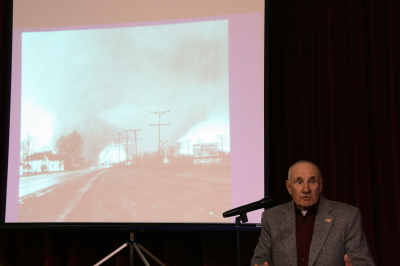
The stories and memories were amazing, and some quite touching and emotional. One huge highlight for me is captured in the photos below. In the first photo, the image shown on the projector screen depicts the notorious twin funnels that swept through the Midway Trailer Park south of Dunlap, Indiana. The image is one of the most famous tornado photographs ever taken, and the man standing next to it is the person who took it, retired Elkhart Truth newspaper photographer Paul Huffman.

Paul Huffman stands next to a projection of his Pulitzer Award-winning photo of the Midway twin funnels.

Paul Huffman stands next to a projection of his Pulitzer Award-winning photo of the Midway twin funnels.

Paul and his wife were traveling north on US 33 shortly after 6:00 p.m. on April 11, 1965, when they spotted the tornado moving in from the southwest. Stopping the car, Paul grabbed his camera and snapped a series of six dramatic photographs as the tornado morphed from a narrow funnel into the two-legged monster that devastated the hapless trailer court, then moved off to the northeast in a cloak of rain.

How fast was the tornado moving, I wanted to know. Fast, Paul said. Probably seventy miles an hour. How close was he, someone else asked. Around a quarter-mile. Were he and his wife at all close to the debris? An ironic smile. Yes, his wife replied, the two of them experienced some debris falling around them. Would a flattened automobile qualify?

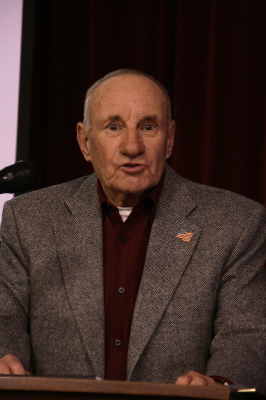
Paul Huffman speaks at the 2008 memorial observation of the 1965 Palm Sunday Tornadoes.

Paul Huffman speaks at the 2008 memorial observance of the 1965 Palm Sunday Tornadoes.

One powerful moment occurred after the event had officially ended and people were milling around the tables full of memorabilia. My friend Pat was showing me a photo Paul had taken during rescue operations at the trailer court. In the photo was a young Pat, laying on a stretcher. Over her hovered her husband, Bill. To the right stood a fireman.

As we looked at the photo, an elderly gentleman standing nearby named Dwight Kime said, “That fireman was my brother-in-law.” Dwight himself had been one of the rescue workers. As it turned out, he was the one who found Pat and Bill’s baby, Chris, amid the rubble–one of the youngest of the ten fatalities in the trailer court. Dwight was visibly moved as he came to understand that Pat had been the child’s mother. It has been forty-four years since that terrible evening, but the memories–and the hidden sadness–never fade. I am glad that Pat’s little boy was found and cared for in death by such a tenderhearted man as Dwight Kime. And I am just as glad that, after all these years, he and Pat got to meet and talk at last. That is God’s grace.

Elkhart County Historical Museum Remembers the 1965 Palm Sunday Tornadoes

My friend Debbie Watters, prorieter of the 1965 Palm Sunday Tornado Memorial Park in Dunlap, Indiana, sent me the following article from the Elkhart Truth newspaper:

It’s been almost 44 years since the Palm Sunday tornado tore through Elkhart County, killing dozens and injuring hundreds. It will be the focus of a special program at a local museum.
The Elkhart County Historical Museum is organizing a remembrance of the April 11, 1965, di saster. The memorial will be from 2 to 4 p.m. April 5 at the museum, 304. W. Vistula, Bristol.
Nicholas Hoffman, director and curator of the museum, said the tornado is an important part of local history.
“It was a really big occurrence that impacted many people,” Hoffman said.
Patrick Murphy, a meteorologist from the National Oceanic and Atmospheric Association, will talk about how tornadoes form and the factors that led to the 1965 tornado outbreak that spawned 40 tornadoes across the Midwest and left 271 people dead.
“We’re really excited to have NOAA participating in this event with us because they’re certainly the experts on these events,” Hoffman said.
A panel of survivors of the Palm Sunday tornado will take questions after Murphy’s presentation.
The panel will include John Clark, a retired Elkhart police officer, and Paul Huffman, the retired Elkhart Truth photographer who snapped the famous photo of the twin twisters.
“[Huffman] captured the horror of that day with one photograph,” said the curator.
There will be an open microphone portion for anyone interested in talking about the disaster.
The museum will also provide table space for collectors to display items they found in the wake of the tornado.
For more information call the museum at 848-4322.
Of course I plan on attending. My interest in the Palm Sunday Tornadoes extends back to my childhood, and in recent months it has become an area of increasing research. I am particularly excited to learn that Paul Huffman–whose photograph of the twin funnels striking the Midway Trailer Court, remains one of the most dramatic, all-time classic tornado photos ever taken–will be one of the panelists. That’s just my opinion, but I think that many severe weather meteorologists, tornado historians, and storm chasers will agree. Over the years I have viewed hundreds of tornado photos. I have seen some incredible images, ranging from the sublime to the scary, but nothing quite like that old black-and-white snapped over forty years ago by a young press photographer as he stood in the inbounds with his camera just a few hundred yards from mayhem, witnessing the last moments of a community.
I hope to get a chance to talk with Mr. Huffman. I also look forward to meeting Pat Murphy, lead forecaster for the Northern Indiana NWS. He and I have connected previously concerning the Palm Sunday Tornadoes, and have made plans to get together next week Sunday, April 11–the 44th anniversary of the outbreak–to trace the paths of some of the twisters. But that’s a separate story, and while this is an area of personal fascination for me, there’s also another, parallel motive which I’m hesitant to divulge just yet.
Stay tuned, though. You’ll be reading more about the 1965 Palm Sunday Tornadoes in this blog.
And on that note, I invite you to leave a comment if you experienced the Palm Sunday Tornadoes firsthand. If you are a storm survivor, or if you possess personal, unpublished photographs or old film footage of one of the actual tornadoes, I would love to hear from you.

Of Sax Practice and Railroad Tracks

I just returned from a nice, two-hour saxophone practice session out by the railroad tracks.

The railroad tracks?

Oh, I guess I haven’t told you about my practice habits. They have as much to do with where I practice as what I practice.

Living in an apartment, I try to be considerate of my neighbors. I like to think that they’d enjoy my music, but realistically, there’s only so much that even the most ardent jazz lovers can take of listening to the same licks, patterns, and scales repeated ad nauseum, blaring down the hallway and through the walls. So for years, my practice room has been my car. My routine has consisted of driving to the outbacks of Kent County and parking at various locations along the CSX tracks between Kentwood and Lansing, where I practice my horn and watch for the trains to roll by.

I love trains. Obviously, I also love playing my sax. It’s nice to be able to combine those two interests in a productive way. Tonight, as I do so often, I parked at one of my favorite trackside spots near a small community called, appropriately, Alto. I didn’t see any trains, but I had a most productive practice hashing out some diminished and diminished/whole tone licks, and woodshedding the Charlie Parker tune “Ornithology” in several keys.

I always return feeling good about my playing after a session like tonight’s. The time goes so fast! And that’s as it should be.

The best way to make a living is to earn money doing things we’d pay money to do. Playing the sax is one of those things. I can’t say I make a living at it, but it certainly supplements my cash flow; it’s part of the picture of my livelihood. I’ve been at it a long time now, and most of that time I’ve been practicing in my car by the tracks–or, during the warm months, often outdoors. If I ever do buy a house and gain an honest-to-goodness practice room of my own, I think I will still maintain my railroad track sessions. I’d miss them far too much not to. Habits are hard to break, and there’s no reason to break a good one in the first place.

Storm Chasing Selectivity (aka Impulse Control, aka Curbing the Impulse to Chase Any and Every Dumb System That Comes Down the Pike)

If the developmental curve of storm chasing is analogous to the seasons of life, then I think I’ve moved out of adolescence into young adulthood. Just as testosterone-driven impulses become tempered with knowledge and experience as callow youth transitions into maturity, so do idiotic, desperate, SDS-and-adrenaline-fueled urges to chase at the drop of a hat become balanced by an awareness of how stupid it is to waste time and gas driving hundreds of miles in pursuit of borderline scenarios.

Living in Michigan carries a steeper price tag than living in Kansas or even Iowa when it comes to busted chases. I can’t afford not to be selective, and I think I’ve finally internalized that lesson. As this year’s convective weather season has begun to ramp up, so far my greatest attainment hasn’t been successful chases, but rather, my refusal to get pulled into 2,000-mile excursions this early in the year.

Dixie Alley has had its moments, but so far they’ve been nothing like 2008. Tornado Alley has also offered a few setups, even one or two moderate risks, but I’ve been content to follow them at home on the radar, and I’ve been glad I did. If I lived in Oklahoma, I’d have been on them in a heartbeat. But when the party’s over and you live in Michigan–well, it had better have been a darned good party, because it’s a long drive home.

True, I chased at the beginning of this month in Kansas and Oklahoma. But I was already in the neighborhood, so to speak, and the chase opportunities were just frosting on the cake. I was happy with the Hutchinson, KS, action on March 7, but I probably wouldn’t have gone after it if I’d had to travel 800 miles to see it instead of simply heading north up I-35 from Norman.

Until last year, my chases have largely been event-driven. A system would move in and my buddy Bill, or Kurt, or Tom, and I would head out to Illinois, or Iowa, or Kansas, Nebraska, or Texas, or wherever, and chase it.  Last May was the first time I’ve spent more than three days out west. The logistics were different and definitely superior, and a change in my life circumstances–i.e. getting “restructured” with a decent severance, and starting my own business as a freelance writter–allowed me to tap into them.

This year I hope to spend even more time out on the Great Plains. The nature of my profession allows me that flexibility, and I love it.  This may be the year when I finally take a ten-day chase vacation and conduct my business out on the road.

I hope so. It’s been a long winter, I’ve waited a long time, and I’ve been very patient.

And now I’m itching to see some tornadoes.

Using Sequence in Jazz Solos: Some Exercises

Howdy, campers. As promised, I’m back with a few exercises on sequences that you can actually wrap your fingers around.

Before you proceed further, please take a moment to read my introductory post on this topic, written a couple days ago.

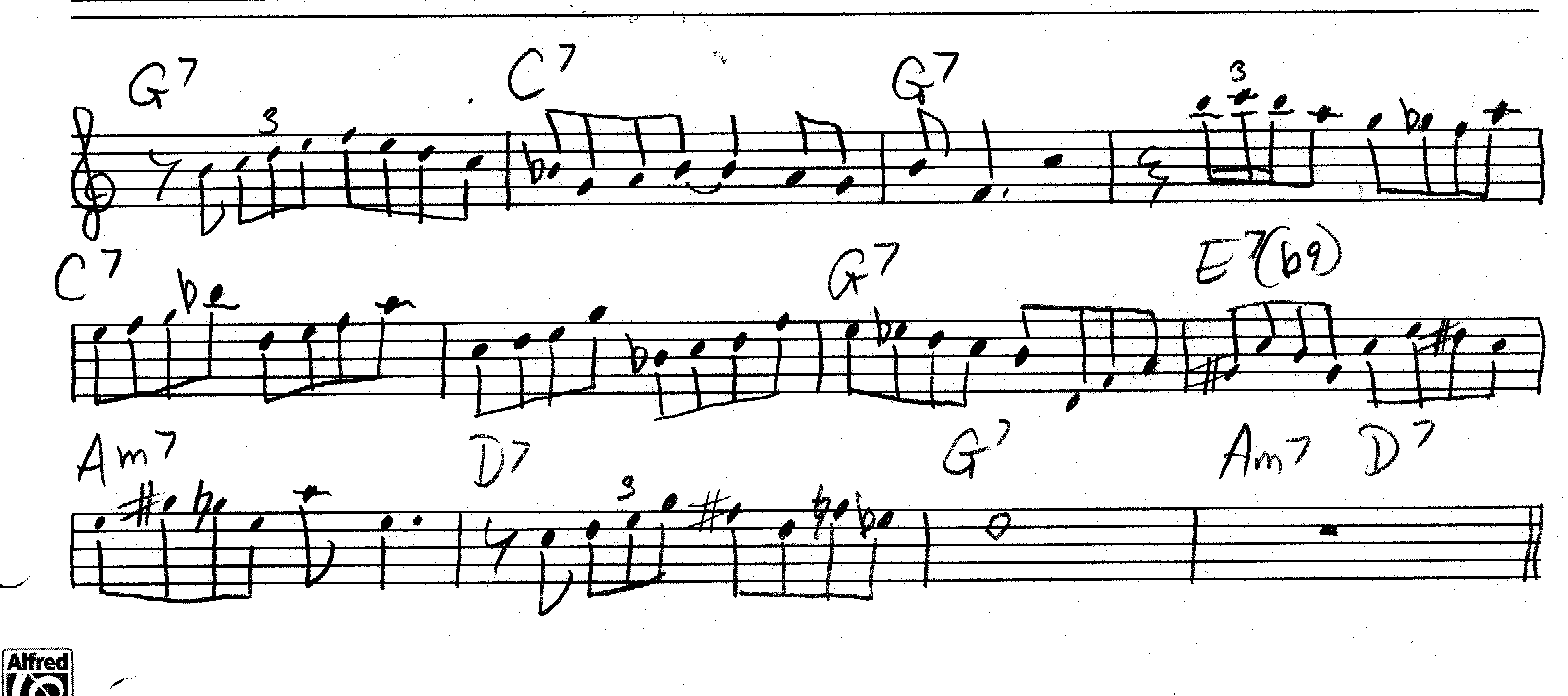
And now, assuming that you’ve done as I requested and acquired a foundational grasp of what sequence is and why it’s such a handy tool for the jazz musician, here’s the first exercise. It illustrates the concept of diatonic sequence. The sequence happens to move up by thirds starting on the chord tones of a C major 7, but it could just as easily move up or down by seconds, or fourths, or up and down at random intervals.

Diatonic Sequence

You could use the same pattern over a C7 by changing the note B to a Bb. But my point isn’t to show you how to outline a chord. It’s to demonstrate how the use of diatonic sequence provides a sense of logic and cohesiveness which you can use to advantage in improvising a jazz solo.

Sequence does such a good job at “making sense” of an idea that you don’t even have to play in key to sound good. In fact, “wrong notes” can sound very cool when you play them as part of a sequence. The temporary harmonic clash creates color and interest.

Sequentially mirroring an idea exactly, interval for interval, is one way to quickly slip out of key, letting the weight of the sequence rather than harmonic agreement justify the use of individually questionable tones. In the following example, root movement descends by major thirds.

Notice that the idea resolves to a chord tone. It’s cool to take your listeners for a temporary excursion into outer space, but you generally want to bring them back to planet earth again with a healthy dose of consonance.

Exact Repetion

Again, the movement downward by major thirds is just one possibility.

You can add further interest by shifting the rhythm of a sequence. The following shows the same sequence as above, but the six-note pattern is now imposed on a 4/4 setting rather than 3/4. I’ve marked the separations between each group of notes in the sequence.

Exact Repetition with Syncopation

Note that I’ve used the sequence over a different chord, an F#+7(#9), another nice application for the augmented sound implied by the major third root movement.

Finally, here is a twelve-bar blues to illustrate the use of sequence in an actual jazz solo. The ideas may seem a bit forced, but they give you a feel for how both diatonic sequence and exact repetition might be applied in an improvisation.

sequenceblues

The above illustrations just touch on the myriad creative and highly personal ways that sequence can be used in jazz solos. To recap: sequence can help you organize musical material in a way that creates cohesiveness and momentum, and that gives “wrong notes” a powerful sense of rightness when you want to play outside the changes.

Like any other component of music, sequence needs to be used judiciously. The right amount adds spice; too much just sounds overdone and even boring. Listen to how the greats of jazz use sequence, work with it yourself, take risks, and let your ear be the judge. And need I say…have fun!

The Last Snows of Winter

As I begin this post, it’s snowing outside.

Spring has sprung, and it’s snowing.

All irony aside, there’s nothing particularly unusual about that this time of year. Late March through mid-April are prone to the residual effects of winter. Fuzzy catkins may cover the pussy willows in the marshes, skunk cabbages bloom in the swamps and wet woods, and robins pogo across the lawns in search of earthworms, but that doesn’t mean the snows are entirely done with us.

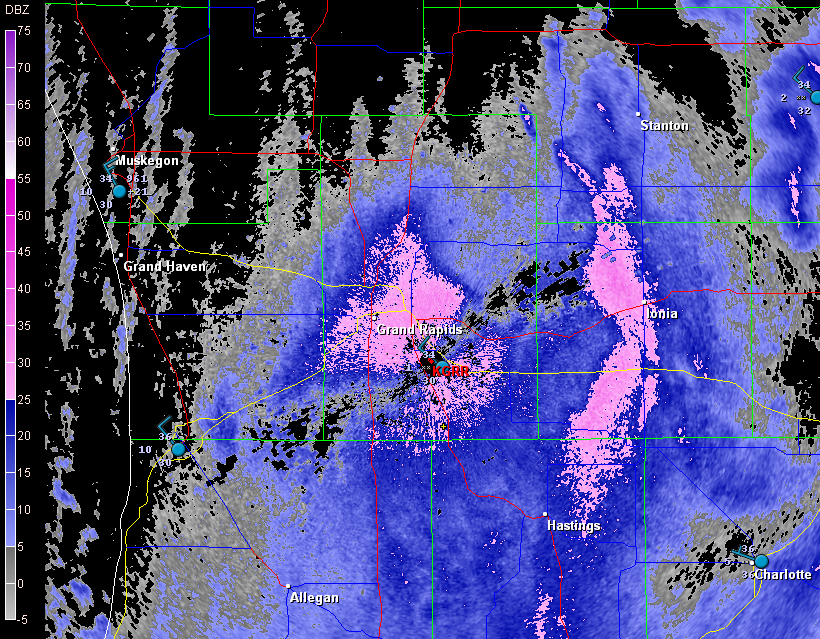
See for yourself. Here’s the radar for my area from just a few minutes ago.

GR2 radar scan shows a snowy afternoon in West Michigan.

GR2 radar scan shows a snowy afternoon in West Michigan.

I don’t mind. Even though the forecast through the week calls for colder temperatures and an occasional dusting of the white stuff, I know it’s all just transitory. We’ve already seen 70 degree temperatures and had our first lightning storm. Today is just winter being a poor loser.

Me, I’m looking ahead. The wildflowers and the weather systems are waking up together, and with the year’s first, shakedown storm chase in Tornado Alley already under my belt, I’m content in knowing that the main action is now mere weeks away.

Bring it on. I’m ready!

Using Sequence in Jazz Improvisation

Okay, campers, listen up: it’s time to talk about…

SEQUENCE.

Yes, sequence. A fundamental building block of music, and a very handy device in the improviser’s toolkit.

What is sequence? There’s nothing mysterious about it. Sequence is simply the repetition of a melodic idea beginning with different tones. Sequence can be diatonic within a key, and many scale exercises consist of scale material organized sequentially. Sequence can also be an exact, interval-for-interval repetition of a motif (or lick), which often–indeed, almost inevitably–will take you out of key.

The beauty of sequence lies in the coherency it brings to a solo. Sequence is a means of organizing melodic material in a way that the listener can immediately relate to. In the midst of a free-form flow of melody, sequence provides a sense of logic, a momentary theme for the ear to latch onto and follow through one or more permutations.

In its simple, diatonic form, sequence creates interest as you navigate your way through a single scale, chord, or ii-V7-I cadence. But sequence can also be used to take you out of key The strength of repetition has a way of making “wrong” notes sound right–a quality that becomes increasingly important when you’re playing tunes with little in the way of harmonic interest. When you’re in the midst of a two-chord jam, diatonic scales get boring pretty quickly. You’ve got to create energy. How? By using chromaticism–tones outside the key center that add color. Sequence is a great way to do so in an organized fashion.

Now, one picture is worth a thousand words, right? “Don’t tell me, show me,” is what you’re thinking. Relax. I’m not going to leave you hanging without a few examples. I’ll provide some material you can practice in an upcoming post. Right now, I just want to introduce the concept of sequence and whet your eagerness to get a few exercises under your fingers.

“But I want to start noooowwww!!!

Patience, Grasshopper. It’s Saturday afternoon, it’s spring, and I want to get out and enjoy the day. Stay tuned, though. I’ll be back with a few goodies. Promise.

Winter Has Ended. Welcome to the Spring!

In a few short hours, it will be spring. To be more precise, at 7:44 a.m. Eastern Time, the vernal equinox will occur. In a moment of time, the exact center of that enormous ball of gas we call the Sun will cross Earth’s equator, and in that second, winter 2009 will die and this year’s spring will be born.

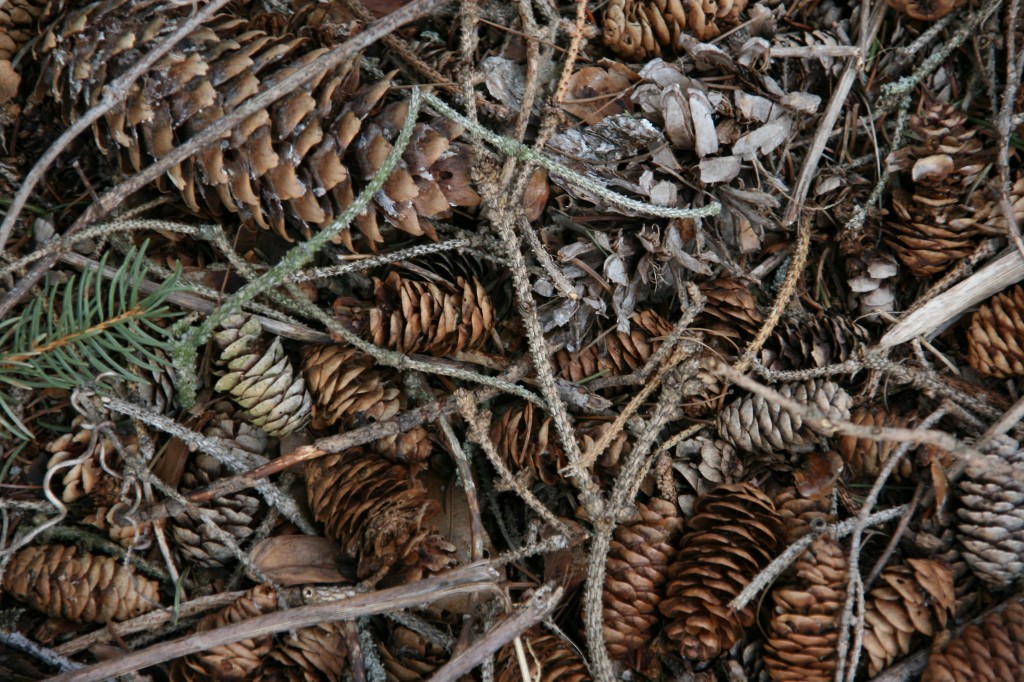
To celebrate, I thought I’d post a couple of photos. The first is of a medley of pine cones and twigs, artfully woven together by Mother Nature on a bed of needleleaf duff in a grove of evergreens. The forest floor can render some surprising and sublime collages; this one, covered by the snow until only recently, is one of the finest I’ve seen.

Pine cones turn the ground beneath an evergreen grove into a work of art at a roadside park near Ionia, Michigan.

Pine cones transform the floor of an evergreen grove into a work of art at a roadside park near Ionia, Michigan.

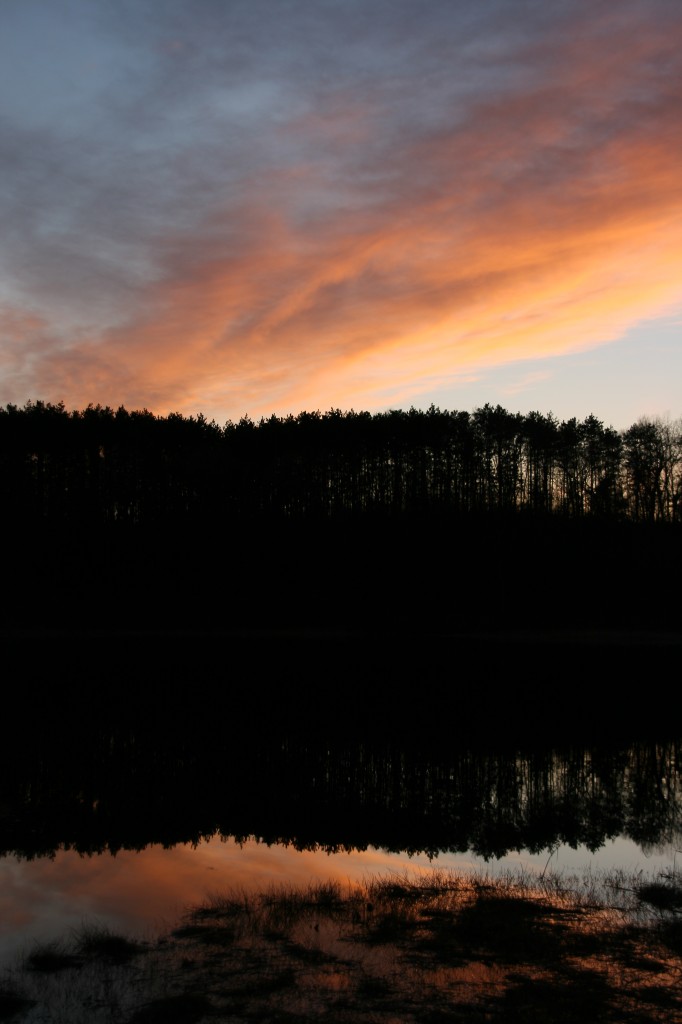
The following is a sunset image that I took Wednesday evening at Shaw Lake, just south of Middleville. The lake is surrounded by an incredible example of a rare wetland known as a prairie fen, inhabited by wild orchids and carnivorous plants. It’s an otherworldly place, truly beautiful, and unfortunately, also terribly abused by fishermen who have enough energy to bring in their bait containers, beer cans, and other trash, but evidently not enough muscle, brains, or strength of character to carry their empties out.

Excuse my mini-rant. The photo is of the next-to-last sunset of winter, 2009. It feels more like a sunrise in a sense, with its promise of lengthening days and the rebirth of the green months.

A plume of cirrus lights the sky at sunset at Shaw Lake in northern Barry County.

A plume of cirrus lights the sky at sunset at Shaw Lake in northern Barry County.

A Beautiful Day in Michigan

IT’SSPRINGIT’SSPRINGIT’SSPRING!!!

It’s SPRIIIIIIIINNNNGGGGG!!!!!

Okay, maybe it’s not quite spring officially–still another five days before the vernal equinox–but when I see skunk cabbages blooming in the swamps, then as far as I’m concerned, spring has arrived. Everything else is just a formality.

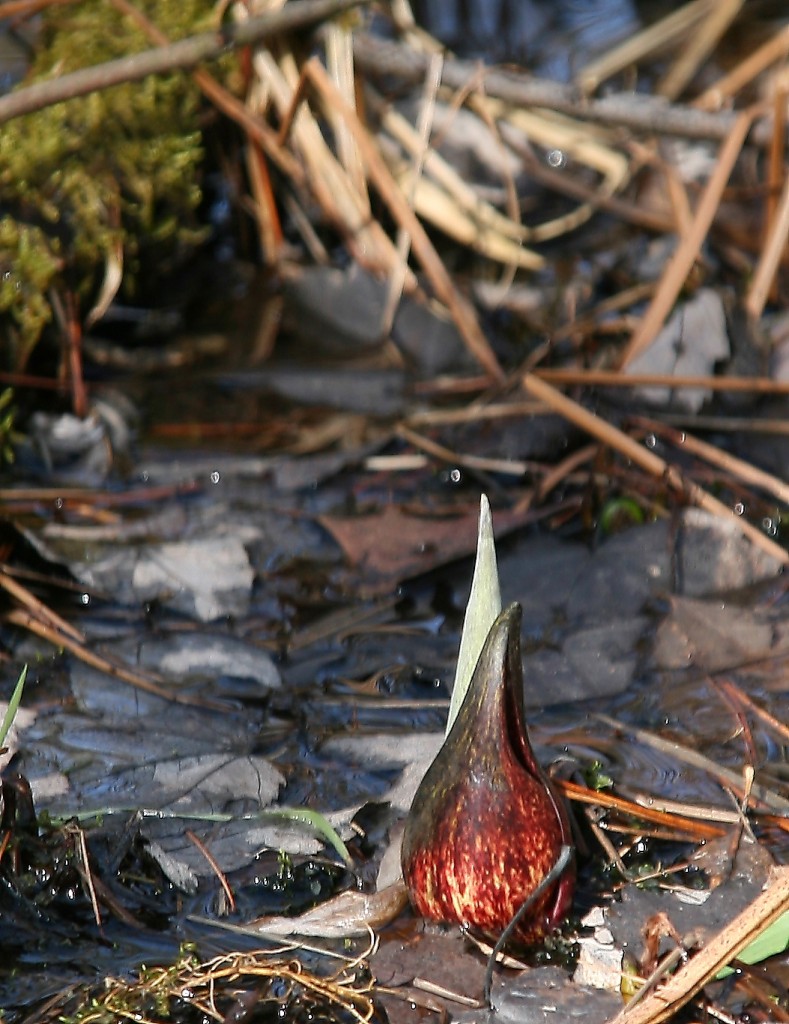
Skunk cabbage, earliest of the Michigan wildflowers

Skunk cabbage, earliest of the Michigan wildflowers.

With its odd-looking purple cowl shielding a flower spathe within, the skunk cabbage is nothing you’d want to put in a pot on the windowsill, but it’s nevertheless one of my favorite wildflowers. It’s a quirky little plant with plenty of character, plucky enough to lead the procession of the spring wildflowers in Michigan.

I came upon the one above while hiking a wetland trail in Yankee Springs the other day. The afternoon was beautiful, a bit chilly but on the leading edge of a warming trend that will put the temperatures into the fifties by today and as high as sixty degrees by Tuesday.

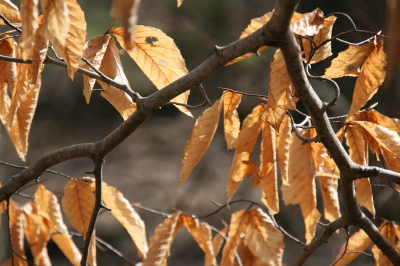
On a broad, blue day filled with the promise of warmer seasons to come, even last year’s vanishing remnants were transfigured by the sun. A bough of old beech leaves hung like Japanese lanterns in a shaft of sunlight.

Old beech tree leaves catch the sunlight.

Old beech tree leaves catch the sun.

Of course “the kids”–my collection of carnivorous plants–are out on the deck. I removed them from the refrigerator three weeks ago to boot them out of hibernation, and they have responded with a vigorous rush of flowers and leaves. The Venus flytraps are now open for business, and the Sarracenia oreophila isn’t far behind, with an exuberant array of young traps already ten inches tall and nearing the point when they’ll pop open.

White mold wiped out most of my flytrap seedlings during the winter, but a good hundred or so have survived. It’ll be interesting to see how much they increase in size this growing season.

All that to say…YAHOO!!! It’s SPRIIINNNGGG!!! Maybe not by the calendar, not quite yet, but don’t tell that to the robins because they don’t care, and neither do I. Just take a walk in the woods and you’ll know. Spring is here at last.