So Much for Thursday in Illinois

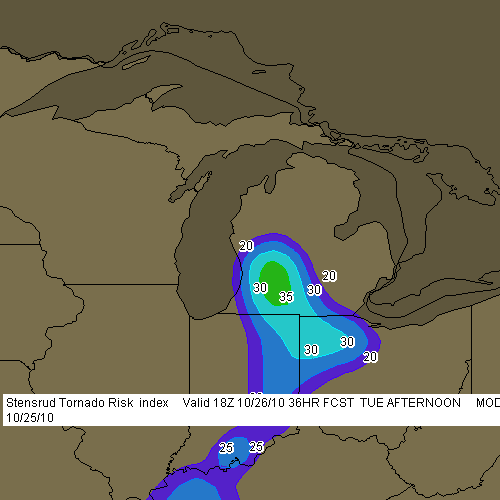
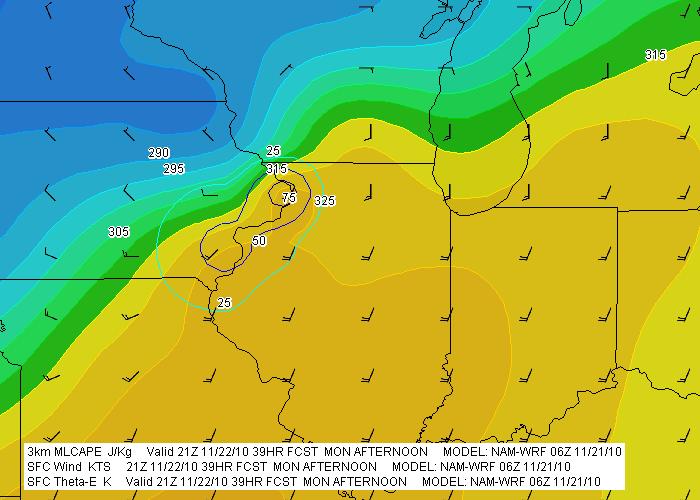
I was hoping, really hoping, that this Thursday would shape up as my first chase day of the year out in Illinois. The NAM sure looked promising for a second, but now, like Dante’s inferno, it has “Abandon all hope, ye who enter here” written over the door.

The GFS was never very positive to begin with, but at this time of year, Great Lakes chasers are optimistic out of sheer desperation, and I guess I wasn’t the only one who was rooting for the NAM with its bullish CAPE of up to 1,500 j/kg and sweet lapse rates.

But it’s gone, all gone. Yesterdays NAM runs weakened the CAPE and shuttled it south and east. A nice cold core setup in southeast Iowa/northwest Illinois materialized long enough to whisper sweet nothings, but nothings are probably all they were. The 500 mb low has since slunk apologetically back west toward Kansas City, with its -25 C temperature minimum well displaced from the surface moisture lobe. The setup could still change, but unless it bumps back east and stacks back up, I’m not going to drive that far to find out.

I will, however, very likely head toward the Michigan border around New Buffalo. Moisture looks to be ample with mid- to upper-50s dewpoints augmented by evaporation, backed surface winds, and precip breaking out by 21Z if this present NAM verifies. If it does, there could be a bit of lightning and thunder, and at least the slim possibility of a brief spin-up; if not, it’ll have been a pleasant break-in drive for chase season 2010.
El Nino and a Delayed 2010 Storm Season

Back in December I wrote a post speculating how El Nino might affect the moisture fetch from the Gulf of Mexico. I wrote as a non-expert, which is always my position regarding weather related stuff, but it appears that my concern about the influence of cooler sea surface temperatures on return flow actually held water.

Tornado season normally begins ramping up in Dixie Alley in February, solidifies in March, peaks in April, then begins to decline in May as the action moves west and north toward traditional Tornado Alley.

Last year the tornado total for February, 2009, was 43. It consisted of six tornado days, two of which were outbreaks of 12 and 21 tornadoes.

This year, the tally for February was a statistically unprecedented zero. That’s no, nada, zippo tornadoes at all last month. Instead, the South experienced record-breaking cold weather, with snow in virtually all of the southern states and a series of brutal winter storms lashing Oklahoma, Texas, and parts of Dixie Alley.

Now we’re into March, and the snow seems to finally be behind us. As I sit here writing, I can look out the sliding doors of my apartment at a beautiful day with temperatures climbing into the mid forties. I’ll take that with a smile, along with the warming trend that’s in store for this coming week here in West Michigan. But at the same time, sampling buoys across the Gulf of Mexico, I see water temperatures in the low to mid fifties and some really horrible dewpoints. It looks a lot like what the ENSO sea surface temperature table has predicted, namely, cooler-than-average temperatures.

We’re presently looking at  systems moving through the Plains that might be tornado breeders if they weren’t starved for moisture. It’s hard to get excited about dewpoints that barely scrape into the low to mid fifties pretty much everywhere except waaay down in southern Texas and Louisiana.

no images were found

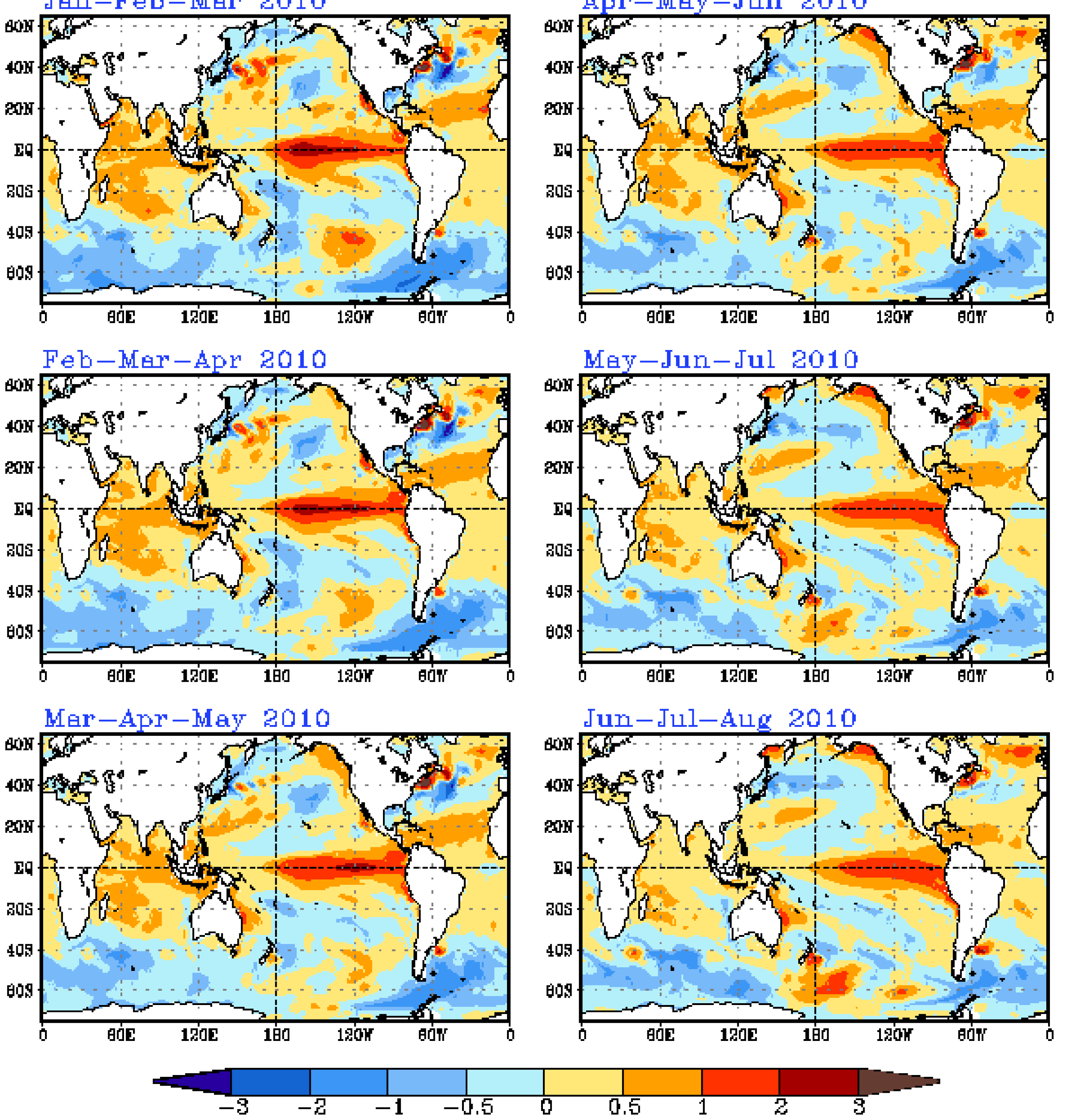
Okay, it’s only March. What’s a bit scary is to think that the Gulf may not be up to snuff till as late as May. Click on this image of the Climate Prediction Center”s ENSO sea surface temperature anomaly forecast, updated March 1, and you’ll see what I’m talking about. The first two tables are the ones you want to pay attention to. That blue in the Gulf of Mexico doesn’t look too promising.

I hope I’m wrong, and it could be that I am. A quick glance at water temperatures west of the Florida peninsula shows some temps into the seventies well out into the Gulf, so maybe things will pick up more quickly than the map suggests. The ENSO update does indicate that El Nino is weakening:

•A majority of the models indicate that the Niño-3.4 temperature departures will gradually decrease at least into the summer.

•The models are split with the majority indicating ENSO-neutral conditions by May-July 2010 and persisting into the Fall. Several models also suggest the potential of continued El Niño conditions or the development of La Niña conditions during the Fall.

–Page 27, March 1, 2010, CPC-NCEP ENSO Update

That’s a good sign, kind of. The last part leaves us hanging, but as always, time will tell.

More immediately, I wonder, as I did three months ago, whether we won’t see a delayed storm season. I think, I hope, that when it does finally arrive, it will be a stellar one.  There’s reason to be hopeful, considering the ample ground moisture available for evapotranspiration throughout Tornado Alley, including areas that languished last year under a severe drought. No such problem this year. I hear some chasers talking about West Texas, and I’ll bet they’re right. Once the Gulf finally does set up shop, whether sooner or later, I expect to be making some trips out west. See y’all at the edge of the meso.

1965 Palm Sunday Tornadoes: Great Forecasting, Poor Warning Infrastructure

The death toll for the historic 1965 Palm Sunday Outbreak varies depending on your source, but the number 271 packs the authority of a U. S. Weather Bureau survey submitted by a five-man team to Dr. Robert White, the chief of the bureau, just three weeks after the disaster. Add to it one known casualty from Iowa who lingered until after the report was released before succumbing to his wounds, and 272 is a reasonable tally.

However many deaths were in fact attributable to the Palm Sunday Tornadoes, the bottom line is, a shocking number of people perished in the 20th century’s second-worst tornado outbreak.

Why? Certainly there was no fault with the forecasting, which was as spot-on as you could possibly hope for, even without the benefit of all the severe weather parameters that exist today.

The research team appointed by Chief White asked that same question: what was the breakdown? Three weeks after conducting extensive surveys through the tornado-stricken six-state region, they had answers, and recommendations to accompany them that have shaped the course of both tornado research and operational forecasting.

The Weather Bureau Survey Team Report of Palm Sunday Tornadoes of 1965 is fascinating in a number of respects, not the least being the fact that in it, one can see the shape of things to come. Striking as well, amid the overall commendable efforts on the part of the various weather bureaus to warn the public, were a few notable communication disconnects. The report shows that the first two tornadoes of the outbreak struck at about the same time, 12:45 CST, in eastern Iowa. The first warning wasn’t issued until 1:00, fifteen minutes later.

In West Michigan, the Alpine Avenue F4 tornado in northwest Grand Rapids, which leveled the Swan Inn and tracked as far as Rockford, struck at the same time that the first warning was issued. Ditto for the town of Burnips, located fifteen miles southwest of Grand Rapids. Residents in the beginning paths of these tornadoes had zero lead time. Two hours later to the east, in similar fashion, Radnor, Ohio, received its warning at the same time that a tornado was tearing its way through town. As for Marion, Indiana, seven minutes advance notice was probably very little better than nothing.

Remember, in those days, civil defense sirens weren’t sounded during tornado warnings in Great Lakes communities. The only means of alerting the public to imminent danger was radio and TV, and those depended, of course, on people being tuned in to them.

The long and short of it is, the warning system back then was nothing like what we have today. We’ve come a tremendously long way in 45 years. Many of the strides we’ve taken were first set in motion by the research and recommendations of the Palm Sunday Outbreak survey team. If anything good can be said about the mayhem of that dark April evening, it is that out of its tragic losses arose advances in the public warning system that continue to do a marvelously effective job of saving lives today.

Ongoing Severe Weather in Dixie Alley

Looks like that surface low I wrote about a few posts ago is delivering its payload to Dixie Alley. Yesterday tornadoes spun down in northeast Texas and Louisiana, and now today it appears that the action will continue farther east.

I can’t help feeling a bit smug about the forecast and target area I sent to my chase partner, Bill Oosterbaan, who I believe has been down in Kentucky on business. After doing a quick-‘n-dirty scan of various NAM parameters and model soundings, I emailed him that he might have a crack at some action along I-40 between Jackson and Nashville, Tennessee.

With the 1630 SWODY1 now in, I see that my target area is in the heart of the SPC’s 5 percent tornado outlook. Tennessee may be under the gun in a while. Sure hope Bill is in a position to take advantage of the new year’s first chase opportunity.

Dixie Alley: Are Storms on the Menu for Late Next Week?

Just as I was preparing maps for a blog post on the possibility for severe weather in Dixie Alley next weekend, I got a call from my brother Pat in Port Townsend, Washington. Was I aware of the deep low off the northwest coast, he wondered? A local meteorologist named Cliff Mass had been talking about it and posting about it in his blog. Today he opened with the following:

The new high resolution forecasts (4km grid spacing, initialed 4 AM) are in and the potential for a significant coastal wind event remains. Here are two plots of sea level pressure and surface wind speed for 4PM, 10 PM, and 4 AM, starting on Sunday afternoon. A deep low center moves up the coast and sustained winds on the coast are 45-50 kts. Gusts could easily be 15-20 kts higher.

The Sunday 00Z NAM shows a persistent surface low bottoming out at 974 millibars, with some mighty tight isobars there along the coast. All I can think is, dang! There’s a wind machine, if you please. But that’s just for starters. The GFS shows the low deepening to 958 mbs late Tuesday night. By Wednesday, lower pressure is invading much of the west, and the scenario for Friday, Saturday, and Sunday across Dixie Alley begins to shape up.

no images were found

That was really what I was going to write about. Please don’t preach to me about long-range models and wishcasting. Of course I know it’s nothing but wishcasting right now. In the middle of January, can you blame me? And anyway, there’s at least some consistency established in depicting a walloping low moving into the Central Plains and then on up toward the Great Lakes. That much looks good.

.

no images were found

But what about moisture and instability? Heck, I don’t know, and right now I don’t care. Give it five days and let’s see what happens. It’s enough at this point to have something to keep an eye on. Here are some 18Z maps to ponder. Click on them to enlarge them.

no images were found

How Will El Nino Affect the Tornado Season in 2010?

Have you wondered what ramifications this present El Nino has for the 2010 tornado season? I have. At first I was excited to think of all that winter precip bringing relief to the parched South, removing drought from the equation and enhancing the moisture fetch in the spring. Now, however, I’m wondering whether that advantage won’t be offset by other concerns.

Not being a climatologist, or even modestly astute in matters of climatology, the best I can do is speculate, and my speculation is probably fraught with misinformation (aka bullcrap). Nevertheless, after looking at the Climate Prediction Center’s December 21 update of their ENSO report, I can’t help trying to make some sense of it as it pertains to storm chasing.

The report makes it clear that the present El Nino is intensifying, with sea surface temperatures (SSTs) now averaging 1.2 C above normal in the eastern Pacific.

no images were found

The six charts on page 28 of the report depicting projected sea surface temperatures caught my eye. I’ve included them here. Click on the image on the right to enlarge it.

As you read the charts, notice the following:
* Panels 3 and 4 (March-May and April-June) show above-average SSTs in the eastern Pacific, pooling significantly off of Baja.
* Slightly lower-than-average SSTs preside in most of the GOM.
* Panel 5 (May-July) shows warmer temperatures finally moving toward the coast of the GOM.
* With the June-August map, the GOM seems to be in good shape, and the SST anomaly off of Baja appears to be modifying.

What I make of this picture is that subtropical moisture from the southwest (i.e. the subtropical jet) may play a bigger-than-usual role in the springtime weather, while Gulf moisture return may be delayed. That’s not a very promising scenario for this coming storm season.

Again, I am NOT a climatologist, and all of the above is just my clumsy attempt to piece together stuff I’m aware of but don’t really understand. So chances are good that my reasoning is out in left field, and if that’s the case, then more knowledgeable heads than mine are free to correct me. I’m not attempting to make a long-term prognosis here so much as I’m simply processing information, trying to understand the big picture.

I’ve already posted on this topic in Stormtrack, in the hope of generating some discussion and gaining insight into the matter. If I glean some gems of wisdom, then a follow-up post here on Stormhorn.com  may be in order. For that matter, if you’ve got a better handle on the picture than I do, then please comment here and and set me straight. Believe me, I won’t mind being wrong.

Forecast Model Simulations for 1965 Palm Sunday Tornadoes: Part 2

The drive down to the WFO at State College, Pennsylvania, was well worth my while (see my previous post). Operational forecaster and research meteorologist David Beachler was a pleasure to work with–personable, patient, and eager to help me understand the exhaustive forecast simulations he had produced on the 1965 Palm Sunday Tornadoes. Having pored over the data with David, gaining his insights on its strengths and weaknesses, I am now extremely excited about what I’ve got on my hands.

David’s modeling uses the WRF-ARW 40 km. The resolution is too coarse to offer the fine details that the SPC is capable of producing, but it gives an excellent overall feel of what forecasters and storm chasers might see in the models if the Palm Sunday synoptic setup were to unfold today instead of forty-five years ago in 1965.

no images were found

There’s no way I can begin to cover all the material, which in any case I need to sift through in order to put together a reasonably concise and meaningful scenario. But I can at least give you a sample of some of the stuff I’ve got to work with. Click on the following images to enlarge them.

First, here is a hand analysis of the kind that is accessible to anyone through NOAA’s historical daily weather maps archives. Besides the surface map for April 11, 1965, you also get the previous day’s surface map, 500 mb chart, and other info. It’s what you would have encountered when you turned to the weather page in the newspaper that morning.

What you would never have seen–because parameters such as CAPE, CIN, helicity, and so on didn’t exist back then, and because even if they had existed, the forecast models which could have depicted them were still years down the road–is this map showing SBCAPE and low-level shear.

The map is for 2200Z, or 6 p.m. EST–roughly the time at which tornadoes began moving through northern Indiana.

It gets even better. Here is a model sounding for KGRR, also at 2200Z, using WRF-ARW Bufkit data. The skew-T and hodograph depict the conditions that were shaping up to produce the F4 Alpine Avenue tornado that formed

around 6:50 p.m., as well as other tornadoes in west and southwest Michigan that day. The helicity is impressive–and look at those winds! Forty knots at 850 millibars is no mere puff of air.

What really excites me is that, using RAOB’s cross-section feature, I should be able to reconstruct a vertical profile of the atmosphere for the entire outbreak area. I’m not sure how deeply I want to go with that, but I have the capacity.

Bear in mind that I’m just showing a couple of representative glimpses derived from a 00Z, day-one model initiation. In fact, David provided me with a range of initiation times that allows me to get a good sense of how the maps might have progressed from several days prior to the actual tornado outbreak.

In practical terms, the maps and model sounding data I’ve got correlate to the NAM. They’re not the NAM, but for storm chasers who typically work with the GFS, ECMWF, GEM, NAM, and RUC, what you see here is probably closest to what you’d find using the North American Mesoscale Model.

That’s all for now. This has been a time-consuming post, and at 2:30 in the afternoon, I need to pull away from it so I can bathe and eat. I didn’t arrive home until 3:00 a.m., so it’s time for this road warrior to reset his time clock and get on with the rest of life.

Forecast Model Simulations for 1965 Palm Sunday Tornadoes: Part 1

Today I’m making the trip to State College, Pennsylvania, where I’ll be overnighting and then meeting tomorrow with operational and research meteorologist David Beachler at the CCX National Weather Service office.

Earlier this year–thanks to John Laurens at KGRR, who contacted him on my behalf–David took such forecasting data as exists on the 1965 Palm Sunday Tornadoes and ran it through a computer. (That’s putting it quite simply, I’m sure.) The result is a veritable blizzard of hourly model simulations which I’m hoping to narrow down to something that can give me new insights into the second worst Great Lakes/Midwest tornado outbreak of modern times. If all goes well, one of the results well be an engaging scenario for the storm chasing community.

Of course, a project of this nature will take some refining. The first hurdle is my own ignorance as a non-meteorologist. It’s one thing for a layman like me to use forecast models in identifying target areas for storm chases; it’s another thing to understand the whys and wherefores of those models.

A second challenge is to sift through the accuracy of the data, since we’re talking about a massive amount of extrapolation from a paucity of decades-old source material; and a third is to distill the immensity of info that David has provided into a reasonably straightforward, meaningful synopsis.

What I’m hoping for, in the end, is a series of surface and upper-air charts that can answer the question, “If the same synoptic conditions that produced the Palm Sunday Tornadoes unfolded today, what might we see in the models from a few days out until the time when tornadoes started dropping?”

This project has been in the wings for a while as part of a larger project which I’m keeping mum about for now. I want to get this part taken care of first, and I’m excited that I’m finally getting to meet with David and go over the data with him, so I can better understand how to interpret it and narrow down a selection from it that will be most useful. I’m extremely appreciative of David’s work, and his willingness to help me sift through it.

Gotta go. I need to hit the road in a couple hours. Here’s hoping for good driving.

Subscribe to Stormhorn.com!

Pause a second and look to your right at the top of the sidebar. Notice anything different?

That’s right! Now you can get my latest blog posts on Stormhorn.com delivered right to your front door (or, more precisely, your inbox). All you have to do is subscribe to your choice of either RSS feed or email. So if you’ve found my meanderings on the topics of jazz and storm chasing enjoyable and perhaps even helpful, then I hope you’ll sign up.

And to sweeten the deal, here are some of the FABULOUS PRIZES that YOU could win just for subscribing to my Stormhorn.com blog:

* XXXX          * ?????          * !!!!!          * @&%#!!!

Right, there are no fabulous prizes. There is, however, plenty to hold your interest if you’re a storm chaser, a weather nut, a saxophonist, a jazz musician, or just someone who enjoys a good read. If that appeals to you, then please take a moment to subscribe.

Thanks!

Bob

What Storm Chasers Do During the Off Season

What do storm chasers do when there’s nothing to chase? Watch the “Storm Chasers” series on Discovery Channel.

Of course I don’t speak for all storm chasers. But a good number of you, like Tom, Bill, and me, have been parked in front of your televisions on Sunday nights, watching Reed dominate, Tim deploy turtles, and Sean wipe his face in frustration. Once a week, we all get to vicariously relive this year’s chase season–the storms we got, the storms we failed to get, the days we wished we had chased, the days we’re glad we didn’t.

Here are some photos of me droogs that I took during last night’s “Storm Chasers” session. Just a nice, pleasant evening of buddies, beer, pumpkin pie, and tornadoes. Bill supplied the pie

and I brought the Golden Monkey, a Belgian trippel whose potency I had forgotten but swiftly recalled. It’s one of those beers where, once it gets a hold of you, the best thing you can say is as little as possible. Just shut up and enjoy the show. Last night’s was great. Next week’s, featuring the Aurora, Nebraska, tornado, looks to be awesome.

Once the series winds down, whatever shall we do? View old tornado DVDs and mutter a lot, I suppose. Think thoughts like, “Only 120 days till April.” Stay away from sharp objects. Or, if you’re like Mike Kovalchick who just looooooves winter, hope for a good blizzard so you can go chase thundersnow.

Mike is probably onto something. It beats sitting in a dark corner cutting out paper dolls with a blunt-nosed scissors. Or maybe not. I may give the doll thing a try once the snows roll in.