Highlights of the 1965 Palm Sunday Tornado Memorial in Bristol, Indiana

Yesterday I made the drive to the Elkhart County Historical Museum in Bristol, Indiana, to attend the forty-fourth memorial observance of the 1965 Palm Sunday Tornadoes. The occasion may have been low-key, but it was nevertheless remarkable. A couple of the factors that made it so were purely personal. I finally got to meet my long-distance friend and owner of the Tornado Memorial Park in nearby Dunlap, Debbie Watters. We’ve connected so well across the miles via email that when we finally got to talk person to person, it was as natural as if we’d hung out together forever. It was a double pleasure to meet her daughter and husband as well.

Then there was my other “tornado lady” friend, Pat McIntosh, who attended the meeting with her brother, John. What a sweetie! The three of us caught dinner afterward near Middlebury.

The stories and memories were amazing, and some quite touching and emotional. One huge highlight for me is captured in the photos below. In the first photo, the image shown on the projector screen depicts the notorious twin funnels that swept through the Midway Trailer Park south of Dunlap, Indiana. The image is one of the most famous tornado photographs ever taken, and the man standing next to it is the person who took it, retired Elkhart Truth newspaper photographer Paul Huffman.
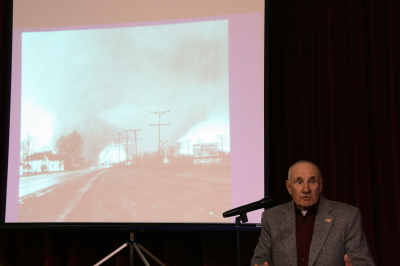
Paul Huffman stands next to a projection of his Pulitzer Award-winning photo of the Midway twin funnels.

Paul Huffman stands next to a projection of his Pulitzer Award-winning photo of the Midway twin funnels.

Paul and his wife were traveling north on US 33 shortly after 6:00 p.m. on April 11, 1965, when they spotted the tornado moving in from the southwest. Stopping the car, Paul grabbed his camera and snapped a series of six dramatic photographs as the tornado morphed from a narrow funnel into the two-legged monster that devastated the hapless trailer court, then moved off to the northeast in a cloak of rain.

How fast was the tornado moving, I wanted to know. Fast, Paul said. Probably seventy miles an hour. How close was he, someone else asked. Around a quarter-mile. Were he and his wife at all close to the debris? An ironic smile. Yes, his wife replied, the two of them experienced some debris falling around them. Would a flattened automobile qualify?

Paul Huffman speaks at the 2008 memorial observation of the 1965 Palm Sunday Tornadoes.

Paul Huffman speaks at the 2008 memorial observance of the 1965 Palm Sunday Tornadoes.

One powerful moment occurred after the event had officially ended and people were milling around the tables full of memorabilia. My friend Pat was showing me a photo Paul had taken during rescue operations at the trailer court. In the photo was a young Pat, laying on a stretcher. Over her hovered her husband, Bill. To the right stood a fireman.

As we looked at the photo, an elderly gentleman standing nearby named Dwight Kime said, “That fireman was my brother-in-law.” Dwight himself had been one of the rescue workers. As it turned out, he was the one who found Pat and Bill’s baby, Chris, amid the rubble–one of the youngest of the ten fatalities in the trailer court. Dwight was visibly moved as he came to understand that Pat had been the child’s mother. It has been forty-four years since that terrible evening, but the memories–and the hidden sadness–never fade. I am glad that Pat’s little boy was found and cared for in death by such a tenderhearted man as Dwight Kime. And I am just as glad that, after all these years, he and Pat got to meet and talk at last. That is God’s grace.
Of Sax Practice and Railroad Tracks

I just returned from a nice, two-hour saxophone practice session out by the railroad tracks.

The railroad tracks?

Oh, I guess I haven’t told you about my practice habits. They have as much to do with where I practice as what I practice.

Living in an apartment, I try to be considerate of my neighbors. I like to think that they’d enjoy my music, but realistically, there’s only so much that even the most ardent jazz lovers can take of listening to the same licks, patterns, and scales repeated ad nauseum, blaring down the hallway and through the walls. So for years, my practice room has been my car. My routine has consisted of driving to the outbacks of Kent County and parking at various locations along the CSX tracks between Kentwood and Lansing, where I practice my horn and watch for the trains to roll by.

I love trains. Obviously, I also love playing my sax. It’s nice to be able to combine those two interests in a productive way. Tonight, as I do so often, I parked at one of my favorite trackside spots near a small community called, appropriately, Alto. I didn’t see any trains, but I had a most productive practice hashing out some diminished and diminished/whole tone licks, and woodshedding the Charlie Parker tune “Ornithology” in several keys.

I always return feeling good about my playing after a session like tonight’s. The time goes so fast! And that’s as it should be.

The best way to make a living is to earn money doing things we’d pay money to do. Playing the sax is one of those things. I can’t say I make a living at it, but it certainly supplements my cash flow; it’s part of the picture of my livelihood. I’ve been at it a long time now, and most of that time I’ve been practicing in my car by the tracks–or, during the warm months, often outdoors. If I ever do buy a house and gain an honest-to-goodness practice room of my own, I think I will still maintain my railroad track sessions. I’d miss them far too much not to. Habits are hard to break, and there’s no reason to break a good one in the first place.

Storm Chasing Selectivity (aka Impulse Control, aka Curbing the Impulse to Chase Any and Every Dumb System That Comes Down the Pike)

If the developmental curve of storm chasing is analogous to the seasons of life, then I think I’ve moved out of adolescence into young adulthood. Just as testosterone-driven impulses become tempered with knowledge and experience as callow youth transitions into maturity, so do idiotic, desperate, SDS-and-adrenaline-fueled urges to chase at the drop of a hat become balanced by an awareness of how stupid it is to waste time and gas driving hundreds of miles in pursuit of borderline scenarios.

Living in Michigan carries a steeper price tag than living in Kansas or even Iowa when it comes to busted chases. I can’t afford not to be selective, and I think I’ve finally internalized that lesson. As this year’s convective weather season has begun to ramp up, so far my greatest attainment hasn’t been successful chases, but rather, my refusal to get pulled into 2,000-mile excursions this early in the year.

Dixie Alley has had its moments, but so far they’ve been nothing like 2008. Tornado Alley has also offered a few setups, even one or two moderate risks, but I’ve been content to follow them at home on the radar, and I’ve been glad I did. If I lived in Oklahoma, I’d have been on them in a heartbeat. But when the party’s over and you live in Michigan–well, it had better have been a darned good party, because it’s a long drive home.

True, I chased at the beginning of this month in Kansas and Oklahoma. But I was already in the neighborhood, so to speak, and the chase opportunities were just frosting on the cake. I was happy with the Hutchinson, KS, action on March 7, but I probably wouldn’t have gone after it if I’d had to travel 800 miles to see it instead of simply heading north up I-35 from Norman.

Until last year, my chases have largely been event-driven. A system would move in and my buddy Bill, or Kurt, or Tom, and I would head out to Illinois, or Iowa, or Kansas, Nebraska, or Texas, or wherever, and chase it.  Last May was the first time I’ve spent more than three days out west. The logistics were different and definitely superior, and a change in my life circumstances–i.e. getting “restructured” with a decent severance, and starting my own business as a freelance writter–allowed me to tap into them.

This year I hope to spend even more time out on the Great Plains. The nature of my profession allows me that flexibility, and I love it.  This may be the year when I finally take a ten-day chase vacation and conduct my business out on the road.

I hope so. It’s been a long winter, I’ve waited a long time, and I’ve been very patient.

And now I’m itching to see some tornadoes.

The Last Snows of Winter

As I begin this post, it’s snowing outside.

Spring has sprung, and it’s snowing.

All irony aside, there’s nothing particularly unusual about that this time of year. Late March through mid-April are prone to the residual effects of winter. Fuzzy catkins may cover the pussy willows in the marshes, skunk cabbages bloom in the swamps and wet woods, and robins pogo across the lawns in search of earthworms, but that doesn’t mean the snows are entirely done with us.

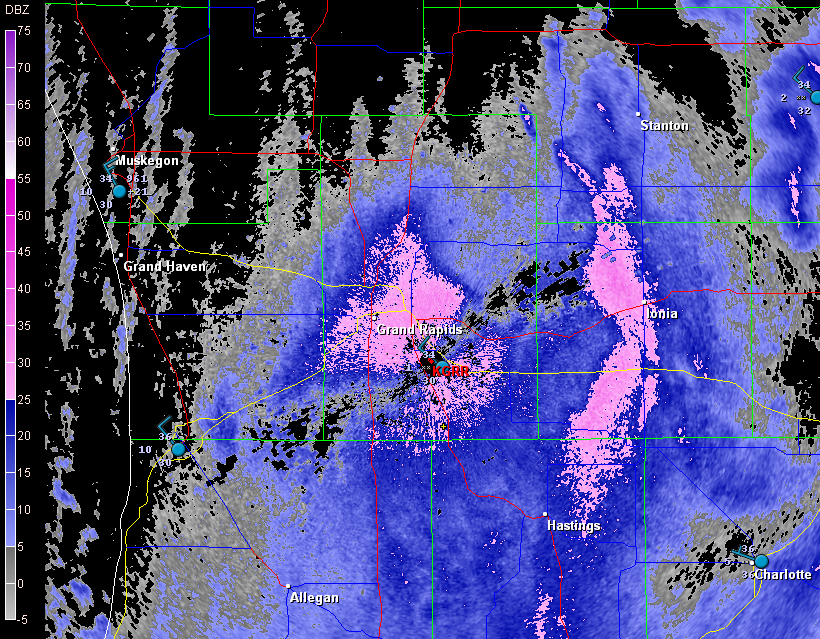
See for yourself. Here’s the radar for my area from just a few minutes ago.

GR2 radar scan shows a snowy afternoon in West Michigan.

GR2 radar scan shows a snowy afternoon in West Michigan.

I don’t mind. Even though the forecast through the week calls for colder temperatures and an occasional dusting of the white stuff, I know it’s all just transitory. We’ve already seen 70 degree temperatures and had our first lightning storm. Today is just winter being a poor loser.

Me, I’m looking ahead. The wildflowers and the weather systems are waking up together, and with the year’s first, shakedown storm chase in Tornado Alley already under my belt, I’m content in knowing that the main action is now mere weeks away.

Bring it on. I’m ready!

Winter Has Ended. Welcome to the Spring!

In a few short hours, it will be spring. To be more precise, at 7:44 a.m. Eastern Time, the vernal equinox will occur. In a moment of time, the exact center of that enormous ball of gas we call the Sun will cross Earth’s equator, and in that second, winter 2009 will die and this year’s spring will be born.

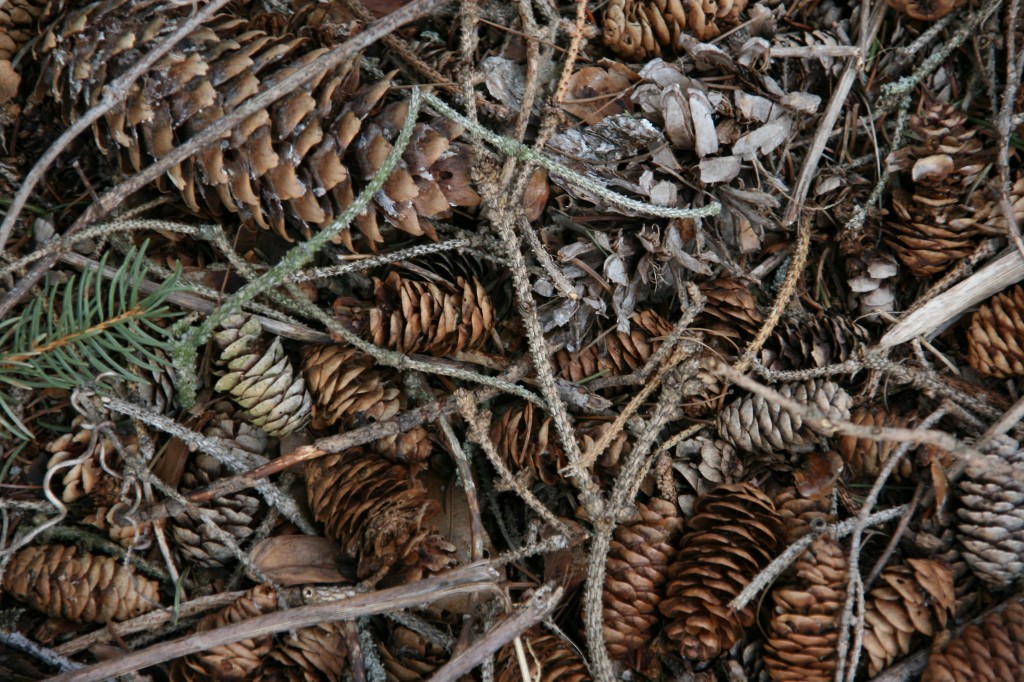
To celebrate, I thought I’d post a couple of photos. The first is of a medley of pine cones and twigs, artfully woven together by Mother Nature on a bed of needleleaf duff in a grove of evergreens. The forest floor can render some surprising and sublime collages; this one, covered by the snow until only recently, is one of the finest I’ve seen.

Pine cones turn the ground beneath an evergreen grove into a work of art at a roadside park near Ionia, Michigan.

Pine cones transform the floor of an evergreen grove into a work of art at a roadside park near Ionia, Michigan.

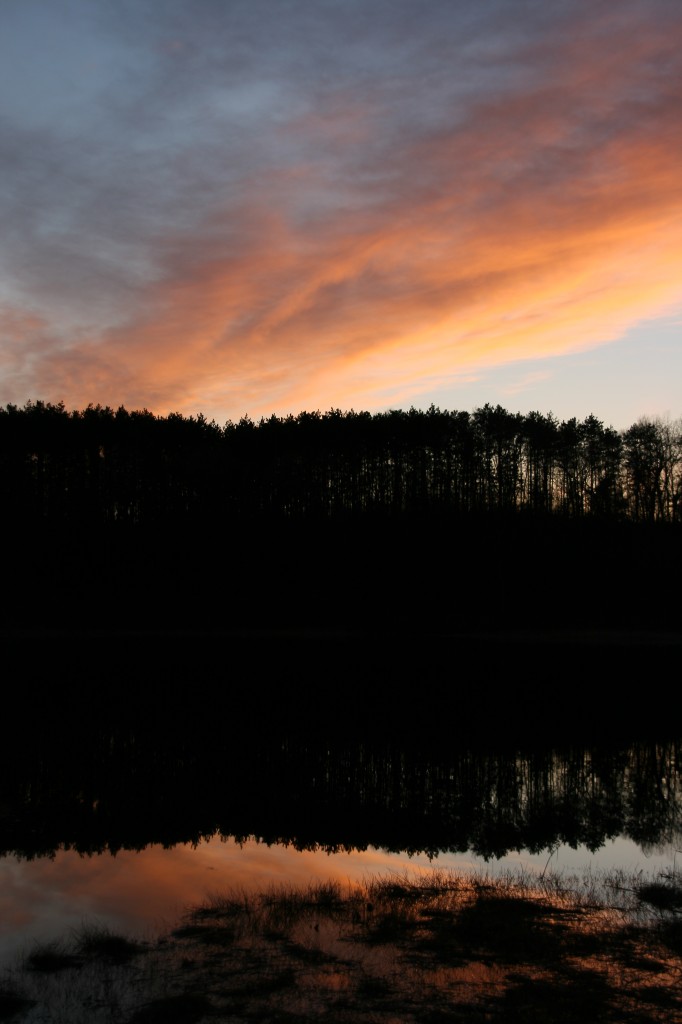
The following is a sunset image that I took Wednesday evening at Shaw Lake, just south of Middleville. The lake is surrounded by an incredible example of a rare wetland known as a prairie fen, inhabited by wild orchids and carnivorous plants. It’s an otherworldly place, truly beautiful, and unfortunately, also terribly abused by fishermen who have enough energy to bring in their bait containers, beer cans, and other trash, but evidently not enough muscle, brains, or strength of character to carry their empties out.

Excuse my mini-rant. The photo is of the next-to-last sunset of winter, 2009. It feels more like a sunrise in a sense, with its promise of lengthening days and the rebirth of the green months.

A plume of cirrus lights the sky at sunset at Shaw Lake in northern Barry County.

A plume of cirrus lights the sky at sunset at Shaw Lake in northern Barry County.

A Beautiful Day in Michigan

IT’SSPRINGIT’SSPRINGIT’SSPRING!!!

It’s SPRIIIIIIIINNNNGGGGG!!!!!

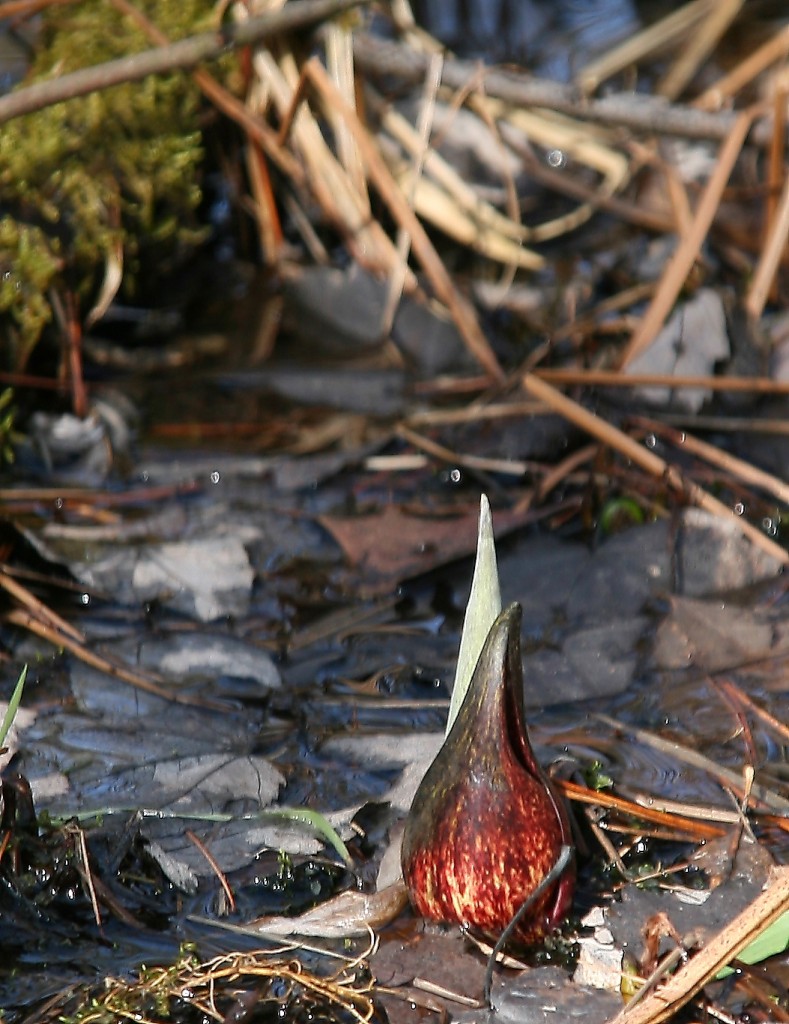
Okay, maybe it’s not quite spring officially–still another five days before the vernal equinox–but when I see skunk cabbages blooming in the swamps, then as far as I’m concerned, spring has arrived. Everything else is just a formality.

Skunk cabbage, earliest of the Michigan wildflowers

Skunk cabbage, earliest of the Michigan wildflowers.

With its odd-looking purple cowl shielding a flower spathe within, the skunk cabbage is nothing you’d want to put in a pot on the windowsill, but it’s nevertheless one of my favorite wildflowers. It’s a quirky little plant with plenty of character, plucky enough to lead the procession of the spring wildflowers in Michigan.

I came upon the one above while hiking a wetland trail in Yankee Springs the other day. The afternoon was beautiful, a bit chilly but on the leading edge of a warming trend that will put the temperatures into the fifties by today and as high as sixty degrees by Tuesday.

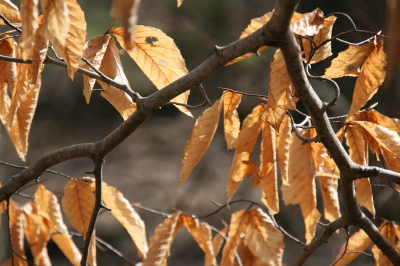
On a broad, blue day filled with the promise of warmer seasons to come, even last year’s vanishing remnants were transfigured by the sun. A bough of old beech leaves hung like Japanese lanterns in a shaft of sunlight.

Old beech tree leaves catch the sunlight.

Old beech tree leaves catch the sun.

Of course “the kids”–my collection of carnivorous plants–are out on the deck. I removed them from the refrigerator three weeks ago to boot them out of hibernation, and they have responded with a vigorous rush of flowers and leaves. The Venus flytraps are now open for business, and the Sarracenia oreophila isn’t far behind, with an exuberant array of young traps already ten inches tall and nearing the point when they’ll pop open.

White mold wiped out most of my flytrap seedlings during the winter, but a good hundred or so have survived. It’ll be interesting to see how much they increase in size this growing season.

All that to say…YAHOO!!! It’s SPRIIINNNGGG!!! Maybe not by the calendar, not quite yet, but don’t tell that to the robins because they don’t care, and neither do I. Just take a walk in the woods and you’ll know. Spring is here at last.

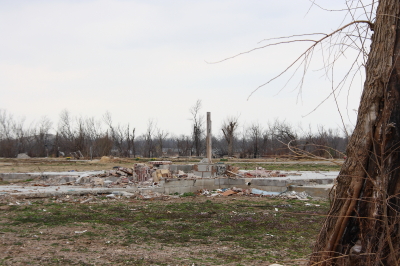
A Tornado Ghost Town

Two years after being completely leveled by a 1.7-mile-wide tornado, the town of Greensburg, Kansas, is  far down the road to recovery and has become a shining emblem of Green America. Not so with Picher, Oklahoma. One year after its visitation by an EF-4 monster, half of the small mining town is worse than gone, and the other half appears just a shadow’s breath away from becoming a ghost town

neighborhood1

Picher, Oklahoma

The town’s demise is not due strictly to the tornado; the storm simply drove the last, very large nail into the coffin. Driving into the community from any direction, you’ll inevitably see the true culprits: vast piles of tailings tainted with the toxic residues of zinc and lead mining operations. Ironically, the same industry that at one time formed the town’s economic backbone has also spelled its doom. Unlike Greensburg, Kansas, which went green and found its salvation in  national attention and an influx of funds, poor little Picher is blighted beyond redemption.

According to the Washington Post, “The mines were shut down in the 1970s, and all that is left in and around Picher are about 1,000 people and giant gray piles of mining waste, known locally as ‘chat,’ some hundreds of feet tall and acres wide, that loom over abandoned storefronts and empty lots.

“The piles are loaded with heavy metals that have contaminated the air and the groundwater and placed the northeastern Oklahoma town in the middle of the Tar Creek Superfund Site, the largest and one of the most polluted in the country. To add to Picher’s misery, a federal study released in January determined that the abandoned mines beneath the city could cause cave-ins without warning.”

That was back in January, 2007, before the tornado. There certainly are no thousand souls left in Picher today. I doubt there are one hundred. It’s a depressing, ugly, desolate place. Yet there are people who remember and love it as home, and a handful who still call it so.

Nothing Left

Nothing Left

Last Saturday, my buddy Bill Oosterbaan and I began our chase day with a visit to Picher. The northern part of the town is just a town, though with its empty streets, it reminded me of the set for a spaghetti Western. As for the southern part, it’s blown to smithereens.

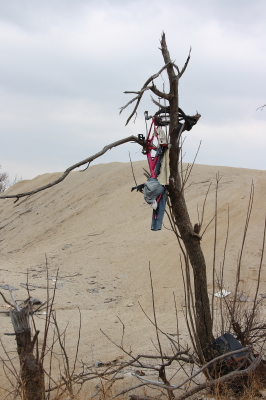
bike-in2

Bike in Tree

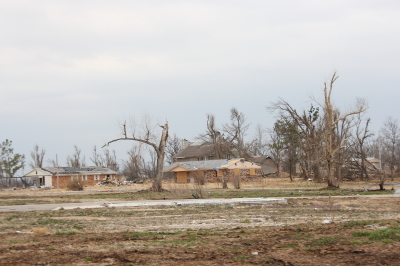
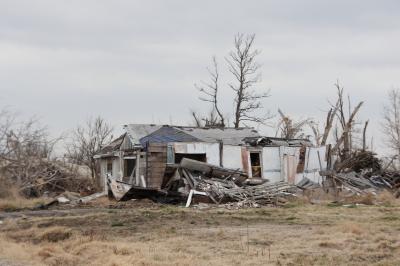
Many of the homes have been cleared away, leaving only cement slabs where neighborhoods once stood. Other battered structures remain, their siding stripped away, roofs missing, walls torn out, twisted window frames gazing vacantly at a landscape of tortured trees, tornado trash, lethal chat hills, and toxic lagoons. Debris litters the fields, and sheets of tin and other objects wrap and twist around the treetops. No one is in a hurry to clean any of it up. There’s no need to. No one is coming back.

What's Left of a House

What's Left of a House

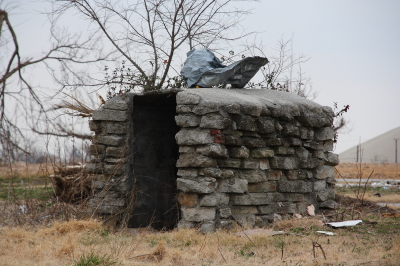
On the north end of the damage track stands an old storm cellar. Presumably, in a tornado that claimed seven lives, the cellar saved a few when the time came for it to serve its purpose. Once a house stood nearby; today, the rough-hewn block shelter stands alone, much like the rest of what is left of Picher, Oklahoma. The cellar resembles a crypt, and in a way, I suppose it is–a memorial marker for a town that is no more.

Storm Cellar

Storm Cellar

Preparing for Storm Season 2009

Out of curiosity, I just ran the GFS down to 384 hours. The SPC has posted a light risk for parts of the South on Wednesday, but that may be just a foretaste of an upcoming active period. Did I already write about this recently? Not sure, but if so, I’m writing again.

Long-range prognostication is something like reading tea leaves, but consulting the numerical models still beats going to a groundhog for your two-week weather forecast. At around 204 hours, a nice surge of moisture appears to unlock the the Gulf of Mexico for several days, with 55 degree  dewpoints extending as far north as Missouri, southern Illinois, and Indiana.

Am I hanging my hat on this? Heck no. I’m just thinking, quite wistfully, how nice it would be if what I just saw bore some resemblance to how things actually play out nine days hence. In February, one dreams if he’s a northerner and shudders if he’s a resident of Dixie Alley.

I’m anxious to to see some great storms this year. Last year was fabulous, but I blew some great photo ops because I didn’t know how to use my camera. This year I think I’ve overcome that concern. Now if only the weather and my finances will cooperate.

Meanwhile, I’ve decided to make the best of the holding pattern by signing up for Tim Vasquez’s severe weather forecasting class. It’s a small group setting that will be held on Sunday, March 8, in Norman, Oklahoma. I just shelled out my hundred bucks today and am really looking forward to attending this thing. My chase partner, Bill Oosterbaan, will be joining me. This ought to be a perfect way to really tighten down our forecasting skills for storm chasing season 2009 by learning from one of the foremost gurus of the field. I own nearly all of Tim’s books, and also his Forecast Laboratory software. It’ll be cool to finally pick his brain for eight hours in a focused, fairly personal setting.

More immediately, though, this evening the sun set at 6:17 here in Caledonia, and tomorrow the temperature is supposed to spike to a sweltering 36 degrees. I’ll take that and like it for now. It presages good things to come.

Of Sunset Calendars and Skunk Cabbage

February. Ah, February. From the beginning to the end of this month, we gain an hour and twelve minutes of daylight here in Caledonia, Michigan. That’s thirty-seven minutes in the morning and thirty-five minutes in the evening. Sunset on the 28th will be at 6:31p.m. I call that a pretty good deal, and I’m pleased to see warmer temperatures this weekend giving us a taste, however temporary, of longer, pleasanter days to come.

It’s amazing how much the sunrise/sunset times vary from north to south and east to west in a single state. I won’t cite examples, but if you’re curious enough to find out for yourself, here’s a link to the U.S. Naval Observatory chart to help you do so. Time is stated in military format for the time zone of the particular town you choose, whether EST for Shamokin, Pennsylvania, or MT for Denver, Colorado.

Anyway…the days really are getting longer. Believe it or not, the beginning of the spring wildflower parade isn’t all that far away. It starts subtly, though, and humbly, with the lowly skunk cabbage. I love this odd-looking little plant that sends up its mottled, marroon-and-green hoods in the swamps, often amid melting drifts of snow. Smell a broken piece from any part of the plant and the aroma of burnt rubber and raw onions will quickly tell you that the name skunk cabbage is an apt one. But the plant is nonetheless one of my favorites, both because of its quirky nature and because it is a true harbinger of spring.

As is true of most people, there’s far more to the skunk cabbage than meets the eye. In fact, I smell a post coming up for a future WaterlandLiving blog. Can’t wait to see this pioneer of the wildflowers start putting in its appearance, possibly as early as the end of this month and certainly by mid-March. Once I spot the skunk cabbage, I know that spring is underway at last. And I’m ready for spring, aren’t you?

Not Enough Tornadoes

Here is a conversation you’re unlikely to overhear at a restaurant:

“I’m going to move.”

“Why? Vermont is such a beautiful state.”

“Not enough tornadoes. I’m thinking maybe Hays, Kansas.”

Nope, you just won’t hear most people talk that way. A generous supply of tornadoes simply isn’t a big selling point for the average homebuyer. On the other hand, if you’re a storm chaser, it could be a compelling reason to sell your chalet near Boise, Idaho, and move to Wakeeney.

I just finished perusing a thread on Stormtrack where chasers were considering this question. The earnestness of the discussion struck my funny bone. I mean, the concept of moving somewhere because it has lots of tornadoes is utterly foreign to most Americans, who are unmotivated by tornado accessibility. In fact, I’d venture to say that many people would consider the idea downright weird. (“You’re moving where because of what?“)

Chasers, however, seem to see nothing unusual about factoring in tornado statistics as a motivating factor in home buying.  It’s weird. And the reason I laugh is because I can relate. I’m not ready to pack up my bags and move from Michigan, because busted economy or not, I love this state. But if I ever do move, it won’t be to California because of the ocean, or Florida because of the warm weather, or Vermont because of its rural New England beauty. It’ll be to the Great Plains because of the dryline.

Realistically, I can’t see it happening anytime soon. I might be able to find a location with a decent brewpub, such as Wichita, but where would I go to hear some decent live jazz, let alone play it? That side of me is as important as the storm chaser in me. Maybe the two can be reconciled. To be honest, I’m not too worried about it. It’s just fun to think about, and certainly worth laughing about.

I do kinda wonder, though, what it would cost to build an underground bunker as a vacation home in the Texas panhandle.