Harlem.org: Jazz History at the Click of a Mouse

Last week, my lady Lisa sent me a link to a very cool website called harlem.org, which invites viewers to “explore jazz history through one photograph.”

Now, the photo in question, taken by Esquire camera man Art Kane, is one I had seen before, and is in fact quite famous. Featuring a veritable who’s who of jazz history, all gathered together on the steps and sidewalk outside an apartment in Harlem, the picture is utterly remarkable. Count Basie, Lester Young, Coleman Hawkins, Dizzie Gillespie, Marian McPartland, Milt Hinton, Mary Lou Williams, Thelonius Monk, Sonny Rollins, Maxine Sullivan, Stuff Smith, Oscar Pettiford…all there, along with many others, fifty-seven in all. The patriarchs and the young lions, side by side.

Still more amazing, however, is how harlem.org has utilized this photo to give you quick, biographical insights into everyone who appears in it. Just mouse over the photo to a general area of interest, click, and that section of the photo is enlarged. Now mouse one by one over the musicians in the enlargement and their names appear in a pop-up balloon. And here’s where it gets good: when you click on a particular musician, a larger window pops up containing a photo and information about him or her.

What I’ve described is just a thumbnail sketch of what the site has to offer. If you’re at all interested in the history of jazz, this website is a must. It’s worth visiting just to see the photo alone, but I promise you, you’ll find much more of value besides.
Of Camp and Cacti: Photos from 4th of July Week

Among the many interests that my sweetheart, Lisa, and I share is a love for photography. This last week we’ve poked around together in the outdoors with our Canon cameras and harvested a variety of images. So rather than write a lot of words, I thought I’d share a few photos with you. They’re about neither jazz nor storm chasing; they’re just odds and ends from nature and life at large.

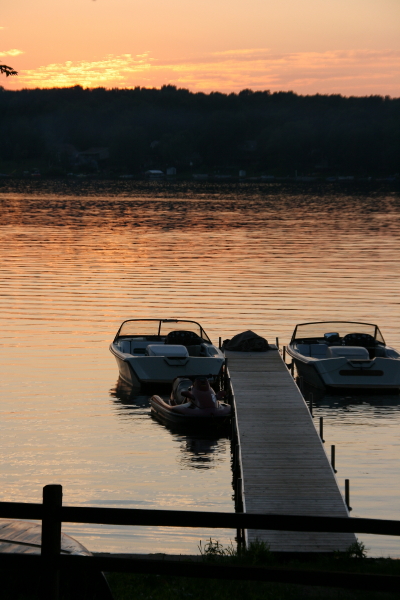
Last weekend Lis and I headed up to Camp Henry, a Christian camp located on Kimball Lake north of Newaygo, to spend the Fourth of July with our close friend and dear sister in Christ, Kimberly Dunn. Kimber lives in Redding, California, but has been doing a summer internship here in Michigan at the camp. It was great to see her, and during our visit, Lisa and I naturally took a lot of photos.

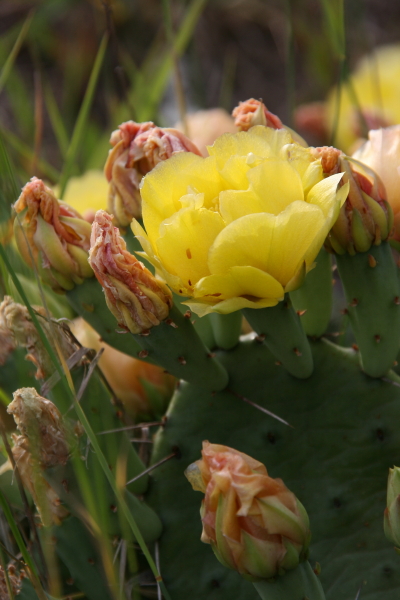
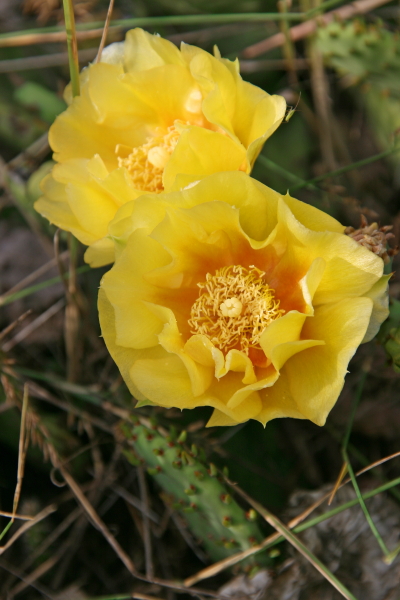
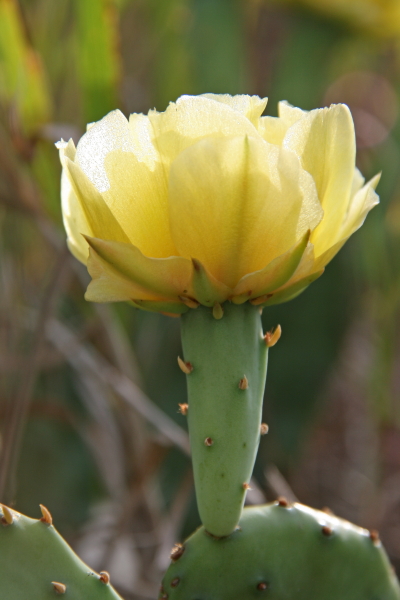
Then yesterday, we went out on a photo expedition to capture prickly pear cacti in bloom. There is at least one species that is native to Michigan, the eastern prickly pear, Opuntia humifusa, also known as devil’s tongue. The blooming season for it is winding down, but there are still plenty of bright, butter-yellow blossoms available to fill a camera viewfinder.

With many photos to choose from, I’ve opted for images from nature and the outdoors, subjects that Lisa and I both gravitate toward more than anything else. I hope you enjoy the selection.

Sunset at Camp Henry

Sunset at Camp Henry

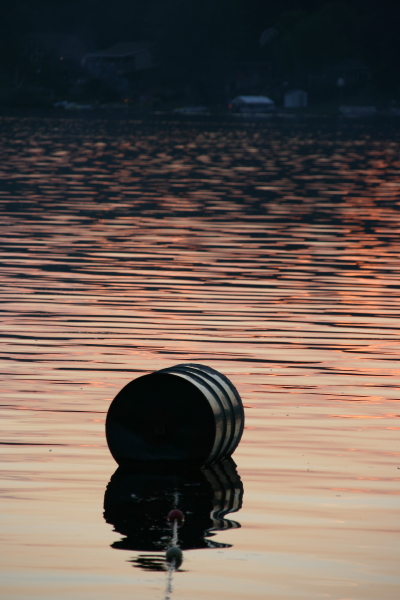
Swimming Buoy at Sunset, Camp Henry

Swimming Buoy at Sunset, Camp Henry

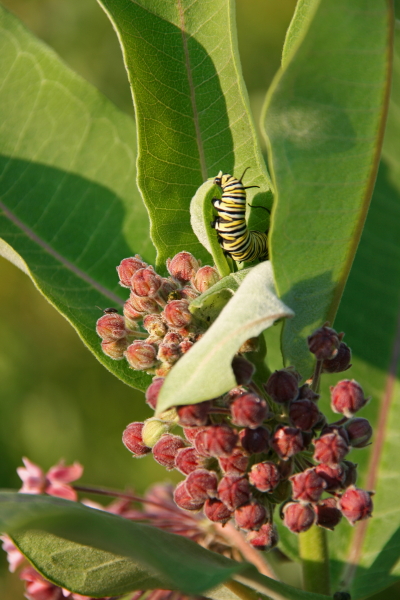
Monarch Butterfly Caterpillar on Milkweed

Monarch Butterfly Caterpillar on Milkweed

Loosestrife Flowers. These are a native species, not the highly destructive exotic, purple loosestrife, which takes over wetlands.

Loosestrife Flowers. These are a native species, not the highly destructive exotic, purple loosestrife, which takes over wetlands.

Eastern Prickly Pear

Eastern Prickly Pear

Also Known as Devil's Tongue

Also Known as Devil's Tongue

Opuntia Humifusa in Flower

Opuntia Humifusa in Flower

VORTEX 2 in Northwest Missouri

After years of planning and digging for research dollars, VORTEX 2 finally hit the pavement this spring, only to be met with a severe weather famine. It had to have been heartbreaking for the team, watching that merciless, unending ridge stretch from day to day and week to week, knowing that the clock was ticking on their window for gathering data.

Thankfully, tornadic storms hit the Plains before the window closed, and the team got what they needed. I wish it had gone as well for me. My tally for this season has been one tornado. But I did at least get the compensation of catching some nice storms with cool structure, including the June 7 supercell in northwest Missouri that every chaser in the country seemed to be after–including, of course, the VORTEX 2 armada.

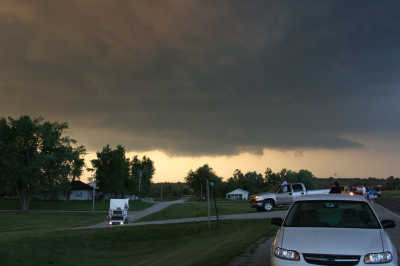
Just for kicks, here is a shot of one of the DOW trucks–the new one with the square radar rig. I believe I took this shot south of Forest City. The DOW is parked to the left in the photo, and I’m looking at it head-on. Viewed from that angle, the radar unit looks like the front end of a tractor trailer.

One of the DOW (Doppler On Wheels) trucks collecting data.

One of the DOW (Doppler On Wheels) trucks collecting data.

Sure does bring back memories. I hope I’ll get a chance to make a few more before the chase year closes. Prime storm season is over, but it’s still a long time yet before the snows fly.

Waking Up in Dallas

Morning. I’m still in bed, and from the next room, sounds of family are drifting through the door. I’m in Dallas with my sister Diane, visiting with my brother Brian, sister-in-law Cheryl, and little nephew Samuel. Since the last time I saw him, Sam has transitioned from babyhood to little-boyhood. He has acquired a vocabulary, a white baseball cap that it’s very important to wear (backwards or sideways, as is the custome), and a very cool train set that we played with last night.

My lady Lisa is holding down the fort back in Grand Rapids, where the weather is providing a much cooler contrast to the upper-90s heat that’s on the menu for this week here in north Texas. Chasing storms is of course out of the question. I’ve family to visit, a bit of work to do, and in any case, there are no storms. Summer has hit and the atmosphere is capped as tightly as an oil drum. On Stormtrack, chasers are bidding the 2009 chase season adieu. I note that the SPC has outlooked days 5-6, but they’re not using the kind of language that gets me very excited.

I’m keeping this short. I can hear the sound of forks clicking on breakfast plates. It’s time to shower up and get myself going.

Sax on the Beach

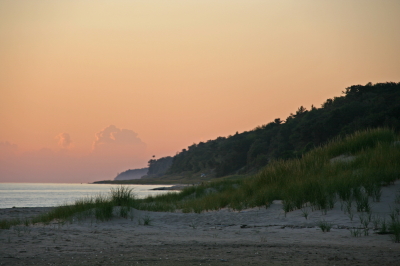
Looking north along the Lake Michigan coast at sunset.

Looking north along the Lake Michigan coast at sunset.

Sax anywhere is great, but sax on the beach is fantastic.

Take a Squeegee to your naughty mind. I’m talking about playing the saxophone, thank you, and about one of the places where I particularly enjoy playing it. There’s something very special about heading out to the lakeshore and practicing my saxophone accompanied by the sound of the waves and the cry of the seagulls.

If you follow the jazz side of this blog, then you know that I love to play my horn outdoors. My practice habits are fairly eccentric in that regard. Many years of apartment dwelling, which include neighbors whom I haven”t wished to disturb, have taught me that my woodshed is wherever I choose to make it. The state parks. The cow pasture at the edge of town. Most often my own car, parked by the railroad tracks out in the countryside.

But there’s no place quite like the shores of Lake Michigan.

It’s been a long time since I’ve taken my horn out there, but yesterday provided a reminder of what I’ve been missing. Regretfully, I didn’t have my saxophone with me, but I did have my sweetheart and best friend, Lisa. From our little outing in Muskegon State Park, I thought I’d share a few images with you of…

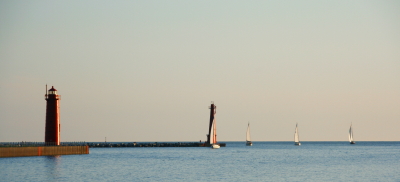
sailboats out on the waters…

sailboats1

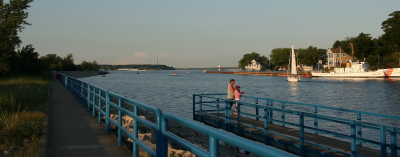
…the north boardwalk along the Muskegon channel…

muskegonboardwalk

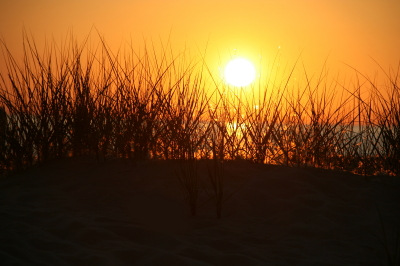
…dune grass silhoutted by the setting sun…

marramsilhouette

As for the great sand dunes that are one of the hallmarks of this beautiful state, I’ve already given you a glimpse of them up at the top of the page, but the really imposing dunes lie in the northern and southern ends of the Lower Peninsula. Perhaps in another post I’ll include some shots of Sleeping Bear, Warren Dunes, P. J. Hoffmaster Park, and Nordhouse dunes–vast tracts of sand, marram grass, and wooded dunes that reflect the wild beauty of the Michigan outdoors. It is a wide open sublimity that speaks to something deep inside me, and that has colored the music I play for many years.

One of these days soon, I will visit the lakeshore again–this time with my saxophone, to serenade the gulls, the waves, the far-stretching sands, and the setting sun.

The Summer Pattern Is Setting In

The SPC has placed Michigan and the Great Lakes in a slight risk area for tomorrow. But tornadoes aren’t in the picture. The summer pattern appears to be setting in, with the jet stream moving its headquarters to the US/Canadian border. As far as Michigan is concerned, that’s close enough that we can still expect some decent kinematics here and there. But what we get tends to result in linear MCSs more than supercells and the like.

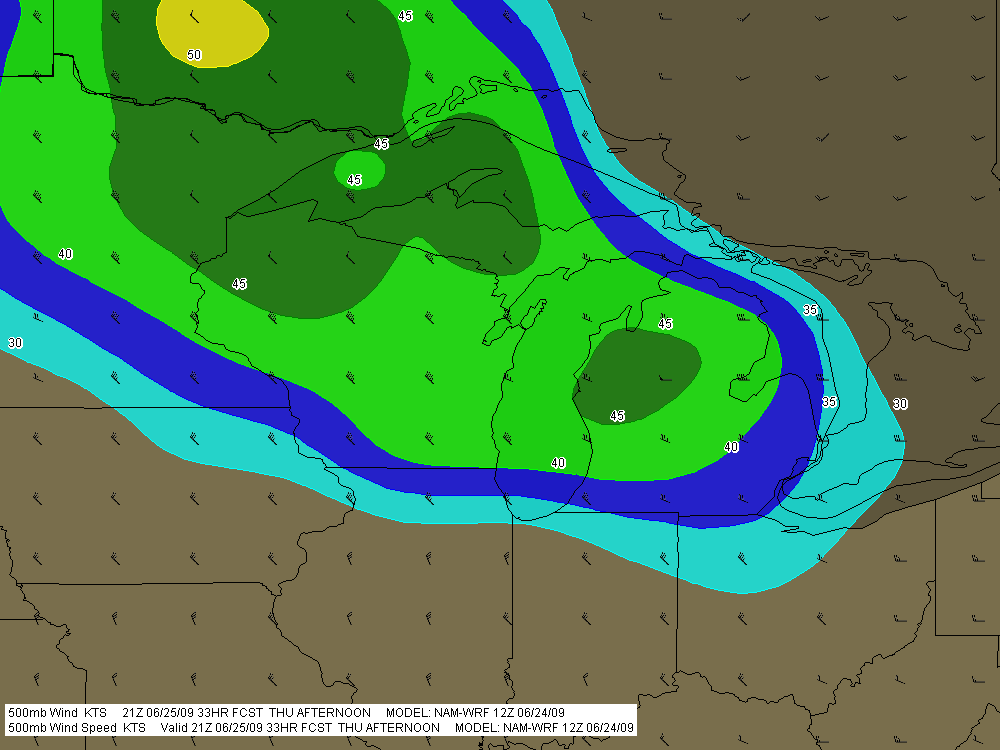
Tomorrow’s SBCAPE should settle in between 2,500 and 3,000 j/kg, with dewpoints in the 70s. That’s certainly an ample supply of convective fuel. And F5 Data shows this for H5 wind speeds at 21Z:

If you can live with northwest flow, that’s not bad. But of course, the underlying winds are all westerly. Once again, Michigan’s energy will get sabotaged by unidirectional winds. How pathetically par for the course! Maybe we’ll get some supercells, but we’re unlikely to see the low-level helicity needed to make them tornado producers. Probably better knock on wood when I say that, because the lake breeze zone can do some funny things with locally backed winds. Overall, though, I think the order of the day will be some nice, burly, ouflowish thunderstorms.

What do I know, though? I’m still pretty green as a forecaster, and I recall a couple years ago when the models showed a unidirectional setup with nothing in the way of helicities, and an F3 tornado ripped through Potterville.

One of the nice things about living in Michigan this time of year–among the many wonderful advantages of this beautiful state–is that we’re prone to get a couple supercellular events when the traditional Tornado Alley of the Great Plains simmers under a titanium cap. Those occasions aren’t anything you can count on, but it’s nice when they happen–for me and my fellow storm chasers, anyway. I suppose other folks here might see things a bit differently.

The Loudest Sax Player Ever

My friend and fellow musician Dave DeVos once told me, “You are the loudest sax player I’ve ever known.”

His words weren’t a compliment, just a statement of fact tinged with a slight mix of incredulity and annoyance. I’m a very loud sax player, much louder than I realize. As the old cliche says, I don’t know my own strength.

Of course I can play softly, but soft is not my default mode. Part of that is attributable to my horn, which is an old Conn 6M “Ladyface” that is very good at translating the air I move through it into immense volume levels. Another part is due to my mouthpiece, a Jody Jazz classic #8. But I think the main reason I’m a loud player is directly linked to the guy behind the horn. I just seem to have a knack for massive sound output.

I wasn’t always a loud player. I entered my freshman year in college a quiet young saxophonist. My sound at the time was styled after Tom Strang, a local alto man who owned a jazz bar in Ada called the Foxhead Inn. Tom had a smooth, mellow sound, very pleasing to the ears. He was not a loud sax player.

As an early influence, Tom’s tone pointed me toward a somewhat Desmondesque approach, not exactly the kind of robust Cannonball sound that could melt the wax in a listener’s ears at 100 feet. It was more a kind of foofy-foof-foof tone–subdued and, I thought, pleasantly sophisticated.

It was this mellow, sedate sound that I brought with me to the student big band at Aquinas College, where I sat under the august directorship of jazz professor Bruce Early. I was assigned to the first alto chair, and my lack of experience was such that I felt eminently qualified to fill the position. Clearly word of my abilities on the sax had preceded me, and Bruce had simply placed me where he knew I belonged. First chair. It was inevitable.

I’ll never forget my first awakening to the possibility that maybe I wasn’t all that and a supersized order of fries. The band was playing through some tune I’ve long since forgotten, and in the middle of the chart there was space for an alto solo. Cool. A chance for me to show my stuff, give Bruce a taste of my chops. I launched into the solo. Foofy-foof-foof, I played, subtly, while the rhythm section whanged away.

Bruce stared at me. “Play louder,” he said.

Ah. Louder. Okay then. Foof-foof-foofy-foof! I declared, in a volume that could almost be heard from ten feet away.

Bruce’s stare became a glare. “Louder!” he barked.

My gosh, what did this guy want? Here I was, foofing as loudly as ever I had foofed, and Bruce was calling for more.

I returned his glare with a desperate glance.

Foof? I played. Foofy-foof!

I was trying, but I quickly trended toward the softer, cocktail lounge volume that I was used to.

That did it for Bruce. “BLOW!!!!” he yelled. “For crying out loud, BLOOOWWWWW!!!!!!”

Some of the more seasoned musicians snickered, and my face went red as a beet. Hell’s bells. Fine, if it was volume Bruce wanted, I’d give him volume. And I did. I had a lot to learn about embouchure and tone production, but at that point I instinctively dipped into the raw essentials, filled my lungs with air, and blew my ever-loving cheeks off.

From that time on, while Bruce yelled at me for any number of things, my volume level wasn’t among them. He never again complained that I was playing too softly. Nor has anyone else, for that matter. Not ever. I’ve played with highly amplified blues bands and church worship teams and outblown them without using a microphone. I’ve been asked plenty of times to turn it down a bit, please. But no one has ever come to me and said, “Could you play louder? I can barely hear you.”

Just ask Dave. He’ll be glad to tell you, as soon as his ears stop ringing.

June 8: Mini-Supercell in Northern Illinois and Severe Squall Line on the Lake Michigan Shoreline

This is really part two of the previous post. After chasing a potent, monster hailer of a supercell north of Saint Joseph, Missouri, I overnighted at a hotel outside of Des Moines, Iowa. When I stepped outside the next morning, the air was much cooler and drier, a stable atmosphere that wouldn’t produce so much as a sneeze, let alone a tornado.

But I knew that the SPC had outlooked the area to my east across northern Illinois, and for several days I myself had been eyeballing my home state of Michigan, where the NAM-WRF had been consistently indicating the possibility of tornadoes. With a little luck, I hoped to make it back in time to chase whatever convection might pop up along the warm front.

As I approached Davenport, I observed  towering cumulus muscling up through the troposphere. However, I didn’t pay them any attention–that is, until Bill Oosterbaan called to inform me that the SPC had just issued a mesoscale discussion for the area just east of me. Even as we talked, I noticed a lowering on a cumulus tower a mile or two to my northeast. When it continued to develop, I decided to investigate. Leaving I-80, I parked across from a truck stop at the Atkinson exit to watch.

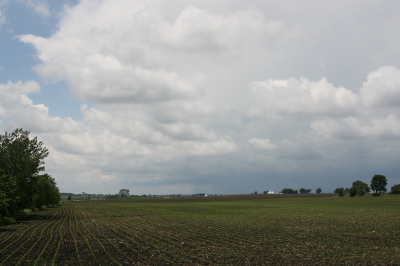
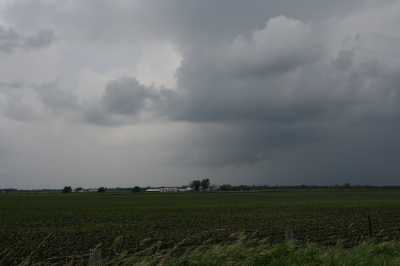
The next cell to my west quickly grabbed my attention. It had a nice rain-free base, and as I watched, scud began to form and ascend in an obvious updraft, coalescing into a small, ragged wall cloud. Grabbing my camera and getting out of my car, I noticed right away that the air was very different from back in Des Moines–considerably warmer and with plenty of moisture. The wall cloud fell apart before I could get a pic, but the overall structure remained interesting.

A mini-supercell approaches Atkinson, Illinois, just north of I-80.

A mini-supercell approaches Atkinson, Illinois, just north of I-80.

More brief, non-rotating wall clouds formed and dissipated one by one, so I figured I’d head north of town and observe. With surface winds veering and the overall flow unidirectional, I had no expectation of seeing tornadoes, but the mini-supercell made for some fun and interesting viewing.

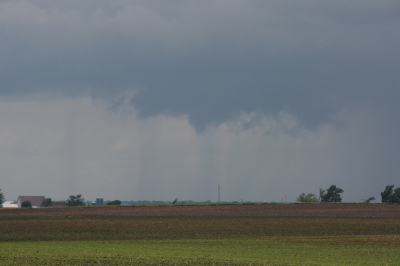
Ragged, non-rotating wall cloud.

Ragged, non-rotating wall cloud.

Distant wall cloud and back side of main updraft tower.

Distant wall cloud and glimpse of updraft tower.

I was tempted to follow the storm, but decided it was a red herring. If at all possible, I wanted to make it back to Michigan in enough time to chase the setup there, and that left me no time to play around on the western Illinois backroads. So I headed back to I-80 and busted east.

The first Michigan supercell fired up earlier than I’d hoped, and I bit my lip as I followed its progress on GR3 and watched it hit Lansing. If only I had driven east last night for two more hours, or left in the morning two hours earlier… But the previous day’s chase had left me exhausted. And you know, one of the downsides of being a Michigan-based storm chaser is, you just don’t have very high expectations when it comes to your home state. I mean, it’s Michigan. Home of convective table scraps, squall lines, and embedded supercells that don’t produce squat.

As it was, I watched several more storms fire up and develop rotation along the warm front that stretched across mid-Michigan. I was making decent progress and still had hopes of catching up with some of the southernmost cells. But by the time I crossed the state line, the action all had shifted well to the east, and it became clear that I wasn’t going to see any of it.

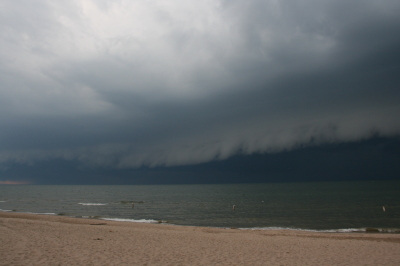
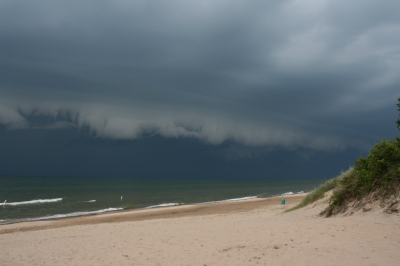
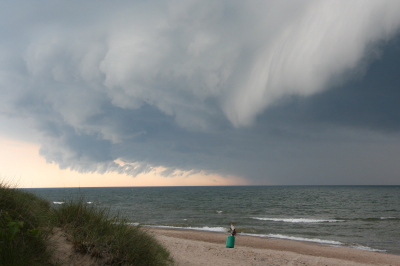
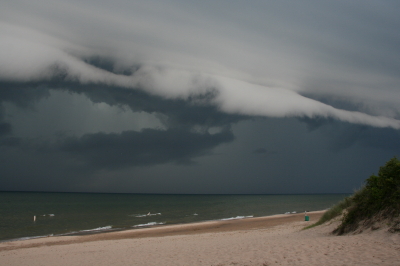
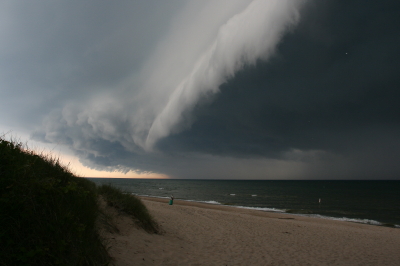
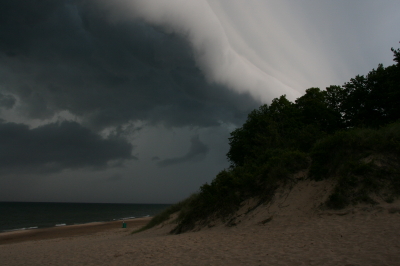
Instead, taking fellow chaser Mike Kovalchick’s suggestion, I headed toward the lakeshore at Allegan Beach to intercept a short but potent squall line. I’m glad I did. The backdrop of Lake Michigan and its dunescapes lends a breathtaking drama to incoming storms. The following photos depict the progress of the arcus cloud moving in across the waters. What these images can’t convey is the full, awe-inspiring sweep of cloud, big lake, and shoreline; of the solemn foreboding of some great event about to unleash itself upon a landscape cloaked in storm shadow; of the shelf cloud moving silently overhead like the furrowed eyebrow of a dark, scowling giant; and of sand spray blowing and trees thrashing in the wind as the gust front arrived.

I’ll let the photos tell their story as best they can, and leave the rest to your imagination.

An arcus cloud advances toward the Lake Michigan shoreline at Allegan Beach.

An arcus cloud advances toward the Lake Michigan shoreline at Allegan Beach.

View to the north.

View to the north.

Looking south...the storm closes in.

Looking south...the storm closes in.

Looking north...closer still.

Looking north...closer still.

Almost overhead.

Almost overhead.

One last shot to the north, then it's time to make a dash for the car.

One last shot to the north, then it's time to make a dash for the car.

Chasing Storms after the Concert

Bill, Kurt, and Tom are leaving tonight to chase Saturday’s setup out west. I’m staying behind to play with Francesca and Friends at the 2009 Grand Rapids Festival of the Arts. Ordinarily I’d feel a bit torn, but I have an idea that the better action will be on Sunday and–from the looks of the 12Z NAM-WRF–Monday. So when I step onto the stage tomorrow afternoon, unless between now and then a confluence between the NAM and GFS suggests that capping will suddenly no longer be an issue and Armageddon is going to break out in the Great Plains, I will be a man at peace.

But directly after the concert, I plan to pack my bags and head for the Corn Belt, where I’ll hook up with the guys and chase storms on Sunday and, if the present NAM-WRF comes at all close to verifying, Monday.

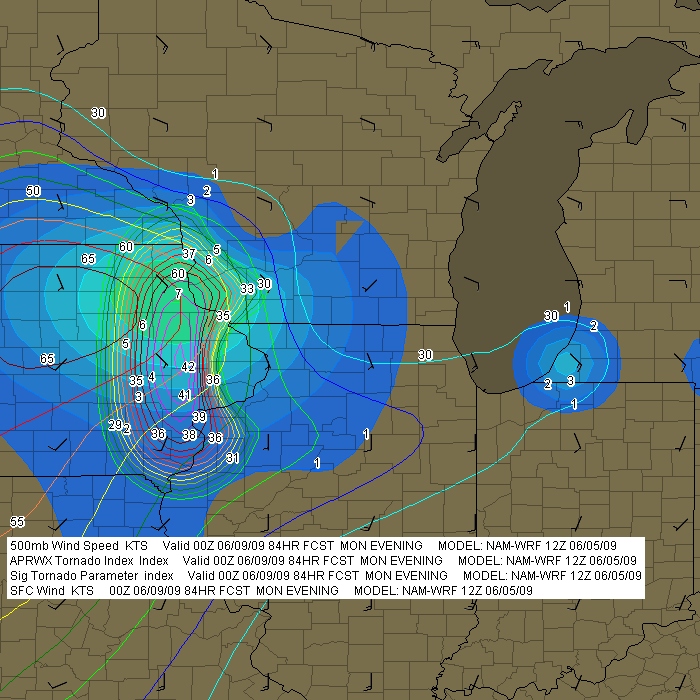
Frankly, I’m somewhat skeptical about Monday. Previous runs have consistently painted such a different scenario, with majorly veered surface winds and a unidirectional flow overall, that the 12Z’s placement of the weak surface low in eastern Iowa seems too good to be true.  Here’s an image from F5 Data showing sigtors, APRWX sigtor, surface wind barbs, and H5 wind speeds:

12Z NAM-WRF for 0Z Monday

12Z NAM-WRF for 0Z Monday (F5 Data)

Suddenly all the elements in terms of moisture, instability, and shear are lining up, along with a 7 sigtor in Iowa and even a 4 in southwest Michigan (in the usual lakeshore location, Berrien County). Makes me more than a little suspicious. But I think I can at least count on Sunday, and we’ll see whether future model runs continue to paint a rosier trend for Monday in Iowa and the Great Lakes.

So it’s play my saxophone on Saturday, then chase storms on Sunday and maybe Monday.  That’s about as nice an arrangement as I could possibly ask for–other than for this year to finally be the one where our act at the Festival doesn’t get interrupted by a hailstorm. That has happened three years in row. But I’ve got a good feeling that tomorrow is the day when we’ll finally make it through intact. That’ll be good. I’d just as soon save the hail for the day after.

Remembering the Parkersburg/Hazleton Tornadoes

One year ago today, the second EF5 tornado in the history of the new Enhanced Fujita Scale rating system descended on Parkersburg, Iowa, and obliterated the southern third of the town. I and fellow storm chasers Bill and Tom Oosterbaan and Jason Harris could see the intense rotation moving over Parkersburg on GR3 as we stairstepped southeast from the northern edge of the cell, heading for an intercept. There’s a certain sense of disbelief when you see something like that, a feeling of, Naah, it can’t be as bad as it looks.

But it was. A few miles farther down the road, with the rotation still at least ten miles to our west, debris–some of it fairly large–began to fall from the sky. That was when we knew for sure. Something terrible had happened. Even with pieces of sheet metal clanging down onto the pavement in front of us, I had a hard time believing that a tornado disaster had just occurred, but I think we all felt a certain sober awareness that a community had been hit.

We intercepted the storm near Fairbank, where the NWS indicates that the Parkersburg tornado occluded. Parking on a sideroad, we watched as a large, new wall cloud formed and moved directly toward us. Warning an Amish family who was standing in their yard, watching, to take shelter, we scooted south and then east, watching as the wall cloud lowered and kicked up a ton of dust. A second, enormous tornado had formed, barely discernible through the haze. We tracked with it to the east as it headed on a collision course for Hazleton, mercifully grazing the southern edge of that town. Had it hit head-on, I suspect that the Hazleton tornado’s EF3 rating would have been higher.

It’s hard to believe that a whole year has passed since that event and the several days of Great Plains action that preceded it. What a difference between then and now, with a nasty ridge casting a pall on this May’s peak chase season.

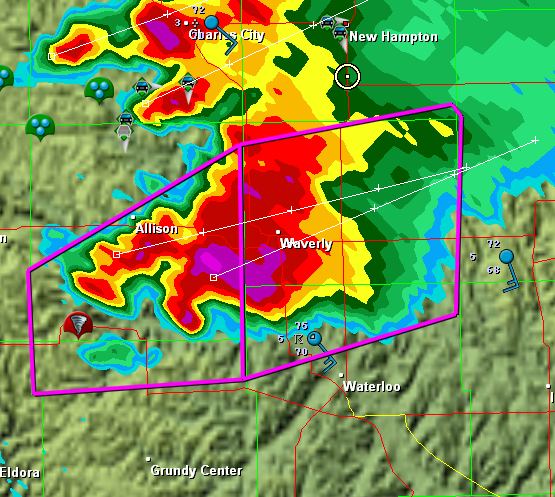
In remembrance of the Parkersburg/Hazleton tornadoes, I’m including a couple visuals. The first is a radar grab of the supercell as it moved out of Parkersburg. The tornado icon is a storm report from the town, just minutes old. You can see our GPS position marked by a circle with a dot in the middle of it on the northeast edge of the storm

The Parkersburg, Iowa, tornadic supercell.

The Parkersburg, Iowa, tornadic supercell.

The second is this YouTube link to my video of the Hazleton tornado. My videography may not be the best in the world, but I think you’ll get a sense of the intensity this storm evoked. It was my first really big tornado, and it was close.

I doubt this year has anything in store for us  like what we saw that day. But who knows? I’m not ready to write off this chase season yet–though I certainly hope it doesn’t hold a catastrophe like the Parkersburg tornado.