A Fun Friday Gig at Saint Cecilia Music Society

It’s nights like last night that remind me how much I LOVE to play the saxophone! There’s nothing like a small combo of good players to bring out the best in me. Hopefully I help bring out the best in them, too, but in any case, the guys Friday evening brought me into my Zone.

The gig belonged to drummer Brad Dawson, and the event was his sister’s wedding reception. Brad is a superb all-around musician whom I had a chance to play with briefly before he moved to California well over ten years ago. He was a 17-year-old kid back then, but already he was playing a whole lot of drums and immersing himself deeply in jazz. He’s been back in town for while now, and tonight we finally got a chance to make some decent music together.

As for the rest of the musicians, Bob Van Stee played piano and Matt Herradia laid the bass foundation. Joining me on the front line was a flugelhorn/trumpet player whose name, I regret to say, escapes me. I wish I had his card, because he played very nicely. I  liked his use of space, particularly because my own approach tends to be an aggressive, hard bop style. It’s a pleasure when another player’s concept provides enough contrast from my own that it makes me think and gives me ideas.

The setting was the second floor ballroom in the Saint Cecilia Music Society building in downtown Grand Rapids. It’s a wonderful place for company parties and wedding receptions, and with two Steinway grand pianos on its stage, you’d think it would also be a great room to play in. But the acoustics are such that the sound seems to evaporate immediately after it leaves the musicians’ instruments. I had to really listen in order to hear Bob on the piano, and Matt’s bass came across as an indistinct thumping, though he was only six or seven feet behind me.

For all that, it was a very enjoyable evening playing straight-ahead jazz. Other than Brad, the musicians are guys I haven’t played with before, though I’ve known about Bob VanStee for years. I love that kind of situation. There’s something about jazz that connects people who previously were strangers. You can tell when a person has paid his or her dues, and you sense an unspoken camaraderie, a mutual appreciation. You hear different ideas, new ways of doing things, and you learn from them.

And of course, getting paid is always nice!
August Reminiscences: My First Successful Storm Chase

Ah, August. In its own way, it’s a lot like February: a month whose respective season of the year has settled in and ripened into predictability. Upper winds are weak and storms are often the pop-up type, providing a quick flash-and-bang along with localized rainfall before fizzling out. Yet on the horizon, like the first cirrus wisps of a fast-moving cold front, you can see change coming.

This morning I awakened to the distant grumble of thunder, and when I opened the drapes, the sky was an odd, fish-flesh paleness with darkness moving in. Oh, joy! Upon hearing me stir, Lisa stepped into the room with a smile and told me that a squall line was approaching. Now, that’s the way I like an August day to begin! I fired up the computer and consulted GR3. It was a skinny line, but the NWS was saying big things about it’s being quite the wind machine. Eight miles up the road, the KGRR station ob reported heavy rain; yet here in Caledonia, we got just a mild spray of precipitation, the lightning called it quits, and the line which had threatened to enter like a lion left like a lamb. Now it’s no longer even detectable on the radar.

More thunder is in the forecast for today, though, and for the next few days, as a weak warm front sloshes back and forth and as air mass storms generate more boundaries to fire up convection. It’ll be a bland but enjoyable show.

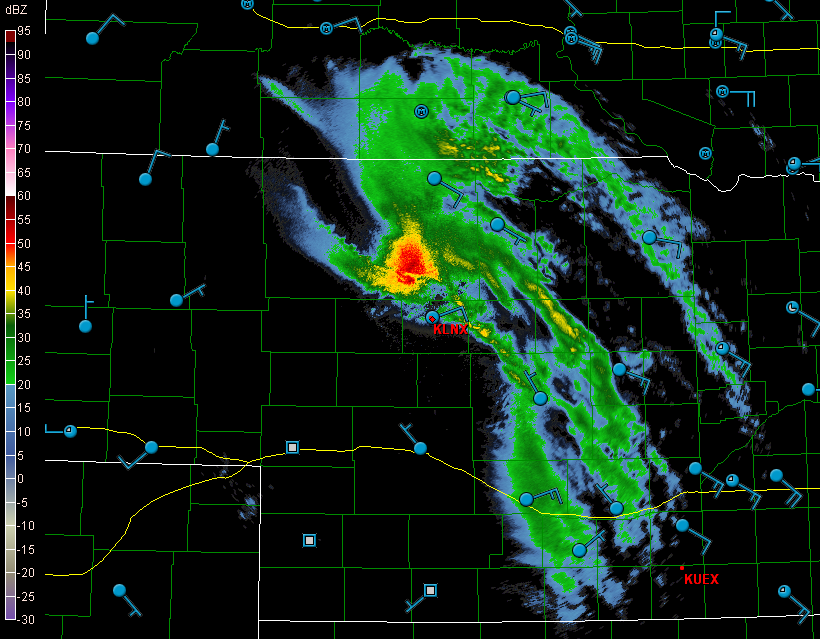
While my attitude toward August may seem patronizing, this month is capable of producing an occasional potent surprise. On August 24, 2007, I was sitting in the Hastings library when a line of storms formed just to the west and drifted directly overhead. I had my laptop with me with GR3 running, but my forecasting skills and overall experience were still pretty embryonic, and I dismissed some telltale signs, both radar and visual, because forecast models indicated a straight-line wind event.

The storms matured overhead, blasting Hastings with rain and lightning, and then moved to the east and steered an EF-3 tornado through the town of Potterville. I could have easily intercepted it if I had known what the heck I was doing. There it was, a perfect chase opportunity, gift-wrapped with a large ribbon and dropped smack into my lap, and I was too dumb to untie the bow. Aaargh! Four years later, I could still whap myself alongside the head.

But God showers his kindness even on the ignorant. My first successful chase was eleven years earlier, back in August of, I believe, 1996. I don’t remember the exact date, but I can assure you that in those days, cluelessness was a level of expertise I had yet to attain. However, I had at least learned a few things about storm structure and a few concepts such as shear and CAPE. So when the morning blossomed into an exceptionally sticky day–dewpoints had to have been in the mid-70s–and when I noticed clouds in the afternoon leaning over and curling at the tips, I sensed that something was up.

Around 4:30, I happened to glance out of one of the wrap-around windows at the place where I worked and did a double-take. A wall cloud was forming just a mile or so to my south. Hot dang! I watched it for a bit as it moved eastward, then decided to do something about it.

Leaving work early, I hopped into my little Nissan Sentra and blasted after the storm. I had no laptop, no radar, no weather radio, no experience, and very little knowledge. Instinctively I stayed to the south side of the storm. But as it neared Ionia, I could no longer make out cloud features. I wasn’t even certain that the storm still existed. I hit M-21 and traveled east a ways, then north, smack into the precip core. Yep, the storm was still there. But where was the wall cloud? Was there still a wall cloud?

Emerging from the rain, I headed back west, then south down M-66, effectively circling the supercell. As I approached Ionia from the north, the wall cloud came once again into view. Cool! The storm most definitely still had its teeth.

I tracked behind the storm down M-21, getting right to the rear edge of the circulation. Near Muir, a streak of white condensation shot suddenly out of the woods on the right side of the road half a mile in front of me. Was that a tornado? I wasn’t sure, but it looked mighty promising. Also a bit unnerving. I dropped back and put a little more distance between me and the updraft area.

A while later, somewhere in the open country around St. Johns, I parked and observed as the wall cloud reorganized east of me. While I didn’t realize it at the time, I was watching a classic supercell, as nicely structured and impressive as anything I’ve seen out in the Great Plains. It tightened up, with a nice inflow band feeding into it. Then, to my astonishment, a beautiful, slender white tube materialized underneath it a mile away. Extending fully to the ground, the ghost-like tube translated slowly to my right for a distance of probably no more than half a mile, then dissipated. I had just seen my first tornado!

At that point, the storm weakened. No doubt it was just pulsing, but I dropped it and headed for home. However, I soon discovered that another storm was right on the heels of the first one, making a beeline toward me down M-21.

What were the odds that it, too, would be a supercell? Plenty, of course, but to me at that time they seemed as remote as lightning striking twice in the same place. Nevertheless, something told me that I needed to exercise caution, a hunch that verified as I headed back into Muir. An evil-looking flying saucer meso was approaching the town. Hmmm…maybe it would be prudent of me to drop south.

A couple miles out of the path of the updraft, I parked, got out of the car, and stood on the roadside listening to the thunder grumble and watching as the mesocyclone drifted uneventfully over Muir and vanished off to the northeast. Then I climbed back into my vehicle and headed back to M-21, and west toward home.

I was stoked. I had witnessed my very first tornado! Wow! Thank you, Lord, thank you, thank you, thank you!

It was a milestone in my life so huge that hitting the deer just outside of Ada seemed like practically a non-event. Within a nanosecond, the yearling bounded out of the woods and into my path, driven by a powerful urge to bond with my radiator. Much to both of our chagrin, it succeeded.

But you know, I love a good story, and I recognized all the elements of a great one, a real red-letter day. Not only had I experienced my first successful storm chase, but to top it off, I had also collided with a whitetail and demolished my front end. It doesn’t get much better than that–or at least, it wouldn’t until fourteen years later on May 22, 2010, in South Dakota. That was the ultimate storm chasing experience. But that’s another story.

As for this story, all fun and excitement aside, I had learned a sobering lesson about the dangers of storm chasing. I had come face to face with the dark side of nature–with a force that, beautiful as it was, was also fearful, uncontrollable, and deadly, capable of wreaking havoc on a scale that beggars description. No question about it, deer are dangerous. I enjoy seeing them at a distance, just not up close.

Oldies But Goodies

Sorry–I seem to have let an entire week slip by without posting. Many bloggers have a knack for slapping out short, cogent posts in 15 minutes or so, but that’s not a gift of mine. Just about every post takes me several hours to write, particularly the ones that include musical exercises. So when I have other things packing my schedule, the prospect of sitting down and creating a post can seem daunting.

That has been the case this week. Could be a streak of just plain old laziness somewhere in the mix, too, but mainly, these past few days have been busy ones. My brothers Pat and Terry arrived for a two-week visit Monday, so family has been a priority. And work still goes on, regardless–gotta make a living.

Today my bros, my sister, Diane, and I headed to Newaygo, rented some kayaks, plopped them into the Muskegon River, and spent the afternoon taking a delightful 6-mile drift with the current. The Muskegon is a surpassingly beautiful stretch of water. I saw three bald eagles soaring overhead, slews of large turtles sunning themselves on logs, several kingfishers, a green heron, and brilliant red cardinal flowers rimming the banks in swampy areas. Altogether it was a most satisfying day.

But of course, as I said, I haven’t had time to write. So I figured that instead, I’d refer you to a couple of links to archived articles. The first is one I wrote one year ago, titled “Will I Ever Become a Good Jazz Improviser?” The second article is for storm chasers by guest poster Andrew Revering of Convective Development, Inc., on how to forecast severe weather during northwest flow.

I hope you enjoy the articles, and will find your journey back to last August’s posts profitable and refreshing. As for me, I’m tired. It has been a long day, it’s now after midnight, and I’m going to bed. G’night!

Survivor Guilt: The Unseen Tornado Trauma

“The thief comes only to rob and kill and destroy; I have come that [you] may have life, and have it to the full.”–Jesus (John 10:10)

Forty-five years after he lost his younger brother in one of the 1965 Palm Sunday Tornadoes, Pete Johnson still finds it hard to talk about what happened that dreadful evening in northern Indiana. He feels responsible for his brother’s death.

The name Pete Johnson is fictitious. I doubt the man I interviewed yesterday afternoon would mind if I shared his real name or that of his brother, but my conversation with him is so fresh, and my topic so potentially sensitive, that out of care and respect I’m calling him Pete in this post.

Pete was with his family visiting an aunt and uncle in Dunlap, Indiana, when the deadliest tornado of the entire six-state outbreak swirled into view outside the picture window. As his relatives sought shelter indoors, Pete’s parents packed the kids into their car and took off down the road in a frantic attempt to outrun the tornado. They didn’t succeed. Pete’s dad told him that a house hit the car. All Pete remembers is experiencing a blow to the head and then regaining consciousness out in a field, where he’d been blown by the wind. Rescue workers rushed him off to a hospital. It would be some time before he learned that his younger brother, Mark, hadn’t survived.

Mark’s body wasn’t found until a week later, buried under debris in the devastated Sunnyside neighborhood. Pete wants to believe that his brother’s death wasn’t his fault. But still, after all these years, he wonders: What if…?

What if he’d gone straight to the car instead of hiding in the closet, as his aunt had told him to do? Maybe those few extra seconds would have saved his brother’s life. What if his family had ridden out the tornado at his aunt and uncle’s house, which sustained only minimal damage? What if…?

There’s no satisfying the what-ifs of survivor guilt. You can respond to them with your head, perhaps, but your heart doesn’t buy the answers, not when the wound goes as deep as the loss of a loved one taken by a disaster. There’s seemingly no closure, no tying off of the open ends, no last stone to turn after which the supply of unturned stones finally ceases. At the bottom of it all lies a tyrannical, perpetually haunting lie: “I’m to blame.”

People with survivor guilt suffer–and “suffer” is an appropriate word–from a form of self-imposed penance for not having been the one to perish instead of their loved one. Reliving the incident year after year, they blame themselves for failing to foresee the unforeseeable and stop the unstoppable, for not preventing things over which they had no power. Really, for not being God.

Tornadoes are quirks of the atmosphere, not so much objects as unfathomably powerful processes dependent on an ironically delicate balance of ingredients. Earlier this year I watched one take out the heart of an Illinois town, then disappear into nothingness seconds later. Like lions and Alaskan brown bears, tornadoes are magnificent but also deadly and unpredictable.

As a storm chaser, I’m captivated by the beauty and drama of tornadoes. Yet I’m also keenly aware of their dark side. Who isn’t? The human impact of tornadoes, when it occurs, is seldom conservative and often it’s wholesale. Homes blown to pieces. Trees debarked, debranched, uprooted and thrown hundreds of feet. Vehicles crumpled into balls of metal. Worst of all, bodies mangled and lives ended.

But there’s another kind of damage that can’t be seen. Long after the dead have been buried, long after houses and neighborhoods have been rebuilt, years after people have gotten on with their lives, a sadness lingers. And for many, survivor guilt haunts them. You can build a new home, you can buy a new car, but you can’t replace a loved one, and what do you do with your own wounded heart?

I believe there’s healing for those who struggle with survivor guilt. I don’t mean the sorrow of losing someone close; that will always remain, and it is not necessarily a bad thing. But the sting of guilt which serves no good purpose is exactly the kind of thing Jesus came to put an end to.

Let me be clear, as I share from a Christian perspective, that I have little interest in dogma, any more than Jesus did. The wounds that life can inflict are too real for game-playing. But just as it’s possible to glibly quote the Bible in a way that misses its meaning and heart, it’s equally possible to lightly dismiss the Bible and so miss not only its unnervingly pinpoint assessment of the human condition, but also the power and hope of the gospel for some very practical life issues.

The life, ministry, and teachings of Jesus reveal the heart of a God who desires that we should find true, deeply rooted peace in our souls that flows from the peace we have with him. For those who trust in him, Jesus has resolved the issue of guilt in all its forms, including survivor guilt, with a power and effectiveness that extend beyond the unpredictable events of our lives to a deep and certain, eternal foundation. In his execution on the cross, Jesus took everything that runs counter to the character and will of God and, absorbing it into himself as the eternal scapegoat for mortal mankind, put it to death. Then, in his resurrection, he opened the doorway to a new kind of life that is not subject to the values and limitations of this world.

This is fancy language, but for those who struggle with survivor guilt, the bottom line is simple: God looks at you and says, “Not guilty.” His heart toward you is that you should have life, not death; peace, not self-recrimination. That’s no mere religious proposition–it’s the living, breathing, passionate longing of God for your best, your freest, and your highest.

Given the reality of what God desires for you, the question isn’t whether you could have done something that might have saved your loved one. You’ll never know. That question is a deception from the devil, who loves to torment people with issues that have endless complexities and no resolution. It’s really no question at all–it’s a prison sentence and a distraction from the simplicity of faith. The true, powerful question is whether you’ll stop holding yourself accountable when God himself doesn’t, and stop beating up an innocent person whom he loves very much: yourself.

As you consider that question, here’s another one to contemplate along with it: If the situation had been reversed and you had been the one who perished while your loved one lived, would you have wanted your surviving loved one to live the rest of their days with the guilt that has haunted you? Wouldn’t you rather have desired with all your heart that he or she would think of you with love but not guilt, and fulfill the gift and potential of their life in freedom?

What you would want for your loved one would surely be your loved one’s desire for you. Love does not condemn, but frees and blesses.

I realize that what I’ve proposed is easier said than done. I just want to put the possibility before you–the seed of a new way of thinking which, I hope, can make a difference for you. I’m well aware that I haven’t experienced what you’ve experienced. My struggles have been my own. Yet they have been significant in their own right, and in the face of them, Jesus has made me a freer man as only Jesus can. So my words to you are spoken both humbly and frankly, with a longing that you should know peace at last, peace that only the love and grace of God can bring.

One of the titles by which the Scriptures call Jesus is “Prince of Peace.” The peace he offers rests not on life circumstances, but on an interpersonal relationship with him in which the quality of life that resides in him flows to us. It is a life in which guilt, shame, and torment can’t be found. If you belong to him, then the peace which is native to that life is more than his will for you–it is your very birthright as a child of God.

My prayer for you, if you struggle with survivor guilt, is that your birthright will become real to you in a way that frees you from a weight that is not really yours to carry. Bring it to Jesus and trust him with it. You don’t know what to do with it; he does. Letting him do so is a journey he’s eager to make with you if you’re willing to make it with him.

Spam Rant

Excuse me while I depart from the normal storm-, jazz-, and saxophone-related material on Stormhorn.com long enough to let off some steam. Sorry, but I’ve had it up to here with email spam, and I feel a profound need to vent if not outright vomit.

I have deleted, I have blocked, I have blacklisted, I have steadily added keywords to my spam filter, and still the unwanted sales messages pour in daily, relentlessly. They are tasteless. They are offensive. They are irritating as hell. And, at least where I’m concerned, they are worse than ineffective–that is, unless the goal of the unscrupulous marketers who send them is to infuriate me. In that, they’re succeeding. As for getting me to buy their products, never in a million years are they going to see a solitary farthing from me for their…

* Cheap Swiss Watches. Hey there, Spammer, why not just stand on a street corner in a rain coat with big interior pockets filled with your trashy fake Rolexes and hawk them to passers-by? That’s the time-honored way.

* Sex Products. Pardon my bluntness, Spammer, but you’re a lot more concerned about the size of my penis than I am, and if I felt otherwise, I wouldn’t come to you for help.  As for “sex pills,” what kind of vast quantities do you think I consume? Judging by the volume of email you send me daily, a dump truck ought to be pulling up to my place once a week and restocking my supply of your cheap Viagra through a coal chute. But if you want the truth, I’m not using your products at all, and I never will.

So stop calling me “User Bob” in your subject lines, because I’m not a user. And while you’re at it, “Friend Bob” doesn’t work with me either. I know you think that using my name and calling me “friend” is the Marketing Magic Button, but here’s a tip: Disingenuousness is never good marketing. I’m not your friend and you’re not my friend. You’re a sleazy, greedy, unprincipled, disrespectful purveyor of sham products that you’re marketing illegally, and if I knew of a way to shut you down, I’d do it in a heartbeat.

* College Degrees and Diplomas. Let me get this straight: I “deserve” a master’s or doctor’s degree and you’re the folks who are going to help me get one in just 6 weeks. Gosh, what a great idea. I’ll consider your offer of a cheap and easy graduate education once you learn how to write and spell on at least a 3rd-grade level.

* Cheap Software. Guess what? I can find my own cheap, not to mention free, software online without your help. I don’t need your cheap software. I don’t trust your cheap software. I don’t want your cheap software. And I’m not going to buy your cheap software. Take your cheap software and stick it in dark, sunless posterior accommodations.

I suppose it goes without saying (though I’m going to say it anyway) that I delete all such messages without opening them as soon as I see them. What amazes me is the sheer audacity of the folks who send them. We’re talking about an entire spam marketing industry that is premised on violating people’s communication boundaries, an industry that is all about peppering their unwilling database with an endless supply of unwanted sales messages. It’s the good old shotgun approach: If you shoot enough pellets, a few are bound to find their mark, and hang whoever else they hit.

The approach must work; otherwise, such an industry wouldn’t exist. But of course, spamming is illegal, and I marvel at the willful dehumanization that lies behind it. Spam filters are the modern counterpart of a “No Solicitors” sign to a vacuum cleaner salesman. In developing technology that enables them to slide over, under, and around those filters, spammers are saying, in effect, “Nuts to your sign, nuts to your closed door, and nuts to you. I’m coming in anyway!”

A Hoover salesman who tried to sneak in through a side window would deserve to have a shotgun stuffed in his face. Unfortunately, no virtual shotgun presently exists that can inspire spammers with a sudden ethical awakening.

Wouldn’t it be nice, though, if one did? Wouldn’t it be extraordinarily cool if someone would develop a spam filter that not only deleted the most sophisticated forms of spam, but that could also, at the user’s discretion, trace its way back to the sender and wipe out their entire database? Just a thought.

Hmmm…

Hey, there, Scouts, if one of you is looking for a project for your Hacking Merit Badge, have I got a fantastic idea for you!

1965 Palm Sunday Tornado Book: The Next Phase

Even as my book “The Giant Steps Scratch Pad” nears completion–it now awaits only the cover, which is being designed by a graphic designer friend of mine–my other, more ambitious project is also moving along. That would be my book on the 1965 Palm Sunday Tornadoes.

With important (to me, at least) information in my hands and a key interview now completed, the latest delay has been purely my own making. But it’s about to end. This afternoon I head down to Elkhart, Indiana, to interview my first two tornado survivors, one a retired police officer and the other an emergency worker who helped with rescue operations at the Midway Trailer Court.

This is exactly the boot in the butt I need to get myself going on the next phase of the book: firsthand accounts of tornado survivors. In the months to come, I anticipate making trips to northern Indiana and southeast Michigan, not to mention places in my hometown area of Grand Rapids, in order to get people’s stories straight from the sources.

If anyone reading this post was directly involved in the tornadoes (that is, you got hit by one of the tornadoes or otherwise witnessed a tornado in action) or knows of someone who was whom you think I might want to interview, please leave a comment on this post or else contact me.

Also, if you know of photographs of the actual storms that aren’t already in common circulation, I’d be keenly interested in seeing them. I’m not talking about damage photos, nor am I talking about photos such as the twin funnels hitting Midway that are accessible online. Rather, I’m thinking of old, long-forgotten photographs that might be sitting in your dresser drawer that you or your Uncle Pete snapped with the old Brownie camera. That kind of picture.

This next part will take time to complete, but it should be easier overall than the first part, particularly the second chapter. More updates will follow when I have news that’s worth sharing.

An Independence Day Double-Header: Summer Weather Is Here

It’s July 4, Independence Day. Happy Birthday, America! For all the problems that face you, you’re still the best in so many, many ways. One of those ways, which may seem trite to anyone but a storm chaser, is your spring weather, which draws chasers like a powerful lodestone not only from the all over the country, but also from the four corners of the world.

no images were found

This has been an incredible spring stormwise, but its zenith appears to have finally passed for everywhere but the northern plains. And right now, even those don’t look particularly promising. That’s okay. I think that even the most hardcore chasers have gotten their fill this year and are pleased to set aside their laptops and break out their barbecue grills.

Now is the time for Great Lakes chasers to set their sights on the kind of weather our region specializes in, which is to say, pop-up thunderstorms and

no images were found

squall lines. The former are pretty and entertaining. The latter can be particularly dramatic when viewed from the eastern shore of Lake Michigan, sweeping in across the water like immense, dark frowns on the edge of a cold front. If you enjoy lightning photography, the lakeshore is a splendid place to get dramatic and unobstructed shots. Not that I can speak with great authority, since so far my own lightning pictures haven’t been all that spectacular. But that’s the fault of the photographer, not the storms.

The images on this page are from previous years. So far this year I’ve been occupied mainly with supercells and tornadoes, but I’m ready to make the shift to more garden variety storms, which may not pack the same adrenaline punch but lack for nothing in beauty and drama.

July 4th is a date that cold fronts seem to write into their planners. I’ve seen a good number of fireworks displays in West Michigan get trounced by a glowering arcus cloud moving in over the festivities. But tonight looks promising for Independence Day events. Storms are on the way, but they should hold off till well after the party’s over.  That means we’ll get two shows–the traditional pyrotechnics with all the boom, pop, and glittering, multicolored flowers filling the sky; and later, an electrical extravaganza, courtesy of a weak cold front. A Fourth of July double-header: what could be finer than that?

Street Musician on the Paul Henry Thornapple Trail

Yesterday I made my first dollar ever as a street musician. It wasn’t a conscious effort. I’ve never busked in my life, and if I were to take up busking as a serious practice, I wouldn’t choose the place I was at. For that matter, the term “street musician” doesn’t at all capture the essence of either my location or my activity.

I was out on the Paul Henry Thornapple Trail in Middleville, one of my favorite outdoor spots to practice my saxophone. The Paul Henry is an old railroad bed that has been converted to a paved hiking trail. It winds through an area of considerable natural beauty, blessed with an impressive diversity of habitats and a commensurately large variety of wild birds.  Along the south side of the trail, the lovely Thornapple River flows serenely by. To the north, an ancient millpond serves as a haven for sandhill cranes, great blue herons, mute swans, and other waterfowl. Red-headed woodpeckers flit among the trees, and farther down, where the open marsh grades into a hardwood swamp, cardinal flowers punctuate the shade-dappled trailside with exclamations of crimson.

I love to take my sax out to the trail, out to the bridge over the short channel connecting the Thornapple River to the millpond, and practice my horn. I was doing so yesterday evening, hammering out some material in the keys of Eb and F#, when a red-headed woodpecker flew up and perched on the trunk of a small tree not fifteen feet away. It was a striking bird, with black wings and upper body, a white breast, and a shocking red head–a sight rarely seen in these parts but one you can’t miss when it’s in front of you. However, not being a seasoned bird watcher, I wasn’t quite certain it was a woodpecker.

So when an elderly couple came strolling along the trail, I addressed them. “Did you see the bird that flew into that tree?” I asked. “It’s got a bright red head. I think it’s a red-headed woodpecker.  Do you know your birds? Maybe you can tell me.”

The man said no, he didn’t know what kind of bird it was, but he wanted to give me something. He unfolded a dollar bill that he had in his hand and handed it to me. “We’ve been listening to you down the trail,” he said with a smile.

I laughed and accepted the dollar bill from him. “Thanks!” I replied. “I think I’ll frame it. That’s the first dollar I’ve ever made as a busker–and I’m not even busking!”

The three of us talked for a while about the woodpeckers, and music, and the beauty of the trail. Then the couple went their way and I pocketed the dollar and returned to my practicing.

One of the rewards of practicing outdoors is the variety. You never know what you’ll see or whom you’ll meet.

And with that thought, it’s time to end this post and go practice my horn. See you in July.

Fiasco in the Farmer’s Field, Part 2

(Continued from Part 1) This was one steamed sheriff. He came across even-keeled enough, but he appeared to be seething just below the surface. We handed him our licenses and he took our information. Then he proceeded, in a sort of tightly controlled fury, to vent. It seemed that earlier in the evening, one of the numerous storm chasers who were tracking the tornadoes had blasted past this guy at over 90 miles an hour. Having his hands already full at the time, the sheriff couldn’t give pursuit. He was understandably infuriated at the chaser’s reckless driving.

Now we and the rest of our contingent in the field were getting the backdraft of this officer’s anger. Evidently he had concluded that storm chasers as a group thought they owned the road. I’m sure there was more behind his attitude than this alone, but the speeding chaser, whoever he was, certainly didn’t help matters any.

The sheriff had already arrested one of our group on the pretext of having written a bad check something like 20 years ago, and now he appeared to be deciding what to do with us. Ben and Adam once again did a great job of communicating with this man, who seemed to progressively cool down as we complied, listened, and affirmed his grievance. He made it quite clear, however, that our pilgrimage across the farmer’s field was going to cost us. If we didn’t fork over whatever yet-to-be-determined amount was required, then he would see to it that bench warrants were issued and we’d wind up paying a whole lot more.

On the whole, I heard plenty of anger and threatening and zero concern for our situation. In the end, though, the cop drove off without further incident and left us alone in the darkness to wait for our ride.

It occurred to me that, uncomfortable as our situation was, I had my travel bag with me and could at least exchange my wet footwear for some nice, dry socks, and my mud-splattered shorts for some clean jeans. Doing so made life more pleasant as we waited for Mike Umscheid to show up.

And the wait wasn’t so bad. It was a good opportunity to get to know Adam and Danny, whom until this day I had never met, and Ben, a fellow Michigan chaser I had first connected with just a few months prior. These are all young guys in their mid to late twenties, but they’re passionate, knowledgeable, and capable chasers with rapidly growing track records. I think it’s a safe bet that May 22 is one day we’ll all remember.

A couple hours passed and Mike finally pulled up. By this time, Ben and Danny had determined to withdraw some money from the ATM and post bail for the fellow chaser, a friend of theirs, who was sitting in the Ipswich jail. So off went those two with Mike, leaving Adam and I sitting by ourselves. A while later, up drove a police car with a special delivery: the chaser in question. It seemed that the charges had been dropped, the chaser had been released, and the sheriff’s deputy–a young guy with a refreshingly pleasant, friendly demeanor–was kind enough to drop him off with us at the Shell station.

This was another chaser whom I had never met until this day, and he had his own story to tell which I won’t get into here. He and Adam talked and I mostly listened. The man was naturally upset about being detained, but he said that the two officers who kept watch over him at the jail treated him well and enjoyed talking with him about storm chasing.

More time passed. It was getting onto dawn when Bart rolled into the parking lot–or rather, when my buddy Tom pulled in driving Bart’s vehicle. Bart was sound asleep in the passenger seat. The guy was utterly exhausted, but he revived when the three of us clambered in.

We headed back east to Aberdeen, where Bart and Mike Umscheid had secured hotel rooms for everyone. My chase partner Mike Kovalchick had a one-bed room, but believe me, at that point the prospect of sleeping on the couch was pure bliss.

I don’t know what time I finally awoke, but when I did, Mike was gone. He and the other vehicle owners were back out at the field, where the farmer–after getting a damage estimate from his insurance agent and securing agreements from all of the vehicle owners–hooked up his tractor to the vehicles and pulled them out.

Mike’s vehicle was a mess, but it was nothing that a trip to the car wash couldn’t cure. Bill and Tom took to the hoses, and I don’t know how many quarters they fed into the wash, but it was a ponderous quantity. The amount of clay caked on that Subaru was just unbelievable; there seemed to be a never-ending supply of it in the wheels, the wheel wells, and underneath the vehicle, but eventually it all came off. Then the four of us headed over to Walmart, grabbed a bunch of cleaning supplies, and went at the interior. When we were finished, Mike’s Outback looked fit for the showroom–sparkling clean, as pristine as if it were brand new, which in fact it was. This had been one heck of a break-in for it, but it had handled the rigors beautifully and come up smiling.

Mike mentioned that the farmer finally did understand why we’d driven onto his field. Once he saw the barn that the tornado had destroyed a short distance from where our road had dead-ended, he evidently got the picture of how things had been. On his part, he just wanted compensation for his damaged property and the time it took to haul out the vehicles. That was only fair. If someone drove up on my lawn in order to avoid colliding with a cement truck, I’d understand completely, but I’d still want help getting my lawn back in shape.

The next day, headed west on another chase, the four of us passed through Ipswich and I snapped a photo of the Shell station for memory’s sake. In case you were wondering why there’s a picture of a gas station at the top of this page, now you know.

If any two people in this whole affair deserve to have medals struck for them, those two are Bart Comstock and Mike Umscheid. If either of you gentlemen happen to read this post–thank you! You drove yourselves far beyond the dropping point to make sure that your fellow chasers were all safe and taken care of. I regret meeting you for the first time in such circumstances. Yet if things had been different, I’d never have gotten to see you guys rise to the occasion so magnificently. I and everyone else in that field owe you a debt of gratitude.

The whole incident is now five weeks behind me. It seems like a year. A lot of life slips by before you know it. But from that day’s fantastic chase, to the hair-raising ride across the field with tornadoes closing in, to the night-long vigil at the Ipswich Shell station, this is one story I’ll be telling for as long as I have a storytelling breath left in me.

Fiasco in the Farmer’s Field

So there we were, a whole bunch of storm chasers, stuck in the middle of a flooded field north of Roscoe, South Dakota. Why were we there? Believe me, it wasn’t for the beer.

It was Saturday evening, May 22, 2010. A few minutes earlier, caught down a dead-end road with a snake’s nest of tornadoes breathing down our neck, we had taken last-ditch, evasive action by bailing south down the fence line, and finally, cut off by standing water, out into the field until we could go no farther. Then we braced ourselves and rode out the storm.

It was the closest call I can imagine experiencing without going airborne. A funnel materialized right in our midst, barely missing one of the vehicles. Rear-flank downdraft winds in the neighborhood of 100 mph blasted us. But in the end the storm moved off, having destroyed an old barn north of where the road had dead-ended but leaving us none the worse.

Except that now we were stuck in a rain-soaked, flooded field. And a new set of problems began to emerge.

Most of the guys in the other vehicles were people whom I had never or only recently met, but whose names I was well acquainted with. Two of them, Bart Comstock and Mike Umscheid, became the heroes of the day–the only guys who managed to make it out of that morass with their vehicles and subsequently pushed themselves well beyond exhaustion to make sure that every last man-Jack of the rest of us was accounted for and found lodging for the night.

Now, I’ll be the first to say that I probably don’t have all the details straight. It was a complex scenario, and to this day I still don’t know who all was involved. To the best of my understanding, though, Bart notified local authorities that a bunch of chasers were stuck out in a field, and the authorities notified the property owner, and the property owner was majorly pissed.

Back in the field, the first news we got–in our vehicle, anyway–was that three tractors were on the way to pull us out. By this time, the sun had set and it was dark, with lightning from other storms in the area flickering all around. I didn’t relish the thought of spending the rest of the night out in the middle of nowhere, so I was glad to hear that help was on the way. But that hope soon got dashed when we learned that the farmer was mad as hell at us and had no intention of helping us out, or, for that matter, of letting us leave.

This just flat-out blew my mind. From my perspective at that point, the man had damn near gotten us killed by plowing over our escape route, and now he was angry at us for fleeing across his field in order to preserve our lives. What were we supposed to do, sit there and let the tornadoes hit us? If we hadn’t taken the action that we did, chances were good that we’d have wound up on his property anyway as a bunch of crumpled vehicles and injured or dead chasers. It amazed me that anyone would have such little regard for human lives.

Those were my thoughts at the time. In retrospect, I think the farmer simply didn’t understand what we had been up against, any more than I and my fellow chasers understood what he was up against. Seeing through another person’s eyes doesn’t come easily. We are hampered by the sheer force of our own perspective. We take limited information, process it through the filter of personal experience, and draw swift conclusions colored by self-interest without considering what other pieces of the puzzle may exist.

This particular puzzle was a large one and I’ll never know all the pieces that were involved. I just know there were a lot.

There were us chasers who, having survived the tornadoes, found that our ordeal was far from over. There was the farmer, who had just gotten word that a bunch of crazy storm chasers were stuck out in his field after driving across his newly planted wheat. There was a local sheriff with a lot on his plate after a large tornado had plowed through his area, who–partly due to an infuriating experience with a storm chaser earlier in the evening–used his authority in a way that, in my opinion, tarnished his badge.

There were also some drunken farmers who, as I understand it, tore an antenna off one of the chasers’ vehicles and tried to pick a fight with its owner. There were other locals who showed understanding, goodwill, and helpfulness toward both the farmer and the chasers. There was one from our number who got arrested on the pretext of a ridiculous charge, and there were the deputies who treated him with courtesy and interest during his brief detention at the Ipswich jail. There were lots of people, each with a story to tell and each bringing a unique point of view to the mix.

It’s never wise to jump to conclusions in such cases. It takes time for details to filter in and the big picture to emerge, or at least a better view of it than a person is likely to get at first glance.

Thanks to Bart and Mike, all of us eventually made it out of the field that night. We had to leave the vehicles behind, but there’s a point where nothing else can be done and all a body wants is to get some rest. Through a mix-up I won’t even try to explain, I wound up separated from my group and found myself trudging across the field with Ben Holcomb, Adam Lucio, and Danny Neal. Lugging as much of our belongings with us as we could, we walked along the fence line–now a slippery mud pit strewn with intermittent post holes–up to the road. A pickup truck was waiting there. We threw our stuff into the back and clambered aboard.

The driver of the truck turned out to be the land owner. Whatever his mood may have been, he was decent enough to give us a ride partway up the road. At that point, we were delayed by a bottleneck farther up, so we got a chance to talk with the farmer and with another of his neighbors who walked up to the vehicle.

Ben and Adam did a good job of engaging these guys. I was in no conversational mood myself, but I listened and heard enough to conclude that this had been a terrible spring for South Dakota farmers. A massive amount of El Nino rains had flooded large swaths of cropland, delaying or altogether scuttling planting in some sections. Considering how hard these folks work to make a living and what a tough deal this year was handing them, I began to understand something of how the land owner might have felt: a hellish winter, ruinous flooding, tornadoes blowing through and taking out the power grid, and now this–a bunch of crazy chasers stuck in his field after tearing through his wheat.

The farmer drove us partway back up CR 130, then left us to fend for ourselves. Fortunately, his neighbor in the pickup ahead of us was willing to give us a lift. He was a decent man, sympathetic toward both his fellow farmer and toward us. A storm spotter himself, he seemed to understand what we’d been up against. He told us that if it had been any other year, we’d have had no problem, but that this year, many side roads in the area were impassable due to the rain.

The man dropped Ben, Adam, Danny, and me off at a Shell station in Ipswich. Power was out in the town thanks to the tornadoes, which had taken down high-tension lines back down the road in Bowdle.

I had been in touch with one of my chase partners, Bill Oosterbaan, via cell phone, and I gave him another call to find out his status. He, his brother Tom, and Mike Kovalchick were all with Bart, who had run out of gas en route to Aberdeen. Like us, they were stranded. Fortunately, Mike Umscheid had gone to get gas for them, so it was just a matter of waiting till he returned. Then Bart would drop off my buddies at a hotel and come for us.

The time now was something like 1:00, and from the sound of it, we had a few hours to kill before Bart would show up. There was nothing to do but hunker down and wait. My legs were coated with mud from trying to push out Mike’s vehicle earlier in the evening, and my tennis shoes were little more than big, wet clumps of black clay. The other guys weren’t quite such a mess as I was, but they were wearing T-shirts and it was cold out.

It was at this point that the sheriff drove up to check us out. When he learned that we were some of the storm chasers who had gotten stuck in the field, he smiled one of those smiles that tells you the person behind it is not your friend. “I’ve been looking for you guys,” he said. “I need to see your driver’s licenses.”

(To be continued.)