I Hope You Don’t Mind If I Repeat Myself

There are two broad aspects of productive practice on the saxophone, or for that matter, on any musical instrument. Those aspects are the intellectual and the physical. The intellectual side involves figuring out what you’re doing and why. The physical part is pure muscle memory, a matter of developing technique. Your goal as a musician is to gradually and increasingly knit together both of those aspects into a seamless whole. For that matter, neither of the two exists apart from other, but there are times when you will find that you’re weighting one concern more heavily than the other.

In this post, I’ll address a critical component of successfully developing the physical side. It’s really no deep, dark secret, but it eluded me for a long time, and when I finally discovered it, my technique–and consequently my playing overall–took a quantum leap forward. So, Grasshopper, I now pass on to you the chops-building key of the ages. Make the following wisdom your practice mantra:

Repeat, repeat, repeat.

I repeat: REPEAT.

Whether it’s a simple scale pattern, a complex lick, or a digital exercise that you’re striving to run seamlessly through all twelve keys, repetition is the vehicle that moves the material you’re practicing from that first phase of slowly piecing it together under your fingers, to internalizing it in a way where you own it and can produce it at a moment’s notice.

What do I mean by “repeat”? Simple. You play your material–slowly enough to play it well. Then you play it again. And again. And again. And again, and again, and again…

You increase your speed gradually as the material works its way into your fingers. Ten times, fifteen times, twenty times…what you’re doing is programming your fingers. It’s the same principle as learning to type. The more you do it, the less you have to think about what you’re doing as muscle memory takes over, converting the intellectual aspect of what you’re practicing into automatic response.

Repetition is not some strange concept. It’s the norm. It’s what you do if you want to become proficient on your axe.

It takes time. Yes, time. That’s one reason why an hour is really nothing once you become truly immersed in practicing your instrument. Two hours is more realistic–and believe me, once you discover the magic of the woodshed, you can go much longer than that, and you’ll want to.

Repetition isn’t a magic bullet, but it’ll go a long way to developing the stuff you need in order to be a great improviser.

So I hope you don’t mind if I repeat myself one more time:

Repeat, repeat, repeat.

Now…tell me what I just said.

Very good, that’s right…

Repeat.

Francesca and Friends at Grand Rapids Festival of the Arts

Next weekend the annual Grand Rapids Festival of the Arts will draw several hundred thousand people from Friday evening through Sunday afternoon. The festival, now over thirty years old, is one of West Michigan’s most popular springtime events–an amalgam of literature, art, dance, music, and ethnic food, with the operative word being variety.

On Saturday, June 6, I will be playing sax with Francesca and Friends on the Calder Stage from 3:15 to 4:00 p.m. If you follow this blog, then you’re familiar with Francesca Amari. She’s a stellar performer who covers the spectrum from jazz standards to pop to show tunes, and a lovely friend. It’s always a pleasure and privilege to share the stage with her as a side man, and it will be very cool to have the band featured on the festival’s main stage.

Obviously, I want to be in prime playing shape. I hope to spend some serious time this week practicing my horn after having been away from it for several weeks. A truly nasty bronchitis put me out of commission, and I’m still suffering from an irritating dry cough that feels as if a little gremlin were sitting inside me, tickling my lungs with a feather. The doc finally prescribed an inhaler for me Thursday to help me get past this thing, and I’ve spent some time getting reacquainted with my saxophone. Feels so good!

While time away from the woodshed unquestionably has a deleterious effect on one’s technique, I’ve found that it often frees up creativity. I don’t know why this is–I just know that it’s not a bad thing to take a break from my horn every now and then. I lose something, but I also gain something. And I’m not the only musician who has experienced this phenomenon.

Anyway, I’m back to my patterns, scales, licks, and interval studies. It’s nice to hit them afresh. What’s already there comes back quickly, and it has the advantage of feeling new.

But about the festival. Come on out and get an earful of Francesca and Friends, not to mention the many other sights, sounds, and savory tastes of Festival 2009. It’s a great way to spend a June afternoon in West Michigan.

“Oleo” a la Hancock and Brecker

How about a romp through Rhythm changes? I’m always intrigued to see the different ways that master musicians handle that most contrafacted of all chord progressions besides the blues. The tune in this case is “Oleo,” and the band is Herbie Hancock, Buster Williams, Al Foster, Bobbie McFerrin, and Michael Brecker.

The YouTube video you’re about to see is a truly weird, creative, and delightful rendition, with McFerrin scat singing and acting a total goofball…and obviously having a blast. But I don’t think there’s any doubt that while these guys are just dinkering around, loose and laughing, the level of musicianship and interplay is monstrous. And need I say, Brecker delivers on the tenor sax.

This is a funny, fun, and really insane musical excursion that I think you can only loosely call “Oleo.” But you’ve heard enough from me. Give the band a listen.

Chicken Soup for the Solo

The meds that the doc prescribed for me seem to finally be working their mojo. I’m still coughing, but it’s no longer a painful cough, and yesterday’s feverishness has passed. Today I went out and bought a bunch of Amish chicken and a whole passel of assorted veggies and rice, and I made up a huge potful of chicken soup. I’ve heard more than one person tell me that the old wive’s tale is true: homemade chicken soup has a wholesome, curative property. I believe it. People breathing their last gasp have been known to revive at a mere whiff of my chicken soup.

Anyway, it’s been a week since I’ve played my horn, and in the interrim, I’ve felt so lousy that I haven’t even thought about it. As for storm chasing, ha. Good thing I didn’t go down to Tornado Alley last weekend with Bill and Tom–not only would I have been miserable, but by now they would be, too.

Storms have been lighting up the Plains pretty much all week. My friend Kurt Hulst was out in Oklahoma yesterday with his pal Nick, and he posted some nice pics on his blog. I’m assuming he caught the supercells in northern Texas earlier today as well. Can’t wait to see those photos.

Of course, I’ve been out of the action. Out of practice on my sax, out of the picture for chasing storms. In another couple of days, though, I should be ready to rumble. I just hope the weather feels the same way. My head is finally back on my shoulders only barely enough that I might start giving a rip about the forecast models, and maybe even be able to make some sense out of them again.

Enough for now. Tornadoes can wait. Right now, a bowlful of chicken soup is calling my name. If I eat enough, I might find myself in good enough shape by tomorrow to blow a few notes on my saxophone. Chicken soup for the solo. I like that idea.

Rick Margitza Plays “My Foolish Heart”

The chest congestion that has dogged me since Saturday has blossomed into a very nasty cold, with a cough that concerned me enough that today I finally went to see the doctor. He slapped the stethescope to my chest, I breathed deep, and he said, “Oh, yeah.” Meaning, meds needed.

I now have two pills under my belt out of a 10-day, 30-dose prescription. If there’s any consolation to this, it’s knowing that I’m in the process of finally knocking this bug out after it has done such a thorough job of making my life miserable these last few days.

So I’m not going to write much. Instead, I’m going to share with you this YouTube link of tenor saxophonist Rick Margitza playing My Foolish Heart with the John Fedchock New York Big Band. Rick is an astonishing player–a stunning virtuoso with a magnificent command of the altissimo register, a beautiful and inventive use of angularity, and always, a very pretty, almost delicate tone that treats a ballad with great tenderness and sensitivity, even in the midst of  a torrent of ideas. Listen and be amazed.

And with that, I’m signing off and making myself a cup of tea.

Wedging into Tornado Season

Bill called to say that he and the crew just saw a wedge out there in western Oklahoma. The LSR gives the town of Crawford, near the Texas panhandle border, as the location.

Good for the lads–and the lass, as I understand there’s a new female member of the crew. As for me, sitting here in my La-Z-Boy sofa, nursing a chest cold and watching the radar, naturally I feel like shooting myself through the head. A wedge on a PDS day–and the show is just getting started. And I’m not there! AAAAAHHHHHH!!!!!!!

If there’s any consolation, it’s knowing that I’ve been able to make myself useful doing a little nowcasting. And it sounds like the team got some cool footage. Can’t wait to see it.

Mostly, though, I can’t wait to kick whatever is causing this blasted chest congestion and get out to take some video of my own. Tornado season 2009 is underway!

Shifting gears, last night’s gig at One Trick Pony with Francesca and Friends was a blast, even if I was feeling under the weather. Wright McCargar and I had a discussion about the impact of musicians on each other’s playing. In my experience, one bad musician can drag a whole group of good musicians down; and, conversely, one great musician can kick good players up to the next level. There’s nothing like being with really good musicians, and Francesca and her rhythm section are exactly that.

Moving back to storm chasing, it’s time for me to publish this post and then check out the radar. The storms bumping off of the dryline look to be going tornadic, and I’m thinkin’ that my buddies will have their hands full for the next five or six hours. Sure wish I was with them. But GR2AE ought to keep me entertained; maybe I can capture a few radar grabs to correspond with the photos that I’m sure will be coming back from out west.

Jazz and Storm Chasing: Facing the Trade-Offs

And so it begins in earnest. The 2009 Tornado Alley storm chasing season, that is. Me droogs Bill and Tom left today to chase this weekend’s opening action in Iowa, en route to the main play in the Oklahoma/Texas panhandle region. I couldn’t join them as I’ve got a couple of commitments, including a gig with Francesca Amari tomorrow night plus a search for new living accommodations.

Today’s setup out in Iowa was such that I did’t feel too much like I was missing out on something. The storms have turned out to be massive hail producers (LSR from five miles southwest of Greene: “All hail…very little rain falling”), but not a single tornado report have I seen, not in Iowa, not in Wisconsin, not in the entire CONUS.

Tomorrow and Sunday look to be a different matter, though, and I wish like anything I could be out there with the guys watching tubes drop. But as I’ve said, I’ve got commitments.

It’s funny how my two great passions–playing jazz and chasing storms–can conflict. But that’s how it is. You can’t chase storms when you’re on a gig, though ironically, sometimes the storms have come along and canceled the gig. Three years in a row, I got hailed out at the annual Grand Rapids Festival of the Arts. It doesn’t seem to matter who I’m playing with. I’m a freeking hail magnet, and in June or July, you book me for an outdoor event at your peril.

This year, I’ve actually adopted a policy of not accepting any gigs during the peak storm chasing months of May and June. That’s the time of year when the storm chaser in me outweighs the jazz musician. Tornado weather is seasonal in a way that jazz isn’t. Once those mid-levels heat up and the steep lapse rates of spring give way to summertime’s Cap of Doom, that’s all she wrote. I don’t have the time or money to chase the Canadian prairies. So I’ve got to grab my storm action when it’s prime time. This year, I hope to spend ten days or so in mid to late May out in Tornado Alley. I am looking forward to it so much I can practically taste it!

Meanwhile, Bill and Tom are out there headed for Oklahoma without me. Sniff! Ah, well. I hope those dirty dogs get skunked. No, wait…what I mean is, I hope my buddies see some really great tornadoes and get all kinds of cool footage that they can show me when they get back, causing me to grin in maniacal delight while dying inside.

Okay, let’s try that one more time. The compensation for not chasing is getting to do a gig at One Trick Pony in downtown Grand Rapids with Francesca, Dave, Wright, and Tommie–some truly fine musicians whom I absolutely love to play with. A Saturday night spent playing my sax is a Saturday night well spent, and I can’t wait to hit the stage with Francesca and Friends. If you happen to be in the vicinity, please drop on down to the Pony and give us a listen. You’ll like what you hear. The show starts at 8:00 and continues till 11:00.  Hope to see you there!

The Bob Hartig Quartet Plays the Thornapple Jazz Festival

This past weekend I had the pleasure of fronting my own jazz quartet for two consecutive days as a part of the Thornapple Jazz Festival. Now in its sixth year, the festival has begun to expand its reach beyond Hastings to other, outlying communities in Barry County. This year included Delton and Middleville.

Thus, on Friday the lads and I took the stage at the MidVilla Inn on M-37 just north of Middleville. The turnout was modest, but not at all bad for a small town that isn’t known as a hotbed of jazz. As for a rhythm section, I couldn’t have asked for better players. Ric Troll is one of the tastiest drummers and all-around musicians I know, with tremendous musical sensitivity. Dave DeVos is a seasoned and solid bassist who, like me, has a relentless thirst to grow in the mastery of his instrument. And keyboard man Paul Lesinski is nothing short of fabulous, a player of great inventiveness and the technical excellence to pull off anything his fertile mind conceives.

Together, these guys are my musical dream team. They made it easy for me to pull off my allotted two sets with the kind of energy and spontaneity that are the soul of jazz. If all it takes is one bad player to make a good band sound lame, it’s also true that a great band can boot a decent soloist up to the next level. It takes a certain baseline of aptitude and experience for that to happen, but once you achieve that level, then players the caliber of Ric, Dave, and Paul can lift you out of the ordinary and inspire you to stretch, to push beyond your normal, self-imposed limits and explore new musical territory. That, at least, has been my experience as a jazz saxophonist.

I was very pleased with our performance at the Mid Villa, and again Saturday night at the Waldorf in downtown Hastings. The Waldorf is one of my favorite restaurants, with out-of-this world cooking and absolutely stellar, award-winning microbrews, and I’ve wanted to bring a straight-ahead jazz combo there for a long time. Mike, the owner, finally booked my quartet for the dinner crowd from 6:30-8:30, and we got our chance.

Our song list ran the spectrum from bebop to ballads to Latin to jazz/rock, and included such tunes as “Anthropology,” “Footprints,” “Triste,” “Stolen Moments,” “Have You Met Miss Jones?” and “Song for My Father.” We even played one of my own originals, a Latin-flavored ballad that I wrote several years ago called “Tracy” in honor of a love lost but fondly remembered.

It was a joy to participate in the Sixth Annual Thornapple Jazz Festival, and an honor to be invited by the event’s driving force and musical manager, my friend Joe LaJoye. Joe, if you happen to read this post, thank you! The guys and I had a blast. Maybe next time around you’ll be able to take a breather from all the responsibilities of “makin’ it happen” long enough to sit in with your trumpet for a tune or two, eh?

Of Sax Practice and Railroad Tracks

I just returned from a nice, two-hour saxophone practice session out by the railroad tracks.

The railroad tracks?

Oh, I guess I haven’t told you about my practice habits. They have as much to do with where I practice as what I practice.

Living in an apartment, I try to be considerate of my neighbors. I like to think that they’d enjoy my music, but realistically, there’s only so much that even the most ardent jazz lovers can take of listening to the same licks, patterns, and scales repeated ad nauseum, blaring down the hallway and through the walls. So for years, my practice room has been my car. My routine has consisted of driving to the outbacks of Kent County and parking at various locations along the CSX tracks between Kentwood and Lansing, where I practice my horn and watch for the trains to roll by.

I love trains. Obviously, I also love playing my sax. It’s nice to be able to combine those two interests in a productive way. Tonight, as I do so often, I parked at one of my favorite trackside spots near a small community called, appropriately, Alto. I didn’t see any trains, but I had a most productive practice hashing out some diminished and diminished/whole tone licks, and woodshedding the Charlie Parker tune “Ornithology” in several keys.

I always return feeling good about my playing after a session like tonight’s. The time goes so fast! And that’s as it should be.

The best way to make a living is to earn money doing things we’d pay money to do. Playing the sax is one of those things. I can’t say I make a living at it, but it certainly supplements my cash flow; it’s part of the picture of my livelihood. I’ve been at it a long time now, and most of that time I’ve been practicing in my car by the tracks–or, during the warm months, often outdoors. If I ever do buy a house and gain an honest-to-goodness practice room of my own, I think I will still maintain my railroad track sessions. I’d miss them far too much not to. Habits are hard to break, and there’s no reason to break a good one in the first place.

Using Sequence in Jazz Solos: Some Exercises

Howdy, campers. As promised, I’m back with a few exercises on sequences that you can actually wrap your fingers around.

Before you proceed further, please take a moment to read my introductory post on this topic, written a couple days ago.

And now, assuming that you’ve done as I requested and acquired a foundational grasp of what sequence is and why it’s such a handy tool for the jazz musician, here’s the first exercise. It illustrates the concept of diatonic sequence. The sequence happens to move up by thirds starting on the chord tones of a C major 7, but it could just as easily move up or down by seconds, or fourths, or up and down at random intervals.

Diatonic Sequence

You could use the same pattern over a C7 by changing the note B to a Bb. But my point isn’t to show you how to outline a chord. It’s to demonstrate how the use of diatonic sequence provides a sense of logic and cohesiveness which you can use to advantage in improvising a jazz solo.

Sequence does such a good job at “making sense” of an idea that you don’t even have to play in key to sound good. In fact, “wrong notes” can sound very cool when you play them as part of a sequence. The temporary harmonic clash creates color and interest.

Sequentially mirroring an idea exactly, interval for interval, is one way to quickly slip out of key, letting the weight of the sequence rather than harmonic agreement justify the use of individually questionable tones. In the following example, root movement descends by major thirds.

Notice that the idea resolves to a chord tone. It’s cool to take your listeners for a temporary excursion into outer space, but you generally want to bring them back to planet earth again with a healthy dose of consonance.

Exact Repetion

Again, the movement downward by major thirds is just one possibility.

You can add further interest by shifting the rhythm of a sequence. The following shows the same sequence as above, but the six-note pattern is now imposed on a 4/4 setting rather than 3/4. I’ve marked the separations between each group of notes in the sequence.

Exact Repetition with Syncopation

Note that I’ve used the sequence over a different chord, an F#+7(#9), another nice application for the augmented sound implied by the major third root movement.

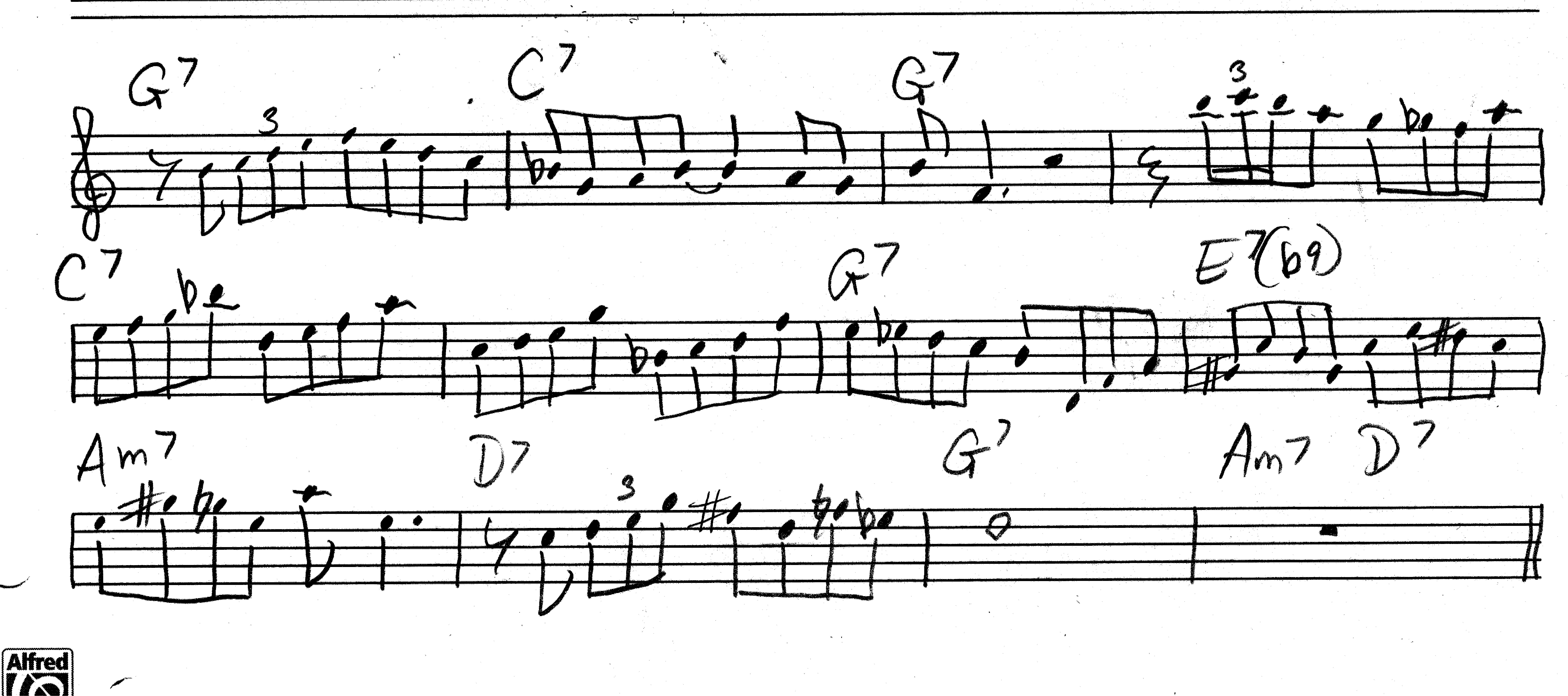
Finally, here is a twelve-bar blues to illustrate the use of sequence in an actual jazz solo. The ideas may seem a bit forced, but they give you a feel for how both diatonic sequence and exact repetition might be applied in an improvisation.

sequenceblues

The above illustrations just touch on the myriad creative and highly personal ways that sequence can be used in jazz solos. To recap: sequence can help you organize musical material in a way that creates cohesiveness and momentum, and that gives “wrong notes” a powerful sense of rightness when you want to play outside the changes.

Like any other component of music, sequence needs to be used judiciously. The right amount adds spice; too much just sounds overdone and even boring. Listen to how the greats of jazz use sequence, work with it yourself, take risks, and let your ear be the judge. And need I say…have fun!