Bracketing: Some Chromatic Exercises

In a previous article on bracketing for jazz improvisers, I described the melodic device of emphasizing a note by surrounding it with changing tones. Since bracketing is used extensively by jazz soloists, it makes sense to develop an approach for practicing this technique in a way that can help you apply it readily and easily to your improvisations.

The following exercises will help you develop chops for a kind of bracketing that I’ll call chromatic bracketing because the upper and lower neighbors are often both chromatically altered in order to achieve a half-step approach to the target note from above and below.

More commonly, the upper neighbor remains unaltered, diatonic to its key, while the lower neighbor is raised. You can also have fully diatonic brackets in which no alteration of either note occurs. In this post, however, we’ll deal with chromatic brackets.

Chromatic Intervals

Perhaps you’re familiar with the following chromatic scale exercise:

Chromatic Major Seconds

If not, you’ve got your work cut out for you. Hop to it, Grasshopper! It’s an abbreviation of a chromatic scale workout featuring the interval of a major second, and you need to know it throughout the full range of your instrument–not just the descending version shown here, but the ascending version as well.

“But why? What’s the point of mastering such a dry-as-dust technical exercise?”

Good for you! You’re thinking about practical application, not just building technique for technique’s sake. And when it comes to bracketing, the above exercise is a building block that can help give you mastery. Let’s call it step one in an organized approach to developing bracketing proficiency.

“Great, so what’s step two?”

I’m so glad you asked!

Target notes

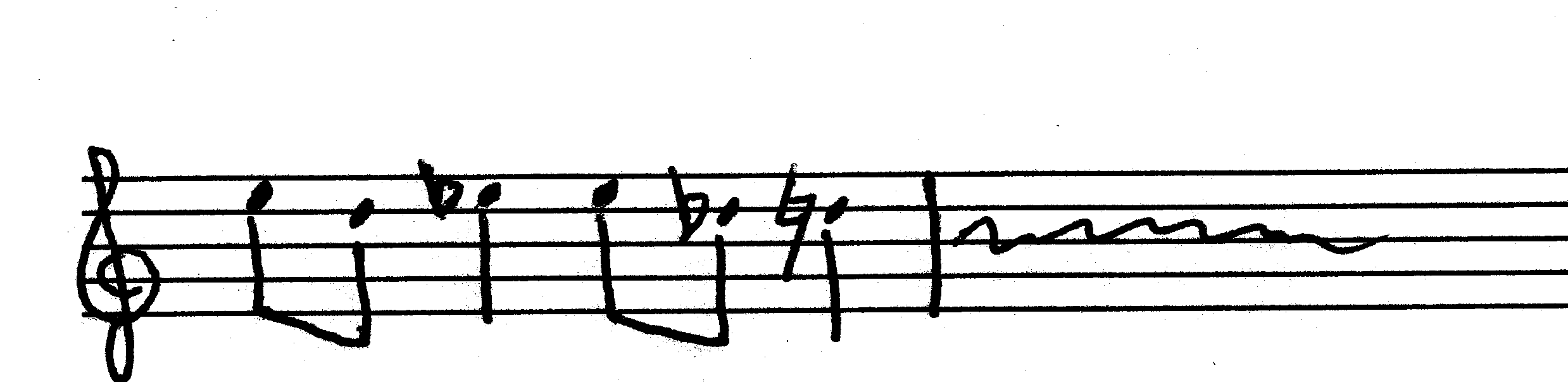
Each couplet of notes in the preceding exercise serves to bracket the first note of the couplet that follows it. For instance, E and D bracket Eb; Eb and Db bracket D; D and C bracket C#; and so forth. In each instance, you have a chromatic upper and lower neighbor surrounding a target note, thus:
Target Notes

So…step two: apply this pattern to the entire chromatic scale, up and down your instrument. (This is a great way to go about learning the first chromatic scale exercise shown farther up.)

Got it down cold? Good. In fact, a fantastic achievement for the time it took you to move from that last paragraph to this one. You’ll make Coltrane look like a piker.

Just messin’ witcha! I’ll be serious, now, promise. Let’s say that you have in fact worked through the exercise of chromatic brackets with target notes. The question still remains, how do you apply it to practical playing situations?

Presenting step three, where it all comes together…

Practical application

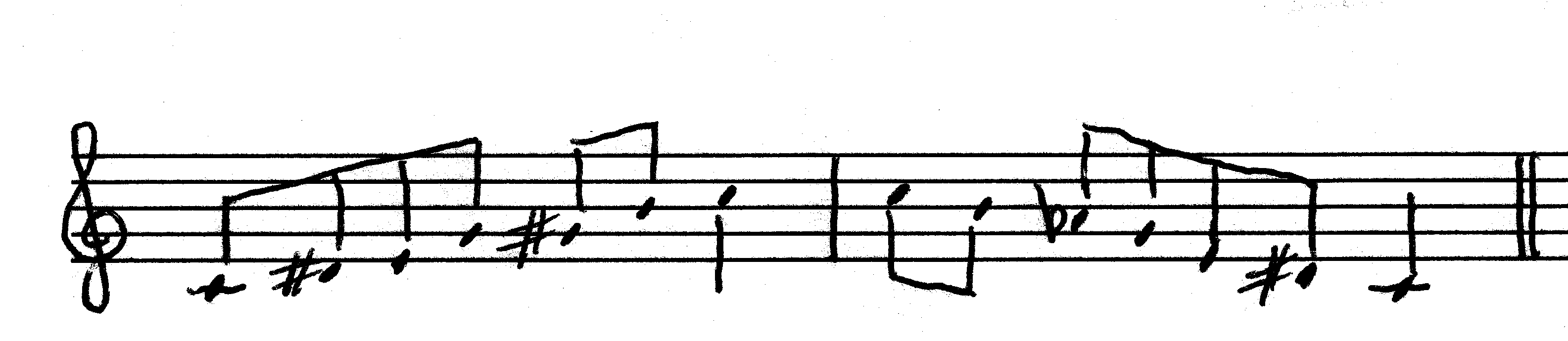
The following exercise consists of three licks, each of which begins with a chromatic bracket and a target note. I’ve supplied some chords to give each lick a context, but I haven’t tried to create any particular progression from one bar to the next, just offer three examples among a host of possibilities for utilizing the bracketing technique.

Bracketed licks

Note that the last bar leads with not just one, but two couplets from the chromatic scale exercise. You can use as many couplets as you wish in your playing, guided by your own sense of good taste, before resolving the last couplet to a target note that launches you into a new idea.

More options to choose from

The material here has concerned itself with chromatic bracketing based on the interval of a major second. But it’s only intended to get you started. There are plenty of ways that you can expand on the concepts shown here.

You can invert the couplets (e.g. D to E targeting Eb; Db to Eb targeting D; and so on).

Or you can use the interval of a minor third, which can help you get a better feel for brackets that use a diatonic upper neighbor and a chromatic lower neighbor (e.g. D to B targeting C; C# to A# targeting B; C to A targeting Bb).

For that matter, if you really want to get into it, you can work through the chromatic scale with all kinds of intervals–major thirds, perfect fourths, major sixths…take your choice. You can apply the principles described in this post to all of them. As you move beyond neighboring tones into wider intervals, I’m not sure you can correctly call what you’re doing “bracketing” anymore, but you can darn well call it useful.

One last thing: exercise three showed examples of licks that started with brackets. I wrote them this way in order to help you quickly connect the first two exercises to actual musical ideas. However, brackets can and should be used within lines as well, not just at their beginning.

That’s all for now. I’ve given you plenty to chew on. Now it’s time for me to go and eat.
Internalizing the Sound of the Augmented Scale

Just out of curiosity, I poked around on YouTube to see whether any video tutorials existed that would allow listeners to get the actual sound of the augmented scale into their ears. I came across this excellent lesson by guitarist Geoff Stockton.

Geoff does a great job explaining the construction of this symmetrical scale and giving its basic application to major seventh and minor seventh chords. His video not only helps you understand the theory behind the augmented scale, but very importantly, gives you a superb introduction to how the scale sounds. Listen and absorb!

The Augmented Scale

…John Coltrane and Oliver Nelson brought [the augmented scale] to the masses in the late ’50s and early ’60s. In more recent years, tenor legend and bandleader Michael Brecker (who passed away in January of this year) made good use of the scale, and required that Mike Stern, John Scofield, Pat Metheny, and other guitarists who played for him over the years also know how to harness the pattern’s power.

–from “Secrets of the Symmetrical Augmented Scale” by Josh Workman, EQ online edition

If you want to lend a touch of mysterious, Eastern-sounding chromaticism, angularity, and symmetrical sequence to your solos, consider the augmented scale. I’ve dipped into this unusual, colorful scale from time to time, and lately, in spending more time exploring its sounds and possibilities, I’m becoming captivated with what it has to offer.

The augmented scale is a hexatonic scale–that is, it only has six tones. It is also, like the diminished and whole tone scales, a symmetrical scale. This means that the interval relationships between scale degrees are repeated to create a symmetrical pattern. In the case of the augmented scale, moving upward from the tonic, the scale intervals are: minor third, minor second, minor third, minor second, minor third, minor second.

Here’s what that looks like on the staff.

C augmented scale

There are a couple easy ways to understand the augmented scale. One way, using the C augmented scale to illustrate, is to think of approaching each note of a C augmented triad with its leading tone–i.e. the note B leads to C, D# leads to E, and F## ( or more simply, G) leads to G#. Note that while in this approach you begin with the note B, the actual tonic of the scale is C.

Another way to picture the augmented scale is to superimpose two augmented triads with roots a half-step apart, then organize the resulting tones linearly in a scale. In the case of the C augmented scale, you would superimpose C+ on top of B+. Again, the actual tonic of the scale is C.

A variation of this approach is to superimpose two augmented chords with roots a minor third apart from each other. To get a C augmented scale, you would superimpose Eb+ (same as D#+) on top of C+.

As is also true of the diminished and whole tone scales, the symmetrical nature of the augmented scale makes its root ambiguous. The repeated pattern of a minor third and minor second produces not just one, but three possible tonics separated by a major third. In other words, when you learn the C augmented scale, you’re also learning the E augmented and G# augmented scales. This means that when you’ve learned the C, Db, D, and Eb augmented scales, you’ve learned all the rest as well. Nice, eh? You get all twelve scales for only a third of the work!

There’s plenty more to say about the augmented scale, but I’m not going to try to cover it all here. Dig inside the scale and discover its possibilities for yourself. Here’s a simple pattern to help you get started. The pattern is in C (and E, and G#/Ab). Memorize it, then transpose it to Db, D, and Eb.

C augmented scale pattern

Oh, yes–lest I forget, you’ll want to know how to apply the augmented scale. I’m still working that out myself, but here are a few pointers. Use the C augmented scale with
* a C+ or CM7.
* a C7 or C+7, but watch how you handle the #7. The chromatic tones can be viewed as passing tones, or they can become upper extensions if you alter the chord.
* a B7(b9) or B7 altered chord.
* an Am, Am6, or Am#7 chord.

You can also use the augmented scale with “Giant Steps” the same way you’d use a blues scale with the blues. But that’s a separate post.

This scale doesn’t come easily, but it’s well worth acquiring. However, it’s a more advanced study. You’d be wise to make sure you’ve got your basic major and minor tonalities down, including your cycle of dominants and ii-V7-I patterns, before you go digging into the more abstract stuff. Just my opinion. Take it with a grain of salt as you find your own way. Whatever you do, keep practicing–and have fun!

Kenny Garrett with Miles

When it comes to alto sax players, Kenny Garrett sits in the tiptop echelon of exciting contemporary voices. The man not only has formidable chops, but a deep understanding of how to use them to generate consistently electrifying performances.

This YouTube clip features Kenny playing with Miles Davis in Paris. As high-energy as the music is, I find the unspoken connection between the two men–the jazz patriarch and the keeper of the flame–to be almost as fascinating as Kenny’s solo. Davis appears mesmerized by the sax warrior’s unrelenting barrage of ideas, and Kenny seems inspired by the presence of the Legend. Whatever the dynamic actually was, evidently sparked by some microphone problems that Garrett was experiencing, the result is unquestionable. There’s a whole lot of music going on here.

I love Kenny’s use of sequence, repeated tones, and motifs as organizational devices. And check out his tone splitting toward the end of the solo. In every respect, both technically and conceptually, the guy is an absolute master. Wish I could get my arms around just half of what he’s doing!

Finding Jazz in the World Around Us

My sweet lady, Lisa, and I took a trip to Meijer Gardens earlier this week. Today, sifting through the photos I took as our tram ride wound along the curvy path through the world-class outdoor sculpture garden, and afterward as we strolled through the remarkable plantings in the children’s garden, I’m struck–as I often am–at how the elements of music are woven into the very fabric of our world.

Jazz is all around us. Form, space, unity, diversity, rhythm, dynamics, improvisation, color, texture, contrast, creativity–whether in music, nature, speech, literature, art, human relationships, or above all, our relationship with God, you’ll find the same qualities working together to create beauty and interest.

Consider the qualities of space and contrast. In a jazz solo, the notes you don’t play are as important as the ones you do. Too much clutter, too many notes in endless procession, ceases to communicate. As in writing and conversation, well-placed punctuation–held notes, brief pauses, and longer rests–helps to shape musical ideas and gives them breathing room. Yet the furious density of artfully placed double-time passages creates another form of color. Both space and density can be overdone; it’s the contrast between the two that helps raise a solo from the doldrums to vitality.

The massive red iron piece titled “Aria” is a great visual representation of the interrelationship between music and art. The piece has a rhythm to it, shape, space, contrast–all the aspects of a well-crafted jazz improvisation.

Aria: like a jazz solo cast in metal.

Aria: like a jazz solo cast in metal.

Here are a few more images from the sculpture garden and children’s garden that remind me of music and jazz.

What musical elements can you detect? Space? Sequence? Color? Dynamics?

What musical elements can you detect? Space? Sequence? Color? Dynamics?

This landscape sculpture creates unity out of contrast and serenity out of movement.

This landscape sculpture creates unity out of contrast and serenity out of movement.

If only I could play a solo as creative, spontaneous, and cohesive as this!

If only I could play a solo as creative, spontaneous, and cohesive as this!

Lisa: the beautiful song God has brought to my life!

Lisa: the beautiful song God has brought to my life!

Using Angularity in Jazz Improv

If you want to add interest and color to your jazz solos, anglify them. “Anglify” might not be a real word, but it ought to be, and it is now as far as this post is concerned. Word coinage is one of my prerogatives as a word wizard.

Anglify. It’s easy to get caught up in linear playing, weaving scales up and down like a stock market graph, but that approach will get old fast unless you mix it up with other melodic devices. Angularity is a good one. Wide interval leaps grab attention; they stand out like bold letters and exclamation points in a sentence.

Writing about angularity forces me to consider exactly what it is. If I were to define it, I’d say it’s the use of two or more consecutive interval leaps of more than a third in any direction. Fourths and fifths are commonly used in angular playing, but any large interval qualifies. The point is, you’re no longer playing notes in a straight line; you’re breaking up the melodic terrain into hills and valleys, moving out of the flatland and into the mountains.

Pentatonic scales are a rich source of fourths and fifths when you start doing interval exercises with them. You can also do exercises on fourths and fifths, or on any interval, using any scale or root movement.

Starting a line with an angular approach is a good way to say, “Listen to this!” Here’s a little diminished whole tone lick I’ve been woodshedding lately. It begins with a leap of an augmented fourth followed by a diminished fourth (aka a major third) up to the raised fifth of the D7 #5, #9 chord. (For ease of use, I’ve shown that note on the staff as Bb rather than A#.)

angular

Note how the arpeggio in the second half of bar two further breaks up the very linear, chromatic flow. The combination of linearity and angularity engages attention.

As always, take the above lick through all twelve keys. Try moving it through the circle of fifths to acquire facility in a lot of playing situations.

Emile De Cosmo and the Byzantine Scale

If anyone embodies the improvisational and technical aspects of jazz education, it is Emile De Cosmo. I’ve had the pleasure of getting to know Emile since the time he contacted me about an article I had written about jazz contrafacts, and I can tell you, the man is deeply knowledgeable, and as excited to share his insights into jazz theory and technique building today as he was back in my college days, when I first bought one of books in his Polytonal Rhythm Series.

Our initial conversation, back in early February, resulted in my adding another of his books, The Diatonic Cycle–a tour de force of the twelve major scales and their relative harmonic minor scales–to my practice library. Last week, after chatting with Emile on the phone, I purchased yet another book coauthored by him and his wife, Laura. A compendium of articles that Emile and Laura wrote for Jazz Player magazine, The Path to Jazz Improvisation is a treasury of insights into the vast array of scales and modes that are available to jazz improvisers today. At $14.95, the book truly is a steal–and no, Emile didn’t give me a free copy so I’d write him a glowing review*. I ponied up the money just like anyone else, and I’m glad I did. I know a fair amount about jazz theory, but there always seems to be something new to learn, and Emile and Laura’s book is proving to be a good source.

I’m thinking right now about the chapter I’ve been reading on the Byzantine scale. In his foreword to the book, David Gibson, editor of Jazz Player, writes, “When I read his chapter on the Byzantine Scale I almost fell off my chair. I had never thought about jazz in those terms. I suddenly realized that jazz improvisation has roots which go back much further than the jazz master of the 1920s, 30s, 40s, and beyond.”

Of course my curiosity was piqued by Gibson’s words. The Byzantine scale? I’d heard of it before, but never explored it. I think I had some vague idea that I had it already tucked in my pocket as some mode of the harmonic minor scale. And indeed, the Byzantine scale is related to the harmonic minor, but it is a scale unto itself, and a darned interesting one.

Probably the easiest way to conceive of the Byzantine scale is, as Emile describes, to superimpose two major seventh chords a half-step apart. For example, if you dovetail CM7 and DbM7 and then arrange the chord tones in successive order, you get the following: C, Db, E, F, G, Ab, B, C.

Another way to think of this is to approach every tone in a major seventh chord with its chromatic lower neighbor–e.g. for the DbM7 chord (Db, F, Ab, C), you would precede the Db with C, F with E, Ab with G, and C with B.

The De Cosmos recommend using the Byzantine scale with major seventh and dominant seventh chords that share the same root as the scale. In other words, you’d use a C Byzantine scale over a C7b9 or a CM7. At least one other application quickly suggests itself to me as I look at the structure of the scale, and that is to pair it with an altered dominant that is based on the second degree of the scale. For instance, by playing a C Byzantine scale over a Db7#9, you get both the flatted and natural sevenths (B and C), allowing the latter to function as a passing tone between the flat seventh and the root of the chord.

I have to say, though, that it may be a while before I dig into the Byzantine scale in earnest. Right now I’m focusing on the diminished whole tone scale, with some forays into both the augmented and diminished scales. Those pack challenges enough. But I think I can see a new area of woodshedding on the horizon. Emile and Laura’s book should prove a valuable resource, and you’ll hear more about it from time to time. I have yet to write about Emile’s concept, the polytonal order of keys, or POOK, for short.

But that’s for another post. As for this one, well…the day is beautiful, and Lisa and I have plans to visit Meijer Gardens. It’s time to get rolling. Happy practicing!

_____________

*Emile did, however, send me a POOK T-shirt and a CD of he and Laura playing tunes that he had written. I don’t mind telling you that the De Cosmos can blow!

Jazz Goatee

Having nothing much to say tonight, I thought, what the heck, maybe you’d like to see a recent photo of me. The goatee is something new. I’ve had one in the past, but I got tired of it and trimmed it off. However, I fancy that I look rather good in a goatee, so I thought I’d take another whack at growing one. After all, a goatee is a pretty jazz musicianly thing.

closeup11

Mine has more salt in it than seems right for a guy who’s only thirty years old and has been for quite a few years. But that’s okay. I’m told it makes me look dignified. I’m far too young to look dignified, but I’ll take that over looking ugly.

Besides, my buddy Dewey assures me that people will treat me with more respect and take me more seriously now that I’m sporting a goatee. Of course, it’s hard for me to take Dewey seriously when he tells me this, since he himself is not wearing a goatee.

No matter. What counts is, my lovely woman Lisa thinks I look good, and she made me look fairly decent in this photo. A bit red-faced, but that comes with blowing a saxophone, something I’ve been doing for over forty years now. I think you’ll have to agree that’s a pretty neat trick for a guy who’s only thirty years old.

“Will I Ever Become a Good Jazz Improviser?”

What does it take to become proficient at improvising jazz? Will I ever become a decent player?

Have such thoughts ever nagged at you? Perhaps you’re at the stage where you’ve acquired a decent technique, but you’re uncertain how turn it into flowing, musically cohesive improvisations. Will you ever be able to make the leap between mere good chops and great jazz solos?

Or maybe you’ve been playing the sax for a while and you think you’re making strides. Then you come across a YouTube video of some young firebrand who’s blowing circles around anything you ever dreamed of playing, and your heart sags. At that point, you think one of two things: What am I wasting my time for? or I can be that good too if I work at it.

Depression or determination. I’ve felt both emotions at different times. When I was 26 years old, I took a year of music at Wayne State University in Detroit. During my time there, living on campus, I made arrangements to practice after hours in the music building, where I normally woodshedded from 9:00 p.m. to as late as 3:00 in the morning. I worked hard, doing scale exercises, running patterns, and memorizing solos from the famous Charlie Parker Omnibook.

One evening I walked into the building early and heard sounds of music drifting from the auditorium, where one of Detroit’s high school jazz bands was playing a concert. I listened for a bit. They sounded pretty good! But I had work to do, so I broke away and headed for one of the empty classrooms, which I preferred over the smaller practice rooms. Then I assembled my horn and began to work on one of the Omnibook transcriptions I was memorizing.

A few minutes later, several of the high school band members walked into the room. The concert had ended, and they had heard me playing down the hall and decided to get an earful. Cool. I didn’t mind if they hung out and listened. I chatted with them a bit, and then the bass player said, “Hey, we gotta get James.” The other guys agreed that James definitely needed to be gotten, and one of them left to look for him.

I continued to work on my Bird transcription. Pretty soon, in walked a fourteen-year-old kid with a tenor sax tucked under his arm. He listened to me for a minute, then said, “Oh, ‘Ornithology.'” He put his horn to his mouth and started to rip through the Parker solo from memory as flawlessly as if his genetic makeup included an ‘Ornithology’ chromosome. Then, having demonstrated his mastery of a solo that I was only beginning to get my arms around, the kid proceeded to double-tongue a chromatic scale up into his horn’s altissimo register, high enough to sterilize the flies in the room.

I wanted to slap him.

The kid went on to tell me how he planned to master not just the saxophone, but all of the woodwind instruments. Whether he has entirely fulfilled that lofty ambition in the years since, I can’t say, but I do know that today, jazz virtuoso James Carter plays a large number of the woodwind family in addition to the tenor sax.

Fellow saxophonist Tom Stansell, whose family owns and operates the celebrated Blue Lake Fine Arts Camp in Muskegon, where Carter spent a summer as a student years ago, once commented, “No one ever told the kid that it’s hard to play fast.”

As for me, I just kept plugging away at my saxophone. My journey as a musician hasn’t taken me to New York at age 21 or on international tours. Rather, it has placed me in Caledonia playing for cows in the pasture at the west edge of town and taking gigs as they come, which they seem to be doing more and more of lately.

And they should be. Because while I’m no James Carter, I’m a good sax player. I’ve been told on different occasions that I don’t realize how good I really am, and maybe that’s true. I hope so. Coming from capable musicians, compliments like that certainly encourage me, because I’ve worked hard to bring together all the technical stuff–the scales, arpeggios, patterns, solo transcriptions, and everything else I’ve labored at over many years–into something that sounds interesting, original, personal, passionate, and…well, musical.

I hadn’t initially planned to share the above anecdote, but there’s a point to it: discouragement and inspiration often come from the same source, and they’re just a matter of how you look at things. Maybe you’re not playing the way you wish you could play today. But if you stick with it, one day you’ll look back and realize how far you’ve come. The technique that you’re presently unsure what to do with will have become your servant, the building material of ideas which you spin with confidence and ease out of your horn. You may not be the next Michael Brecker–or maybe you will be–but that’s not what it’s about. Do what you do for the love of what you do, and everything else will follow in its time.

Not all of us have the same advantages. Not all of us grew up in musical families or were steeped in jazz at an early age. Not all of us have the same natural aptitude, the same educational opportunities, or the same life circumstances that permit us to practice as much as we’d like. But all of us have the ability to choose whether to persevere or give up. So…

“Will I ever become a good jazz improviser?”

If you quit, the answer is no.

If you keep at it, studying the music, listening to great players, and practicing diligently and consistently, the answer is yes.

Don’t rob yourself of the joy of playing music worth hearing. Don’t deprive the world around you of the pleasure of hearing you. And don’t belittle the talent God gave you, because into that talent is woven a purpose that is higher than you may imagine.

Stay with it. You’ll be glad you did.

Year of the Cap Bust

I guess I’m just a slow learner when it comes to technical stuff that involves linear thinking. Sooner or later, though, if I stick with something long enough, I usually emerge more knowledgeable for having done so. Nowhere has this been more true than in storm chasing, an activity which obviously depends heavily on figuring out if and where there will be decent storms to chase.

Seems like I’m constantly being confronted with some new aspect of the atmosphere that I haven’t factored into my forecasting, or that I haven’t factored in as effectively as I needed to. The upside of that, though, is that I wouldn’t even be aware of what I don’t know if I hadn’t learned enough to at least recognize my areas of ignorance. If my forecasts aren’t as expert as those of a trained meteorologist, they’re nonetheless a seven-league bound beyond when I was just beginning to grapple with all those arcane terms and acronyms of convective weather such as SBCAPE, CIN, 0-6km bulk shear, LIs, helicity, and lapse rates, and when the only thing I could do with a skew-T or a hodograph was shake my head in bewilderment.

This has been the year of discovering the 700 mb/12C limit. By “discovering,” I mean through empirical experience, and by “empirical experience,” I mean cap busts. Of course, I’ve endured plenty of cap busts in my development as a storm chaser; I just didn’t understand exactly what was going on, or why the high risk area I was sitting in was producing nothing more than smug blue skies rather than carnivorous supercells.

One memorable day in Iowa drove home the lesson perfectly. MLCIN was supposed to erode by later in the afternoon, and it got to a point where it was eroding, at least according the RUC. With SBCAPE at some ridiculous figure like 7,000 j/kg, I figured that at some point a convective tower would punch through the cap and go absolutely gonzo. Instead, the clouds kept firing up into the nicely sheared environment and then dying, firing and dying, firing and dying. The reason? A 700 mb temperature of around 14C, possibly considerably higher. Lesson learned: it doesn’t much matter what the models have to say about the CIN eroding when you’ve got mid-level temperatures like that.

I experienced another cap bust yesterday, though I can’t feel too bad about it since I had no compelling reason to head out in the first place, the conditions were so marginal. It was interesting to notice that in this situation, the circumstances were reversed: RUC showing my area under very breakable 700 mb temps of around 10C, but with MLCIN creating some concern. However, the CIN appeared to be eroding, and when an SPC mesoscale discussion spotlighted the area I was in, I started feeling happy about having made the drive down to west-central Illinois.

But the CIN started building back in, and by 00Z I found myself socked in under values around -300 j/kg. Not much a parcel of air can do with that, I guess, no matter how big the CAPE is. I turned around and headed home.

A paper by Bunker, Wetencamp, and Schild of the NWS in Rapid City, South Dakota, explores the ins and outs of the 700 mb/12C limit and concludes that it has a limited, conditional application. However, as my buddy Mike Kovalchick pointed out to me, the paper also reveals that only 5 percent of tornadoes within the study period formed when H7 temps exceeded 12C, and virtually no violent (EF4 and EF5) tornadoes occurred above that threshold.

So for practical use in storm chasing, the 12C limit appears to be a very useful rule of thumb. The issue for me then becomes a matter of refining my ability to know when cold air advection will lower the 700 mb temps. But that’s a subject for another blog. I’m tired of thinking. It’s time to go meet my buddy Dewey down in Plainwell and grab a brew at Arie’s. Ciao!