Highlights from the 2009 COD Severe Weather Conference

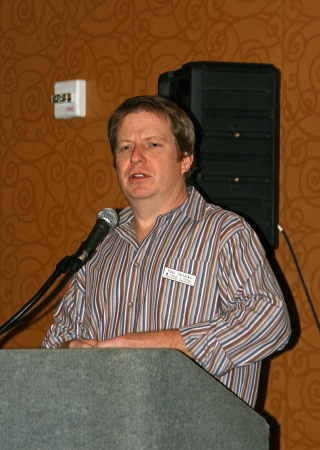
Paul Sirvatka of COD, conference organizer

Paul Sirvatka of COD, conference organizer

The 2009 College of DuPage Severe Weather Symposium is now behind me, and in the light of it, it seems a bit weird to think that the day after, I headed over to my buddy Bill’s to watch the next episode of the Storm Chasers series on Discovery Channel. It feels like two different worlds, like boarding a bus in Grand Rapids and getting off on Mars. But the difference is superficial, a matter of editorial slant; the raw material remains the same, and however it gets spun on television, it’s nevertheless the stuff of research. In reality, people really, truly are going out there and surrounding supercells with an armada of mobile radars and other devices, including manned probe vehicles, all in the interest of collecting data that can increase our understanding of, in a nutshell, what makes tornadoes happen.

The conference featured some of the most knowledgeable and revered names in severe weather research, operational forecasting, and storm chasing: Eric Rasmussen. Chuck Doswell. Roger Edwards. Roger Wakimoto. Josh Wurman. The list goes on, but the point is, a lot of very knowledgeable heads were present in the Double Tree Hotel’s conference room this past week, and some of the insights they shared were fascinating.

Taylor and Carlsen of Environment Canada

Taylor and Carlsen of Environment Canada

Some of the coolest stuff didn’t even come out of the United States. Neil Taylor and Dave Carlsen of Environment Canada shared a photogrammetric analysis of the Elie, Manitoba, F5 tornado, and preliminary findings from the 2008 UNSTABLE team’s exploration of a well-known but hitherto unresearched dryline phenomenon in Alberta. The latter featured EC’s own mobile mesonet, complete with a Doppler-equipped airlplane.

Here are just a few, representative snapshots of the many other topical materials covered:

* Adam Houston talked about the effects of entrainment on unstable parcels, and suggested that the important issue for storm formation isn’t whether a parcel is merely unstable, but whether it is “supercritical”–i.e., possesses enough CAPE to overcome the effect of entrainment.
Eric Rasmussen

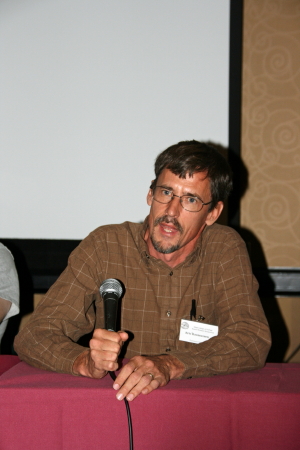
Eric Rasmussen

* Eric Rasmussen shared some of the prelimary findings of VORTEX2, describing the interaction of the RFD with horizontal vortex rings in tornadogenesis.

* Roger Edwards discussed the forecast funnel and the pros and cons of numerical models in operational forecasting.

* Al Pietrycha offered an operational forecasting perspective on non-mesocyclone tornadoes, and more specifically, on landspouts.

* For his dinner presentation Saturday night, Chuck Doswell gave an overview of the history of severe weather forecasting and research, and shared his outlook on things to come.

The shape of the future was in fact a topic of concern for a number of the speakers, notably Doswell and Edwards. Amid the influx of information from the research community on misocyclones, vorticity arches, moisture
Roger Edwards

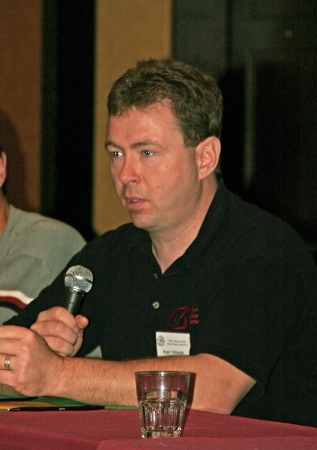
Roger Edwards

convergence, and so on, those on the operational side focused on a more pragmatic matter: the widespread over-reliance on numerical models versus hand analysis.

Will forecast models replace human forecasters? According to Doswell and Edwards, yes, at least for most forecasting scenarios. Edwards emphasized that when it comes to severe weather events–the most difficult to forecast, and the costliest in terms of lives and property–humans will still play an important role. But both men deplored the degree to which forecasters have abdicated hand analysis to the models, which continue to make advances in accuracy at the expense of human development. In a word, the attention and the money are being invested in building better technology, not better forecasters.

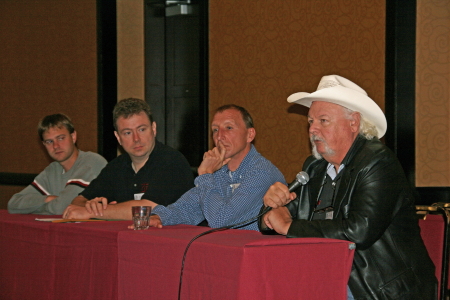
Doswell’s message to meteorology students was blunt: either soak in as much information as possible, and commit to becoming experts at hand analysis and motivated self-educators, or else find a different career. Chuck, who is not known for being shy about sharing his viewpoints, wasn’t being nasty, just extremely forthright.
Chuck Doswell speaks

Chuck Doswell speaks

The mets from Environment Canada, Carlsen and Taylor, were clearly shocked to learn how dependent United States WFOs have become on forecast models. The Canadian meteorologists take hand analysis as a given part of their jobs, and couldn’t imagine not rolling up their sleeves and interacting with the surface and upper-level charts firsthand.

If there was a primary take-away value for me from this conference, I guess that’s it: the importance of getting my arms around hand analysis. Practically speaking, while I found the other material fascinating and enriching, much of it was not particularly applicable to my needs as a storm chaser. The first priority is to get to the right storms. Everything else falls into place from there.


COD Severe Weather Symposium: Are You Going?

It’s drawing closer, and I’m getting excited. I’m talking about the College of DuPage’s upcoming Severe Weather Symposium, which will be held November 5-7. With a lineup of presenters that features some of the foremost luminaries in severe thunderstorm research, the event promises to be stellar.

I’m surprised I haven’t seen more talk about it on Stormtrack, but maybe that’s because the symposium is being held in Chicago rather than out in the Great Plains. Or perhaps it’s because the midweek timing puts a crimp on people who have to work.

But while proximity may be an issue for some and scheduling for others, the content is compelling enough that if you’re anywhere within a couple hundred miles, it will truly be your loss if you don’t make time for this event. Looking over the agenda, here’s what I see:

* All of Thursday afternoon is devoted to various aspects of convective initiation. If you want to improve your targeting skills with the latest information, this day alone ought to be worth its weight in gold.

* Day two focuses largely on tornadogenesis, but includes other topics such as a photogrammetric analysis of the Elie, Manitoba, F5 tornado, and issues in severe weather warnings. The latter presentation will no doubt address the hotly contended use of the enhanced “tornado emergency” wording.

* Day three will…well, look, here’s the complete agenda. You can read it for yourself, and conclude, as I did, that this is going to be a standout event for storm chasers.

I’ve been waiting for a long time for another severe weather conference courtesy of Paul Sirvatka and the College of DuPage. I attended two of their symposiums some years ago, back when my storm chasing skills were still very formative, and each one was time well spent. This one looks to be the best yet. Poised between the end of a stormless autumn and the long, desperate, SDS-riddled winter months, it will provide a welcome immersion into the world of tornado research and operational forecasting that ought to bear dividends when the Gulf reopens for business again next spring.

Breaking a Waterspout with a Gunshot?

While doing a bit of Googling on waterspouts, I came across an article in eHow that made me do a double-take, titled “How to Break a Waterspout with a Gunshot.”

My first response was to wonder whether the writer was referring to an old marine practice that I dimly remember reading about of trying to dissolve waterspouts with cannon fire. But no, the writer doesn’t require that you use a cannon. All you need is a gun, he assures you, preferably one with “the blast strength of a shotgun or better.”

Here’s a link to the article. And since it’s a short piece and I’m leery of broken links, I’m going to also quote it here for you in its entirety.

Instructions

  • Step 1: Assess the strength of the waterspout. Waterspouts are dangerous and require extreme caution, especially if you are going to approach one. You need to assess if getting close to the waterspout is feasible and safe. One good way of assessing the strength of a waterspout is to look at the clouds above it. Regular cumulus parent clouds usually produce weak waterspouts, while supercells produce stronger variants.
  • Step 2: Approach the waterspout. For the sake of breaking the waterspout with a gunshot, the closer you get to the waterspout the better. For the sake of your safety though, distance is preferable. This means that you need to get as close as you can get to the waterspout without jeopardizing your safety or the safety of your vessel and crew.
  • Step 3: Ready your weapon. A gun with the blast strength of a shotgun or better is required to break the waterspout. Most cases of successful use of a gunshot to break a waterspout occurred with a shotgun. So if you have a shotgun on board load it and get ready to fire.
  • Step 4: Fire multiple times. The more times you hit the waterspout the better your chances of breaking it. Your goal is to disturb the atmospheric dynamic that causes and sustains the waterspout with the force of the shotgun blasts. So, the more chaos you add to the waterspout the greater the chances that you can disturb the equilibrium of forces that produce the weather phenomenon.

Hmmm…sounds reasonable. Anyone care to give it a try? Let me know–I’ll lend you my 12 gauge. On second thought, no I won’t. Chances are that’s the last I’d see of it.

I wonder where this person has gotten his or her information, and what actual research–versus anecdotal evidence and pure speculation–is available to back it up? Even the weakest waterspout involves vast scales of motion that extend upward for thousands of feet and aren’t likely to be be impressed by twinky little shotgun pellets passing through them. I’ve seen a video of an airplane flying through a fair-weather waterspout, and the spout didn’t so much as hiccup.

I’m ready to be proved wrong, but I have a hunch that any purported waterspout thwartings by gunshot stem from encounters where the spouts were already at the point of dissolution. Waterspouts aren’t known for their longevity; still, a spout is going to break up when it’s darned good and ready to. Until then, peppering away at it with  “a gun with the blast strength of a shotgun or better” (precisely what “or better” means is unclear to me, but I doubt it matters) isn’t going to make much difference.

I’m no expert on waterspouts, but I do have an opinion on them, namely, that waterspouts are  something to enjoy from a distance, avoid when boating, and respect as a phenomenon over which we have little control.

As for breaking one with a gunshot, gee, why not? But first, let’s you and me go on a snipe hunt. Now, you just stand over there in that swamp, hold this burlap bag open, and call, “Here, snipe-snipe-sniiiiipe!” while I circle around through the woods…

COD Severe Weather Symposium

The College of DuPage will host its fourth severe weather conference in Downer’s Grove, IL, on Thursday, November 5, through Saturday, November 7. At $220 a pop for non-students, it’s a pricey proposition. But considering its proximity, Great Lakes chasers may want to invest their shekels. I’ve attended two conferences hosted by Paul Sirvatka et al some years back, and they were very worthwhile. With its cast of preeminent presenters, and topics that include the preliminary findings of Vortex 2, this year promises to be particularly rewarding.

According to the FAQ on the symposium website, “This conference is intended to present the latest in severe weather meteorology to a diverse group of severe weather professionals and students. National conferences present some of this material but time contraints do not allow for a detailed look into the state of the science.”

In the words of COD:

The conference is intended for professional operational and research meteorologists, upper-level undergraduate and graduate students of atmospheric science, storm chasers, severe weather spotters and severe weather enthusiasts. We assume that attendees will have some understanding of severe weather meteorology in order to receive maximum benefit from the severe weather sessions. The focus of the conference is primarily on understanding the latest techniques for severe weather forecasting, the use of meso-scale and storm-scale modelling, physical processes leading to the development of supercells and tornadoes and the effective use of remote sensing in severe thunderstorm evolution and behavior.

This symposium will also highlight some of the preliminary results of VORTEX II.

Rooms at the DoubleTree Hotel and Suites, where the conference will be held, are available for $95 per night and will accommodate four persons.

So there you have it. If you can afford the hotel prices and the cost of the conference, which includes an evening banquet, then this is one event you’ll want to make. I’m contemplating my cash flow, holding my breath, and getting set to register.

Waterspout Prediction and the Waterspout Nomogram

After last Saturday’s busted waterspout chase, I’ve become curious about what goes into predicting waterspouts. It’s an area I haven’t paid much attention to, but after reading a paper on waterspouts sent to me by Mike Kovalchick, I’m interested in learning their forecasting parameters.

I had always thought there were just two categories of waterspout: non-mesocyclone and mesocyclone. But the paper presents four categories: tornadic, upper low, land breeze, and winter. All of them fall within a range of variables depicted on a “waterspout nomogram” that correlates convective cloud depth and the difference between water temperature and 850 mb temperature.

Tornadic waterspouts cover a broad swath of the nomogram. The remaining three kinds fall within more specific territory:
* Land breeze waterspouts require a minimum convective cloud depth of 5,000 feet, stretching all the way up to 32,500 feet, and water/H85 temp differences between 11 and 19 degrees C.
* Upper low waterspouts require a minimum convective cloud depth of 6,500 feet, stretching up to 36,500 feet, and water/H85 temp differences between 9 and 19 degrees C.
* Winter waterspouts, as one would expect, are a different animal. Convective cloud depths range from 2,250 feet to 9,750 feet, with water/H85 temp differences starting at 24 C and apparently extending beyond that indefinitely.
* All of the above presume 850 mb wind speeds of less than 40 knots.

This is obviously an extremely simplified summary which I’ve extrapolated from the waterspout nomogram. The nomogram brings out variables that I haven’t addressed here, and it’s well worth checking out in the aforementioned paper (see above for link).

Developed by Wade Szilagyi of the Meteorological Service of Canada, the nomogram is in use for predicting Great Lakes waterspouts, and evidently is under consideration for use in the Mediterranean Sea as well. It looks to be an easy-to-understand tool, and one I’ll surely be using as the Lake Michigan waterspout season ramps up.

Waterspouts in the Lake Michigan Forecast

The marine forecast for Saturday remarked on the possibility of waterspouts on Lake Michigan. Kurt Hulst and I headed to the lakeshore in the hopes of seeing a few spouts, but we wound up disappointed.

We initially targeted Holland, but once we arrived, it became clear that our best shot would be farther north where at least some convection was showing on the radar. So we headed up Lakeshore Drive to Grand Haven and parked in the state park.

In a word, we got skunked. Decent vertical development didn’t begin to show up until it was time to leave, around 4:00 p.m. Kurt needed to be home by 5:00 for a dinner date with his grandmother, so there was no question of sticking around. That was unfortunate, as some formidable-looking cloud bands were finally starting to roll in, and I’m left to wonder whether there were in fact any reports of waterspouts later in the afternoon. As for Kurt and me, we didn’t see a thing, other than some very impressive surf rolling in on a stiff northwest wind.

I’ve never seen a waterspout, and neither has Kurt. Today did nothing to change our unbroken record. Oh, well. Maybe next time.

Guest Blog: Storm Chaser Andrew Revering on How to Forecast Northwest Flow Events

Regarding tornado potential…with storms moving southeast or even south in some cases, you have to keep in mind that the storm-relative inflow will have to shift in order to maintain a good, dry updraft and support supercellular structure.

Welcome to the first guest post in my new, improved Stormhorn.com blog! I’m pleased to feature Andrew Revering sharing his insights on forecasting northwest flow chase scenarios. Northwest flow seldom produces severe weather; however, some noteworthy tornadoes have occurred in northwest flow. I’m delighted to have Andy share his knowledge about how to forecast the rare chaseworthy setups.

Andy is the proprietor of Convective Development, Inc., and the creator of the unique, enormously powerful F5 Data forecasting data feed and software. A meteorology student both privately and in educational institutions for his whole life, Andy has been a storm chaser for 15 years, four of which he served as a contract storm chaser for KSTP, an ABC-TV affiliate in Minneapolis. Andy started writing weather software in 1996 as a high school senior, developing such programs as AlertMe, APRWeather, WarnMe, StormGuide, AlertMe Pro, SkyConditions, and F5 Data. His current projects include F5 App, F5 Maps, and CellWarn.

During the nearly three years that I’ve used Andy’s F5 Data, I’ve been impressed not only with the power of the product, but also with the knowledge, friendliness, and helpfulness of its creator. Without further preamble, here he is, helping you to get a better handle on…

FORECASTING CHASEWORTHY NORTHWEST FLOW SCENARIOS
By Andrew Revering

The weather pattern known as northwest flow often means cold, stable air and clearing skies, since it comes in the wake of a large synoptic low that has just come through, cleaning the atmosphere of moisture and instability. However, on rare occasions northwest flow can produce very photogenic supercells and even tornadoes.

A northwest flow setup is normally undesirable for storm chasing because severe weather typically occurs in the warm sector before a synoptic system passes, with the jet coming in from the southwest. After the system passes, the shifting jet structure puts you into the northwest flow with limited moisture and instability. With desirable surface features now to your east, you will typically have scrubbed the atmosphere of any good moisture and instability, thereby preventing severe weather from occurring.

However, this is not always the case. A weak ridging pattern, for example, can also produce northwest flow, and it’s possible for weaker surface systems to traverse the flow, bringing in adequate moisture and instability to create a chaseworthy setup.

Regarding tornado potential, the concerns to look at from a forecasting perspective are the same you would consider with a typical deep trough/southwest or westerly flow scenario. Check for adequate deep shear and low-level shear (helicities, 1 km shear vectors, etcetera). You also want to look at the storm-relative inflow. However, with storms moving southeast or even south in some cases, you have to keep in mind that the storm-relative inflow will have to shift to maintain a good, dry updraft and support supercellular structure.

Keep in mind some basics. In order to sustain a single-cell or supercell structure, besides having decent deep-layer shear (40-plus knots at 6 km depth vector), you should also have the environmental wind directions blowing at an angle, with storm motion at roughly ninety degrees from the direction of the environmental winds.

For example, in a classic scenario, storms move due east, with surface winds moving from the south. This allows unstable, warm, moist air to enter the storm on the south side. The storm moves east because the upper-air steering winds are pushing it in that direction. Therefore, when the tower of the storm goes up it gets tilted downwind to the east of the updraft, and rain falls ahead of the storm.

That’s the key point here: rain falls ahead of the updraft. So when you have warm “feeder” air flowing toward the southern side of an eastbound storm, that air can enter the storm unobstructed by precipitation, thus allowing for warm, buoyant air to drive the updraft.

Conversely, if the surface winds came from the east of this same eastbound storm, you’d have storm-relative inflow at 180 degrees. This is BAD for a storm when it comes to producing a tornado, because the incoming air is encountering all of the cold outflow produced by the rain core. It cannot effectively get around this obstacle to feed the updraft. So two problems occur: 1) the warm environmental air gets blocked by the outflow; and 2) the inflow speed decreases, which in turn greatly decreases the low-level shear vector.

Think of it as an extreme. If outflow blocks the environmental winds completely you have zero knots of inflow air into the updraft, which becomes contaminated by the outflow.

In this scenario, the warm air still gets into the storm to feed it, but the storm becomes front-fed, with the warm inflow riding up over the cold outflow. It enters the storm at the mid levels, pushed there by the outflow/gust front, which creates a wedge and causes a shelf cloud to form. The storm then becomes outflow-dominant—linear, multicellular, or some other mode that is unfavorable for tornadoes.

To summarize, then, you need the environmental wind direction to be entering the storm at an angle between, say, 45 and 135 degrees of a storm’s motion to help the storm maintain a super-cellular shape (along with good deep-layer shear and other parameters).

Applying these general principles to a northwest flow event, if your storm motion is southeasterly, south-southeasterly, or southerly, you need storm-relative inflow to be west-southwesterly, westerly or possibly even easterly or east-northeasterly. Since the storm motion is usually going to be southeasterly, the westerly surface options are typically the better choice.

This seems illogical to most chasers. These are not the typical directions you would expect for good inflow; however, they can work well if you have enough instability, moisture, and other of the right ingredients.

When chasing northwest flow storms—or any storms—keep in mind that you want to be on the side of a storm where the environmental inflow is approaching the storm. In a classic setup with an eastbound storm and southerly surface winds, you would look for the updraft base on the south side of the storm (though that can vary from the southeast to southwest side of the storm as well). In a northwest flow scenario, if the surface winds are west-southwest, look for your updraft base on the west-southwest or west side of the storm if its moving south, south-southeast, or southeast. This arrangement can be disorienting to a chaser who doesn’t normally chase storms moving in these directions. In northwest flow, the south or east side of the storm will have few features and present what looks like an outflow-dominant storm, making it easy to miss the tornado on the other side.

Northwest flow storms can be good tornado producers for another reason that I haven’t mentioned yet: they typically bring in cool air in the mid levels. This cool air advection greatly increases instability provided there’s good moisture and instability at the surface. Getting the right surface conditions in place is difficult, but those conditions are the key factor in a good northwest flow setup. Surface moisture and instability combined with unusually cold temperatures in the mid levels can add up to decent instability overall.

Additionally, if the mid levels are cold enough—say, less than -16C at 500mb—you may get a ‘hybrid’ cold core setup to amplify the scenario. However it probably wouldn’t be a true cold core as defined by Jon Davies’ work, given the presence of northwest flow and the likely absence of a significant mid-level cyclone in the area.

Most northwest flow setups occur in June, July, and August, with the peak being in July. These three months account for 85 percent of northwest flow events as studied by Kelly et al, 1978. It is pretty evident that the delay in northwest flow setups during the severe season is due to the lack of adequate moisture in earlier months. In the summer you can get an adundance of moisture that lingers after the passage of a system, allowing for a northwest flow system or even a post-frontal storm or two.

Storm chasers often ignore northwest flow patterns because they typically mean few low pressure centers for convergence and moisture fetch. But while severe weather is rare with northwest flow, it can occur. So keep an eye out. You can easily miss a decent chase scenario by writing it off too quickly.

Some Reflections on the Icons of Jazz and Storm Chasing

I just finished looking through a couple forum threads on Stormtrack.org, one of them about what makes a person a “true” storm chaser, and the other about storm chasing legends, about the forerunners who have risen to icon status. In reading the latter thread, I was struck by a similarity between jazz and storm chasing that I had never seen before: each is a distinctively American art form.

While today both jazz musicians and storm chasers hail from all over the world, yet we owe our respective crafts to a handful of American pioneers who, guided by passion and a quest to learn and excel, first set forth into uncharted territory and showed the rest of us the way.

Both pursuits are young. Jazz has been with us for only a century. Storm chasing has existed half that time, a little over fifty years. In the history of both, the progression of discoveries and advancements has been rapid, even dizzying. One obvious difference is that the patriarchs of jazz have passed on, whereas most of the veterans of storm chasing are still with us. Louis Armstrong is long gone, but David Hoadley remains a present inspiration, and while I’ve never met him, I assume from his occasional input on Stormtrack–the online descendant of Hoadley’s trade magazine for chasers–that he’s still fairly active.

I suspect that Hoadley wouldn’t see himself in the same light as Louis Armstrong. From all accounts of David, he’s a humble man who likely would feel surprised to be compared with the likes of Louis. Yet both men are innovators. Both followed their instincts to accomplish something that had never been done before. In Armstrong’s case, the result was the birth of a brand new musical language of feeling, inflection, and improvisation. With Hoadley, it was the acquisition of knowledge and insights that could only come from actively pursuing tornadic storms rather than passively waiting for the storms to come to him.

Louis Armstrong, Benny Goodman, Charlie Parker, Dizzy Gillespie, Miles Davis, John Coltrane.

David Hoadley, Tim Marshall, Jim Leonard, Chuck Doswell, Al Moller, Howard Bluestein.

The lists are only partial, and over time they will grow. Storm chasing probably has more potential for true innovators to rise within its ranks than does jazz, for similarities aside, jazz is driven primarily by creative explorations that have for the most part already been made, whereas storm chasing deals with a subject about which much still remains unknown, and is influenced to a much greater degree by advances in meteorology and technology. Regardless, the icons of each field occupy a special, venerable position that can never be duplicated. The rest of us–whether we’re small-town musicians or world-renowned artists, or whether we’re neophyte chasers or OKU grad students with plenty of chase seasons under our belts–can only do the best we know how to carry the torches lit by our predecessors.

From our ranks, too, new knowledge will come and new beauty will be birthed, and from time to time, someone truly remarkable will rise to the surface. Let’s hope that person’s generosity of spirit will be in keeping with his or her abilities.

As was Louis’ Armstrong’s. As is David Hoadley’s.

August 20 Tornadoes in Canada

Yesterday’s storms marched across West Michigan pretty uneventfully, but as they moved east, they grew fangs. Moving into better helicity and shear, they began to develop supercellular characteristics from around Saginaw down into Ohio. It was interesting to track them on the radar, but I had no idea what was coming as they moved into Canada.

KDTX showed some small but nicely shaped and very suspect-looking cells moving out over Lake Huron. Evidently a few of them meant business. Tornadoes began dropping in Ontario, with the area around Toronto getting slammed, and with one fatality recorded in the town of Durham.

Here’s a video of the strong tornado that hit Vaughan, just north of Toronto. Looks like the person who posted on YouTube lifted the footage off of the news. I looked for other footage, but while there’s plenty out there, much of it isn’t of very good quality. This is some of the best I could find. There is presently one pretty dramatic, close-range clip of the Durham tornado which a young woman shot with the video cam on her cell phone, but I’m not confident that the link will last very long. Maybe this one won’t either, but I’m crossing my fingers and hoping it does.

Emile De Cosmo and the Byzantine Scale

If anyone embodies the improvisational and technical aspects of jazz education, it is Emile De Cosmo. I’ve had the pleasure of getting to know Emile since the time he contacted me about an article I had written about jazz contrafacts, and I can tell you, the man is deeply knowledgeable, and as excited to share his insights into jazz theory and technique building today as he was back in my college days, when I first bought one of books in his Polytonal Rhythm Series.

Our initial conversation, back in early February, resulted in my adding another of his books, The Diatonic Cycle–a tour de force of the twelve major scales and their relative harmonic minor scales–to my practice library. Last week, after chatting with Emile on the phone, I purchased yet another book coauthored by him and his wife, Laura. A compendium of articles that Emile and Laura wrote for Jazz Player magazine, The Path to Jazz Improvisation is a treasury of insights into the vast array of scales and modes that are available to jazz improvisers today. At $14.95, the book truly is a steal–and no, Emile didn’t give me a free copy so I’d write him a glowing review*. I ponied up the money just like anyone else, and I’m glad I did. I know a fair amount about jazz theory, but there always seems to be something new to learn, and Emile and Laura’s book is proving to be a good source.

I’m thinking right now about the chapter I’ve been reading on the Byzantine scale. In his foreword to the book, David Gibson, editor of Jazz Player, writes, “When I read his chapter on the Byzantine Scale I almost fell off my chair. I had never thought about jazz in those terms. I suddenly realized that jazz improvisation has roots which go back much further than the jazz master of the 1920s, 30s, 40s, and beyond.”

Of course my curiosity was piqued by Gibson’s words. The Byzantine scale? I’d heard of it before, but never explored it. I think I had some vague idea that I had it already tucked in my pocket as some mode of the harmonic minor scale. And indeed, the Byzantine scale is related to the harmonic minor, but it is a scale unto itself, and a darned interesting one.

Probably the easiest way to conceive of the Byzantine scale is, as Emile describes, to superimpose two major seventh chords a half-step apart. For example, if you dovetail CM7 and DbM7 and then arrange the chord tones in successive order, you get the following: C, Db, E, F, G, Ab, B, C.

Another way to think of this is to approach every tone in a major seventh chord with its chromatic lower neighbor–e.g. for the DbM7 chord (Db, F, Ab, C), you would precede the Db with C, F with E, Ab with G, and C with B.

The De Cosmos recommend using the Byzantine scale with major seventh and dominant seventh chords that share the same root as the scale. In other words, you’d use a C Byzantine scale over a C7b9 or a CM7. At least one other application quickly suggests itself to me as I look at the structure of the scale, and that is to pair it with an altered dominant that is based on the second degree of the scale. For instance, by playing a C Byzantine scale over a Db7#9, you get both the flatted and natural sevenths (B and C), allowing the latter to function as a passing tone between the flat seventh and the root of the chord.

I have to say, though, that it may be a while before I dig into the Byzantine scale in earnest. Right now I’m focusing on the diminished whole tone scale, with some forays into both the augmented and diminished scales. Those pack challenges enough. But I think I can see a new area of woodshedding on the horizon. Emile and Laura’s book should prove a valuable resource, and you’ll hear more about it from time to time. I have yet to write about Emile’s concept, the polytonal order of keys, or POOK, for short.

But that’s for another post. As for this one, well…the day is beautiful, and Lisa and I have plans to visit Meijer Gardens. It’s time to get rolling. Happy practicing!

_____________

*Emile did, however, send me a POOK T-shirt and a CD of he and Laura playing tunes that he had written. I don’t mind telling you that the De Cosmos can blow!