“Tornado Alley” Chaser Party

Saturday in Chicago was possibly the best inauguration of a new chase season that I’ve experienced. A little time to take in some of the Museum of Science and Industry; then watch Sean Casey’s long-awaited new Imax film, Tornado Alley; then head over to Skip Talbot’s place and hang out with fellow chasers and watch storm chasing videos…what could be better?

It was good to reconnect with Michigan native Ben Holcomb, whom I hadn’t
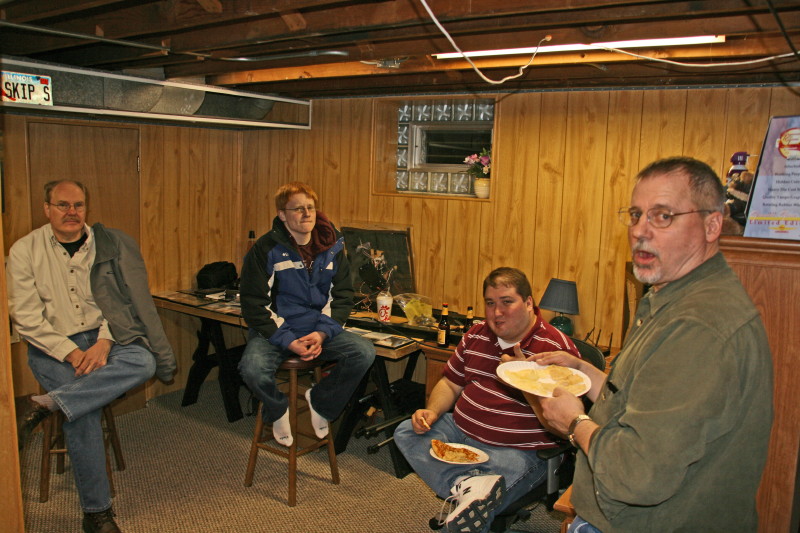
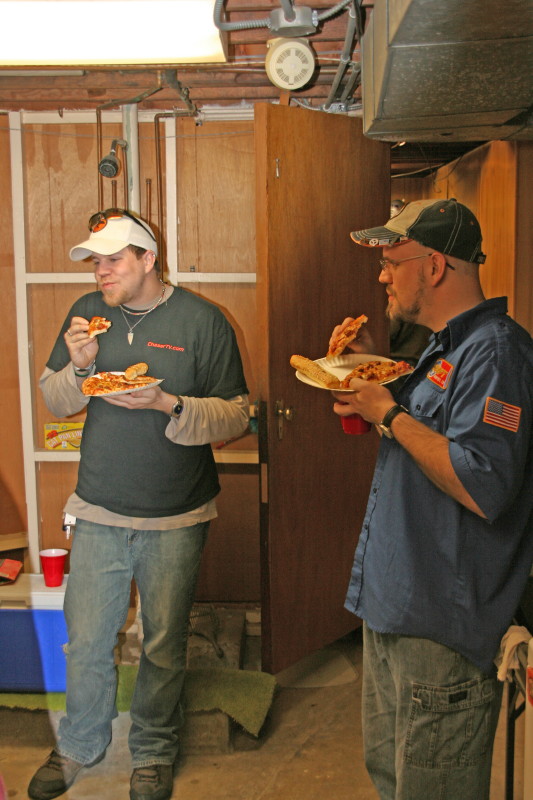
seen since he moved to Oklahoma City last year; with fellow Michiganites Nick Nolte and B. B. and L. B. LaForce; and with Scott Bennet, Adam Lucio, and Danny Neal, comrades in arms along with Ben from the infamous Field Fiasco of May 22 in South Dakota. Plus, it was a pleasure to finally be able to meet some people whom I’ve known of for a long time, including Skip Talbot, who hosted the fete.

My buddy Bill Oosterbaan and I left Grand Rapids for Chicago around 10 a.m. Saturday and arrived at the museum with time to spare. Fifty or sixty miles down the road, I realized that I had left behind a couple 4-packs of barley wine which I had bought exclusively for the occasion. It was a minor downside to a great trip. Drat! Now I guess it’s up to Lisa and me to drink all that barley wine–an onerous task, to be sure, but we’ll manage it. In fact, we’ve already whittled away the workload by half, and I’m contemplating a bottle tonight after I’ve finished writing this post.

Watching tornado videos and hanging out with chasers has got me hankering to see some storms. It won’t be much longer now! And this year I’ve got everything I need to kick things up a notch or two with a great new camcorder and live streaming video. Wednesday I meet with one of the Channel 8 meteorologists to discuss doing some media chasing–connection courtesy of Ben Holcomb. Thanks, Ben!

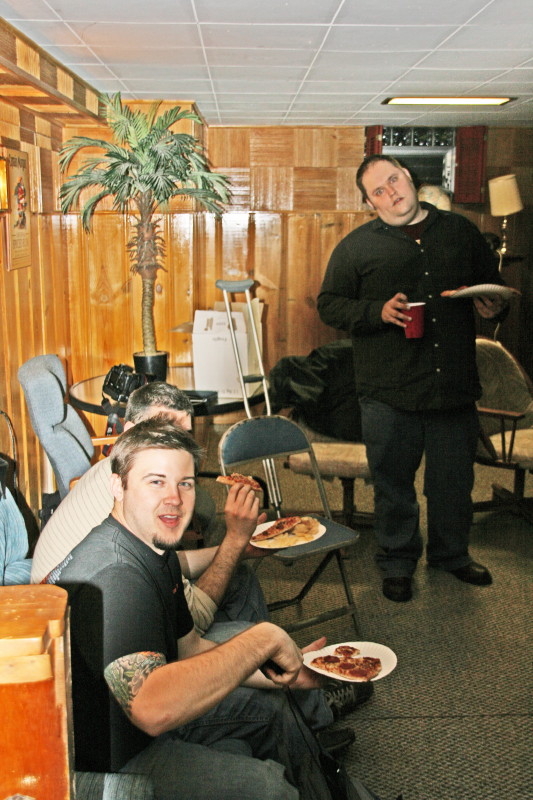
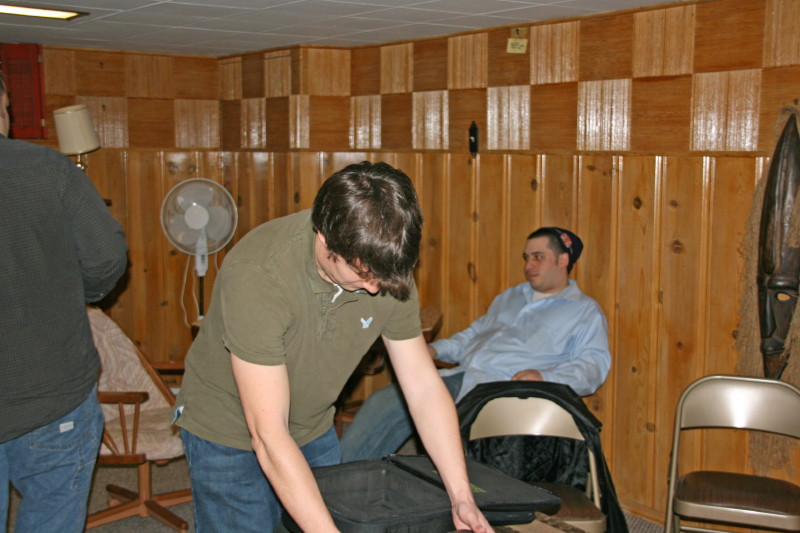
But back to the party, here are a few photos. If you were there and don’t see yourself here, sorry–I didn’t intentionally leave you out. I just didn’t get everyone, and these shots are merely representative.

Skip, thanks to you and Jenny for opening your home to us. To everyone else: great seeing you, and I look forward to crossing paths with you again at the edge of the meso.
What Do You Need to Chase Storms?

“How do I become a storm chaser?” If you’ve been asking that question, this post is for you. I write it with some reservation, knowing that there are people more qualified than I to address the topic. That being said, I’ve been chasing storms with some modicum of success long enough now that I’m confident my insights can have value for those who wonder what it takes to get started.

What do you need in order to chase storms? I’ve seen some lengthy lists developed in response to that question. The input is good, but it can overcomplicate matters, and too much of it all at once can be daunting. If you focus on the word “need,” the answer is much simpler. That’s my approach here: strip it down to the basics, then build from there.

The Foundational Stuff

Here, in my opinion, are the few things that a storm chaser cannot do without:

◊ A roadworthy vehicle, be it yours or a chase partner’s. By “roadworthy,” I mean one that can successfully manage the terrain you’ll be chasing in. If your territory is the flatlands of Illinois and Indiana, or if you intend to stay on main roads that aren’t likely to run out of pavement, then pretty much any vehicle will serve you. On the other hand, if you plan to chase down west Kansas backroads, then you’d better have four wheel drive and great tires; otherwise, the clay out there will slurp you down and ruin your day.

◊ Road maps. Self-explanatory, I think.

◊ Money. You need gas for the tank, right? And maybe a burger along the way.

◊ Basic knowledge of storm structure. Sure, you can chase storms without knowing anything about their features and behavior. But you can’t chase them safely, and the odds of your chasing them successfully are slim. So learn all you can. West Texas storm chaser Jason Boggs has created an outstanding list of educational resources that you can access as quickly as you can click your mouse. Jason’s list mixes basic and advanced material together without discriminating between them. It’s all good, but you should start with the fundamental stuff that deals with storm structure. Veteran chaser Gene Moore’s material on identifying storm features is a good first bet.

Also, a quick plug for Stormtrack, the online informational clearing house, learning resource, and virtual community for storm chasers worldwide. You’ll learn an awful lot just browsing the forum.

One final word on learning: there’s nothing like a mentor. If you can hook up with a seasoned chaser who’s willing to show you the ropes, grab the chance. You can shorten your learning curve significantly. But if such a person isn’t available to you, don’t let that stop you.

◊ Light bars for your vehicle. Absolutely mandatory. How is the world going to know you’re a storm chaser if your vehicle doesn’t resemble a mobile road block?

JUST KIDDING! Don’t worry about light bars just yet.

That’s it for the essentials. Pretty basic, aren’t they–just you, your vehicle, maps, money, and a bit of knowledge. It really doesn’t take any more than that to intercept storms. The main thing is to get out there and do it.

Assuming that you’ve got the fundamentals in place, let’s look next at a few things that will make your chases more successful and your experiences more rewarding.

Important Tools of the Trade

Can you chase storms without a laptop equipped with radar software and mobile data? Of course you can! Ask any chaser who’s been around ten years or longer and they’ll tell you. When the pioneer chasers began paving the way for the rest of us, they did it without all the trimmings. Even Rain-X wasn’t trademarked until 1972, and David Hoadley was chasing storms long before then.

For that matter, I didn’t have any of the following tools of the trade for many years during my own illustrious ascent as a storm chaser. Of course, I didn’t see any tornadoes, either, so don’t take your cues from me. I will tell you that I had a lot of fun learning the slow, hard way. However, my successes came when I started adding a few resources, concurrent with improving my knowledge of forecasting and storm morphology.

All that to say that while the items below aren’t absolutely indispensable, that doesn’t mean they’re not important. They’re very important, and not many chasers today, including the veterans, chase without them.

◊ Laptop computer. It’s your control center.

◊ Power inverter to power your laptop and charge your cameras.

◊ Radar software. Besides a laptop, this should be your first purchase on the list of storm chasing tools. I recommend GR3, at least to begin with. It’s the one used by most chasers, and for good reason: it’s a fabulous program designed specifically for storm chasing, with incredible functionality and flexibility. Just get it, okay? For $80, trust me, you can’t go wrong. For that matter, you get a free trial period that lets you play with the program for a few weeks before you slap down your money.

◊ USB modem and mobile Internet connection. Your best bet is to purchase a USB modem outright; that way you’re not locked into a 2-year contract, and you can deactivate your account during the off-season instead of continuing to pay for data you’re not using. As for Internet connection, Verizon currently provides the best data coverage nationwide, and a lot of chasers use it. Others prefer Sprint, also a good choice. Where you’ll be chasing is something to consider in making your decision.

◊ Radar data feed for GR3. You can use the free feed that NOAA provides. But a lot of chasers prefer a dedicated feed such as those provided by Allisonhouse and MichiganWxSystem. Priced around $10 a month, such a feed is well worth the money.

Nowadays more chasers are using Android phones with radar apps. Not being the geeky type, and also not having the cash, I haven’t looked into these setups. I like having a large display in front of me anyway instead of a tiny screen, but I’m not knocking those who are working with with handheld units. The point is, however you get it and however you display it, you want good, detailed radar information delivered to you with timely updates.

◊ GPS and mapping software such as De Lorme. You’ll also want a serial port emulator that will allow you to use GPS simultaneously with both your map and your radar.

◊ Rain-X. Worth every dollar it costs, and it doesn’t cost much.

SPC Convective Outlooks link. After all, all your great gear doesn’t amount to squat if you can’t find storms! Since you’re new to storm chasing, chances are you don’t have the knowledge to make your own forecasts. Start acquiring it now, beginning with the Storm Prediction Center’s convective outlooks page. It will do two things for you: 1) show you graphically whether and where storms are expected to fire, and 2) through its detailed forecast discussions, familiarize you with the terminology and thinking that go into severe weather forecasting.

◊ Light bars. Don’t leave home without them. How will drab, ordinary, non-storm-chasing mortals know you’re a storm chaser unless…oh, hey, wait a minute. Sorry, we’re still jumping the gun. Forget I mentioned light bars. You don’t need light bars. Not now, anyway. Patience, patience!

Moving On

◊ Station obs, upper air maps, and other forecasting data. Here’s where it gets fun! Making your own forecasts is what separates the be’s from the wannabe’s, and sooner or later you’ll want to try your hand at it. Luckily for you, a cornucopia of forecasting resources is available to you for free online. So start acquainting yourself with the tools of the trade. Check out the tabs at the top of my Storm Chasing page for starters. Also, take a peek at the resources available on my friend Kurt Hulst’s site, Midwest Chasers.

◊ Anemometers, weather meters, and other gadgets. Once you start chasing, you’ll soon run into vehicles tricked out with various devices useful for personal monitoring of wind speed, wind direction, moisture, barometric pressure, and other localized weather conditions. You don’t need any of this stuff in order to enjoy success chasing storms. But depending on how deep and techy you want to get, you might decide that some of it is for you. Just get it for the right reason: to enhance your chasing, not to impress the world with a mess of whizbangs and dingdongs ornamenting the top of your vehicle.

Me, I like to keep things simple. Nothing about my car shouts “storm chaser,” and the only gadget I use is a Kestrel 4500 hand-held weather meter. It’s a cool little device, a regular Swiss Army Knife filled with all sorts of nifty features that I don’t need. I use it mainly to get local, real-time reads on the dewpoint, temperature, and wind speed, information that I do find very useful.

◊ Camera and/or camcorder. A no-brainer if you want to capture visual images of your chases.

◊ Communication equipment. While it probably goes without saying, you should at least carry a cell phone with you. A lot of chasers are also HAM radio operators, and this spring I’ll be joining their ranks with a hand-held unit of my own. I’ve chased for fifteen years without HAM, but I’ve seen the benefits of having it.

◊ Spotter Network. A service of Allisonhouse, Spotter Network interfaces with your radar software and GPS to show other chasers where you’re at and to show you where everyone else is positioned. More importantly, it allows you to quickly and efficiently submit reports of severe weather online from your location.

◊ “NOW can I have a light bar? Can I? Pleeeeze?”

Oh, good grief. Yes, fine, all right, go, get your precious light bar if you must. Buy seven or eight of the damn things. Pick up a spotlight or two while you’re at it. Perish forbid that you should settle for anything less than the candlepower of a NASA launch pad.

My serious opinion: any gadgets you purchase should have a genuinely practical application. I don’t own a light bar myself because I don’t need one. I’m not trained as a first responder, and in the event of an emergency, my best response normally won’t be to clear the road for myself or alert others to my presence, but to get the heck out of the way of emergency personnel who need to get through.

You, on the other hand, may in fact have medical or emergency training and a legitimate use for a light bar. If so, then get one. If not, what’s the point?

And this leads me to comment on one final, vitally important aspect of storm chasing…

Your Attitude

Even as storm chasing has captivated the public through documentaries and reality TV shows, it has also gotten a black eye in some parts of the country due to the misbehavior of irresponsible yahoos. More of these jokers are surfacing all the time. So let’s be clear: chasing storms does not give you license to act like a self-centered idiot. Use common sense. You don’t own the road, so drive safely and respectfully. If you want to stop and film, find a safe place to pull aside so you don’t impede traffic. Drive at a sane speed that doesn’t endanger others, and bear in mind that hydroplaning is a more serious danger to chasers than tornadoes.

Also, have some respect for people who have been chasing for a while. Some experienced chasers have expressed disgust, anger, and disinclination to continue sharing their knowledge after encountering know-nothing newbies who think they know it all. So remember, as a neophyte you’ll earn respect by showing respect. Humility, a thirst to learn, and passion for the storms will get you places that posturing and arrogance never will.

‘Nuff said. Good luck, stay safe, and have fun.

Tornado Safety: Is It a Good Idea to Seek Shelter in a Ditch?

With storm season nearly upon us, now is a good time to revisit a post on tornado safety which I wrote back in November.

Our understanding of tornadoes in the 21st century eclipses what we knew about them, or thought we knew, thirty years ago. Moreveover, our sophisticated warning system has made us much safer during severe weather events today than in decades past. Yet, while the NWS has done what it can to debunk them, some outdated myths still persist.

The notion that motorists who see a tornado approaching should leave their vehicles and seek shelter in a ditch isn’t exactly a myth. Rather, it’s a gray area that you may want to consider more deeply before you bet your life on it. So give this article a read–and we’ll both hope that you never have to put it to the test.

March: When Daylight Lengthens

Today is March 6, and between the first day of the month till now we have already gained fourteen minutes of daylight here in Caledonia, Michigan. By the end of the month, that figure will have grown to an hour and 29 minutes–52 minutes in the morning and 37 in the evening. That averages out to a gain of around 2.9 minutes every day.

March is the month when daylight happens.

Small wonder that storm chasers do a happy dance when March 1 arrives. It’s designated the beginning of meteorological spring for good reason. Henceforth the days are poised to lengthen rapidly. The sun is climbing higher in its arc over the northern hemisphere, putting in a longer workday and shining more intensely. That means warmer temperatures, juicier dewpoints, and increasing instability. Things start happening. The new storm season’s convective pump is getting primed, and preludes of the next few months start showing up on the radar.

So why complain about March? It may not be pretty, but it loves ya.

First Day of Meteorological Spring!

IT’S SPRING!!! Spring, spring, springity spring SPRIIIIIINNNG! O joy! O rapture! It’s springspringspringspringwonderfulwonderfulspring!!!!!!!!!!!

And lest I forget to mention it–it’s spring!

Oh, I know, you’re thinking I’ve lost my mind. Unless, of course, you’re a storm chaser or a meteorologist, in which case you know exactly what I’m talking about. As for the rest of you, forget about that old astronomical calendar that wants to make us all wait almost three more weeks for spring to arrive. That way of thinking is so passe, so limiting. Embrace a new outlook full of fresh, springy-sproingy possibilities. Think meteorological spring, which begins March 1–today!

This is the day all you storm chasers have been looking forward to, and I know from reading a couple of your notes on Facebook that a good number of you have been doing air somersaults and cartwheels. You’re happier than Tigger on pot, and I don’t blame you one bit, because we all know what has just entered the room: Storm Season 2011.

That’s right, boys and girls. Dust off your laptops, put your hail helmets in the back seat, and pour yourselves a nice, stiff shot of Rain-X, because it’s time for a toast. Here’s to moisture rolling in from the Gulf. Here’s to a higher sun, warmer temperatures, and longer days. Here’s to strong mid-level jets, deep lows, and gonzoid helicities. I wish you all safe chasing and classic supercells, my friends, and ample reason for steak and beer at the end of your outings.

L’chaim!

Let the games begin. It’s spring!

Guest Post: Roger Edwards Looks at the High Cost of Indiscriminate Budget Slashing in Public Safety

Roger Edwards is a great guy–a Dallas Cowboy fan, family man, writer, photographer, and down-to-earth Renaissance man. He’s also a name anyone involved in storm chasing is either quite familiar with or else ought to be. When the man talks about severe weather, his words pack the clout of not only a veteran chaser, but also one of today’s foremost authorities on his subject.

With his wife, Elke, Roger maintains an engaging online presence in their blogs Stormeyes and Weather or Not, as well as in the scholarly Electronic Journal of Severe Storms Meteorology. Besides being a prominent weather scientist and forecasting expert, Roger is also a deep thinker and a superb writer whose passion for the world around him colors his words. I’m delighted and honored to feature him as my guest. Given free rein to expound on whatever topic was hot upon him, Roger took a direction I didn’t expect. His message is a timely one that speaks not only to all those of us who, like Roger, “feast on the smorgasbord of atmospheric violence,” but also to everyone–and “everyone” here means everyone–who is impacted by services of our government that are essential to public safety and health.

There, Roger–how’s that for an introduction? Now I’ll shut up and let you take the microphone.

Protection of Life and Property: The Necessary Government Role

By Roger Edwards

I am writing not as a government employee tasked with protection of life and property through severe storm forecasts. Nor am I writing as a member of an employees’ union that is publicizing the most draconian possibilities, as whispered to them by an inner sanctum of upper management (who, unlike the union, can’t legally lobby).

Instead, I type on my own behalf as a taxpayer and private citizen who just happens to be intimately familiar on a personal level with the front-line impacts of some asinine and infantile political posturing that’s happening right now in Washington, DC.

Disagreement on how to finish paying for the rest of this fiscal year threatens either a shutdown of “non-essentials” or a budget that slices the daylights out of many that are both essential and not. “Essential” means law enforcement, military, utilities, storm forecasting, air-traffic control, prisons, border patrol, and other such activities that directly affect public safety and that aren’t necessarily 9-to-5 day jobs. Essential employees are not paid during a shutdown, but are required to report to work as “emergency” personnel. I am included in that, as part of a 24/7/365 storm-forecasting group.

The most extreme budget scenarios for the rest of fiscal 2011 (through October) could result in rolling closure of both warning offices and national forecasting centers, along with unpaid furloughs lasting weeks at a time. That would be insane, headed into both peak tornado and hurricane seasons. What a crappy, backhanded “reward” for the dedication and effort that severe weather and hurricane forecasters devote every day and night…all day, all night. (Don’t worry, I never would resort to faking illness like those lying liars in Wisconsin…I actually am honest, and care too much about my duty!)

Politicians of both parties, in their zeal (and however noble the principles) are ignorantly unaware of the truth that not all government is equally useful, and that the most valuable and necessary government functions are those that protect life and property…period! In any democratic (lower-case “d”) system, all else is secondary to public safety as a responsibility of a government.

Here’s the ugly reality: Those life-saving functions that mean the most are typically small and focused, scattered and buried throughout numerous much bigger agencies full of bloat. In the tangled mess of government bureaucracy, the needed is interwoven with the unneeded, the important with the optional, the efficient with the wasteful–sometimes very tightly! You can argue that it’s partly by design, in order to use the lifesaving functions as human shields against elimination of the wasteful rubbish. I’ll fully grant that it could be a valid argument and a tactic used by some politicians to protect sacred pork.

But it’s still reality. To remove the unnecessary areas in shrinking big government is a good thing, done very selectively. But most elected officials don’t understand this and try to engage in shortsighted slashing that throws babies out with bathwater.

Meanwhile, as in the current standoff over a looming “shutdown,” those government employees engaged in protection of life and property are used as pawns for show. It’s a dirty, rotten, slimy game of political brinkmanship brought about by the shortsighted spending practices of Congresses and administrations of both parties, past and present.

Such childish foolishness, purely for the sake of posturing, cuts the meat and bone under the fat. It’s happened before, it’s nothing new, and it’s ridiculous. The strategy: Threaten to cut the visible, necessary stuff–like storm forecasting, air-traffic control, meat inspection, border security, law enforcement, anti-terror and such–to cover for fiscal irresponsibility on the unnecessary rubbish. It is a time-honed ploy, definitely bad for the country, and speaks to the immaturity and ignorance of politicians in general.

Does fiscal austerity need to happen? Absolutely! Liberals as a whole, and fiscally liberal Republicans, cannot bury their heads in the sand anymore and ignore the national debt. Think of the less-than-worst scenarios that may result as short-term pain for long-term gain.

Public debt is out of control. That’s an overwhelming national consensus. We all need to make sacrifices to cover for past and current fiscal irresponsibility by politicians of all parties. I support smart, targeted cutting of government, starting with the fat.

Notice that I have not complained about the salary freeze, which includes my own. It’s only fair that all government employees sacrifice some. If I now can’t buy a new violin for my daughter in orchestra because the family budget needs to be tightened, because it’s better for the country…it’s unfortunate, but that’s life. Others are far worse off!

Answer this, however: Do politicians have a history of smart, targeted streamlining of swollen government? Do politicians have a track record of taking intelligent, careful time and consideration, or do they instead resort to short-fused, publicity-grabbing, slash-and-burn, one-size-fits-all grandstanding?

To answer that, watch the news and read the stories today, where Democrats blame Republicans, Republicans are blaming Democrats and each other, and back-and-forth grandstanding commands the press. Then think back to past government “shutdowns” such as that at the end of 1995 and early 1996, or 1990 (each of which happened since I’ve been involved). Republicans or Democrats in the Presidency, Republicans or Democrats in Congress, none are blameless in the sort of showboating and lack of foresight that allows the federal budget sickness to get this far.

I’m here to tell you that life-saving functions must not be chopped. That includes storm forecasting.

Consider both sides of this coin.

Five cents. This gleaming little Jefferson is about how much NOAA (which includes the National Weather Service) costs each of us taxpayers each day. Some of that involves all the people and machines that enable forecasts of both dangerous and calm weather. Some of NOAA admittedly involves top-heavy layers of management and bureaucracy above the front-line workers. Much of those are glad-handing, paper-pushing, suit-and-tie roles that I see as not absolutely necessary, and that could and should be trimmed. Yet when those very bureaucrats are ordered to make recommendations for cuts, do you think they will be targeting their own jobs? If you do, I’ve got land about a hundred miles south of New Orleans to sell you.

Life-saving nickels are being swept off the pavement right in front of an out-of-control dump truck overflowing with borrowed zillion-dollar bills, representing entitlements and other giant-scale spending that needs to be braked first. Politicians generally don’t have the courage to do that, nor the understanding to thoughtfully focus merit-based cuts elsewhere. The chopping devolves into a blind, mindless, one-size-fits-all exercise; hence, we must take the bad with the good, the inefficient with the necessary, hoping someone with patience and courage eventually conducts a long, careful, well-informed, and elaborate trim inside each bureaucracy with a very fine and efficient surgical knife.

Ask yourself something more: Are national and local severe storm outlooks, tornado watches and warnings, hurricane watches and warnings, winter storm watches and warnings, and every other daily forecast, worth five cents? You decide. And if you say yes, tell your elected officials in no uncertain terms.

===== Roger Edwards =====
American taxpayer and
severe weather scientist

New Website on 1965 Palm Sunday Tornadoes (and the Truth about “The Twins”)

Someone has finally done it. Elkhart County native Jenni Siri has set about developing a website dedicated to the 20th century’s second worst tornado outbreak, the infamous 1965 Palm Sunday Outbreak. Like me, Jenni has been shaped by the outbreak in a way that has remained with her. In her website, she has provided a forum for survivors of that day to share their experiences.

A few days ago, in an email exchange, I shared my thoughts with Jenni concerning a peculiar controversy which arose out of the Palm Sunday event. It concerns what is probably the most celebrated tornado photograph of all time: Elkhart Truth photographer Paul Huffman’s award-winning photo of twin funnels sweeping across US 33 between Goshen and Elkhart, Indiana.

In his newspaper account, Huffman described the tornado approaching and demolishing the Midway Trailer Court. Yet others have insisted that they saw “The Twins,” as they have been called, strike the Sunnyside Division in Dunlap, nearly 3 miles up the road.

Who is right? After nearly 50 years, the issue still persists. Can it ever be settled?

I believe both sides of The Twins controversy have told the truth about what they saw, and I have a very good reason for thinking so. When I shared my thoughts with Jenni, she asked whether I’d be willing to post them on her site. I had planned to save my theory for my book on the Palm Sunday Tornadoes, but that book is taking a long time to write. Meanwhile, why not try to resolve a conflict which, to my thinking, was never necessary. There’s an explanation that makes truth-tellers out of everyone, liars out of no one, and strikes me as just plain common sense.

But you can’t read it here. Believe me, once I finished my writeup, I was sorely tempted to post it in this blog! But a promise is a promise after all. So instead, I invite you to check out my article, “The Truth about ‘The Twins,'” on Jenni’s excellent site.

This Year’s Regional Focus for Tornadoes: What Do YOU Think?

My last post has now got me thinking ahead to the spring weather season. I’m going to do something I haven’t done before on this blog: rather than share my thoughts, I’m going to ask you for yours.

Here’s the question: What part of the country do you think the focus for tornadoes will be this year? Southern plains, northern plains, farther east…where and how do you think things will play out, and why?

This isn’t a hardcore survey. It’s for fun and curiosity to see how people think. Please click the “comment” tab to respond. If I get a few meaty, thoughtful responses, I’ll share the highlights and interact with them in another post.

Bear in mind that this is a La Nina year. While no research exists that solidly establishes a link between La Nina and tornado outbreaks east of the Mississippi, nevertheless statistics show a correlation. It’s one among various things to consider in what will probably still end up as a roll of the dice. The weather just doesn’t care about our reasonings! But it’s still fun to think about this topic, and a few months from now will tell how close (or far off) we were.

So, what part of the United States do you think will keep storm chasers busy this spring–or will this be a dead year for tornadoes? Lean in and give your nickel’s worth.

Warming Trend through February

Today temperatures are forecast to be in the mid to upper 30s here in West Michigan, and by Friday they should be well into the forties. With a little luck, we may even see our first 50-degree day of the year. This warming trend has been no secret, and it’s the kind of thing that draws me out of my wintertime apathy about weather maps and whets my curiosity. The next week seems pretty well defined, but what lies beyond the horizon?

So this morning I did something I haven’t done for quite a while: I peered into the magic 8 ball of the 6Z GFS all the way out to 372 hours, to the forecast hour of 18Z Monday, February 28. My point in doing so was to get a sense of what general trend might be shaping up. What I see is the beginning of springtime incursions of warmer air. Not to say that we up here in the northwoods can don our swimsuits and head for the beach, but it looks like this week may mark the end of the long stretches of bitterly cold weather. We could see more days near or above freezing, and at times up into the forties, rather than in the 20s and teens.

In just two more weeks meteorological spring will arrive. Granted its foibles, overall the long-range GFS appears to be rolling out the carpet. We’re not there yet, friends, but today’s warmup offers a view from the hilltop and the end is in sight. We’ve almost made it through another winter.

The Groundhog Day Blizzard of 2011

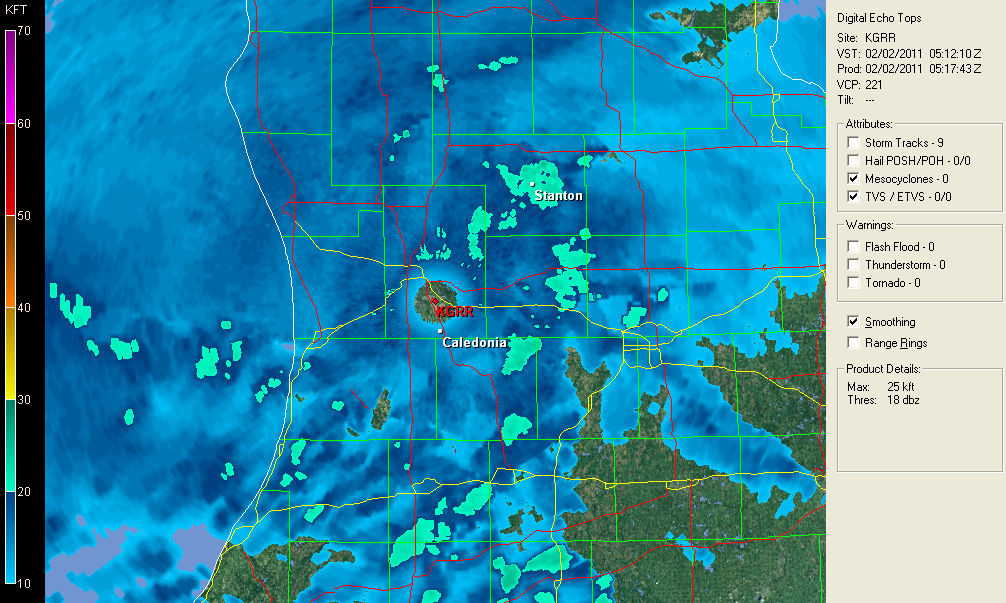
blizzard3-2011The cloud tops are up to 20,000 feet here in Caledonia, and about two minutes ago the first impressively bright flash of lightning lit the blizzard swirling around my apartment. Thundersnow! Rare, but  not unexpected tonight, and now that it has arrived, I’m continuing to see sporadic flickers of lightning. That initial one was a doozy, though, and all I can think is, Cool! How often does one get to hear thunder rumble through the teeth of a February blizzard?

Man, is it blowing out there!

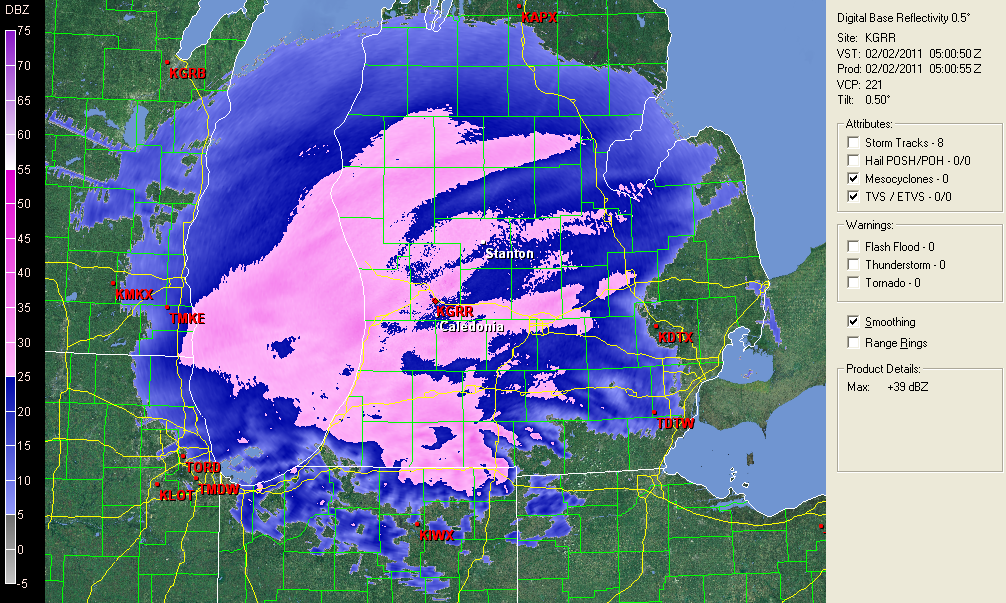
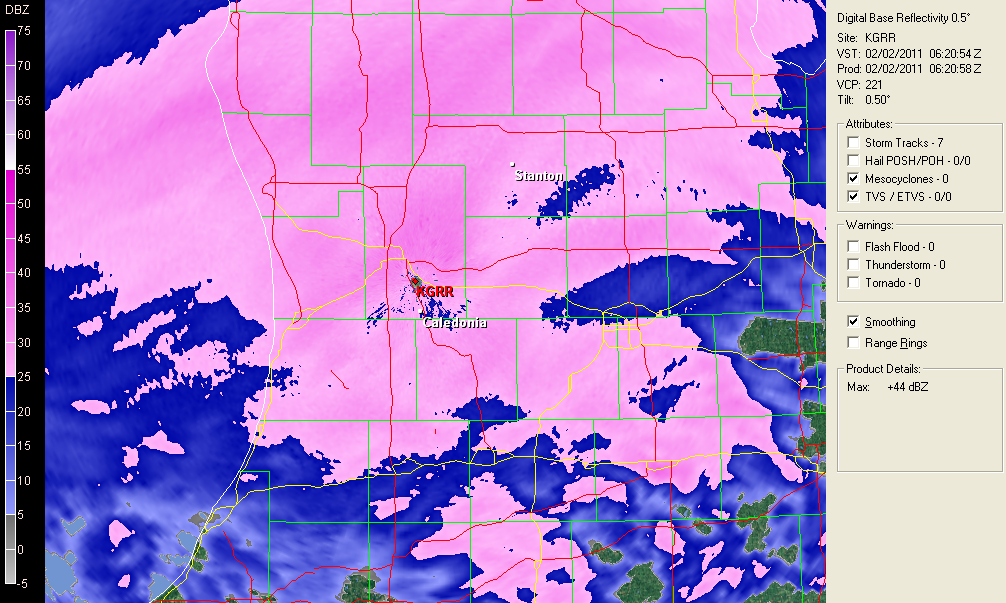
All eyes have been on this winter storm for the past several days, watching it move from forecast models into reality. Nowcloud-tops-2011here it is, and it is a humdinger. Anywhere from a minimum of 12 up to 16 inches of snow is predicted to dump on our area, and south of us it only gets worse. Pink is the color that indicates heavy snowfall on my radar color table, and I don’t recall ever seeing such a large expanse of it covering my screen before. Between now and sometime tomorrow morning is when the heaviest snowfall is supposed to occur, and looking outside my window at the maelstrom swirling dimly out of the midnight sky, I see nothing to contradict that prognosis.

blizzard4-2011Ah! Another flash of lightning and another rumble of thunder! This is nice. Imagine that–me, an avowed snow grinch, enjoying a blizzard! But I have to say, this storm appears to be living up to all expectations. I honestly don’t recall that I’ve ever experienced thundersnow before, so I’m really pleased to be getting such a novel form of entertainment.

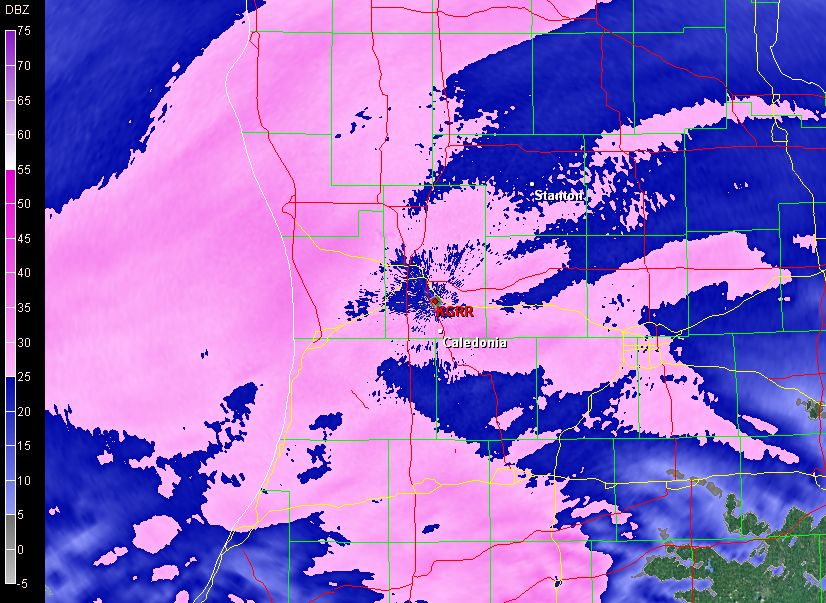
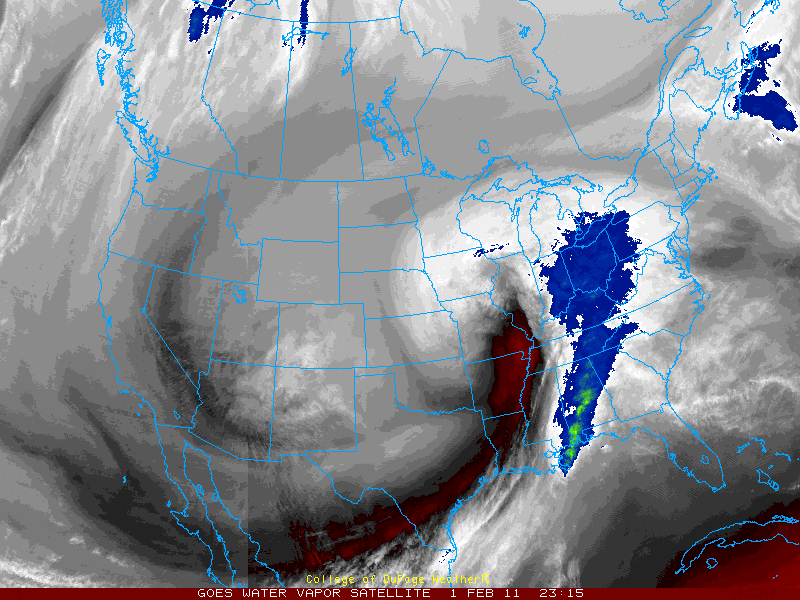
The three fairly recent radar grabs and the water vapor image on this page will give you an idea of what a truly wild evening this is. Click on the images to enlarge them. The first and third are basic winter reflectively images, with the latter offering a more zoomed-in look at southern Michigan. Look at all that pink! Interrogating a few of the deeper hues has given me reads of nearly 40 Dbz, and that’s nothing compared to elsewhere, and perhaps to what yet lies in store for us.

blizzard-2011-wvAs for the second screen, that shows cloud tops. The teal colored blobs indicate tops of 20,000 feet or greater, where thundersnow is likeliest to occur. And the fourth image depicting water vapor gives a macro view of what the entire system looks like as an immense entity sweeping eastward, with the dry slot punching upward into Illinois.

This may be one for the history books. I’m glad I stocked up on groceries, because I doubt I’ll be venturing out tomorrow. I doubt anyone will be. I’m certain that all the schools will be closed, and quite possibly many businesses as well. It will be a good day to hunker down and feel grateful for being indoors.

Zang! Another bright flash. I just got a phone call from my friend Brad Dawson, who lives down near Gun Lake. He tells me that a big towerblizzard6-2011500 feet from his house is getting continually struck. That has to be an experience, and from the looks of things, it’s apt to be one that continues through the night. Lacking any similar tall objects here, the lightning isn’t as constant, but it continues to flicker, and the storm itself is intensifying. What the heck–here’s one last image: a current radar scan. I just got a reading of 43.5 Dbz in one of the darker blobs of pink!

This is one howler of a winter storm system. But I’m done watching it for now. It’ll still be here in the morning. Time for me to hit the sack and enjoy the light show for a while before I fade out. Good night!