Looking Down to Dixie

This bright morning sun streaming through the sliding door of my balcony is blinding. At quarter-to-ten on the day before Thanksgiving, it shines low over the southeast horizon directly onto my face, forcing me to write with my left eye shut. That is not an altogether satisfying modus operandi, but I don’t feel like closing the blinds or wearing a … well, what the hell, why not wear a hat? I’ve just put on my trusty Tilley. Problem solved, though Lisa will probably look at me oddly when she steps into the room.

Here in West Michigan, we’re moving into high pressure and a warming trend through the holiday. But “warm” is a relative word which in this case means not terribly cold–rather nice, really–but don’t plan on wearing a T-shirt.

Hundreds of miles to my south, though, warm means warm. Warm enough to get the job done for convective weather. From now through April, Dixie Alley once again becomes the star of the show. The trough moving in for the weekend offers a good example of why.

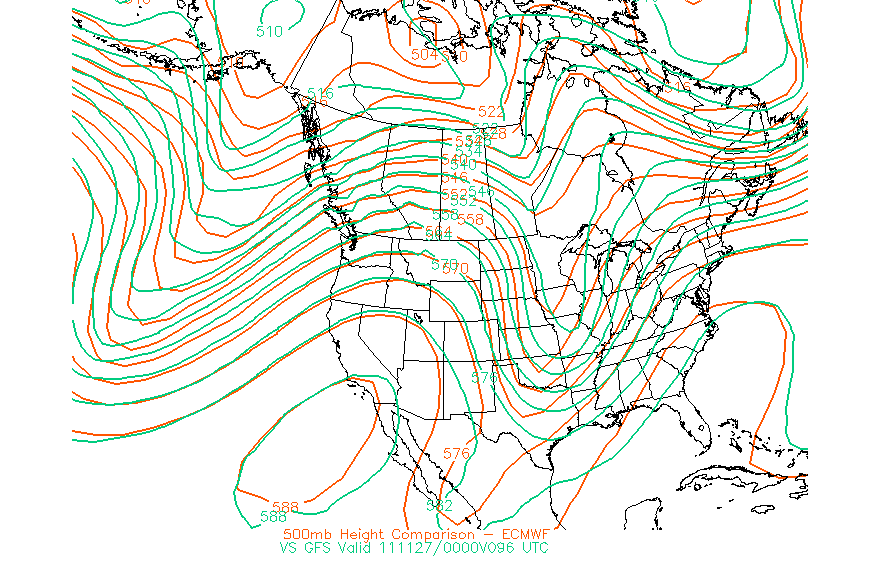
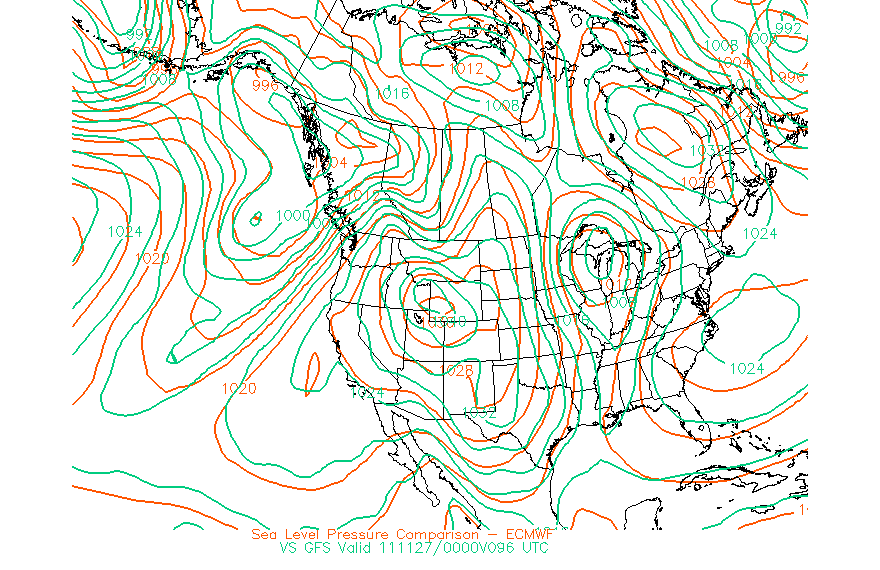
It’s a deep trough, and a surface low up in the Great Lakes looks to wick up enough moisture into the Southeast to stoke the storm machine. I’ve included a couple of the latest 00Z Euro/GFS comparisons plus Euro 850 mb relative humidity to give you a sense of what’s shaping up for 96 hours
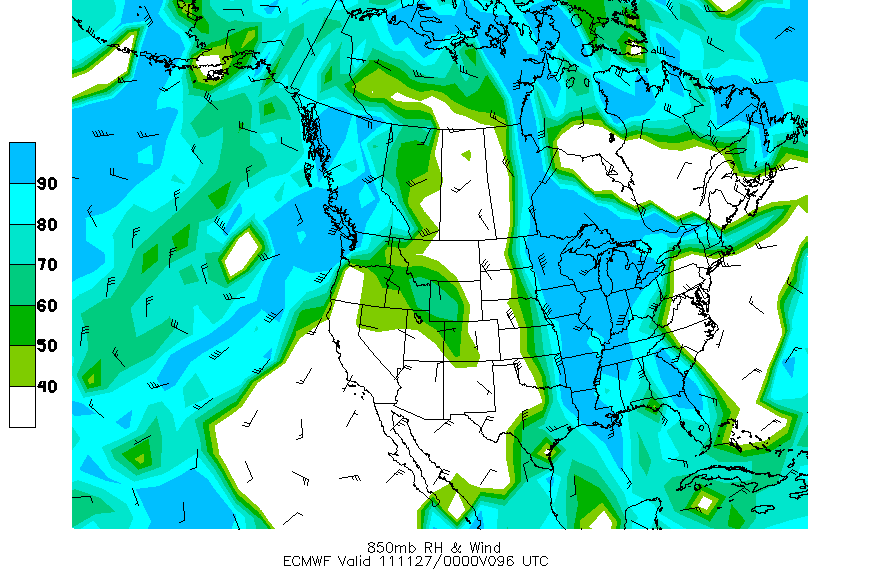
(click on images to enlarge them). The GFS is predictably faster than the ECMWF, but both are pointing to the same overall scenario, with the trough eventually pinching off into a closed low.

Cloud cover presently looks like it will be rampant, minimizing instability. Still, given some ripping bulk shear, this system is something to keep an eye on as it evolves, particularly if you live in Dixie Alley.

That’s all for now. The sun has moved and is no longer blinding me. Time to get on with the rest of this day. May you and yours enjoy a happy and blessed Thanksgiving!
Fall Meeting of the Michigan Storm Chasing Contingent

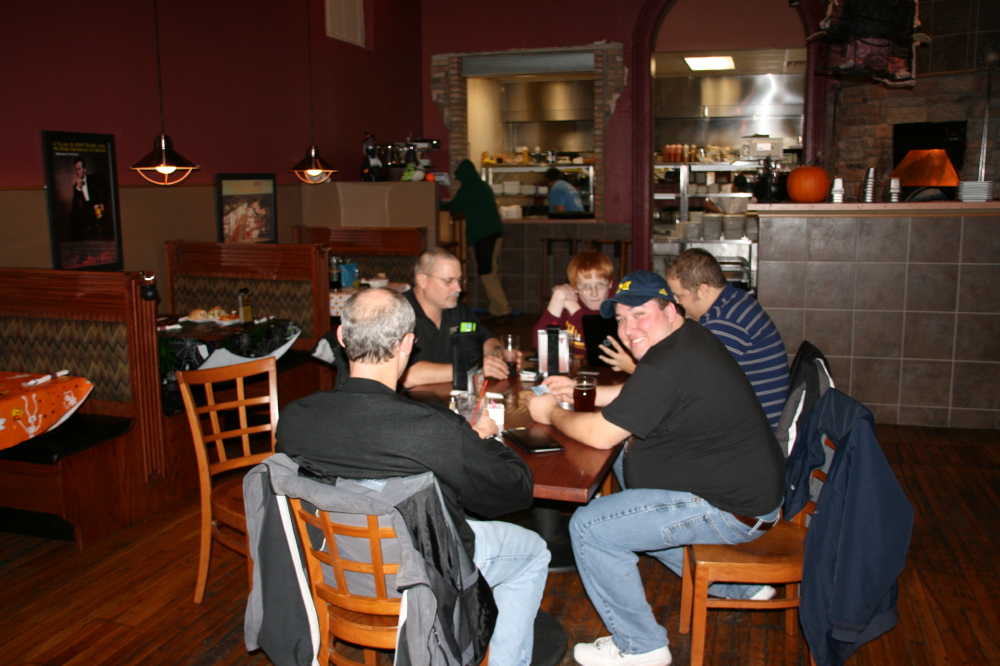
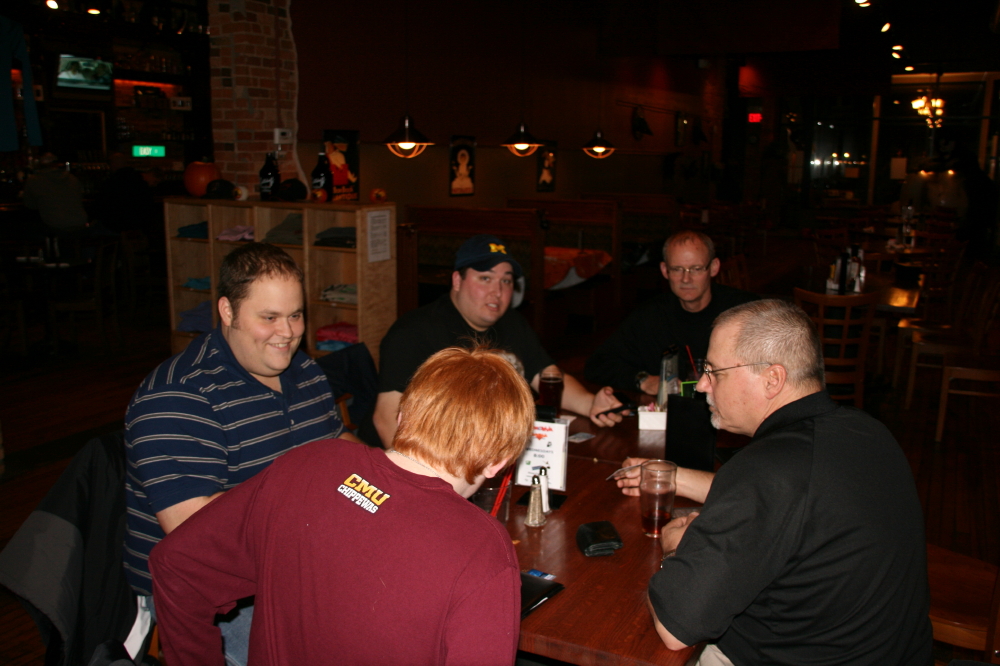
Last Thursday, October 27, the Michigan Storm Chasing Contingent convened at its favorite meeting place, the Walldorff Brewpub in Hastings. Present were L. B. LaForce, Ben Holcomb, Bill Oosterbaan, Tom Oosterbaan, Nick Nolte, and I, the unofficial recorder. The meeting was called to order, or at least something approaching order, and it was immediately moved that beer should be purchased. The motion was passed by five out of six, with one member abstaining. The recorder found himself in possession of a 24-ounce schooner of Cobain’s Double Dark IPA, which easily balanced out the abstention.

Truthfully, there is no official Michigan Storm Chasing Contingent. I made up the name. Membership dues have not been levied and cards have not been issued. The whole notion of a Michigan Storm Chasing Contingent is something of an oxymoron to begin with. Nevertheless, most of these guys have had a pretty impressive year, with plenty of miles logged and tornadoes observed. The sorriest mug in the lot was me, but I won’t go into that; 2011 is almost over now, and I’m done whining. The big thing is, Ben Holcomb was visiting from Oklahoma, and that seemed like a good reason for all of us to get together and hang out for the evening.

The Walldorff is becoming a tradition for us, and it’s not a bad one. The place has award-winning craft brew. The cuisine, made from scratch using local produce, meats, and dairy products, is also fabulous, but the beer is the main draw. Not that this is a hard-drinking bunch; they’re actually pretty conservative. But they do enjoy the Bee Sting Ale, one of the many superb craft brews turned out by Sam, the Dorff’s world-class brewmeister.

As for me, I opted for the Cobain IPA with its double-bitter blast of mega-hops and roast malt. It was the first beer I had ordered at the place since I joined its pub club a couple months ago, and I figured that it was time I finally took advantage of my member’s discount. I expected a nice price break. What I didn’t anticipate was the 24-ounce mug that the waitress set in front of me. It was big enough to generate its own lake breeze, and I could see surf breaking against the brim. Good grief. At 8.5 ABV, the Cobain is a potent brew, and all I wanted was a modest glass. I just can’t knock off such stuff with impunity anymore like I used to. Out of shape, out of practice, and getting older. Oh, well.

It was great to see all the guys, though we missed Kurt Hulst, who had to work. There’s nothing more interesting than storm chasers talking shop, at least as far as other chasers are concerned, and this year

afforded plenty of notes to compare. Ben, Bill, and Tom had been on the May 24 Chickasha tornado, a particularly violent beast that may be upgraded to EF-5. Seems that it pitched a Ford F-150 pickup truck 800 yards–nearly half a mile. It’s hard to fathom that kind of power.

But enough. It’s late, this recorder is tired, and it’s time I put this post to rest. Till next time, gents: L’chaim!

Another La Nina for Winter 2011–2012

Snowfalls that paralyzed entire regions. A record-breaking tornado season. An unrelenting summer heat dome that baked much of the nation for weeks on end, coupled with disastrous drought conditions in the southwest. That has been our weather year 2011 to date, courtesy of its La Nina, which commenced in June of 2010 and ended last April.

In another month, we can kiss the whole mess good-bye and good riddance. It’s not the kind of year a body wants to see repeated anytime soon. But with yet another La Nina winter shaping up, chances are that’s what we’ve got in store. In its typical terse language, NOAA’s Enso Cycle: Recent Evolution, Current Status and Predictions sums things up thus:

• La Niña conditions are present across the equatorial Pacific.
• Sea surface temperatures (SST) were at least -0.5°C below average across the central and eastern equatorial Pacific Ocean.
• Atmospheric circulation anomalies are consistent with La Niña.
• La Niña is expected to strengthen and continue through the Northern Hemisphere winter 2011-12.

.

The United States needs another La Nina right now the way a sick drunk needs another bottle of Boone’s Farm. We’re still reeling from the previous episode, and now here comes round two. While no one can predict with certainty how it’s going to play out, the generalities are these:

• The north-central CONUS and portions of the Great Lakes down through the Ohio Valley are likely to see colder and wetter conditions.

• The south and southwest can expect warmer and drier weather–not welcome news to those living in West Texas and other places that have already endured week after rainless week this summer.

Also, while you won’t find it stated in ENSO literature, statistically, tornado outbreaks east of the Mississippi have tended to occur during La Nina springs. Whether a correlation does in fact exist, circum 2011 certainly seems to corroborate the notion.

Let’s hope that this new player turns out to be La Nina Lite in terms of its impact. I can’t imagine that it will be as nasty as its predecessor, but anything is possible. We’re only getting started, and already the Northeast has gotten clobbered with a record-setting winter storm. The plus side is, parts of the drought-stricken West have received a rare and welcome snowfall. That’s good, and I hope they get more precipitation, lots more, be it snow or rain.

For those of you who pray, this new La Nina is something to enter in your prayer list and keep an eye on. This winter could be another bad one, and storm chasers may once again have their hands full next spring. Let’s hope that Dixie Alley experiences nothing like what it did this year. We’ll find out five or six months from now.

Book Review: Severe Storm Forecasting by Tim Vasquez

Beginning with his Weather Forecasting Handbook, which I purchased years ago at a College of DuPage severe weather conference, I’ve collected one-by-one nearly all of Tim Vasquez’s books on storm chasing and weather. The only exception is Tim’s most recent, 2011 publication, the Weather Forecasting and Analysis Handbook, and that’s next on my list.

The owner of Weather Graphics and the well-known storm chasing forum, Stormtrack, Tim is a widely acknowledged guru of storm chasing and operational forecasting, particularly in the severe weather arena. The man possesses more convective knowledge in his left pinkie than most of us do in our entire bodies, and in this fairly recent publication, he organizes information that is most relevant to chasers and severe weather junkies.

In Tim’s words, “Severe Storm Forecasting was a project started in 2007 to serve as the perfect companion for intermediate forecasters and a refresher for experienced forecasters. It maps the current state of severe thunderstorm forecasting from an operational framework rather than a research or academic perspective. Equations, physics, and lengthy citations have been kept to a bare minimum.” (From the preface.)

In other words, the book is intended to provide up-to-date, practical information that storm chasers can readily apply in forecasting and in the field. Since its release in 2010, I’ve been wanting to get my hands on this book. A while ago, I finally shelled out my $29.95 and purchased a copy, and I’ve spent the last several weeks chewing on it. It’s nutritious fare: thoughtfully organized, as current as is possible in a field shaped by rapid technological advances, and accessible to anyone who wants to apply him- or herself to developing severe weather forecasting skills.

Severe Storm Forecasting is divided into 10 sections as follows:

  • The Forecast Process
  • The Thunderstorm
  • Mesoscale Convective Systems
  • Tornadoes
  • Hail
  • Lightning
  • Stability & Shear
  • Radar
  • Satellite
  • Diagnosis
  • .
    An appendix contains additional information on the WSR-88D radar and the more commonly used diagnostic tools in severe weather forecasting, and also supplies blank, reproducible hodograph and skew-T/log-P charts.

    While the topics covered will be familiar to chasers who do their own forecasting, I’ve found plenty to broaden my scope, ranging from brand-new insights to discussions on topics with which I was only vaguely acquainted. For example, the section on QLCS tornadoes is the first time I’ve seen the subject given more than a casual nod. Here in Michigan, linear systems are far more common than isolated supercells, so it’s nice to encounter a book that spends a little time looking at their role as occasional tornado breeders.

    A strong asset of Severe Storm Forecasting is the way it aggregates the broad array of elements that are relevant to severe weather and then expands on them in one tidy package. Don’t get me wrong: this isn’t one-stop shopping. One book simply can’t cover everything in depth; pick any chapter and you can make a further study of its subject. But this book does much more than skim the surface. It is by no means a mere primer; it is a text that will equip you with a broad and substantial grasp of severe weather forecasting, and you shouldn’t conceive of it as a one-time read that you move through linearly and then “finish.” There’s too much content for a reader to absorb all in one pass, and much of it needs to be connected with field experience in order for it to gel. So look at Severe Storm Forecasting as a reference that you will process bit by bit. Once you’ve accomplished your initial read, you will return to it again and again.

    In the style of his other books, Tim has made ample use of sidebars to provide interesting asides that range from the historical to the technical. Just riffling through the pages, I find, for example, a call-out on page 75 that consists of material written in 1888 by Gustavus Hinrichs that sheds light on the origin of the word “derecho”; then a few pages later, on page 80, I read a smaller sidebar that discusses the term “swirl ratio”; and still further along, on page 95, I come across a fairly extensive personal communication from Paul Markowski on the contributing factors in warm versus cold RFDs.

    Three recommendations for improvement:

    1. 1. I’m surprised that a glossary was not included in a work of this nature. It is the one area in which I consider this book to be lacking, and I hope Tim will address the matter in his next edition.
    2. 2. An online supplement would add value. This could feature graphic, possibly interactive, examples of such topics as lifting and modifying forecast soundings, radar interpretation, and so forth. The supplement would be accessible only to purchasers using a code included in the back of the book. It could be used with other of Tim’s books as well, so one supplement could serve multiple purposes.
    3. 3. I have the sense that the editing was grassroots. The result is quite good, but speaking as someone with a background in publishing, I think the book could benefit from further proofreading or perhaps a light edit.

    With these things said, Severe Storm Forecasting is an eminently useful and well-done resource that belongs in a storm chaser’s library. If you’re a new chaser, I would recommend that you start with Storm Chasing Handbook, also by Tim; then purchase this book to expand your knowledge. Those with a bit more experience can jump right in. Regardless of your level of expertise, get this book. At some point, you’re either going to be glad you own it or else wish that you did.

    Purchasing Information

    • Severe Storm Forecasting by Tim Vasquez, 262 pages.
    • $29.95 plus shipping, available from Weather Graphics.

    NOTE: This is a non-paid, unsolicited review. I’ve written it as a service to my readers because I personally appreciate Tim’s book and feel that it provides a valuable and well-organized resource for storm chasers and severe weather buffs.

    Relocated: A Review of Ben Holcomb’s 2011 Storm Chasing DVD

    With his newly released second storm chasing DVD, Relocated, Ben Holcomb has done a fabulous job of capturing the action out west during 2011, a banner year for chasers. I just finished watching the DVD with Kurt Hulst. That makes my third time, and I’ve only had the video for a week.

    I much enjoyed Ben’s maiden voyage DVD, which shows highlights from his first three years of chasing. Relocated improves on that foundation. As its name implies, this DVD reflects Ben’s move from Lansing, Michigan, to Norman, Oklahoma, smack in the heart of Tornado Alley. It also demonstrates Ben’s development as a videographer and producer, as evidenced by the quality of both the content and the packaging. From laid back to intense to pure wow, the moods and dialog in Relocated cover a variety of situations a chaser is apt to experience; and the storms are always the star of the show, which is how it should be.

    While I’m on that last subject, one thing I appreciate about this video is its conservative use of background music. I enjoy a certain amount of music for spice, but not a lot. Mostly, I like to hear the environmental sounds of the chase–the crack of thunder, swoosh of the wind, and clatter of hail; the spontaneous comments and interactions of chasers; even the road noise and the sound of the car engine. I want to feel like I’m there, and this video does that for me.

    Anyone who knows Ben knows how passionate he is about chasing. He moved to Oklahoma to maximize his opportunities to chase tornadoes, and 2011 rewarded him with a bumper crop. The action starts on April 9 in Mapleton, Iowa, a day that drew a lot of chasers out for an early chase. This section ends with a neat synchronization of freeze frames with music. I won’t say more–you’ll have to see for yourself. I’ll just tell you that it’s clever and nicely executed.

    A couple weeks later, on April 24, things appear to have gotten a bit hairy for the Benster out in Baird, Texas. As he trains his camera on a distant lowering, a vortex spins up in the field next to him, and it becomes clear that circulation is establishing itself directly overhead. Call me a wuss, but that is the kind of situation that would make me pee like an elderly aunt in a beer tent, and it evidently inspired Ben to lean plenty on the accelerator, all the while continuing to shoot video. The result is some exciting footage shot at uncomfortably close range, and for me it’s the adrenaline spike of this DVD. Don’t try anything similar at home.

    The footage from the May 24 Oklahoma outbreak is outstanding. What more could a chaser possibly want? The Chickasha EF4 grows rapidly from a cone to a powerful stovepipe as it crosses the road and then moves past Ben’s position at a distance of perhaps three-quarters of a mile (just guessing here). The tornado continues to grow into a violent wedge with a collar cloud circulating around it like a monstrous merry-go-round, dropping lower and lower toward an immense dust plume that rises up to meet it. Remember I mentioned that this video packs wow-ness? Well, here is a prime example.

    Next, Ben captures a spectacularly beautiful white rope-out of the Shawnee tornado, which crosses the highway, then more-or-less anchors in a field and attenuates into nothingness as debris drifts out of the sky, sparkling in the sunlight. The camera probes high up the side of the disintegrating rope funnel, all the way up to its juncture with the cloud base. Very nice.

    The June 20 section, shot in Nebraska with J. R. Hehnly, is one I find a bit frustrating to watch because I missed the tornadoes myself by about an hour. Not Ben. He got great, ongoing footage of a cyclic supercell that kept popping out tubes one after the other. A high point, fairly early in this part of the DVD, is some fantastic multiple vortex action after the first tornado crosses the road in front of the vehicle and then intensifies. You see a gorgeous white cone with suction vortices pirouetting around its base, an elegant egg-beater. It’s my favorite scene in a DVD that’s full of great tornado videography, and I’m caught between admiring the storm’s beauty and wanting to bang my head against a wall. Aaagh! Sixty more miles…one lousy hour sooner…nutz. Bad for me, but good for Ben and J. R.

    That’s it for the tornadoes, but Ben has sweetened the deal with bonus footage of the last launch of the Atlantis space shuttle. Right, that has nothing to do with storm chasing, but it was obviously a standout event for Ben, as it would have been for anyone. So why not conclude this 75-minute DVD with a personal glimpse of a historic moment?

    Relocated is a thoroughly satisfying video that anyone with a jones for tornadoes and severe weather will enjoy. Be aware, though, that this is the real deal, a realistic and personal presentation of storm chasing as most chasers experience it rather than what reality TV has made it out to be. The camera is often hand-held by a guy who is either simultaneously driving or else trying to gain an optimal view from the passenger seat. That’s part of the package, and it makes for an honest and engaging production.

    Purchasing Information
    Purchase price for Relocated is $15.00 plus $2.00 shipping. For more information and to place your order, visit Ben’s site, where you can also buy his first video, My First Three Years, for the same price. Or save $2.00 when you purchase both videos together for just $28.00 plus shipping.

    If you’re looking for some great storm footage to while away the hours from now until spring, buy this video. And no, Ben didn’t pay me to say that or to write this review. I took it upon myself to do so because Ben is a good friend, a passionate chaser, and a guy who puts not only expertise but also a considerable amount of heart into what he does. Which is why Relocated rocks, and why it belongs in your video collection.

    A Stormy Evening in Stanton

    Last weekend my best male friend, Dewey (aka Duane, aka The Scurvy Rascal), and I headed up to a hunting camp in the backwoods of Kalkaska, Michigan, for a weekend retreat. It was a time of refreshing for both of us: a time of reconnecting and confirming our friendship after a season, for each of us, of being hammered on by life; a time of drinking good craft beer and Scotch whiskey, and eating steaks cooked over an open fire; a time of hunting, and shooting clays, and blasting away with assorted pistols, including my favorite, a model 1911 .45; and a time of prayer, and reading the Bible, and talking about our passion for God, our beloved women, and life in general. A good, good time.

    I drove up to Dewey’s home in Stanton Thursday evening. My laptop came with me, but I had suspended my data account with Verizon, and for some reason I was unable to access Duane’s router. With storms in the forecast, naturally I wanted to know what the radar had to show. So Dewey pulled up KGRR on his laptop, and Bingo! A nice line was moving toward Stanton and looked to arrive within a half-hour.

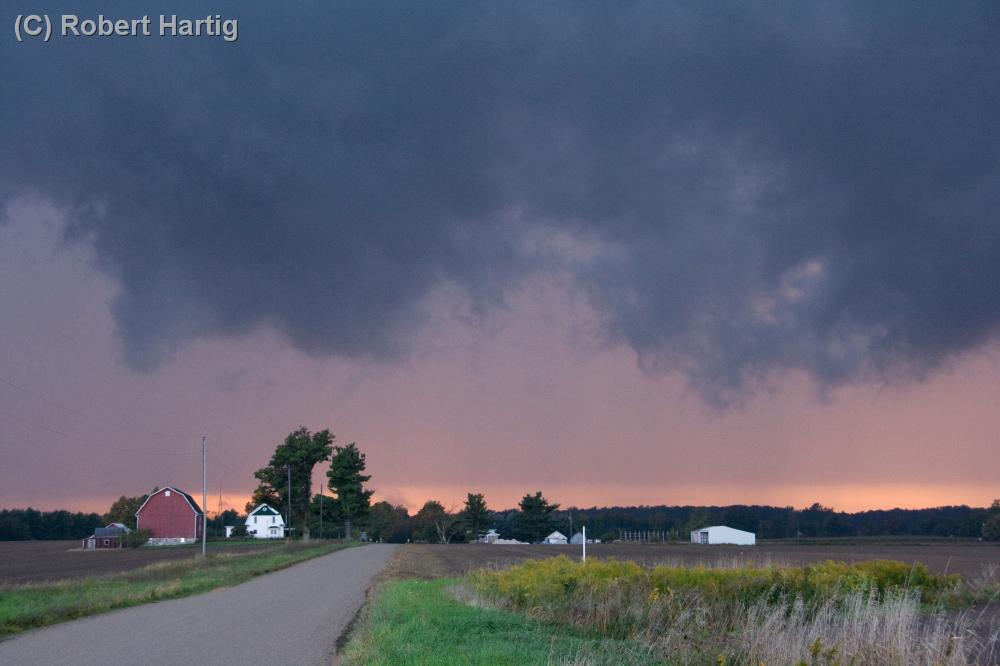
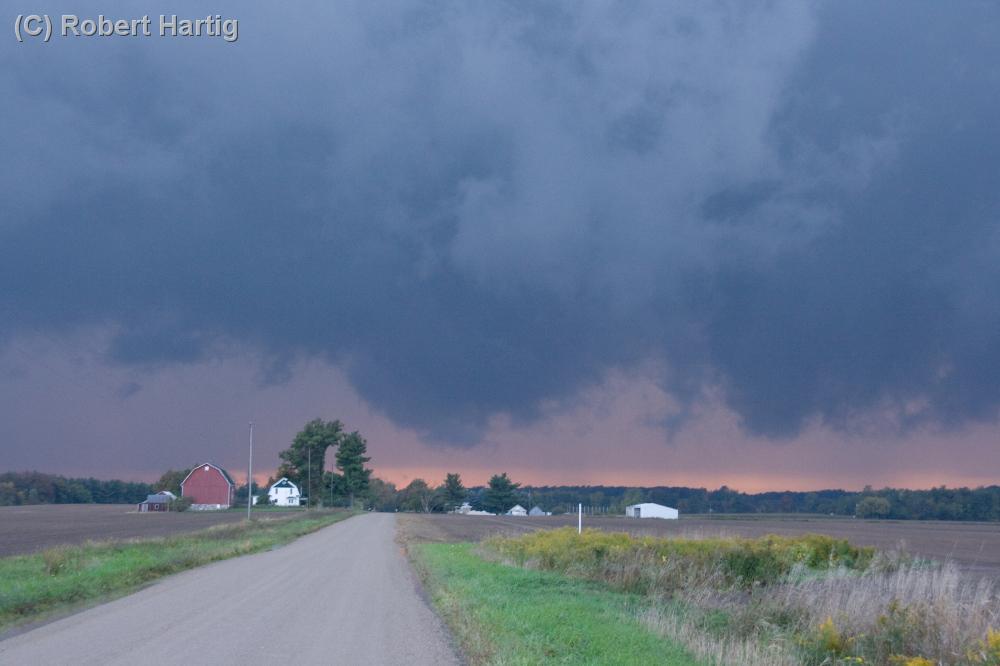
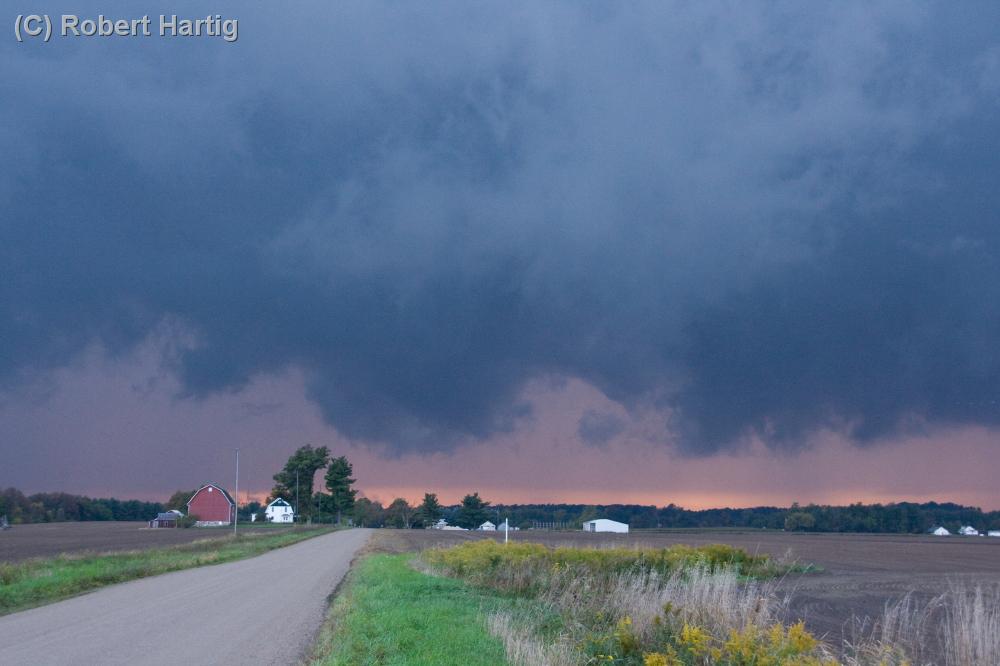
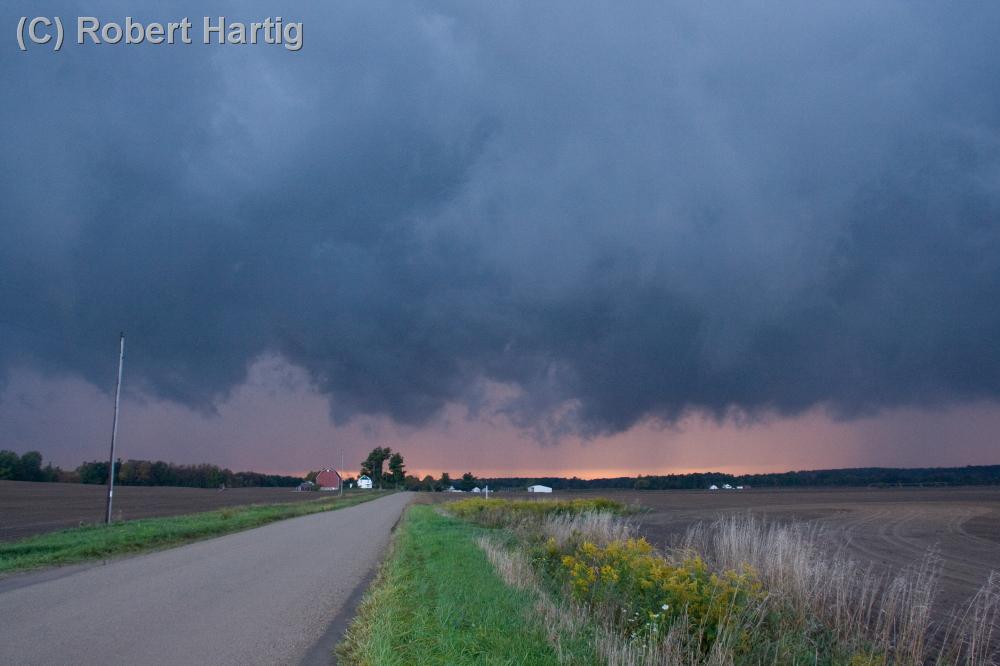
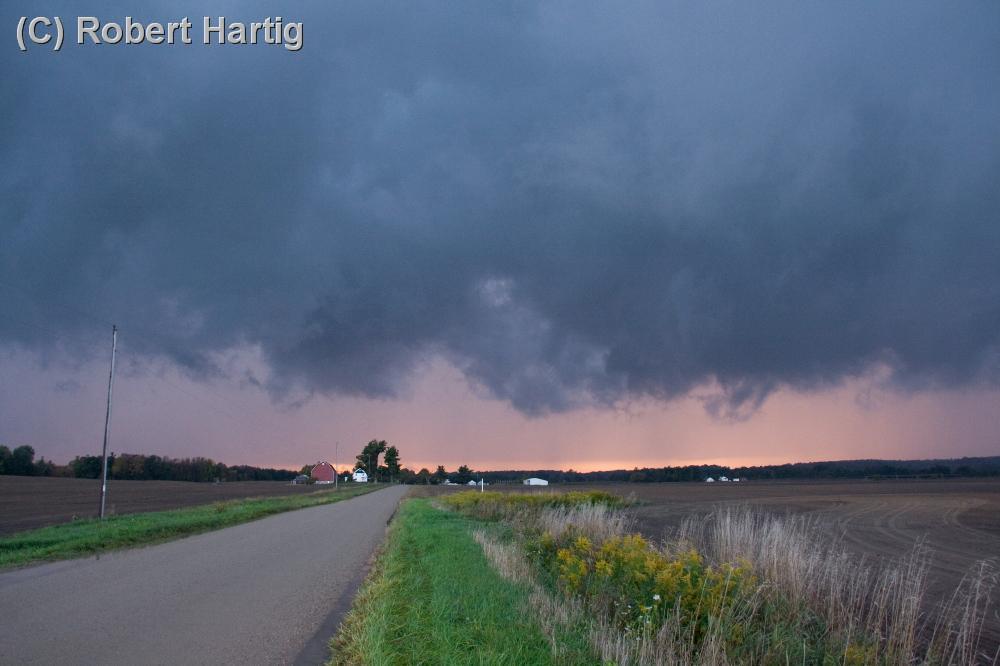
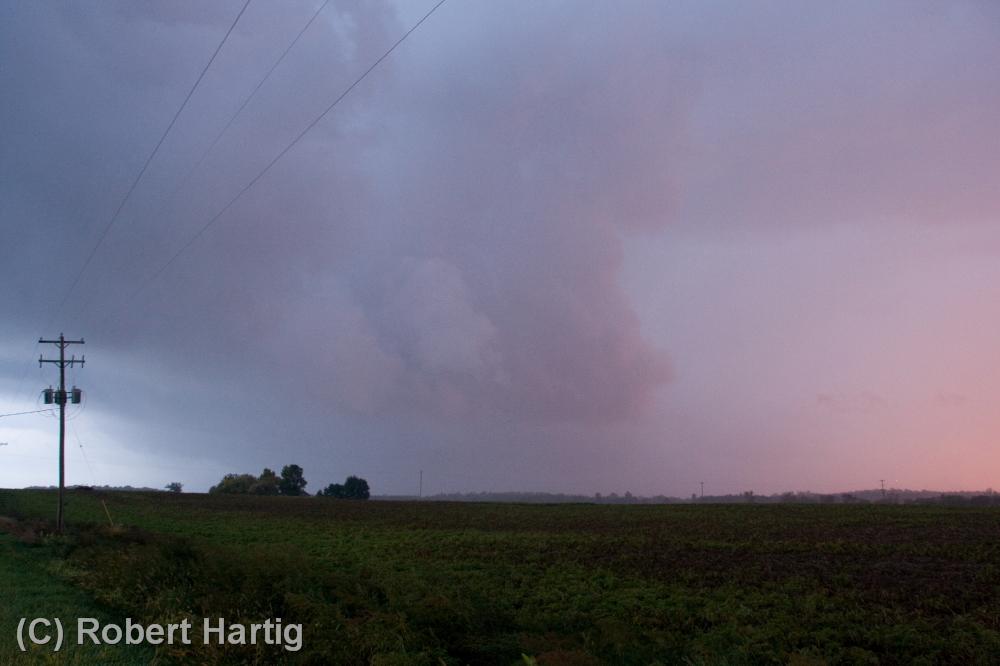
    What the heck. I hopped in my car and took off, intent on finding a picturesque sweep of open landscape where I could watch the storm move in. As you can tell from the images on this page, I found one.

    The storm was not nearly as formidable as it looks. It provided a nice bit of wind and a brief downpour; mostly, though, it was beautiful and offered a treat for the eyes. The setting sun filtered in low behind the cloud base, shining its rose-colored light through a curtain of rain and illuminating the backsides of gray, steamy towers.

    But why am I talking like this? Here, see for yourself. The photos are in sequence; click on them to enlarge them, and enjoy the view.

    My July 27 Michigan Tornado Video, for What It’s Worth

    Michigan is not Oklahoma. It is not even Illinois. If you’re a storm chaser who has any life experience with this state, as a few of you do besides me, you know exactly what I mean. Had Dorothy and Toto lived here instead of in Kansas, The Wonderful Wizard of Oz would never have been written. That or else author L. Frank Baum would have had to find a dfferent means of lofting his main character and her little dog somewhere over the rainbow.

    Sure, Michigan gets its annual tally of tornadoes. It’s just that most of them are something less than what you’ll encounter west of the Mississippi or down south in Dixie Alley. That’s not a bad thing, given our population density. But it does require Michigan-based chasers to either travel long distances out of state or else languish from convective malnutrition.

    You want to see a Michigan tornado? Okay, I’ll show you a Michigan tornado. But be forewarned, it’s not a pretty sight. It’s barely any kind of a sight at all. When I first spotted it, I wasn’t even certain it was a tornado, though after reviewing my HD clip and getting a couple of other reliable opinions, I’m now convinced. Good thing, too, because it’s all I’ve got to show for this year in terms of actually seeing a tornado. That’s pretty pathetic, considering the chase opportunities that circum 2011 has presented. But you can’t chase when your 85-year-old mother is having a knee replacement, as mine did on April 27, the day of the 2011 Super Outbreak; or when you just don’t have the money to go gallivanting freely across Tornado Alley, a reality that has badly limited me this year.

    Given such circumstances, you grab what you can, where you can, when you can. July 27 was an example. Although a light risk tapped on the very westernmost edge of Michigan, my state was for the most part outlooked for nothing more than general thunderstorms. Severe weather wasn’t a concern. So imagine my surprise when I spotted distinct rotation on GR3 in a cell just to my southwest, heading ESE toward Hastings.

    Grabbing my gear, I hopped in my car and headed east, setting up my laptop on the way. And what do you know! The radar didn’t lie. The storm had a large, well-defined wall cloud that I caught up with as I approached Hastings on State Road.

    Since my video clip doesn’t show much in the way of structure, let me assure those of you who care about such things that this storm had good visual clues: impressive wall cloud, crisp updraft tower, and a warm RFD cascading off the back end. As I’ve already mentioned, storm motion was ESE, which corroborates my recollection of a northwest flow regime and explains why the rotation was more on the northwest part of the cell than the southwest. Also, as I recall, surface winds were from the SSW, though I can’t say how they were behaving ahead of the updraft area as I never managed to outpace the storm.

    With all that said, here’s what happens in the video: Heading south behind the storm, I first spot the tornado out of my side window, which is covered with raindrops. Those somewhat obscure the funnel, but you can still make it out as a small, faint, whitish blotch connecting the cloud base to the treeline a little ways to the right of center. At this point I’m debating with myself and conclude that the feature is just scud. I park the car, zoom in on the storm and lose focus, then roll down the window and zoom back out. You’ll then see a small sapling mid-screen, and the tornado still barely visible to its right as a tiny strand of light gray condensation set against the darker background. It, translates almost imperceptibly to the right for a handful of seconds before vanishing. In my HD clip, I can make out something of an actual rope-out, but you can’t tell with YouTube.

    Nevertheless, even though YouTube isn’t great for detail, I think you’ll see what I’m talking about overall. I promise you, it’s there; you just have to look closely. And use your imagination. And be highly suggestible. And believe in the Tooth Fairy. (I’ve also got some clips of Sasquatch and the Loch Ness monster that you may take an interest in, but those are for another time.)

    The tornado doesn’t appear in the day’s storm reports, and I don’t believe the supercell that produced it ever got severe-warned. I think I was the only chaser on the darn thing, at least from my side of the state. I did report the wall cloud to GRR. I never bothered with the tornado because it was there and gone before I’d made up my mind what it was. It certainly was an anemic little puke, and I’m not sure whether to feel grateful that I scored at least one tube this year or to feel mortified about even claiming it. I almost felt sorry for the poor thing, and if I could have, I’d have taken it home and cared for it until it was healthy, and then released it under some nice, beefy updraft tower while strains of “Born Free” played in the background.

    Go ahead and laugh, but I’m probably the only chaser in Michigan who got video of this tornado. Then again, that’s nothing to brag about, particularly in a year when so many chasers have captured videos of violent, mile-wide monsters. It’s just, like I said, all I’ve got to show. Yeah, I was there with my buddies right by the airport when the April 22 Saint Louis tornado hit, but none of us actually saw a funnel. I doubt anyone did after dark in all that rain. So July 27 is it for me, my sole visual record. Mine, all mine. Bob’s tornado. I’ve assigned it an F6 on the original Fujita scale, F6 being a hypothetical rating associated with “inconceivable damage.” That description fits perfectly, as this tornado was practically hypothetical, and it’s inconceivable to me that it could have damaged much of anything. Maybe snatched up an ill-fitting toupee, but that’s about it.

    So there you have it: a genuine Michigan tornado. Now you know what storm chasing is like here in my state. It’s just another of the great perks that this supercell haven has to offer besides its economy.

    I will say this: we do have fantastic craft beer.

    So Much for Waterspouts

    Waterspouts were in the marine forecast for Lake Michigan today. For that matter, they’re still there through tomorrow. But while people on the west side of the pond witnessed a few spouts, they didn’t materialize here on the Michigan shore.

    With a closed upper low retrograding to the southwest and a persistent land breeze pushing convergence well offshore, out over the middle of the lake, any waterspouts that formed were far out of view from Michigan eyes. From the South Haven beach where Nick Nolte and I were hanging out, I could see a line of low towers pushing up over the waters 20 or 30 miles to west, moving ever-so-slowly to the northwest. The only Michiganians who might have seen a spout were boaters.

    Sigh … I got up bright and early and arrived at the beach around 8:00 a.m., but the waterspouts eluded me. Nothing new there. I have yet to see a spout, but I live in hope.

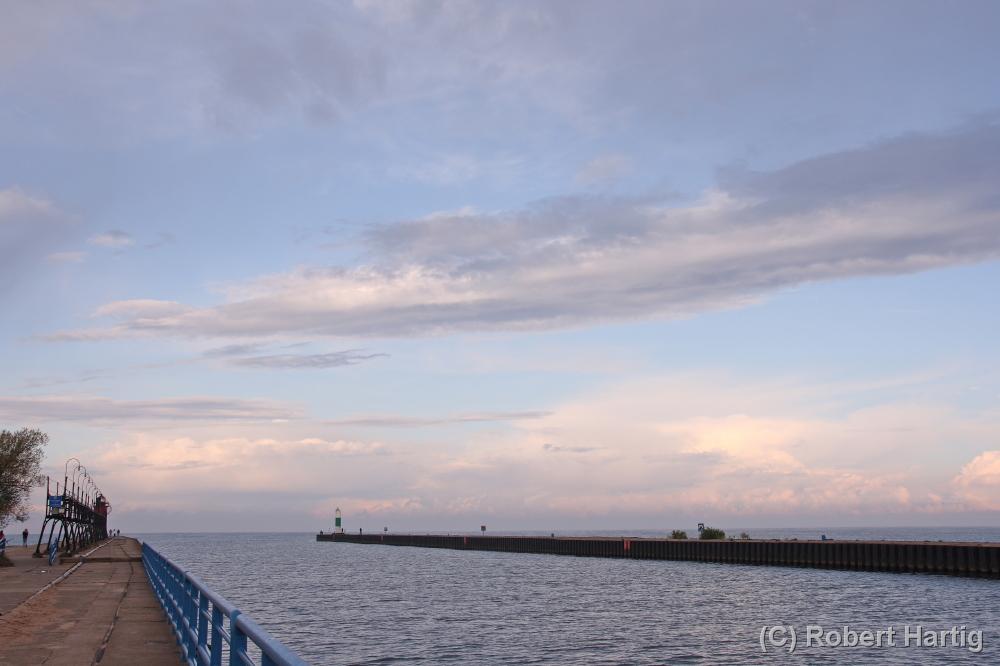
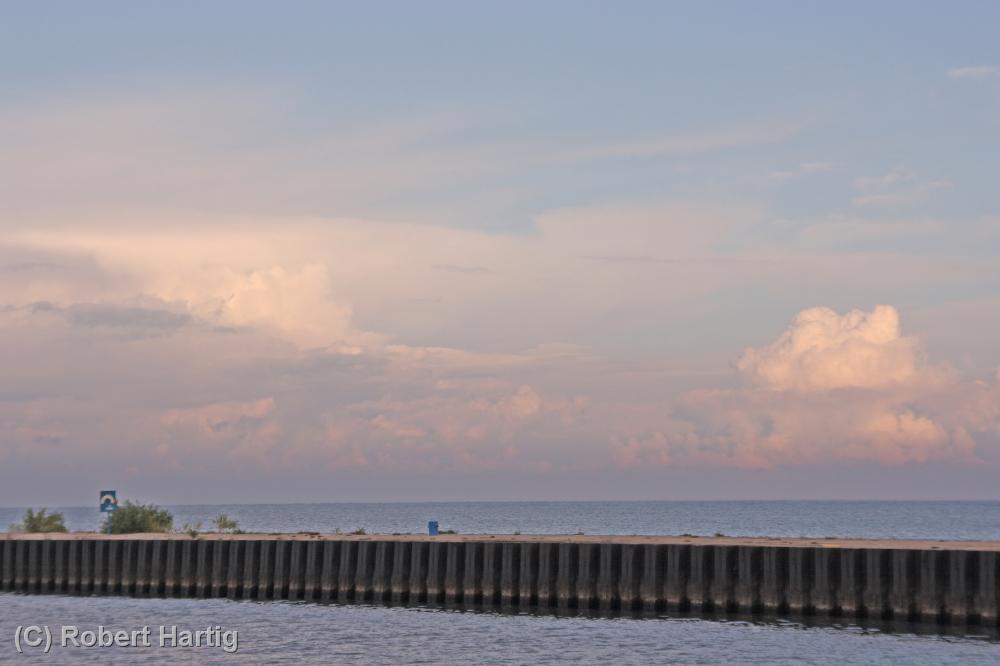
    The clouds over the lake were pretty, though, lit by the morning sun. I snapped a few photos just to show I was there, paying my waterspout dues. I figure that if I keep slipping tokens into the slot, pretty soon I’m bound to come up with a winner. Meanwhile, a few pics on a cool, moody September morning on the lakeshore aren’t a bad compensation prize.

    Hurricane Rain

    Standing on the waterfront of Atlantic Beach watching the brobdingnagian surf from Hurricane Irene batter the shore, it didn’t immediately occur to me that I was getting drenched. But I was. The driest part of me was my hair, covered as it was by my rain hood. Otherwise, I was thoroughly soaked. But I was oblivious to my waterlogged state, and this is something that, upon contemplation, I find remarkable.

    Irene was my first–and quite likely will be my last–exposure to hurricane rain. What strikes me about that rain, apart from its intensity, is how extraordinarily comfortable it feels. It is the warmest rain imaginable, unlike anything I’ve ever experienced in Michigan or anywhere else in the United States. Irene’s rain was so bathwater warm, and the air so equally balmy, that there was no sense of chill present to tell my skin, “Yo! You are freeking wet!”

    A warm summer shower in Michigan is something that your inner thermometer still registers as fairly cool, though not objectionably so. As for the rains of a northern autumn, those will freeze you to the marrow. In contrast, Irene’s rain was so warm that at first I was barely aware of being rained on. It wasn’t until I looked down at my legs and saw the state of my shorts that I realized I was saturated.

    Top-to-bottom saturated, it turned out. My Helly Hansen rain jacket, which had seen little use since its faithful service 10 years ago up in the Canadian wilderness, was in a state of deterioration that rendered it worthless. Unknown to me, pieces of blue rubber from the collar were cleaving to my neck in a ring. The zipper wouldn’t zip. And the warm rains of Irene had penetrated my protective layer and drenched my shirt. Had I been in Michigan, I’d have known about this state of affairs quickly. But not in Irene’s tepid environment. Chill just isn’t a part of the skin’s alert system in a tropical cyclone. A person could drown in comfort simply by standing outdoors.

    Now, isn’t that fascinating. Okay, maybe not. Not to those of you who live on the Gulf Coast, anyway. But for a lad from a small West Michigan cow town, it’s the peak of interest. Here in the frozen hinterlands, we reach for novelty where we can, and hurricane rain qualifies.

    Ahem … okay, enough for tonight. There’s a bowl of oatmeal that I want to watch congeal. Signing off.

    September 3, 2011, Outflow Boundaries

    Yesterday morning my friend Kurt Hulst called to say, “Grab your camera. There’s a great shelf cloud coming your way. It passed my location before I could get a picture.”

    Okay, then. My apartment faces east, and all I could see was blue sky. Not even a hint that a storm might be approaching from the west, and usually one gets at least some kind of a clue. But I snatched up my camera and car keys regardless and headed outside.

    Yes, there it was–a hazy arcus cloud moving my way from the west and northwest. I hopped in my car, with the intention of finding a better view for taking photographs than my parking lot afforded. But the cloud was moving faster than I realized, and by the time I reached 108th Street, it was almost on top of me. So, with the wind kicking up flurries of leaves in front of me, I headed east, thinking to put a little distance between the shelf cloud and me.

    Several miles down the road, I turned north, parked by a buffalo farm, stepped out of my car to get a look, and realized immediately that my cause was lost. The cloud was right overhead. It had to have been moving at least 60 mph. So much for weather photos. Within seconds, I was looking at the backside of the arcus, and it wasn’t particularly photogenic.

    For that matter, there wasn’t much to it. No ensuing rain, no lightning, no thunder, no storm at all, just blue skies. I can’t speak for other parts of the country, but here in Michigan it is an odd thing to observe an impressive-looking shelf cloud with absolutely nothing behind it! The cloud evidently had formed as the isolated effect of cold outflow from dissipated storms back in Wisconsin, in conjunction with a closer, severe-warned MCS to the north. Back at home, I could see the outflow boundary arching southwest all the way down into Indiana and moving rapidly east.

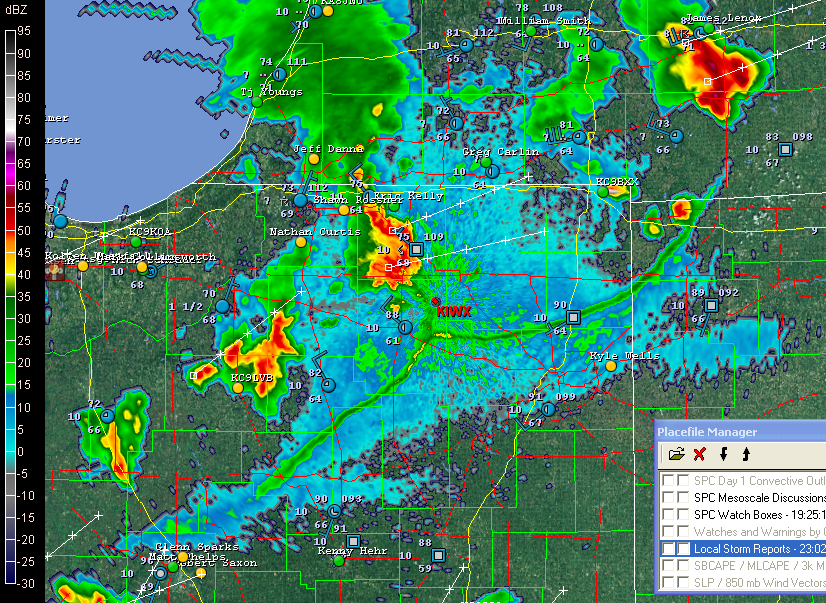
    Yesterday seemed to be the day for such phenomenon to be clearly defined on the radar. Later in the afternoon, GR3 showed a similarly highly distinct outflow boundary down in northern Indiana. The source of this one was easy

    to see: storms to its northwest and north. It looked pretty vigorous, and I wondered if it was putting on a show similar to what I had witnessed.

    As an item of curiosity and an example of a highly defined outflow boundary–I suppose you could call it a runaway gust front–I captured a screen shot. Click on the image to enlarge it.