Heading for an Iowa Chase

As I write, I’m heading west down I-80 with my storm chasing buddy Bill Oosterbaan. Our target: Waterloo, Iowa. The 9Z RUC shows a nice convergence of 850 and 500 mb jets overspreading massive CAPE by 21Z, with a robust 200 mb jet nosing in. Progged surface winds could be better, but skew-Ts still show nice veering with height, and storm relative inflow is majorly backed.

Oh, yeah…and we’re looking at dewpoints of 75 degrees and higher, with dewpoint depressions around 5 degrees. LCLs should be so low we may have to tunnel underground to find the cloud bases.

The SPC has hatched out this area for tornadoes. No surprise. After a relatively modest season, we may be on the verge of a significant outbreak. It’s a bit sobering to think that Parkersburg, Iowa, could get slammed again. I expect we’ll see a PDS statement at some point today, and I wonder whether the outlook won’t get bumped from a moderate risk to a high risk as well.

Tomorrow also looks to be a hugely active day, and the latest SREF places a sigtor in Michigan. So stay tuned. I’m sure there will be more to come.
June 8: Mini-Supercell in Northern Illinois and Severe Squall Line on the Lake Michigan Shoreline

This is really part two of the previous post. After chasing a potent, monster hailer of a supercell north of Saint Joseph, Missouri, I overnighted at a hotel outside of Des Moines, Iowa. When I stepped outside the next morning, the air was much cooler and drier, a stable atmosphere that wouldn’t produce so much as a sneeze, let alone a tornado.

But I knew that the SPC had outlooked the area to my east across northern Illinois, and for several days I myself had been eyeballing my home state of Michigan, where the NAM-WRF had been consistently indicating the possibility of tornadoes. With a little luck, I hoped to make it back in time to chase whatever convection might pop up along the warm front.

As I approached Davenport, I observed  towering cumulus muscling up through the troposphere. However, I didn’t pay them any attention–that is, until Bill Oosterbaan called to inform me that the SPC had just issued a mesoscale discussion for the area just east of me. Even as we talked, I noticed a lowering on a cumulus tower a mile or two to my northeast. When it continued to develop, I decided to investigate. Leaving I-80, I parked across from a truck stop at the Atkinson exit to watch.

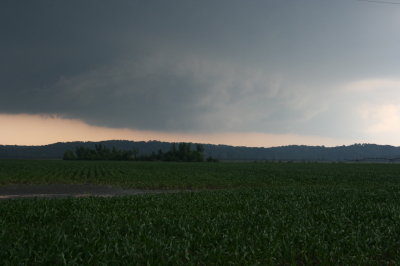
The next cell to my west quickly grabbed my attention. It had a nice rain-free base, and as I watched, scud began to form and ascend in an obvious updraft, coalescing into a small, ragged wall cloud. Grabbing my camera and getting out of my car, I noticed right away that the air was very different from back in Des Moines–considerably warmer and with plenty of moisture. The wall cloud fell apart before I could get a pic, but the overall structure remained interesting.

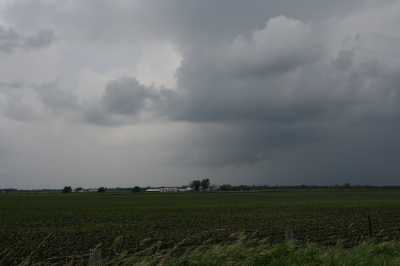
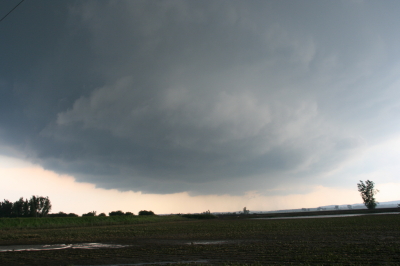
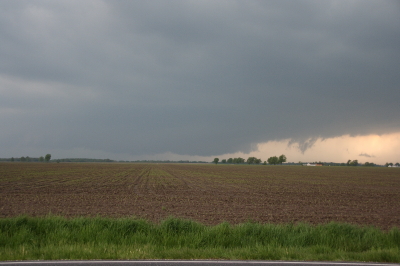
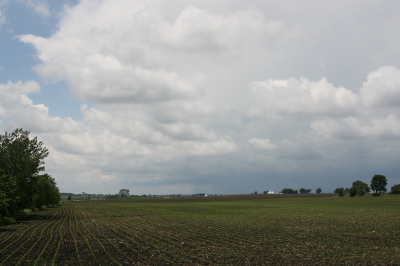
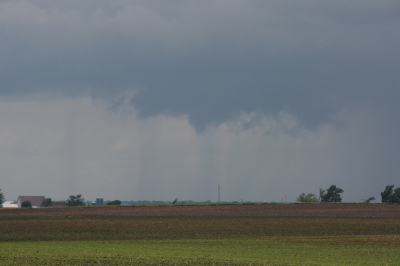
A mini-supercell approaches Atkinson, Illinois, just north of I-80.

A mini-supercell approaches Atkinson, Illinois, just north of I-80.

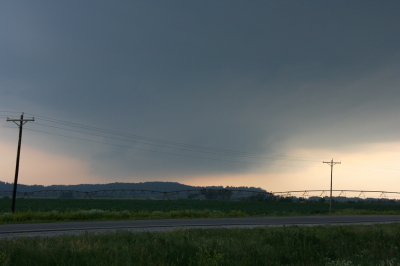
More brief, non-rotating wall clouds formed and dissipated one by one, so I figured I’d head north of town and observe. With surface winds veering and the overall flow unidirectional, I had no expectation of seeing tornadoes, but the mini-supercell made for some fun and interesting viewing.

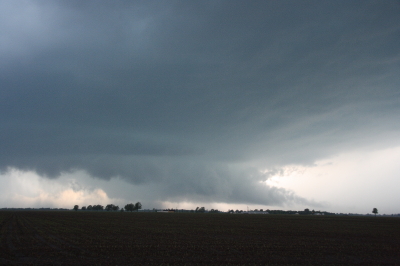
Ragged, non-rotating wall cloud.

Ragged, non-rotating wall cloud.

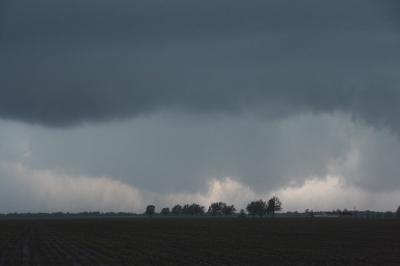
Distant wall cloud and back side of main updraft tower.

Distant wall cloud and glimpse of updraft tower.

I was tempted to follow the storm, but decided it was a red herring. If at all possible, I wanted to make it back to Michigan in enough time to chase the setup there, and that left me no time to play around on the western Illinois backroads. So I headed back to I-80 and busted east.

The first Michigan supercell fired up earlier than I’d hoped, and I bit my lip as I followed its progress on GR3 and watched it hit Lansing. If only I had driven east last night for two more hours, or left in the morning two hours earlier… But the previous day’s chase had left me exhausted. And you know, one of the downsides of being a Michigan-based storm chaser is, you just don’t have very high expectations when it comes to your home state. I mean, it’s Michigan. Home of convective table scraps, squall lines, and embedded supercells that don’t produce squat.

As it was, I watched several more storms fire up and develop rotation along the warm front that stretched across mid-Michigan. I was making decent progress and still had hopes of catching up with some of the southernmost cells. But by the time I crossed the state line, the action all had shifted well to the east, and it became clear that I wasn’t going to see any of it.

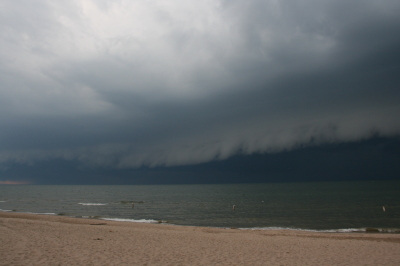
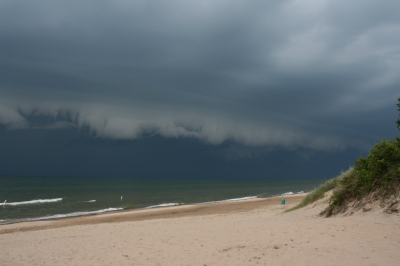
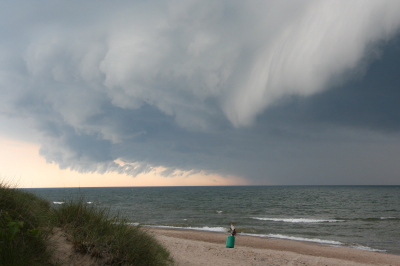
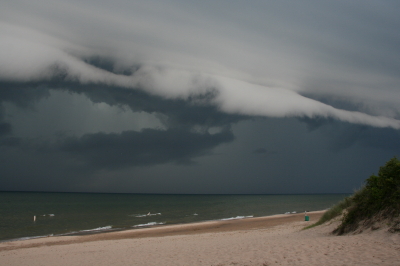
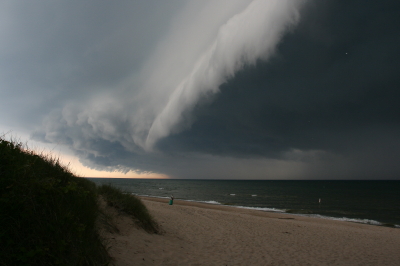
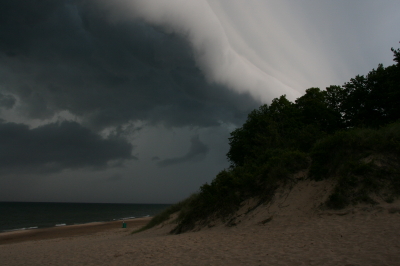
Instead, taking fellow chaser Mike Kovalchick’s suggestion, I headed toward the lakeshore at Allegan Beach to intercept a short but potent squall line. I’m glad I did. The backdrop of Lake Michigan and its dunescapes lends a breathtaking drama to incoming storms. The following photos depict the progress of the arcus cloud moving in across the waters. What these images can’t convey is the full, awe-inspiring sweep of cloud, big lake, and shoreline; of the solemn foreboding of some great event about to unleash itself upon a landscape cloaked in storm shadow; of the shelf cloud moving silently overhead like the furrowed eyebrow of a dark, scowling giant; and of sand spray blowing and trees thrashing in the wind as the gust front arrived.

I’ll let the photos tell their story as best they can, and leave the rest to your imagination.

An arcus cloud advances toward the Lake Michigan shoreline at Allegan Beach.

An arcus cloud advances toward the Lake Michigan shoreline at Allegan Beach.

View to the north.

View to the north.

Looking south...the storm closes in.

Looking south...the storm closes in.

Looking north...closer still.

Looking north...closer still.

Almost overhead.

Almost overhead.

One last shot to the north, then it's time to make a dash for the car.

One last shot to the north, then it's time to make a dash for the car.

June 7 Northwest Missouri Supercell

Now that I’ve had a chance to rest up and catch up after Sunday’s chase in northwest Missouri, it’s time to do a writeup. I’ll summarize by saying that there were no tornadoes, but there was some great structure along with hail the size and disposition of wild boars.

My plan was to hook up with Bill, Kurt, and Tom, who had headed west a day ahead of me in anticipation of chaseworthy storms. Unfortunately, a stout cap quashed an otherwise potent setup, and the guys–along with lots of other storm chasers–endured a blue sky bust. Like I told Bill, they needed me out there with them to erode the lid for them.

I left around 10:00 Saturday night and drove as far as Davenport, Iowa, where I overnighted. The next day, I hightailed it for Topeka, Kansas. Bad route choices delayed my arrival, and storms had already initiated by the time I got within the vicinity. But that actually simplified my choice. Rather than heading into Kansas, I worked my way north of Saint Joseph, Missouri, along I-29, then hit the backroads to intercept a supercell that was making its way across the border near Rulo, Kansas.

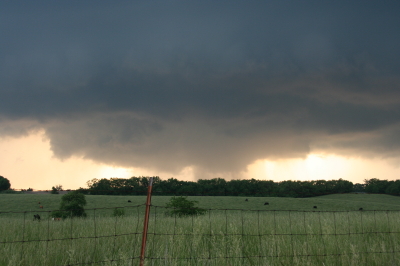
Parking my car outside of Big Lake, Missouri, I set up shop and got some nice photos as the storm moved in. The base was lowering and developing a rotating wall cloud. Here is what the storm looked like when I took my first shot.

Wall Cloud at Big Lake, Missouri, June 7, 2009

Wall cloud at Big Lake, Missouri, June 7, 2009.

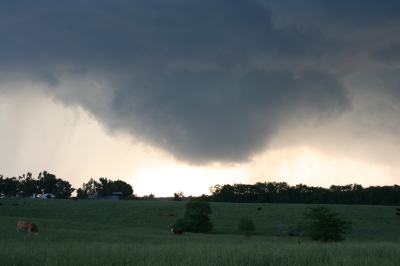
The cloud was southwest of me and moving eastward, which meant that I could expect plenty of rain and probably a good clobbering by hail. In a little while, sure enough, golfballs began to fall all around me. No rain, just sizeable hail. The cloud at this point was directly to my south and looked like this:

Wall cloud passing to the south.

Wall cloud passing to the south.

It was time to vamoose, and none too soon. The advance guard of a veritable armada of storm chasers was driving by. I pulled in behind the DOW (Doppler On Wheels) and other Vortex 2 vehicles and followed them toward Forest City. By the time I reached SR111 and began heading south, I had pulled ahead of the circulation. I wanted a few photos of the wall cloud advancing directly toward me, so I found a place to pull aside. Opening the car door, I stepped out into some ripping inflow and snapped a few shots.

Wall cloud approaching SR 111 north of Forest City.

Wall cloud approaching SR 111 north of Forest City.

I missed the really big, gorilla hail that some chasers encounterd, but the occasional baseball size was big enough for me. Somehow I escaped getting hit by the larger chunks, though one of them hit my roof squarely with a loud whack. I still haven’t checked to see whether there’s a dent.

Eventually I caught up with the guys at the I-29 overpass, where a zillion other chasers were also parked. Seems like everybody and his dog’s first cousin was on this storm. If I ever get rich enough to purchase a dedicated chasemobile, it won’t be an SUV or a TIV-style monstrosity. It’ll be a concession van with a fold-out bar.

Anyway, Bill, Tom, and Kurt forged ahead and I followed them for a ways, but eventually opted for a more southern route when they headed north toward Union Star. I figured they’d be hitting heavy precip and probably some nasty hail, and I wanted to stay on the south edge of the updraft, which was heading east by southeast. Here are a couple photos from what was, from my vantage point, one of the more promising episodes in the life of the storm.

Wall cloud with clear slot wrapping in.

Wall cloud with clear slot wrapping in.

Possible funnel cloud trying to develop.

Possible funnel cloud trying to develop.

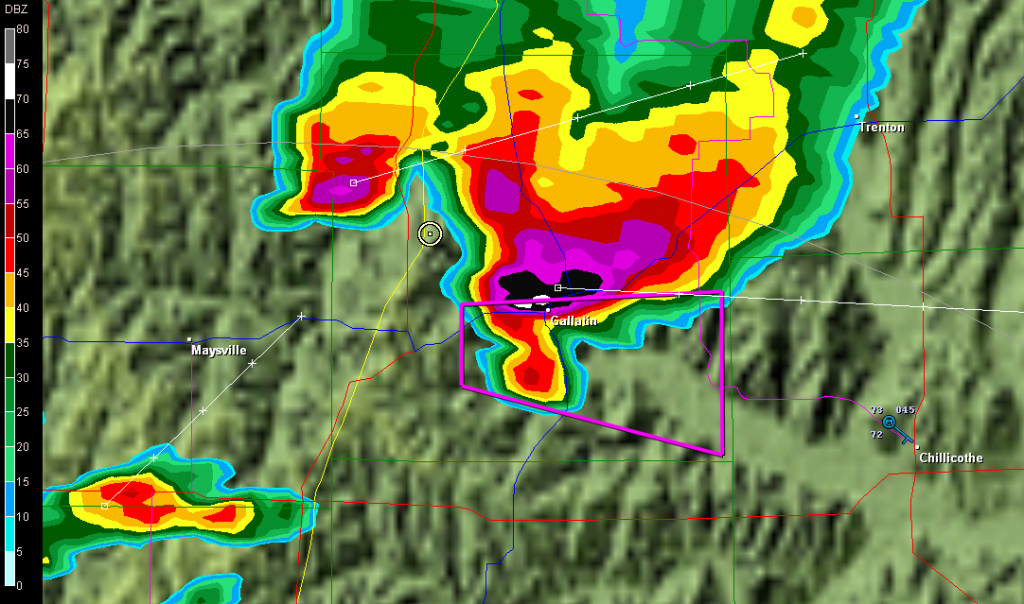
I believe the above shots were taken near Amity. From there, I headed east through Maysville and Weatherby, and across I-35 to just west of Altamont. There, I decided to end the chase and start heading home. The storm at that point was heading into Gallatin and was showing one of the best reflectivity echoes of its career on GR3.

Base reflectivity showing tornado-warned storm approaching Gallatin.

Base reflectivity showing tornado-warned storm approaching Gallatin.

But darkness was closing in, and I had no desire to chase this storm at night through the hinterlands of northwest Missouri. At that point, I was thinking about overnighting in Des Moines, and I had miles to go before I slept.

What a Blast! Playing Sax with Francesca at the Grand Rapids Festival

What fun it was to play with Francesca Amari this afternoon at the 2009 Grand Rapids Festival of the Arts! And how nice to finally NOT get rained and hailed out. High clouds moved in, thickened and threatened and lenta somewhat somber feeling, but never produced so much as a solitary raindrop.

We played at the main stage by the massive, bright orange Alexander Calder stabile, “La Grande Vitesse,” which is the massive and graceful icon of Grand Rapids. Our 45-minute set included tunes from Francesca’s DVD Better Days, plus jazz standards such as “Fly Me to the Moon” and my own feature tune, “My Funny Valentine.” Our bass player, Dave DeVos, had another gig at the festival and was much missed. But Wright McCargar did a stellar job filling in the bottom end, a job no keyboard player relishes because of the limitations it imposes, but which serves when there’s no bassist.

I was pleased to see my mother and sister, Diane,  out there in the audience. It’s such a blessing to have their support.

So…now the festival is behind me, and I’m preparing myself to head for Nebraska in pursuit of storms. Looks like fellow Michigan storm chaser Mike Kovalchick will be joining me. We’ve got a long drive ahead of us. Sometime tomorrow, we’ll hook up Bill, Tom, Kurt, and a friend of Bill’s. The last time I chased was May 13. I am ready and raring, and I hope the weather roars. The SPC shows a 30 percent area in tomorrow’s outlook, mostly in Iowa.  The 18Z NAM suggests a more western play, but maybe that’ll change.

Right now, storms look like they may have initiated northwest of Des Moines, but what I’m seeing doesn’t look like much–yet. I’m about ready to reboot GR3 and take another look. The guys drove all night to make the play today. I hope they score big. But I have an idea that tomorrow is going to be the main act. And then there’s Monday. I’ll be really curious to see whether the Great Lakes gets the kind of weather the NAM has been suggesting.

Chasing Storms after the Concert

Bill, Kurt, and Tom are leaving tonight to chase Saturday’s setup out west. I’m staying behind to play with Francesca and Friends at the 2009 Grand Rapids Festival of the Arts. Ordinarily I’d feel a bit torn, but I have an idea that the better action will be on Sunday and–from the looks of the 12Z NAM-WRF–Monday. So when I step onto the stage tomorrow afternoon, unless between now and then a confluence between the NAM and GFS suggests that capping will suddenly no longer be an issue and Armageddon is going to break out in the Great Plains, I will be a man at peace.

But directly after the concert, I plan to pack my bags and head for the Corn Belt, where I’ll hook up with the guys and chase storms on Sunday and, if the present NAM-WRF comes at all close to verifying, Monday.

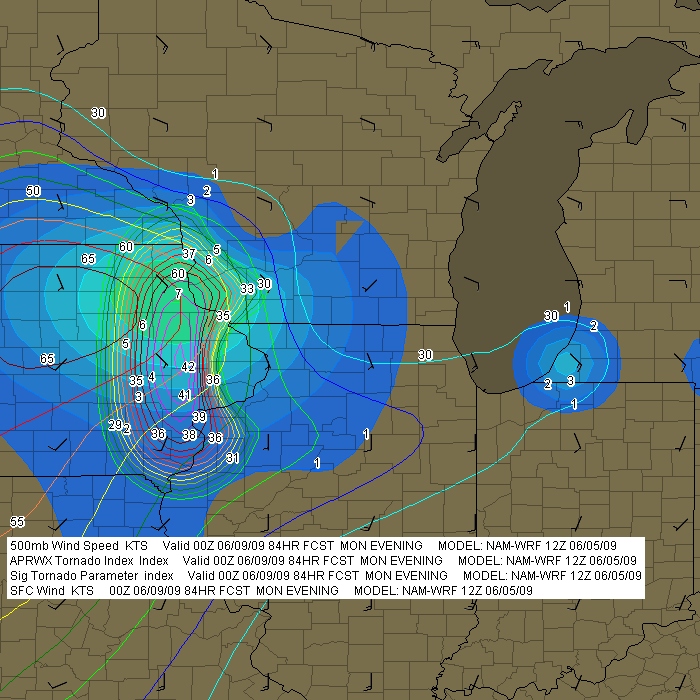
Frankly, I’m somewhat skeptical about Monday. Previous runs have consistently painted such a different scenario, with majorly veered surface winds and a unidirectional flow overall, that the 12Z’s placement of the weak surface low in eastern Iowa seems too good to be true.  Here’s an image from F5 Data showing sigtors, APRWX sigtor, surface wind barbs, and H5 wind speeds:

12Z NAM-WRF for 0Z Monday

12Z NAM-WRF for 0Z Monday (F5 Data)

Suddenly all the elements in terms of moisture, instability, and shear are lining up, along with a 7 sigtor in Iowa and even a 4 in southwest Michigan (in the usual lakeshore location, Berrien County). Makes me more than a little suspicious. But I think I can at least count on Sunday, and we’ll see whether future model runs continue to paint a rosier trend for Monday in Iowa and the Great Lakes.

So it’s play my saxophone on Saturday, then chase storms on Sunday and maybe Monday.  That’s about as nice an arrangement as I could possibly ask for–other than for this year to finally be the one where our act at the Festival doesn’t get interrupted by a hailstorm. That has happened three years in row. But I’ve got a good feeling that tomorrow is the day when we’ll finally make it through intact. That’ll be good. I’d just as soon save the hail for the day after.

Remembering the Parkersburg/Hazleton Tornadoes

One year ago today, the second EF5 tornado in the history of the new Enhanced Fujita Scale rating system descended on Parkersburg, Iowa, and obliterated the southern third of the town. I and fellow storm chasers Bill and Tom Oosterbaan and Jason Harris could see the intense rotation moving over Parkersburg on GR3 as we stairstepped southeast from the northern edge of the cell, heading for an intercept. There’s a certain sense of disbelief when you see something like that, a feeling of, Naah, it can’t be as bad as it looks.

But it was. A few miles farther down the road, with the rotation still at least ten miles to our west, debris–some of it fairly large–began to fall from the sky. That was when we knew for sure. Something terrible had happened. Even with pieces of sheet metal clanging down onto the pavement in front of us, I had a hard time believing that a tornado disaster had just occurred, but I think we all felt a certain sober awareness that a community had been hit.

We intercepted the storm near Fairbank, where the NWS indicates that the Parkersburg tornado occluded. Parking on a sideroad, we watched as a large, new wall cloud formed and moved directly toward us. Warning an Amish family who was standing in their yard, watching, to take shelter, we scooted south and then east, watching as the wall cloud lowered and kicked up a ton of dust. A second, enormous tornado had formed, barely discernible through the haze. We tracked with it to the east as it headed on a collision course for Hazleton, mercifully grazing the southern edge of that town. Had it hit head-on, I suspect that the Hazleton tornado’s EF3 rating would have been higher.

It’s hard to believe that a whole year has passed since that event and the several days of Great Plains action that preceded it. What a difference between then and now, with a nasty ridge casting a pall on this May’s peak chase season.

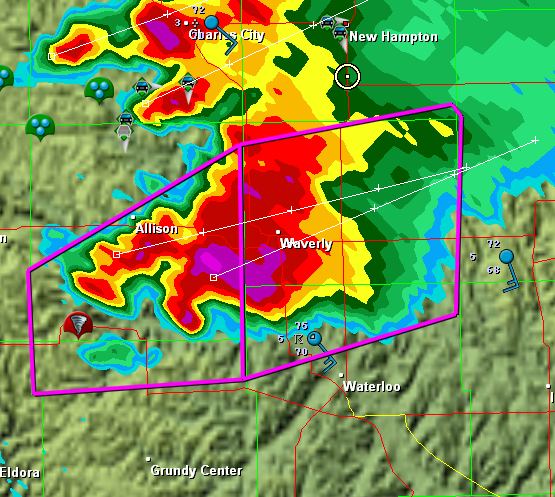
In remembrance of the Parkersburg/Hazleton tornadoes, I’m including a couple visuals. The first is a radar grab of the supercell as it moved out of Parkersburg. The tornado icon is a storm report from the town, just minutes old. You can see our GPS position marked by a circle with a dot in the middle of it on the northeast edge of the storm

The Parkersburg, Iowa, tornadic supercell.

The Parkersburg, Iowa, tornadic supercell.

The second is this YouTube link to my video of the Hazleton tornado. My videography may not be the best in the world, but I think you’ll get a sense of the intensity this storm evoked. It was my first really big tornado, and it was close.

I doubt this year has anything in store for us  like what we saw that day. But who knows? I’m not ready to write off this chase season yet–though I certainly hope it doesn’t hold a catastrophe like the Parkersburg tornado.

Tribute to a Storm Chasing Partner

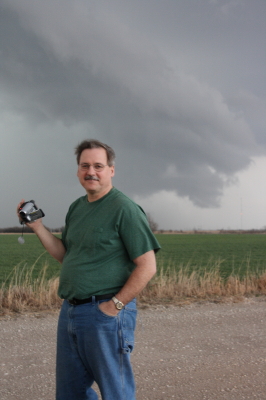
Wild Bill Oosterbaan, Chase Partner Extraordinaire

Wild Bill Oosterbaan, Chase Partner Extraordinaire

I contemplated cropping the above image to achieve a better visual balance. Then I thought, nah. For one thing, what’s the point of trying to balance the photo of a character who’s as wildly off kilter as Bill. For another, and all kidding aside, I’d have to trim out a good portion of the storm clouds. And that would be like trimming out the very essence of Bill Oosterbaan. You see, clouds like those are Bill’s passion. They’re what first brought us together thirteen years ago, and they’ve been propelling us across the miles ever since in search of convective mayhem.

Bill is my chase partner. Of course, I chase with some other great friends and storm chasers as well, but Bill…well, I’ve just covered more miles with him by far, paid more dues, experienced more busted chases, learned more about weather, and yes, seen more tornadoes and beautiful storms, than with anyone else. This post is my tribute to my fellow chaser, comrade in convection, and good friend of over a decade.

Bill and I are very different temperaments. Conduct a Meyers-Briggs personality profile of each of us and your first conclusion probably wouldn’t be that we ought to get in a car together and travel 1,000-plus miles at a stretch in search of intense, potentially lethal weather. But we’ve survived both the storms and each other, and learned quite a bit in the process. And, I might add, we’ve had a heckuva lot of fun.

I first met Bill back in 1996. That was the year I also conducted my first successful storm chase right here in Michigan. I had already done a chase or two with Bill and his brother, Tom, but on that sticky August day, the two of them were out on the golf course. So when a supercell fired up and formed a wall cloud right outside the window where I worked, I drove solo across the Kent and Ionia County countryside and scored a slim, elegant tube tornado north of Saint Johns.

On my chases since then, though, I’ve rarely been without Bill. So our development as storm chasers has followed a very similar track. I saw my first Great Plains tornado with Bill. In 2005 we chased the record-breaking Six State Supercell together from west of Columbia, Missouri, all the way back to Michigan. On two separate occasions, we’ve witnessed nighttime tornadoes strike large towns. Our technology has advanced from a miniature TV and stop-offs at airports  and libraries in order to access radar data, to laptops equipped with all the tools known and loved by storm chasers today. We’ve even figured out how to use most of the stuff. Our forecasting skills have grown from those early days of trying to decode the arcane language of SPC discussions, to making our own forecasts with increasing success.

Lately my laptop of four years has been giving me fits. This is  nothing new, but it has gotten to the point where I’ve finally ordered a new one from Dell. It’s a heavy-duty toughbook that’s made to take punishment, perfect for the road. Bill sees  in it the end of an era. He says he’s going to miss watching my eyes bulge and the veins pop out in my neck. I hate to deprive him of such a simple pleasure; it’s a small thing, and it causes him so much joy. On the other hand, I think he’ll agree that there’s a lot to be said for having a computer that doesn’t crash when we need it most. Typically that happens while we’re in pursuit of some rain-wrapped meso with who knows what lurking in its interior.

I look forward to tracking down plenty more mesos with my friend and long-time chase partner. Many more storms, countless more hours on the road, and yes, more arguments with the ornery cuss. Because the storms are what it’s about for both of us, and I think we’ve learned–and will continue to learn–plenty from each other about chasing them. Our respect for one another is mutual, as is our love for the wild, untamed beauty of Big Weather. When Bill and I talk, it’s mainly about storms. We never get bored. For us, talking about the weather is far from trivial conversation. There’s always something new to learn, something fresh to discover.

That’s why I refuse to trim those storm clouds out of the picture up above. To lessen their presence would be to lessen the story they tell about the man standing in front of them. They’re a vital part of Bill. So let the clouds remain and let the picture look a bit unbalanced. After all, Bill’s a storm chaser. What kind of balance do you expect out of a guy who hunts tornadoes?

Bill, mi amigo, it sure has been a blast. Here’s to you. Here’s to shared experiences, to the thousands of miles we’ve driven, and to the thousands we’ve yet to drive. Here’s to the the Lord who has kept us safe and blessed us with success.

And, as always, here’s to the storms.

Video of May 13 Edina Tornado

My tornado videos to date aren’t of the best quality, but I’ve decided to put my footage of Wednesday’s tornadic supercell up on YouTube anyway. It’s not the greatest, but it’s not terrible, either, and it does provide a record of the storm from our vantage point on SR15, approximately two miles north of Edina, Missouri, that other storm chasers may find of interest.

Please note that I do know the difference between a beavertail and a tail cloud–I just got my terminology turned around. Also my sense of direction, in saying “counterclockwise” when I meant “clockwise.”

Nuff said. Hope you enjoy the video.

May 13 Tornado in Northern Missouri

Updraft Base

Updraft Base

This is the view that met us as we pulled off the road a couple miles north of Edina, Missouri, yesterday evening. “We” were Bill Oosterbaan, Derek Mohr, and me, and what we were looking at was the only supercell in Missouri on Wednesday, May 13, to produce a tornado–this despite a sizeable moderate risk that swept across most of Illinois and Missouri all the way down to Kansas and Oklahoma.

The storm was showing strong rotation, and had already put down a damaging tornado twenty miles to our west in Kirksville. We lost Internet connection as we approached the storm, but our last scan showed what appeared to be a storm merger with two distinct areas of rotation. The radar didn’t lie, and the proof of it provided an interesting scenario.

Wall Cloud Forming

Wall Cloud Forming

In the second image, you can see a ragged patch of scud ascending to the right and in front of the lowering in the background. This is the beginnings of what became an impressive wall cloud. Within a couple of minutes, the scud had matured into this…

Wall Cloud

Wall Cloud

The tail cloud to the right continued to grow to an astonishing length, displaying vigorous motion, feathering in rapidly toward the updraft. Meanwhile, a rain curtain began to wrap in from the south behind the wall cloud. This suggested a second mesocyclone following in the wake of the first area of rotation. I commented on this in the video I took of the storm, and my hunch soon proved true.

As the storm drew nearer, another prominent lowering began to emerge. It was exhibiting rapid motion, moreso than the more visually interesting wall cloud in the foreground. A tornado appeared immanent within this broad rotation, and in another minute multiple vortices were square dancing in the distance. One vortex soon tightened up and became dominant, fattening up into a nice hose. But the rain bands were starting to conceal the tornadic activity, and in a bit it was hard to tell exactly what was happening.

The storm quickly evolved into a nasty high precipitation beast, and from then on any tornadoes were effectively cloaked in rain.

Sorry, no stills of a well-formed tornado–I had set my camera down in favor of my video recorder–but I did manage to capture what looks to have been the beginnings of the multiple vortex phase.

Multiple Vortex Tornado

Multiple Vortex Tornado

No, you can’t see any visible touchdown in the photo, so maybe the circulation wasn’t tornadic at that moment.  If not, it was shortly after. I sure wouldn’t have wanted to be standing underneath it.

After the chase, Bill dropped Derek and me off where we had left our cars at the K-Mart in Springfield, Illinois. Then the three of us headed off in our respective directions–Bill toward Corydon, Indiana; Derek toward northern Michigan; and I back toward Grand Rapids. On my way home, I picked up fellow Michigan chasers Mike Kovalchick and Mike Bishop. They had experienced an automotive failure that took them out of the chase, forcing them to ditch their vehicle in Lincoln–truly a bummer. It was great to reconnect with Mike Kovalchick, and to meet Mike Bishop for the first time. Having a couple fellow storm chasers in the car sure made the long trip home seem shorter.

The day out chasing did me a world of good, but I need a good night’s sleep, and I have work to do tomorrow. By the time the next round of weather arrives, though, I should be primed and ready to go.

Painted Trilliums and a Mid-Week Storm Chase

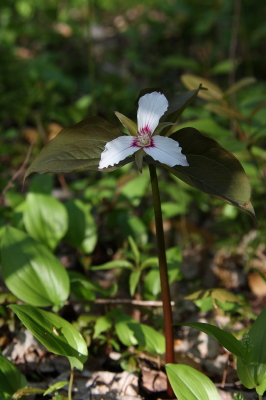
Painted Trillium

The painted trillium, trillium undulatum.

You’re looking at one of Michigan’s rarest wildflowers, the painted trillium.

With plans for a picnic in place and nothing but sunshine in the forecast for today, Lisa and I headed east with our cameras for a Michigan Nature Association preserve near Port Huron. The location is one of a handful where the painted trillium grows in this state, keeping company with the red trillium, which is also uncommon but far more widespread than its painted cousin.

Good luck finding this in the Michigan woods!

Good luck finding this in the Michigan woods!

Out east in the Appalachians, the painted trillium is fairly common. But in Michigan, if you ever catch a glimpse of this plant, count yourself fortunate indeed. The images in this post are a prize, and it was a double blessing that I got to share the experience of capturing them with Lisa, who loves the outdoors as much as I do.

But enough eye candy. Turning from wildflowers to weather, Wednesday looks to be shaping up as a chase day in Illinois. It’s nice to see the action coming close to home. The question right now isn’t whether there will be a severe outbreak, but where will be the optimal chances for tornadic activity. With a strong cold front moving in, a squall line seems inevitable. But with the winds veering strongly from the surface up to 500 millibars, hodographs are nicely curved and helicities ought to be formidable. Play the warm front? Maybe. It’ll certainly be a tempting target, within easy reach of Grand Rapids. But I want to see what happens with clearing. It would be nice to see a buildup of CAPE in northern Illinois.

Wait and see is the name of the game. Right now all eyes are on the NAM and GFS. But Wednesday morning will tell. I’m crossing my fingers and toes and hoping to see signs of clearing on the satellite.