Stormhorn Blog is Back Up and Running

Lately, due to life’s fast pace, I haven’t kept a close track of the Stormhorn blog. So I was unaware, until my buddy Kurt Hulst informed me of it, that folks have been unable to link to my blogsite.

This is to let you know that the problem has been fixed, thanks to my lovely computer tech girlfriend, Lisa, who instantly and correctly suggested that a corrupt plug-in was the culprit.

Stay tuned–I’ll be posting content of greater interest this weekend. For now, this is just a heads-up that Stormhorn is back (just in case ya missed me).
Tomorrow’s Chase Scenario

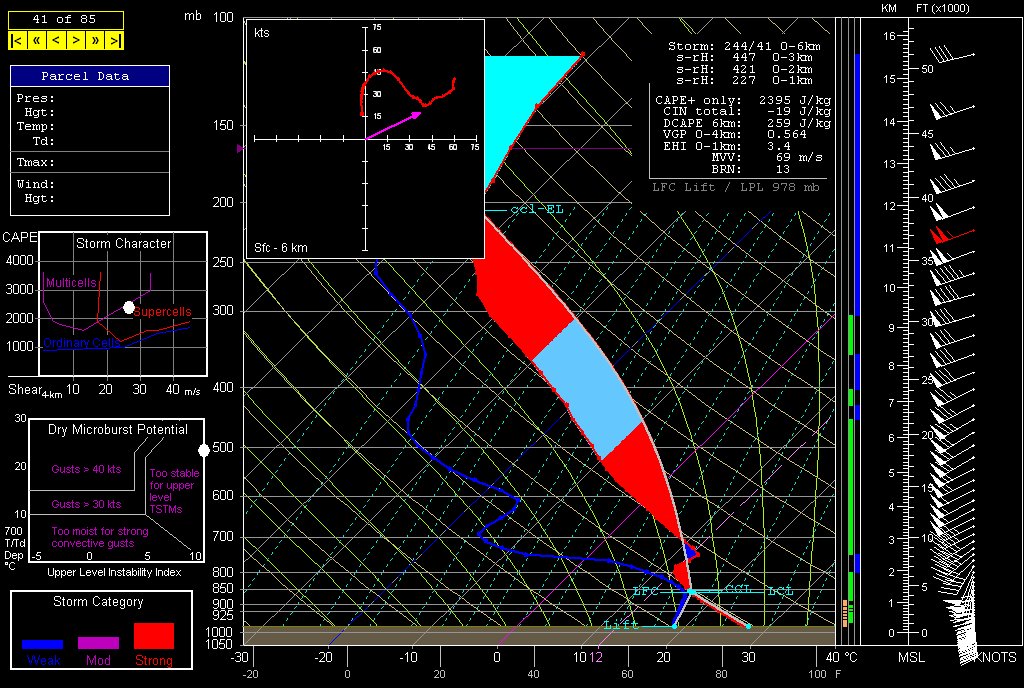
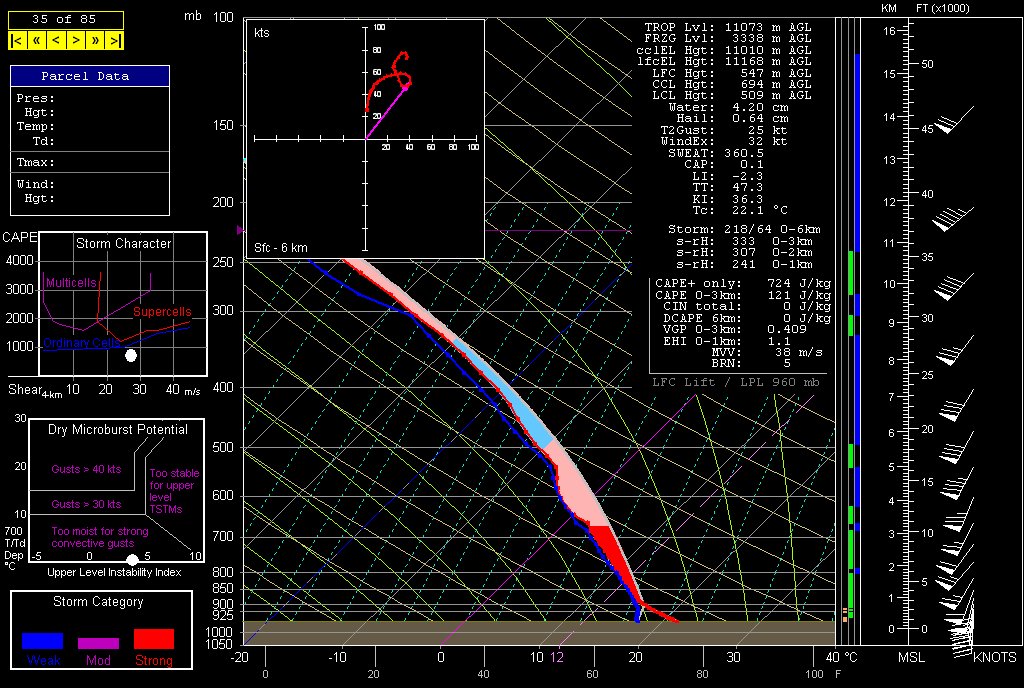
If I were to pick a chase target for tomorrow, it would be Rolla, Missouri. That’s based on a sampling of the 6Z model soundings of the GFS, NCEP’s present model preference.

Frankly, though, I can’t get too excited about this system. True, it seems to be shifting the activity to within striking distance, where I could conceivably go chasing and still make it back Friday morning in time to make an appointment that I absolutely can’t miss. But instability isn’t all that great, and besides, who wants to go chasing in Missouri hill country?

If the NAM verifies, things will shift north a bit. But I don’t see that making a practical difference. It’s a marginal setup at this point, and unless things improve, I don’t think I’ll feel short-changed sitting this round out. Maybe the next trough will be an improvement.

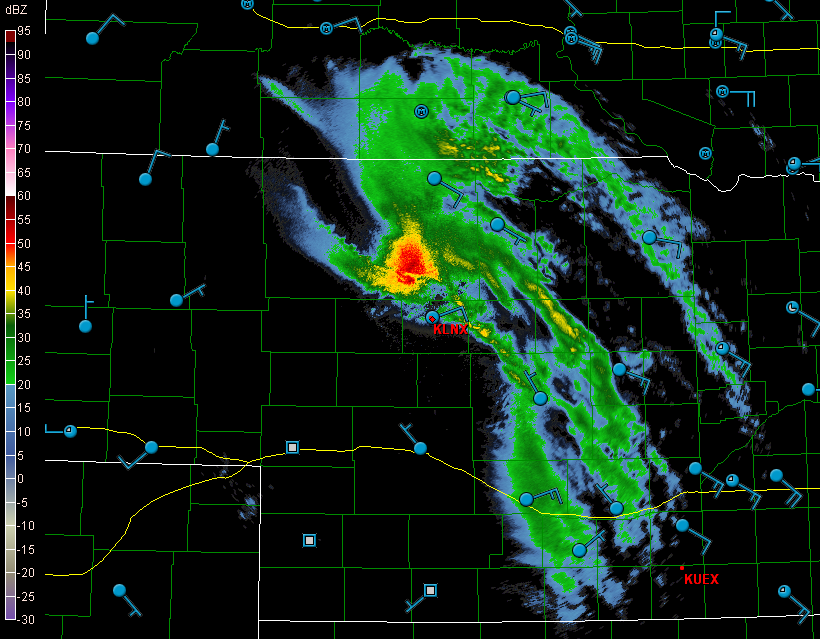
ADDENDUM: Ouch! Just looked at the SPC’s afternoon update. If they’re right, then only the desperate and the insane will be chasing tomorrow. They’ve pulled the 30 percent risk down mostly into Arkansas, tapping on southeast Oklahoma, northeast Texas, and extreme southern Missouri down around Branson. Anyone for a chase through the Ozarks?

Lightning over Lake Michigan

The storm system that has been in the models for the past week produced a fast-moving squall line that blew from Wisconsin across Lake Michigan. Kurt Hulst and I were there on the shore just north of Holland, Michigan, to catch the action.

Kurt is a great lightning photographer. Look for his photos of last night’s storm on his blog.

As for me, I’m a neophyte when it comes to lightning. Shooting at night, the problem I encounter is focus. Unfortunately, most of my shots were too blurred to crop, and since I was shooting wide angle, cropping is essential. However, a couple shots didn’t turn out too badly. The one shown here is the best of the lot. Click on it to enlarge it.

Surface Dewpoints Map Now Operating

The problem with the surface dewpoints map on my Storm Chasing page is fixed. Everything is now running the way it should be.

New RUC Maps on Storm Chasing Page

Storm chasers, check out the new RUC maps on my Storm Chasing page. They’re still under development, and they’re not comprehensive, but they do offer you something different. I haven’t seen F5 Data weather maps on other sites. If you’re a fan of tornado indices such as the EHI and STP, you’ll like the proprietary APRWX Tornado Index, which includes Great Lakes waterspouts.

For some strange reason, the surface dewpoint map keeps displaying surface temperatures instead. Not sure why, but obiously it needs fixin’. Everything else works as it should. I’ll welcome your comments/suggestions.

Crystal Ball Gazing with the GFS

Yesterday’s trough passed through pretty much as expected, without a whole lot of fanfare and certainly not with anything tornadic. So the question is, what lies ahead? Anything?

Maybe.

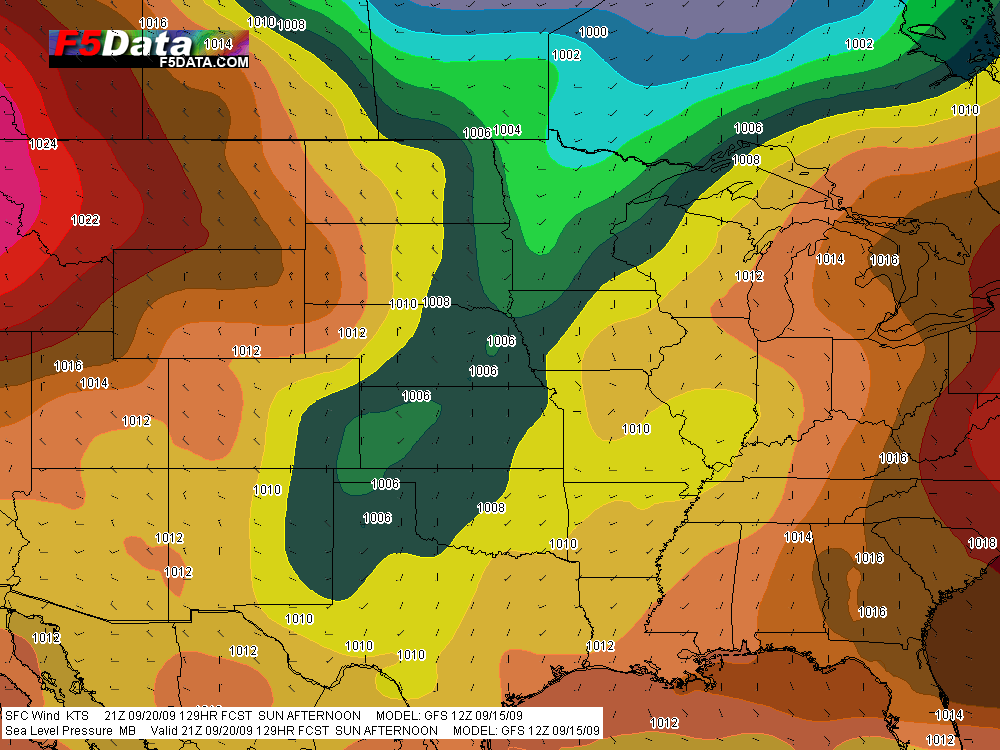
At least we’re not locking in under another ridge. Today is the first day of autumn, the weather patterns are changing, and the GFS and ECMWF seem to agree on a 500 mb trough affecting the Midwest over the next several days. And yeah, yeah, I know it’s just reading tea leaves, but here are a couple 132-hour GFS maps for next Sunday at 00Z. At the risk of stating the obvious, click on the images to enlarge them. The first shows sea level pressure (shaded), surface wind barbs, and 500 mb height contours.

The second map shows 500 mb winds (shaded) with wind barbs, and 300 mb wind contours.

The big question mark may be moisture. But this far out, it’ll be nice if that even matters by the time Sunday arrives. This time of year, living in the Great Lakes, the best one can do is hope. But there’s nothing wrong with hoping.

Next Week: Troughing in the Picture?

I’m prepared to get my hopes up a bit. The ECMWF and GFS both now appear to agree on a trough working its way through the country’s mid-section. Here’s the current GFS for 21Z Sunday afternoon:

GFS Sea Level Pressure for 21Z Sunday.

GFS Sea Level Pressure for 21Z Sunday.

Granted, there’s a lot more that needs to happen, such as mid-level winds and moisture connecting, but this will do for starters. It’s a better picture than yesterday.

The GFS wants to move this system through faster than the ECMWF, but at the moment I’m not going to worry my head about it. All I care about right now is, both forecast models are pointing to a bit of troughiness taking shape. It’s something to keep an eye on. Fingers remain crossed, and while I’m still not holding my breath, I’m hoping that the next few days will offer some reasons to do so.

Storms Next Week: Is There Hope?

I love this balmy, blue fall weather. But down inside me, not too far from the surface, convective starvation is gnawing away. Does 2009 have a “second season” in store? Judging by this year’s insipid, ridge-robbed primary storm season, there’s reason to wonder, but I sure hope so.

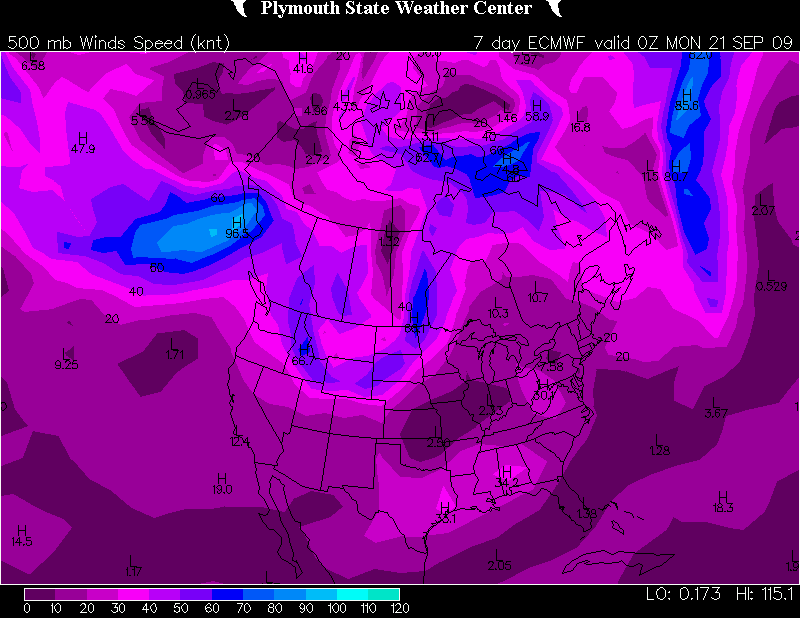
There may be a flicker of hope for a week from now, at least if you go by the ECMWF.

090914162010

ECMWF 500 mb winds for Sunday night.

As for the GFS…mmmph.  More zonal flow, though the sea level pressure map suggests a hint of troughing for the northern CONUS. Not anything to pique one’s interest, though. And here’s the SPC’s 4-8 day outlook:

VALID 171200Z - 221200Z

   ...DISCUSSION...
   GENERALLY BENIGN CONDITIONS -- WITH RESPECT TO THE POTENTIAL FOR A
   SUBSTANTIAL SEVERE EVENT -- ARE FORECAST THROUGH DAY 5-6 /I.E. FRI.
   AND SAT. SEPT. 18-19/...AFTER WHICH SOME FAIRLY SUBSTANTIAL MODEL
   DIFFERENCES BECOME APPARENT BETWEEN THE GFS AND ECMWF.  THOUGH SOME
   HINTS THAT SEVERE POTENTIAL COULD INCREASE FROM DAY 6
   ONWARD...CONFIDENCE REMAINS QUITE LOW ATTM.  UNTIL THEN...SEVERE
   POTENTIAL APPEARS LIMITED AT BEST...AS SLOWLY PROGRESSIVE PATTERN
   ALOFT KEEPS THE MUCH OF THE U.S. UNDER THE INFLUENCE OF LONGWAVE
   MEAN RIDGING.  GIVEN THE LACK OF APPRECIABLE SEVERE POTENTIAL DURING
   THE FIRST HALF OF THE PERIOD...AND LACK OF CONFIDENCE IN MODEL
   GUIDANCE BEYOND...NO SEVERE THREAT AREAS WILL BE HIGHLIGHTED THIS
   FORECAST.

I’m rooting for the Euro. It sure would be nice to see some storms. Any kind of storms. Just some decent lightning would be much appreciated right about now.

As I’ve said more than once this year, I’m crossing my fingers but I’m sure not holding my breath.

Breaking a Waterspout with a Gunshot?

While doing a bit of Googling on waterspouts, I came across an article in eHow that made me do a double-take, titled “How to Break a Waterspout with a Gunshot.”

My first response was to wonder whether the writer was referring to an old marine practice that I dimly remember reading about of trying to dissolve waterspouts with cannon fire. But no, the writer doesn’t require that you use a cannon. All you need is a gun, he assures you, preferably one with “the blast strength of a shotgun or better.”

Here’s a link to the article. And since it’s a short piece and I’m leery of broken links, I’m going to also quote it here for you in its entirety.

Instructions

  • Step 1: Assess the strength of the waterspout. Waterspouts are dangerous and require extreme caution, especially if you are going to approach one. You need to assess if getting close to the waterspout is feasible and safe. One good way of assessing the strength of a waterspout is to look at the clouds above it. Regular cumulus parent clouds usually produce weak waterspouts, while supercells produce stronger variants.
  • Step 2: Approach the waterspout. For the sake of breaking the waterspout with a gunshot, the closer you get to the waterspout the better. For the sake of your safety though, distance is preferable. This means that you need to get as close as you can get to the waterspout without jeopardizing your safety or the safety of your vessel and crew.
  • Step 3: Ready your weapon. A gun with the blast strength of a shotgun or better is required to break the waterspout. Most cases of successful use of a gunshot to break a waterspout occurred with a shotgun. So if you have a shotgun on board load it and get ready to fire.
  • Step 4: Fire multiple times. The more times you hit the waterspout the better your chances of breaking it. Your goal is to disturb the atmospheric dynamic that causes and sustains the waterspout with the force of the shotgun blasts. So, the more chaos you add to the waterspout the greater the chances that you can disturb the equilibrium of forces that produce the weather phenomenon.

Hmmm…sounds reasonable. Anyone care to give it a try? Let me know–I’ll lend you my 12 gauge. On second thought, no I won’t. Chances are that’s the last I’d see of it.

I wonder where this person has gotten his or her information, and what actual research–versus anecdotal evidence and pure speculation–is available to back it up? Even the weakest waterspout involves vast scales of motion that extend upward for thousands of feet and aren’t likely to be be impressed by twinky little shotgun pellets passing through them. I’ve seen a video of an airplane flying through a fair-weather waterspout, and the spout didn’t so much as hiccup.

I’m ready to be proved wrong, but I have a hunch that any purported waterspout thwartings by gunshot stem from encounters where the spouts were already at the point of dissolution. Waterspouts aren’t known for their longevity; still, a spout is going to break up when it’s darned good and ready to. Until then, peppering away at it with  “a gun with the blast strength of a shotgun or better” (precisely what “or better” means is unclear to me, but I doubt it matters) isn’t going to make much difference.

I’m no expert on waterspouts, but I do have an opinion on them, namely, that waterspouts are  something to enjoy from a distance, avoid when boating, and respect as a phenomenon over which we have little control.

As for breaking one with a gunshot, gee, why not? But first, let’s you and me go on a snipe hunt. Now, you just stand over there in that swamp, hold this burlap bag open, and call, “Here, snipe-snipe-sniiiiipe!” while I circle around through the woods…

COD Severe Weather Symposium

The College of DuPage will host its fourth severe weather conference in Downer’s Grove, IL, on Thursday, November 5, through Saturday, November 7. At $220 a pop for non-students, it’s a pricey proposition. But considering its proximity, Great Lakes chasers may want to invest their shekels. I’ve attended two conferences hosted by Paul Sirvatka et al some years back, and they were very worthwhile. With its cast of preeminent presenters, and topics that include the preliminary findings of Vortex 2, this year promises to be particularly rewarding.

According to the FAQ on the symposium website, “This conference is intended to present the latest in severe weather meteorology to a diverse group of severe weather professionals and students. National conferences present some of this material but time contraints do not allow for a detailed look into the state of the science.”

In the words of COD:

The conference is intended for professional operational and research meteorologists, upper-level undergraduate and graduate students of atmospheric science, storm chasers, severe weather spotters and severe weather enthusiasts. We assume that attendees will have some understanding of severe weather meteorology in order to receive maximum benefit from the severe weather sessions. The focus of the conference is primarily on understanding the latest techniques for severe weather forecasting, the use of meso-scale and storm-scale modelling, physical processes leading to the development of supercells and tornadoes and the effective use of remote sensing in severe thunderstorm evolution and behavior.

This symposium will also highlight some of the preliminary results of VORTEX II.

Rooms at the DoubleTree Hotel and Suites, where the conference will be held, are available for $95 per night and will accommodate four persons.

So there you have it. If you can afford the hotel prices and the cost of the conference, which includes an evening banquet, then this is one event you’ll want to make. I’m contemplating my cash flow, holding my breath, and getting set to register.