An October Great Lakes Wind Machine

Geeze, is it ever blowing out there! The low pressure system that I’ve been harping about this past week has been moving through the Great Lakes, bringing with it temperatures in the low 70s, rich dewpoints, heavy rain, and wind gusts as high as 48 miles an hour.
Here’s a grab of the current conditions at 9:15 eastern time. Click to enlarge.

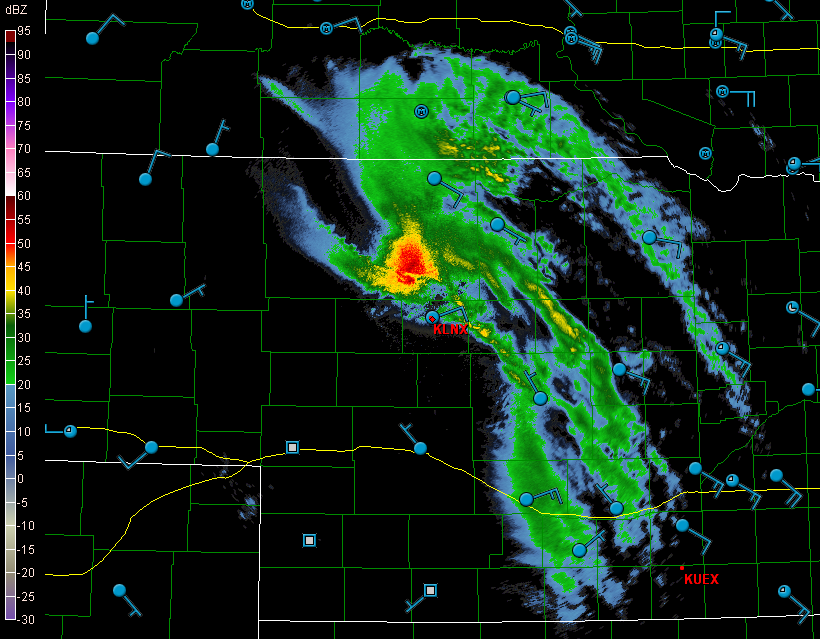
The 980 mb low has nudged off the Minnesota border into Ontario and continues to deepen rapidly as it heads east. You can see the line of storms firing along the cold front all the way down into the Gulf. Mississippi and Alabama got hammered earlier with an outbreak of supercells, but that action seems to have died down now. Not so the wind here in Grand Rapids, Michigan. It began picking up from the south in the afternoon, but it has now veered to the southwest with the passage of the cold front.

Temperatures have dropped over ten degrees over the past hour or so. The KGRR station ob says 58 degrees, but just 60 miles to my east, KLAN is registering 70 degrees.

There won’t be much left of the leaves come tomorrow morning. This system has been typical of a Michigan October–a wind machine that denudes the trees, delivering the coup de grace to the warm season and requiring those of us who live in the Great Lakes to gird our minds for winter. Ugh! These next five months won’t be fun.
The Farmers’ Almanac Secret Weather Formula: Even Eric Rasmussen Doesn’t Know It–But One Man Does

In a recent post, I poked a bit of gentle fun at the Farmers’ Almanac’s long-range forecasts, speculating that the Almanac’s weather sages were consulting woolly bear caterpillars to determine the nature of the coming winter.

Writing the article was good for a grin, but doing so got me to wondering: How the heck do those folks over at Farmers’ Almanac go about making such perilously far-out weather predictions, anyway? Surely they must have a few highly knowledgeable weather heads on staff with access to some extremely sophisticated technology, along with a formidable understanding of global climatology, oceanography, and whatnot.

So I posed the question on Stormtrack, and Lansing meteorologist Rob Dale responded with a link back to the Almanac which answered my question beautifully. Turns out the Farmers’ Almanac is far more advanced than I ever dreamed.

What’s their secret? A roomful of meteorologists hunched over sophisticated computers? A database brimming with decades worth of climatological statistics?

Nope. The Farmer’s Alamanac doesn’t need computers, and it doesn’t need no stinkin’ mets, climatologists, or databases. No, they’ve got something better: a solitary “calculator” named Caleb Weatherby and a nearly 200-year-old, proprietary formula developed by the Almanac’s founder, David Young, which allows Weatherby to calculate the Almanac’s forecasts several years in advance.

Did you get that? Several years. We are no longer talking weather forecasting here, we are talking prophecy. But perhaps prophecy is one of the secret ingredients blended into Young’s incredible formula.

According to the Almanac, “Since 1818, this carefully guarded formula has been passed along from calculator to calculator and has never been revealed*.” No one else besides Caleb Weatherby knows it. Not the SPC, not NASA, not the CIA, not Chuck Doswell, not even your mother.

While the formula eludes even the lofty craniums at NOAA, who must resort to more primitive devices such as GOES, Doppler radar, atmospheric soundings, numerical models, and a fleet of high-tech computers, the Almanac assures us that their formula “considers many factors, such as sunspots, moon phases, and other astronomical and atmospheric factors and conditions.” They forgot to mention eye of newt, but I suppose that would be giving away too much.

Just in case you’re doubtful, the Almanac furnishes a long list of their forecasting triumphs. I have to tell you, though–and I don’t wish to shock you, but confession is good for the heart–that I’m nevertheless a bit skeptical. Spin is spin, and a lot of things can be spun, including the conclusions extrapolated from weather statistics and meteorological crapshoots.

To be fair, the Almanac admits that “weather forecasting still remains an inexact science. Therefore, our forecasts may sometimes be imperfect. If you are planning an outdoor event, we recommend that you also check forecasts from local sources.”

That last, modest caveat is a bit of good advice, and if you’re a fan of Farmers’ Almanac forecasts, you’d do well to take heed. Go ahead and plan your family reunion picnic at the park six months in advance based on what the Almanac says; but if I were you, when it comes down to the week of, I’d place a whole lot more faith in the predictive expertise of your local WFO than in something generated by the Almanac’s calculator several years prior. I mean, you never know–ol’ Caleb might have been missing a few essential chicken bones from his rattle when he was doing his forecasting dance for that day.

Now, please, please, please…if you’re a die-hard devotee of the Farmers’ Almanac, don’t take me too seriously. I’m just having fun, but I really think fondly of the Almanac. It’s a beloved and revered slice of Americana that bears a torch of genuine, irreplaceable folk wisdom, and if you swear by its forecasts, great. Continue to swear by them (or at them, when they don’t pan out quite the way you expected). I’ve personally enjoyed reading them, and they’re harmless enough. The world would be a poorer place without them, and certainly less amusing.

But when it comes to chasing storms or going camping, I’ll probably look elsewhere for my weather information. Punxatawney Phil, for instance. He’d make a great chase mascot, and I’ll bet he’s  a whiz at pinpointing storm initiation.

______________________

* All quotes excerpted from the Farmers’ Almanac article, “How does the Farmers’ Almanac Predict the Weather? [sic]” Article’s web page address at the time of this blog post: https://www.farmersalmanac.com/farmers-almanac-forecasts

Friday’s Outlook: A Real October Leaf-Stripper

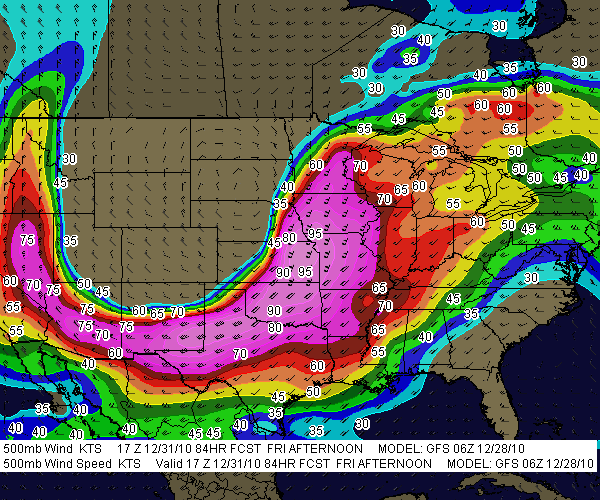
Whichever model gives the more accurate picture–the GFS or the WRF-NMM–one thing is sure: we Michiganians can say good-bye to the leaves. This Friday’s weather system promises to be a real October leaf-stripper, with a formidable low-pressure center deepening rapidly as it moves through Ontario.

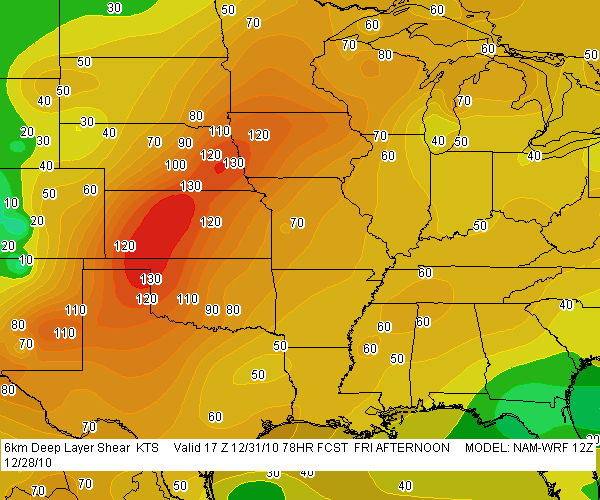
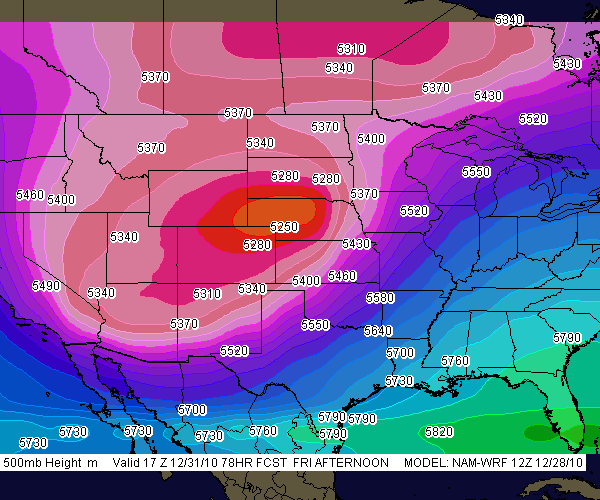
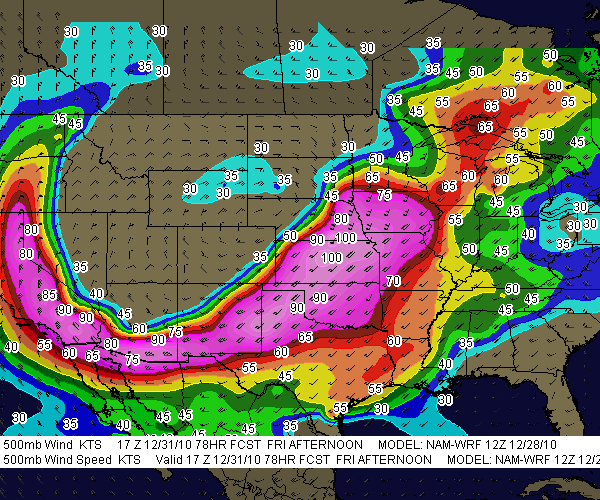
The two forecast models continue to differ in timing, with the GFS moving the cold front rapidly through the state’s mid-section by 18Z, while the NAM plays it more conservatively and backs the surface winds considerably more. The NAM is also much more aggressive with 850 mb winds, with the 12Z run calling for 75 knots (!!!), while the GFS dribbles out a paltry 55-knot LLJ.

I have a hunch that the GFS is closer to the truth, though of course, time will tell.

Both models agree that instability will be non-existent. Not much there to gladden the heart of a storm chaser. But by golly, we’ll be seeing some wind. Bye-bye leaves!

For the sake of comparison, I took a sampler of 6Z model soundings for both the GFS and the NAM for Jackson, Michigan–a nice, central location that should offer a good compromise between both models. The differences are striking. Click on the images to enlarge them. For 21Z, I’ve shown only the NAM; by that time, the GFS has the winds lined out.

Forecast hours for Friday, October 30

15Z

GFS

NAM

18Z

GFS

NAM

21Z

NAM

My White-Top Pitcher Plants Are Open for Business!

Bugs, beware! My white-top pitcher plant, Sarracenia leucophylla, has sent up its flush of autumn traps. The two largest traps are open, and they are spectacular. And, I might add, with the weather warming up these past couple of days, they have been doing business. I was there just in time to witness the first

hornet fall prey to one of the newly opened leaves. It landed on the lid, poked around for a bit, then promptly dropped straight down into the tube and wedged hopelessly at the very bottom. Today, with the sun backlighting the leaves, I could see the shadows of more insects, some struggling to get out. It was a rather grim drama playing out under the bright sunshine, but I’m no fan of yellow jackets, and I find it hard to feel much pity for insects that have been known to land on me and sting me just for the apparent mean-spirited hell of it.

Anyway, the two newly opened leaves look stunning, and four more are in various stages of development. I thought I’d share a photo with you; click on the image to enlarge it. You’ll find more shots of the white-top and other North American pitcher plants in the Wildflowers & Outdoors section of my Photos page.

Grasshopper Passion

So here I am, caught on the twin-horned dilemma of no storms to chase and no gigs to play. But you, my faithful readers, are longing for a word from Stormhorn.com, and I feel my responsibility toward you weighing heavily upon me. What can I offer you?

Grasshopper passion.

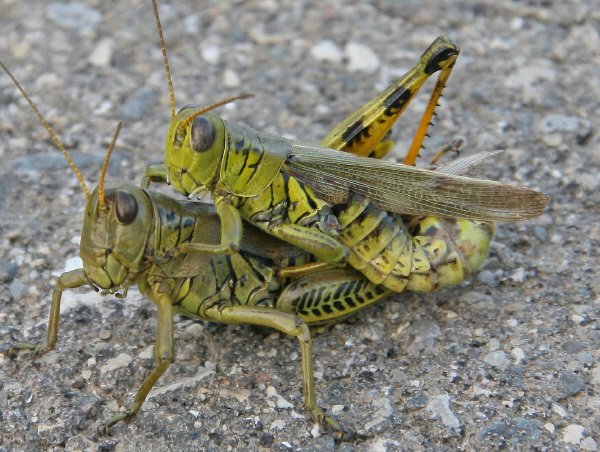
A few weeks ago, back in September, I took a hike at a nature park in nearby Ada, Michigan. Evidently, early fall is the season of love for grasshoppers, a time during which they become the Woodstock generation of the insect world, and in numerous places all along the trail, hoppers were locked in shocking, shameless public displays of unbridled lust.

Somehow, though, I found it hard to take offense. Probably my moral sensitivity has become dulled by Hollywood and advertising. Then again, grasshopper passion just isn’t all that passionate. By way of example, I submit the following photo of a couple locked in the throes of ecstasy. Click the image to enlarge it, though why you would want to do so is beyond me.

I have to say, judging by the looks on their faces, that this pair doesn’t seem particularly excited. In fact, they don’t even appear to be awake. When your brain is the size of an ant booger, situational awareness just isn’t going to be one of your key strengths.

I took a number of shots of these two hoppers, and they all look the same. I can testify that what you see here is as heated as it gets. A minute later, neither of my subjects had moved a solitary grasshopper muscle. It’s as if having sex had turned them to stone. Having better things to do than wait for them to finish their sordid business (Him: “So…was it good for you?” Her: “Was what good for me?” Him: “I’m not sure.”), I moved on.

Taken altogether, insect porn is pretty G-rated stuff, on a par with watching Kermit the Frog eat oatmeal. Parents, no need to shield your children’s eyes. The only trauma they’re likely to experience is boredom.

Lightning over Lake Michigan

The storm system that has been in the models for the past week produced a fast-moving squall line that blew from Wisconsin across Lake Michigan. Kurt Hulst and I were there on the shore just north of Holland, Michigan, to catch the action.

Kurt is a great lightning photographer. Look for his photos of last night’s storm on his blog.

As for me, I’m a neophyte when it comes to lightning. Shooting at night, the problem I encounter is focus. Unfortunately, most of my shots were too blurred to crop, and since I was shooting wide angle, cropping is essential. However, a couple shots didn’t turn out too badly. The one shown here is the best of the lot. Click on it to enlarge it.

Pitcher Plants on the Balcony

It’s getting toward that time of year when I’ll be taking the kids indoors. During the warm months, as far as I’m concerned, they can stay outside all night long, and they do. Pretty soon, though, the nights will get frosty and the kids will get cold. Does that mean I’ll let them in? Heck no. Not right away, anyway. They can darn well stay outside, and without a stitch of clothes on, at that. I’m not about to pamper them. The cold air will do them good before I finally take them inside and shut them in the refrigerator for three months.

Before you report me for child abuse, let me explain that “the kids” are my carnivorous plants, which I keep out on the balcony at my apartment. Presently they are flourishing, still sending up new trap leaves in mid-September. But my white-top pitcher plant, Sarracenia leucophylla, is in the process of rapidly producing its  fall flush of traps, a sure sign that autumn’s triggering mechanism is bringing changes to my little collection. Waning daylight and plummeting temperatures will soon signal the kids to go into hibernation, at which point I will take them out of their pots, wrap them in sphagnum moss, dust them with sulfur, and stick them in the frig for their mandatory rest period.

There will be more of them in the refrigerator this year. The family has grown. Besides several potfuls of Venus flytraps, I now own all eight species of United States pitcher plants. Now I’m working on adding variations, beginning with the addition of Sarracenia rubra var. wherryii, S. flava var. cuprea, and the “maroon throat” variation of S. alata. I’d love at some point to add the rare S. rubra var. jonesii to the collection, but that may be tricky. The variety is cultivated and sold by at least one reputable dealer, but interstate transport may be a problem. Collection from the wild is, of course, out of the question; besides being illegal, the poaching of a rare and endangered species is flat-out reprehensible.

But I digress. Right now, as I was saying, the kids are out on the balcony and loving this warm, moist, misty September weather. My oreophila put out its phyllodia months ago, so it’s got a head-start on hibernation. The rest are, as I have said, still cranking out leaves that seem to be getting only more robust. And I’m really looking forward to the fall show of the leucophylla, which is easily the gaudiest of the Sarracenias.

Yeah, I know–you want pictures. Okay, I’ll post some. But not now. Give me a few days, then look in my photos section under the wildflowers tab. Right now, I just wanted to offer you a diversion from jazz and weather. After all, there’s more to life, and certainly more to my life, which seems to be marked by quirky interests. I’d say the kids qualify for “quirky,” wouldn’t you?

Once There Were Trains

For many years, it has been my habit to practice my saxophone in my car. Living in an apartment and not wishing to bother my neighbors has forced me to find alternatives for my woodshedding, and my vehicle has served me well in that regard. In fact, I like it so well that if I ever do get around to buying a house, I will probably continue to practice in my car.

Since I love trains, my habit has been to park along a railroad track that stretches between Grand Rapids and Lansing. It has always been a fairly active route, and most days I’ve been able to count on seeing at least one train, and usually two or more, go by while I’m playing my horn.

Until recently. What has happened to the trains? Lately I haven’t seen a one. Really. Not in days. I just returned a while ago from one of my practice spots by the railroad crossing near Alto, and I didn’t get so much as a flicker on the semaphore lights.

This economy has hit a lot of folks pretty hard here in Michigan. I’ve got to believe that the collapse of the auto industry has had a dramatic impact on railroad transport. What I can say for sure is, the trains are no longer rolling along my favorite tracks the way they’ve done for so many years. I hope it’s just a temporary lull, and that railroad traffic will pick up again over time. Practice is still good, and I love being out in the countryside by the tracks, working my sax over and watching the sun set over the woods and the fields of alfalfa, corn, and soybean. But something’s missing. It just isn’t the same without the trains.

Breaking a Waterspout with a Gunshot?

While doing a bit of Googling on waterspouts, I came across an article in eHow that made me do a double-take, titled “How to Break a Waterspout with a Gunshot.”

My first response was to wonder whether the writer was referring to an old marine practice that I dimly remember reading about of trying to dissolve waterspouts with cannon fire. But no, the writer doesn’t require that you use a cannon. All you need is a gun, he assures you, preferably one with “the blast strength of a shotgun or better.”

Here’s a link to the article. And since it’s a short piece and I’m leery of broken links, I’m going to also quote it here for you in its entirety.

Instructions

  • Step 1: Assess the strength of the waterspout. Waterspouts are dangerous and require extreme caution, especially if you are going to approach one. You need to assess if getting close to the waterspout is feasible and safe. One good way of assessing the strength of a waterspout is to look at the clouds above it. Regular cumulus parent clouds usually produce weak waterspouts, while supercells produce stronger variants.
  • Step 2: Approach the waterspout. For the sake of breaking the waterspout with a gunshot, the closer you get to the waterspout the better. For the sake of your safety though, distance is preferable. This means that you need to get as close as you can get to the waterspout without jeopardizing your safety or the safety of your vessel and crew.
  • Step 3: Ready your weapon. A gun with the blast strength of a shotgun or better is required to break the waterspout. Most cases of successful use of a gunshot to break a waterspout occurred with a shotgun. So if you have a shotgun on board load it and get ready to fire.
  • Step 4: Fire multiple times. The more times you hit the waterspout the better your chances of breaking it. Your goal is to disturb the atmospheric dynamic that causes and sustains the waterspout with the force of the shotgun blasts. So, the more chaos you add to the waterspout the greater the chances that you can disturb the equilibrium of forces that produce the weather phenomenon.

Hmmm…sounds reasonable. Anyone care to give it a try? Let me know–I’ll lend you my 12 gauge. On second thought, no I won’t. Chances are that’s the last I’d see of it.

I wonder where this person has gotten his or her information, and what actual research–versus anecdotal evidence and pure speculation–is available to back it up? Even the weakest waterspout involves vast scales of motion that extend upward for thousands of feet and aren’t likely to be be impressed by twinky little shotgun pellets passing through them. I’ve seen a video of an airplane flying through a fair-weather waterspout, and the spout didn’t so much as hiccup.

I’m ready to be proved wrong, but I have a hunch that any purported waterspout thwartings by gunshot stem from encounters where the spouts were already at the point of dissolution. Waterspouts aren’t known for their longevity; still, a spout is going to break up when it’s darned good and ready to. Until then, peppering away at it with  “a gun with the blast strength of a shotgun or better” (precisely what “or better” means is unclear to me, but I doubt it matters) isn’t going to make much difference.

I’m no expert on waterspouts, but I do have an opinion on them, namely, that waterspouts are  something to enjoy from a distance, avoid when boating, and respect as a phenomenon over which we have little control.

As for breaking one with a gunshot, gee, why not? But first, let’s you and me go on a snipe hunt. Now, you just stand over there in that swamp, hold this burlap bag open, and call, “Here, snipe-snipe-sniiiiipe!” while I circle around through the woods…

Waterspouts in the Lake Michigan Forecast

The marine forecast for Saturday remarked on the possibility of waterspouts on Lake Michigan. Kurt Hulst and I headed to the lakeshore in the hopes of seeing a few spouts, but we wound up disappointed.

We initially targeted Holland, but once we arrived, it became clear that our best shot would be farther north where at least some convection was showing on the radar. So we headed up Lakeshore Drive to Grand Haven and parked in the state park.

In a word, we got skunked. Decent vertical development didn’t begin to show up until it was time to leave, around 4:00 p.m. Kurt needed to be home by 5:00 for a dinner date with his grandmother, so there was no question of sticking around. That was unfortunate, as some formidable-looking cloud bands were finally starting to roll in, and I’m left to wonder whether there were in fact any reports of waterspouts later in the afternoon. As for Kurt and me, we didn’t see a thing, other than some very impressive surf rolling in on a stiff northwest wind.

I’ve never seen a waterspout, and neither has Kurt. Today did nothing to change our unbroken record. Oh, well. Maybe next time.