The Field, Final Chapter: Tornado Heart

This is the last installment of my account of the drama that unfolded for a number of storm chasers, including my group of four, on May 22, 2010, in northeast South Dakota. I’ve waited to share this part because it’s personal–not a deep, dark secret, but something which until now I’ve kept to myself and a few friends. It is, however, an incident I’ve wanted to write about, and with seven months passed and Christmas just a few days away, now seems like an appropriate time to do so.

If you were one of those who were out there in the field that day, you’ll agree that we were fortunate to have escaped without injury when the outcome could easily have been quite different. Perhaps the greatest gift we have this Christmas is the fact that we’re all here to talk about our experience. You were there; you know how it was. It was a hell of a ride that has made for a story we’ll probably tell and retell the rest of our lives, but at the time there was reason to wonder just how much longer our lives would last.

For the rest of my readers, you can read my detailed account including photos here. I’ll summarize by saying that a routine move to reposition east of a violently tornadic supercell near Roscoe turned into a trap when the road–which showed as a through-road on our mapping software–dead-ended where a farmer had recently plowed it over. As tornadoes began to spin up just west of our contingent and head directly toward us, all seven or eight vehicles drove madly south along a fenceline in a desperate attempt to outmaneuver the worst part of the storm. A quarter-mile down, blocked by ponding, we turned into the field and drove another hundred yards or so until we could drive no farther. Then we parked, braced ourselves, and hoped for the best. And those who believed in a loving, watchful God, prayed. I was one of them.

I’m writing this post to thank my heavenly Father for not only responding to those prayers, but also, as I have intimated above, for letting me know in a personal and moving way that He was there with us in that field, present and protecting us all.

Spiritual topics trigger different things in different people. So let me make something plain. I write as a disciple of Jesus; I do NOT write as an emissary of contemporary Churchianity. Jesus I love, but I don’t care for much of religious culture, any more than I care for boxes of any kind. So whether you’re a Christian or a non-Christian, kindly resist the urge to stick me into a nice, tidy category that would likely say more about you than about me. I know the questions that arise surrounding answered–and unanwered–prayer. I also know the conclusions people easily arrive at, both pro and con. My purpose isn’t to address any of that in this post; rather, I am here to tell you a story and let you make of it what you will.

As Mike’s Subaru Outback bounced along the fenceline behind the vehicle in front of us, grinding its way into and out of muddy potholes, I had a good view to the west from the passenger’s seat. Rain bands spiraled and braided, hinting at unseen vortices. At one point, to my considerable consternation, I saw twin funnels wrapping around each other like a pair of dancing snakes, moving straight at us. They reminded me–I kid you not, so please don’t shoot me for saying this–of the “sisters” in the movie “Twister.” I’d estimate that their distance from us was around 150 yards. My buddy Bill Oosterbaan saw them too.

That was the moment when I realized we were not going to outmaneuver the storm, and the words “seriously screwed” took on a whole new dimension. It dawned on me that now would be an excellent time to pray, and I did, earnestly. I don’t remember my exact words, but the gist of them was that I asked God to protect us, all of us. The scenario was bathed in a strange sense of unreality, and it seemed incredible to think that I was praying for my life. But that was in fact what I was doing.

Whatever happened to those serpentine vortices I don’t know. Evidently they dissipated before they reached the fenceline. But their image lodged in my mind, and it got called back the following day in an unusual way, as you will see.

At length our caravan’s flight for safety ended in the manner I’ve already described above, and the storm descended on us in full fury. On Stormtrack, a chaser recently shared some radar images of that phase of the storm, and in one of them, you can plainly make out not just one, but two eye-like features passing directly over and just north of our location. Suffice it to say that the rotation above us was complex and broad. I remember a fierce wind that seemed to constantly switch direction, and mist driving along the ground at high velocities along with the rain. A tornado spun up briefly about a hundred feet from one of the vehicles; I didn’t see it, but Adam Lucio captured it on video* and my eyes just about popped out of my skull when I saw the clip. Daaaaamn! Any closer and…well, who knows, but it probably wouldn’t have been a pretty picture.

Fast forward past the rest of the storm and the miserable drama that ensued. It was the following day and I was sitting in a hotel room in Aberdeen. I fired up my laptop, logged into my email, and…hey, what was this? A message from my friend Brad Doll. Hmmm, cool! Brad and I rarely email each other. Curious, I opened his note.

I wish I had saved it–I thought I did, but I can’t locate it. Otherwise, I’d quote it exactly. But it’s easy enough to recreate the essence of it: “Hey, brother, just thinking of you and your love for tornadoes and thought I’d share this picture with you.–Brad”
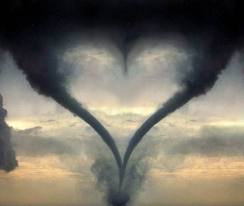
I opened the attached file. It contained the obviously Photoshopped picture you see here of two mirror-image, snaky-looking tornadoes with a funnel dividing the clouds between them, forming a heart. You can find the image without much trouble on the Internet, but I had never seen it before. As I looked at it, the snaky double-funnels I had seen yesterday popped into my mind. The similarity was weird–not that the previous day’s very real tornado resembled a heart; the only thing it looked like was scary as hell. No, it was the overall shape of its twin vortices and the way they had appeared in relation to each other that struck me.

Then it hit me. Brad didn’t have a clue where I was. He had no idea what I’d just been through. And he had never emailed me an image file before. Not only was the communication in itself unusual, but the timing of it was…well, it was incredible.

I could feel the tears coming to my eyes as the realization sank in. This email wasn’t from Brad. Not really. Brad was just a humble and available scribe; the message was from my Father, my wonderful heavenly Father. It was His way of saying, in a simple but powerful way, “Bob, I love you!”

What I’ve just written is something I believe with all my heart. God knows us through and through. He knows what makes you, you, and me, me; and He knows how to speak to each of us intimately, in ways that touch us in deep places if we have ears to hear. Here is what I believe He was saying to me:

“Bob, when you, Tom, Bill, Mike, and the rest of the guys were fleeing along that fenceline like scared rabbits, I saw you. I heard your prayer and the prayers of all who called on Me. And I was with you. My hand covered you and my presence protected you all–because I love you all, every last man of you who was there. Today, Bob, I’m letting you know that I truly was there–that yes, it was Me–and that I carry you in my heart.”

I am not one who calls every unusual thing that happens a miracle. I believe that genuine miracles are rare, and I dislike devaluing their reality by sloppily misapplying the word. But I also believe in grace, and from time to time I have witnessed extraordinary examples of what it can do. After receiving the email from Brad, I am convinced that what happened in the field on May 22 was one of those occasions. Things could easily have turned out far worse for those of us who were there. Instead of a joyous Christmas, this year could have been one of great sadness for our loved ones, and of an empty chair at the dinner table–a chair that once was ours. But this Christmas will not be that way. We will sit down once again with our families, and we will eat, and we will exchange gifts. We will get on with the rest of winter after the holidays. And we will return to the Great Plains this coming spring to enjoy another season of chasing the storms that we love.

Just about anything can be written off as coincidence, just as almost anything unusual can be written in as a direct act of God when it wasn’t necessarily so. It’s a matter of one’s worldview. If, having read my account, you’re inclined to consider my experience just a peculiar fluke, perhaps not even all that strange, then so be it. I can’t prove differently to you and I don’t feel that I need to try. But I most definitely believe otherwise, as does my friend Brad, and Tom, and Bill, and, I am sure, at least a few others who were there in the field.

It takes faith to see God’s kingdom, and faith is perhaps best described as an extra faculty, a sixth sense that augments the first five senses. It perceives and understands differently, and sees a different and higher reality behind the stuff of our lives. It is believing, but it is also a kind of knowing that I’ve never been able to describe satisfactorily. Like the color blue, once you’ve seen it, you know what it is; but whether you’ve experienced it or not, blue is blue, and so it is with the kingdom of heaven. However accurately or inaccurately, faith is the eye that sees it.

To my wonderful Lord, Brother, and Forever Friend, Jesus, whose birth I gratefully celebrate this season: Thank you–for so much more than I can begin to tell. And to my friends and fellow storm chasers, brothers and sisters of the skies, saints, sinners, seekers, wherever your worldview stands: May your Christmas be marked by grace. And may there be great steak and good beer in store for all of us this coming year.

Merry Christmas,

Bob

__________________

* You can see Adam’s clip along with more footage from the field, plus a whole lot more, on the DVD “Bullseye Bowdle,” produced by the lads at Convective Addiction. If you enjoy storm chasing videos, this one’s the real deal–and no, the guys haven’t paid me a solitary cent to plug it here.
For the Birds

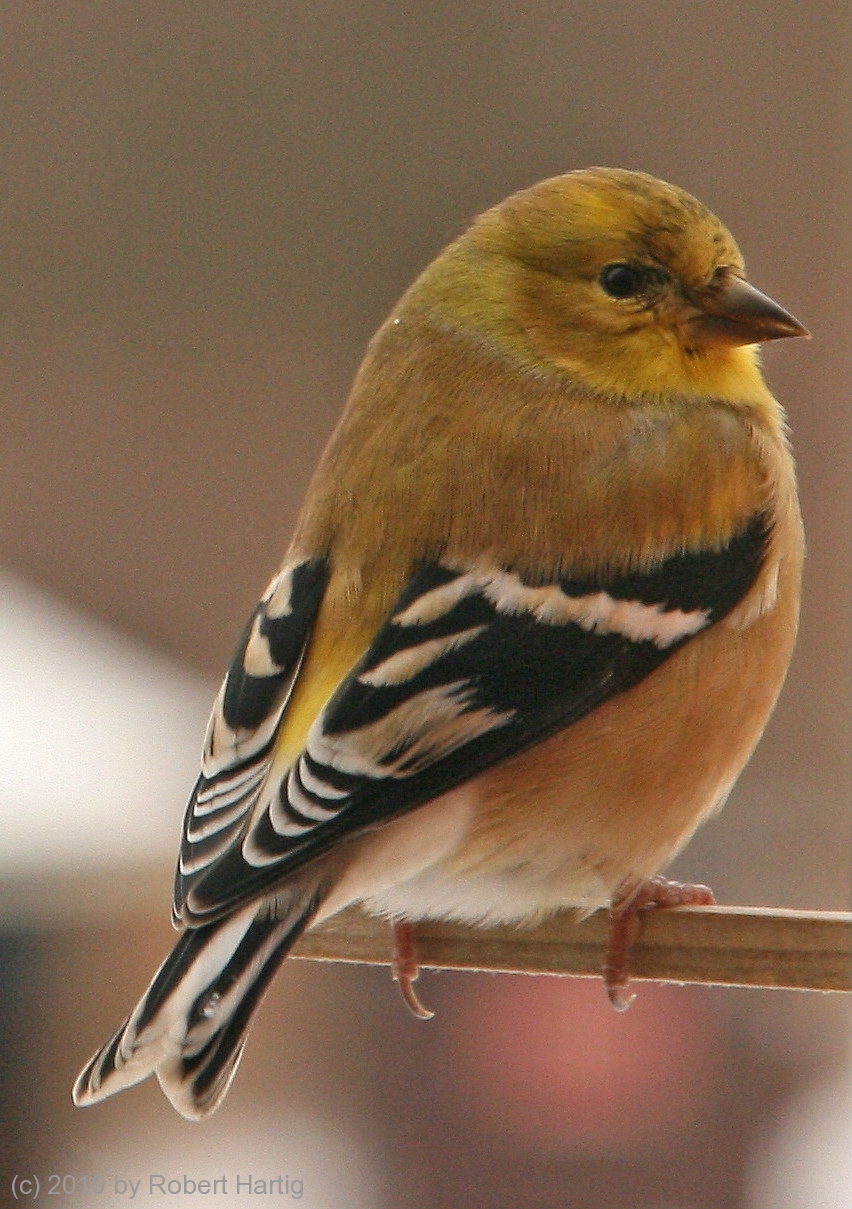
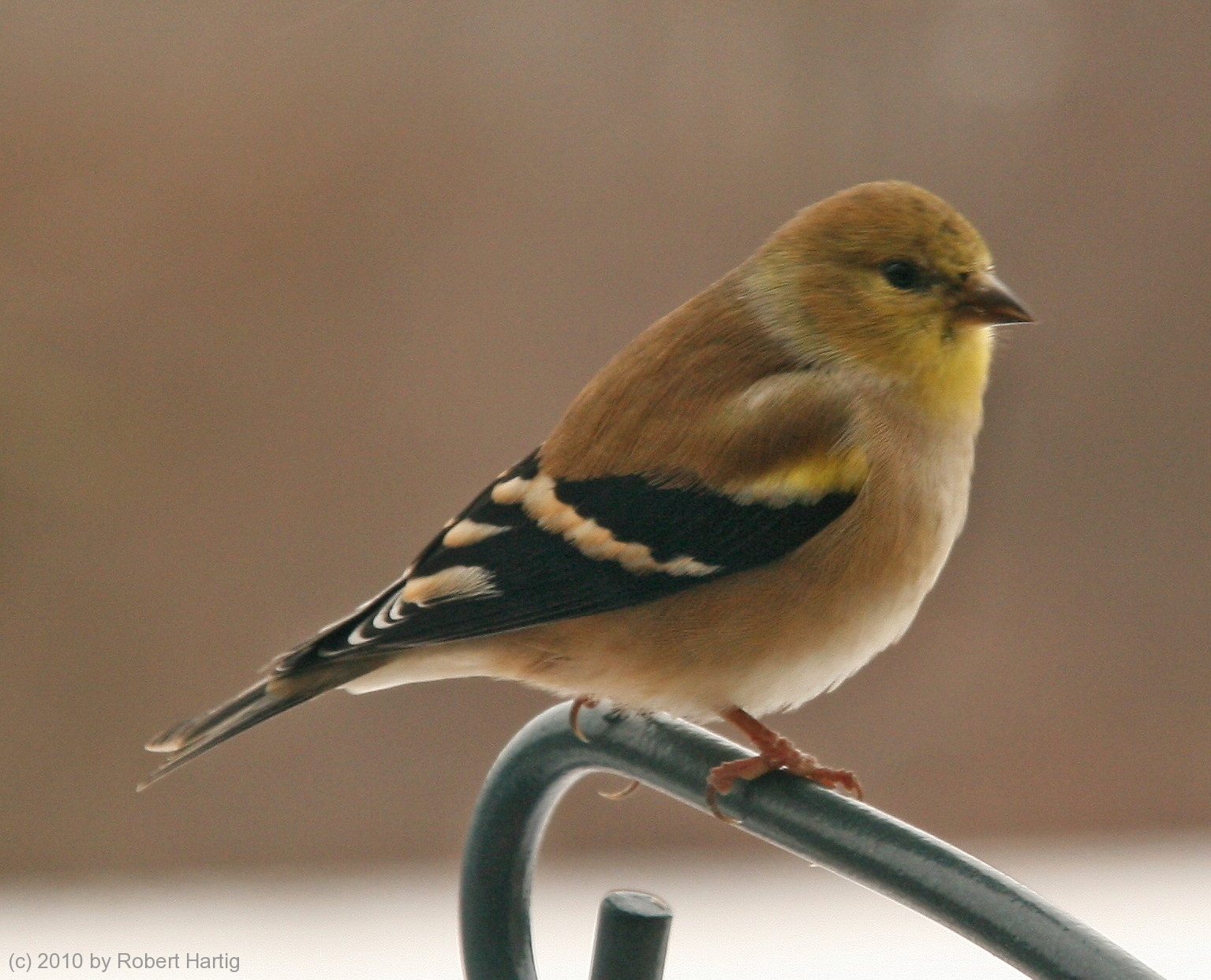
The little fellow you see here paused long enough for me to snap his photo, but his repose was fleeting. Inaction is a concept foreign to goldfinches when they’re in feeding mode, which is pretty much from sunrise to sunset. (Left click on photos to enlarge them.)

Just outside my sliding glass door, a blizzard of finches descends on my feeding station early in the morning, and the party continues throughout the day. Other wild birds join in the melee–chickadees, white-breasted and rosy-breasted nuthatches, tufted titmice, sparrows, and a male and female downy woodpecker. Occasionally a shy junco or two will put in a brief appearance, and a big bruiser of a bluejay flits in now and then, brashly announcing his presence with a cry that lets the whole neighborhood know he’s here, and whacks away at the suet with his wedge-like beak.

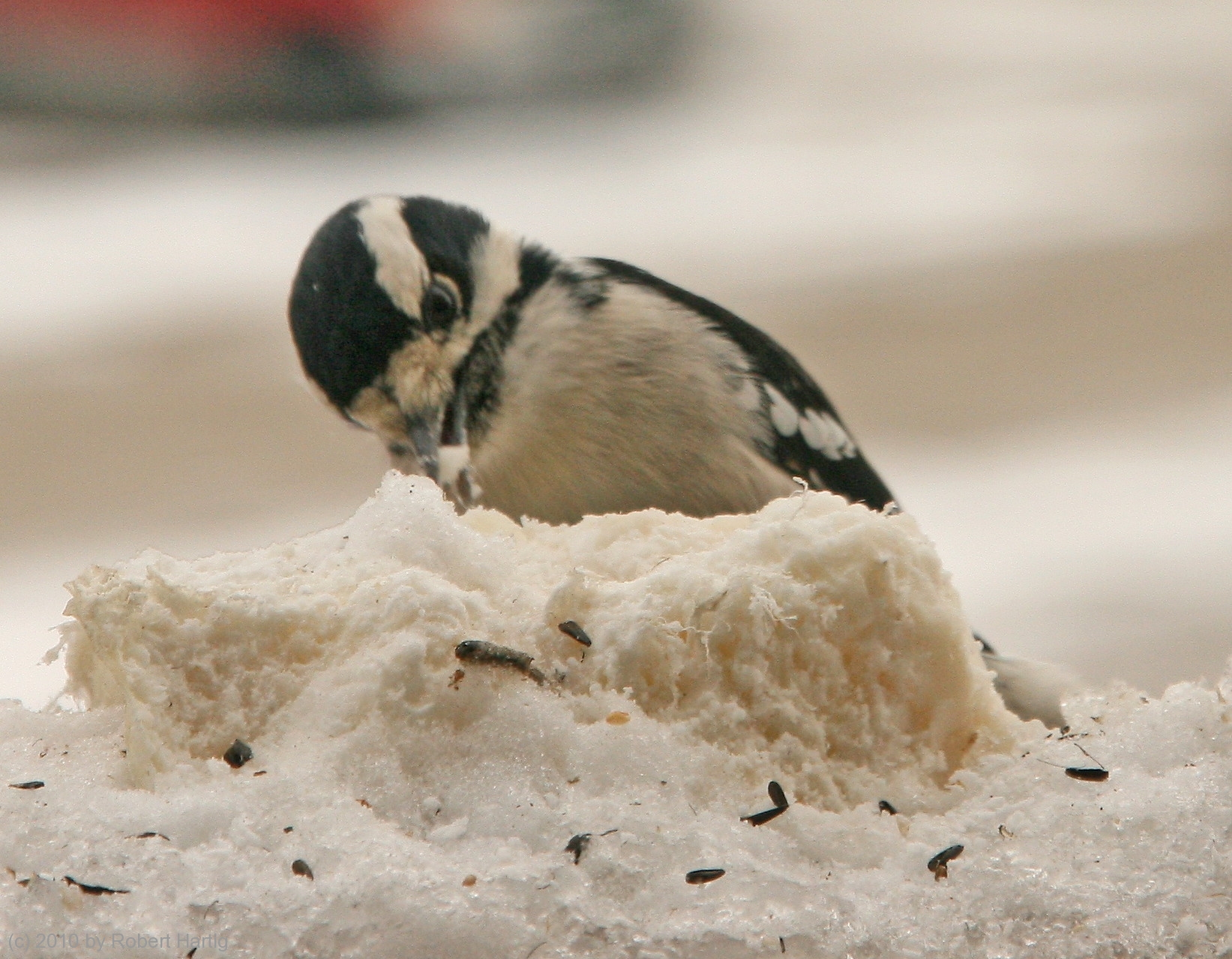
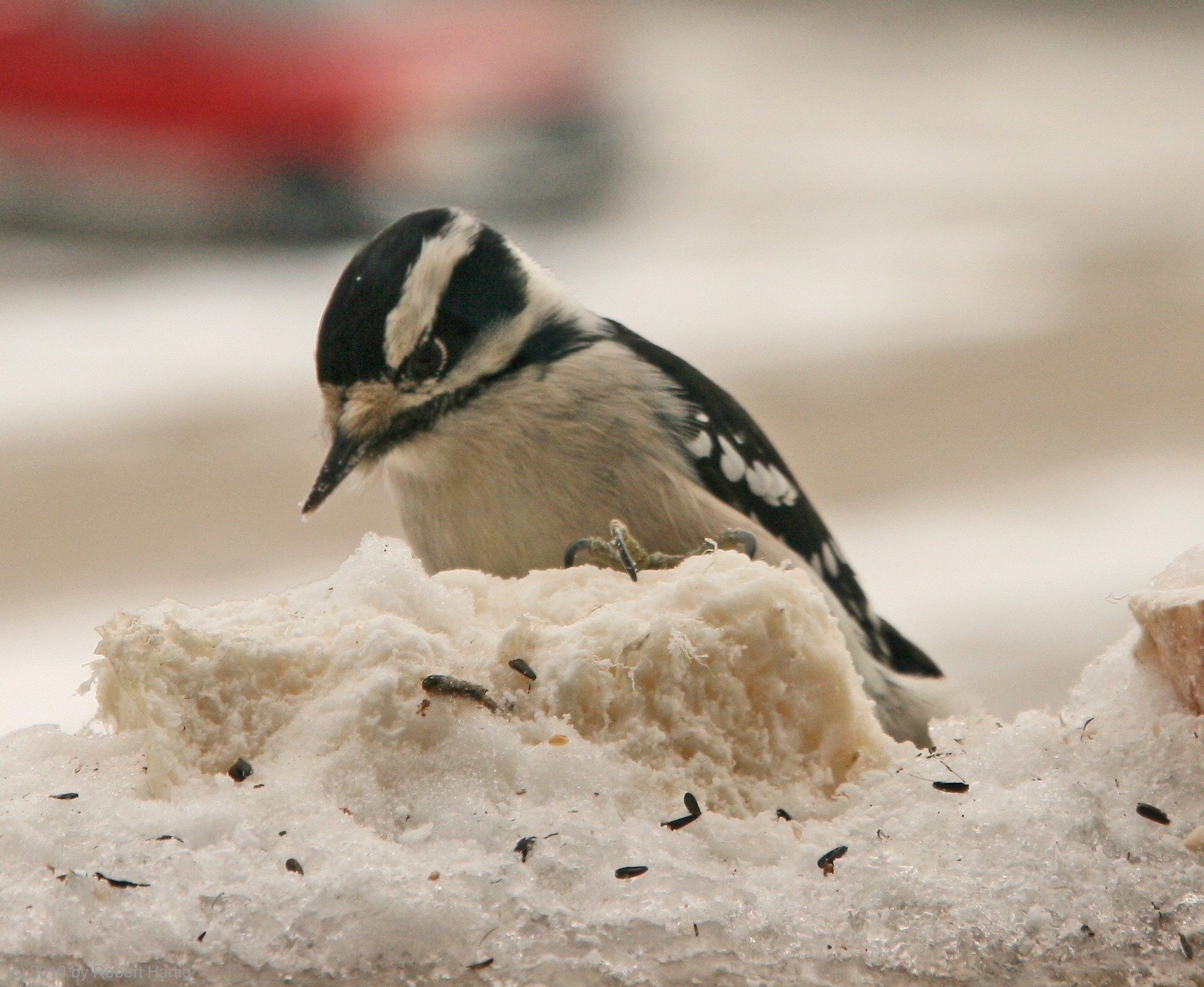
When killing frost signals the last gasp of the growing season, then, like a changing of the guard, the plants come in off my balcony and the bird feeding station goes out. Two tube feeders–one filled with wild bird mix, the other with black oil sunflower seed–hang from the station’s metal arms in company with a bag of thistle seed for the finches. This year, determined to attract a woodpecker or two if I could, I also hung out a mesh onion bag full of suet and slapped a couple more hunks out on the balustrade. It’s as a complete a smorgasbord as any bird could hope for, and the response has been supremely rewarding. It has included, I’m happy to say, the woodpeckers–a sprightly gentleman with a red bar across his head, and his consort, a perky little lady without the bar, each showing up when the other isn’t there and gorging with mighty singleness of purpose on the suet.

During the winter months, the feathery circus out there on the balcony reminds me that life goes on even when bitter winds blow. Today I tripoded my camera by the sliding door, intent on capturing a few images from the carnivalia. With so many birds thronging the feeding station, you’d be surprised at how difficult it can be to get a decent shot. These are not creatures who like to sit still, let alone pose for the camera. The bright-eyed goldfinch to your  left complied for about a second, long enough to look coy and unspeakably cute. It’s not for nothing that a bunch of these little guys and gals is called a “charm.”

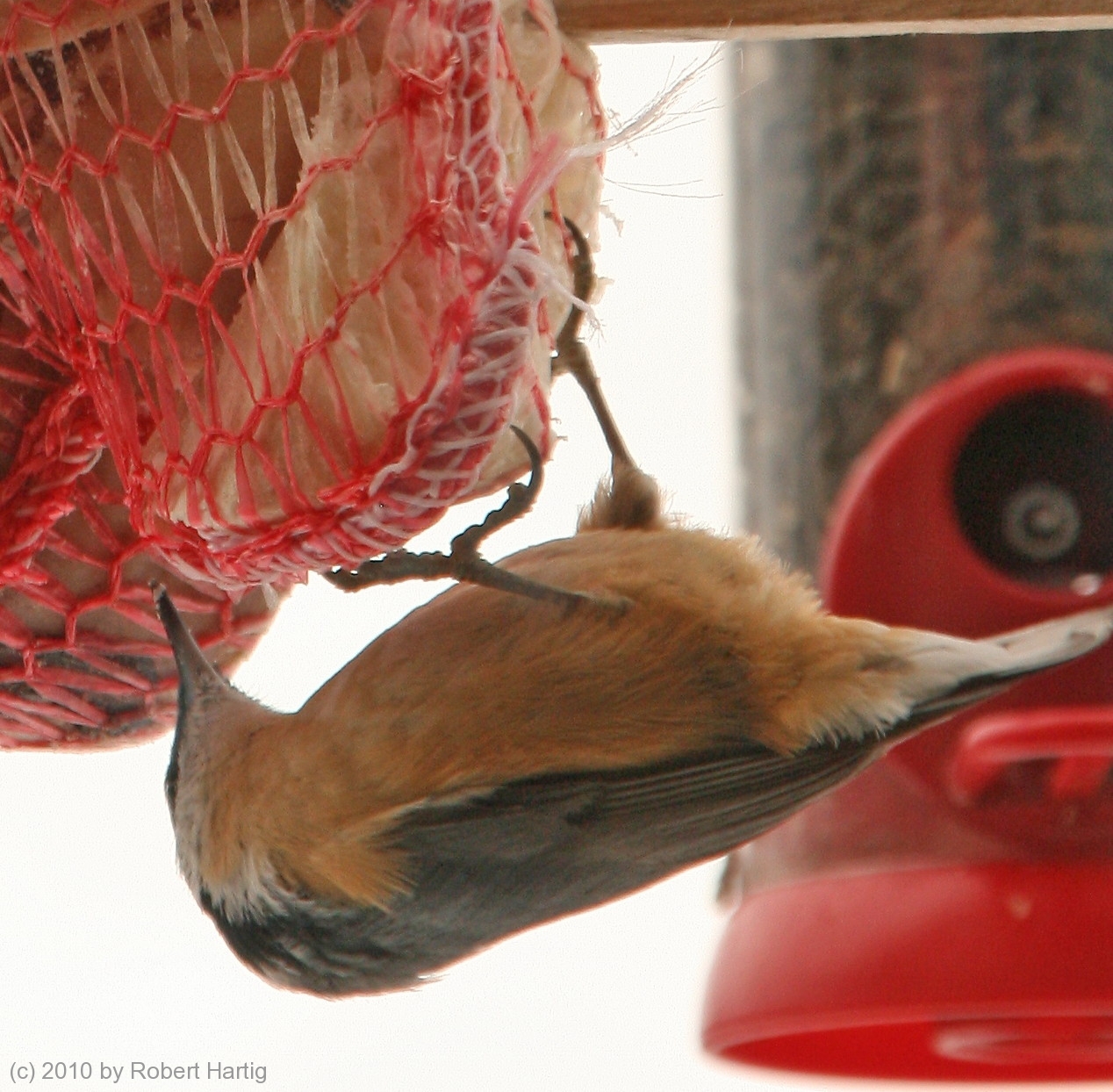
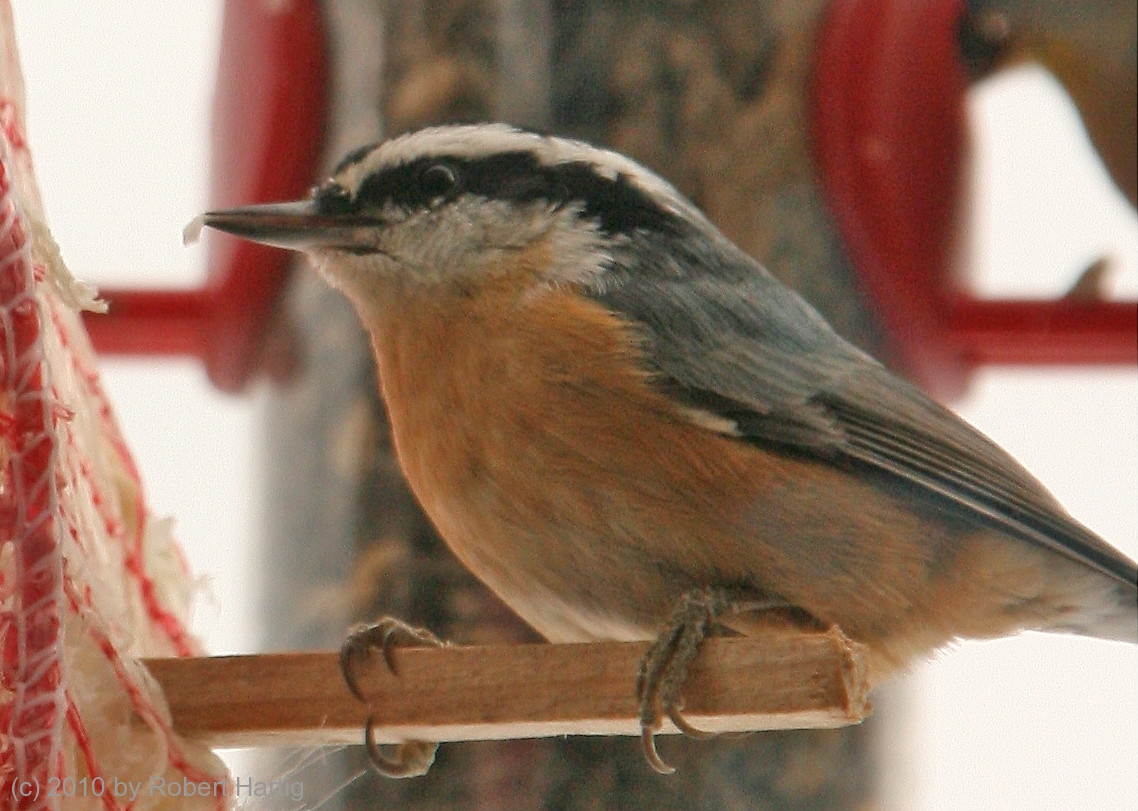
The woodpeckers and nuthatches were more demanding. I had to wait for them, and they had a way of showing up when I had walked away from the window. I did finally manage to catch them at an opportune time. The nuthatches are a favorite of mine, part comedian and part acrobat, with no apparent sense of up or down nor any regard for the law of gravity.

Talking about the weather has for me never been synonymous with shallow conversation. There is a time of year when I find few topics more fascinating. Unfortunately, winter isn’t

that time. Music, too, inexhaustible though it may be as a pursuit, has its limitations for me as a focus for blogging. In a word, I just don’t always have musical or weatherly stuff to write about, and I don’t like stretching too far for material. It’s a big world, filled with all kinds of interest and plenty of alternatives when subject matter gets thin. The birds are at the window day in and day out, chattering, flitting, quarreling, and consuming black oil sunflower seed with marvelous rapidity. They deserve a nod if not my outright gratitude. When snow cocoons the northwoods and whirls across the parking lot, they make me smile, and they’ll see me through till spring.

So this post is for the birds.

Or had you been thinking that all along?

Reflections on Picher, Oklahoma

On May 10, 2008, the town of Picher, Oklahoma, sustained a blow from a massive EF-4 tornado. I use the word “sustained” because saying that the town “survived” the tornado wouldn’t be accurate. Seven people lost their lives in a community that was for all intents and purposes already dead. The tornado was just the last, devastating twist in a place torn asunder by the very industry that once comprised its economic backbone. Ghost towns don’t survive; they just fade into oblivion, and there in far northeast Oklahoma, less than a mile south of the Kansas border, Picher–dubbed by the media as “America’s Most Toxic Town”–had been fading long before the tornado loomed on the horizon to finish the job.

It is an eerie thing to visit a tornado ghost town. Back in spring of 2009, my buddy Bill Oosterbaan and I drove through the empty streets that thread beneath the massive, brooding hills of lethal “chat” left from the city’s lead and zinc mining operations. The mining ceased in 1967, leaving residents to deal with the potential for cave-ins, a tainted water supply, and a poisoned environment that earned their little community the dubious status of poster child for the Tar Creek Superfund.

On the south end of the town, you can see where the tornado blew through. In a thriving city, rebuilding would have largely erased the scars, but no rebuilding will ever take place in Picher, and tornado trash remains strewn across the landscape. Fifty years from now, things probably won’t look all that different from the way they are today. Time means nothing to a ghost.

But I’ve already written more than I had planned to. My initial intention was to steer you toward my previous article on Picher that I posted last year, which includes photos of the tornado-damaged part of town plus my uncomfortable reflections on my visit there. Picher is not large, nor is it pretty, and it’s certainly not inviting, but it is a place you’re not likely to forget.

First Day of Meteorological Winter

Some of you will greet the news with glee, others with a groan, but either way, today is the first day of meteorological winter. Right, we’ve still got another three weeks before the winter solstice, when the year’s shortest period between sunrise and sunset marks the arrival of astronomical winter in the northern hemisphere. But it sure looks like winter right now to me, and that’s what matters to meteorologists. For them, winter begins December 1, just as each of the other three seasons commences on the first day of its three-month block. Why? Because that arrangement corresponds better with how we experience seasonal weather in real life. Here in Michigan, we often get a pretty good hammering of snow in November, and by winter solstice on December 21 (or sometimes 22), we’re already usually pretty well socked in. It seems almost laughable when someone announces on solstice that it’s the first day of winter. Really? Could’a fooled us. We thought it began a month ago.

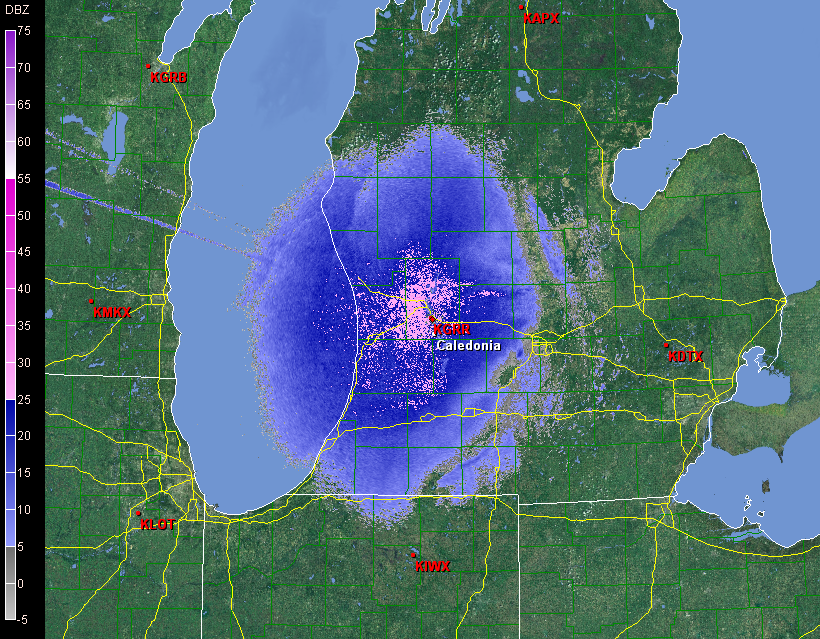
I woke up this morning to be greeted, very appropriately, by the year’s first snow accumulation. Yesterday temperatures opened in the low fifties, but they began dropping and the afternoon grew downright chilly. Today snow is falling, and out in the parking lot a woman is brushing the white stuff off of her car. It’s almost like winter has been consulting its watch, waiting in the wings and then entering the stage exactly on cue with a bucketload of lake effect. The snow will be with us for a few days, now, and the radar will continue to look a lot like the image on this page. Click on it to enlarge it, and get used to it, because you’ll be seeing a lot of similar pictures from now until meteorological spring arrives on March 1, 2011.

Severe Weather Potential Monday in the Western Great Lakes

A couple days ago, Lisa informed me that Dr. Greg Forbes was forecasting severe storms Monday in eastern Iowa and northern Illinois. I thought, hmmm…a bit far out to be definitive, but maybe I ought to take a look. I’ve been following the models since, and after this morning’s 6Z runs, it looks like Forbes is onto something.

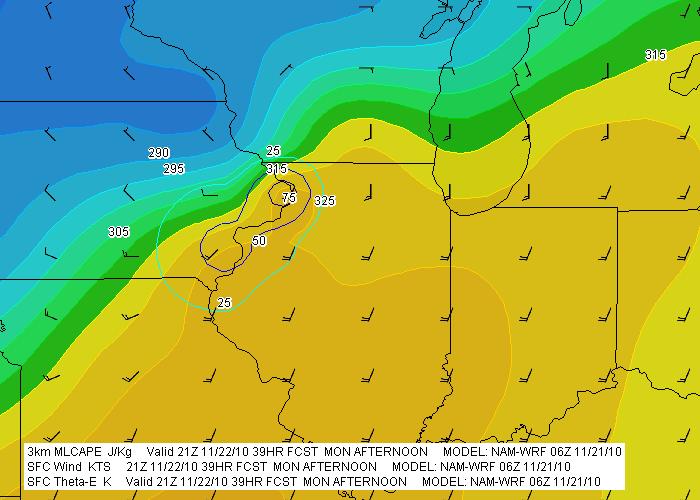
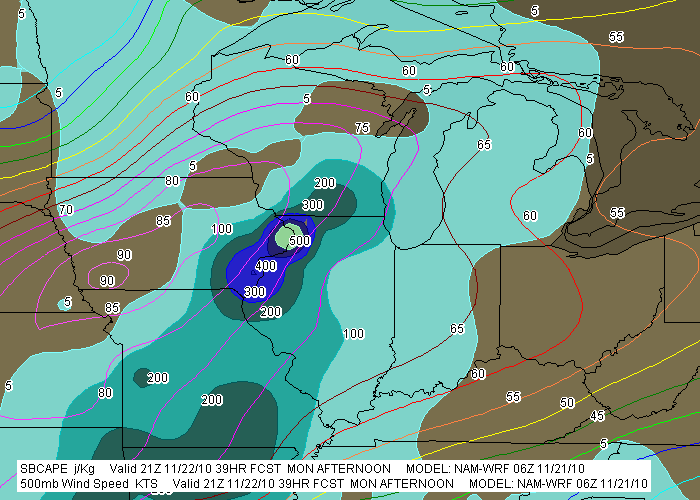
Both the NAM and GFS suggest that an area from far eastern Iowa through northern Illinois and southern Wisconsin may be under the gun in the afternoon or evening. Here are a couple of NAM maps that will give you an idea why (click on maps to enlarge). The bottom line is that a low pressure system is cranking unseasonably warm temperatures and dewpoints in the mid-50s or higher into the Great Lakes region. The potential exists for weak instability to coincide with stiff 850 and 500 mb jet cores.

The GFS paints a somewhat more aggressive picture than the NAM and wants to clip things along a few hours faster. If that pans out, then north-central Illinois and south-central Wisconsin may see the best play. But both models are calling for essentially the same thing. Note the bullseye of 500 SBCAPE and 75 J/kg 3km MLCAPE at Clinton, Iowa, coincident with a nose of Theta-E bulging into the area. The GFS depicts the same scenario, albeit at 18Z rather than 21Z.

Today, Sunday, temps are forecast to rise into the 50s here in Grand Rapids, and tomorrow they should make it into the low 60s along with a significant increase in moisture. We stand a chance for a few thunderstorms of our own, particularly when the cold front moves in Monday night. As the KGRR forecast discussion puts it, “GIVEN TEMPS IN THE LOWER 60S…IT MAY ACTUALLY FEEL A BIT HUMID MONDAY AFTERNOON. THE CURRENT MENTION OF SLGHT CHC TSRA STILL LOOKS GOOD.” The SPC day 2 outlook has even thrown in mention of isolated tornadoes from southern Michigan southward, but tomorrow’s models will give a better sense of whether that’s any real concern. Helicity should be adequate, but instability is weak, and a November night-time squall line in Michigan is not your typical tornado machine.

Right now, the bottom line looks like warmer-than-usual weather in our area today and especially tomorrow, with storms in the offing in northern Illinois and nearby areas. And behind that, setting the tone for Thanksgiving, colder weather. So enjoy this last spate of warmth, because winter is waiting in the wings.

Late-Season Thunderstorms in Lower Michigan

Amazing as it seems on November 17, I just heard a rumble of thunder. It wasn’t the first today. Several hours ago, a small line of storms swept through southwest Michigan, dumping rain, producing occasional lightning, and prompting warnings of “strong storms in the area capable of producing pea-size hail.”

Taking the unexpected opportunity, I hopped in my Buick and headed down into Barry County, where the more intense cells were moving through. We’re not talking anything major here–tops maybe scraped up to 20,000 feet–but this time of year I’ll take whatever I can get in the way of convection. Not being aware of any lifting mechanism in lower Michigan, I’m a bit mystified what it is that has been firing off the storms. The RUC soundings for 20Zand prior shows weak CAPE in the neighborhood of 200 J/kg with light winds at all levels. With surface temps peaking at 52 degrees, maybe that minimal instability has been enough to support some modest updrafts.

Whatever the case, it has been nice to get these late-season popcorn cells. They’re dying off now that daytime heating is dwindling, but they’ve made for a bit of serendipitous fun throughout the afternoon. And now I suppose we return to our regularly scheduled program of November drabness. I’m looking forward to watching Storm Chasers tonight and reliving the wild drama of May 22 in South Dakota.

Leave Your Car and Take Shelter in a Ditch? Not So Fast!

You’ve heard it repeated often over the years during tornado warnings: If a tornado approaches you while you’re driving, abandon your vehicle and seek shelter in a ditch. For several decades that instruction has been disseminated as if it were gospel truth. But is it a proven life-saver or, like, some other popular tornado safety myths (hide under an overpass, open the windows of your house, head for the southwest corner of the basement) bad advice that could get you hurt or killed?

In my opinion, it depends. While the National Weather Service has historically recommended the ditch, recently at least some weather stations have been modifying that advice, and a lot of experienced storm chasers disagree with it vehemently. Among the excellent reasons why they would prefer to take their chances in a vehicle rather than in a ditch, they cite the following:

◊ Flooding. A ditch is a poor escape option if it’s rapidly filling with water. There’s no point in surviving a tornado only to drown in a flash flood.

◊ Debris. All kinds of material can get pitched into a ditch with lethal force during a tornado. This is no idle concern; ditches regularly fill with tornado debris.

◊ Electrocution. There you are hiding in your nice, flooding ditch, and down comes a power line smack into the water. Fzzztttt! You’re a crispy critter.

◊ Snakes. Depending on where in the country you live, you could find yourself keeping company with rattlesnakes, copperheads, and water moccasins.

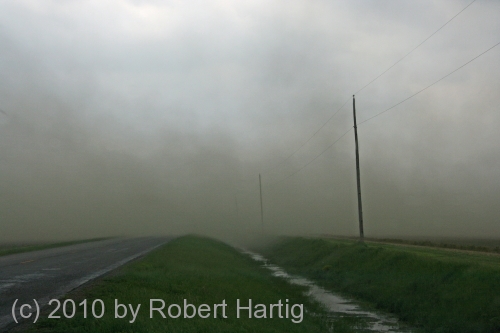
All of the above are reasons commonly given by chasers why they will never abandon their vehicles in favor of a ditch. I’ll add one of my own: Unless a ditch is sufficiently deep, chances are good that the wind will just scoop you right out of it and blow you away. Take a look at this photo of a rear-flank downdraft (a type of strong, straight-line wind from a severe thunderstorm) and note how the dust fills the shallow ditch on the right. The RFD jet was crossing the road about 100 feet in front of our car when I snapped the photo, and it was easy to see that the wind wasn’t merely blowing over the ditch–it was blowing into it. There’s no reason why tornado winds won’t do exactly the same thing, only a lot more intensely. (Note as well the rainwater in the ditch and the power lines hanging overhead.)

Still not convinced? Check out this up-close video of a small but intense tornado traveling along a roadside ditch in Minnesota and consider how you would have fared had you been taking shelter there.

And then there’s the obvious.

Why on earth would you want to abandon your best means of escaping the tornado altogether, not to mention the added protection your vehicle affords, in order to expose your soft, pink body fully to the elements?

Contrary to what you may believe, you can outmaneuver a tornado. Storm chasers do it all the time. Tornadoes move at roughly the same speed as their parent storm. True, some can rip along at 60 mph or more, particularly in the early spring. But most tornadoes move at a much slower rate, generally between 25-45 mph. Given a decent road grid, unless you’re in an an urban area where traffic is congested, or unless your view of the tornado is impeded by terrain or precipitation, your most commonsense survival tactic is to get out of harm’s way. If you can see a tornado, you should be able to escape it unless it is nearly on top of you.

How to outmaneuver a tornado: advice for the average Jane or Joe.

Those of you who are storm chasers can skip this section. You’re already quite familiar with approach and escape tactics, or at least, you should be. (Of course, you’re more than welcome to share your own wisdom in the comments section, and I hope you will.) The following is written for the saner 99.9 percent of the population who don’t go gallivanting across the vast American heartland in the hopes of encountering massive wind funnels filled with debris, but who would like to know what to do when they see one approaching while they’re out driving in their cars.

Let’s say you find yourself in just such a situation. Your most obvious first step is to determine whether the tornado is moving toward you. Chances are it will simply miss you. If you’re north of its path, you may want to park under a shelter, because if you’re not already getting clobbered by hail, you probably will be shortly. If you’re south of the tornado, you might want to head a little more south yet just to be on the safe side. Then pull of the road and enjoy the spectacle, because it’s not one you’ll see every day.

If the tornado is in fact heading your way–if it appears to be growing larger without apparently moving–then you need to take action. Assuming that it’s approaching from the west or southwest, as will be the case in most (though by no means all) situations, your best bet is to head south.

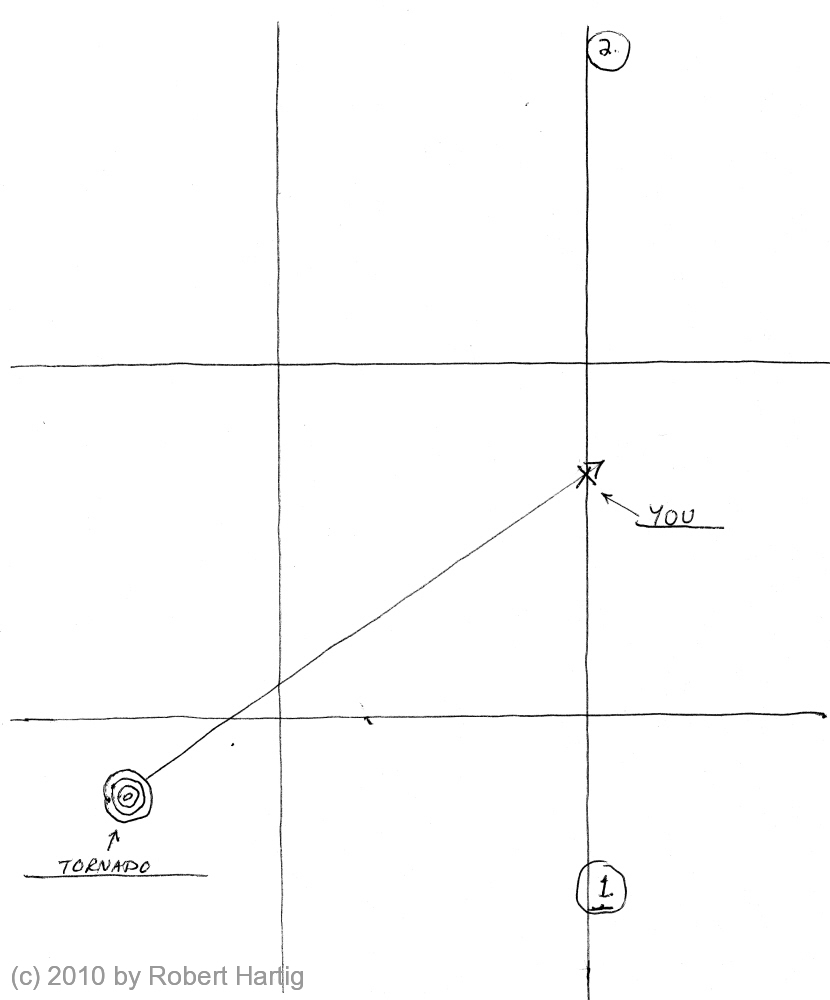
In the map to your right (click to enlarge), the tornado is moving northeast directly toward you. Note the location of the number 1. That’s the general direction you want to head in for reasons you can easily see. If south isn’t an immediate option, then drive east and bail south at your first opportunity. Depending on how near you are to the tornado as it passes north of you, you may get slammed with vicious straight-line winds wrapping in from the storm’s rear flank, but that’s better than getting munched by the tornado itself.

The overall point is to sidestep the tornado by moving at a right angle to its path. (Situation: You’re standing in the middle of a railroad track and a train is coming. What’s the smart thing to do? Answer: Right–step off the tracks!)

Heading north toward location 2 is also an option, but it’s one you’re better off avoiding if you can. While you’ll escape the tornado, you will very likely find yourself in the storm’s hail core. As a general rule, heading south will take you away from the big hail and blinding rain. Of course, if you think the tornado is likely to pass south of your location and you’re concerned about crossing its path, then use common sense and either stay where you are or else move north.  Better to risk losing your windshield than your life.

Let’s say, though, that you’re in a worst-case scenario. There’s no fleeing. Many chasers, probably most, would still prefer to ride out a tornado in their vehicle rather than in a ditch. Granted, neither option is a good one. There’s no question that the more violent tornadoes can do horrible things to an automobile; pictures abound of cars and trucks crumpled into balls of metal, or wrapped around trees, or filled with lethal debris. But at least your vehicle provides a layer of protection that you wouldn’t have in a ditch.

So is a ditch ever a good option?

This is a good place to mention that the ideas shared in this article are my opinion. They are not the result of scientific research. Then again, neither is the decades-old advice to abandon your vehicle for a ditch. It started as someone’s reasonable-sounding idea that gained authority through repetition rather than actual proof. Still, it does make sense to get as low as possible during a tornado, and I personally think there are occasions when a ditch could offer viable protection.

It’s a matter of situational awareness. Is the ditch deep, deep enough that it could minimize your exposure to the wind? If it were me, that would be my first question. Assuming that the answer was yes, my next concern would be with my surroundings. I would feel much more hopeful about sheltering in a ditch in the open countryside, with little in the way of trees and other large debris to get chucked at me, than I would in an area full of structures all strung together with power lines. And what about vehicles? I would certainly want to get far enough away from my own car that it wouldn’t be likely to roll over on top of me.

Flash flooding? Snakes? Those issues are of greater concern in some parts of the country than others. The best I can say is, know the environmental hazards of your territory and make your choices accordingly.

Again, the best way to survive a tornado is to get out of its path. Since most tornadoes are only a few hundred feet wide, avoiding them in a vehicle is quite easy given decent visibility, good roads, and ample lead time. If you’re in your car and you spot a tornado approaching in the distance, don’t take the fatalistic view that you can’t outrun it. It’s probably not heading directly at you in the first place. Determine where it is heading and do what you need to in order to position yourself elsewhere.

However, if it appears to be growing larger without moving to either the right or left, then you need to either skedaddle or else find adequate shelter. Ditches rarely qualify. In most circumstances, you should consider a ditch as only a last-ditch option.

Between Idolatry and Joy: Some Thoughts on Life from a Jazz Saxophonist and Storm Chaser

There is an art to pursuing the things we’re most passionate about without letting them consume us. I certainly find this to be true of my own two interests, jazz saxophone and storm chasing, but the principle applies to all of us in whatever our preoccupations may be. Without fascination, energy, focus, and joy to drive us wholeheartedly in our pursuits, there’s no point to them; yet without restraint, self-awareness, and awareness of the broader world around us, it is easy to become a mile deep in our passions and an inch deep in life at large. Between these two realities, for me and I think for many of us, there lies a dynamic tension.

As a disciple of Jesus, I have to reckon with the issue of idolatry. In Old Testament times, an idol was easy to identify. It’s hard for us today to fathom people fashioning gold calves and graven images, both human and bestial, and then worshiping the things that they themselves had crafted. Yet that’s exactly what people did back then, both in pagan nations and in apostate Israel.

The funny thing is, we’re no different. We still bow down to the works of our hands, to things that are capable of becoming our gods if we let them. Things that blind us to truths bigger than ourselves and hinder our capacity to love God and others.

The problem with our modern idols, however, is that they’re not readily identifiable as such in the same manner as, say, a brazen bull or a figurine of Marduk. Anything in our lives can become an idol–our careers, our pursuits, significant relationships, the desire for love, our injuries and disappointments, our causes, our appetites, our emotions, our cars and other possessions, even our ministries and charitable occupations. Idolatry today is not usually something that is innate to the things in our lives, but is a matter of our attitude toward them and God. In ways subtle and not so subtle, it’s easy for us to invest ourselves in what we have and what we do in such a way that we allow it to define life and purpose for us. That’s a problem, because any of it can be taken away from us at any time, and sooner or later all of it is going to go. Then where do we find meaning; then where do we find life?

Moreover, we can become irresponsible and selfish in reaching for what we’ve defined as life, setting our pursuits above people we love and who love us. When we’re frustrated in those pursuits, we can become downright nasty, even destructive, toward persons who seem to inconvenience us, challenge us, or obstruct us. We’ll sacrifice others to our idols and justify ourselves in doing so rather than deal with our own hearts.

All this in the quest for life on our own terms.

Well do the words of Isaiah the prophet speak to us today: “[The idolater] feeds on ashes; a deluded heart misleads him. He cannot save himself or say, ‘Is not this thing in my right hand a lie?'”

Is there a flip side to this coin?

Of course there is. If God never intended for us to enshrine the things that we enjoy and love to do, neither does he want us to smother those things in sackcloth. In the Bible’s book of Genesis, in the Creation story, God from the beginning gave Adam and Eve something meaningful to do. They were gardeners, caring for the trees and flowers in Eden. Ironically, after they sinned, the man and woman’s immediate response was to hide from God behind the very things he had assigned them to cultivate and protect.

The problem lay not in the shrubs and trees and vines, but in Adam and Eve. The greenery in the garden was the same as the day when God first looked on it and called it good; it was the human heart that had changed. Ever since, in various ways, we’ve had a tendency to conceal ourselves from God and from each other behind the things we do.

Yet those same pursuits also have the potential to express the robust life of Jesus living in us untamed and unfettered. There’s nothing at all winsome about Christians who are so paranoid about idolatry that everything they do is constrained by a gray, lackluster religiosity. Many well-meaning believers confuse holiness with a boxed-in, sanctimonious, hermetically sealed existence that is about as invigorating as paper pulp. It hardly mirrors God’s exuberance in the act of creation, when with a decisive word he spun the visions of his heart into being–planets, suns, galaxies, luminous gas clouds, multiplied quintillions of celestial objects, all whirling across the velvet-black vastness; ocean tides pulsing and surf crashing against craggy shorelines; wildflowers waving in vivid, multi-hued pointillism in meadows and forests, knit together, unseen, by untold millions of miles of subterranean roots and rootlets.

Talk about a hobby! It was no dour, stuff-shirted God who created this fabulous world around us, this universe that awes and fascinates and humbles us; no, it was an eternal being who throughout the ages remains forever young–smarter than the most brilliant scientist, wiser than the wisest sage, yet passionately, perpetually, and unapologetically a child at heart.

God created us to live our lives as wholeheartedly, creatively, lovingly, generously, fearlessly, and beautifully as he lives his, in ways unique to each of us. Failure to do so is in itself a form of idolatry, a lack of trust that the One who hardwired us with our personal interests also supplies the grace and wisdom to express his life and fulfill his intentions through those interests.

The overarching principle is love–love of God and love of others. Love is ultimately what separates between idolatry–which is about pursuing our own independent way on our own terms–and the abundant, God-dependent life that Jesus offers. Christianity is not about good morals and rock-hard dogma; it is about nothing less than the life of Jesus himself living inside us, energizing us, guiding us in the pathway of his character. That is no weak, wan way of living. To be sure, it is a way that is often marked by self-sacrifice, pain, loneliness, misunderstanding, prayer, struggle, and self-control. But it is also a way infused with immense purpose, remarkable potential, endless fascination, and a joy that can be found in nothing else this life can offer.

In conclusion

Bringing all of the above to bear in a practical way for those of us who chase storms and/or play music: Whatever you do, do it with all your heart. God is not glorified by a timorous approach to the things you enjoy, nor does he want you to walk on eggshells for fear of offending him. Just keep in mind that there is more to life than your pursuits. Enjoy those pursuits, treasure them, but don’t grasp them so tightly that you can’t let go, and don’t let them give you tunnel vision so that you fail to see and participate in the broadness of life around you. Other people’s worlds are as rich and important as yours; to the best of your ability, enter into them, celebrate them, and let them expand you. Harness your interests in a way that makes your life bigger, not smaller–an expression of generosity, not selfishness, and of a Christlike perspective that values God and others most of all.

Behind the sound of a saxophone playing now tenderly, now exuberantly, always striving for creativity and beauty…behind the sublimity, the fascination, and the awe of a tornado churning across the open prairie…you can, if you choose, hear the song and see the face of God. If you submit your heart to him, he will in turn release his own magnificent heart in and through the things you love to do.

This, in part, is what life, true life, is about: allowing the things that are central to us to become the servants and the expressions of Someone far bigger than ourselves, and of a kingdom greater than our own.

Intense Autumn Storm System Arrives Tomorrow in the Great Lakes

I’m not going to try to be particularly clever in writing this post. Instead, I’m going to throw a bunch of weather maps and a few soundings at you and let them tell the story.

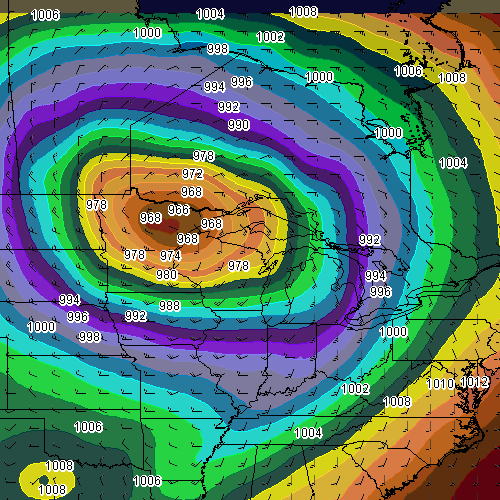
I will say that the weather system that is shaping up for late tonight on into Wednesday for the Great Lakes has the potential to be of historic proportions. In terms of sea level pressure, I’ve seen a number of comparisons to the great Armistice Day Storm of November 11, 1940. However, there are two significant differences: this storm is a bit earlier in the year, and the forecast pressure has been consistently and significantly deeper. The Armistice Day storm dropped to 979 millibars; this one may be in the 960s. In other words, we may see a record-setting barometric pressure with this system.

The bottom line is, this thing will be a wind machine like few we’ve ever seen. Here’s the current forecast discussion from the weather forecast office in Grand Rapids, Michigan.

LOW PRESSURE IN THE SOUTHERN PLAINS WILL RACE NWD AND PHASE WITH A
LOW OVER THE DAKOTAS AND RAPIDLY DEEPEN AS THE UPPER TROUGH DIGS
ACROSS THE UPPER MS VALLEY. THIS WILL LEAD TO VERY STRONG DYNAMICS
ALONG THE TRAILING COLD FRONT LATE TONIGHT. EXPECT STRONG TO SEVERE
STORMS TO DEVELOP ALONG THE FRONT AND RACE EAST. A 70KT LLJ AND
115KTS AT H5 INDICATE IT WON/T TAKE MUCH TO GET SVR WINDS WITH THIS
LINE OF STORMS LATE TONIGHT. A VERY STRONG PRESSURE COUPLET...ON THE
ORDER OF 6MB/3 HRS WILL FOLLOW THE COLD FRONT. THIS WILL LEAD TO
STRONG WINDS DEVELOPING BEHIND THE FRONT. BUFKIT WIND PROFILES SHOW
MIXING INTO THE 55-60KT LAYER AT 2K FT. IT IS LOOKING INCREASINGLY
LIKELY THAT WE/LL SEE SUSTAINED WINDS AROUND 35 MPH AND WIND GUSTS
OVER 50...AND CLOSER TO 60 ALONG THE LAKE SHORE. AS SUCH WE EXPANDED
THE HIGH WIND WATCH TO COVER THE ENTIRE CWA.

WINDS WILL DECREASE TUESDAY NIGHT AS MIXING WANES...BUT WILL
INCREASE CONSIDERABLY AGAIN WEDNESDAY. THIS IS A SLOW MOVING STORM
THAT WILL RESULT IN A PROLONGED WIND EVENT FOR THE CWA.

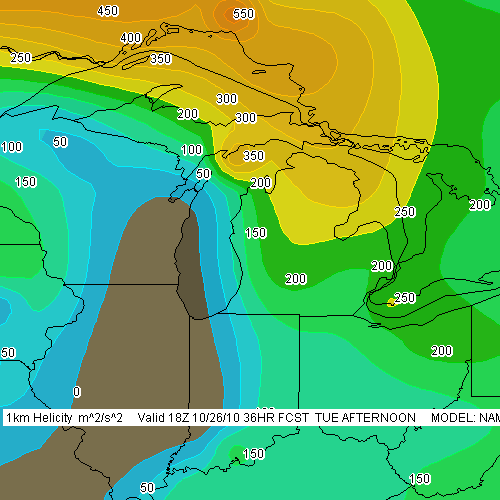
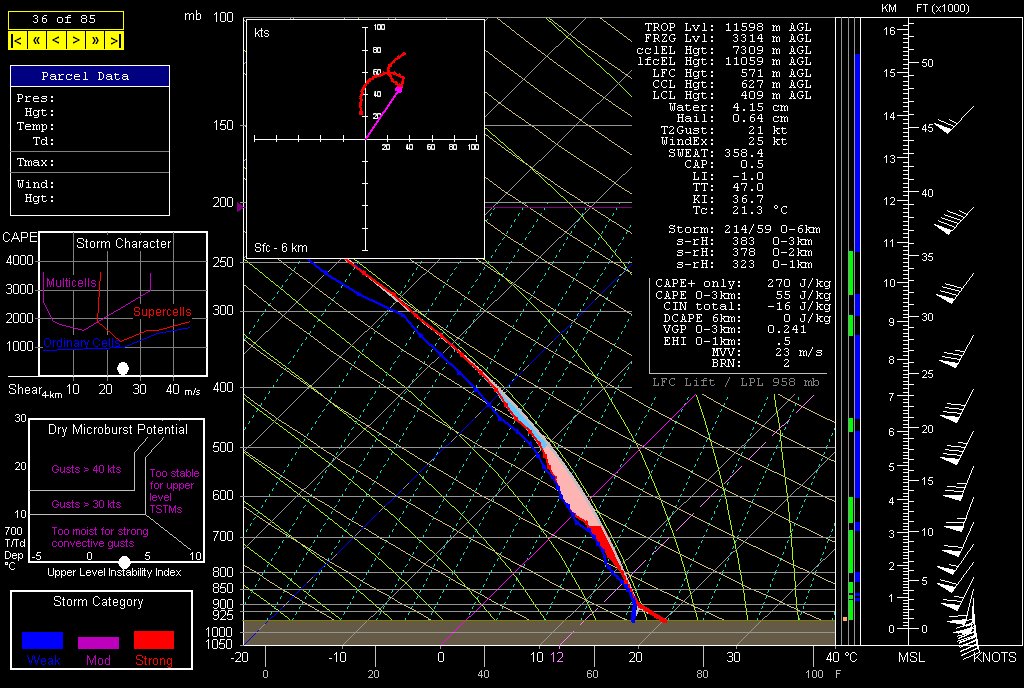
I’m not going to add a lot to that, but I do want to mention the possibility of tornadoes during a brief window of time. Hodographs preceding the front curve nicely, with 1 km storm-relative helicity exceeding 300 showing on this morning’s 6Z NAM sounding for Grand Rapids at 17Z tomorrow afternoon. If enough instability develops–and with winds like the ones we’re looking at, it won’t take much–then we could certainly see some spin-ups as the squall line blows through. And if there’s enough clearing to allow discrete storms to fire ahead of the front, chances for tornadoes increase all the more.

With storms rocketing along to the northeast at over 60 miles an hour, the thought of chasing them is laughable. Anyone out to intercept them will have to watch the radar, position as strategically as possible, and then hope for the best. Serendipity will be the name of the game. That game could begin as early as noon here in Michigan, and it looks to be over before 5:00 p.m.

Not the wind, though. That’ll be hanging around for a while.  Batten down the hatches, campers–we are in for one heck of a blast.

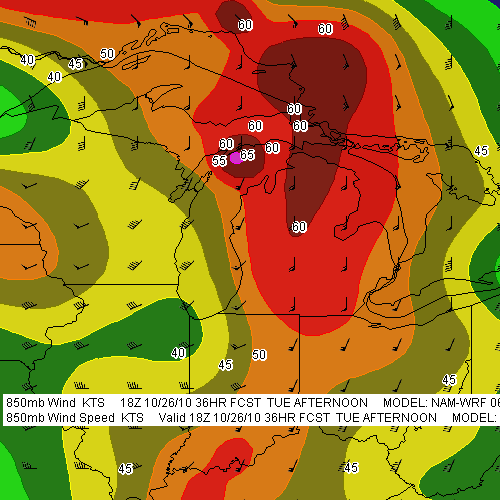
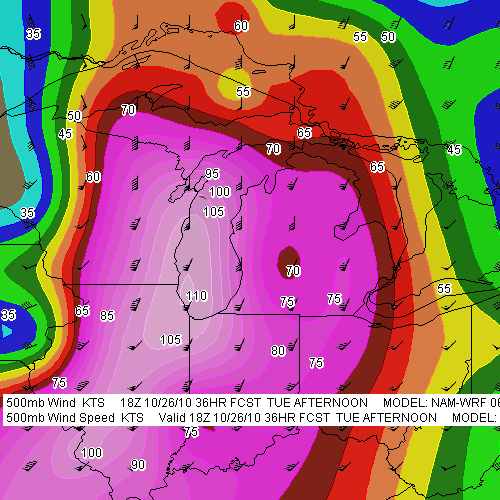
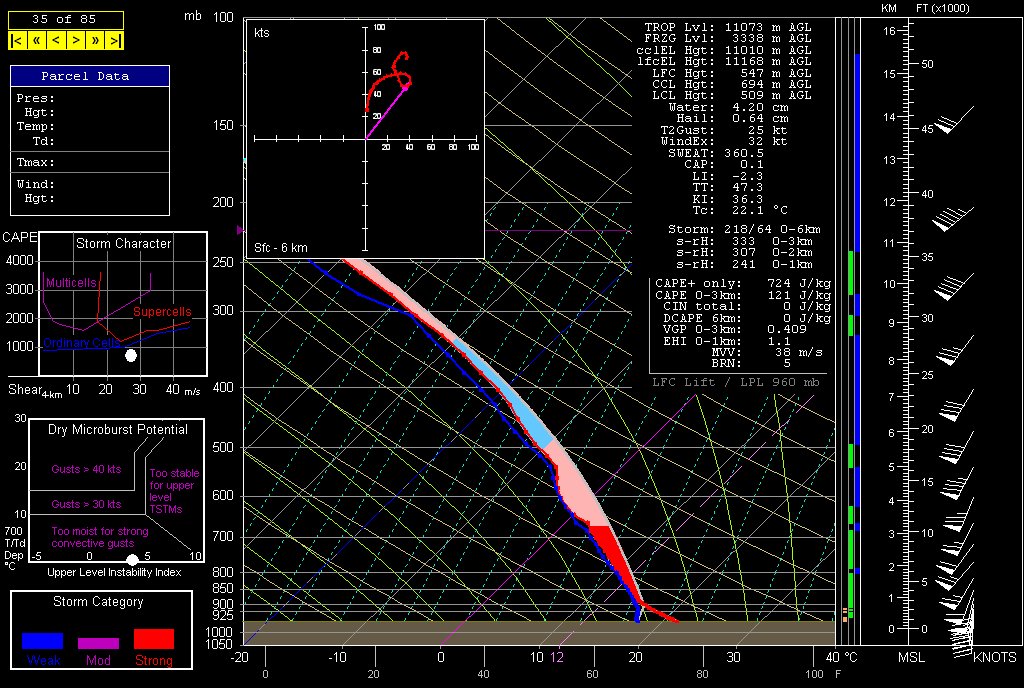
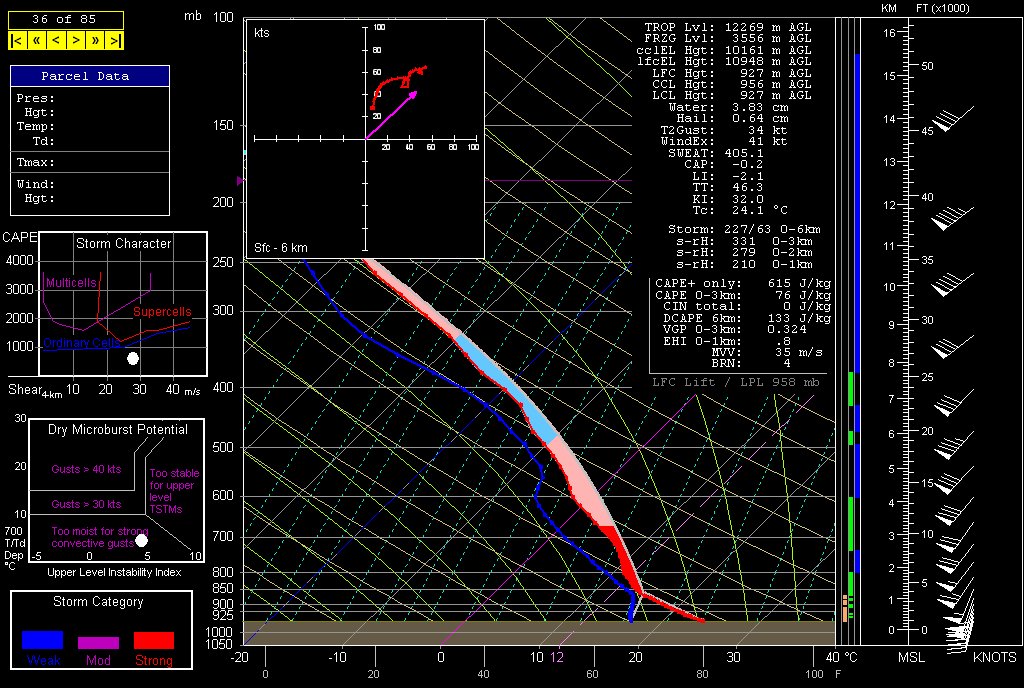
Without further ado, here are some weather maps and NAM forecast soundings from this morning’s 6Z run. Click on the images to enlarge them. Just look at that surface low! Pretty jaw-dropping, I’d say.

Forecast maps for 18Z Tuesday, October 26, 2010


Soundings

Grand Rapids, MI (forecast hour 17Z)

South Bend, IN (forecast hour 16Z)

Muncie, IN (forecast hour 17Z)

Late October Chase Bust

After 1,200 miles and a busted chase in northern Missouri and southwest Iowa, I returned home at 2:30 in the morning. Why on earth, you may wonder, would I travel all that way to watch storms that never did more than produce weak wall clouds and a bit of hail? What madness possessed me and my chase partner, Bill Oosterbaan, to go storm chasing this late in the year anyway?

For one thing, the setup actually looked promising on paper. You can read all about it in my previous post, but the long and short of it was, the right ingredients looked to be in

place. For another thing, look: it’s the end of October, and in view of the fact that I’m probably not going to see another chaseworthy setup within a day’s drive for the next four or five months, I’ll take what I can get. I grasped at a slimmer straw than yesterday’s for my first chase of 2010, and now, at the end of the year, it was nice just to get out, hit the open road one last time with my long-time chase buddy, Bill, and take whatever came our way.

I might add that, had we actually gotten a tornado or two, Bill and I would have looked like storm chasing geniuses, the guys who score on a day when other chasers stay home. Talk about my status as a chaser going up! “How did you know?” everyone would ask. I’d just smile sagely. “Instinct,” I’d reply. “You get to where you can just sense it in your gut.”

Excuse me, I seem to have been dreaming. As I was about to say, dropping south out of Des Moines down I-35, we headed toward a small convective cluster in northwest Missouri near Maryville that was trying to get going south of a weak warm front. The shear was present to help these storms organize and you could see them doing their best, but  evidently the instability

just wasn’t enough to really inspire them. Firing toward the end of peak heating with rapidly waning insolation, the storms may have choked off the CAPE with their own shadows. Maybe a little more moisture would have done the trick, maybe a little better heating, but whatever the case, the storms never offered much more than some weak wall clouds and a bit of hail.

Our first storm actually looked promising for a minute, exhibiting a decent wall cloud that

looked like it actually might intensify. But that never happened. What we were left with for our long drive was an enjoyable afternoon and evening roaming through the hilly, autumnal landscape of Missouri and Iowa, doing one of the things we both love best–following the sky, chasing the clouds.