Bird Song: Hearing Charlie Parker for the First Time

If there is one name that is synonymous with the alto saxophone, it’s Charlie Parker. For that matter, no jazz musician of any kind–saxophonist, trumpet player, bassist, pianist, you name it–can explore the craft without becoming keenly aware of, if not at some point deeply immersed in, the music of Bird. If Dizzy Gillespie was the clown prince of the bebop school, Charlie Parker was its pied piper, a quirky and unpredictable genius whose God-given creative torch burned too brightly to be quickly extinguished by the excesses that eventually overcame him.

Some jazz musicians grow up with Parker played regularly at home as a vital part of the musical ambiance. Others discover Parker’s music later in life. I fall into the latter category. Ours was not a particularly musical household, though Mom loved the Nutcracker Suite and Dad dug his Louis Armstrong, Bessie Smith, and Sidney Bechet records.  My own musical tastes, once they began to develop, naturally tended toward the rock of the seventies, particularly art rock bands such as Jethro Tull, King Crimson, Yes, Genesis, and Pink Floydd.

I did have the advantage of playing in a big band beginning in the eighth grade. That experience gave me an invaluable exposure to the music of Basie and Ellington, and to the American songbook at large. But bebop? What was that?

Then came my first year at Aquinas College, and a course on modern music appreciation with Dr. Bruce Early. The class covered plenty of ground, as I recall, including the music of some of my favorite rock bands. Inevitably, we got into the various kinds of jazz, which was Bruce’s real thrust with the class. Dixieland I was familiar with, and as for big band swing, I had been playing that since junior high school. But suddenly, jazz began to take on deeper dimensions for me. And one day, Bruce dropped a record onto the turntable, and out of the speakers came the most unbelievable saxophone music I had ever heard. It was blazing. Brilliant. Blinding. Beautiful. Wild, yet–though I wouldn’t have thought of the description at the time–wonderfully logical.

That was my first exposure to Charlie Parker, and it left me stunned. How on earth could anyone play a saxophone like that?

I didn’t have ears enough to comprehend what it was that I had heard. I only knew that it pointed toward possibilities on the alto sax that I had never dreamed of. It was like stepping through a door out of a tiny room and discovering an entire mountain range on the other side.

Fortunately, I was too young and too dumb to feel utterly overwhelmed. That’s probably why I’m still playing the saxophone today. Some contemporaries of Parker weren’t so fortunate. I read of one saxophonist who, after hearing Bird in flight, pitched his horn into the river in despair. Today I understand that sentiment a little better–because, now that I’m more than twice as old as Parker was when he first lit his fire and greased his skillet, I still can’t cook the way he could. I have, however, learned a lot from him, and continue to learn.

If Bird hadn’t been given to the monstrous indulgences that eventually destroyed him, I wonder, as many musicians have wondered, what else he might have accomplished. Would bebop have been his apogee, his singular torch against whose sun-like flame all his future achievements would have paled? Or would it have been the spark to still brighter creative expressions? Dizzy is still with us; had Bird’s life been other than what it was, he might be here, too. But it wasn’t and he’s not, and all we can do is speculate on what might have been or might not have been–and absorb the alto saxophonist’s legacy. In the words of Charles Mingus, “If Charlie Parker was a gunslinger, there’d be a whole lot of dead copycats.”
The Trouble with Reading Glasses: A Jazz Saxophonist’s Lament

Reading glasses suck.

No, let me restate that: Reading glasses are a boon, but having to wear them sucks. And it particularly sucks, sucks to the fourth power, when one is trying to read big band charts on a bandstand.

Am I the only horn player who has this problem? I seriously doubt it.

I go through reading glasses like they’re M&Ms chocolate-covered peanuts. I buy them, lose them, buy them, lose them. So I get the cheapest ones I can find–I mean, reeeaally cheap, $1.99 glasses which I purchase at Ace Hardware in Hastings. They do the job just fine for most purposes, but playing in a big band is not “most purposes.” It’s a purpose set apart that poses some peculiar problems.

For one thing, those classy, low-slung bandstands which are so much a part of the big band tradition place the music a couple feet away and well below my natural line of vision. I compensate by scroonching forward and down in a manner that would inspire admiration in a circus contortionist.  This gets me closer to the music, allowing me to read it.

Most of it, that is. There comes a point, as I approach the bottom of a chart, where the music dips below the frame of my glasses, and I’m confronted with a decision whether to scroonch even farther–and believe me, four hours of scroonching in this manner does nothing to improve either my posture or my attitude–or else attempt to read the remainder of the page without the assistance of lenses.

Now, my vision isn’t so bad that option B isn’t feasible, at least in theory, but a funny–though not knee-slappingly so–thing happens when I attempt it: I lose my place in the music.

This leaves me frantically scrambling to find my place while the rest of the band chugs merrily onward. Eventually, Eric or Hugh or whoever is playing tenor next to me points to a spot on my chart, and I dive back in with varying levels of success, depending on my familiarity with the arrangement. It’s frustrating and embarrassing.

Life would be so much easier if I could trade the bandstand for a good, old-fashioned music stand which adjusts easily for height and distance. Get those charts right smack in front of my eyeballs, where I can read them without the aid of a telescope, and I’d be fine. But no, that’s not how it works, not with a big band, where low-rise bandstands are integrally woven into the mystique.

That, my friends, is why I emerge from big band gigs with the posture of a Cheeto. Reading-glasses-induced scroonching is doing me in.

I may be a well-maintained 53 years old, but I’m still 53. That’s not old enough yet to qualify as a curmudgeon, but there are times when I come pretty close, and an entire evening of imitating a hunchback is one of them.

So why do I continue to put up with the frustrations and, in all seriousness, the physical discomfort? Because I enjoy playing the music. I’m not primarily a big band musician; my natural habitat, where I really spread my wings and fly, is small combos. But I came up through big bands, and I’m glad for the opportunity to still play the great old arrangements from time to time. I mean, you can’t get a better jazz education than you’ll find in the music of Duke and Basie, you know? That’s why I continue to pay the cost of tuition.

There’s no problem with the library, none whatever. I just wish I could find some reading glasses that would enable me to read the books without a hitch from cover to cover.

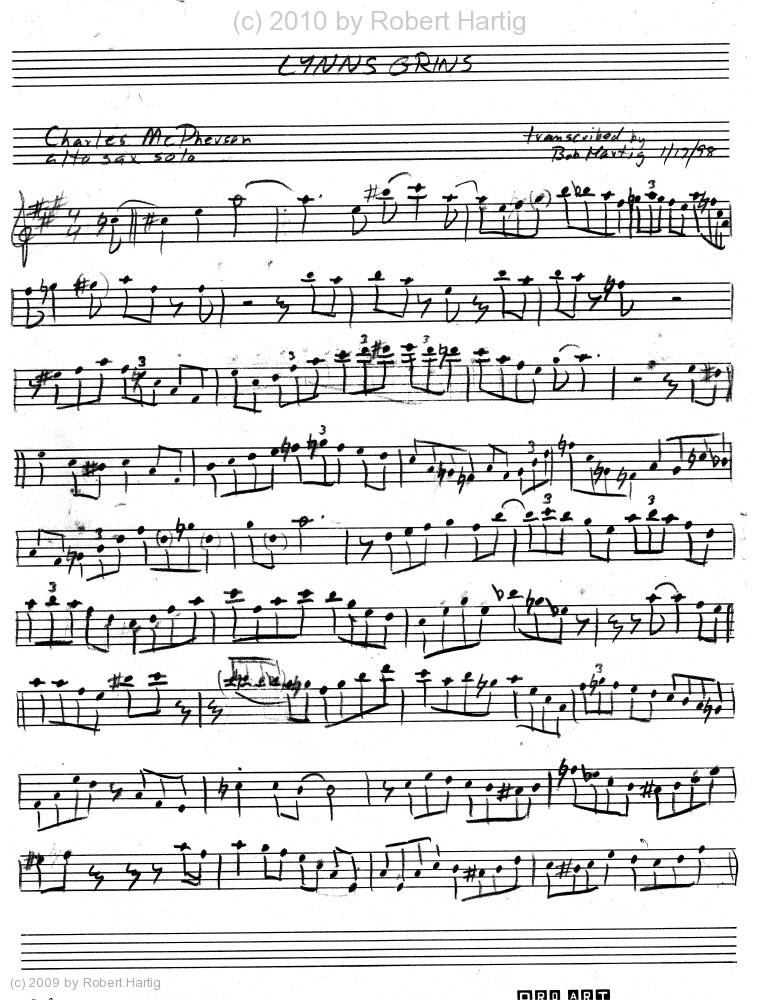
Lynn’s Grins: A Charles McPherson Alto Sax Solo Transcription

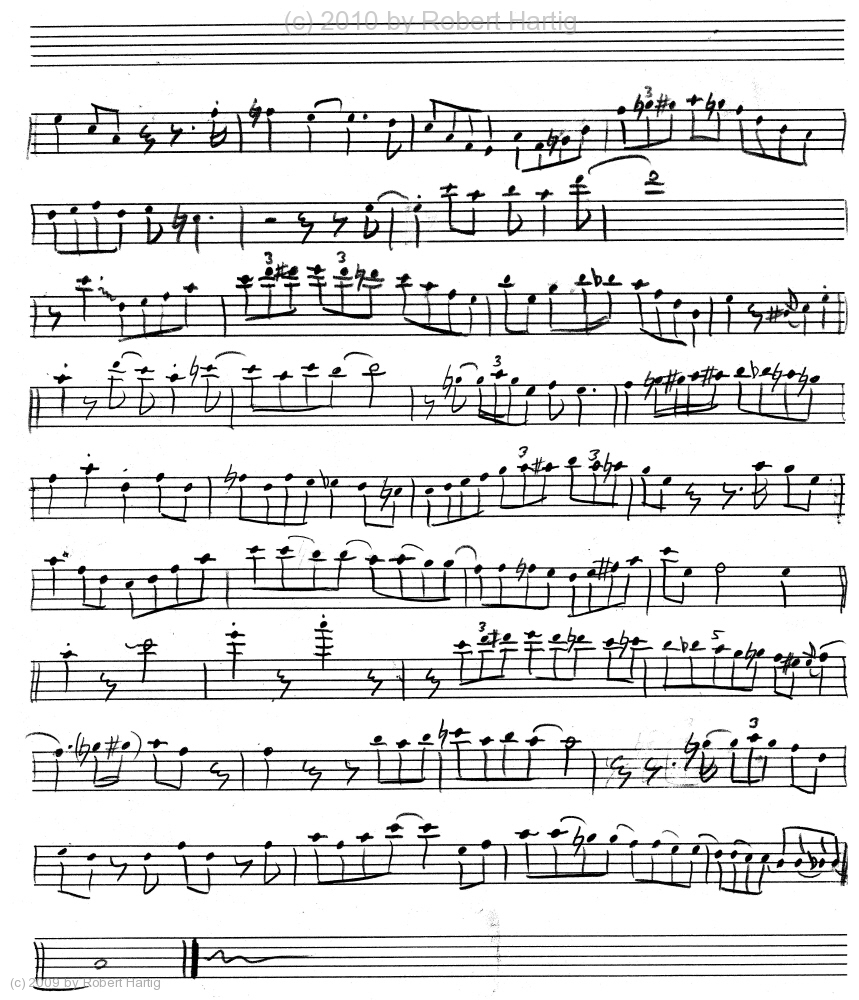
Ready for another saxophone solo transcription? “Lynn’s Grins” by alto saxophonist Charles McPherson is one of my favorites. It’s a concert C blues (alto key of A) at a medium-fast tempo, and it features McPherson in full cry, showing the listening world that he knows a thing or two about bebop. (Click on the images to enlarge them.)

From his simple opening statement outlining the tonic triad, McPherson plunges headlong into a millrace of ideas, toying at times with outside colors but always staying within the basic framework of the parent key.

There’s plenty to pick up on from this solo, and the best way to do so is by getting to work on it. What are you waiting for? Get cracking!

You’re a Good Man, Charlie Brown

This post is a continuation off of the previous one. Last night was the final night of the stage musical “You’re a Good Man, Charlie Brown” in Hastings. The show enjoyed a decent and enthusiastic turnout. Today, as I reflect on it, I want to say what a truly impressive job the young actors turned out. These small-town high school kids rendered an absolutely stellar performance, and it was a privilege for me to have played a small part in making it happen.

What I saw onstage clearly reflected a lot of talent, dedication, focus, hard work, enthusiasm, and friendship and mutual supportiveness among the cast. The result was not merely a superb production, but also a joyous one, and, frankly, a touching one as I consider the network of human relationships that lay behind it.

To any of the teen performers who happen to read this post: Bravo! Splendidly done! Charlie Brown, Linus, Lucy, Snoopy, Sally, Schroeder–each of you did a fantastic job. I’m well aware that there were plenty of others who helped make it happen–supporting cast, stage help, directors, and so on. My congratulations and appreciation goes to you all.

God bless each of you. Enjoy the afterglow of a magnificent show–and have a wonderful Christmas.

Storm Chasing Musicians

When I started the Stormhorn blog two years ago, I envisioned two distinct readerships: storm chasers and musicians. Knowing nothing about blogging, I naively figured I could reach both audiences. I mean, what the heck, why not?

Amazingly, it seems to be working. The whole world may not be flocking to Stormhorn.com, but enough of you are finding your way here, and I’m encouraged to see the numbers steadily growing. Maybe that’s because musicians and storm chasers possess some important traits in common: a penchant for the unusual; a passion to excel; a thirst for personal involvement with something that is intense and deep; a fascination with how and why things work; a high degree of commitment and self-motivation; and a love of beauty.

For some of you, the focus is music. For others, it’s storm chasing. But both pursuits are fascinating and rewarding, and I’ve felt from the start that there’s a connection between them, and plenty of crossover appeal.

In fact, a good number of you bridge both worlds. In a recent thread in Stormtrack’s Bar & Grill (sorry, no link to the thread–B&G is a “members only” section), fellow chaser Wes Carter posed the question, “Who plays musical instruments?”

A fair number of you do, it turns out, including at least one who earns his living at music. That would be Huntsville, Alabama, blues man Dave Gallaher. Both as a solo act and with his trio, “Microwave Dave and the Nukes,” and also as a disk jockey for his twice-a-week radio broadcast, “Talkin’ the Blues,” Dave has made an impressive mark regionally, nationally, and internationally. A musician doesn’t accomplish something like that without paying some serious dues; it takes not only world-class skill, but also great crowd appeal and tremendous perseverance. You really want to check out Dave’s website.

Then there’s Brandon Goforth. While these days I’ve been hesitant to post YouTube links due to their unpredictable shelf life, I’d be remiss not to steer you toward this link featuring Brandon’s rock guitar artistry.The guy can play.

Dave and Brandon are just two stellar examples of people who are both musicians and storm chasers. There are plenty more. Maybe you’re one of them. Do you consider yourself primarily a musician who chases storms, or would you call yourself a storm chaser who plays music? Or are you, like me, so passionate about both pursuits that the question is irrelevant? Regardless, there’s an interplay between the two disciplines which suggests active minds with large appetites for life and learning.

By the way, I’m never without my saxophone. I take it with me wherever I go, and that includes out to the plains when I’m chasing storms. Some chasers toss a football while waiting for initiation; I practice my sax. So to my fellow chasers who play an instrument (most likely guitar): if we cross paths and you’ve got your axe with you, we just may have the makings of an impromptu Great Plains jam session.

Keep your eyes open for me this coming spring. And if any of you happen to know of a good jazz venue in Tornado Alley, please let me know. Such places are hard to come by out west.

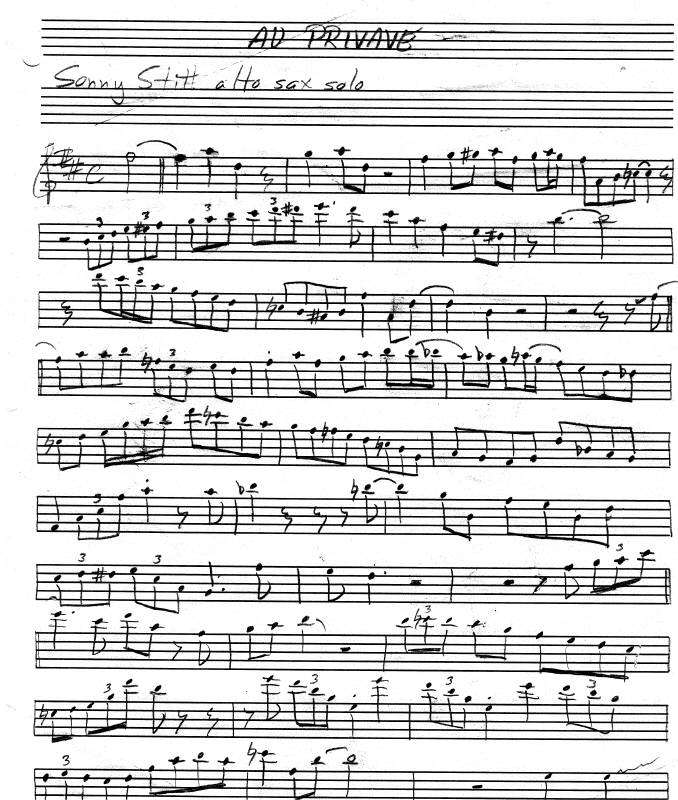
Sonny Stitt “Au Privave” Solo Transcription for Alto Sax

Sonny Stitt. Just in case you forgot how bad he really was, there’s a CD out there titled…

Sonny Stitt: Just in Case You Forgot How Bad He Really Was.

.

With an all-star lineup of guest musicians including fellow saxophonists Richie Cole and John Handy, the CD, published by 32 Jazz, is a Stitt tour de force featuring the American songbook and classic bebop.

Among the selections is the Parker tune “Au Privave.” Like Bird and virtually all of the other great boppers and jazz musicians before, during, and after him, Stitt was steeped in the blues. “Au Privave” features Stitt blowing several headlong, muscular choruses, demonstrating exactly what an alto player of his caliber is capable of doing with the old, familiar twelve-bar form.

I thought you might enjoy letting your fingers travel the same patterns as Sonny’s did on his “Au Privave” solo. So here for your enjoyment and edification is my transcription of the first three choruses. Please forgive the sizing disparity between the two sheet music copies. I haven’t yet gotten image reproduction down to a fine science. But it’s Sonny’s inventiveness that is the focus, and I trust that will survive even my mutilations.

Sonny Stitt solo on Au Privave

Sonny Stitt, Au Privave p. 2

Sitting in with the Local Musicians

It’s always a pleasure to sit in with local musicians. In Suttons Bay, Michigan, I got a chance to blow with some very, er, unusual cats. Talk about jazz being an art form.

I had played a fun gig in Leelanau the previous evening just north of Cedar with the Rhythm Section Jazz Band. Lisa came with me, with the idea that we’d overnight in Traverse City and then take in a bit of northern Michigan. There’s no more beautiful place than the Leelanau peninsula in the fall, and we took our time driving through the area, up the east coast along Grand Traverse Bay to Leelanau State Park and the Grand Traverse Lighthouse, then down the shoreline of Lake Michigan to Sleeping Bear.

Stopping in the artsy-craftsy town of Suttons Bay, we had gotten some coffee and were heading back to the car when I happened to spot a jam session taking place outside a shop. Strangely, though, not a note was being played. As you can see, the band was in fact a group of stylized jazz musicians made

out of metal and set out on the lawn. Whatever the tune was that they were playing, they seemed to be really getting into  it, but something was missing. Ya can’t have a jazz band without a sax player, ya know!

Naturally, I volunteered my services, and we went at it. Lisa caught our little ensemble with her camera. Hope you enjoy the pics!

Once There Were Trains

For many years, it has been my habit to practice my saxophone in my car. Living in an apartment and not wishing to bother my neighbors has forced me to find alternatives for my woodshedding, and my vehicle has served me well in that regard. In fact, I like it so well that if I ever do get around to buying a house, I will probably continue to practice in my car.

Since I love trains, my habit has been to park along a railroad track that stretches between Grand Rapids and Lansing. It has always been a fairly active route, and most days I’ve been able to count on seeing at least one train, and usually two or more, go by while I’m playing my horn.

Until recently. What has happened to the trains? Lately I haven’t seen a one. Really. Not in days. I just returned a while ago from one of my practice spots by the railroad crossing near Alto, and I didn’t get so much as a flicker on the semaphore lights.

This economy has hit a lot of folks pretty hard here in Michigan. I’ve got to believe that the collapse of the auto industry has had a dramatic impact on railroad transport. What I can say for sure is, the trains are no longer rolling along my favorite tracks the way they’ve done for so many years. I hope it’s just a temporary lull, and that railroad traffic will pick up again over time. Practice is still good, and I love being out in the countryside by the tracks, working my sax over and watching the sun set over the woods and the fields of alfalfa, corn, and soybean. But something’s missing. It just isn’t the same without the trains.

How to Master Circular Breathing on the Saxophone

It has been so many years since I first learned how to circular breathe that I rarely give the matter a thought anymore. It occurs to me, though, that to many sax players, circular breathing remains a technique shrouded in mystery.

There is, after all, something about it that appears almost miraculous. Most saxophonists would be challenged to hold a tone for thirty seconds. So how on earth did saxophonist Vann Burchfield manage to sustain a single note for 47 minutes, 6 seconds, in 2003, beating the previous record set by Kenny G of 45 minutes, 47 seconds? (An even more interesting question is, why did he do it? But the point of this article is to discuss the mechanics behind such a feat, not the psychology.)

Sensationalism aside, circular breathing is a useful technique with practical benefits for those who add it to their tool kit. But how does one go about doing so?

Begin by understanding the basics of how circular breathing works.

The principle is fairly simple (which is not to say, easy to master). You support your tone with air from your lungs in the usual way. However, when your air supply begins to dwindle, you store a quick reservoir of air in your cheeks. Then, closing off the back of your throat, you sustain your tone by contracting your cheeks while simultaneously–and very quickly–replenishing your lungs with air by breathing in through your nose.

This accomplished, you reopen the back of your throat and once again blow from your lungs. Repeat the procedure as often as necessary.

It sounds tricky, and it is at first, but the essentials really aren’t any great secret. Like any discipline, though, circular breathing takes time and persistence to master. Once you’ve got the hang of it, you’ll find that you’re able to continue playing indefinitely, spinning out lines for as long as you please without having to break the flow.

Here’s a simple, step-by-step process to get you started.

1. Get in touch with your air reservoir. How do you do this? Simple: take a breath and then puff out your cheeks. Now continue to puff out your cheeks while breathing in and out through your nose. Note how the back of your throat automatically closes in order for you to accomplish this, sealing off a reservoir of air in your mouth that keeps your cheeks “inflated” while your lungs continue their normal breathing rhythm.

2. Repeat the above procedure. But this time, blow a controlled stream of air through your lips, allowing the reservoir of air in your cheeks to empty itself like a leaky balloon. When you start losing pressure in your cheeks, then–without interrupting the air flow through your lips–breathe in through your nose and then release the air from your lungs into your mouth, replenishing the reservoir of air. Then close off your throat again. Continue doing this till it seems easy (which will probably happen fairly quickly because it is easy, much easier to do than it is to describe!).

The objective is to maintain a steady air stream through your lips while opening and closing your throat to replenish your air reservoir.

3. Till this point, the focus has been on getting a feel for the air reservoir in your mouth/cheeks. The reservoir is key, but in circular breathing, you’ll only use it for the second it takes to fill your lungs with air, after which your throat remains open and you blow in the normal fashion.

So in this exercise, blow a steady stream of air through your lips, allowing the pressure to puff out your cheeks, but support the air stream from your lungs. Keep it going for five or ten seconds, until your lungs begin to empty. Then close off your throat and keep the air stream moving by using the air in your mouth reservoir, as in exercise number two. Simultaneously, inhaling through your nostrils, fill your lungs back up with air. Then open your throat back up and blow from your lungs once again.

4. Once you can comfortably and consistently perform the above exercise, you’ll have gotten your arms around the essentials of circular breathing. At this point, you are in fact performing the technique. Now it’s just a matter of transferring it to your instrument.

When I was first learning to circular breathe, I found it helpful to work with the soprano saxophone. Assuming a conservative reed/mouthpiece combination, the soprano uses less air than the larger horns, making the learning curve easier. If you’ve got a soprano sax, I highly recommend that you practice circular breathing on it before you try it on your alto or tenor.

Start by seeing how long you can sustain a single tone in the middle register of your instrument. The note C on the staff works great. Avoid extremely high and low notes for the time being. Concentrate on making a smooth transition between lung support and reservoir support, striving for minimal pitch wavering, change in volume, and certainly break in tone when closing and reopening the back of your throat.

From here on, gaining proficiency is just a matter of focused, self-analytical practice. However, there are…

A few things to be aware of.

These involve the way you use your mouth reservoir to sustain a tone.

In the above exercises, you’ve had your cheeks puffed out and allowed the air to leak out of them in a controlled stream. Once you start blowing through a mouthpiece, you’ll find that things aren’t quite so easy. The air goes at a faster rate, and you need to contract your cheeks like a bellows in order to provide enough air pressure to sustain a tone on the horn.

Ultimately, of course, you want to dispense with puffing out your cheeks as much as possible. Cheek-puffing is handy as a preliminary learning device, but it’s ruinous on intonation and good breath support. As you spend time refining your circular breathing technique, you’ll find that you can exert air pressure from the back of your throat by lifting your tongue forward. I don’t know how better to describe what I’m getting at, but I’m quite certain that you’ll discover it for yourself if you continue to practice circular breathing.

Once you’re able to sustain a single tone with reasonable control, try playing a scale using circular breathing. From there, try a favorite lick. Circular breathing while playing lines is challenging at first, but once you’ve acquired the ability, you’ll find that moving notes are actually more forgiving than long tones. They tend to mask the unwelcome waver that often attends the shift in air support.

And that, my friends, is that. My job is done. Yours is just beginning. Grab your horn and get started.

Kenny Garrett with Miles

When it comes to alto sax players, Kenny Garrett sits in the tiptop echelon of exciting contemporary voices. The man not only has formidable chops, but a deep understanding of how to use them to generate consistently electrifying performances.

This YouTube clip features Kenny playing with Miles Davis in Paris. As high-energy as the music is, I find the unspoken connection between the two men–the jazz patriarch and the keeper of the flame–to be almost as fascinating as Kenny’s solo. Davis appears mesmerized by the sax warrior’s unrelenting barrage of ideas, and Kenny seems inspired by the presence of the Legend. Whatever the dynamic actually was, evidently sparked by some microphone problems that Garrett was experiencing, the result is unquestionable. There’s a whole lot of music going on here.

I love Kenny’s use of sequence, repeated tones, and motifs as organizational devices. And check out his tone splitting toward the end of the solo. In every respect, both technically and conceptually, the guy is an absolute master. Wish I could get my arms around just half of what he’s doing!