preload
Feb 07

I initially became acquainted with Tim Vasquez’s books a good ten or so years ago at my very first severe weather conference at the College of DuPage. Tim was sitting at a table selling, among other things, his Weather Forecasting Handbook. I bought a copy and began chewing on it, and I have continued to do so ever since over the years. There’s a lot of essential information packed into the 204 pages of the old “Purple Book.” (Tim’s books are known colloquially by the color of their covers.)

That book took me deeper into a world of meteorological concepts that I was only beginning to become aware of, ones that storm chasers need to know. My brain not being the kind that readily absorbs such stuff by reading alone, it took me a long time and many read-throughs to grasp some of the arcane principles, language, and tools that are integral to making one’s own forecasts and selecting target areas. I still have a few things to learn–okay, plenty of things–but much of the material Tim covered is now familiar to me, and I apply it regularly.

Ragged and torn from long use, my old copy of Tim’s book sits beside me now as I write. Next to it is a brand-new copy of its heir-apparent, the Weather Analysis and Forecasting Handbook.

While anyone familiar with the old book will recognize much of the material, the new Purple Book is far more than just a makeover. At 260 pages, it provides considerably more information, all of it reflecting current research and technology. This is weather forecasting as it is today, not as it was a decade ago. Indeed, so much new material has been introduced; so much of the pre-existing text has been revised and expanded; the illustrations have been updated and extended to such a degree; and the content has been so thoroughly reorganized overall, with an eye on taking the reader beyond concepts to analysis and forecasting, that the Weather Analysis and Forecasting Handbook is for all intents and purposes a new book, not just an updated edition. And, I might add–and I say this rather grudgingly, having cut my teeth on the old handbook–this new volume is a more comprehensive and helpful resource than its venerable predecessor. There is just a lot more to this book, and it’s all presented in a well-thought-out fashion.

Main Content

One significant change in the Weather Analysis and Forecasting Handbook is the organization of its content. As does the previous book, this one begins by introducing foundational physical concepts such as mass, force, pressure, temperature, the Coriolis force, geostrophic wind, vorticity, and so forth.

The second chapter on observation also appears largely familiar, though it keeps abreast of current practices. However, the previous treatment of clouds is only lightly addressed because the subject is given an entire section of its own in the book’s appendices.

Beginning with chapter three, the changes become pronounced. Here is a very abbreviated overview of the book’s structure from this point:

Chapter three: Thermodynamics–Deals with instability and familiarizes the reader with atmospheric soundings. Here is where you’ll learn how to read and interpret that essential forecasting tool, the skew-T/log-P diagram.

Chapter four: Upper Air Analysis–Taking a top-down approach to forecasting, this chapter introduces constant pressure charts, long waves and short waves, divergence and convergence, jets and jet streaks, and other atmospheric processes and influences from 100 mb down to 925 mb.

Notably missing is a structured introduction to charts for specific pressure levels, such as the 500 mb height map. That discussion has been shifted to the appendices. Instead, chapter three focuses on the various factors that the maps depict, and the book makes such liberal use of the different maps by way of illustration that the reader gains familiarity with them through osmosis. My guess is, Tim believes that by helping readers understand upper-air dynamics and processes, the significance and use of the various maps will become apparent through real-world examples.

Chapter five: Surface Analysis–Learn how to read a surface chart, get a basic grasp of air masses, and discover the importance of various boundaries, from cold and warm fronts to drylines and outflow boundaries.

Chapter six: Weather Systems–This chapter groups together concepts from several chapters in the old forecasting handbook. The presentation is logical and fresh. Subjects covered include all-important baroclinic lows and highs, barotropic systems, arctic air outbreaks, and winter weather systems.

Chapters seven and eight deal, respectively, with satellite and radar. Suffice it to say that they are required reading. Since both remote-sensing tools are visual in nature, plenty of pictures are provided to illustrate patterns, systems, outflow boundaries, velocity aliasing, severe weather signatures, and so on.

I’m a bit surprised to see not a single screen grab of a velocity couplet, either in the radar chapter or in the ensuing chapter nine on convective weather. However, velocity products rely highly on a full-color format and don’t lend themselves easily to this book’s black-and-white images. Tim points this out later in figure 9-6, where he writes, “Typical NEXRAD color schemes do not reproduce well in monochrome books.”

Importantly, the chapter on radar discusses the new dual-polarization technology that is being implemented nationwide at the time of this review. Dual-pole is a huge development in the NEXRAD system, probably the biggest stride forward since the deployment of NEXRAD itself.

Chapter nine: Convective Weather–For aspiring storm chasers, this chapter will likely be the Holy Grail of the book. Besides dealing with the ins and outs of thunderstorms, from single-cells to supercells to mesoscale convective systems, this chapter discusses storm-relative winds and introduces another indispensable forecasting tool, the hodograph. Chapter nine moves on to talk about tropical systems including hurricanes.

Chapter ten: Prognosis–This last chapter in the main body of the book deals with the actual process of forecasting. Readers will at this point have recognized that Tim is a strong advocate for understanding not merely how the atmosphere is likely to behave, and where, and when, but also why. Here he discusses the four-part forecasting process. He emphasizes the importance of a hands-on approach to analysis while at the same time recognizing the key role of numerical models, the application, strengths, and weaknesses of which he discusses at length. The chapter concludes with a brief overview of ENSO and teleconnection patterns.

The entire book is amply illustrated. Barely a page exists that doesn’t include some kind of black-and-white chart, map, or photograph. These visual supplements are clear and immensely helpful, to the extent of being integral to understanding much of the written content.

To round things out, the book is peppered with sidebar commentary ranging from the informative, to the philosophical, to the historical, to the humorous. For instance, on page 31 I find a table of NATO color codes; page 57 furnishes a thumbnail discussion of long waves; a lengthy entry on page 120 describes five different empirical forecast techniques; and on page 166, there’s a wry commentary on how to tell whether a tornado is forming using the “thumb tab” approach of the Field Guide to North American Weather.

Appendices

This section is an informational gold mine. Strangely, it’s not even mentioned in the table of contents, so I’m going to give you the breakdown here:

Appendix one: Forecaster’s Guide to Cloud Types–Photos and descriptions of major cloud types, including brief discussions of each one’s significance from a forecasting standpoint.

Appendix two: Surface Station Plots–What all those numbers and symbols mean.

Appendix three: Surface Chart Analysis Procedures–Brief guidelines for doing surface analyses.

Appendix four: Upper Air Station Plots–Similar to the second appendix, except applied to upper air plots.

Appendix five: Upper Air Chart Analysis Procedures–This is about as close to an overview of specific pressure maps as this book provides, which it does from an analysis perspective. This appendix divides into three short sections on upper-, middle-, and lower-tropospheric charts. Between them, they provide insights on the significance, use, and analysis of upper-air maps from 100 millibars all the way down to 925 millibars.

Appendix six: An Isoplething Tutorial–Veteran forecasters invariably are strong advocates of hand analysis, and Tim is a prime example This appendix shows you how to get started at creating your own hand-analyzed weather maps.

Appendix seven: Conversions and Symbols.

Appendix eight: Instability Index Summaries–Brief discussions of the more commonly used forecasting indices such as CAPE, CINH, lifted indices, the energy-helicity index, and the SWEAT index. A couple of these tools–BRN shear and storm-relative helicity–aren’t in themselves related to instability; however they’re so widely used in severe weather forecasting that they require discussion, particularly since they’re factored into such true instability indices as the EHI, STP, and Bulk Richardson Number.

Appendix nine: Types of Thermodynamic Diagrams–Brief discussions and graphic examples of the skew-T/log-P, emagram, Stuve, pastagram, aerogram, and tephigram.

Appendix ten: Blank Diagrams–Reproducible blank skew-T and hodograph.

Appendix eleven: Observation Format Overview–For the incredibly geekish, a quick reference guide to the most commonly used weather-reporting formats: METAR, SYNOP, and TEMP (radiosonde code).

Additional appendix materials without assigned section numbers include the following: suggested reading, software, educational websites, government weather agency websites, and top-ten weather myths.

Three Recommendations


Let me preface my following few critiques by saying that this is a fantastic book. The author is both a veteran storm chaser and an educator, and that combination has inspired him to create a practical resource that is both accessible to lay-persons and helpful to operational forecasters. Storm chasers and anyone who wants to develop skill at weather forecasting would do well to put it in their library.

This said, I have three comments that Tim may wish to consider at some point:

• I liked the old handbook’s quick, specific introductions to the 200/250/300 mb, 500 mb, 700 mb, 850 mb, and surface charts. The overviews of those charts gave me–at a time when I was a complete novice and needed weather knowledge delivered to me in brick form–an instant, systematized reference to the constant-pressure maps that are such essential tools of the trade.

Granted, entire books have been written about weather maps, including Tim’s own Green Book, the Weather Map Handbook. The new Weather Analysis and Forecasting Handbook is obviously not intended to fill such a role. But perhaps in the appendix section, the fifth appendix could be fleshed out a bit by providing a top-down sampling of CONUS maps for a single date/time. That way those unfamiliar with upper atmospheric maps could see how, say, March 13, 2011, at 1200 UTC mapped out at 300 mbs, 500 mbs, 700 mbs, 850 mbs, 925 mbs, and on the surface.

• Granted the limitations of trying to translate something as color-dependent as radar velocity products into a gray-scale format, there may nevertheless be a benefit to making the attempt. I say this because the ability to recognize storm-relative velocity couplets is so critical in storm chasing. While the illustrations on page 145 (figs. 8-2a–f) do a good job of conveying the general idea, there’s nothing like real-life examples. Perhaps such examples could be included in the future, whether directly in the book or possibly as a link to a page featuring radar screen captures on Tim’s Weather Graphics website.

• A quick, easy-reference glossary of essential terms would be a welcome addition.

With these three suggestions on the table for Tim to consider in his next edition, I unhesitatingly recommend this book. It’s superb, a labor of love by one of the gurus of operational forecasting who clearly cares a great deal about helping others learn the ropes.

Some months back, I reviewed Tim’s other recent publication, Severe Storm Forecasting. It’s another excellent resource for storm chasers in particular, covering some of the same ground as this book and expanding considerably on the subject covered in chapter nine, “Convective Weather.” Good as that book is, though, Weather Analysis and Forecasting provides the more complete, well-rounded picture. Be forewarned: it’s not a book you will read and absorb in one sitting. It is chewy material that will require you to approach it analytically and patiently. This is a resource you will pull off the shelf again and again, whether to re-engage with material you’re still trying to grasp or to refresh yourself on concepts you’re already familiar with.

Purchasing Information

  • Weather Forecasting and Analysis by Tim Vasquez, 260 pages.
  • $29.95 plus shipping, available from Weather Graphics.

NOTE: This is a non-paid review. I’ve written it as a service to my readers and to Tim because, having read the book, I’m convinced of its value for storm chasers and severe weather buffs.

Tagged with:
Feb 02

In Part One of my interview with veteran storm chaser Shane Adams, Shane recalled his formative years as a chaser in a simpler time when laptops, mobile data, and the media hadn’t transformed the landscape of storm chasing.

Part Two begins with several questions that deal with more pragmatic matters of forecasting and target selection. From there, Shane recalls his experience with the deadly May 4, 2007, Greensburg supercell. It’s a unique perspective on the storm in its post-Greensburg phase as it continued to spin off massive, violent wedges, and Shane’s account includes a haunting encounter with Macksville police officer Tim Buckman shortly before he was fatally injured by one of the tornadoes.

Finally, Shane reflects on the top three chases of his career and tells why he considers them so.

Question: I just finished listening to an interview with David Hoadley on the High Instability podcast, and I was struck by the similarity between some of what he had to say and your own comments [in response to my last question in Part One]. Realistically, chasing continues to evolve; yet I resonate with your gratitude for having come up in a simpler time when there was nothing to detract from the supreme value of the storm and the sky. I’d imagine—correct me if I’m wrong—that today you use at least a laptop and GR3 on your chases. But I get that you’re a minimalist at heart. Let’s talk about what a chase looks like for you these days. First, what is your process for forecasting? What things do you look for in picking your target?

Shane: These days, I use the same computer models all other chasers use. Within that, of course, there are several different sources. Personally, I use the College of Dupage computer model website. The reason why is, most model pages use CONUS maps. I don’t like CONUS maps because they make individual states and regions too small for detailed analysis in my opinion. CoD uses regional maps, which are much easier to analyze down to the mesoscale and even microscale level. It’s important for me to be able to recognize a specific area within a state while looking at model data, so I can overlay in my head the actual spot where I believe all the ingredients will come together. Looking at a CONUS map, I might be able to say, YYeah, southwest Oklahoma looks good,”  but I can’t tell exactly where in southwest Oklahoma I need to be. The difference between a career day and a bust can be as little as twenty or thirty miles, something that is impossible to pinpoint using CONUS maps. So definitely College of Dupage is my forecasting lifeblood. When their site is down, I am not happy LOL.

As far as a target is concerned, again, I’m pretty much like everyone else. You want the basic four of course: moisture, instability, wind shear, and a source of lift. I tend to gravitate toward instability, with slightly less attention to wind shear. I’ve not had much luck chasing highly dynamic systems with low instability, so those are a big turnoff for me when looking at a forecast. Also, those type setups typically have very fast storm motions, making chasing more difficult. With more focus on instability and less on wind shear, I try to find an area with the most explosive potential for upward motion in a place where storm speeds won’t be as fast (lack of intense shear). Of course this dream scenario rarely unfolds in reality as often as I’d like, but in any chase setup, I will always first target the area of greatest instability and fine-tune from there based on other parameters.

Q: If you were to head out into the field without the benefit of Internet, equipped only with your morning forecast and the knowledge you’ve gained over the years, how would situational awareness inform your decisions as the afternoon progressed? In other words, how might simply looking at the sky or observing changing conditions tell you that you’re in the right spot—or, conversely, that you need to move?

S: One built-in advantage of cutting your chasing teeth in central Oklahoma is, 99 percent of the time the dryline is west of you. This means that you wake up in the warm sector on most days and simply have to drive west until the clouds thin out.

Drylines are marked visually by a sharp decrease in cloud coverage, vertical height, and base level. Bases will rise, tops will flatten, and the overall number of clouds will decrease as you approach the dryline. This was one of the first lessons I learned; the scenario was nearly automatic each time I chased because I never woke up on the dry side of the dryline.

Warm fronts are perhaps even more pronounced visually, as north of them on many chase days, there will be a solid overcast of low clouds. These clouds begin to thin as you near the warm front, and then as you move south there are fewer and fewer clouds until you’re in clear sunshine—plus whatever early-bird towers are trying to build in the warm sector.

My targets usually put me near either a dryline or warm front, so my biggest visual clues are simply watching how clouds behave.

Q: Storms are firing and you’ve got multiple options. Without using radar, how would you determine which storm you’ll go after?

S: Usually when faced with having to choose from multiple storms, it’s right after initiation, and every storm has the same potential to become tornadic. Because of this, I almost always opt for the storm I have the best position or approach angle on. Sometimes it works, sometimes it doesn’t.

In other situations where you’re a good distance from the storms and they’re in different directions from you, you have to analyze the situation more closely based on storm history and the immediate environment. If, for instance, I’m thirty miles south of the triple point, and I have a storm north of me right on the triple point and another one forty miles south of me, then I have to consider certain things and do a quick pro/con list for each storm in my head: the north storm is closer, but it’s moving away … the south storm is farther away, but it’s moving towards me … but the north storm will have better helicity sitting right on the warm front, so there’s a better chance it could produce a tornado … but it could also cross the warm front into the cool side and become elevated before I get to it … so the south storm seems like the way to go … but I’m going to have to punch through the entire core to get a view … these are not easy decisions, and they must be made quickly. I’ve been right, I’ve been wrong, but the worst situation is when you’re indecisive and end up missing both because you took too long to commit to one or the other. I’m much better off just sticking to my target, driving there, and letting the situation unfold … instead of just driving to a general area and waiting until after initiation to pick a storm.

Q: You were among those who chased the Greensburg storm. Describe your experience.

S: In all reality, we busted on this day. By dusk, we were well north of the Greensburg storm as it developed, and had already thrown in the towel and stopped for food. Because I chase to get good tornado video, I always quit after dark unless I’m already on a tornadic storm. So we’d been sitting in the Great Bend Pizza Hut drowning our sorrows with a large Meat Lover’s and Bud Light.

On a whim, Mick Ptak, the friend I was chasing with, had decided to bring his laptop inside “just in case” to watch the radar. We’d never done this before, so the fact that he’d chosen this night was, in hindsight, very lucky and ironic; if he hadn’t done so, we’d have sat there eating and missed the entire event. Or even worse, been in the path of more deadly storms well after dark.

Somewhere during beer number two, we both glanced over at the radar. Mick had been running a velocity loop, and the couplet we were looking at was off the charts, like nothing we’d ever seen before. We immediately went into chase mode, with Mickey grabbing all the gear while I ran to the counter to pay for the meal. I asked if the tab was below $20, and when the person said that it was, I just threw a twenty at them and ran out the door.

We raced south while listening to live reports coming over NOAA radio. It was obvious something terrible had happened in Greensburg, although neither of us at the time had any idea the magnitude.

We got to Pratt, which is about thirty miles east of Greensburg, and turned west. We stopped near Haviland, where we began our actual “chase” of the Greensburg storm. I remember scores of emergency vehicles screaming by us for several minutes, all headed west from Pratt. The scanner was alive with constant chatter regarding the disaster that had just happened. We were using the velocity loop on radar as our main source of info, because the lightning wasn’t helping out as much as we needed. The first of three giant tornadoes we would observe that night loomed to our northwest, buried in darkness and probably precipitation. We were sure we were looking at a tornado, but it was so big and so hard to see, it was impossible to make it out clearly (it would be partially revealed in a capture from my video). The inflow was so incredible, I had to wedge myself against the open car door space while leaning against the door to keep it from closing on me. We moved back east and then north once the storm started moving further away.

Watching the radar, we were noticing alarmingly large spaces between mesocyclone occlusions. Not only were these couplets incredibly powerful, they were also unbelievably huge. It made sense that the “handoff” distance between mesos would be greater than normal as well, because the mesos themselves were so unusually large. Normally, five miles southeast of an ongoing meso/tornado is a reasonably safe distance, but not tonight. We kept a minimum of about seven to eight miles between us and the tornadoes for fear of being run over by the next cycle jumping toward us. Unfortunately, later that night, a local LEO would become an example of how these large-span meso jumps can be lethal.

As we continued north, we met a car coming south, frantically flashing its lights. At this point, with this storm and what it had already done, we weren’t taking any chances, so we turned around and headed back south. No sooner had we done so than Mick said, “There’s a huge wedge back there!” I stopped the car and we jumped out. I hadn’t yet seen it, but I could tell by Mick’s reaction that it was big. A few more seconds passed by, then a big flash of lightning lit up one of the largest tornadoes I’ve ever seen. “Whoah, I see it!” We held our ground and watched this huge wedge tornado through intermittent lightning flashes for a couple of minutes, then continued further north.

We stopped a few miles south of Byers, and a police car pulled up beside us. We didn’t know it at the time, but the driver was Officer Tim Buckman of the Macksville police department, a neighboring town to Byers about ten miles north and slightly west. We told him about the large tornado we’d been seeing off and on for the previous ten or so minutes, and he was already aware of it. He continued on ahead of us, and we followed him into town. Once we arrived in Byers, we saw Officer Buckman pulled over at the fire station, talking to a few firemen/spotters. As a courtesy, we stopped and asked him if he minded if we continued on ahead to chase the tornado. He said we could, but it was “at your own risk.” We told him we understood, thanked him, and drove north of town about a mile, where we stopped.

We continued to get glimpses of the tornado, and after a while, Officer Buckman drove past us. He went about a mile or so north, then turned west. The tornado was well off to our northwest, and the area he was driving into would’ve been a prime spot for the next tornado if the storm recycled. I remember thinking, as I videotaped his flashing red and blues moving slowly off toward the large tornado in the distance, “I wouldn’t go that way.”

As Tim Buckman’s emergency lights faded off into the darkness to our north-northwest, we became focused on a new area that was north of us, but closer than the previous tornado had been. Matching up what we were seeing to the radar, we were convinced this new area was the next probable tornado, southeast of the now dissipating tornado near Macksville, some ten miles to our north-northwest. We stayed put where we were, partly because we were almost out of gas at this point, but mostly because we were too spooked to get any closer. After a few more minutes, another large tornado became partially visible with lightning strikes. The eastern edge was buried in rain, but the west side of this monster loomed quite clear, a solid wall of black. We sat and watched this tornado, which was south of St. John, for maybe five minutes until we could no longer make it out. After that, we decided we’d call it a night, because we had another chase looming the next day, and we’d need some rest (though we hardly got any).

I don’t know why we even thought we could, but we drove back to Pratt, and managed to get a room at the first hotel we stopped at. I spent all night going over my video, finding bits and pieces of tornadoes within the lightning strikes. I wrote a report on Stormtrack while the local television news was showing us the first shots of the Greensburg monster we’d seen—incredible. The sirens never stopped all that night, with constant emergency vehicles driving to Greensburg and driving back from there with injured. It was a very dark and brooding night, probably the most unsettling night of my chase career. Since then, I’m much more wary about after-dark chasing. I was never very interested in nocturnal chasing, because night-time video is rarely worth the effort in my opinion. However, the significance of this event made the endeavor very worthwhile, and in the process, we managed to get video of tornadoes that nobody else did. What at first seemed like a curse actually became a blessing of sorts; we’d missed the marquee tornado of not only the event, but the entire year—but we’d managed to pick the storm up where almost everyone else had lost it, getting trapped by the devastation in Greensburg. The result was observation and video documentation of large tornadoes that no other human eyes ever found.

A few days later, unfortunately, we learned that a Macksville police officer had been killed by a tornado east of there. As it turned out, the officer killed was the one we’d spoken to that night during the Macksville tornado. He had made his way through rural areas just southeast of his hometown to get back to the highway east of Macksville so he could observe the large tornado threatening his community. Tragically, the last tornado we saw, from the same spot where we last saw officer Buckman driving northwest towards the Macksville tornado, formed south of his position, and struck him as he moved east on highway 50, critically injuring him. He would succumb to his injuries a few days later. We were likely the last ones to ever see him before this tragic event.

Q: Granted this may be a hard question to answer, but what has been your most outstanding chase, and what made it so?

S: I measure greatness in a chase by multiple factors: number of tornadoes seen, quality of tornado video, historical significance of the event, and overall aesthetic/sensory/spiritual experience. Even with that, I cannot choose just one day. So using the formula I described just now, I’ll try to narrow it down to just one event that fits each category.

Number of tornadoes seen: Even though it’s tied for second all-time for the most tornadoes I’ve seen in one day, I would have to give the nod for most tornadoes to May 29, 2004. Great video, but what stands out most about this day for me is the sheer number of visible tornadoes. Every size and shape imaginable, with the most incredible display of tornadic behavior I’ve ever witnessed: Multiple tornadoes merry-go-rounding about the parent mesocyclone. Tornadoes zigging, zagging, and doing full circles. Absolutely incredible!

Quality of tornado video: This category belongs to June 12, 2004. The infamous “glowing” Mulvane tornado steals the show from this event, but all the tornadoes that day were very photogenic, and I was able to capture incredible video of them all. This day is the bar for what I expect to bring home on video every time out. Mulvane was the first tornado I ever heard the roar from.

Historical significance: If we’d actually seen the Greensburg, Kansas, tornado that night, this would’ve likely been my number-one. However, May 3, 1999, remains at the top of this category. Many firsts happened for me that day; first F5 tornado, first 3+ tornado day, first double-digit tornado day (ten tornadoes), first up-close tornado encounter (less than a half-mile), and unfortunately, my first killer tornado.

I almost doubled my career total on this day. I had been chasing a little under three years at the time, and though I’d seen some tornadoes, I had never seen a day even close to this. Despite the dark cloud that hung over this event because of the of the human tragedy it brought, yet for me as a chaser, the sheer magnitude of what we’d seen and captured on video was almost overwhelming. That whole week was surreal: getting calls for interviews, having television crews at our apartment taping shows, the whole nine yards. The week after May 3, 1999, was as close as I would ever come to money and fame as a chaser. I appeared on television in both America and Germany (the German show actually aired first, so my TV debut was international LOL), and made $2,100 from video sales. There were no brokers in 1999. I had to fight those bloodthirsty wolves on my own, and in the end, despite the fact that I won the war, I decided the battle scars just weren’t worth $2,100. My television and video sales career began and ended that week.

Overall aesthetic/sensory/spiritual experience: Hands-down, this category goes to October 24, 2010. This was a day that brought back that old “chase first, forecast second” philosophy from my early years, but only because of my laziness. The only reason we even left the house that day is because Bridget Geaughan, my girlfriend/chase partner since 2008, was watching a storm explode just east of our apartment. We’d spent the previous two days busting on setups that, in my opinion, had looked better than this day. I wasn’t about to waste my Sunday on a third consecutive goose chase. However, Bridget pushed for us to chase and I caved.

Once we got out on the road after the initial storm she’d seen, it was obvious we’d never catch it. By now I was fully into chase mode, and I figured our only hope was to start heading southeast, cross the dryline, and hope like hell something new formed to our southwest. The plan worked to perfection, and we encountered the tornado of our lives in Rice, Texas. This chase has been well-documented in chasing circles, mostly because Bridget live streamed almost the entire lifecycle of the tornado. I’ll never forget looking up at the top of the funnel as it was in a near-steady-state, watching how the base seemed to get pulled into it like a bathtub drain. It was a view I’d not had before and haven’t seen since, but one I could get used to. Probably a once-in-a-decade type experience, maybe once in a lifetime.

———————–

Thanks, Shane, for an informative, thoughtful, moving, and overall terrific interview! To those of you who’ve read it: check out Shane’s blog, Passion Twist. It’s aptly named–filled with insightful, detailed, and well-written chase logs; packed with photos; and stamped with Shane’s unquenchable love for chasing storms.

Tagged with:
Jan 31

In recent years, due largely to the influence of Discovery Channel’s Storm Chasers series, storm chasing has exploded as an avocation. What began over fifty years ago with a handful of individuals roaming the American heartland in pursuit of nature’s most violent and beautiful storms has evolved into a hobby practiced by multitudes, shaped by the media, and facilitated by state-of-the-art technology.

Today, equipped with a laptop, a modem stick, and radar software, a beginning chaser has an excellent chance of seeing tornadoes right out of the starting gate. But it wasn’t always so. Once there was no GR3, no mobile data, no live streaming, not even any laptops—and nowhere nearly as many chasers as there are today.

New chasers conceive of storm chasing as it is, not as it was. That’s inevitable. People live in the present, not the past, and any of us can only board the train from the platform we’re standing on. Yet the past wasn’t all that long ago—that pre-tech era when the tools of the trade were few and the likelihood of busting far greater. Those of us who came up during those simpler times treasure the experience and carry a different perspective than those who cut their teeth on techno-chasing.

To scores of chasers who have been around the block a few times, Shane Adams needs no introduction. Shane has been a storm chaser since 1996. He’s well-known as a passionate and highly experienced chaser who lives, eats, and breathes storm chasing. With six storm chasing videos to his credit, Shane is the host of the weekly podcast The Debris Show; and, with his girlfriend and fellow chaser, Bridget Geaughan, he is the coauthor of the storm chasing blog Passion Twist.

Shane was good enough to do a written interview with me covering a broad range of topics of particular interest to storm chasers. The questions and responses range from the retrospective and occasionally philosophical to the practical.

Shane is an articulate, thoughtful, and passionate interviewee with much to share. Since the article is lengthy, I’ve broken it into two parts. In this first part, Shane talks about his personal development as a storm chaser; and, in the light of his own experiences, he reflects on the state of chasing today.

In part two, which I’ll release in another day or two, Shane talks about his personal approach to forecasting and chasing. He shares his unique account of chasing the tragic May 4, 2007, Greensburg, Kansas, supercell, and he looks back on the three most outstanding chases of his career.

Enough of my introduction. Here’s part one.

.

Interview with Storm Chaser Shane Adams

.

Question: Some background stuff to begin with. Talk a bit about your boyhood. You currently live in the Fort Worth, Texas, area. Have you lived in Tornado Alley all your life?

Shane: I was born in Oklahoma City and lived there until my parents divorced at age four. After the divorce, my mother and I moved to Healdton, Oklahoma, which is in the southern portion of the state. Growing up there for me was fun, because we lived in the same house for thirteen years, and I made many lasting friendships and knew the area well. We had a pasture that butted up to our neighborhood, and my friends and I would spend countless hours playing out there, back when kids actually played outside. That was pretty much my life pre-storms, although growing up in Oklahoma my entire life, I had been aware of storms as far back as I could remember.

Q: What event, or events, first served to flip the switch of your fascination with tornadoes?

S: As I mentioned, I had always known about thunderstorms. I can remember way back, first seeing this weird word they always used on television weather warnings: tornado. I knew about severe thunderstorms but had no clue what a tornado was. My mother tried to explain it to me, but her very limited knowledge and understanding, coupled with my young mind, just didn’t really paint the picture.

Then April 10, 1979, came along. A massive F4 tornado ripped through southern portions of Wichita Falls, Texas, just eighty miles southwest of Healdton. A few months later, one of the local television stations did a story on the tornado. I was in my room when suddenly my mother started yelling for me. I ran out into the living room, and she pointed to the television. I looked at the screen and saw a huge, black, boiling mass of cloud scraping along the ground below the most ominous sky I’d ever seen. “There,” she said. “That’s a tornado.”

I was hooked for life.

Q: It’s one thing to be intrigued by tornadoes; it’s another to actually chase them. When did you first start chasing, and what inspired you to do so? What was your first chase like for you?

S: I dabbled with chasing for years before I really started, but this was nothing more than glorified spotting. I would move from one edge of town to the other, but when the storms moved on, I never followed. I did this infrequently from 1988–1995.

On April 21, 1996, I went on my first true chase, where I actually drove out of town, over the road, to try and find a tornado. However, this too was a spur-of-the-moment thing, and I only had a cheap disposable camera and a cooler full of ice in case I found big hail. There was no plan, except that if I got into hail bigger than golfballs, I would back off, fearing a tornado I couldn’t see would be close behind.

I did get hail up to golfballs that day, saved a few in my cooler, and took a few snapshots I never developed. But this was nothing I would consider a real chase by my standards. To make it a real chase for me, there must be a video camera for documentation. Otherwise, it’s just a drive.

My first “official” chase was June 6, 1996. I was working a landscaping job with a friend of mine named Greg Clark. It started to get stormy early that afternoon, so we decided to knock off early. I said on a whim, “We should go chase these storms and try to find a tornado.” Greg not only liked the idea but suggested that we grab his mother’s video camera and tape the experience. It had never crossed my mind to actually videotape a tornado, but I was wild about the idea. (As it turned out, having the video camera that day was pivotal towards me becoming a chaser).

We grabbed the video camera, stopped by my place to look at a live update from one of the local television stations, and then took off towards a storm that was tornado-warned. There was no plan; we just called it as we went. All I knew at the time was, you want to be out of the rain, so we just drove right into the heart of the storm until the rain stopped. A lowering was to our south, so we turned east to pace it. We stopped, and I started shooting video. Literally seconds after I did, a small tornado formed out of nowhere, right in the spot I was pointing at, lasting less than a minute. It was pure dumb luck, but it was a critical moment for my chasing future.

Q: That first tornado obviously hooked you. What was your growth curve as a storm chaser like from that point?

S: I laughed out loud when I read this one. To put it simply, I was horrible. For years. I got by the first four or five years on sheer passion and tenacity. I didn’t know anything about the atmosphere or that I even needed to. Computer models were something I didn’t even know existed for the first year I chased. All I was armed with was an unrelenting, unrivaled passion to see tornadoes. There really was nothing else other than the minimal, basic structural and behavioral experiences I was slowly developing as I chased more and saw more.

As the years started going by, I started to recognize patterns and tendencies purely from what storms looked like or what the sky in general looked like. By my fifth season, I was pretty good at working a storm—meaning, how I handled it once I found it—even though I knew virtually nothing about finding storms. Basically, I learned how to chase storms way before I ever learned how to forecast them.

Q: Who were some of your key influences during those early years—people who helped you learn the ropes or who simply inspired you?

S: The first storm chaser I ever heard of was Warren Faidley. I received The Weather Channel’s Enemy Wind on VHS for Christmas in 1992 and wore the thing out. I had no clue there were people out there who actually chased storms seriously. But even more, I had no idea there were several people other than Faidley who had been doing it for years.

The first storm chaser I began to seriously follow and look up to was Jim Leonard. He was bigger than life to me. I was brand-new to chasing and just discovering the wonders of my storm chasing passion. Jim was the guy who, in my eyes, had done everything I wanted to do. His dedication to the art of chasing, and the fact that he’d started around the same age as I was and was still as dedicated well into his forties, was amazing to me. I idolized him, and I’m not the star-struck type. I met him briefly at a landspout seminar hosted by Al Pietrycha in Norman in 1997. I asked him a few questions about what was, at the time, my favorite intercept video from him: his June 8, 1995, Allison, Texas, wedge tornado. It was such a thrill to actually be standing next to my hero, although he had no clue who I was or that I worshiped him LOL.

Another chaser who, in my later formative years, really reached out to me was Gene Moore. He realized how ignorant I was but also saw my passion and dedication. While he could’ve easily ridiculed me, he instead took the time to talk to me about a few things he considered the basic, important essentials for storm forecasting. Things I still use to this day, every forecast, every chase.

Q: You came up in a time when technology and the media hadn’t yet shaped storm chasing the way they do today. What was chasing like for you in those days? What benefits do you think you gained from the minimalist, old-school approach that younger chasers today are missing?

S: The main difference between chasing now and chasing when I started is the laptop computer, but that’s over-simplfying things. Back in the day, we didn’t just not have computers, we didn’t have smart phones or iPods either. Today’s chasers never have to deal with long hours on the road the way chasers did years ago. Sure, twelve hours cooped up in a vehicle is still extreme, but it definitely softens the experience when you have constant entertainment at your fingertips, the way you would at home.

Chasers today don’t talk to each other, they chat. They stream. They surf. They listen to music. There will be a carload of chasers and each one will be in their own world, playing on a cell phone. Chasers today will never know what it’s like to spend twelve hours in a car when all you have for passing the time is conversation. And many times for me personally, I didn’t even have that, because many of my past partners were champion sleepers when there was nothing exciting going on. It takes a special kind of person to willfully strap themselves in for a ride that could last over twenty-four hours, with absolutely no guarantee of seeing anything—even less of a guarantee without constant streaming data 24/7 to lead you to the storm on a string—and absolutely nothing to pass the time. These techno-generation chasers will never experience that level of dedication, and quite frankly, if many of them were to, I doubt some would stayas dedicated.

Basically now, chasing is just people doing all the same things they would be doing at home otherwise, except there’s a drive involved and maybe a storm or tornado. The “grueling, long hours” which are so often brought up by chasers praising their allegiance to their craft are nothing more than what they do every day, except they have to stop to use the potty.

I’m very grateful I was able to endure the type of chasing I did for a good number of years. We would jump in a car and drive to Missouri or Illinois from Oklahoma on a whim, with nothing to guide us except NOAA radio. We were always broke, so hotels were an extremely rare treat at best, maybe once or twice a year. Normally we’d just drive in shifts, and do straight-through chases of twenty-four hours or more. And this was with no Internet, no Spotify, and no Angry Birds. Just a carload of guys who shared one common goal: to see a tornado.

One time in 2000, we left Norman at 1:00 a.m. and drove straight through to North Dakota only to miss all the tornadoes by forty-five minutes. We stayed the night in Fargo, then drove straight back the next day, missing even more tornadoes because we got there too late again. That was a 2000-mile, two-day trip for some thunder and lightning. We had several of those back in the day, when the only thing fueling us was the desire to simply see and videotape a tornado.

There are few of today’s new chasers who would ever willfully endure that type of experience. Kids today want everything on a plate, with a remote, a keystroke, or some other too-easy device designed for no other purpose than to make an already easy life that much easier. A lot of chasers like to toot their own horn (nice pun, eh?) about how dedicated, extreme, and hardcore they are. Doesn’t take much to drive 500 miles when you know you’ve got Internet the entire way and a nice, comfy hotel bed waiting for you that night. Try it with nothing but a NOAA radio and knowing that regardless of what happens, you’re not sleeping again until you get back home the following day. That’s hardcore.

But it’s a different world, and I have to accept that. I look around, and I really can’t relate to most newer chasers. They rely on electronics for their lifeblood, they care as much about making money as simply videotaping a tornado, and they’re all so busy trying to come up with the next big thing or gimmick. For me, at the end of the day, it’s about the storms and tornadoes, period. Streaming doesn’t matter, money doesn’t matter, and every other chaser out there doesn’t matter. All that matters is my video camera and that tornado in front of it. My day ends when the last tornado ends and the setting sun bleeds away. Their day is just beginning, hustling to contact brokers or potential customers with their day’s bounty. That’s fine for them, but chasing isn’t work for me. It can’t be, because I love it too much to ruin it by putting money at the top of the priority list. Everyone likes to deliver that famous line, “Hey, if I can get some money back that’s great,” but the reality is, once you taste money from chasing, it stops being about seeing storms and starts being about selling video. Because making $$$ from chasing is too much work for it not to be the top priority.

I’m happy fading back into obscurity, with my long resume filled with amazing catches the world doesn’t value because they haven’t been splashed all over the internet and television. I’m perfectly content to sit back and watch the flame wars, the ego battles, and of course, the constant brand/money wars. I watch this blur of an activity, as it is today, and smile inside, thinking back to how simple and innocent it was so many years ago. Even more simple and innocent years before my own career started. I’m proud to have come along when I did, to get a taste of the tail-end of a great era of storm chasing. There’s no doubt I’m the chaser I am now because of the way I learned, and that’s something I cherish. I haven’t seen the most or the best, been the closest, or lived through the worst, been the most famous or the most respected. I’m just doing my own thing the best way I know how, and will continue to trudge forward, ever-attempting to pen the next chapter in my life’s storm chasing adventure.

(Coming in Part Two: personal forecasting and chase approaches, the 2007 Greensburg storm, and top three career chases.)

Tagged with:
Jan 13

I don’t normally let so much time elapse between posts, but…

  • •  I’ve been hugely focused on an editing project; and
  • •  I sprained my ankle a few weeks ago, greatly curtailing my activities; plus
  • •  this has been an abnormally warm, largely snowless winter thus far; and so, adding everything together
  • •  I haven’t had much to write about.

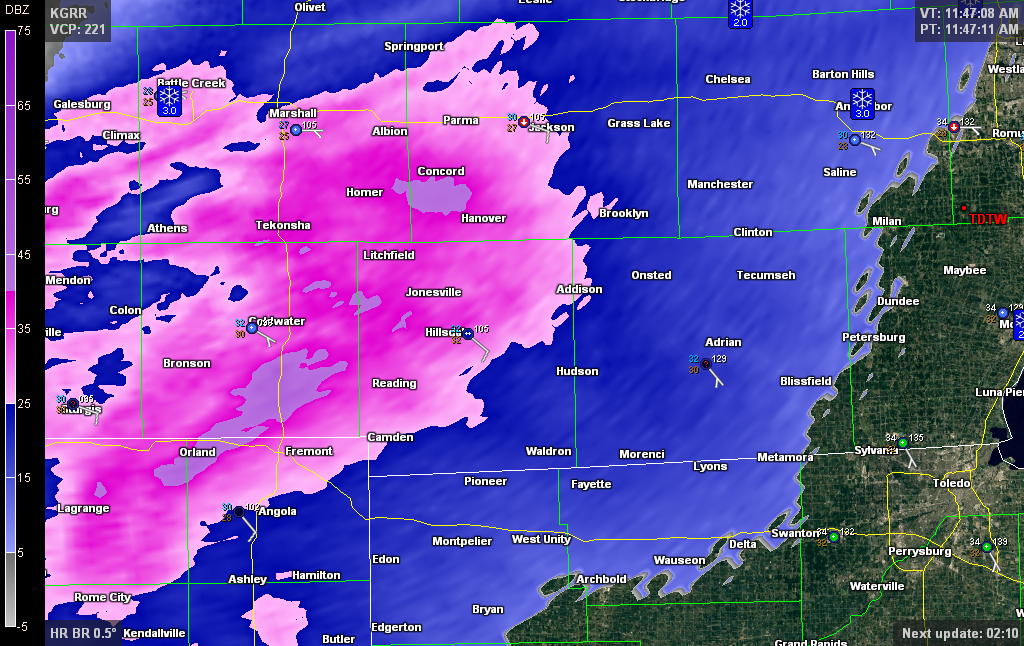
winter-storm-1122012_924am But that has changed with the arrival of this latest winter storm, which I am live-streaming on iMap even as I write. Here’s what it looks like on the radar as of around 9:20 a.m. (Click on the image to enlarge it.) A little farther down the page is a corresponding view from my balcony here in Caledonia, Michigan. Let’s put it this way: it’s not very pleasant outside.

The Grand Rapids weather office has this to say:

...WINTER WEATHER ADVISORY REMAINS IN EFFECT UNTIL 7 PM EST THIS
EVENING...

HAZARDOUS WEATHER...

 * SNOW WILL CONTINUE TO FALL ACROSS THE AREA INTO THIS MORNING
   BEFORE TAPERING OFF. SOME LOCAL POCKETS OF HEAVIER SNOW WILL BE
   POSSIBLE AT TIMES.

 * STORM TOTAL SNOW ACCUMULATIONS OF 3 TO 6 INCHES ARE EXPECTED
   THROUGH 7 PM FRIDAY EVENING...WITH LOCALLY HIGHER AMOUNTS
   POSSIBLE.

 * SOME WIND GUSTS OF UP TO 30 MPH WILL CAUSE SOME BLOWING AND
   DRIFTING SNOW LATER TODAY.

The updated aviation forecast includes this addendum:

AREAS IN THE WARNING WILL SEE 5 TO 8 INCHES WITH SOME AMOUNTS UP TO 10
INCHES POSSIBLE.

Latest station ob at GRR shows a temperature of 27 degrees. That’s not at all horrible for this time of year in Michigan. What we’re getting is actually standard fare. But that’s not to make winter-storm-1122012 light of it. Conditions certainly aren’t balmy, and a 20-knot northwest wind doesn’t help. This is a great day to be inside. It’s times like now when the benefits of working at home become strikingly apparent. No scraping ice off the windshield of my car. No driving down icy roads. Just a manuscript to edit while catching glimpses of the birds swarming the feeder against a backdrop of windblown snow.

Life’s good things aren’t necessarily pricey. I’m content with a cuppa joe, a warm apartment, my work in front of me, and a pretty landscape outside the window with the snow piling up. From the looks of it, we’ve got around four inches right now. Bring on the rest of it. I’m not going anywhere.

Tagged with:
Jan 02

With the arrival of the new year, Winter 2012 appears to finally be kicking into gear here in West Michigan. I’m ready for it. We got off light in December, with little in the way of snowfall and much in the way of unseasonably warm temperatures. On New Year’s Eve, temps scraped above 40 degrees. In that respect, this New Year has been very similar to the last one, though not quite as warm.

snow The mercury started dropping yesterday afternoon as the wrap-around from a departing low ushered in colder air, and with it, the first significant snowfall of the season. Here’s what the L2 radar looked like at about 1:00 p.m. yesterday as the snow was getting started. Possible blizzard conditions were in the GRR forecast discussion at that point, but the winds never intensified to that level. Station obs currently show northwest surface winds up to 20 knots through West Michigan, and just up the road at the airport the temperature is 25 degrees. That sounds like winter to me.

first-snow And the snow that is piled on top of my balustrade and covering the cars out in the parking lot looks like winter. Here’s a view of the bird feeding station out on my balcony to give you an idea of how much snow has stuck since yesterday. Looks to be about four inches. More may visit me yet here in Caledonia, but right now we appear to be situated between bands of the heavy lake effect stuff, with the most intense band streaming south-southeast from along the lakeshore by Muskegon and Grand Haven toward Kalamazoo and Centreville.

I see that a few storm chasers are out for a romp. Enjoy yourselves, lads. Me, I’m recovering from a sprained ankle and my car is in the shop, so I’m not going anywhere. Today is a day to ice my ankle, kick back with a big mug of Lapsang Souchong tea, watch the finches frolic at the feeder, work on an editing project, and let the icy winds blow.

Happy New Year, everyone!

Tagged with:
Dec 15

June 17, 2010. If you were in Minnesota on that date, I need say no more. Regretfully, I was not there. But Adam Lucio was, and in his new DVD chronicling his chases from 2008 till today, Adam’s Minnesota chase–which rewarded him with some of the most visually stunning tornadoes of circum 2010–is just one in a list of potent tornado events captured on video.

No, it’s not the next best thing to being there in Minnesota–how could it be? What it is, is great footage of some spectacular storms, the kind of video that makes me wish like anything that I had been there and glad that Adam has done such a good job of showing me what I missed.

If for no other reason than the 2010 Minnesota outbreak, Adam’s DVD is a viewing windfall for storm chasers and weather junkies. However, June 17 is just one of a number of memorable chases that appear in The Noob. More recent footage from 2011 includes the dusty EF-3 Litchfield, Illinois, cone of April 19; a turbulent EF-4 wedge from the historic April 27 Super Outbreak; and the violent Oklahoma storms of May 24.

The Noob also whisks me down Memory Lane to May 22, 2010, in South Dakota, an unforgettable day for those of us who chased the northern plains. And heading back even further, Adam shares some visceral footage from 2008 of a large tornado crossing I-57 south of Chicago, his hometown.

At nearly two hours in length, Adam’s DVD covers a lot of material, and I’m not going to attempt a blow-by-blow analysis of it all. I’m just going to comment on a few highlights and let you discover the rest for yourself when you buy the DVD. Which you should do. You’ll congratulate yourself on your purchase every time you watch it.

I’ve already mentioned the Minnesota outbreak of June 17, 2010. This is the one section of the DVD where I took notes, because the storm was simply incredible. The video first shows an initial elephant trunk near Kiester. It’s followed by another much larger tornado, and from here the drama rapidly ramps up. I’ve heard some guys describe this date as their best chase ever, and I can see why: there’s a lot going on with both the tornadoes and the surrounding sky.

As the second, dark wedge does a multi-vortex dance on the other side of a distant woodlot, a new circulation rapidly develops in the foreground. There appears to be no handoff of energy from one circulation to the other at this point; for a while, presumably, two distinct, large tornadoes coexist in close proximity to each other. Eventually, however, we’re left with just one large, white cone surrounded by a huge, rapidly revolving collar cloud. The effect, already spectacular, becomes even moreso as the tornado moves toward Conger and then onward toward Albert Lea. It is a monstrous, long-track tornado that displays every shape and behavior in the book.

What at times captivated me as much as the tornado was the behavior of the clouds in the foreground. There’s at least one instance where you can see clear signs of anti-cyclonic rotation, both on a broader scale and in smaller swirls of cloud. It’s amazing to watch. And so is the horizontal vortex that passes overhead. The 1 km helicity near this storm had to have been just plain crazy.

Moving on, the Alabama footage is engaging not so much from a visual as a historical standpoint. Don’t misunderstand me, it’s good, entertaining viewing; it’s just nothing like the Minnesota section. What makes it remarkable is the date: April 27, the day of the 2011 Super Outbreak. Not since the infamous 1974 Super Outbreak have so many powerful tornadoes wrought such havoc in a single day. For that reason, this section of The Noob may be of historic interest in the future.

The May 22, 2011, South Dakota footage captures another spectacular, beautifully structured storm. What sets it apart, however, is the insanity of that a number of chasers experienced when the road they chose for an escape route dead-ended in a farmer’s wheat field. Adam was among them, along with his chase partners, Ben Holcomb and Danny Neal. With multiple tornadoes spinning up and advancing toward them, the chasers took the only evasive action they had left by bailing south into the field, where ponding eventually cut them off. “Game over,” as Adam put it. From that point, all they could do was hunker down and brace themselves until … well, you’ll just have to see for yourself what happened. Ben Holcomb captured the intensity of that part of the chase on camera, and Adam has included Ben’s video as part of the South Dakota section.

I might add, my buddies and I were in that same field just a stone’s throw from Adam’s vehicle, and I remember well how it was that day. But some of the footage here reveals things even I didn’t see, and viewing it makes me realize how truly blessed all of us were to have escaped without injury.

I could continue on, but you get the idea. The Noob is a great storm chasing DVD that delivers a huge amount of bang for your 14-and-99/100 bucks.

Adam is a passionate and capable chaser who takes every opportunity available to him to go where the storms will be. The title of his new DVD reflects to me both humor and humility, winsome qualities in any person.

The Noob is raw chasing. Adam clearly invested time and care in editing his material, and he offers a few nice editorial touches (such as Ben Holcomb’s embedded footage during part of the hair-raising South Dakota field escapade). For the most part, however, the DVD doesn’t get too fancy. In my book, that’s a plus. The occasional splashes of background music are conservatively used, not overdone, and hence a welcome addition rather than a subtraction from the focus of this video, which is tornadoes and the experience of chasing them.
.

Critique

Is there room for improvement? Sure. Much of the video footage is hand-held, which makes for slightly to drastically shaky viewing. Of course, this is real-life chasing–not a professional film crew, just one guy with a camera coping with constantly changing conditions as he pursues the most violent and volatile weather phenomenon on the planet. Some of the storms were clearly moving fast, and Adam didn’t have time to park his vehicle, set up his tripod, toss out a lawn chair, and sip his favorite beverage, iced tea, while casually filming. I noticed that he made better use of his tripod with slower moving storms. In any event, I’m pretty sure he has already been considering how he might get more stable shots next season.

My second comment: There were times when I wanted to see a continuing view of a tornado’s interaction with the ground, not the sky. In the Minnesota footage, a large wedge barely misses two farms, appearing to barely graze behind them. Yet the camera drifts away from the drama on the ground–it had to have been terrifyingly dramatic for the people living at those farms–to the cloud base, back and forth. There’s enough ground footage to give a good feel for what’s happening; still, I want the focus to remain on the lower part of the funnel as it sweeps past past human habitations, so I can dwell on the story unfolding there at the surface.

With those two critiques out of the way, the only question left is, do I recommend this DVD?

Are you kidding? Absolutely! Yes. Buy it. Watch it once, watch it again, watch it multiple times. This is killer stuff.
.

Purchasing Information

The Noob is 1 hour, 57 minutes long. Purchase price is $14.99 ($17.99 international). For more information and to place your order, visit Adam’s site.

Tagged with:
Dec 01

Today is the first day of meteorological winter. Since my post on this date last year explains why, from a weatherly perspective, winter begins on December 1 instead of December 22, there’s no need for me to re-pave that same road here.

However, the weather today is quite different from what it was a year ago. Back then, we were getting a pretty good dusting of lake effect snow, and I included a radar capture in that day’s post to show what we could expect for the next four months. In contrast, today has dawned clear-skied, and this bright sun streaming through the sliding glass door directly onto my face is forcing me to squint with my left eye and prompting me to fetch my broad-brimmed Tilley hat directly after I dot this sentence.

There, hat installed. Much better. Now, what was I saying? Oh, yeah … unlike last year’s snowy opener here in West Michigan, this winter is stepping in with a smile. But that signifieth nothing. Two days ago, on November 29, the state got its first taste of accumulation in a belt that slanted, roughly, from Coldwater up toward Saginaw.

Here in my little town, what was initially forecast to be at least an inch of snow turned out to be just an errant flake or two. The payload didn’t miss us by much, though; just a few miles to the east, the snow came down. Last night, driving home from a practice session with my sax in Clarksville, I noticed that the fields were covered. The satellite photo to your left shows what the actual accumulation looks like from above. (Thanks to my friend Mike Kovalchick for initially posting this image in Facebook.)

Cold temperatures are becoming the norm. From here on, the forties will be a high, and anything in the fifties, a gift. We’re in that transition zone between rain and snow, with snow becoming the dominant form of precipitation. More of it is in the forecast for this week, and I don’t doubt that by the time the winter solstice arrives on December 22, meteorological winter will already have settled in with a smug grin on its face.

Today, though, the sun is shining, and while this isn’t exactly T-shirt weather, I’ll take it. Time to sign off and get the rest of the day rolling.

——————————

PS  You might also enjoy reading my explanation of the meteorological seasons in  “Winter Comes Knocking,” posted yesterday in my new blog, Fox’s World.

Tagged with:
Nov 25

It’s the day after Thanksgiving, and weatherwise, all I can say about the storm system I wrote about a couple days ago is, eh. Looks like a yawn to me. Heck, it’s November. Not much more to comment about there.

I’m gazing out the window at a gorgeous afternoon here in Caledonia, and in a couple minutes, I’m going to step out to enjoy it. Looks like this will be my last opportunity for a while, maybe quite a while. Tomorrow the rain sets in, and Sunday the temperatures drop. Snow is entering the forecast for this coming week. But today at least is golden.

Ben Holcomb is in town, so around 5:30 I’m heading downtown to get with him, Bill, Tom, and whoever else of the Michigan Storm Chasers Contingent decides to show up at The Tavern on the Square. After that, the guys are going to the Griffins game, but I’ll be passing on that.

Musically, I’ve begun transcribing a Richie Cole solo on the Charlie Parker tune “Confirmation.” For some reason, lately I’ve gotten it into my head that I’m going to nail down this tune once and for all, definitively, and there’s no better way to facilitate the process than transcribing the solo of someone who knows it inside-out. Cole is a monster bebop alto player who burns through Bird changes using the full range of his horn, from low Bb up to an altissimo note that I have yet to identify, a note so high it sounds like a mosquito singing in falsetto.

So there you have it. While the rest of America is bashing its brains out at the Black Friday sales, I’ll be enjoying the sunshine and congratulating myself for staying as far away from the stores as possible. Cheerio!

Tagged with:
Nov 23

500mbecmwf-gfs This bright morning sun streaming through the sliding door of my balcony is blinding. At quarter-to-ten on the day before Thanksgiving, it shines low over the southeast horizon directly onto my face, forcing me to write with my left eye shut. That is not an altogether satisfying modus operandi, but I don’t feel like closing the blinds or wearing a … well, what the hell, why not wear a hat? I’ve just put on my trusty Tilley. Problem solved, though Lisa will probably look at me oddly when she steps into the room.

slp_ecmwf-gfs Here in West Michigan, we’re moving into high pressure and a warming trend through the holiday. But “warm” is a relative word which in this case means not terribly cold–rather nice, really–but don’t plan on wearing a T-shirt.

Hundreds of miles to my south, though, warm means warm. Warm enough to get the job done for convective weather. From now through April, Dixie Alley once again becomes the star of the show. The trough moving in for the weekend offers a good example of why.

It’s a deep trough, and a surface low up in the Great Lakes looks to wick up enough moisture into the Southeast to stoke the storm machine. I’ve included a couple of the latest 00Z Euro/GFS comparisons plus Euro 850 mb relative humidity to give you a sense of what’s shaping up for 96 hours 850rh_ecmwf (click on images to enlarge them). The GFS is predictably faster than the ECMWF, but both are pointing to the same overall scenario, with the trough eventually pinching off into a closed low.

Cloud cover presently looks like it will be rampant, minimizing instability. Still, given some ripping bulk shear, this system is something to keep an eye on as it evolves, particularly if you live in Dixie Alley.

That’s all for now. The sun has moved and is no longer blinding me. Time to get on with the rest of this day. May you and yours enjoy a happy and blessed Thanksgiving!

Tagged with:
Oct 31

Snowfalls that paralyzed entire regions. A record-breaking tornado season. An unrelenting summer heat dome that baked much of the nation for weeks on end, coupled with disastrous drought conditions in the southwest. That has been our weather year 2011 to date, courtesy of its La Nina, which commenced in June of 2010 and ended last April.

In another month, we can kiss the whole mess good-bye and good riddance. It’s not the kind of year a body wants to see repeated anytime soon. But with yet another La Nina winter shaping up, chances are that’s what we’ve got in store. In its typical terse language, NOAA’s Enso Cycle: Recent Evolution, Current Status and Predictions sums things up thus:

• La Niña conditions are present across the equatorial Pacific.
• Sea surface temperatures (SST) were at least -0.5°C below average across the central and eastern equatorial Pacific Ocean.
• Atmospheric circulation anomalies are consistent with La Niña.
• La Niña is expected to strengthen and continue through the Northern Hemisphere winter 2011-12.

.

The United States needs another La Nina right now the way a sick drunk needs another bottle of Boone’s Farm. We’re still reeling from the previous episode, and now here comes round two. While no one can predict with certainty how it’s going to play out, the generalities are these:

• The north-central CONUS and portions of the Great Lakes down through the Ohio Valley are likely to see colder and wetter conditions.

• The south and southwest can expect warmer and drier weather–not welcome news to those living in West Texas and other places that have already endured week after rainless week this summer.

Also, while you won’t find it stated in ENSO literature, statistically, tornado outbreaks east of the Mississippi have tended to occur during La Nina springs. Whether a correlation does in fact exist, circum 2011 certainly seems to corroborate the notion.

Let’s hope that this new player turns out to be La Nina Lite in terms of its impact. I can’t imagine that it will be as nasty as its predecessor, but anything is possible. We’re only getting started, and already the Northeast has gotten clobbered with a record-setting winter storm. The plus side is, parts of the drought-stricken West have received a rare and welcome snowfall. That’s good, and I hope they get more precipitation, lots more, be it snow or rain.

For those of you who pray, this new La Nina is something to enter in your prayer list and keep an eye on. This winter could be another bad one, and storm chasers may once again have their hands full next spring. Let’s hope that Dixie Alley experiences nothing like what it did this year. We’ll find out five or six months from now.

Tagged with: