Not Enough Tornadoes

Here is a conversation you’re unlikely to overhear at a restaurant:

“I’m going to move.”

“Why? Vermont is such a beautiful state.”

“Not enough tornadoes. I’m thinking maybe Hays, Kansas.”

Nope, you just won’t hear most people talk that way. A generous supply of tornadoes simply isn’t a big selling point for the average homebuyer. On the other hand, if you’re a storm chaser, it could be a compelling reason to sell your chalet near Boise, Idaho, and move to Wakeeney.

I just finished perusing a thread on Stormtrack where chasers were considering this question. The earnestness of the discussion struck my funny bone. I mean, the concept of moving somewhere because it has lots of tornadoes is utterly foreign to most Americans, who are unmotivated by tornado accessibility. In fact, I’d venture to say that many people would consider the idea downright weird. (“You’re moving where because of what?“)

Chasers, however, seem to see nothing unusual about factoring in tornado statistics as a motivating factor in home buying.  It’s weird. And the reason I laugh is because I can relate. I’m not ready to pack up my bags and move from Michigan, because busted economy or not, I love this state. But if I ever do move, it won’t be to California because of the ocean, or Florida because of the warm weather, or Vermont because of its rural New England beauty. It’ll be to the Great Plains because of the dryline.

Realistically, I can’t see it happening anytime soon. I might be able to find a location with a decent brewpub, such as Wichita, but where would I go to hear some decent live jazz, let alone play it? That side of me is as important as the storm chaser in me. Maybe the two can be reconciled. To be honest, I’m not too worried about it. It’s just fun to think about, and certainly worth laughing about.

I do kinda wonder, though, what it would cost to build an underground bunker as a vacation home in the Texas panhandle.
Why I Hate Snow

I really don’t hate snow. Loathe it, yes.  Wish it would rot in hell like the fourfold abomination it is, certainly. But hate? Come, now, what is there to hate about snow, other than the fact that it’s cold, wet, miserable, a road hazard, and an overall royal pain in the keister?

Hmmm…judging from my attitude, we’re definitely moving on toward February, when attitudes toward snow here in Michigan tend to shift from  aesthetic appreciation to pragmatism. It takes both an artist and a pragmatist to live in this state year-round.

Okay, I confess: I really don’t hate snow. I just like to gripe about it, that’s all. Looking outside today at the large, white flakes drifting out of the late January sky, I don’t mind admitting that the stuff is downright pretty, and winter wouldn’t be winter without it. From a practical standpoint, we need all the snow we can get, lots and lots of it, to bring the Great Lakes levels back up to snuff from their alarmingly low levels. And just between you and me, speaking as an aesthete, I’d miss snow if we didn’t have it. It’s part of Michigan, and I sure do love this state.

So come on, snow! Hit me with your best shot and see if I don’t come up smiling and asking for more.

I probably won’t. But I’m still glad it’s snowing. Hurray for snow.

I hope it goes away soon, though.

Lake Michigan Ice Formations

Ice Formations Along the Coastline

Ice Formations Along the Coastline

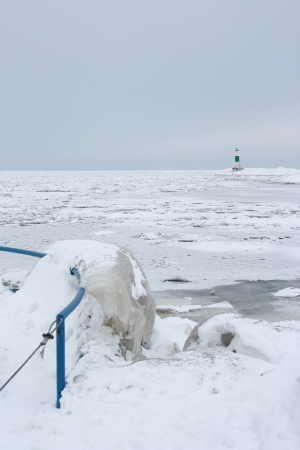
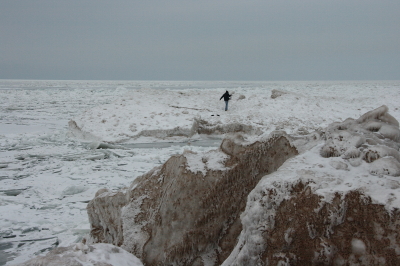
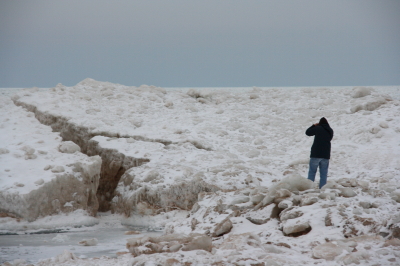
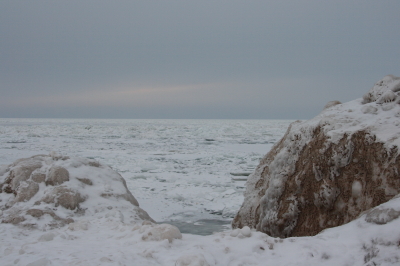
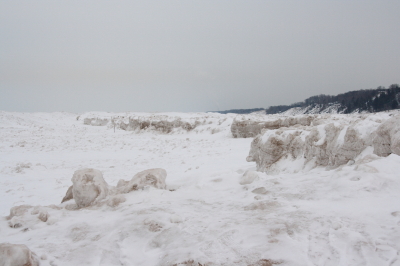
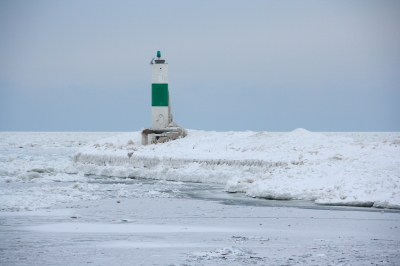
These past few days have been busy ones, but yesterday I took time to head out to Lake Michigan with my friend and fellow storm chaser Kurt Hulst to photograph the ice formations. They’re spectacular. If you’ve never heard of them, let alone seen them, I can assure you that you’re missing something. Ice forms all along the Great Lakes shores, but I have a hunch that the formations along the west coast of Lake Michigan are particularly scenic for the same reason that the sand dunes are: they’re a product of the prevailing winds that blow across the lake, whipping waves and spray across vast stretches to create, layer by layer, fantastic frozen sculptures of  ice, sand, and snow. A more austere landscape you can’t hope to find this side of the Arctic Circle–otherworldly, almost alien in its frigid beauty.

I’m not going to write much about the ice formations here because I want to save my creative juices for my next installment on the WaterlandLiving blog this Friday. But I am going to share a few images to give you a taste of one of the upsides of winter in Michigan. And be sure to check out Kurt’s site, too; he’s a great photographer, and I’m sure he’ll have some very cool (pun totally intended) shots of his own on display.

Lighthouse

Lighthouse

Lighthouse, Holland State Park

Lighthouse, Holland State Park

Kurt Out On the Ice

Kurt Out On the Ice

Crack in the Ice

Crack in the Ice

Lake Ice

Lake Ice

Significant Tornadoes, by Tom Grazulis

Man, what a busy day it has been! It’s amazing how occupied I can be without hardly budging from my La-Z-Boy couch. But then, my couch is as much my office as it is a piece of living room furniture. More, for that matter. With my computer keyboard in my lap and my screen parked on a stool to my left, here is where I earn most of my living as a freelance writer.

I’ve spent most of my day hammering out copy for a couple clients. I just finished a project a short while ago. I still have a chewy assignment that I haven’t even begun yet, but that can wait till tomorrow. This weekend will be a busy one, but in this tough economy, it’s great to have the work, and I can say in all honesty and with much gratitude that I have some truly wonderful clients. I am richly blessed, not just with consistent work doing what I love to do, but also with good relationships with people who, besides clients, are friends and brothers in Christ.

But the working day for me is over, and I am now turning my focus to other things. In my spare time, I’m acquainting myself with cPanel and–now that I can actually access the code–revamping the metatags for my Stormhorn.com website. The switchover from GoDaddy to Tablox as a web host, and from b2evolution to WordPress for blog software, has freed me up to take a more hands-on approach to my website and blog, and the next phase of the learning curve for this non-techie has begun.

And that’s just what’s happening on the sidelines. Today I went to the Hastings Public Library and picked up the copy I had requested of Significant Tornadoes, 1680-1981, by Tom Grazulis. It’s a formidable volume–the authoritative, exhaustive record of virtually every significant tornado in United States history that can be traced. Grazulis’s work is nothing short of remarkable, a real labor of love, and the result is a book whose poundage alone is enough to impress. This is one you want to load on a pack mule if you plan on taking it anywhere, but the information it contains is priceless.

And I need that information because I’ve been working on a book on the 1965 Palm Sunday tornadoes. I’ll tell you more about that some other time, but if you’ve followed this blog for a while, then you know that the Palm Sunday tornado outbreak has been a recurrent theme. There is a reason for that, and the time has finally arrived for me to do something about it. I wrote the prologue a couple months ago, and now, after a bit of a delay, I’ve written about two-thirds of the first chapter. I expect to have it completed within the week, and then it’s on to the next phase, which will consist of a fair amount of research.

And that’s enough on that topic. I’ve done enough writing for the day, and my bowl of cottage cheese and mug of abbey ale are demanding my attention.

A Cold Day in Caledonia, or, The Irony of Virtual Storm Chasing in January

Whoo-WEEE, is it cold outside! Nine degrees, the KGRR METAR says, but I think the gents at our local WFO are being optimistic. It”s cold enough to make a snowman ask for a down jacket. Cold enough to crystallize a penguin”s nuts. (Did I just say that?) Cold enough to make a summer home in Antarctica sound good. Cold enough to…okay, okay, I”ll stop. Put down that gun. But we are talking one significantly frosty day here in beautiful Caledonia, Michigan, folks, a real booger-freezer if ever there was one.

Tomorrow the temperature is progged to rocket back up to a balmy ten degrees. That”s an improvement, though not one that inclines me to slip on a T-shirt. Saturday, however, the warming trend kicks in full force, and we”ll all be sweating to a downright tropical nineteen degrees. So you can see that there”s light at the end of the tunnel.

I’m going out with my camera in a bit to capture some shots for Dave VanderVeen”s WaterlandLiving blog. I”m not sure what there is to see in weather like this, or how brave I feel about venturing very far out in it. I do have one, um, cool idea, though, so I guess we’ll see. It may get scuttled by lake effect snow. We”re supposed to get a ton of that. But right now the sun is shining. That”s today for you: sunshine, snow, sunshine, snow, back and forth, sloshing around in an atmosphere that feels like the last Fahrenheit has been sucked right out of it. And now, as I look out the window, I see that the wind is starting to kick in. How much more interesting can things get?

What”s particularly ironic is, I”m currently working through Chase Case #8 on Stormtrack, and while all of the other participants are playing to the south on this particular virtual synoptic setup, I”m sitting right here in Caledonia under a moderate risk, waiting for either a model update or for tornadic thunderstorms to fire. Sixties dewpoints, temps in the seventies, nice backing winds…mmmm-hmmm, right. If there”s a solitary dewpoint out there right now, it”s freezing its little buns off.

But I can dream. In fact, right about now, that”s my only option as a storm chaser.

Just wait till May, though. Just wait till May.

Just Another Weekend: A Former Ohioan Remembers the Palm Sunday Tornadoes

I recently received a comment from one of my readers in response to my post on some rare photos of the 1965 Palm Sunday Tornadoes. Jim Stewart resides in Atlanta, Georgia, where he is the morning host and operations manager for WMVV 90.7 FM NewLife Radio. On the day of the tornadoes, though, Jim was a nine-year-old boy living near Lima, Ohio.

In response to his comment on my blog, I invited Jim to share his experience of the storms. He has done so, and to a degree that goes well beyond a mere comment. Jim took time and thought, and has supplied a fascinating, well-written, very personal remembrance of that fateful evening.

No need for me to say more. It”s time for Jim to tell his story, which he calls…

Just Another Weekend

(C) 2009, Jim Stewart

When you are young, time passes slowly, and sometimes it’s a monotonous routine. Monday moves into Tuesday, the week passes, and another ordinary weekend comes and goes. But then there are the times and events that bring change, shaping our lives, our thinking, and our emotions. Such was the Palm Sunday weekend of April 1965.

I grew up as an only child in and near Lima in Allen County, Ohio. Thunderstorms, wind, blizzards, droughts, and the like were commonplace in the Midwest. But what was brewing on that fateful weekend was different.

At nine years of age I was in the fourth grade at Shawnee Elementary School, a rather shy kid without many friends. On Friday of that fateful weekend I became progressively ill in class. I stayed for the full day, but was immediately ushered to bed as soon as I got home when my mother found I had a high fever. Our home at the time was located on Ft. Amanda Road near the intersection with Shawnee Road in the Shawnee Township area, about four miles southwest of Lima.

On Saturday morning, I was taken to the doctor to be checked out. The weather was partly sunny, and cool enough that a jacket was necessary. After being treated for the virus, apparently contracted at school, I spent the rest of the day convalescing on the living room couch. That afternoon my father and I watched a Reds game live from Cincinnati that was played under mostly sunny skies. Everyone in the Great Lakes area was totally oblivious to the terror that would move though the region in just over twenty-four hours.

Sunday dawned in a very strange way, at least to me as a young child, as a heavy thunderstorm raged outside with all the ingredients you would expect in the afternoon or evening of a spring day. It was actually a strong warm front pushing its way northward, ushering in very warm, moist, and unstable air to the region along with an unusually strong jet stream high above, a harbinger of the main event now just a few hours away.

The remainder of that morning is rather sketchy. My parents went to church, and I was left at home with my Great, Great Aunt May, who was living with us at the time. I remember that the weather cleared, and by afternoon the sun was shining. My father and I again watched television, the Master’s Golf Tournament from Augusta, Georgia, with bright sunlight streaming through the western windows of the living room. I never ventured outside that afternoon due to my illness, but I do know it had warmed considerably from the previous day.

In the early evening I was feeling better. My parents went to evening church services and my Aunt May looked after me as we continued to watch television. At the time there were no severe weather watches or warnings broadcast, although tornadoes were already occurring to our far west and northwest.

We were watching local channel 35 WIMA-TV as the Wonderful World of Disney came on at 7:30 P.M. and darkness fell. As the program continued, I noticed a strobe-like flashing in the southwestern sky. The flashing was nearly constant and becoming brighter as time passed. Aunt May, who was setting next to a window, became very nervous as she moved to another chair in the interior of the room for fear that the lightning was going to strike her. Strangely, the thunder had yet to be heard, indicating that we were observing a very strong electrical storm still a distance away but moving our way.

By 8:30 P.M. the storm was more to the west-northwest still putting out a large lightning display, but not quite as intense as earlier. There were still no severe weather statements on local television.

nJust before 9:00 P.M. my parents returned home from church in time to watch Bonanza. They did not say much about the approaching storm other than that there was a lot of lightning going on in the northwest. Soon after Bonanza began WIMA-TV finally broadcast a vague weather alert from the weather service in Toledo that called for “…severe thunderstorms with a tornado or two till 10:00 P.M.” No references were given to any specific counties as tornadoes raged in several locations at that moment; unfortunately this lack of warning likely caused many fatalities.

Around 9:15 P.M. the storm suddenly seemed to explode just to our north in a way I had never seen before nor have seen since as vivid lightning of green, pink, white, orange, and blue lit the sky. I did not realize that the blue flashes were likely not lightning, but rather, power line flashes and transformer explosions as the tornado bisected Allen County just eight miles north of our home. Even the reception from WIMA-TV, located about five miles north-northeast of us, became so bad that it was unwatchable as the storm passed by. We had to switch to another station from Dayton, some sixty-five miles to the south, using our VHF roof antenna. During the time we watched this station, it came in unusually strong, as if it was local. There were some very strange atmospheric phenomenons transpiring for these few moments as the storm traversed the area.

The storm began to move out to the northeast as strong west southwest winds began to buffet our home. The cold front that generated the storm had arrived ending the severe storm threat. I went to bed having no idea of the destruction that had been and was still taking place all around our region. What is now rated as the third largest tornado outbreak in history had left in its wake over 250 dead, thousands injured, and an untold number of homes, businesses, and churches reduced to rubble. The wind howled most of the night as I lay in my comfortable bed, but we didn’t even lose power. We were blessed.

Monday morning dawned bright and sunny. My mother was listening to a local radio station as it ran continuous reports about the tornado that ripped Allen County in half the previous evening. The radio station even had a news correspondent in an airplane reporting live on the damage as he flew over the storm’s path, a rather innovative feat for the time. Feeling better as far as my illness was concerned, I stayed home from school just to be sure I was totally over the virus, but I was feeling rather strange about this unexpected event that was unknowingly affecting my life.

Many stories began to surface after the tornado blew through. My father, a pipe fitter and welder, was working in Toledo at the time and made an early Monday morning drive to work each week. On the morning of April 12 he saw damage from the storm as he drove up Interstate 75 between Beaverdam and Bluffton, with overturned trucks and cars as well as other debris on the highway for nearly a mile. The husband of some relatives who lived just east of Lima observed the storm’s passage from a patio door as the rest of the family huddled in their basement. He said as soon as the storm passed to his northeast the stars came out and he knew it was all over, everything would be fine.

It appears this particular supercell of the 1965 Palm Sunday Outbreak, which generated the Allen County tornado, originated more than two hours earlier southeast of Lafayette, Indiana, and moved, under the influence of unusually strong upper level jet stream wind, east-northeast at speeds of over sixty miles per hour. It appeared to be what is now termed a cyclical supercell that generated many separate, strong, multi-vortex tornadoes. Its nearly 275-mile path ended near Cleveland, Ohio. Across Indiana it leveled the towns of Russiaville, Alto, southern sections of Kokomo, Greentown, southern sections of Marion, and areas near Berne before crossing into Ohio. Once Ohio was the target, the twister passed just north of Rockford, south of Van Wert, and just south of Delphos as it entered Allen County. At that point the storm reorganized, producing a new F-4 vortex just northwest of Elida. This corresponded to the explosive increase in lightning intensity we observed as the storm was passing to our north. Moving along at nearly sixty miles per hour, the tornado destroyed everything in its path, with the little village of Cairo its next pending victim. Mercifully, the tornado lifted just west of the town and set down again just to the northeast, sparing the community major damage.

Relentlessly, the funnel pressed on toward Interstate 75. A railroad parallels the highway between Beaverdam and Bluffton with a deep ditch between the road and tracks. It appears this ditch caught or disrupted the tornado’s circulation enough to divert it to the northeast, where it wreaked havoc with any vehicle on the highway for about a mile. Finally it jumped the road and, reassuming its east-northeast path, moved out of the county.

I observed firsthand the damage two weeks later, when the public was finally allowed into the storm track area. Our family took a Sunday drive following the damage path from west to east. I saw things that were both frightening and fascinating. Many homes were totally destroyed; some still had walls but no roof; vehicles of all types lay scattered across fields, along with bits and pieces of people’s lives. High-voltage transmission towers lay twisted flat on the ground, and an electrical substation was totally wiped out; these were likely the sources of the blue flashes I saw to our north the night of the tornadoes.

I was most impressed with the foundation of an old farm house, wiped clean by the wind, with an upright piano still standing in the open air. Once part of a family fixture in a living room, now the piano was the only a remnant of the home that had once stood there.

It is interesting how a single event can be pivotal in our lives even at a young age. So it was for me with the Palm Sunday Outbreak of 1965. At first my fear of thunderstorms increased. Every year I felt a dread of April and springtime; I imagined that each storm that came up could be like that evening, except this time the funnel would get us. Time passed, and my fear evolved into a great respect for weather in general and deep interest in severe thunderstorms and hurricanes in particular—how and why they form. Still, after nearly forty-four years, there are times when I think back to that weekend and recall the feelings and emotions, remembering those who were adversely affected by the events of that weekend in April, 1965.

The All-Year Tornado Season of Dixie Alley

While the well-known section of the Great Plains known as Tornado Alley has slid into its off season, another, lesser-known part of the country is poised for action. Extending from Arkansas and Louisiana east through Kentucky, Mississippi, Alabama, and western Georgia, the Dixie Alley is rapidly approaching its prime season. For that matter, while March, April, and May are the three most active tornado months in the Southeast, with April being the peak, the tornado machine never really shuts down in Dixie Alley the way it does in the Great Plains.

In fact, after checking out a NOAA slide presentation titled “A Comparison of Tornado Statistics from Tornado Alley and Dixie Alley” by Alan Gerard, John Gagan, and John Gordon, I”m thinking that I need to give much more serious consideration to chasing in Dixie Alley.

There are, of course, a few obvious drawbacks to that idea. The seasonal max offers less sunlight to chase by. The extensive forests suggest to me that visibility is far more limited than in the wide-open expanses of the Plains. And tornadoes that occur in Dixie Alley are more likely to be night-time events than those that occur in Tornado Alley. Bottom line: there”s a big difference between available storms and chaseable storms. That”s the trade-off, and in many cases it may be the deal-breaker.

This being understood, the storms start to increase in February and could provide some opportunities which I shouldn”t dismiss as readily as I have in the past. This is something to discuss with my buddy Bill. I know he”s as hungry for storms as I am, and this could be a remedy.

December 26 and 27 Severe Weather Outbreak

Sixty-degree temperatures and fifty-five-degree dewpoints: can this possibly be Michigan on December 27?

Yup. And that”s not all, folks. I awoke in the middle of last night to a wicked clap of thunder–interestingly, while dreaming I was out chasing storms. The dream I attribute to an acute case of supercell deficiency syndrome, but the thunder was a product of the vigorous system that cranked springtime temps and moisture on up into the Great Lakes.

After several days of vacillating over whether or not to chase, my buddy Bill and I concluded to sit this system out. This time of year, anything that smells even remotely of convective weather is tantalizing, but realistically, anything we could get to within a reasonable day”s drive would be a linear event with embedded supercells in a low-CAPE/high helicity environment. I’ve gotten skunked by those setups enough times to not feel particularly eager about going out of my way to chase one.

Still, like I said, this is December…and the action bumped farther north than the SPC had anticipated…and there were four tornado reports near Kansas City…and…naaaah, Bill and I made the right call. I’ll wait for something a little more promising before I make the drive.

Besides, the tornado watches kept extending north, bringing the action our way as the moisture pumped into northern Illinois and Indiana along with absolutely crazy helicities. Michigan actually wound up in a slight risk area, and with storms continuing to pop up across the landscape, theoretically, there was at least the possibility that something could just sort of drop into my lap. It didn’t, and that”s what it would have taken for me to motivate myself for a chase, but then, we Michigan storm chasers live on hopes and dreams.

As I write, RUC is showing a 1 km helicity of 950 near Fort Wayne, and earlier I saw a reading of 1,050 near where I live. If there had been any CAPE worth speaking of to sustain updrafts, any storms that formed could easily have gone tornadic. But as I said, it’s December. I’m happy just to have felt some close dewpoints, and to have ventured outside without needing a jacket.

With a fairly warm rain and balmy temperatures, the snowmelt has been rapid and flooding extensive. And to make matters still more interesting, the fog generated by mild air interacting with cold snow fields has been both beautiful and treacherous. My first of a number of encounters today with flooded roads came upon me unawares; thanks to the fog, I didn’t see the water covering the pavement until it was too late for me to do anything about it except keep on going and hope I didn’t kill my engine. Thankfully, the water wasn’t deep enough to do any damage, and from that point on, I was in a state of alert.

Temps are still in the fifties, but a cooldown is on the way and snow is in the forecast. Nothing major, though. Compared to what we”ve had, the next few days look to be a cinch. I do have every confidence that winter will snap back down on us like an elastic band. But I also wonder whether the weather machine has any more convective surprises in store for us. Time to take a look at the long-range GFS and see whether another fetch of Gulf moisture might not be ramping up with more convective delights. I wouldn”t mind, not at all.

A Post-Christmas Severe Weather Outbreak? It Just Might Happen.

Now, here’s something you don”t normally expect on the day after Christmas…

Them there is dewpoints, folks–juicy, 55-degree-plus dewpoints stretching as far north as Saint Louis, Missouri, by 18z Friday, and Renselaar, Indiana, by 00z Friday night. And Saturday gets even crazier, pulling a mid-fifties fetch well into Michigan.

With wind fields and helicities every bit as wild as you’d expect for this time of year, this could be the ultimate in late-season storm chasing, or in early-season action, depending on how you do your books.

Several days ago I was just crossing my fingers. I’m still keeping them crossed, but with the WRF now chiming in to corroborate what the GFS has been consistently depicting, I think it’s time to practice saying the words, “severe weather outbreak.” Today’s SPC extended outlook agrees:

WITH A GENERAL CONSENSUS OF MODEL SOLUTIONS LEADING CREDENCE TO THE POSSIBILITY OF 60 F DEWPOINTS MAKING IT AS FAR NORTH AS THE MIDDLE MISSISSIPPI/OHIO VALLEY BY DAY 5/SATURDAY. IN ALL…CURRENT THINKING IS THAT A MULTIFACETED/ALL HAZARDS SEVERE RISK WILL MATERIALIZE ACROSS PORTIONS OF FAR EASTERN OK/OZARKS/ARKLATEX TO THE MIDDLE MISSISSIPPI VALLEY/OHIO VALLEY FOR DAY 4/FRIDAY INTO DAY 5/SATURDAY.

I’m currently considering St. Louis south toward the bootheel, possibly into Arkansas, and hoping that the next run or two nudges Friday’s setup just a shade to the east and north. Bill and I are talking about taking off around midnight Christmas night, and Kurt may join us if he is able.

At this point, I think it”s safe to say we’re in for a winter outbreak that could stretch as far north as central Illinois and Indiana. Should be interesting.

Looking for that perfect, last-minute Christmas gift for the storm chaser in your life? Consider giving a tasteful holiday package of backing winds, veering upper levels, and a little mixed layer CAPE–perfect as a stocking stuffer, and sure to be appreciated by Midwest chasers this Friday and Saturday.

Tornado Photos I Have Known and Flubbed

Even as I’m discovering the rewards of winter photography, I confess that I’m beyond eager for storm season 2009 to arrive. I expect that it will be the year when I finally–finally!–start taking some decent storm photos.

I bought my Canon Rebel XTi with Sigma 18-200mm OS glass in March of this year. Not knowing a thing about DSLR cameras, I naively figured that the automatic settings would make up for my lack of experience. As a result, I made an absolute mishmash of my chase photos. In the extremely low light of some of the storm environments I encountered out west this last May, my camera would refuse to fire at the worst possible moments. Alternatively, the flash would go off, illuminating such fascinating subjects as the rain streaks on the windshield which my auto-focus, in a display of whimsical and sadistic humor, was zeroing in on while ignoring the tornado crossing the road in front of our vehicle at close range. Here”s what I”m talkin” about…

Not exactly everything one could hope for, right?

Please don’t chide me for not spending time getting to know my camera–I thought I had done just that. But the fully manual mode, which could have saved me a lot of grief, was still a mystery to me. So was RAW, and white balance, and bracketing, and anything beyond the basic automatic settings. Nuff said. I got what I got.

Not all of it was terrible, either. If you like wall clouds, I wound up with some cool shots. And at least one tornado photo turned out well enough that you can actually see an elephant”s trunk waaaaay off in the distance, provided you squint and use your imagination.

Still, the Oberlin cone…the small tornadoes circumnavigating the backside of what I think was the Quinter meso…the Hazleton, Iowa, wedge…oh, maaan, the shots I screwed up! I see some of the beautiful images captured by other chasers on Stormtrack, and I’m filled with a mix of admiration and pure-green envy. I could”a been a contender!

But 2009–that’s when I get to redeem myself. I hope. If it”s a good year for storms, and if it’s a good year for me as far as getting to where the storms are, then I think I”ve finally got both the equipment and the basic know-how to put some decent taxidermy in my convective game room. I can”t wait to try!