Forecast Model Simulations for 1965 Palm Sunday Tornadoes: Part 2

The drive down to the WFO at State College, Pennsylvania, was well worth my while (see my previous post). Operational forecaster and research meteorologist David Beachler was a pleasure to work with–personable, patient, and eager to help me understand the exhaustive forecast simulations he had produced on the 1965 Palm Sunday Tornadoes. Having pored over the data with David, gaining his insights on its strengths and weaknesses, I am now extremely excited about what I’ve got on my hands.

David’s modeling uses the WRF-ARW 40 km. The resolution is too coarse to offer the fine details that the SPC is capable of producing, but it gives an excellent overall feel of what forecasters and storm chasers might see in the models if the Palm Sunday synoptic setup were to unfold today instead of forty-five years ago in 1965.

no images were found

There’s no way I can begin to cover all the material, which in any case I need to sift through in order to put together a reasonably concise and meaningful scenario. But I can at least give you a sample of some of the stuff I’ve got to work with. Click on the following images to enlarge them.

First, here is a hand analysis of the kind that is accessible to anyone through NOAA’s historical daily weather maps archives. Besides the surface map for April 11, 1965, you also get the previous day’s surface map, 500 mb chart, and other info. It’s what you would have encountered when you turned to the weather page in the newspaper that morning.
What you would never have seen–because parameters such as CAPE, CIN, helicity, and so on didn’t exist back then, and because even if they had existed, the forecast models which could have depicted them were still years down the road–is this map showing SBCAPE and low-level shear.

The map is for 2200Z, or 6 p.m. EST–roughly the time at which tornadoes began moving through northern Indiana.

It gets even better. Here is a model sounding for KGRR, also at 2200Z, using WRF-ARW Bufkit data. The skew-T and hodograph depict the conditions that were shaping up to produce the F4 Alpine Avenue tornado that formed
around 6:50 p.m., as well as other tornadoes in west and southwest Michigan that day. The helicity is impressive–and look at those winds! Forty knots at 850 millibars is no mere puff of air.

What really excites me is that, using RAOB’s cross-section feature, I should be able to reconstruct a vertical profile of the atmosphere for the entire outbreak area. I’m not sure how deeply I want to go with that, but I have the capacity.

Bear in mind that I’m just showing a couple of representative glimpses derived from a 00Z, day-one model initiation. In fact, David provided me with a range of initiation times that allows me to get a good sense of how the maps might have progressed from several days prior to the actual tornado outbreak.

In practical terms, the maps and model sounding data I’ve got correlate to the NAM. They’re not the NAM, but for storm chasers who typically work with the GFS, ECMWF, GEM, NAM, and RUC, what you see here is probably closest to what you’d find using the North American Mesoscale Model.

That’s all for now. This has been a time-consuming post, and at 2:30 in the afternoon, I need to pull away from it so I can bathe and eat. I didn’t arrive home until 3:00 a.m., so it’s time for this road warrior to reset his time clock and get on with the rest of life.
Forecast Model Simulations for 1965 Palm Sunday Tornadoes: Part 1

Today I’m making the trip to State College, Pennsylvania, where I’ll be overnighting and then meeting tomorrow with operational and research meteorologist David Beachler at the CCX National Weather Service office.

Earlier this year–thanks to John Laurens at KGRR, who contacted him on my behalf–David took such forecasting data as exists on the 1965 Palm Sunday Tornadoes and ran it through a computer. (That’s putting it quite simply, I’m sure.) The result is a veritable blizzard of hourly model simulations which I’m hoping to narrow down to something that can give me new insights into the second worst Great Lakes/Midwest tornado outbreak of modern times. If all goes well, one of the results well be an engaging scenario for the storm chasing community.

Of course, a project of this nature will take some refining. The first hurdle is my own ignorance as a non-meteorologist. It’s one thing for a layman like me to use forecast models in identifying target areas for storm chases; it’s another thing to understand the whys and wherefores of those models.

A second challenge is to sift through the accuracy of the data, since we’re talking about a massive amount of extrapolation from a paucity of decades-old source material; and a third is to distill the immensity of info that David has provided into a reasonably straightforward, meaningful synopsis.

What I’m hoping for, in the end, is a series of surface and upper-air charts that can answer the question, “If the same synoptic conditions that produced the Palm Sunday Tornadoes unfolded today, what might we see in the models from a few days out until the time when tornadoes started dropping?”

This project has been in the wings for a while as part of a larger project which I’m keeping mum about for now. I want to get this part taken care of first, and I’m excited that I’m finally getting to meet with David and go over the data with him, so I can better understand how to interpret it and narrow down a selection from it that will be most useful. I’m extremely appreciative of David’s work, and his willingness to help me sift through it.

Gotta go. I need to hit the road in a couple hours. Here’s hoping for good driving.

Bundling Up for a Michigan Blizzard

As I begin this post, around 5:20 p.m. EST, the KGRR metar shows a temperature of 35 degrees here in Grand Rapids, Michigan. Not far to the southwest, though, closing in on Chicago, northeast Illinois is giving reads of around 20 degrees. The backside of the low pressure system that has brought us a

wintry mix is preparing to bring considerably colder temperatures down upon us, wrapping in from the northwest and west as the low lifts up into Canada.

So far, conditions really haven’t been bad at all, certainly not as bad as the scenario the NWS has painted with a blizzard warning commencing at 1:00 p.m. But I’m sure the weather will worsen; it’s just a matter of time. The guys at the local WFO have the unenviable  task of forewarning the public of potentially lethal winter conditions without coming up looking like goobers when the blob of Jello-O they’ve got to nail to the wall doesn’t entirely cooperate. Predicting severe warm-season weather is tough enough, but forecasting winter weather is a whole different kettle of fish entirely, and my guess is, it’s a harder one to get right.

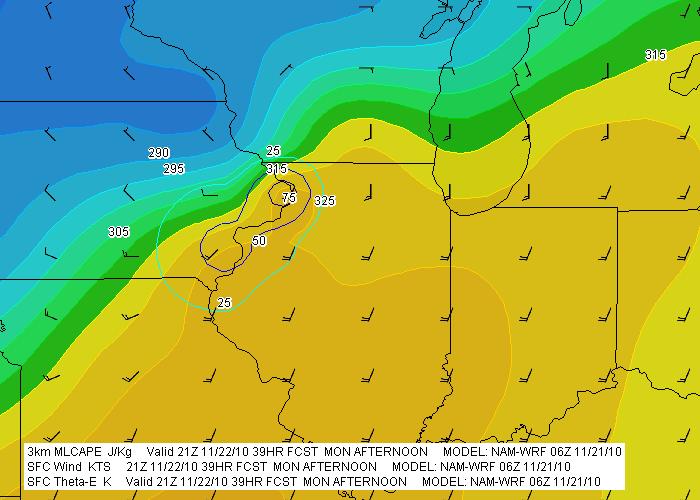
Anyway, here’s what’s presently sitting on top of us here in Michigan. The topmost image is a 2200Z map showing current pressure and wind barbs. The bottom one is a level 2 radar grab with metars. Click on the images to enlarge them. They depict conditions at the time of the evening commute, which aren’t too bad; they also indicate what’s on the way, which isn’t too good. We are gonna get socked, methinks. But that’s okay. Lisa and I have got a couple Christmas movies to watch, good beer, plenty of food, the warmth of each others’ company, and the blessing of the Lord’s presence in our humble but comfortable apartment. Really, it doesn’t get much better than this.

Major Winter Storm on the Way for the Great Lakes

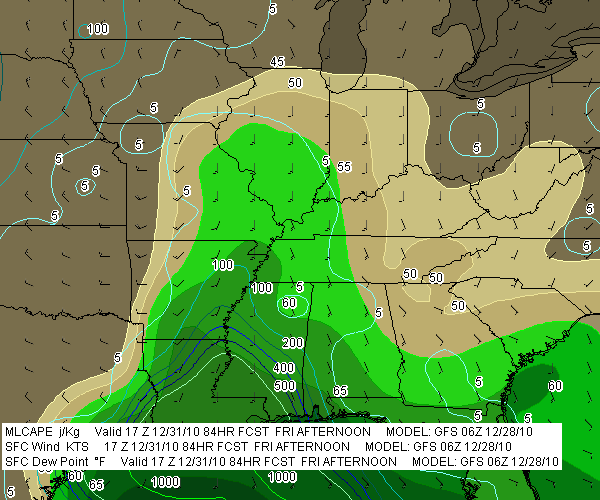
It starts out as a relatively small, innocuous-looking low straddling the California and Nevada border, but by Wednesday afternoon, look out. It’s no longer out west and it’s no longer meek and mild-mannered. According to

today’s 12Z NAM, it’s perched squarely over Michigan, and with a sea level pressure of 976 mbs at 18Z and continuing to deepen, it’s downright ugly. (Click image to enlarge.)

El Nino, Schmell Nino–we are in for one heck of a Great Lakes bomb. The NWS office here in Grand Rapids is calling for a wintry mix in my area changing to all snow, and nothing but snow starting just a little farther north. Wherever you live in the western Great Lakes, though, Wednesday and Thursday are not going to be pleasant. Get set for a one-two punch of winter precip followed by a windy blast of very cold air wrapping around the back of the low as it tracks northeast into Canada, intensifying on the way.

Time to stock up on supplies. Unless you’re a winter weather freak, Wednesday is not going to be a pretty picture.

Moderate El Nino Firmly Entrenched through the Winter

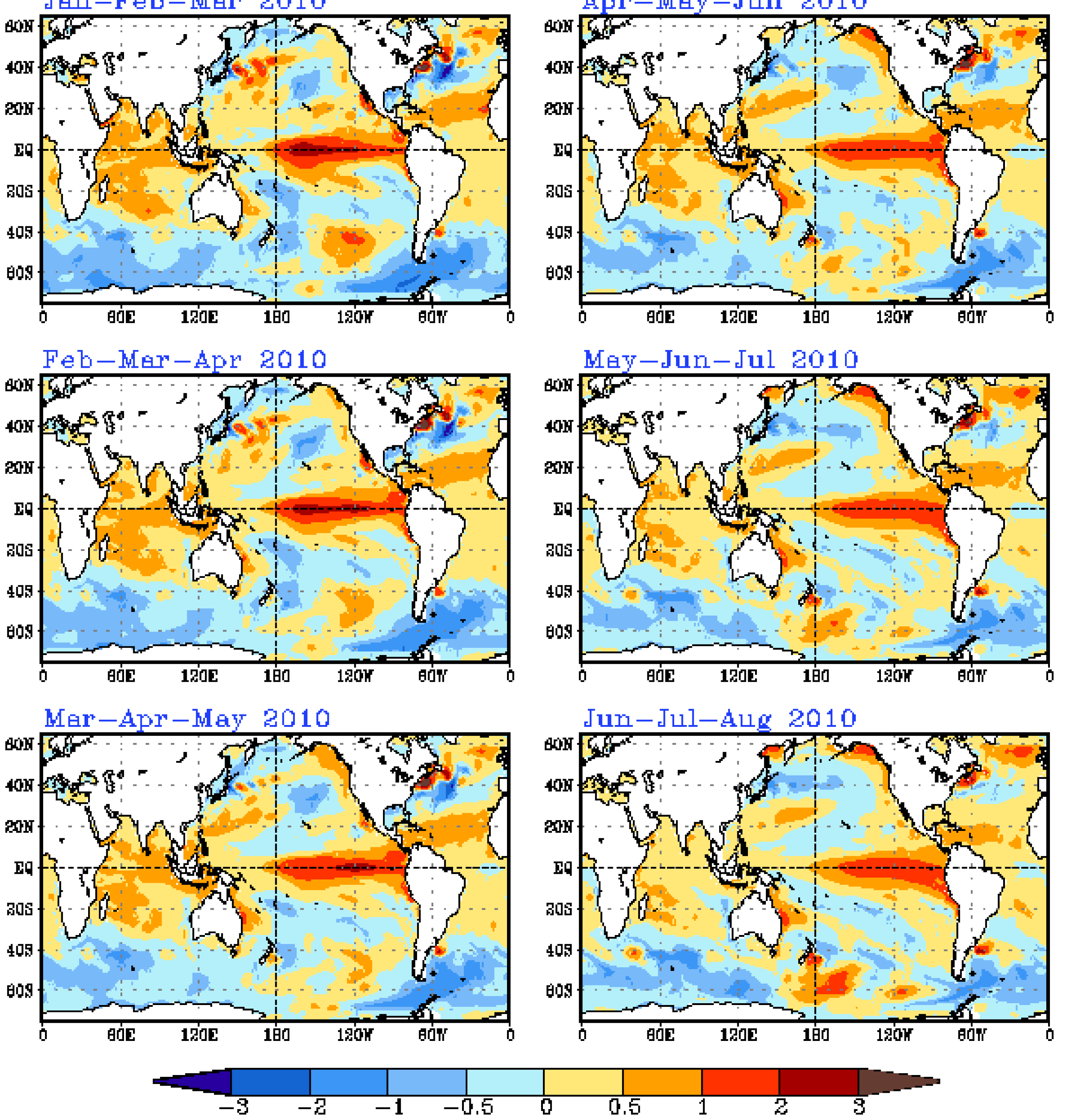
While a few skeptics will no doubt persist, it now appears certain that the present, moderate El Nino will stay with us through the winter, and possibly even strengthen. Here is what the Climate Prediction Center has to say in its November 23 update:

•  During the last four weeks, positive equatorial SST [sea surface temperature] anomalies persisted across the central and eastern Pacific Ocean.

•  During the last 30 days, equatorial SST anomalies increased in some regions across the eastern half of the Pacific.

•  Nearly all ENSO models indicate El Niño will continue through the Northern Hemisphere winter 2009-10. The models disagree on the eventual strength of El Niño, but a majority indicate at least a moderate strength El Niño (greater than +1.0°C) through December-January-February 2009-10.

•  A majority of ENSO models indicate El Niño will continue through March-April-May 2010.

All of the above adds up to the fact that the western Great Lakes region is in for a mild winter. Those of us in Michigan who remember last year’s 200-inch snowfall and bone-freezing cold will welcome the above-average temperatures and below-average precipitation.

The South will also be seeing relief, albeit in a different but no less welcome form. Average to cooler temperatures and above-average precipitation will bring relief to at least some of the areas blasted by last year’s severe drought. Texas looks to be a major beneficiary.

The plenitude of rainfall in store for the southern Gulf Coast and Texas suggests that whatever concerns we may face during next year’s storm season, moisture won’t be one of them. Particularly after last May’s huge letdown, it’s nice to think that in 2010 there ought to be plenty of gas to fuel the convective engine.

Of course, that’s still a long way off. Right now, the best we can do is cross our fingers and hope for no repeats of 2009’s death ridge. I have a hunch that this coming year will be a good one. But first we’ve got a winter to get through, and it’s nice to think this one won’t be as nasty as its predecessor.

New High-Resolution Level 3 Radar Coming in February

Last night Grand Rapids got its first snowfall, and this morning I switched the color tables on GR3 and GR2 to winter mode.

Ugh. I suppose that blue, pink, and purple are going to rule for the next four months. I much prefer plenty of yellow, orange, and red, at least when it comes to radar displays, but we’re at that time of year when those colors aren’t likely to be very meaningful, El Nino or no El Nino.

While switching color tables is relevant to me as a Michigan resident who’s bracing for the winter, it’s nothing compared to the changes coming down the pike for GR3 and other level 3 data users in February. Here’s a message that Gilbert Sebenste of Allisonhouse, a well-known private supplier of raw radar data, posted in the AH and Stormtrack forums:

We have just been informed by the National Weather Service that starting in February 2010, and lasting through April, 2010…the National Weather Service will add higher resolution Level3 radar data products, replacing quite a few of the ones you use right now. The legacy products will continue to be sent for 6 months after all of the replacement products have been added, and will be discontinued on December 1, 2010.

What it all means in a nutshell is this:

1. Resolution will increase
2. The number of reflectivity levels will increase to 256 (meaning you will need to have 256 colors in your color palette to display all the intensity levels)
3. The volume of the files will double, on average
4. The Level3 format will change
5. It will be completed by the end of March, 2010…with legacy products ending 12/1/2010.

Allisonhouse will be working closely with its software partners to provide a seamless as possible transition to the newer and better products upon receipt of transmission from the National Weather Service, and we will provide you with more information as it becomes available.

Wow. Now those, folks, are changes, and it looks like they’ll be here right in time for storm season 2010. High-res level 3–imagine that! My one issue with level 3 has been its coarseness, but that problem is about to be solved. Within a few short months, level 3 data will be coming to us with the same finely shaded resolution as high-res level 2 while remaining a usable product in the field, which is what GR3 is designed for.

Of course, no chaser is going to love the idea of doubling the file sizes. But the improvements look to be awesome, and will give us much more detailed images of storms.

Other Changes on the Way

.

Exciting as the rapidly approaching implementation of high-res level 3 data is, it’s not the only significant development on the horizon. Next year will also see a major phasing-in of dual-pole radar to WSR-88D stations throughout the country. And in the private sector, Andrew Revering of Convective Development, Inc., is working on a huge upgrade for F5 Data forecasting software.

In summary, the technical/informational side of storm chasing will be seeing some significant advancements in the coming year. However many of those improvements are ready for next spring’s severe weather season, let’s just hope that the storms themselves put in a decent appearance.

Subscribe to Stormhorn.com!

Pause a second and look to your right at the top of the sidebar. Notice anything different?

That’s right! Now you can get my latest blog posts on Stormhorn.com delivered right to your front door (or, more precisely, your inbox). All you have to do is subscribe to your choice of either RSS feed or email. So if you’ve found my meanderings on the topics of jazz and storm chasing enjoyable and perhaps even helpful, then I hope you’ll sign up.

And to sweeten the deal, here are some of the FABULOUS PRIZES that YOU could win just for subscribing to my Stormhorn.com blog:

* XXXX          * ?????          * !!!!!          * @&%#!!!

Right, there are no fabulous prizes. There is, however, plenty to hold your interest if you’re a storm chaser, a weather nut, a saxophonist, a jazz musician, or just someone who enjoys a good read. If that appeals to you, then please take a moment to subscribe.

Thanks!

Bob

Black Ice Alert: Are You Prepared for Winter Driving?

At the time of this post, 29 people have already died as a result of accidents caused by icy roads during a winter that has not yet even begun. The tally for last winter was 477, with Michigan tying for fourth place with Illinois and Pennsylvania, all at 29 fatalities. The worst state for ice-related traffic deaths was Indiana at 50 fatalities.

Not surprisingly, the northern states, particularly the Great Lakes states, are the top offenders. But nowhere in our country is exempt. Last winter’s ice-related death toll for Texas was 19; for Oklahoma, 16; for Arkansas, 13. This year so far, Oregon holds an unenviable first place at six fatalities. And so it goes. The point is, icy roads kill no matter where you are.

They kill because no one expects them to. When we head out the door into a freezing drizzle, the word that comes to mind is “annoying,” not “lethal.” Most of us don’t picture such conditions as something that, ten minutes later, will cause us to spin out on a sheet of black ice and go skidding in front of a tanker on the Interstate. But that’s exactly what will happen this winter to people just like you and me.

Storm chaser Dan Robinson is doing all he can to reduce the number of ice-related road fatalities by heightening public awareness. I pulled all of the above statistics from his superbly crafted and highly informative Icy Road Safety website. You’ll find much more there besides what I’ve shared: icy road warning signs, winter driving tips, and some downright scary videos.

Living in Michigan, I’m more alert to the lethality of slippery roads than someone living in, say, South Carolina. But being alert by no means makes me bulletproof; it just gives me an advantage over someone who isn’t regularly exposed to hazardous winter driving conditions. Dan’s website goes a long way to fill in the knowledge gaps and help us all approach icy roads with the caution they deserve.

I urge you to visit Dan’s site. It’s well written and beautifully executed, and it merits attention. Read through it, equip yourself with its potentially life-saving information, and then send the link to family members and friends. Help spread the word: ice kills, but it doesn’t have to.

GRLevelXStuff Has Returned!

Users of GR3 and other Gibson Ridge radar products, rejoice! GRLevelXStuff.com has returned!

A couple months after the site’s disastrous crash, I had pretty much concluded that Aaron et al had given up on it as too time-consuming and costly to resurrect. But tonight, just on a whim, I clicked on their bookmark, and lo and behold, there was ‘Stuff in all its glory.

If you’re already familiar with GRLevelXStuff, this should be good news indeed. If you’re not in the know about it and you use GR3, GR2, or GR2AE, then you definitely need to get acquainted with the site. In its past incarnation, before the disastrous crash that wiped out the entire database, barring the stuff that Aaron had saved on his hard drive, ‘Stuff was the premier support forum for Gibson Ridge users. It was a massively helpful resource in terms of both knowledge and applications. The color table section alone was enormous, and the background section of topo maps couldn’t be beat.

So this is my plug for the reborn GRLevelXStuff. Aaron and his team are hard at work rebuilding it, and such a project requires a community effort. If you use a GRL product, I urge you to visit the site, give the lads a well-deserved thumbs-up, and get involved. Registration–or re-registration, if you were a member of the pre-crash site–takes just a second.

One other thing: if you can afford to, please make a donation. It’s very easy to do so, and every dollar will help. GRLevelXStuff provides a terrific service, and it’s well worth getting behind with your dollars as well as your goodwill. Aaron has been upfront about the costs involved in recreating and maintaining the site, and the need for financial assistance. I just dropped my farthing in the collection basket, and I hope you will, too, if at all possible. Let’s do our best to help make the new ‘Stuff better than ever.

Highlights from the 2009 COD Severe Weather Conference

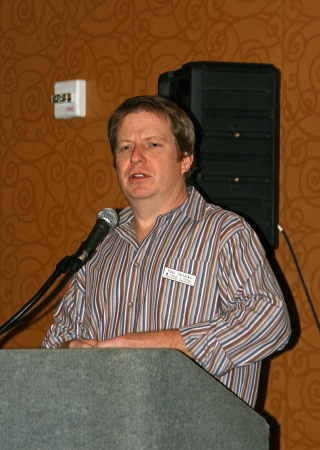
Paul Sirvatka of COD, conference organizer

Paul Sirvatka of COD, conference organizer

The 2009 College of DuPage Severe Weather Symposium is now behind me, and in the light of it, it seems a bit weird to think that the day after, I headed over to my buddy Bill’s to watch the next episode of the Storm Chasers series on Discovery Channel. It feels like two different worlds, like boarding a bus in Grand Rapids and getting off on Mars. But the difference is superficial, a matter of editorial slant; the raw material remains the same, and however it gets spun on television, it’s nevertheless the stuff of research. In reality, people really, truly are going out there and surrounding supercells with an armada of mobile radars and other devices, including manned probe vehicles, all in the interest of collecting data that can increase our understanding of, in a nutshell, what makes tornadoes happen.

The conference featured some of the most knowledgeable and revered names in severe weather research, operational forecasting, and storm chasing: Eric Rasmussen. Chuck Doswell. Roger Edwards. Roger Wakimoto. Josh Wurman. The list goes on, but the point is, a lot of very knowledgeable heads were present in the Double Tree Hotel’s conference room this past week, and some of the insights they shared were fascinating.

Taylor and Carlsen of Environment Canada

Taylor and Carlsen of Environment Canada

Some of the coolest stuff didn’t even come out of the United States. Neil Taylor and Dave Carlsen of Environment Canada shared a photogrammetric analysis of the Elie, Manitoba, F5 tornado, and preliminary findings from the 2008 UNSTABLE team’s exploration of a well-known but hitherto unresearched dryline phenomenon in Alberta. The latter featured EC’s own mobile mesonet, complete with a Doppler-equipped airlplane.

Here are just a few, representative snapshots of the many other topical materials covered:

* Adam Houston talked about the effects of entrainment on unstable parcels, and suggested that the important issue for storm formation isn’t whether a parcel is merely unstable, but whether it is “supercritical”–i.e., possesses enough CAPE to overcome the effect of entrainment.

Eric Rasmussen

Eric Rasmussen

* Eric Rasmussen shared some of the prelimary findings of VORTEX2, describing the interaction of the RFD with horizontal vortex rings in tornadogenesis.

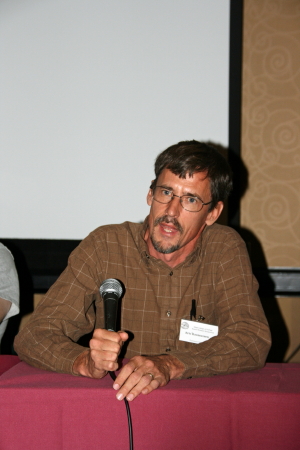
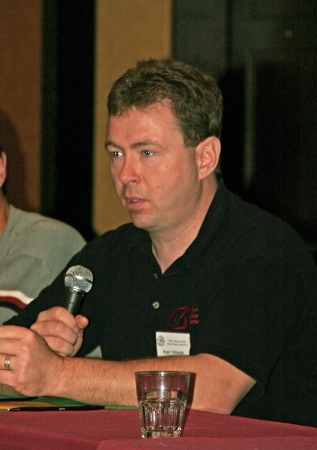
* Roger Edwards discussed the forecast funnel and the pros and cons of numerical models in operational forecasting.

* Al Pietrycha offered an operational forecasting perspective on non-mesocyclone tornadoes, and more specifically, on landspouts.

* For his dinner presentation Saturday night, Chuck Doswell gave an overview of the history of severe weather forecasting and research, and shared his outlook on things to come.

The shape of the future was in fact a topic of concern for a number of the speakers, notably Doswell and Edwards. Amid the influx of information from the research community on misocyclones, vorticity arches, moisture

Roger Edwards

Roger Edwards

convergence, and so on, those on the operational side focused on a more pragmatic matter: the widespread over-reliance on numerical models versus hand analysis.

Will forecast models replace human forecasters? According to Doswell and Edwards, yes, at least for most forecasting scenarios. Edwards emphasized that when it comes to severe weather events–the most difficult to forecast, and the costliest in terms of lives and property–humans will still play an important role. But both men deplored the degree to which forecasters have abdicated hand analysis to the models, which continue to make advances in accuracy at the expense of human development. In a word, the attention and the money are being invested in building better technology, not better forecasters.

Doswell’s message to meteorology students was blunt: either soak in as much information as possible, and commit to becoming experts at hand analysis and motivated self-educators, or else find a different career. Chuck, who is not known for being shy about sharing his viewpoints, wasn’t being nasty, just extremely forthright.

Chuck Doswell speaks

Chuck Doswell speaks

The mets from Environment Canada, Carlsen and Taylor, were clearly shocked to learn how dependent United States WFOs have become on forecast models. The Canadian meteorologists take hand analysis as a given part of their jobs, and couldn’t imagine not rolling up their sleeves and interacting with the surface and upper-level charts firsthand.

If there was a primary take-away value for me from this conference, I guess that’s it: the importance of getting my arms around hand analysis. Practically speaking, while I found the other material fascinating and enriching, much of it was not particularly applicable to my needs as a storm chaser. The first priority is to get to the right storms. Everything else falls into place from there.