Pentatonic Scales by Major Third

Lately I’ve been spending considerable practice time on pentatonic scales. So named because it has only five notes, the pentatonic is as basic a scale as you can get. Its fundamental use for jazz improvisers is to provide a down-homey sound that’s great for playing the blues and a lot of gospel and contemporary praise music. Lacking a major scale’s handle-with-care tension tones of the fourth and raised seventh, the pentatonic furnishes a steady supply of consonant notes that work with pretty much any diatonic chord. It’s hard to go wrong using a pentatonic scale!

But once you start exploring its more complex applications, the pentatonic scale becomes more demanding. It is used freely as a source for angularity and a tool for outside playing, and you have to work out its possibilities in the woodshed if you want to use them skillfully in performance.
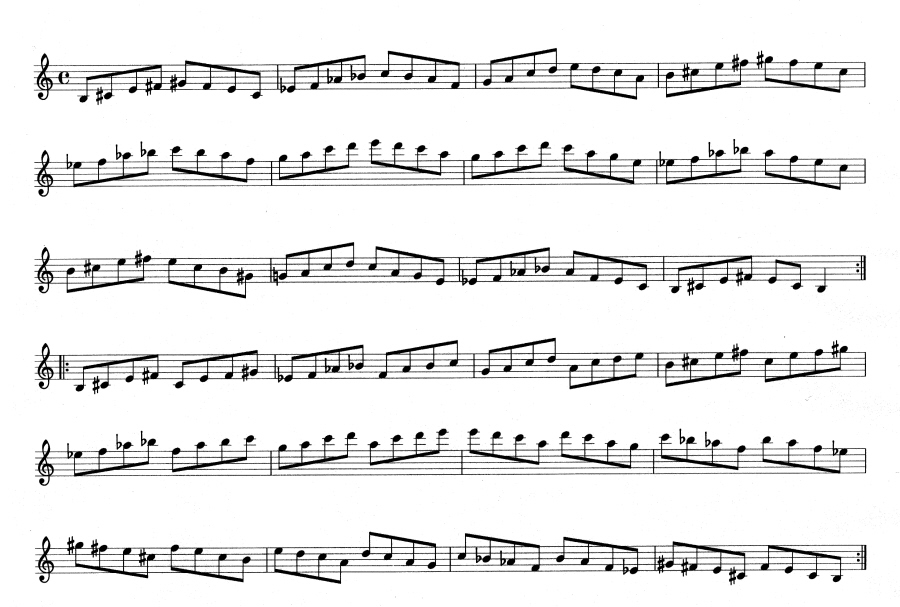
penta-mode-4-by-maj-3rdThe two exercises shown here take the fourth mode of the pentatonic scale and move it by major third. This approach spotlights tone centers that divide the octave into three equal parts. (Click on the image to enlarge it.)

The exercises don’t lay easily under the fingers at first, but stick with them and you’ll soon be ripping through them with Breckerish velocity. Remember, the key is to memorize these patterns as quickly as possible so you don’t need to look at the written notes. Since each exercise takes you through three tonal centers, you’ll need to transpose the material by half-step three times in order to cover all twelve keys.

Get cracking–and have fun!

If you found this post helpful, visit my jazz page for more exercises, articles, and solo transcriptions.

Double-Time Solos: Tips on Playing Fast

Last Saturday’s gig at the Cobblestone was once again a blast. The lineup was different, as Dave DeVos and Paul Lesinski both have previous commitments through February. But  bringing in new players livens things up with fresh approaches, and with Steve Talaga playing keyboard and Charlie Hoats supplying the bass, I had no concerns about the quality of musicianship for the evening. It was my first time playing with Charlie, and he was every bit as superb a player as I’d been told. As for Steve, he’s always been nothing short of fabulous. I am so blessed to get to make music with the kind of guys I’ve been working with lately–not just great musicians, but really decent, down-to-earth people.

But enough about the gig. Let’s talk about playing in double-time.

I don’t know why it has taken me till now to think of writing about this topic. There was a time in my musical development when it consumed me. My introduction to it began when I got my first earful of Bird back in my college days and found myself thinking, “How the heck did he do that?” A lot of people over the years have wondered the same thing about Bird, but I quickly came to realize that he wasn’t the only jazz musician capable of playing really fast and sounding really good. Starting with the boppers, there was Dizzy. There was Dexter. There was Bud Powell. There was Sonny Criss, and Sonny Rollins, and of course Sonny Stitt, who seemed to have built his home in Double-Time Town. Then along came Trane, who progressed from ridiculously fast to…well, what would you call it? In 1958, “Downbeat” jazz critic Ira Gitler described Coltrane’s approach as “sheets of sound,” and the term has been used ever since.

The speed, creativity, and beauty with which skilled jazz improvisers incorporate double-time passages into their solos can seem daunting to beginning players, not to mention flat-out bewildering. I mean, you’ve heard it played, so you know it can be done, but how do you even begin?

As is true with a lot of things musical, the answer is quick but the implementation takes considerable time. Really, the answer is plain old musical common sense that applies to learning how to do anything as a jazz musician: Listen analytically and practice carefully, ad infinitum. And, I should add, transcribe solos or at least memorize a few solo transcriptions.

That being said, let me expand on that wisdom with a few suggestions.

1. Identify a double-time passage that you like and then memorize it. By memorize, I mean work it over faithfully every practice session for a while until it sails effortlessly out of your fingers. If you really want to get something out of it, memorize it in every key, or at least a few other keys besides the one it was originally played in. Doing so will not only develop your dexterity, but also your ability to think quickly in different keys.

2. Start slow! Yes, it’s double-time, but you won’t play it well fast unless you can first play it well slowly. Once you’ve nailed down your passage at that slower speed, then increase your tempo a bit, and keep increasing it incrementally until you’re playing the lick at the same speed as it was originally performed–or, if it’s an idea of your own creation, at a speed as fast as you’d like to be able to pull it off on the bandstand.

3. Use a metronome. It’s easy to race with double-time, and trust me, it doesn’t sound at all impressive when you end up two beats ahead of the rhythm section.

4. Once you’ve got the passage drilled into your fingers fairly well, play with the artist’s recording or with some kind of accompaniment that lets your ears hear a harmonic and rhythmic context for what you’re playing.

5. Note any distinctive features of the passage. Does it involve one or more grupettos (a favorite device of Sonny Stitt’s)? Where do passing tones occur? Are there any alterations to a dominant chord such as an augmented fifth or a flatted ninth?

6. Be aware of how the scales, intervals, and arpeggios you’ve been practicing relate to your double-time passage. They do, and seeing how will add inspiration and direction for your ongoing work on the fundamentals and suggest new ways of approaching them.

7. Be patient and be persistent. This stuff doesn’t come overnight. But it will come provided you stick with it.

8. Realize that you’re striving for the snowball effect. You know: You start with a small snowball, and as you roll it along, it collects more snow and becomes larger and larger–and the bigger it gets, the greater quantities of snow it is able to pick up as you continue to roll it. As you build your musical vocabulary and the technique to execute it skillfully, you’ll find yourself adding material to material, expanding your musical inventory in increasingly creative ways, and ultimately, spontaneously generating brand new ideas. Your thinking will speed up, your capacity to respond intuitively to the music will increase, and so will your dexterity to play on your horn what you hear in your head.

I’ll conclude with a bit of cautionary advice: Just because you can play fast doesn’t mean you should. Let taste, not technique, be your guide. As a jazz musician develops speed and discovers that he or she can play swift passages with increasing effectiveness, a temptation enters to “prove” oneself by playing lots of double-time. But playing fast isn’t the same thing as playing well.

A good jazz soloist knows how to build a solo using slower passages, longer tones, and space as well as the really fast stuff. Double-time is just one device to use along with other devices in the larger context of telling a musical story. The story’s the thing, and a good story is about pace, contrast, and development, not perpetual fast action.

I’m preaching to myself as I say this, because I’m prone to overplay, and one of the things I’m working at is to hold that tendency in check–to lay back more and play in ways that are stylistically appropriate. Strangely, I have a hard time playing with blues bands, and one of the reasons is because in that style, simpler is usually better. Once you develop speed and complexity, it can be hard to trust simplicity. But it’s important to do so.

Enough on this subject. I hope you’ll find this article to be helpful and encouraging. The big thing, again, is  to practice hard and stick with it. Do that and you’ll do fine. Like everything else in music, you’ll master the art of playing double-time in due time as long as you keep working at it.

Stormhorn Jazz: It’s Happenin’ Saturday at the Cobblestone!

Last week’s gig at the Cobblestone was the best yet! The turnout was fantastic, and it included some very welcome faces. My sweet mother and sister, Diane, came to listen. So did Kyle Wellfare, band director for the Caledonia Senior High School and a jazz bass player. And so did long-lost and recently found high school classmates Sue Marie Carrick and Steve Afendoulis.

Steve and I go back a long ways. We were both still in junior high school when he asked me to play in a big band he was forming called The Formal Aires. Managed by Steve’s dad, Gus Afendoulis, and co-directed by saxophonist and big band veteran Ted Carino and composer Sid Stellema, the Formal Aires enjoyed constant weekend bookings at country clubs, weddings, and social events. The band was my introduction to jazz, and Steve was our leader.

When Steve got wind of my gig via FaceBook, he told me he was coming out and asked if he could sit in. Heck yes! It was a real joy to reconnect with him and make music together again after over 35 years. And Steve did great. He hadn’t touched his set in a long time, but he fit right in, keeping the beat and catching the breaks in a way only someone informed by plenty of prior experience could do.

This Saturday my regular partners in music, Dave DeVos and Paul Lesinski, have previous bookings, and that’s the case for the next couple weeks as well. Never fear, though–I have some stellar players joining me: Steve Talaga on keyboards and Charlie Hoats on bass. I’ve not met Charlie in person yet, and I’ve been wanting to, not only because he comes with glowing recommendations, but also because he lives right here in Caledonia just a couple miles up the road from me. As for Steve Talaga, I’m well acquainted with his playing. The man is fabulous. ‘Nuff said.

So put Saturday in your book and come on out. The Cobblestone is developing a reputation for urban-quality dining in an accessible, refreshingly non-urban setting. And of course you’ll enjoy listening to live jazz! Here’s what you need to know:

• Date & Time: Saturday, February 5, 6:0-9:00 p.m.

• Place: The Cobblestone Bistro & Banquet Center

• Address: 9818 Cherry Valley Ave. SE (M-37), Caledonia, MI

• Phone: (616) 588-3223

Reservations are recommended, but walk-ins are welcome.

Update: Music Posts Now Partially Restored

To those of you who follow this blog: Thanks for your patience as I rewire it following a recent and important transition. While I’ve experienced some setbacks, I’m nevertheless making progress and want to let you know where things presently stand.

The current status will be of greater interest to musicians than weather weenies. In a nutshell, my music posts dating back to November 19, 2009, are now all properly linked to the correct images. When you click on an active link for a particular exercise or solo transcription, now the enlarged image that appears will be what you’d expect to see rather than a photograph of a tornado or a wild orchid!

I know you’re not seeing the image thumbnails! But you can still click them and view the full-size images.

Something appears to be screwed up with my image plug-in, NexGen. The past couple of NexGen updates, rather than improve the plug-in, have degraded its functionality, and the last one evidently stripped the image thumbnails from my pages, leaving white placeholders in their place.

Fortunately, the placeholders are active. So if you click on them, you’ll get a full-size image. Obviously, that’s not a satisfactory long-term situation–the thumbnails need to be restored–but one thing at a time. Right now I want to focus on the things that I can easily fix on my end; then I’ll tackle the NexGen issue. My hope is that meanwhile NexGen will release an update that fixes the problem.

My plan: first fix all the music posts, then the weather.

I’m taking this approach for three reasons. First, the music posts get more traffic through the entire history of the the posts. The exercises, transcriptions, and articles deal with information that doesn’t get dated, and since there seems to be a strong, ongoing interest in those posts, I want to get them restored as quickly as possible.

Second, the music posts aren’t as image-intensive as my storm chasing posts, so they’re easier to fix, and I can have them back in shape relatively quickly. I’m already MORE THAN HALFWAY FINISHED with them.

Finally, this is the off-season weatherwise, and while I know that the weather never takes a break–as I write, an intense winter storm is shaping up for much of the CONUS for tomorrow and Wednesday–nevertheless, we’ve got a ways to go before the spring storm season kicks in. This isn’t to say that I’m not anxious to get the storm chasing stuff–not to mention the other aspects of this site such as my photos page and CopyFox page–hooked up with the correct images. It’s just that I’ve got to tackle this job in an orderly fashion.

Bear with me, because I’m hammering away on this thing as best I can. Getting this blog fully restored and coasting along with all sails catching the wind is a huge priority for me. So stay tuned. My next update will probably come soon, once all the music posts are fixed.

YAAAAYYYYY!!!!! Life in Stormhorn Land Is Lookin’ Up!

What I thought was going to take several weeks of work, maybe a month or more, manually restoring my blog images and broken links one by one now has been drastically reduced to a much more manageable project.

My sweetheart, Lisa, is the absolute Bomb, and today her inner geek came through like a champion–with, I might add, considerable patience and supportiveness for technically challenged me. That combination of her knowledge, helpfulness, and gracious attitude has made a huge difference today, on a morning when I woke up feeling depressed about life in general and Stormhorn.com in particular.

I still have my work cut out for me, but the amount of it has been reduced astronomically, and a big, biiiig, what appeared to be majorly headachy part of it is already taken care of with the complete reinstatement of my NexGen image galleries and a simple correction that has fixed a bazillion broken internal links just like that. Within a few hours this morning, this site has gone from a basket case to well on the road to recovery.

On the reader side, though, Stormhorn.com may still appear to be pathetically busted. You still can’t access most of the images, whether solo transcriptions and jazz patterns or radar grabs and weather maps. You may notice that I’ve even removed my CopyFox page from public view. I mean, who’s going to hire a copywriter whose own business site resembles the victim of a shark attack?

Relax, though. I can say, with confidence and a good deal of relief, that everything will be back soon and once again chugging merrily along.

Here’s What Needs to Be Done

I need to reorganize my NexGen image gallery, which won’t take terribly long. Then I need to go into my posts and pages, one by one, and replace bad image links with good ones. That will takes some time, but you should start seeing the beginnings of the restoration today. I’ll be starting with my most recent posts and working back from there into my older posts until everything is as it should be.

Some other, less pressing details also need attention, but all in good time. What I’ve described above is my first priority. It’s now largely a matter of grunt work, but as I’ve said, the workload has been greatly reduced and I feel far better about things than I did last night.

Thanks so much for your help, Lis! You’re awesome, babe!

ADDENDUM: Yes, I Know That Lots of the Images Are Wrong!

Again, I’ve got some messed-up links to correct. So if you find yourself looking at a weather map where a musical exercise ought to be, take it in stride. It’ll all get sorted out in due time.

Update and Gig

The Latest on Stormhorn.com: Navigating the Move

This is my first post after changing my Web host to Dryline Hosting. The transition has been a bit bumpy, largely because I’m not familiar with the details involved in Web hosting and have had to deal with the learning curve. My friend Karina Myers, who with her husband, Mitch, operated the now-defunct Tablox Web Solutions, was gracious enough to move my files for me, and as I look at how many of them there are, I realize how overwhelmed I’d have felt if I’d had to handle the transfer myself. That kind of thing takes infinitely longer when you don’t know what the heck you’re doing!

Anyway, right now you’ll notice that the header and all my images are missing. That includes all the practice exercises and solo transcriptions I’ve developed over the years.

RELAX! (I’m saying that to myself as well as to you.) The image files all still exist. But I’ve obviously got a bit of work to do in order to get them back to where you can once again view and access them. Trust me, doing so is high on my to-do list. I want to get my Stormhorn blog site fully functional as soon as I can, so stay tuned, and please bear with the current, stripped-down look, sans images. It’s only temporary.

Gig Saturday at the Cobblestone

A reminder that my jazz trio plays again Saturday night, January 22, from 6:30-9:30 p.m. at the Cobblestone right here in Caledonia, Michigan. The place is an ideal setting for jazz. The room is such that you can hear the music anywhere while at the same time being able to carry on a conversation. The food and wine are great. And my fellow musicians, bassist David DeVos and keyboardist Paul Lesinski, are some of the best in West Michigan.

Tomorrow is our last booking, and while I hope that the owner will  extend our stay, I don’t know at this point whether that will happen. Ben loves jazz and really wants to make it happen at his place, but he needs an increasing customer base in order to make it work for him financially. So come on out, show your support, and enjoy an evening of  live jazz with the Stormhorn Jazz Trio  in the warm, relaxed, and inviting setting of the Cobblestone Bistro.

• Date & Time: Saturday, January 22, 6:30-9:30 p.m.

• Place: The Cobblestone Bistro & Banquet Center

• Address: 9818 Cherry Valley Ave. SE (M-37), Caledonia, MI

• Phone: (616) 588-3223

Reservations are recommended, but walk-ins are welcome.

Stormhorn Jazz Tonight at the Cobblestone

A quick reminder, in case you haven’t gotten one from me on Facebook, that my jazz trio, Stormhorn Jazz, is playing tonight from 6:30–9:30 p.m. at the Cobblestone Bistro in Caledonia, Michigan. This is a beautiful place with superb food, world-class wines, a good offering of domestic, imported, and craft-brewed beers, an elegant and comfortable bar, and ambiance galore complete with a fireplace and even, yes, a waterfall–plus, of course, live jazz by Dave DeVos on bass, Steve Durst on keyboards, and me on the alto sax and vocals.

The Cobblestone is one of the best things about Caledonia, at least from a musical and dining perspective, and Ben, the owner, loves jazz. So come on out and show your support. I promise you, you’ll be pleased at what you find. Here are the details:

• Date & Time: Saturday, January 15, 6:30-9:30 p.m.

• Place: The Cobblestone Bistro & Banquet Center

• Address: 9818 Cherry Valley Ave. SE (M-37), Caledonia, MI

• Phone: (616) 588-3223

Reservations are recommended, but walk-ins are welcome.

Stormhorn Jazz at the Cobblestone Bistro (Or, The Difference a Bass Makes)

Saturday evening at the Cobblestone Bistro here in Caledonia was one of those very rewarding gigs that result from the combination of a stellar rhythm section, a beautiful setting, and an appreciative audience. I couldn’t ask for better guys to play with than Paul Lesinski and Dave DeVos. Each is a seasoned, top West Michigan veteran on his instrument, and both are just plain nice, down-to-earth guys with no attitudes to deal with. They’re responsible and easy to get along with, solid and intuitive musicians who’ve been around the block many times over, so I have confidence in them. That confidence in turn inspires my own creativity and willingness to take risks as a saxophonist.

Last Friday on New Years Eve, Steve Durst and I played for the dinner crowd as a piano-sax duo. With years of experience under his belt, Steve does a superb job, and we got some very nice compliments. But man, what a difference the addition of Dave on bass made this weekend!

I’m certain Steve would readily agree that having to fill in the bass part with the left hand greatly limits what a keyboard player can do. Good players can pull it off, but I don’t know of any pianist who wouldn’t much prefer having a bassist handle the bass part so his own left hand is free to do what it’s meant to do in a jazz context. The difference is huge–the groove, far better; the sound, fuller and richer; the creative options, much broader; and the energy, multiplied. All without any significant increase in volume that can distract from conversation in a restaurant setting.

The crowd certainly liked our sound. People were actually listening to us and applauding from tune to tune, and even for some of the solos. I stopped to chat with a few of the diners during break, thanking them for their responsiveness, and I got some glowing comments in return. It’s really gratifying to see the interest in jazz that exists in this rural neck of the woods, many miles from the urban center of Grand Rapids.

We play again at the Cobblestone this coming Saturday from 6:30-9:30 p.m., this time with Steve filling the piano chair. If you like live jazz, come on out and enjoy an evening of good food and world-class wines plus the Stormhorn Jazz trio, all in an ambience-rich setting that will warm you as soon as you set foot through the door. Here’s the info:

• Date & Time: Saturday, January 15, 6:30-9:30 p.m.

• Place: The Cobblestone Bistro & Banquet Center

• Address: 9818 Cherry Valley Ave. SE (M-37), Caledonia, MI

• Phone: (616) 588-3223

Reservations are recommended, but walk-ins are welcome.

I should mention the large and beautifully designed banquet hall in the back of the building, styled in the manner of a large, European sidewalk cafe. Ben, the owner, is contemplating special events, so keep your eyes open for jazz concerts in the future. I’ll keep you posted on this site and on my Stormhorn page on Facebook as brainstorms and good ideas become actual dates on the calendar.

Need I say, please come out and support the Cobblestone. It’s a great setting and has the potential to distinguish itself not only for destination dining, but also as a hotspot for jazz that’s located outside the urban clutter, yet close enough to be convenient.

Pentatonic Pattern in Mode Four

You can’t get much more basic than a pentatonic scale. Maybe that’s the reason why I haven’t spent much time focusing on the pentatonic in recent years. But the flip side is, pentatonics can be applied in some pretty complex ways which, far from simple, require as much practice as any other building block of music. At its essence, the pentatonic is a harmless, soulful, and down-homey scale with which you can’t go wrong. But pentatonics are also a prime source of angularity. They’re applied extensively in sideslipping. And they’re used to realize a variety of harmonies, particularly dominant seventh chords of various alterations.

All those possibilities latent within the lowly pentatonic scale! Once you really start exploring its applications, the pentatonic requires extensive work to get it under your fingers. That’s probably the bigger reason why I haven’t spent much time practicing pentatonics: there’s a formidable amount to deal with, and I’ve chosen to concentrate on other things instead.

So I’m by no means writing this post as a master of the pentatonic scale, but rather, as someone who is sharing as he learns. Knowing music theory as I do, I realize how useful the pentatonic scale really is. Frankly, I find its broadness of application a bit daunting, because it means there’s a lot, an awful lot, involved in really internalizing the scale in more than a superficial way. But there’s nothing to be gained by procrastination, so lately, inspired by the playing of Ernie Watts in his album “Four Plus Four,” I’ve been revisiting my pentatonic scales and plan to spend some time going more in depth with them in my practice sessions. To be sure, there was a time years ago when I worked on them pretty consistently, but my overall abilities on the saxophone have expanded since then, so I’m hoping that today I can get my base level of pentatonic proficiency to snowball.

pentatonic-mode-4Here is a simple exercise I’ve been using, built on mode four of the major pentatonic scale. (Click on the image to enlarge it.) There’s nothing particularly novel or creative about it, but that’s not the point. Its meant to help develop dexterity in shifting from one tonality to another, in this case by half-step. The exercise begins with the fourth mode of the F pentatonic scale, and then, as you can see, moves chromatically up and then back down. Work it out two to four bars at a time, focusing on problem areas till you’ve smoothed them out, and then connect the dots one by one until you can play the exercise throughout the full range of your instrument.

Good luck, practice hard, and, as always, enjoy yourself! And don’t forget to check out the many other exercises, articles, and solo transcriptions on my jazz page. They’re all free, and free is good, yes?

It Was a Dark and Stormy Night, But the Band Played On

Happy New Year! Last year was tough but we made it through, didn’t we. I hope that 2011 will be a good year for you, for me, for us all.

Yeesh, I’m starting to talk like Tiny Tim. I’d better get on with this post, which is a summary of yesterday. Weatherwise, the last day of 2010 was a humdinger for convective connoisseurs, and jazz-wise, it was a fun evening for yours truly. While the two topics may seem unrelated, they are in fact integrally connected. It’s a well-known fact among my storm chasing buddies that any time I commit myself to a gig and am therefore unable to chase, tornadoes will drop out of the sky like confetti at a gala event. It’s a gift I have. Statistically, my powers hit their zenith the weekend of the Grand Rapids Festival of the Arts in early June. But anytime of the year, all hell is liable to break loose when I’m booked to play somewhere.

Yesterday was a prime case in point. While Steve Durst and I played a thoroughly enjoyable piano-sax gig for the dinner crowd at the Cobblestone Bistro here in Caledonia, tornadoes mowed across Missouri, Illinois, and Mississippi. You could see the event shaping up earlier in the week, with forecast models depicting a potent longwave trough digging deep into the nation’s midsection on Friday; a surface low working its way northward through Missouri and Iowa; high-velocity mid- and upper-level jets generating massive shear; and, critically, a long and broad plume of unseasonably rich moisture juicing the atmosphere up into Illinois ahead of an advancing cold front.

If you want to get some great insights into yesterday’s setup compared with two other similar wintertime severe weather events, check out this superb article by Adam Lucio in Convective Addiction. Adam’s analysis was spot-on. Tornadoes began spinning up early yesterday morning in Oklahoma and Arkansas and continued on through the day in Missouri and Illinois, surprisingly far north. Rolla and Saint Louis, Missouri, got whacked pretty solidly. Later, as expected, the action shifted south, with severe storms firing in Louisiana and a batch of night-time tornadoes gnawing their way across central Mississippi. Yazoo City found itself in the crosshairs for the third time this year as a strong radar couplet grazed past it, but, mercifully, this time the town appears to have escaped yet another direct hit.

With yesterday’s dust finally settled, the SPC’s present tally shows 40 preliminary tornado reports. Sadly, there were some fatalities, not all of which the reports show. What an awful way for the families affected to end a year that has already been difficult enough for so many people.

And the show isn’t quite over. Today, on the first day of 2011, Tornado Watch #3 is in effect for the Florida panhandle and southern Alabama. If that’s any kind of augur for this year’s severe weather season, April through June could be an interesting time for storm chasers.

But enough about the weather already. Let’s talk about jazz.

The Cobblestone Bistro is a beautiful place to play. I can’t believe that something like it exists in Caledonia, a community not exactly renowned as either a jazz hot spot or a north star of destination dining. But here the bistro is, fully operational now that a long-forthcoming liquor license has put its winsome and comfortable bar in business, and with an owner who appreciates and supports live jazz.

Last night I played my first gig at the Cobblestone for the New Years Eve dinner crowd from 6:00-10:00 p.m. Steve Durst joined me on the keyboards, and we spent an enjoyable four hours playing jazz standards in as elegant and ambiance-rich a setting as you could hope to find.

In a restaurant, particularly in a smaller room, it’s important not to play too loudly. People want to talk, and the music needs to add to the mood, not subtract from it by being too intrusive. That can be tricky for a sax player. A saxophone is not by nature a shy, quiet instrument, and a lot of energy is required to play it softly. But with three tables positioned directly in front of Steve and me, both of us absolutely had to reign in our volume.

Evidently we succeeded. We got no complaints of playing too loudly, but we did get some very nice compliments on our sound.

I’ll be playing at the Cobblestone again next Saturday, January 8, from 6:30-9:30 p.m. with Dave DeVos on bass and Paul Lesinski on keyboards. The trio will be playing as well on the 15th and 22nd, with Steve occupying the keyboard seat on the 15th. If you’re looking for a great night out in a beautiful setting, come and check us out.

And with that, I’m signing off and getting this first afternoon of a brand new year underway. I wish you a very happy and prosperous 2011.

–Storm (aka Bob)