“Round About” Jazz Etude for Bb and C Instruments

Yesterday I published an etude that I wrote based on the chord changes to the Jamey Aebersold tune “Round About.” The tune is included in the second CD of the 2-CD set Dominant Seventh Workout (number 84 ins the Aebersold jazz improvisation CD series).

Since my instrument is the alto saxophone, it was natural for me to write the etude using the Eb transposition. But of course, the whole world doesn’t play Eb instruments. So I promised those of you who play tenor sax, trumpet, flute, and other Bb and concert pitch instruments that I would provide transposed charts for you.
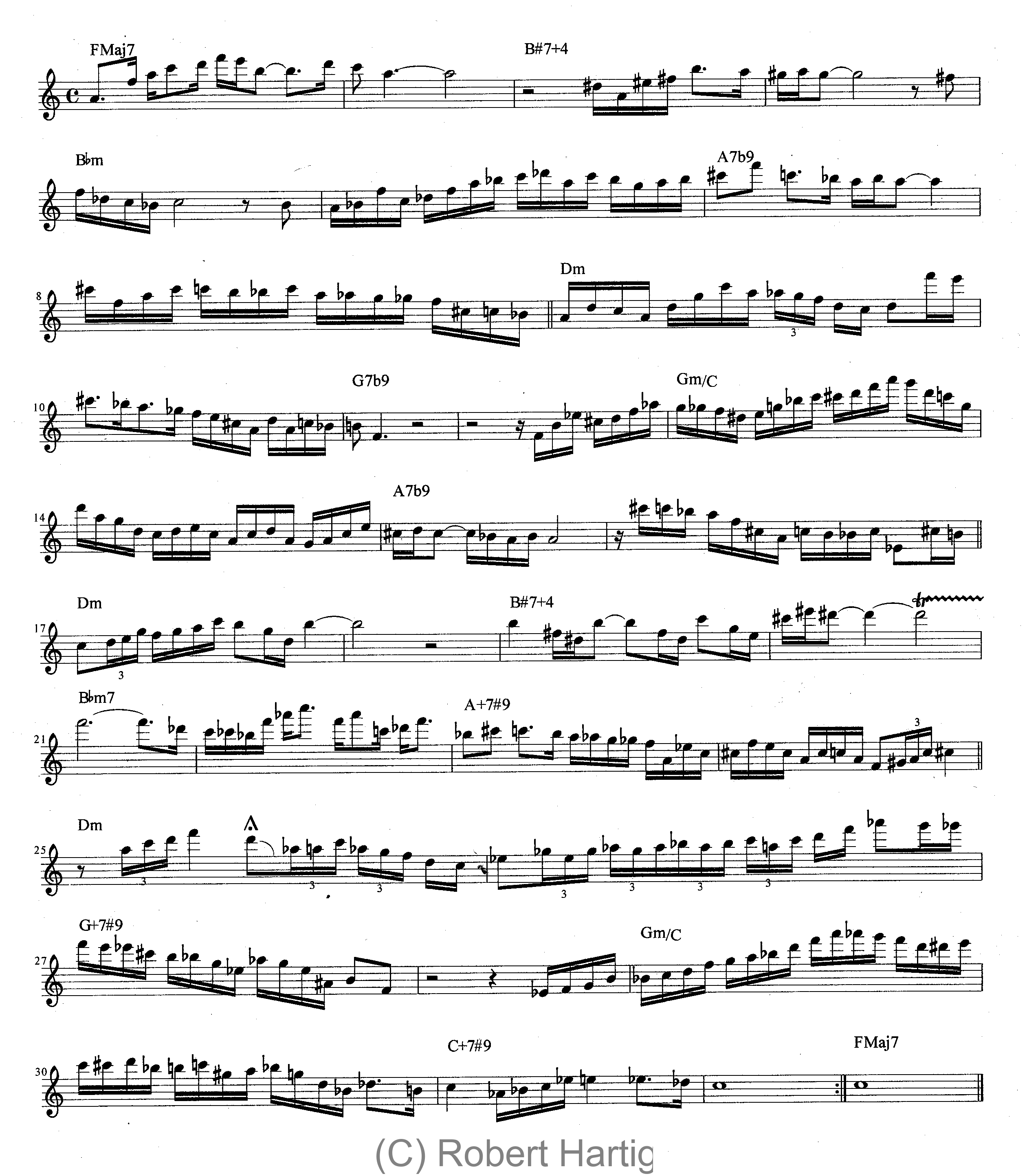
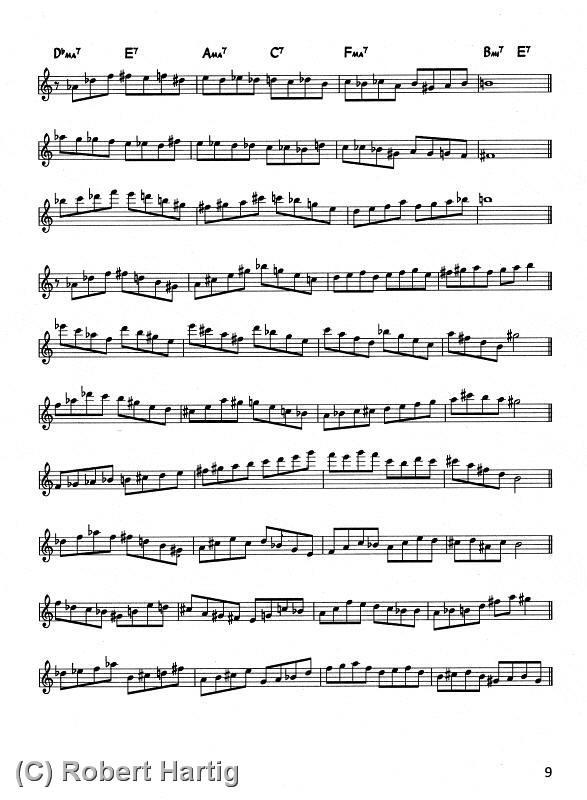
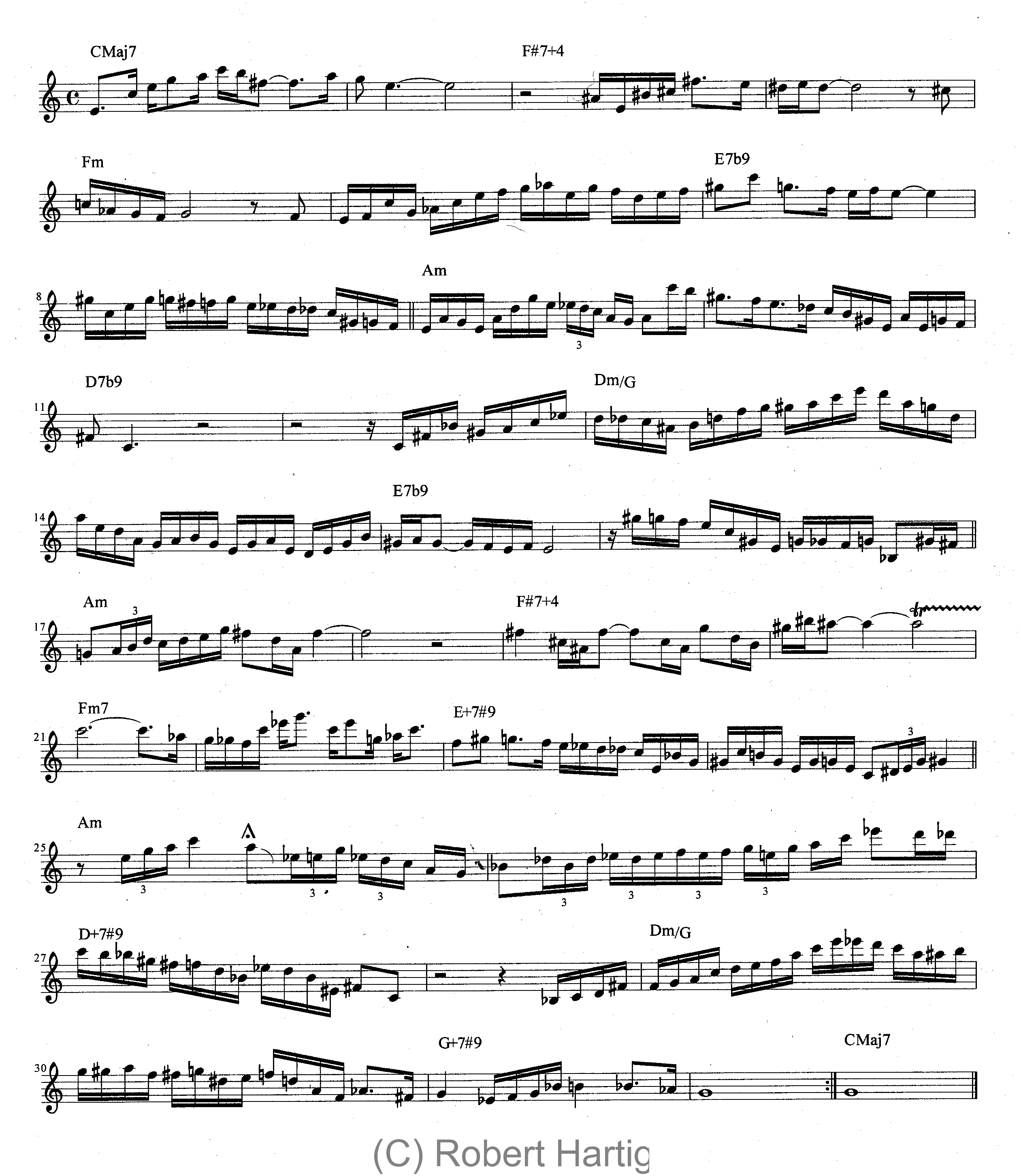
Here they are. The top chart is for C instruments and the bottom one is for Bb instruments. Click on the images to enlarge them. If possible, use the Aebersold accompaniment for “Round About” or have a pianist comp for you as you play the etude so you can hear how the lines work with the harmony.

If you enjoy these exercises, look here for more, along with insightful articles, transcribed solos, and tips on jazz improv.

CORRECTION: Now that this article has been posted for a while, naturally I’ve noticed a transcription error in the C and Bb charts. (The original Eb chart is fine.) Since you can easily make the correction mentally, I’m going to simply tell you what it is. In measures 3-4 and 19-20, the chord symbol should not contain a sharp sign. The correct chord in both locations is as follows: for the C chart, A7+4; for the Bb chart, B7+4.
A Jazz Etude Based on the Jamey Aebersold Tune “Round About”

Lacking access to a rhythm section with whom I can play whenever I want, I practice quite a bit with Jamey Aebersold CDs.  One of my favorites for hashing out ideas and building technique is Aebersold’s volume 84, Dominant Seventh Workout. The 2-CD set provides a thorough exploration of dominant seventh harmony.

Volume 2, track 15, consists of a tune written by Jamey Aebersold titled “Round About.” I play the piece often, both because it’s a great opportunity to experiment with altered dominant chords and also because I simply like the tune. It’s moody, pretty, and fun to play.

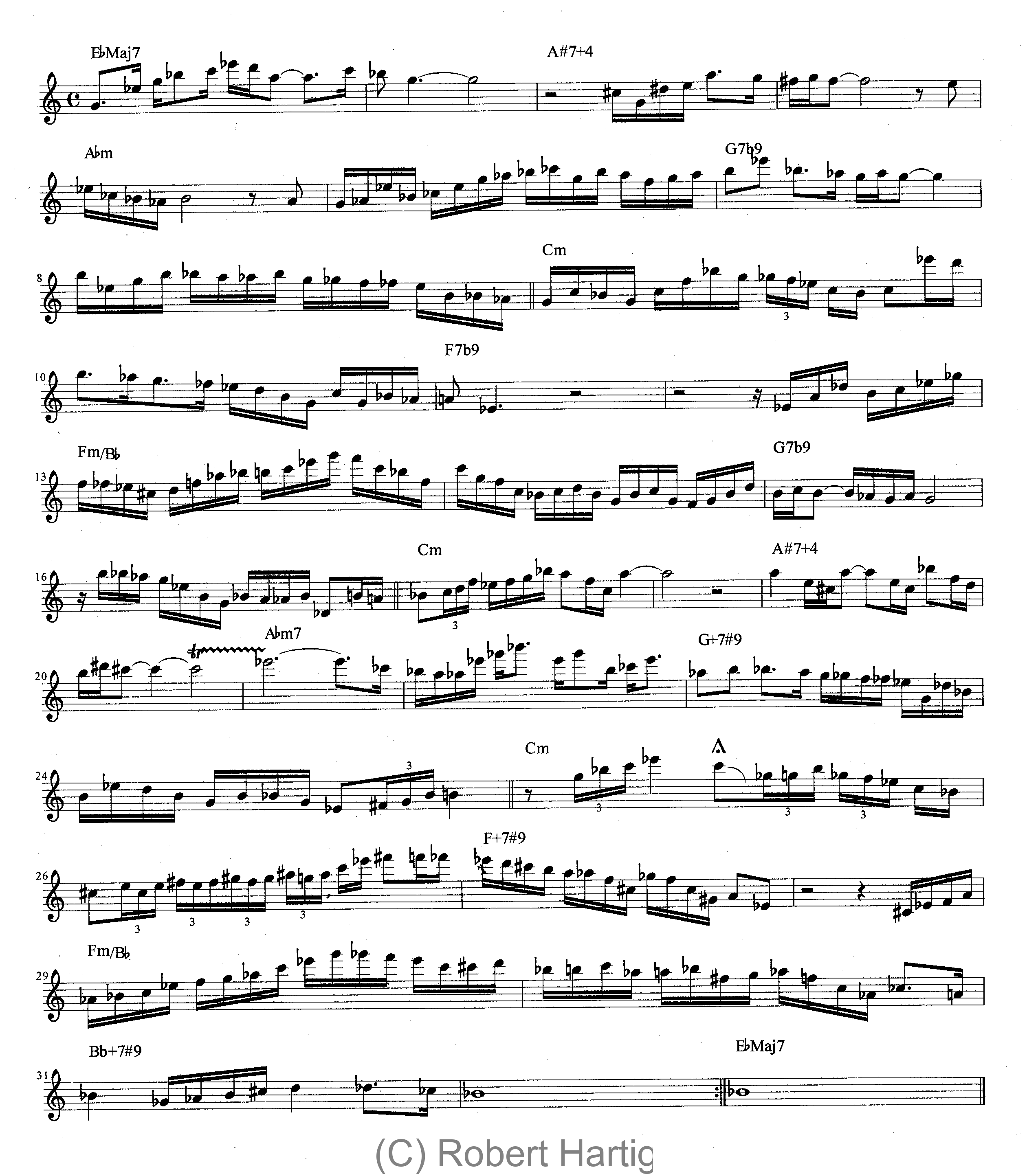
To your right is an etude I’ve written based on “Round About.” Written in the style of an improvised solo, it contains a lot of the ideas I’ve been working with recently: augmented scale, diminished whole tone, pentatonic scale, side-slipping, and more. Click on the image to enlarge it.

The etude works fine as a stand-alone technique builder, but to really get the sound of it–and hence, to make better aural sense of it–I highly recommend that you play the exercise along with the Aebersold CD.

Note that, me being an alto player, I’ve written the etude for Eb instruments. If you play a Bb instrument such as tenor sax or trumpet, or a C instrument such as flute, you’ll have to transpose, at least for now. Stay tuned, though–I will be posting a Bb edition soon, and perhaps a concert pitch edition as well.

Eb players, have fun! And if you enjoy this exercise, check out my jazz page, where you’ll find many more articles, exercises, and solo transcriptions.

Saxopedia: Introducing a New Saxophone Website

A few days ago I received a note from Italian saxophonist Gianfranco Balena informing me of his new website, Saxopedia. Having checked it out, I’m taking a moment to recommend that you do the same if you’re a saxophonist–or, for that matter, if you’re a jazz instrumentalist of any denomination.

Saxopedia is clearly a labor of love on the part of Mr. Balena, and it looks to be a site that will be regularly updated. Of particular interest is the index of jazz solos. Featuring links to over 1,000 free solo transcriptions that cover a huge array of well-known saxophonists, this is as exhaustive a compendium of solos for memorization and study as you’ll ever find. It’s a terrific resource, and you owe yourself a visit. Once you’ve been there, I’m betting you’ll return for more. I will, that’s certain.

Altered Dominant with Pentatonic b6 Scale

Lately my practice sessions have involved both the diminished whole tone scale and the pentatonic scale. There’s a reason for this: the two are related, and both scales go well with the V+7#9 chord. My previous post explored how this plays out with a basic major pentatonic scale. I worked with mode 4 of that scale, starting on the b9 of the V+7#9 chord. In root position, the scale would actually begin on the +4 of the chord.

Today during my practice session I focused on another pentatonic scale rooted on the +5 of the V+7#9. It’s a wonderful sound that really brings out both the major third and #9 of the chord as well as the evocative color of the raised fifth. This scale is not your standard-issue pentatonic; its flatted sixth gives it a mysterious augmented quality.

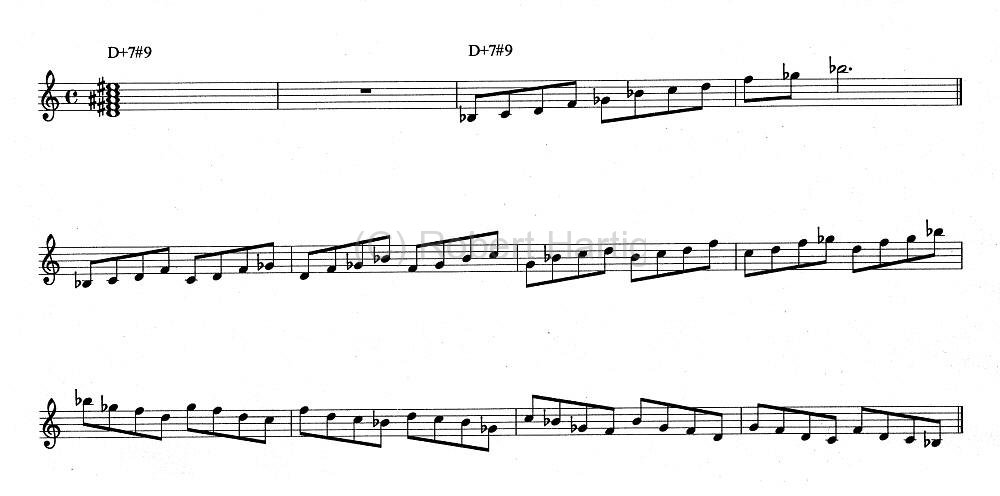
Click on the image to your right to enlarge it. The first thing you’ll see is a D+7#9 chord outlined in whole notes. To its right is an ascending Bb pentatonic scale with a flatted sixth. You’ll see how the scale is entirely consonant with the chord. Moreover, further analysis will reveal that the Bb pent b6 is actually an abbreviated form of the D diminished whole tone scale.

Still more interesting is the fact that the Bb pentatonic scale with a flatted sixth actually is the D+7#9! It’s what you get when you scrunch all the chord tones together linearly (or as near linearly as possible). While I’d love to make myself sound like a master theoretician who has known this fact for most of his musical life, the truth is, I just made the discovery a little while ago. Now I know why this scale sounds so great when played with the altered dominant chord. It is the chord.

Of course the scale has other applications besides the V+7#9, the most obvious being major and dominant chords that share the same root as the scale. I’ll let you work out the various other harmonic possibilities for yourself as they’re not the focus of this post.

Back to the image: The second and third lines introduce you to a basic exercise that will help you start getting your fingers around the pentatonic b6 scale. It would be most helpful if you had some kind of accompaniment sounding the chord when you work on this pattern. You want to internalize the sound of the chord-scale relationship, not just the technique.

It goes without saying, but I’ll say it anyway: Take this exercise through the full range of your instrument and learn it in all twelve keys.

And that’s that. For lots more chops-building exercises, solo transcriptions, and information-packed articles, visit my jazz page.

Diminished Whole Tone Scale Exercise with Pentatonic

The diminished whole tone scale (aka super locrian or Pomeroy scale) has been around for a long time, but it’s still a foreign sound to ears that are steeped in basic major and minor scales. For as many years as I’ve been playing it, it’s still not something I find myself idly humming. Nevertheless, it’s an extremely useful scale, full of colors and possibilities for chord superimpositions.

Think of the diminished whole tone scale as a mode built upon the seventh degree of the ascending melodic minor scale. For instance, a C melodic minor scale contains these notes: C, D, Eb, F, G, A, B, C. Start on B as the scale root rather than C and you’ve got a B diminished whole tone scale.

The scale’s primary use is with the altered dominant seventh chord, which it fits like a glove. The diminished whole tone scale contains virtually every common alteration of the dominant chord you can conceive of: b9, #9, +5, and +11. So when you see, for instance, an A+7#9, the A diminished whole tone is a scale option that should come instantly to mind. Like any scale, you can conceive of it as simply a linear repository of tones, all of which relate perfectly to the altered dominant chord.

The exercise on this page explores three of the many harmonic possibilities contained within the diminished whole tone scale. Click on the image to enlarge it. Each four-bar line sets a given scale against its respective altered dominant chord.

  • The first two bars use four-note cells to outline the seventh, raised fifth, third, and root of the chord. The chord tone is the last note of each cluster.
  • The third bar is a mode four pentatonic scale built on the b9 of the chord.
  • The last bar concludes with a simple lick that expresses the major quality of the chord, then hits two of its tension tone (#9 and b9) before resolving to the root.
  • .
    The purpose of this exercise isn’t so much to give you a great lick as to help you dig inside the diminished whole tone scale to see what it has to offer. There’s plenty more to discover, so consider this a springboard to further exploration. You’d do well to use some kind of harmonic accompaniment as you play this exercise, so you’re training not just your fingers but also your ears.

    Practice hard and have fun! And be sure to visit my jazz page for a large selection of other informative articles, exercises, and solo transcriptions that can help you develop as a jazz improviser. They’re all free, so dig in, learn, and grow with me musically.

    Live Saxophone Jazz Friday at The Seasonal Grille in Hastings

    Tomorrow night keyboardist Bob VanStee and I join forces to play for the one-year anniversary of The Seasonal Grille in downtown Hastings. I feel honored to be a part of the celebration. Justin Straube and his crew are great to work with. They appreciate their musicians, genuinely enjoy the music, and all around are just plain “good people.” In other words, this place is a pleasure to play at.

    Justin has turned out a first-class dining establishment that gives his patrons far more than their money’s worth. The ambiance is comfortably elegant, the kind where you can dress up or dress down and feel good about either option. As for the food and the prices, it’s hard to believe that culinary creations of such superb quality can be so ridiculously affordable. You’d have to look far and hard in order to find meals of comparable gourmet deliciousness that cost so little. Frankly, I don’t know how Justin does it. I think a large part of it is, he simply wants to give people a good deal.

    Anyway…Bob and I play tomorrow (Friday) from 6:00–9:00 p.m. Come on out and get a plateful, a beerful, and an earful. I might add, this is a great date-your-mate location! Here’s the info:

    • The Seasonal Grille
    • 150 West State Street
    • Hastings, MI
    • Time: 6:00–9:00 p.m.
    • Phone: (269) 948-9222

    Some of my storm chasing friends will be coming out tomorrow to hang out with each other. Maybe I’ll see you there too.

    The Augmented Scale: A New Pattern to Whet Your Fingers On

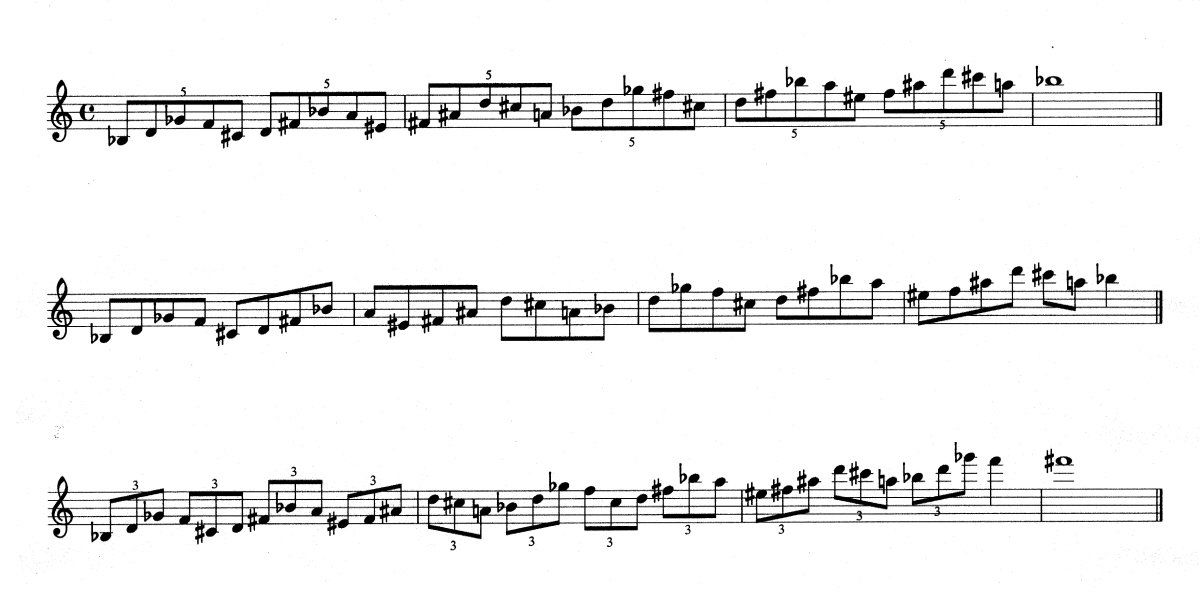
    Here is an augmented scale pattern that I started tinkering with yesterday. It’s similar to one I’ve practiced fairly often, but inserting an extra note into each four-note grouping–resulting in quintuplets–adds both harmonic and rhythmic color.

    The exercise uses the Bb augmented scale. Since it is a symmetrical scale, it also functions as D and F# augmented scales. For the theory behind it, see my first post on the augmented scale and view my page on jazz theory, technique, and solo transcriptions for a number of other articles.

    The image to your right (click on it to enlarge) contains three rhythmic variations of the pattern. The topmost is the pattern as I originally conceived it in five-note groupings. The line below it shows how the pattern lays out in a standard eighth-note flow. Last of all you’ll find the pattern set to triplets. These latter two exercises introduce a polymetric element, displacing accents in ways that pack added interest.

    During the last few months my focus has shifted to pentatonic scales, and my augmented scale work has consequently suffered. The simple truth is, I just don’t have time to cover all the bases. (I wish I did, but no one is paying me to practice eight hours a day!) Lately, though, now that I’ve gotten the preliminary muscle-memory curve behind me with my pentatonic work, I’ve begun to return to the augmented scale. It is a fascinating, hauntingly colorful scale at which I want to become increasingly adept. The augmented and pentatonic scales both now fit into my practice regimen, along with the diminished whole tone scale. By the time I’m finished working all these weird scales into my fingers, I just hope I’ll remember how to play my major scales.

    It goes without saying–it does, doesn’t it?–that you’ll practice this pattern in all four of its tonal iterations (I don’t know how else to say it; you can’t rightly call them “keys”). Remember to keep application in mind. It’s not enough to get this pattern under your fingers; how are you going to use it? Again, see my initial post on the augmented scale.

    Other than that, there’s nothing left to say except, as always, practice diligently and enjoy the journey.

    The Buttermilk Jamboree and Ed Englerth’s Latest CD, Hope. Dream. Sigh.

    Saturday I played with the Ed Englerth Band at the Buttermilk Jamboree near Delton, Michigan. This was the first of what is likely to become an annual all-weekend event at the Circle Pines Camp in the heart of rural Barry County. It was a fun and interesting festival that combined music and arts with the cooperatively owned camp’s longstanding values of ecology and sustainable living. As you might expect, the festival drew an eclectic crowd of every age, from old hippies to young musicians and everything between and beyond. Picture Woodstock in the woods and you’ve got the idea.

    In the midst of this colorful hodgepodge, Ed, Alan, Don, and I did an evening performance on the Sugar Bush Stage. Oddly, while we appeared in the online schedule, the paper printout didn’t include us. We drew a decent group of listeners regardless, and Ed sold a few CDs from his newly minted album, Hope. Dream. Sigh. The CD is in fact so new that Ed paid extra for an early shipment, which arrived at his door mere hours before showtime.

    I want to talk a little about Hope. Dream. Sigh. I’m hesitant to say that it’s Ed’s best effort yet because his last CD, Restless Ghost, is so bloody good. But this CD is at least of that same caliber, and some of the arrangements are easily the most ambitious yet. This is largely due to the way that Ed utilized me on the saxophones. This is the first of his albums on which we…

  • multi-tracked my horn parts to create an entire sax section. The apogee of this approach is the tune “Sad Stories,” with its ironic Calypso beat and wacky, humorous slant on relational woes.
  • created faux baritone sax tracks. Since I don’t own a bari, and since “Empty Pockets” seemed to flat-out demand the incorporation of a bari, we made one electronically by laying down an alto track and then dropping it an octave digitally. It worked great! “Empty Pockets” cooks, an irresistibly driving, hardcore rocker.
  • made unprecedented use of my soprano sax. I’ve been reluctant to play the soprano on previous albums because, well, my intonation sucks. Or so I’ve always thought. But that problem doesn’t crop up on this CD. Two songs feature the soprano in a big way, and in both of them the horn sounds fabulous. “I Do, I Don’t” klezmerizes Ed’s tongue-in-cheek commentary on fantasy living for the not-so-rich and delusional. On the serious side, “When Words Fail” is a minor, blues-drenched look at love that goes the distance when communication breaks down. I got a lot of room to stretch out on this tune as a soloist, and I’m delighted with the results.
  • .
    Ed is a fantastic songwriter and lyricist who steadfastly resists categorization. That’s one reason why I respect him as an artist and love him as a friend. The man has integrity as well as soul. Moreover, in Alan Dunst on drums, Don Cheeseman playing bass, and, I trust, me on the saxophones, Ed has found a small, steady core of fellow musicians and brothers in Christ who grasp and believe in his music. Each album displays growth, new directions, fresh creative expressions.

    Yes I’m biased. Of course I am–what would you expect? But not so biased that I’d speak this glowingly of Hope. Dream. Sigh. unless I believed it was really just that good. It is. Check it out and see for yourself. I might add that, with 17 tracks, you’ll get more than your money’s worth.

    And with that, I’m signing off. Early morning has turned into mid morning and the rest of this Monday stretches before me, with work to do and necessities to attend to. Ciao.

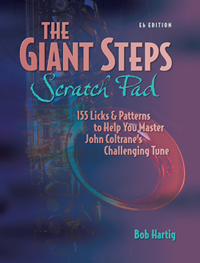
    The Giant Steps Scratch Pad: As Crass a Plug as You’ll Ever Encounter Anywhere

    BUY MY BOOK! BUY MY BOOK! BUY MY BOOK! BUY MY BOOK! BUY MY BOOK!

    Never mind the rest of the gobbledegook on this page–just go to the bottom and start clicking on shopping carts.

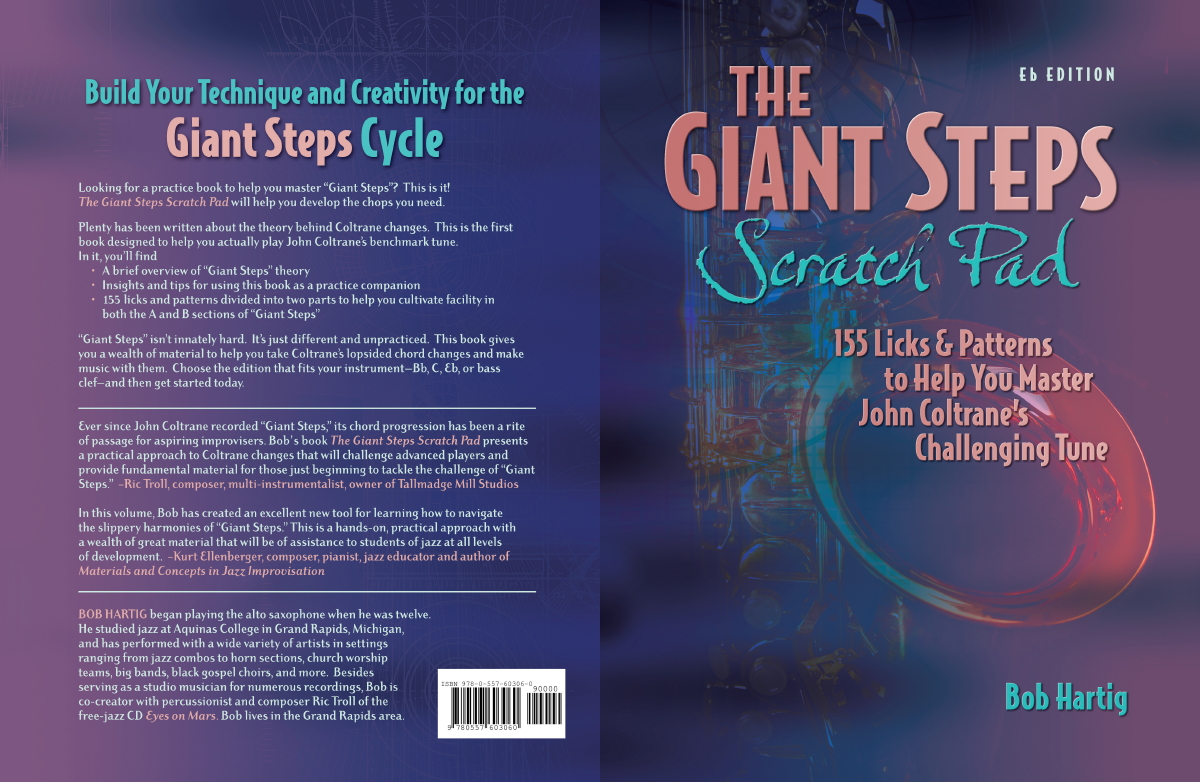
    As for you less impulsive types: Gosh, I hope I’m not being too forward. In real life, I’m the retiring, wallflower type who would never think of grabbing you by the lapels and shaking you wildly about while protruding my eyeballs at you and screaming, “BUY MY BOOK!” Never. The marketing methods I use to get you to buy The Giant Steps Scratch Pad–available in C, Bb, Eb, and bass clef editions–are far more subtle. I prefer to drop discrete hints, such as sending out glossy, full-color mailers that say things like, “This Father’s Day, give Dad the gift that says ‘I love you!’ Give him The Giant Steps Scratch Pad.” Low-key is best, that’s what I say.

    Ummm…did you get the mailer?

    Well, no matter, because here is your reminder that now is the perfect time to get Dad, or Mom, or your Aunt Bronte who plays the crumpophone, or maybe even your little old self, a copy of the Scratch Pad. Why is now so perfect a time? Because now is such a totally in-the-moment time, and jazz improvisation is such an in-the-moment art form, and Coltrane changes typically fly by at such an in-the-moment, near-light speed, that, overlooking the utter pointlessness of everything I’ve just written, you really should cough up $9.50 and BUY MY BOOK.

    Do it. Not only will you be keeping a starving artist in Ramen for a week, but–seriously now–you will also be getting a truly unique and valuable practice companion for jazz improvisers. If you’ve ever wanted to master Coltrane changes, this book will do the trick. To the best of my knowledge, it’s the first practical, hands-on resource for jazz instrumentalists of every kind that helps you develop the technique to play Giant Steps changes. You can find plenty of material on Coltrane’s theory, but very little that you can actually wrap your fingers around in the woodshed.* The Giant Steps Scratch Pad fills that gap, taking you beyond theory to application.

    Here’s what you get:

    • * A brief overview of “Giant Steps” theory
    • * Insights and tips for using this book as a practice companion
    • * 155 licks and patterns divided into two parts to help you cultivate facility in both the A and B sections of “Giant Steps”
    • * 2 pages of licks using the augmented scale–the “universal scale” for Coltrane changes

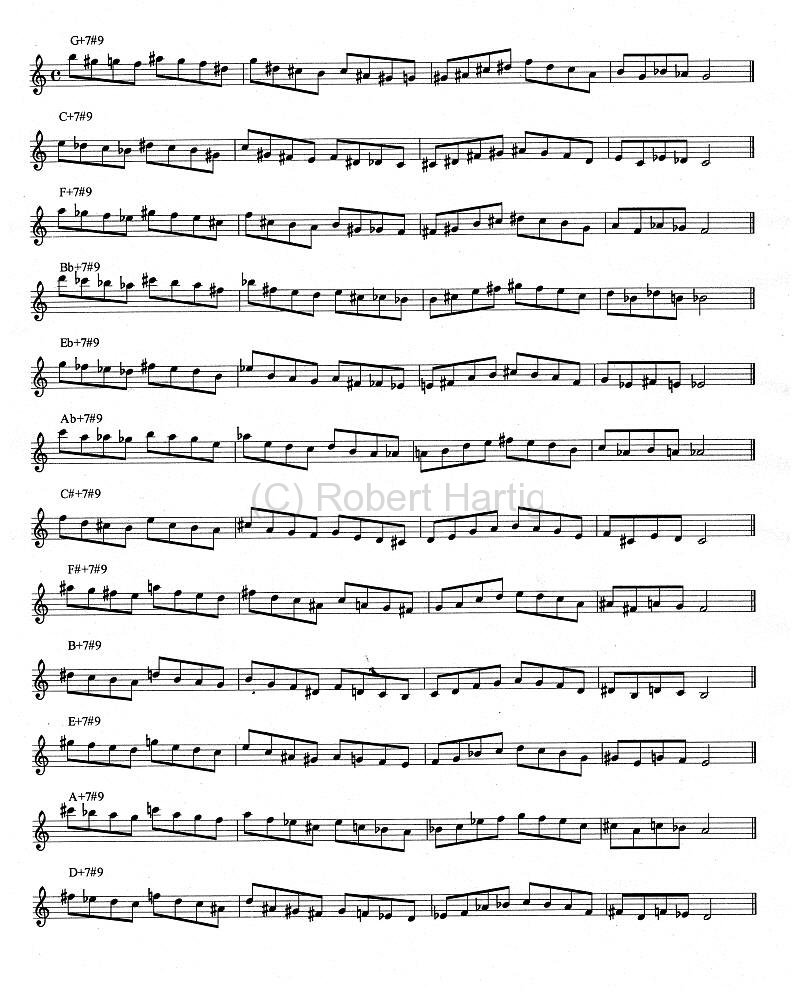
    Click on the image to your left to view a printable page sample from the Bb edition (for tenor sax, soprano sax, trumpet, and clarinet). Print it out, take it with you to your next practice session, and get a feel for what the Scratch Pad has to offer. Each line takes you through the first four bars of Giant Steps changes. Transpose the pattern down a major third for the second four bars.

    AVAILABLE IN C, Bb, Eb, AND BASS CLEF EDITIONS, AND BOTH IN PRINT AND AS A PDF DOWNLOAD. 32 PAGES.

    Instant PDF download, $9.50
    C edition Add to Cart
    Bb edition Add to Cart
    Eb edition Add to Cart
    Bass clef edition Add to Cart
    View Cart

    Print editions–retail quality with full-color cover, $10.95 plus shipping: order here.

    PRAISE FOR THE GIANT STEPS SCRATCH PAD

    “Ever since John Coltrane recorded ‘Giant Steps,’ its chord progression has been a rite of passage for aspiring improvisers. Bob’s book The Giant Steps Scratch Pad presents a practical approach to Coltrane changes that will challenge advanced players and provide fundamental material for those just beginning to tackle the challenge of Giant Steps.’”Ric Troll, composer, multi-instrumentalist, owner of Tallmadge Mill Studios

    “In this volume, Bob has created an excellent new tool for learning how to navigate the harmonies of ‘Giant Steps.’ This is a hands-on, practical approach with a wealth of great material that will be of assistance to students of jazz at all levels of development.” Kurt Ellenberger, composer, pianist, jazz educator and author of Materials and Concepts in Jazz Improvisation

    ——————————-
    * Unless you’re a guitarist. For some reason, I’ve found a modest offering of good, practical material available for guitar players. You’d think that tenor sax players would be the prime audience for lit on Coltrane changes, but not so. Guitarists are the torch bearers. Sheesh. You string pickers have all the luck.

    Uh-oh! Time for Sax Maintenance AGAIN?!

    So there I am in Ed Englerth’s basement tonight, getting set to rehearse for our set this coming weekend at the Buttermilk Jamboree near Delton, Michigan.  I pick up my alto sax, clamp my lips around the mouthpiece and blow, and what happens? FWEEEEEFFFF, that’s what happens. My horn goes FWEEEEEFFFF.

    That’s not a promising sign. Hoping it’s just the reed, I substitute a different one, but once again, anything from low D down balks like crazy, and the higher notes aren’t all that cooperative either.

    So I take my leak light out of my case and run it down the horn, and what’s really frustrating is, I can’t see any sign of a leaky pad anywhere. Maybe that’s due to my strictly neophyte abilities when it comes to troubleshooting saxophone ailments, but still…not even a pinprick of light shining from one of the palm key pads? Nothing?

    Next step: remove the mouthpiece and check to make sure it’s sealing properly. It is–no problems there. And here’s the interesting part: when I put it back on the saxophone neck, my horn plays just fine–for about fifteen seconds. After that, HHAAARRRRNNKKK!!!

    Nutz. This sucks.

    So I set the alto aside and do the rehearsal using my soprano. I’m not crazy about that option since my intonation on the soprano sax leaves something to be desired, but I don’t have much choice. My alto is unplayable.

    I’m wondering whether a loose cork or something may have lodged somewhere in the horn and is impeding the air stream. Better that than have to take my horn to the shop for repair work that I just don’t have the money for right now. It has only been a few months, after all, since I slapped down $160 to have the sax repadded and ministered unto by my repairman.

    Whatever the problem is, I’ve got to get it fixed by this weekend, because I have two gigs, and one of them is a big band gig that doesn’t give me the liberty of simply swapping the alto for the soprano.

    Ugh. Saxual problems. But they can wait till tomorrow to figure out. I’m done thinking about the matter for today.