Sax Maintenance: Happiness is a Tight Horn

After giving the matter some thought, I will admit that there are some things that are better than a freshly adjusted horn. There just aren’t many.

I got my trusty Conn 6M back from my repairman today, and I’ve fallen in love all over again with my “Lady Face.” The horn is an absolute joy to play when all the pads are sealing tightly and the horn has been properly regulated. Tomorrow night, when I play at One Trick Pony with Francesca and Friends, I’ll be getting everything out of my alto sax that it’s capable of giving–and that is a lot, beginning with a fat, round, robust tone that fills the room without any need of a mic.

This is the second time I’ve taken my alto to this present horn technician. He’s pricier than what I’ve been used to paying, but I don’t mind, because the man really knows his stuff. When I walk away from the shop with my horn playing the way it is now–that’s worth it to me. There’s something about a freshly serviced horn that makes it irresistible; pick it up and start playing it, and you can’t put it down anytime soon. At least, I can’t. I gave mine a good workout this evening, and I’d have kept going for another hour had I not had other items on my schedule to take care of.

If you’ve played your horn any length of time, you understand that periodic maintenance is as much a built-in, normal expense of playing the saxophone as purchasing new reeds. I try to get my horn in to the shop every six months or so. That’s not really so much a matter of the calendar, though. I’m just sensitive to my horn, and when it starts getting squirrelly on me–when the low notes blow hard and want to separate into overtones; when the volume becomes difficult to control; when my tone becomes raspy or strident–then I know it’s time to see the tech.

Since the issues that can crop up on a saxophone tend to do so incrementally, it can be surprising just how huge a difference a good maintenance job can make. If you’re a novice player, don’t be shy about taking your horn in to the music store and having a repair man look at it. Just make sure he’s a good one. Most techs know their job, but you may want to ask around and find out if there are one or two names that get stellar recommendations from professional players. I’m really pleased with my present technician, and it helps to know that he gigs regularly himself.

Can’t wait to see what my horn does on Francesca’s Valentine’s Day gig. It’ll be a blast. I hope to see some of you out there tomorrow night at One Trick Pony!

The Wisdom of Not Chasing Storms in February (or, Gee, I’m Glad I Practiced My Sax Instead!)

When it comes to chasing early-season severe systems, I’m getting better about reining myself in. Today was the big test. With a whopper of an H5 jet max–upwards of 120 knots–pushing through northern Kentucky into southern Indiana and Ohio, it was tempting to make the drive down to Xenia and parts thereabouts. True, the whole thing looked to be a massive straight-line wind event, but you never know, right? Particularly when you’ve been cooped up all winter with a nasty case of SDS (Supercell Deficiency Syndrome).

I’m patting myself on the back for not going. In fact, I didn’t chase squat today, not even the grunge that was drifting north from the border and offered at least the possibility of a little lightning. That would have been nice to see in February, but I just couldn’t muster the enthusiasm, and now I’m congratulating myself for my restraint.  The wind event did in fact materialize, but way to the south, down in southern Ohio, Kentucky, Tennessee, and on to the east, and not a solitary tornado report do I see in the whole batch of SPC storm reports. So I’m very glad I managed to ward off the temptation to grasp at straws. Not only am I not presently driving the long 350 miles home, wondering what on earth I was thinking that brought me down there in the first place, but I invested my time into practicing my saxophone, a much more profitable activity.

I worked with my new copy of Emile and Laura De Cosmo’s book The Diatonic Cycle, which arrived today in the mail. It’s fun to work with a practice book again. These days, I do so much of my practicing straight out of my head, and the De Cosmos‘ well-conceived, organized, and interesting approach comes as a welcome new way to work on my scales and keys. It should keep me occupied for a few months as I work my way through all twenty-four major and harmonic minor scales as presented in the book.

Opting for practicing my horn over chasing storms was a smart move today. Yesterday, on the other hand…well, if I lived 500 miles closer to Oklahoma, I’d have been all over yesterday’s severe weather. Sadly, that weather marked the year’s first tornado fatalities. It appears that the sirens weren’t working as a large, violent wedge rototilled the town of Lone Grove, Oklahoma, west of Ardmore, doing EF4 damage and taking fifteen lives. According to reports, some people were caught out in a parking lot. How awful. February is not a time when folks in the Great Plains expect such things, and I’d imagine that many people were caught off guard.

Looking ahead, the Gulf of Mexico appears to be opening up for business in Dixie Alley, but we won’t be seeing any of that moisture this far north again in the foreseeable future.  Tonight we plunge back into snowy conditions. This is, after all, February in Michigan.

Emile De Cosmo and the Polytonal Rhythm Series

I got a most pleasant surprise today while checking my voice mail. A gentleman named Emile De Cosmo had left a message saying that he had run across my post on jazz contrafacts while researching the topic online, and inviting me to call him back. Emile mentioned that he is a jazz educator who has written twenty-six books, and wondered whether maybe I’d heard of his material.

Are you kidding? Heck yes, I’d heard of his books, and of Emile. I’ve known of Emile since back in my college jazz studies days, when I first encountered an ad in Downbeat for his Polytonal Rhythm Series and ordered one of the books from that series.  Good grief–Emile De Cosmo, calling me? What an honor!

Of course I returned Emile’s call, and we had a most enjoyable chat. Besides being a passionate and thoughtful jazz educator, Emile is a genuinely nice, warm, down-to-earth guy, easy to talk to and well worth listening to. Unfortunately, our conversation got cut short by a bad signal on my cell phone, but I look forward to reconnecting with Emile and picking up where we left off. At 84 years old, he’s still going strong, writing books and developing his didactic concepts in jazz. He may be retired from university instruction, but the educator in him doesn’t appear to have taken so much as a breather.

Having visited Emile’s site, I’m struck by how much thought and time the man has invested into perfecting his ideas about helping others develop a fluent technique and “big ears.” The Polytonal Rhythm Series was a magnum opus in itself, but Emile and his wife, Laura, have developed more material over the years. With my interest reawakened, I purchased The Diatonic Cycle and have my sights set on The Path to Jazz Improvisation. I’m also intrigued by The Tritone Cycle, but that can wait. I expect that I’ll have my hands full for a while with the first book once it arrives. The timing is perfect; I’ve been wanting something to help me expand my saxophone practice in a different direction.

Emile, if you read this post, it was great talking with you! I look forward to our next chat. Keep up the great work!

Phil Woods and David Sanborn Play “Willow, Weep for Me”

I just finished watching this YouTube video of Phil Woods and David Sanborn, and I am just blown away. No words for this rendition of “Willow, Weep for Me.” Just listen, that’s all I can say.

Sunset Photos and Sax Licks

We finally got a break in the gray skies and snows. Today’s morning sun rose into a flawless sky, and sunshine predominated all day long, along with warmer–which, at thirty-two degrees, is not to say warm, but an improvement on what we’ve had–temperatures.

I grabbed my saxophone and my camera and headed out to Grand Ledge this afternoon, and on the way out there, I grabbed my first workout in months. I haven’t been in the gym since last October, I’ve been feeling the lack of exercise, and I finally decided the time had come to get back into my workouts. So I dropped in at a modest but great little weight lifting gym out by Lake Odessa and ran through a quick, twenty-minute break-in routine. One set per movement is enough; I’ll be feeling the pain Monday when it comes time for my next bout in the gym.

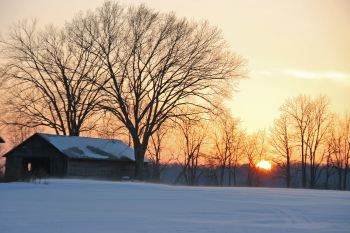
Anyway…I took a number of photos out near Grand Ledge. The ones I liked best were of an old, deserted farmstead at sunset. Thought I’d share a couple with you.

Old Shed at Sundown

Old Shed at Sundown

The Sun Sinks Lower

The Sun Sinks Lower

Afterwards, I found a place to park my car and practice my saxophone. It has been a while since I’ve spent time on my horn. I’ve been writing a book and have been singularly focused on that, and I need to exercise a little balance, tend to other things that are also important. Staying on top of my sax is right up there at the top. It felt good to limber up my fingers and run through some Charlie Parker licks.

It takes discipline to be a good jazz musician. Licks and ideas you think you own for keeps can desert you after a while if you don’t practice consistently. Fortunately, I’d only been away from my axe for a bit, not long enough to damage me. But it always feels good when I pick it back up.

Colder Than a Teacher’s Wit

For whatever reason, the above title just got hold of me, and it”s not going to let go until I do something with it. So here it is in print. Now it”s yours to deal with.

I will say that a few of the teachers I had back in my grade school days did have some pretty cold wits. Mrs. Flikkema could freeze you solid at thirty paces with a sarcastic remark. It”s hard to write a 500-word essay when your fingers are numb to the bone.

But I digress from my objective, which is not to write a lot of words, but to share more pictures from yesterday, plus a couple from today.

Qualitatively, the two days have been very similar, which is to say, just a couple notches above the point where molecules cease to move. Temperatures this cold make for very interesting pictures, and very interesting experiences taking pictures. Earlier, while snapping sunset photos out at Sessions Lake in Ionia Counta, I was distracted by a sudden, tinkling sound. My left earlobe had crystallized, broken off, and shattered into tiny pieces on the ground by my feet.

Okay, that didn”t really happen, but it could have happened. Enough on that subject. Here are some photos.

Francesca Amari and Friends Valentine’s Gig at One Trick Pony

Laaayyy-deez and Gen’lmen!!!

Wives, Husbands, and Sweethearts!!!

Announcing the one and only, the fabulousFRANCESCA AMARI and her band of musical pranksters…

…in a Valentine”s Day extravaganza of love songs, from the tender, to the sultry, to the humorous–all delivered with the spark, presence, and sensitive musicality of Francesca. I’ll be backing her up on the alto sax, along with Dave DeVos on bass and Dave Molinari on keyboards.

The place is One Trick Pony at 136 East Fulton in downtown Grand Rapids, Michigan. It”s going to be a memorable evening of music at a very nice venue. Francesca is a wonderful entertainer, and the rest of us don”t suck mud. So treat yourself and your special someone to a truly enjoyable Valentine”s date filled with great music and good times.

The show starts at 8:00 p.m. Do join us.

Phil Woods and Jackie McLean Play “Cherokee”

I love playing the Ray Noble tune “Cherokee.” It’s a classic bebop vehicle, and the bridge section represents a respectable knuckle-buster for even the more accomplished players. “Cherokee” is typically played anywhere from up-tempo to way, way, way up-tempo. I like to play it fast, but I’ve got my limitations. Once I hit around 300mm, I’m scrambling to stay on top of things.

Maybe one day, if I practice reeeaallly hard, I’ll be able to play it almost as well as these guys. Here are Phil Woods and Jackie McLean playing “Cherokee.” Sit back and get ready for a real bebop tour de force by two virtuoso, veteran alto sax players. Each is a distinct, mature voice in his own right, but here you can tell they’re both unabashed Bird disciples. The ideas don’t stop, and they’re dripping with classic bop vocabulary. Amazing, and a pure joy to listen to.

Using Substitute Dominants

Sooner or later, if you haven’t done so already as a jazz improviser, you”re going to want to broaden your harmonic palette with substitute dominant chords.

Say that term, substitute dominant, and what immediately springs to mind for most musicians is what is also refer to as a tritone substitute, so called because the root is a diminished fifth–a tritone–away from the root of the dominant seventh chord in any given key. For instance, let’s say you’re in the key of C major. The dominant of C is G7. In traditional theory, the G7 is a major/minor seventh chord.

If you drop down a tritone from the G7 and build another major/minor seventh chord, you wind up with a Db7. That is your tritone substitute, the most commonly used substitute dominant.

Note that the Db7 is just a half-step above your tonic chord, C major. Now, you could use a a Db Mixolydian mode with it. But another good choice would be a Db Lydian flat seventh scale–i.e. Db, Eb, F, G, Ab, Bb, Cb, and Db octave. Note that, as is so often the case, a single note makes all the difference. In this case, simply raising the fourth scale degree of the Db Mixolydian mode a half-step, from Gb to G, gives you the Lydian flat seventh scale.

Now, here’s where things get particularly interesting: let’s say you want to inject a little color with an altered dominant, a G+7(#9). That chord immediately suggests that you”ll use a diminished whole tone scale. Guess what? The diminished whole tone scale uses the same notes as the Lydian flat seventh scale; the only difference is, it starts on the G instead of the Db. So in this case, you can use the same scale for either the altered dominant or the substitute dominant! Nice, eh?

One of the earmarks of the tritone substitute is that it flipflops the third and the seventh, which are critical tones in the function of the dominant sound. The flat seventh of the V7 chord is the third of the bII7 chord, and vice-versa. This means that no matter which chord you use, dominant or substitute dominant, the tritone interval between the third and the fifth remains, with all its tension that demands resolution to the tonic chord.

Using the substitute dominant in a ii-V7-I progression gives you ii-bII7-I. You can also alternate the dom/subdom sound on your journey toward the I, thus: V7-bII7-I.

By the way, the tritone substitute is nothing new. In Bach”s day, it was called a Neopolitan chord. Jazz is deeply rooted in European harmony; the genius behind it lies, in part, in how African American musicians fused that harmony with tonal colors and rhythmic approaches that no Western musician would have dreamed of. Jazz truly is a distinctly American art form.

Reflections on the Old and New Years

As I begin this post, the year 2008 has just three hours left. There is much about it that I’m sure most of us won”t miss, but the downsides of life are all too easy to focus on, and we need no reminding of them. Instead, I’d like to thank God for a few of the blessings with which he has filled my life this past year.

I thank my Lord Jesus for…

* My close friends and family. You know who you are. I treasure you!

* Keeping me afloat financially as I”ve gone about forging a new direction as a freelance writer.

* Awesome storm chases in Missouri, Kansas, and Iowa–and my awesome storm chasing partners, Bill, Kurt, and Tom.

* The simple, wonderful gift of good beer.

* My new DSLR camera, and how it is helping me to view the world with an artist”s eye.

* The gift of music, and of growth as a saxophonist and jazz improviser.\r\n* So many, many other blessings, some of which I’m aware and others of which I’m unaware. Such is the grace of Christ.

* Finally, but really first and above all, the Lord himself. For his kindness. For his friendship. For his discipline, and guidance, and for his life that has become my life.

Thank you, Lord, for this year of 2008. Above all, thank you for You.

To all who read these words…

…to musicians, and songwriters, and singers, and all whose souls have been shaped by the melodymaker’s craft…

…to storm chasers, and weather fanatics, and those who have fallen in love with the hiss of inflow over prairie grasses, and the convective sculptures of the Great Plains…

…I salute you! Here”s to a Happy New Year!

This evening, the sun sets on 2008. Tomorrow, for better or worse, 2009 dawns on us all. In the face of a troubled planet, may the grace of the Messiah spring up in unexpected places and cause this next twelve-month”s time to be a hopeful and rewarding one.

Wishing you blessing, prosperity, wisdom, inner peace, and a deepened capacity to live the life God created you to live,

Bob

Aka “Storm”