Remembering “I Remember”: A Tribute to Phil Woods

My introduction to the magnificent alto saxophonist Phil Woods back in my music school days came in the form of a vinyl LP titled “I Remember.” I had been hearing of Woods’ lyrical approach and decided to acquaint myself with it. So off to the music store I went, and returned with the record album that was Woods’ tribute to some of his departed friends and musical influences–Paul Desmond, Cannonball Adderley, Oscar Pettiford, Charlie Parker, and others. The tunes, written by Phil, captured something of the personality and unique qualities of the men he had eulogized in the album.

I remember my first hearing of “I Remember.” I slapped the record on the turntable, dropped the needle, and proceeded to be utterly blown away. Phil Woods not only possessed complete mastery of the alto sax, but he also had a gorgeous, full-bodied tone and a personal, trademark sense of swing by which I’ve been able to instantly identify him ever since. Best of all, though, Phil played beautifully–and I’m using that adverb here in its strict sense. Phil’s playing on that record was truly so beautiful and so passionate that in places, it literally moved me to tears.

I have in mind the tender, deeply moving ballad “Paul,” written in tribute to Paul Desmond. Phil’s solo on that tune just took my breath away, and having listened to it again recently, I still am left speechless by its perfection. “Paul” is very possibly the most creative, flawlessly executed, and heart-wrenchingly lovely rendering of a ballad that I’ve ever heard, and its first impact on me was to raise up Phil Woods forever in my mind as the man to emulate when it came to ballad interpretation. In that I’m far from alone. Countless alto players over the years have looked to Woods as a jazz waymaker, fount of ideas, and source of inspiration.

My stack of LPs is long gone, and when I finally got to thinking about “I Remember” again a couple years ago, I couldn’t find it in a CD edition. It appeared to no longer be in publication, and regretfully, I consigned myself to never again listening to Phil’s beautiful playing on that album.

Jump forward to this Christmas. My sister Diane gave me my very first iPod (have I mentioned that I’m a slow joiner?) plus thirty dollars worth of iTune gift cards. So iTune shopping I went, and guess what I found? Of all the myriad albums to choose from, I chose “I Remember” as my first download.

You can’t imagine how thrilled I am to reacquaint myself with the collection of tunes that was my first exposure to Phil Woods. It seems impossible that thirty years have passed since that time, but today, “I Remember” still has the same effect on me as it did back then. Having developed a degree of expertise on the alto sax that I didn’t possess in those days, I find Phil’s playing to be, if anything, even more awe-inspiring and beautiful than when I first heard him. “Julian” still makes me want to shout for joy. “Charles Christopher” still floors me with its incendiary bebop.

And “Paul” still makes me cry.
New Years Eve Gig at the Cobblestone

Man, this year has blown by fast, hasn’t it! Five days from now we’ll have turned the corner into circa 2011. New Years Eve is the last of the big holidays. After that, we get down to the business of doing winter up here in the circumboreal region.

So what are you doing for New Years Eve? How’s about enjoying it with Steve Durst and me at the Cobblestone Bistro here in Caledonia, Michigan? We’ll be playing jazz standards through the dinner hours from 6:00-10:00 p.m.

Let me tell you a bit about the Cobblestone, because it’s a jewel. Located on the east side of M-37 (aka Cherry Valley Road) on the south end of Caledonia, the Cobblestone is designed for ambiance. Step inside and you’ll find an elegant, modestly sized dining room that features a fireplace, a waterfall fountain, superb cuisine, a selection of world-class wines, and a very nice bar. We’re talking destination dining right here in little old Caledonia. If you’re looking for a cozy place to spend the evening with your special someone, you’ll be absolutely delighted.

Of course, besides all of the above, this New Years Eve you’ll also get Steve on the keyboards and me on the alto saxophone providing live jazz to complement the mood. So come and enjoy dinner with us in one of the nicest settings you can imagine. Here’s the info:

• Date & Time: December 31, 6:00-10:00 p.m.

• Place: The Cobblestone Bistro & Banquet Center

• Address: 9818 Cherry Valley Ave. SE (M-37), Caledonia, MI

• Phone: (616) 588-3223

If the weather proves to be as warm as is currently forecast, this New Years Eve should be perfect for a night out. Spend it with us at the Cobblestone! I hope to see you there.

Practical Tips for Playing the Sax in Church

It has been a couple years since I’ve played my saxophone in a worship team. At some point I will probably participate again, but after 30 years as a disciple of Jesus, during most of which I’ve been involved in church music ministries, I’m not in a rush. Music is a wonderful gift, but in church it can also be an overwhelming one, a powerful categorizing force that can overshadow other aspects of who a musician is as a complete person. So the hiatus has, for me, been necessary and beneficial.

That’s where I’m at, but for many of you, your concern is more pragmatic. You haven’t spent three decades playing in church. You’re just getting started, and what you’d really like to know is how to fit in as a saxophonist–or a trumpet player, or a flutist, or an ocarina player, or whatever–with the rest of your church’s worship team. How do you play your part successfully?

That’s a straightforward question, and I’m happy to respond with a few simple, to-the-point suggestions.

◊ Determine what keys your worship band most often plays in. Black gospel music is typically organ- and keyboard-driven and is likely to use flat keys such as Bb, F, and Eb major. Contemporary music in white churches almost always revolves around guitar, which puts the emphasis on sharp keys such as E, A, D, and G.

◊ As would be true in any setting, whether in church or in a club, know your transposition. If you’re a tenor sax or trumpet player, the key you play in is up a major second from the piano and guitar. If  you’re an alto sax player like me, you’ll be down a minor third. If you play the flute or trombone, you don’t need to transpose to a different key.

◊ Learn pentatonic scales in the most commonly used keys. Most church music is harmonically simple and largely diatonic, and you can cover many a song using a single pentatonic. It’s hard to hit a wrong note playing a pentatonic scale! Of course, you’ll want to add more colors to your palette as you gain familiarity with the music, but pentatonics make a great foundation. The melody for “Amazing Grace” is written entirely from a single pentatonic scale.

◊ Similar to the previous point, learn the major scales of the most commonly used keys. One caveat: Watch how you handle the fourth and seventh scale degrees, as they have the potential to clash with certain chords. That’s one reason why you need to…

◊ Listen! Get a feel for which notes sound good with the chords of a particular tune in different places. In particular, listen to the vocalist and don’t step on his or her toes. Fill in the cracks between lyric phrases, and lay back more when the vocalist is singing. Listen also for what other melodic instruments such as the guitar and keyboard are doing so you can coordinate with them. Overall, be sensitive to the moods of the music and where it’s going.

◊ Don’t be afraid to play! How else are you going to learn? Make your mistakes–that’s part of paying your musical dues. Trust me, most people will never notice the clinkers, and the few who do won’t care.

◊ Strive not to overplay. Unless you’ve been given a solo spot where you get to strut your stuff, keep things simple. If you find yourself playing busily like a beaver in every chorus of every song, cool your jets and give another lead instrument a chance to provide some fills. Consider playing long, held-out chord tones. And remember, often the most effective thing you can play is nothing at all. Drop out for a chorus and notice how subtracting your instrument adds to the music by modifying its texture; and also notice how reentering in the next chorus creates an energy that wouldn’t have existed if you’d been playing all the way through. Contrast is beautiful!

◊ Don’t just learn the tunes–learn your instrument! Practice scales, arpeggios, licks, and patterns. Do the hard work with a spirit of excellence when no one is listening–“heartily, as unto the Lord”–and you’ll be increasingly pleased with the results when you’re playing with the band.

◊ Develop your ears and your instincts as an improviser. You can’t count on charts to get you through. Unless your team uses professional arrangements, chances are good that the way you practice a tune during Wednesday rehearsal isn’t going to be duplicated exactly on Sunday. You’ve got to be able to flex instantly with shifts in direction and even mistakes by the team leader or vocalist. That means you’ve got to–did I already mention this?–listen!

◊ Learn the melody and the form of a song. Doing so will give you a frame of reference so that you’ll never get lost in that tune. You may get temporarily displaced, but you’ll always be able to find your way back to where the rest of the band is without having to hunt it down on a fake sheet. Best of all, knowing the tune will free you to soar within the framework of the music, allowing you to focus on creativity and musicality rather than following a chart.

◊ Be careful about playing in the same range as the vocalist. I’m not saying don’t do it; I’m saying, exercise care and good taste. In particular, try to avoid hitting unison notes with the singer except as a calculated effect. Consider playing in the octave below the vocal range.

◊ Don’t feel you’ve got to play in every song. Not all music was made for the saxophone. For instance, if the band is playing a tune that emphasizes a fast-paced, heavy metal guitar sound, then you might want to sit that one out. Or if a tune is simply too complex for your level of development, to the point where you don’t feel comfortable playing it, then step off to the side and let the rest of the band take it. Just because your instrument can be used doesn’t mean it always should be. It’s a voice; add it or subtract it in a way that best serves the music.

I could offer still more suggestions, and maybe other experienced players will lean in with advice of their own, but this is plenty ’nuff to get you going. Note that I’ve said nothing about the spiritual side of playing in a worship team. Important as that is, it’s not the focus of this post. My intention here has been to give you some nuts-and-bolts input that you can start applying right away. I hope you’ll find it both helpful and encouraging.

If you enjoyed this post, then check out my jazz page, where you’ll find more useful and insightful articles, exercises, and solo transcriptions.

A Diminished Whole Tone Lick

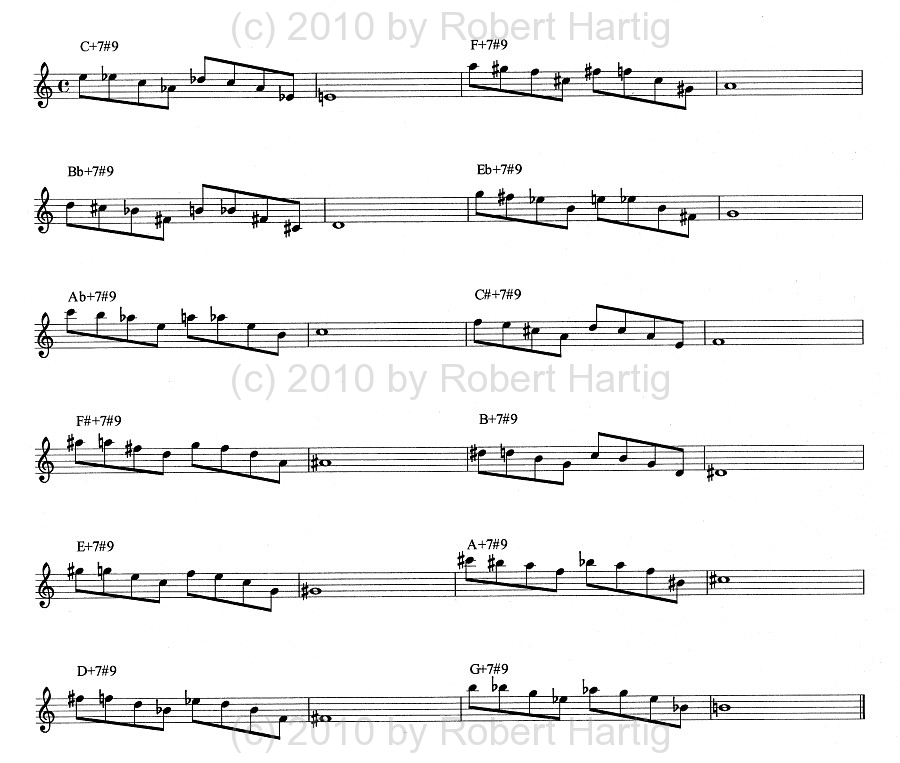
The diminished whole tone scale (aka super locrian scale, altered scale, altered dominant scale, Pomeroy scale) is nothing if not colorful. A mode of the ascending melodic minor scale built on that scale’s seventh degree, the diminished whole tone scale encompasses virtually every alteration to a dominant chord that you can think of: #5, b9, #9, and #11. It’s commonly used over dominant chords of various alterations, and is ideally suited to the V+7#9.

The name “diminished whole tone” refers to the scale’s two tetrachords. The bottom tetrachord derives from a half-whole diminished scale, and the top tetrachord suggests a whole tone scale. For example, connecting the tetrachord B, C, D, and Eb with the tetrachord F, G, A, and B will give you a B diminished whole tone scale: B, C, D, Eb, F, G, A, B. (In actual use, you’d want to think of the Eb enharmonically as a D#, the major third of a B+7#9 chord).

diminished-whole-tone-exercise_0To your right is an exercise that will take you around the cycle of fifths with one of my favorite diminished whole tone licks. (Click on the thumbnail to enlarge it.) I like the lick for three reasons. It starts and finishes on the highly consonant major third of the altered dominant chord, but in between it spotlights the altered tones of the chord (#5, b9, #9). It emphasizes the half-step relationship between the third and #9, and between the b9 and the chord root. And it outlines the major triad built on the raised fifth of the altered dominant–e.g. the #5 of a D+7#9, A# (Bb enharmonically) gives rise to a Bb major triad.

Have fun with the exercise. If you’re not familiar with the diminished whole tone sound, it may take a while to get it into your ear, but you’ll be glad you did.

Look for more exercises, helpful articles, and solo transcriptions on my jazz page.

Playing with Another Horn Person

Last night I moseyed over to Noto’s in Cascade and sat in with Kathy Lamar, Bob VanStee, and Bobby Thompson. Kathy is a fantastic vocalist, and with Bob on keyboards and Bobby on drums, she has a rhythm accompaniment with abilities equal to her own. In recent months I’ve popped in a few times and joined in, and I’ve always enjoyed myself, but never more than last night.

It had been a while since I’d made it out to Noto’s, and I thought I’d call my friend Dave DeVos and see if he wanted to join me out there. He did, and when I walked through the door he was already there, setting up his electric bass. Even better, Dan Jacobs was there with his fluegelhorn, which created a format I’m particularly fond of.

This was my first acquaintance with Dan, but I’d heard of him and had touched base with him on Facebook. Dan is an accomplished player, and sharing the stage with someone of his caliber is a joy. I love to hear what another capable instrumentalist is doing; that fresh influx of inventiveness and technique tweaks my creativity, suggests new ideas to try, and overall kicks me in the butt. Best of all is the interpersonal exchange, the trading fours and switching back and forth between melody and improvised counterpoints, that kind of thing.

As an alto saxophonist, I think I like sharing the stage with a trumpet/fluegelhorn player even more than with a tenor sax player. The variety in sound and approach is greater, and even visually the contrast is striking and, to me, more interesting. Of course, there are some challenges. At least I find there to be. The main one is to play with that other horn person without overplaying. Often enough, I’ll just bow out, and I noticed that Dan did the same last night. Actually, I find that approach enjoyable. It’s nice to just put down one’s horn and enjoy what the other guy is doing. We usually learn more by listening than by talking, and that maxim can certainly be applied to jazz, provided the person we’re listening to has something to say. Dan does, and it was really nice to hear him last night and get a chance to make a little music with him.

Dan, if you happen to read this, you’re great! Thanks for the melodies. I look forward to next time.

Some New Audio Clips for Your Listening Pleasure

Last Monday I got together with Ric Troll (guitar), Dave DeVos (bass), and Randy Marsh (drums), and we rehearsed a few of Ric’s original tunes in his studio, Tallmadge Mill. These guys are wonderful jazz musicians, and Ric is a composer of long standing. His music can be chewy stuff to work through, but this last session the tunes started to gel and we got some pretty nice grooves going.

Ric recorded the whole session, so I’m able to share some sample tracks with you. What you’ll hear are the tunes in rough, but there’s some very nice playing going on.

The New Hip is a basic 12-bar blues, but Ric’s head suggests a soloing approach different from your standard bebop. Attempting to free myself from cliches, I incorporated a more angular style.

The Urge is a fun tune with a high-energy A section and a swinging, cooler-sounding bridge that offers a lovely contrast.

Orcs has been the most challenging number, with it’s polymetric approach and shift to 7/4. It is coming together, though, and will be one heck of a tune once we’ve nailed down the form and the feel. Listen to Randy–the guy just tears it up on the set! Here’s a second take for all you double-dippers.

If you like what you hear, check out my Jazz Page for more sound samples as well as solo transcriptions, articles, and exercises of interest to improvising musicians.

Angularity Exercises

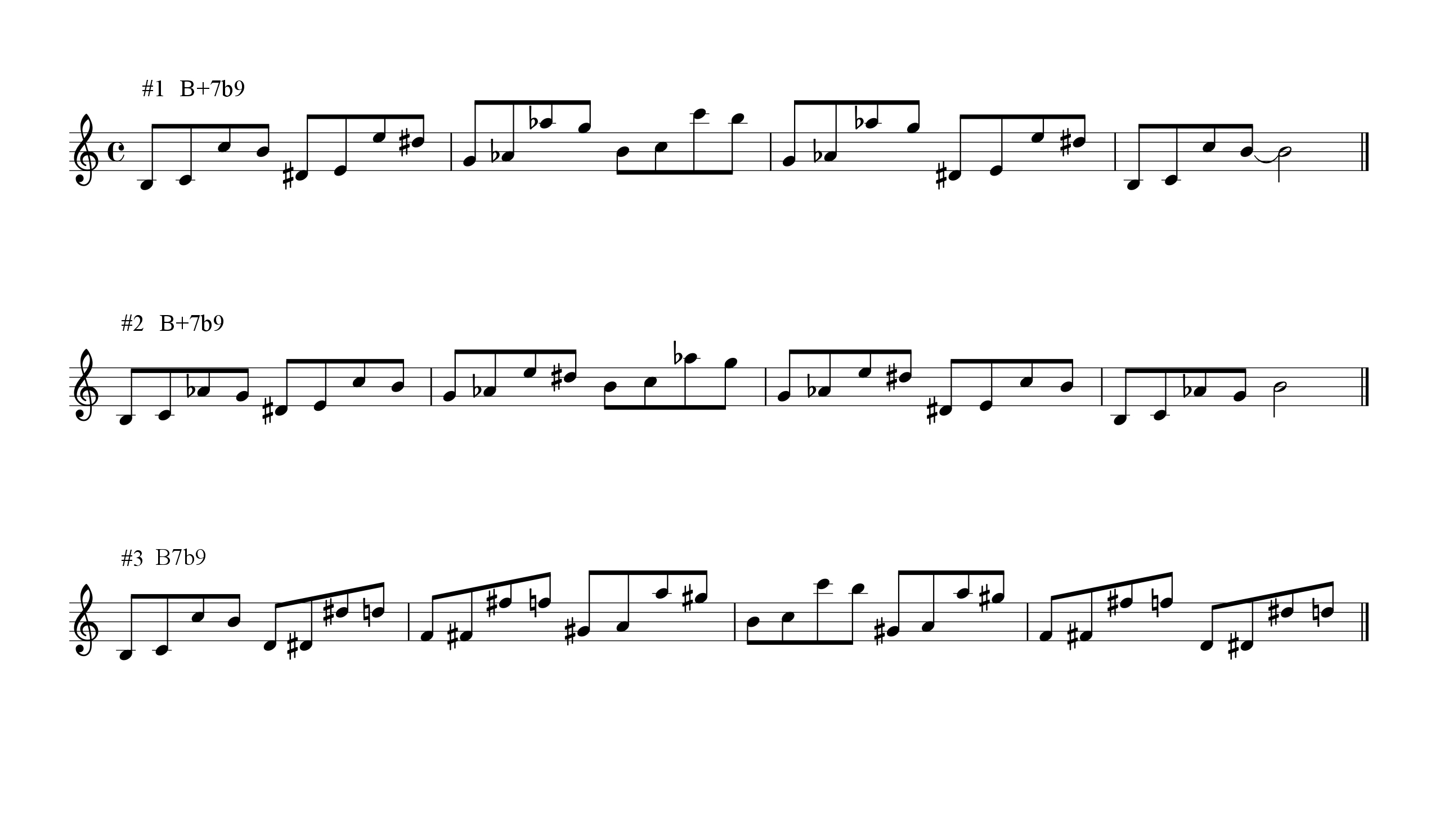
angularity-exercise-1-msczMuch of my playing is pretty boppish, and I’ve wanted to break it up with some different flavors and larger intervals. Lately I’ve been toying with some exercises on angularity involving couplets applied to the augmented scale, and I thought I’d share the wealth. Click on the thumbnail to the right to enlarge it.

The first two exercises are ones I’ve been woodshedding for about a week. They go well, as indicated, with altered dominant chords, but of course they work in any situation where you’d use an augmented scale. While the written exercises specify a B+7b9 chord, you can also use it with an Eb+7b9 and a G+7b9.

The third exercise outlines a half-whole diminished scale and will function as such. I’ve paired it with a B7b9, but it also works with a D7b9, and F7b9, and an Ab7b9.

While it probably goes without saying, play each exercise through the entire range of your instrument and through all twelve keys (“keys” being used here for lack of a better word). Since both the augmented and diminished scales are symmetrical scales, much of your work is done for you. You need learn only four versions of the first two exercises and three versions of the third one.

Happy woodshedding! And if you find these exercises helpful, check out the rest of the offerings on my jazz page.

A Table of Non-Diatonic Tones and Their Common Uses

A while back I shared some ideas on how jazz improvisers can make optimal use of the added flat sixth tone of the major bebop scale. I pointed out that, besides its obvious use as a passing tone that evens out the scale and allows players to move seamlessly from root to octave (or third to third, or fifth to fifth, etc.), the flat sixth also functions readily in a number of harmonic contexts common in jazz.

Yet, useful as the flat sixth (or sharp five) of the major bebop scale can be, it is nevertheless only one of five non-diatonic tones that occur in a major key. In addition, the tonic, supertonic, subdominant, and submediant scale degrees can all be similarly raised a half-step and used in a variety of harmonic applications.

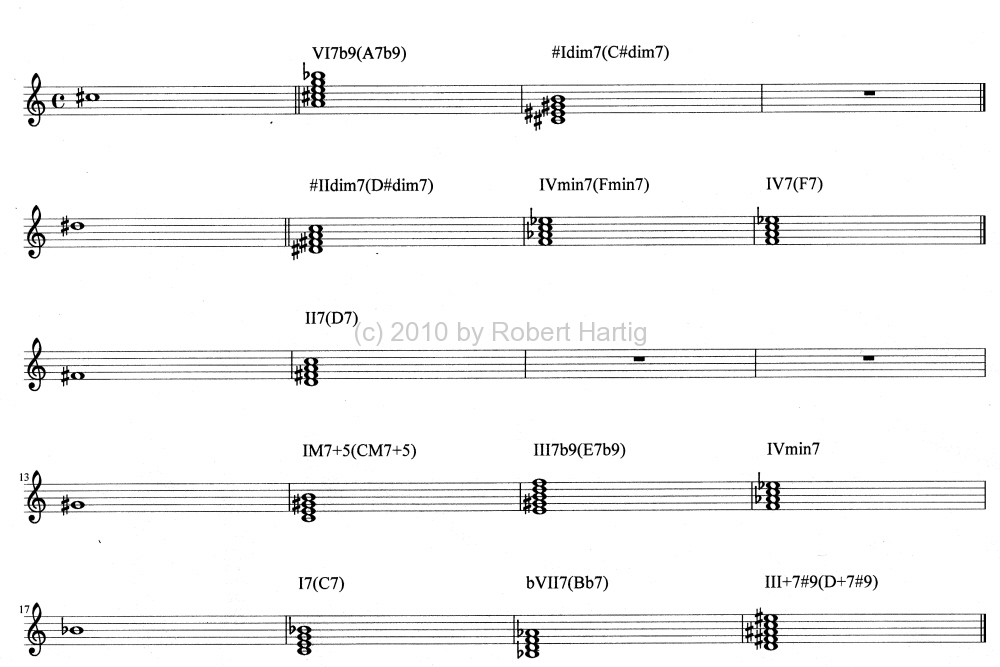
borrowed-tone-applications-002The image to your right  is a table that shows some common uses for each non-diatonic tone in the major scale. (Click on the thumbnail to enlarge it.) The table is by no means exhaustive; it’s just meant to give you a handy reference to harmonic situations you’re likely to encounter as an improviser.

The table is based on the C major scale. In that key, the five non-diatonic tones are C#, D#, F#, G#, and A#.  From top to bottom, the staves begin with a given tone, then show how that tone fits into various chords. The chords are numbered according to their functions and also named (eg. IVmin7, Fmin7). Depending on their application, I may use the enharmonic equivalents of some tones. For instance, instead of A#, I’ve chosen to show Bb, which makes better sense in actual usage.

In stave 1, the VI7b9 and #Idim7 are interchangeable, leading almost inevitably to the IIm7 chord. In the next stave down, the #IIdim7 wants to resolve to the mediant. By adding the scale’s leading tone as the chord root, you wind up with a B7b9, which is the V7 of III. Glancing over the rest of the table, you’ll notice numerous other uses in secondary dominant harmony.

I’m not going to go into detailed explications of every chord, as–assuming that you know your basic jazz theory–the uses of the different non-diatonic tones should be self-evident. Again, the table is not definitive. It’s intended simply to give you a handy reference that can heighten your awareness and help you make more deliberate use of all twelve tones in the chromatic scale. You’re bound to think of other applications not shown in the table.

For practice purposes, you could try working with a single tone. Incorporate it into a major scale to create an eight note scale. Then work out various chordal possibilities that utilize the tone, always keeping in mind the parent major key you’re working in as a frame of reference.

If you’ve found this article useful, make sure you check out the many other articles, exercises, and solo transcriptions on my jazz page. And, as always, practice hard and with focus–and have fun!

Hard-to-Read Music Exercises on Stormhorn: Follow-Up

Have you been having a hard time reading the exercises I’ve provided in my more recent music instructional posts–the ones in which I’ve used transcription software rather than scanned, handwritten material? Some people–including me–have had problems, though not everyone. It seems that some of the lines on the music staves appear faint to nonexistent in places, making it hard to tell the identity of notes.

From what I’m able to tell so far, the issue appears to be part browser-related and part a matter of scale, requiring that the image be adequately enlarged.

Browser: Firefox is my preferred browser. Unfortunately this is the browser on which the problem crops up for me. However, once I click on the image and then zoom in a step or two, everything clears up nicely.

Internet Explorer: When I click on the image, I just don’t have the same problem as with Firefox. The image is clear.

In a nutshell…

If you’re having a hard time reading the exercises, try (a) switching browsers; (b) magnifying the image; or (c) both.

I have an idea up my sleeve that may make everyone happy if it works. I’m going to try it next time I include written exercises in a music post. That shouldn’t be too far down the road now, as it has been a while since I’ve shared such a post. So stay tuned.

Until then, I’ll value your input on the clarity of the exercises. If you’ve had trouble, let me know whether the above suggestions fix things for you. And if you’ve had no problems, let me know that as well.

Thanks!

Bob

Hard-to-Read Exercises on Stormhorn Music Posts

One of my readers has commented that he had difficulty reading an exercise in one of my music posts. I’m guessing that he’s not the only who’s had that problem, since I’ve encountered it myself.

For some reason, while the original image files for my music examples are quite legible, something happens when I upload them to WordPress. The result is that the staves have been reproducing unevenly, making it difficult in places to determine the placement of notes.

Each new instructional post has sent me searching for a fix. So far I’ve been unsuccessful, and I’ve depended on you, my readers, to fill in the blanks, trusting you’d find that the benefits of the exercises outweighed the inconvenience. However, this approach obviously is just a stop-gap, not an acceptable solution.

I’m not sure what the cure is–whether the problem lies in the transcription software I’m using, in WordPress, or in my own lack of technological expertise. Other sites don’t have the same trouble, so I’ve got to believe there’s a simple, viable solution. Until I find it, I thought I’d let you know that I’m aware of the problem, it bothers me at least as much as it does you, and I’m looking for a way to solve it. Meanwhile, thanks for your forbearance!

All the best,

Bob