Chromatic Couplets: Another Way of Unlocking Diminished and Augmented Scales

Have you had enough of the augmented scale yet? Hungry to get back to something nice and basic–a good, old-fashioned diminished scale, for instance?
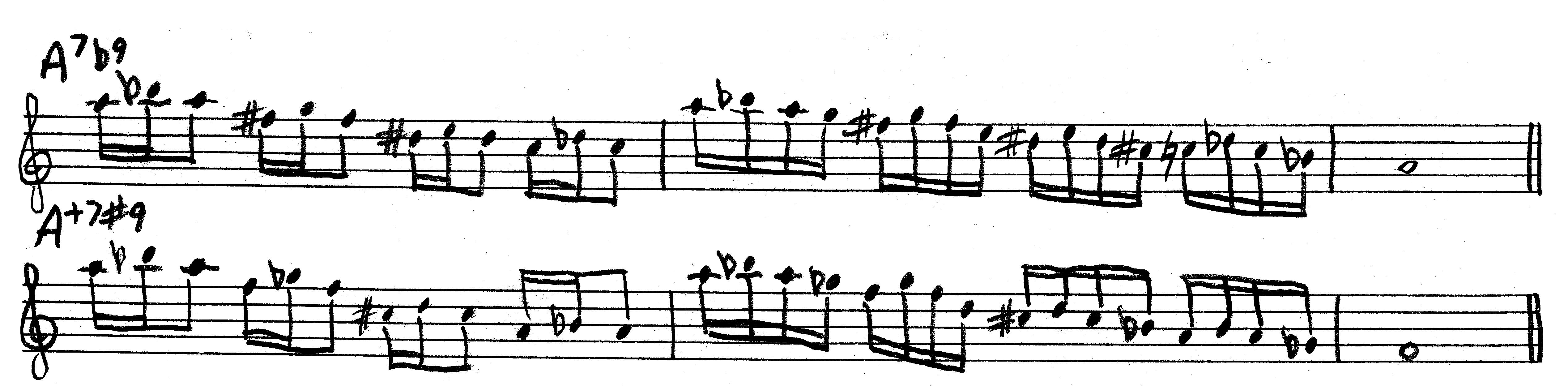
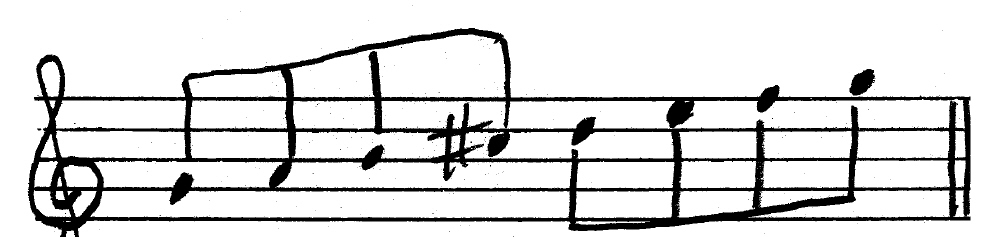
How about the best of both worlds. The two exercises shown here (click image to enlarge) take you through two sets of chromatic couplets, each beginning with the note A. However, the first exercise is built on a diminished scale while the second is based on an augmented scale.

While both scales are symmetrical scales, which implies ambiguity of tonal centers, let’s for the sake of convenience call the topmost scale a Bb whole-half diminished scale, and the bottom scale a Bb augmented scale. A quick glance will tell you that both exercises start on the leading tone of the scale, which also corresponds to an altered dominant chord that the scale works well with.

I love the ethereal, rather mystical sound of  chromatic couplets used in this fashion. The first half of each exercise emphasizes chordal structure; the second half, without adding any extra pitches, creates a more linear feel.

Remember, because each scale is symmetrical, it functions equally well with more than just one chord of the same quality. The first pattern, built on the diminished scale, will not only work with an A7b9, but also with C7b9, Eb7b9, and F#7b9. The second pattern is a good choice for A+7#9, C#+7#9, and F+7#9.

And with that, it’s time for me to wrap up this post and go practice what I’m preaching. For more exercises and articles of interest to jazz and improvising musicians, visit my jazz page.

Augmented Scale Triad Patterns

Judging from my blog stats, there seems to be a lot of interest in the augmented scale. I’m not surprised. It’s a fascinating scale, and I’ve personally been having a lot of fun as I continue to work at getting it into my fingers and my ears.

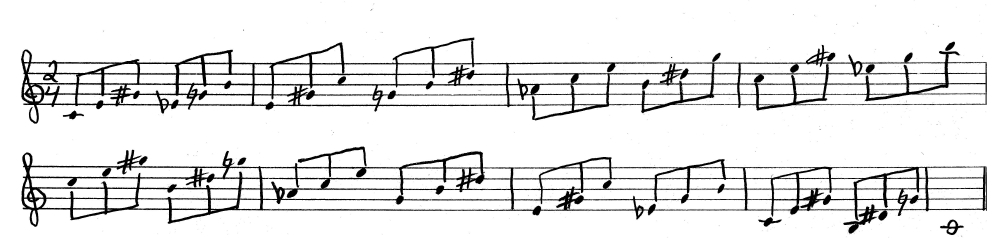
One of the interesting and colorful aspects of the augmented scale is the fact that it gives rise to both augmented triads and major triads in sequential order. In this post, you’ll find three exercises that focus on augmented triads. However, the last one also hints at the major triads contained in the augmented scale. Click on the images to enlarge them to readable size.

As always, take each pattern up and down through the full range of your instrument. Other than that, the exercises are fairly self-explanatory, so I won’t say more, other than practice hard and have fun!

Oh, yeah…and make sure, if you haven’t done so, to check out my jazz page featuring other exercises and articles of interest to saxophonists and improvising musicians.

Subscribe to Stormhorn.com!

Pause a second and look to your right at the top of the sidebar. Notice anything different?

That’s right! Now you can get my latest blog posts on Stormhorn.com delivered right to your front door (or, more precisely, your inbox). All you have to do is subscribe to your choice of either RSS feed or email. So if you’ve found my meanderings on the topics of jazz and storm chasing enjoyable and perhaps even helpful, then I hope you’ll sign up.

And to sweeten the deal, here are some of the FABULOUS PRIZES that YOU could win just for subscribing to my Stormhorn.com blog:

* XXXX          * ?????          * !!!!!          * @&%#!!!

Right, there are no fabulous prizes. There is, however, plenty to hold your interest if you’re a storm chaser, a weather nut, a saxophonist, a jazz musician, or just someone who enjoys a good read. If that appeals to you, then please take a moment to subscribe.

Thanks!

Bob

Double-Tonguing on the Saxophone: Tips from a Neophyte

Let me just say it: learning how to double-tongue on the saxophone is hard.

For as many years as I’ve been playing the sax, a span of time somewhat longer than the age of many igneous rocks, you’d think that by this point I’d have mastered double-tonguing, or at the very least, that the technique would come to me fairly swiftly now that I’ve set my mind on cultivating it. But such is not the case.

Learning how to circular breathe was a snap compared to double-tonguing. Within a week from the time I set out to become a circular breathing practitioner, while I wouldn’t say that I had brought circular breathing to an apogee of artistic perfection, I had at least developed it to a point of rudimentary usefulness.

I can’t make that same claim when it comes to double-tonguing. A week after I first decided to learn it, the only thing I had developed was an extreme degree of frustration, to the point where I concluded to set double-tonguing aside and focus on goals that were humanly attainable, such as “Giant Steps” at 320 mm and one-handed pushups.

But evidently there’s a stubborn streak in me, because I’ve been at it again. And having now spent a few months tinkering with double-tonguing–not with laser-like focus, but spending maybe ten minutes on it during most of my practice sessions–I can say that, by golly, I’m finally getting a handle on the technique. I’m at a point where I can actually double-tongue scales and patterns faster than I can tongue them normally–at least, for a limited amount of time, up until my tongue and throat muscles fatigue.

Tonight I practiced some diminished whole tone and augmented scale sixteenth-note licks, double-tongued, at a speed of around 120 mm. That’s nowhere near as fast as some of the masters are capable of playing, but it’s not bad for a piker, and it’s a heck of an improvement from when I started. Plus, it’s not just my speed that’s picking up; I’m also connecting the notes with increasing evenness.

Give me another six months or so and I may have developed the technique to the point of usability. Right now, I’m simply pleased to be making progress, slow though it may be.

Unlike the flute and brass instruments such as the trumpet and trombone, the saxophone involves a mouthpiece that is physically inserted into the oral cavity. This arrangement complicates the process of learning double-tonguing for sax players. For those of you who, like me, are dealing with the frustrations inherent in learning this technique–the lopsided, inconsistent attacks, the support issues that make your upper-register notes sound like cartoon laughter, and so on–here are a few thoughts from a fellow pilgrim that you may find helpful:

* It’s essential to develop your glottis–that is, the back of your throat. Thus, while the formula for double-tonguing is “da-ga, da-ga,” (which emphasizes the tongue touching the reed on the syllable “da”) I’ve found it helpful to reverse that order. Try double-tonguing using “ga-da, ga-da,” beginning with the glottal articulation instead of the tip of the tongue.

* More, try articulating using only your glottis–i.e. “ga-ga, ga-ga.” No, it’s not easy! But you’ll reap dividends by and by if you stick with it. You’re developing the response in the back of your throat.

” Once you’ve incorporated these first two approaches into your double-tonguing practice for a while, you should find yourself beginning to develop more control using the standard “da-ga, da-ga” double-tongue. It won’t take long before you start seeing an improvement.

* Forget about speed at first, and forget about playing scales and such. Just pick a single tone somewhere in the middle register of your horn, and concentrate on connecting the articulations evenly.

* Reconcile yourself to the fact that success at double-tonguing will not come overnight. This is a tough technique that requires a long-haul attitude.

The way I look at it, working on double-tonguing a little bit every practice session, consistently, will get me a whole lot farther than not working on it. A year from today, assuming that I stick with it, I’ll be much better at double-tonguing than I would be if I gave up. So for me, the adventure continues. Stay tuned. In another six months or so, I hope to have more to report.

A Lydian Flat Seven Workout

In a recent post on the lydian flat seven scale, I explored the theory behind the scale, and I promised that I’d have more to say in the future.

I’m as good as my word, and am back with something you can wrap your fingers around in the woodshed. Click on the image to enlarge a little exercise I put together that explores a few of the ins and outs of the lydian flat seven scale. It’s nothing fancy, just something you can work with that will help open up your ears to the scale’s colors and possibilities.

The scale is a G lydian flat seven scale. For best results, play it with some kind of harmonic accompaniment sounding a G7+ll behind it. An Aebersold CD or Band-in-a-Box is ideal. Transpose according to the requirements of your instrument.

By the way, the lydian flat seven scale also works beautifully when you’re soloing on two major-minor seventh chords that are a major second apart. The A section of the tune “Killer Joe” is a classic example, with it’s repeated, I7-bVII7 pattern.

But getting back to the exercise, please note a couple points of interest. In the eighth bar, I take a momentary excursion to the augmented scale, just to slip outside and add a bit of color. And in bars 11 and 12, I inject some chromaticism by using a favorite lick of mine based on the C#+7(#9). The chord is the tritone-substitute for G7+11, and since the same scale works for both of them, the lick transfers nicely.

By now, the more observant of you will have noticed that the exercise is seventeen bars in length. There’s a reason for that, a deep, cryptic logic that is too difficult to explain here other than to say that I wasn’t thinking and seventeen bars is what I wound up with. Deal with it. And have fun!

Exploring the Lydian Flat Seven Sound (or, Ruminations on a Flatted Fifth)

Hey, there, fellow jazz saxophonists and other jazz instrumentalists, I haven’t forgotten you! Even as I’ve been blogging about the big, late-October weather system that has been blowing through the Great Lakes, I’ve been contemplating my next post for sax players. I hope you’ll find that what follows was worth waiting for.

A riff from Jimmy Forrest

Back in my college days, Basie tenor man Jimmy Forrest lived in Grand Rapids. Naturally, I owned one of his albums, a vinyl LP titled “Black Forrest.” It was a hard-swinging, straight-ahead collection of tunes that showcased Jimmy’s ability to deliver both high-testosterone bebop and wonderfully lyrical balladry. The album included a heaping helping of blues, and in one of those blues, Jimmy worked into his solo a lick reminiscent of the old Jetsons cartoon theme song, which sounded something like this:

I liked that lick, and I incorporated it into my blues playing. The thing that made it sound so hip was the sharped fourth–aka the flat five, though in this application, that’s not the correct theoretical term–which defines the lydian sound.

What makes lydian sound so lydian?

Good question. There are two scales that can be considered lydian: the traditional lydian church mode built off the fourth degree of the major scale, and the lydian flat seven scale, also known as the lydian dominant.

The term “lydian dominant” is a bit confusing, since each word, “lydian” and “dominant,” suggests a function of the scale that cancels out the other one. In this case, however, “lydian” refers to the raised fourth scale degree, and “dominant” describes how the scale and its characteristic chord function. The more accurate term is actually “mixolydian sharp four,” since the scale is used the same way that a standard mixolydian mode is used: as a scale choice for dominant seventh chords.

Whatever you wish to call it, the lydian flat seven sound is defined by its raised fourth scale degree. But other scale options for dominant seventh chords also contain the raised fourth/flatted fifth. The half/whole-step diminished scale and the diminished whole tone scale both come instantly to mind. What makes the lydian flat seven different?

Its consonance with an unaltered dominant seventh chord.

Following is a G lydian flat seven scale, which you would use over a standard G7 chord:

Lydian_Dominant_Scale

Note that this scale neither raises nor lowers the ninth of the G7, nor does it alter the fifth, nor does it lower the thirteenth. Only the fourth degree gets raised a half-step to create the characteristic lydian sound. The raised fourth doesn’t clash with the third of the dominant chord the way that the unaltered third of the standard mixolydian mode does, in effect making the lydian flat seven scale the more consonant scale.

Triad superimposition

When you build triads off of the first and second degrees of the lydian flat seven scale, each triad is major in quality. For instance, a G lydian flat seven scale gives you the following:

Lydian_Triad_Couplets

Note that the first triad outlines the foundational notes of the G7 chord, minus the seventh, while the second triad emphasizes the ninth, raised fourth, and thirteenth. Thus,  a quick way to emphasize the lydian sound over a dominant seventh chord is to superimpose a major triad whose root is a whole step above the chord root. In other words, if you’re soloing over a Bb7, play a C major triad; if you’re working with a D9, play an E major triad, and so forth.

By the way, since neither triad includes the seventh of the scale, you can apply the above superimposition equally well to both the G7 and Gmaj7 chords.

Major triad couplets in inversion for the lydian sound

Okay, time to start getting the stuff I’ve just covered into your fingers and your ears. Click on the exercise to your right to enlarge it. It’s a practical extension of the superimposition principle I’ve just described that takes you through different inversions of the triad couplets based on the G lydian flat seven scale. As always, take the exercise up and down the full range of your instrument, and through all twelve keys.

I’ll have more to say about the lydian flat seven scale, but this ought to keep your woodshed smoking for a while.

Visit my jazz page for more articles on jazz improvisation, jazz theory, and saxophone playing.

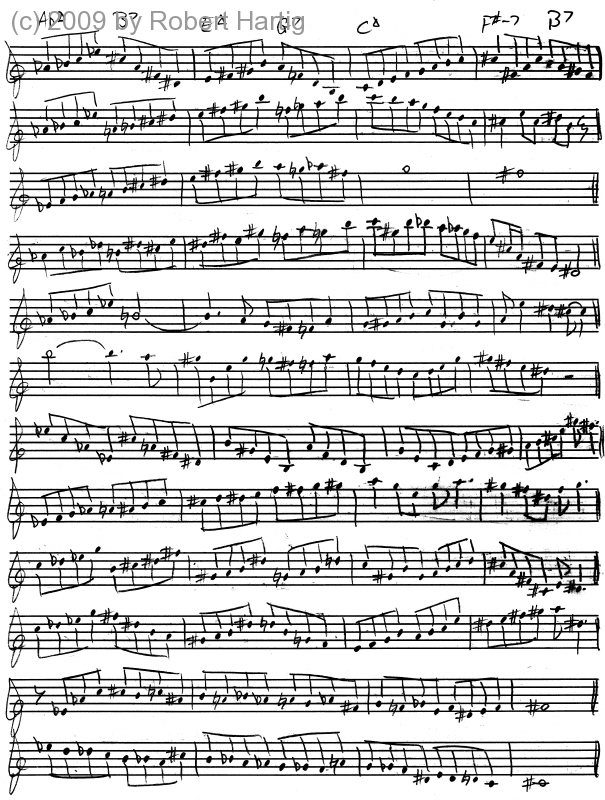
“Giant Steps” Licks and Patterns

After posting a couple days ago on how to use the augmented scale with “Giant Steps” changes, I’ve experienced a renewed interest in woodshedding John Coltrane’s high-hurdle chord cycle.

There was a time in my musical life, maybe ten years ago, when I became moderately obsessed with “Giant Steps.” I painstakingly wrote down my practice material in a music notebook, which I continued to add to until I had a veritable blizzard of ideas to work with.

Today, looking through the web, I see plenty of resources that explore the theory behind the changes to “Giant Steps.” However, I don’t see much in the way of licks and patterns, of application-oriented stuff that a sax player can actually wrap his or her fingers around. So, since I’m presently re-exploring my “Giant Steps” notebook, I thought I’d share a page with you.

Click on the image to the right to enlarge it. It’s all hands-on stuff. If you want to study Coltrane’s theory involving key centers moving by major thirds, you can find plenty of information on the Internet, such as this excellent Wikipedia article. But understanding the “Giant Steps” cycle isn’t the same as playing it, and that’s where this article can help.

One caveat: since I’m an alto sax player, I wrote out the changes in my key. If you play an instrument pitched in Bb or C, such as tenor sax or flute, you’ll need to transpose.

The patterns shown here are for the first four bars of the tune’s A section. With it’s lopsided arrangement of V7-I cadences–which would be simple enough in themselves to negotiate if Coltrane hadn’t placed the bar lines so inconveniently–this section is the one that can be hard to master. I wrote out material for the B section as well, but what I’ve shown here will probably be more to your immediate interest.

Enjoy the material, practice hard, and have fun!

UPDATE: My entire “Giant Steps” practice notebook is now available for sale in C, Bb, Eb, and bass clef editions. Using music notation software, I transcribed all of the handwritten material (including the above image) into a clear, easy-to-read format; wrote a front section that discusses the basic theory of Coltrane changes and gives tips and insights for practice; and had a cover professionally designed.

The Giant Steps Scratch Pad is available as

* PDF download–$9.50

* Print edition–$10.95 plus shipping

The PDF will provide you with the full contents of the book instantly and save you money. The print edition gives you the complete, finished production complete with glossy cover. If you enjoyed the licks and patterns on this page, then The Giant Steps Scratch Pad is for you. View page samples from the Bb edition and order your copy today!

Using the Augmented Scale with “Giant Steps”

I tend to arrive at things the hard way, which is to say, by personal discovery. For instance, I come across a large circular object and find that it has a unique quality, namely, that it rolls, and this gets me all excited, and of course I have to go tell all my friends. “Hey, Fred,” I say, rolling my circular object around on the lawn in front of him, “check this out! Pretty nifty, eh?”

“Ermmm, yeah. Nice. A wheel,” says Fred.

“A what?” I reply.

“A wheel,” Fred repeats, confirming my sudden suspicion that others may have already crossed this territory before me.

“Exactly, ” I say. “A wheel. Isn’t it great?”

Fred scrutinizes me for a second, then walks away. Now you know why I don’t have any friends named Fred. Used to, don’t anymore.

Anyway, the same principle probably applies to this post on using the augmented scale over “Giant Steps” changes. I’m sure it has already been done, and I’m probably just the last person to know about it. But since I haven’t come across any other literature that addresses the subject, either on the Internet or elsewhere, I thought I’d talk about it here.*

I do seem to recall reading somewhere about a connection between the augmented scale and the Coltrane tune, but it was just a passing comment that never went into any detail. I have no idea where I came across it. Evidently it planted a seed, though, because the relationship between the scale and the set of chord changes, both of whose symmetrical constructions emphasize the interval of a major third, has been intriguing me lately.

So earlier this evening, having thought the theory of the thing through, I finally sat down with my sax and my Jamie Aebersold “John Coltrane” CD and played around with the concept. It’s still very new to me, as is the sound of the augmented scale, but I’m satisfied at this point that I’ve acquired a very useful and colorful tool.

Simply put, the augmented scale is as close as you can get to a universal scale that covers “Giant Steps” in its entirety–not just the cantilevered dominant-tonic cycle, but also the ii-V7-I cadences. The application isn’t picture-perfect, but it works, and besides, a little dissonance is beautiful, right?

I’m not going to get deeply into the theory behind my thinking. I’m just going to assure you that, just as you can play an entire 12-bar blues using one blues scale, you can improvise on all of of “Giant Steps” using a single augmented scale. It’s not something you want to base an entire solo on, particularly since the augmented scale is such a foreign sound; but for that same reason, it’s also a very nice color to tap into, and you can coast along on it for as long as you please without having to think too much about making the changes. As long as you stay within the scale, you’re golden.

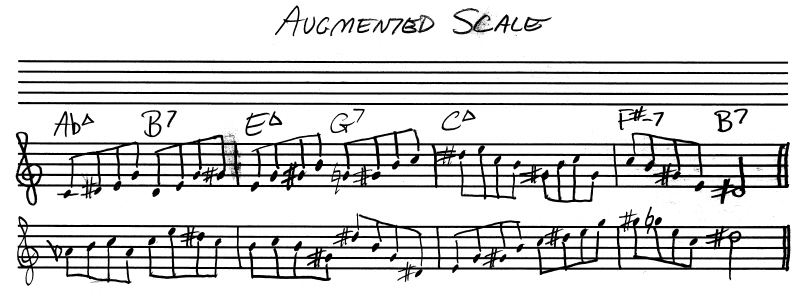
But of course, you want an example. So without further ado, here are a couple of licks on four bars of the “Giant Steps” cycle. Me being an alto man, I’ve written them for Eb instruments, so you may need to transpose. Click on the image to enlarge it.

Three points to be aware of:

• Use care in handling the perfect fourths of the dominant chords and the flatted thirds of the tonics.

• I’ve shown the standard chords without alterations. However, by virtue of its construction, the augmented scale works best with “Giant Steps” when you flat the ninths and raise the fifths of the dominant chords and flat the fifths of the minor sevenths.

• The sound of the augmented scale is quite different from everyday major/minor tonalities. So set those standards aside and suspend judgment until you’ve worked with the augmented scale long enough to get it into your ear.

That’s it. As for any further brain work, that’s up to you. Of course, you’re probably way ahead of me on it to begin with. That’s why, at this point, I’m turning my mind in other directions. For instance, I was sitting under an apple tree the other day, and an apple dropped off and bonked me on the head. I wondered why. What makes things fall? It’s almost like there’s some kind of a force or something. Has anyone looked into that?

They have?

Nuts. I was afraid of that.

————————–

* ADDENDUM: I take it back. After posting this article, I came across an excellent writeup by Jason Lyon that digs deeply into the theory of using the augmented scale with “Giant Steps.”

Stormhorn Blog is Back Up and Running

Lately, due to life’s fast pace, I haven’t kept a close track of the Stormhorn blog. So I was unaware, until my buddy Kurt Hulst informed me of it, that folks have been unable to link to my blogsite.

This is to let you know that the problem has been fixed, thanks to my lovely computer tech girlfriend, Lisa, who instantly and correctly suggested that a corrupt plug-in was the culprit.

Stay tuned–I’ll be posting content of greater interest this weekend. For now, this is just a heads-up that Stormhorn is back (just in case ya missed me).

Sonny Stitt “Au Privave” Solo Transcription for Alto Sax

Sonny Stitt. Just in case you forgot how bad he really was, there’s a CD out there titled…

Sonny Stitt: Just in Case You Forgot How Bad He Really Was.

.

With an all-star lineup of guest musicians including fellow saxophonists Richie Cole and John Handy, the CD, published by 32 Jazz, is a Stitt tour de force featuring the American songbook and classic bebop.

Among the selections is the Parker tune “Au Privave.” Like Bird and virtually all of the other great boppers and jazz musicians before, during, and after him, Stitt was steeped in the blues. “Au Privave” features Stitt blowing several headlong, muscular choruses, demonstrating exactly what an alto player of his caliber is capable of doing with the old, familiar twelve-bar form.

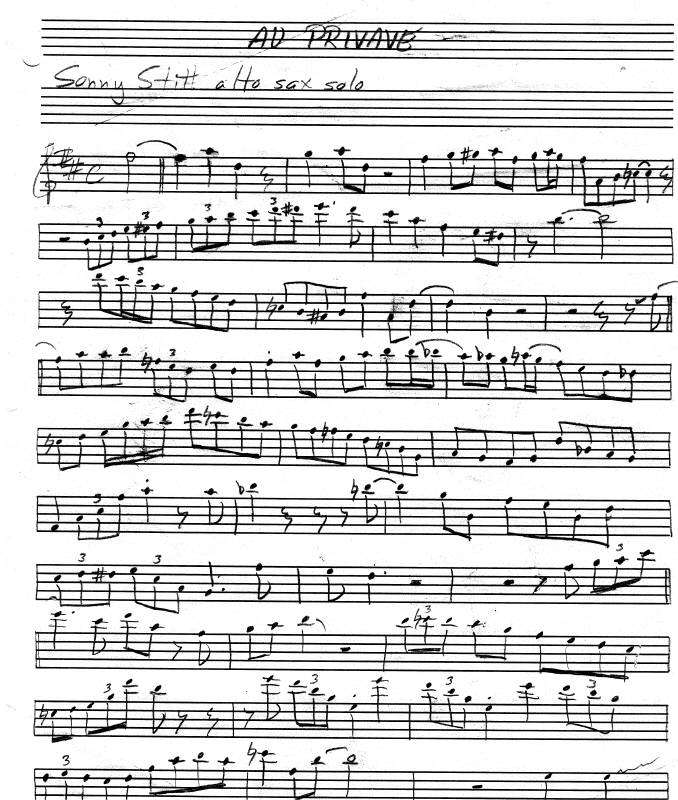
I thought you might enjoy letting your fingers travel the same patterns as Sonny’s did on his “Au Privave” solo. So here for your enjoyment and edification is my transcription of the first three choruses. Please forgive the sizing disparity between the two sheet music copies. I haven’t yet gotten image reproduction down to a fine science. But it’s Sonny’s inventiveness that is the focus, and I trust that will survive even my mutilations.

Sonny Stitt solo on Au Privave

Sonny Stitt, Au Privave p. 2