Ghosted Notes on the Saxophone

When you’ve been playing the saxophone for a long time, it’s easy to forget how certain techniques that have become an organic part of your playing once were mysteries to you. So it was for me with ghosted notes–aka ghost notes, aka ghost tones–back in my college days. I heard certain sax players punctuating their solos with notes treated with a sudden reduction in sound volume that made it seem as if they had been swallowed. It was a very cool effect, but I didn’t know what it was called, and darned if I could figure out how to duplicate it.  One thing was clear: it involved something other than merely adjusting my airstream.

I finally asked fellow alto man Tom Stansell, who used the technique with excellent effect, what it was he was doing and how he did it. Tom quickly filled me in, and the mystery that had been eluding me turned out to be no mystery after all. Within a few minutes during my next practice session, I had a pretty good handle on the technique.

If you’ve never ghosted a note on the sax before, then here’s your opportunity to learn how. What Tom passed on to me, I now pass on to you.

How to ghost a note on the saxophone

Ghosting a note on the sax is simply a matter of tongue placement during articulation. In normal articulation, you separate notes by applying your tongue to the reed dead on, temporarily cutting off air from the mouthpiece and preventing the reed from vibrating. But by applying your tongue to only one corner or side of the reed while maintaining your airflow, you effectively dampen just a part of the reed while allowing the rest of it to vibrate.

That’s all there is to it.

Repeat: to ghost a note, simply touch just a side or corner of the reed with your tongue.

Of course, you’ll refine the technique and personalize your application of it over time, but the above is all you need to get started.

Now the next time you’re playing through a chart and you come across a note or group of notes enclosed in parentheses–the standard notation for ghosting–you’ll know how to treat it.

Unlike circular breathing or double tonguing, note ghosting offers a rare opportunity for instant gratification in a saxophonist’s learning curve, and it’s a very effective tool to have in your musical toolkit. You’ll love how a handful of well-placed ghost notes adds interest and character to your playing.

That’s all, folks. Be sure to check out my jazz page for more helpful articles and saxophone solo transcriptions.
The Trouble with Reading Glasses: A Jazz Saxophonist’s Lament

Reading glasses suck.

No, let me restate that: Reading glasses are a boon, but having to wear them sucks. And it particularly sucks, sucks to the fourth power, when one is trying to read big band charts on a bandstand.

Am I the only horn player who has this problem? I seriously doubt it.

I go through reading glasses like they’re M&Ms chocolate-covered peanuts. I buy them, lose them, buy them, lose them. So I get the cheapest ones I can find–I mean, reeeaally cheap, $1.99 glasses which I purchase at Ace Hardware in Hastings. They do the job just fine for most purposes, but playing in a big band is not “most purposes.” It’s a purpose set apart that poses some peculiar problems.

For one thing, those classy, low-slung bandstands which are so much a part of the big band tradition place the music a couple feet away and well below my natural line of vision. I compensate by scroonching forward and down in a manner that would inspire admiration in a circus contortionist.  This gets me closer to the music, allowing me to read it.

Most of it, that is. There comes a point, as I approach the bottom of a chart, where the music dips below the frame of my glasses, and I’m confronted with a decision whether to scroonch even farther–and believe me, four hours of scroonching in this manner does nothing to improve either my posture or my attitude–or else attempt to read the remainder of the page without the assistance of lenses.

Now, my vision isn’t so bad that option B isn’t feasible, at least in theory, but a funny–though not knee-slappingly so–thing happens when I attempt it: I lose my place in the music.

This leaves me frantically scrambling to find my place while the rest of the band chugs merrily onward. Eventually, Eric or Hugh or whoever is playing tenor next to me points to a spot on my chart, and I dive back in with varying levels of success, depending on my familiarity with the arrangement. It’s frustrating and embarrassing.

Life would be so much easier if I could trade the bandstand for a good, old-fashioned music stand which adjusts easily for height and distance. Get those charts right smack in front of my eyeballs, where I can read them without the aid of a telescope, and I’d be fine. But no, that’s not how it works, not with a big band, where low-rise bandstands are integrally woven into the mystique.

That, my friends, is why I emerge from big band gigs with the posture of a Cheeto. Reading-glasses-induced scroonching is doing me in.

I may be a well-maintained 53 years old, but I’m still 53. That’s not old enough yet to qualify as a curmudgeon, but there are times when I come pretty close, and an entire evening of imitating a hunchback is one of them.

So why do I continue to put up with the frustrations and, in all seriousness, the physical discomfort? Because I enjoy playing the music. I’m not primarily a big band musician; my natural habitat, where I really spread my wings and fly, is small combos. But I came up through big bands, and I’m glad for the opportunity to still play the great old arrangements from time to time. I mean, you can’t get a better jazz education than you’ll find in the music of Duke and Basie, you know? That’s why I continue to pay the cost of tuition.

There’s no problem with the library, none whatever. I just wish I could find some reading glasses that would enable me to read the books without a hitch from cover to cover.

Lynn’s Grins: A Charles McPherson Alto Sax Solo Transcription

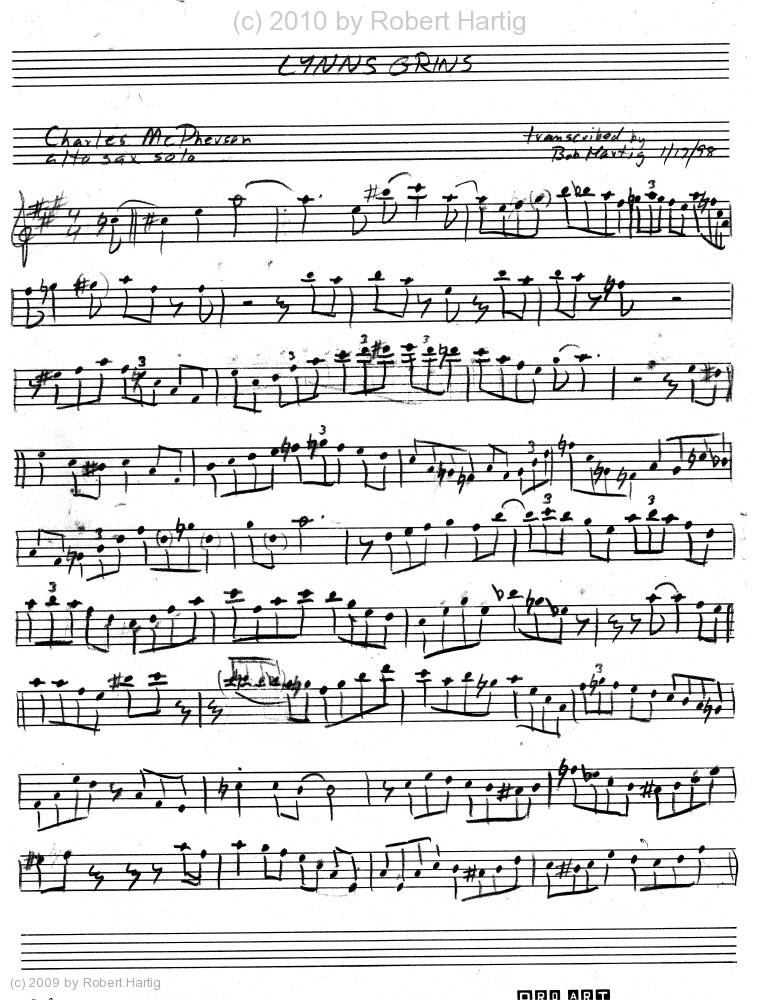
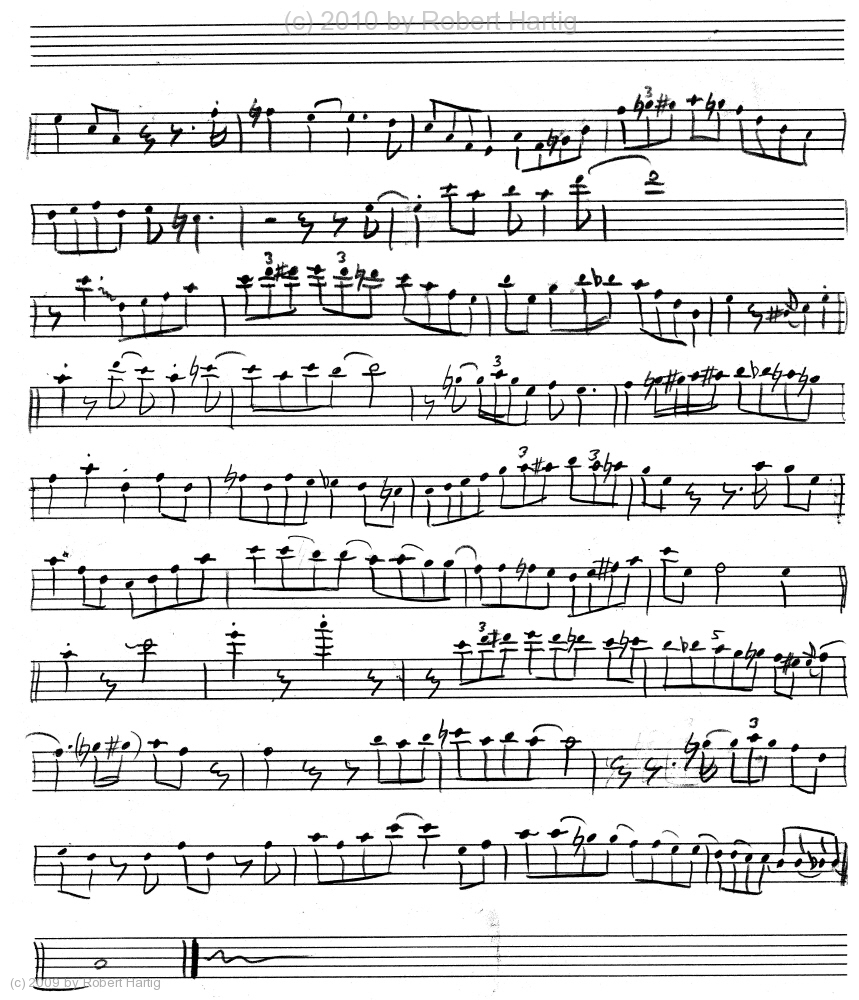
Ready for another saxophone solo transcription? “Lynn’s Grins” by alto saxophonist Charles McPherson is one of my favorites. It’s a concert C blues (alto key of A) at a medium-fast tempo, and it features McPherson in full cry, showing the listening world that he knows a thing or two about bebop. (Click on the images to enlarge them.)

From his simple opening statement outlining the tonic triad, McPherson plunges headlong into a millrace of ideas, toying at times with outside colors but always staying within the basic framework of the parent key.

There’s plenty to pick up on from this solo, and the best way to do so is by getting to work on it. What are you waiting for? Get cracking!

You’re a Good Man, Charlie Brown

This post is a continuation off of the previous one. Last night was the final night of the stage musical “You’re a Good Man, Charlie Brown” in Hastings. The show enjoyed a decent and enthusiastic turnout. Today, as I reflect on it, I want to say what a truly impressive job the young actors turned out. These small-town high school kids rendered an absolutely stellar performance, and it was a privilege for me to have played a small part in making it happen.

What I saw onstage clearly reflected a lot of talent, dedication, focus, hard work, enthusiasm, and friendship and mutual supportiveness among the cast. The result was not merely a superb production, but also a joyous one, and, frankly, a touching one as I consider the network of human relationships that lay behind it.

To any of the teen performers who happen to read this post: Bravo! Splendidly done! Charlie Brown, Linus, Lucy, Snoopy, Sally, Schroeder–each of you did a fantastic job. I’m well aware that there were plenty of others who helped make it happen–supporting cast, stage help, directors, and so on. My congratulations and appreciation goes to you all.

God bless each of you. Enjoy the afterglow of a magnificent show–and have a wonderful Christmas.

Playing Jazz on the Local Level

Last night I spent an enjoyable evening playing in the orchestra pit for a production of the stage musical, “You’re a Good Man, Charlie Brown,” in Hastings, Michigan. Tonight I’ll be there again, and tomorrow night. The cast is all high school kids, and they do a great job. My buddy, Ed Englerth, is sitting in on guitar, and Mark Ramsey on keyboards serves as musical director and does by far the bulk of the actual playing. My job is to keep my ears open and provide improvised sax work wherever it seemed appropriate.

If that sounds like a rather loose approach, it is. But the informality and spontaneity are a good part of the fun for me. You see, we’re not talking some high-pressure effort here that has involved weeks of practice (my preparation consisted of attending the dress rehearsal, then walking in last night and playing the gig). This is a local, grassroots production–which is by no means to minimize the talent, just to recognize a difference in approach that I really enjoy. That’s what’s nice about local efforts: they have an irreplaceable, homespun feel; they are high in entertainment value; they are often very well done; and they tap into and foster the gifts that are right at hand. Some surprisingly bright stars may be shining far from the Big City in a small town near you.

This has been my first time playing with Mark Ramsey, and I’m impressed by his level of professionalism. Hastings, the capital of Barry County, Michigan,  is a small town blessed, as is many a small town, with a number of good musicians. My friend Ed Englerth, for instance, is an absolutely brilliant songwriter. Trumpet man and vocalist Joe LaJoye, the town’s retired band director, is the driving force for jazz in the community and the spearhead of its annual jazz festival. And Mark is the first keyboard player I’ve encountered in the area who demonstrates a well-rounded command of his instrument, one that shows a grasp of many idioms ranging from jazz to show tunes to classical and more. And he’s a very nice guy to boot. No attitude, just a humble spirit and a love for what he’s doing, qualities that make him a joy to work with.

As for the cast of the show, these kids are clearly having a good time. They’re taking their roles as actors seriously, and they’re having fun doing so.

My point is, living in a small town doesn’t necessarily mean lack of opportunity for a jazz musician. Depending on the community, you may delightfully surprised at what you find. Hastings is fifteen miles down the road from where I live in the cow town of Caledonia. My home town being an outlier of Grand Rapids, I have access to a broader music scene that I can tap into. When it comes to playing jazz, some of the musicians I play with reside in Grand Rapids, but others, like me, live farther out–far enough to enjoy the countryside, yet close enough to be a vital part of the West Michigan music scene.

If you work hard at your instrument, and if personal growth as a musician is its own reward for you, then sooner or later you’ll connect with other capable players. You’ll make music. You may not make a living at it, but you’ll find opportunities to share your talent with appreciative ears.

Chromatic Couplets: Another Way of Unlocking Diminished and Augmented Scales

Have you had enough of the augmented scale yet? Hungry to get back to something nice and basic–a good, old-fashioned diminished scale, for instance?

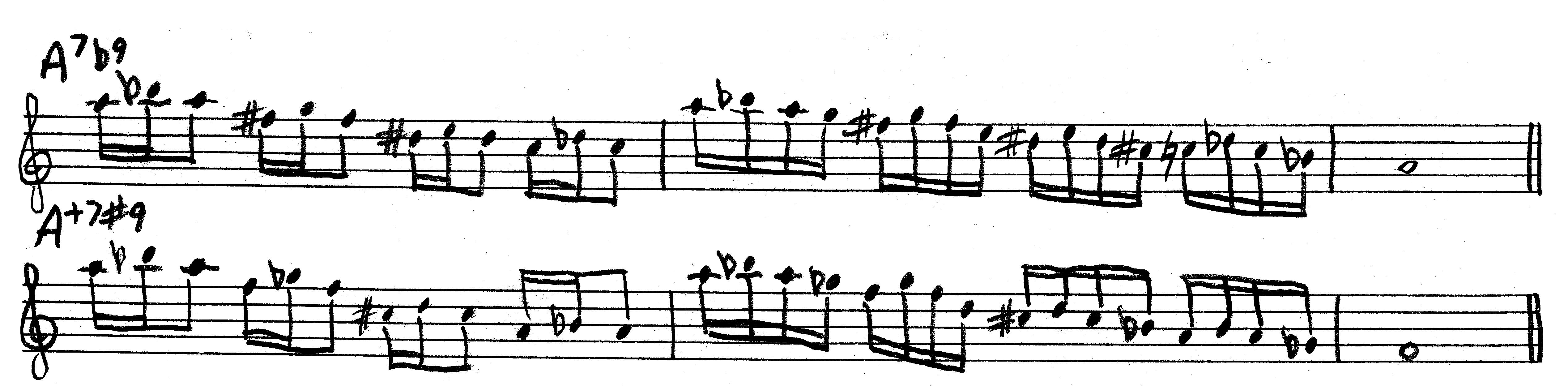
How about the best of both worlds. The two exercises shown here (click image to enlarge) take you through two sets of chromatic couplets, each beginning with the note A. However, the first exercise is built on a diminished scale while the second is based on an augmented scale.

While both scales are symmetrical scales, which implies ambiguity of tonal centers, let’s for the sake of convenience call the topmost scale a Bb whole-half diminished scale, and the bottom scale a Bb augmented scale. A quick glance will tell you that both exercises start on the leading tone of the scale, which also corresponds to an altered dominant chord that the scale works well with.

I love the ethereal, rather mystical sound of  chromatic couplets used in this fashion. The first half of each exercise emphasizes chordal structure; the second half, without adding any extra pitches, creates a more linear feel.

Remember, because each scale is symmetrical, it functions equally well with more than just one chord of the same quality. The first pattern, built on the diminished scale, will not only work with an A7b9, but also with C7b9, Eb7b9, and F#7b9. The second pattern is a good choice for A+7#9, C#+7#9, and F+7#9.

And with that, it’s time for me to wrap up this post and go practice what I’m preaching. For more exercises and articles of interest to jazz and improvising musicians, visit my jazz page.

Augmented Scale Triad Patterns

Judging from my blog stats, there seems to be a lot of interest in the augmented scale. I’m not surprised. It’s a fascinating scale, and I’ve personally been having a lot of fun as I continue to work at getting it into my fingers and my ears.

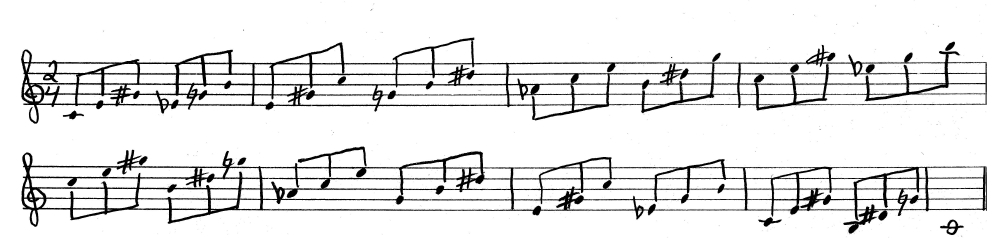
One of the interesting and colorful aspects of the augmented scale is the fact that it gives rise to both augmented triads and major triads in sequential order. In this post, you’ll find three exercises that focus on augmented triads. However, the last one also hints at the major triads contained in the augmented scale. Click on the images to enlarge them to readable size.

As always, take each pattern up and down through the full range of your instrument. Other than that, the exercises are fairly self-explanatory, so I won’t say more, other than practice hard and have fun!

Oh, yeah…and make sure, if you haven’t done so, to check out my jazz page featuring other exercises and articles of interest to saxophonists and improvising musicians.

Subscribe to Stormhorn.com!

Pause a second and look to your right at the top of the sidebar. Notice anything different?

That’s right! Now you can get my latest blog posts on Stormhorn.com delivered right to your front door (or, more precisely, your inbox). All you have to do is subscribe to your choice of either RSS feed or email. So if you’ve found my meanderings on the topics of jazz and storm chasing enjoyable and perhaps even helpful, then I hope you’ll sign up.

And to sweeten the deal, here are some of the FABULOUS PRIZES that YOU could win just for subscribing to my Stormhorn.com blog:

* XXXX          * ?????          * !!!!!          * @&%#!!!

Right, there are no fabulous prizes. There is, however, plenty to hold your interest if you’re a storm chaser, a weather nut, a saxophonist, a jazz musician, or just someone who enjoys a good read. If that appeals to you, then please take a moment to subscribe.

Thanks!

Bob

Storm Chasing Musicians

When I started the Stormhorn blog two years ago, I envisioned two distinct readerships: storm chasers and musicians. Knowing nothing about blogging, I naively figured I could reach both audiences. I mean, what the heck, why not?

Amazingly, it seems to be working. The whole world may not be flocking to Stormhorn.com, but enough of you are finding your way here, and I’m encouraged to see the numbers steadily growing. Maybe that’s because musicians and storm chasers possess some important traits in common: a penchant for the unusual; a passion to excel; a thirst for personal involvement with something that is intense and deep; a fascination with how and why things work; a high degree of commitment and self-motivation; and a love of beauty.

For some of you, the focus is music. For others, it’s storm chasing. But both pursuits are fascinating and rewarding, and I’ve felt from the start that there’s a connection between them, and plenty of crossover appeal.

In fact, a good number of you bridge both worlds. In a recent thread in Stormtrack’s Bar & Grill (sorry, no link to the thread–B&G is a “members only” section), fellow chaser Wes Carter posed the question, “Who plays musical instruments?”

A fair number of you do, it turns out, including at least one who earns his living at music. That would be Huntsville, Alabama, blues man Dave Gallaher. Both as a solo act and with his trio, “Microwave Dave and the Nukes,” and also as a disk jockey for his twice-a-week radio broadcast, “Talkin’ the Blues,” Dave has made an impressive mark regionally, nationally, and internationally. A musician doesn’t accomplish something like that without paying some serious dues; it takes not only world-class skill, but also great crowd appeal and tremendous perseverance. You really want to check out Dave’s website.

Then there’s Brandon Goforth. While these days I’ve been hesitant to post YouTube links due to their unpredictable shelf life, I’d be remiss not to steer you toward this link featuring Brandon’s rock guitar artistry.The guy can play.

Dave and Brandon are just two stellar examples of people who are both musicians and storm chasers. There are plenty more. Maybe you’re one of them. Do you consider yourself primarily a musician who chases storms, or would you call yourself a storm chaser who plays music? Or are you, like me, so passionate about both pursuits that the question is irrelevant? Regardless, there’s an interplay between the two disciplines which suggests active minds with large appetites for life and learning.

By the way, I’m never without my saxophone. I take it with me wherever I go, and that includes out to the plains when I’m chasing storms. Some chasers toss a football while waiting for initiation; I practice my sax. So to my fellow chasers who play an instrument (most likely guitar): if we cross paths and you’ve got your axe with you, we just may have the makings of an impromptu Great Plains jam session.

Keep your eyes open for me this coming spring. And if any of you happen to know of a good jazz venue in Tornado Alley, please let me know. Such places are hard to come by out west.

Double-Tonguing on the Saxophone: Tips from a Neophyte

Let me just say it: learning how to double-tongue on the saxophone is hard.

For as many years as I’ve been playing the sax, a span of time somewhat longer than the age of many igneous rocks, you’d think that by this point I’d have mastered double-tonguing, or at the very least, that the technique would come to me fairly swiftly now that I’ve set my mind on cultivating it. But such is not the case.

Learning how to circular breathe was a snap compared to double-tonguing. Within a week from the time I set out to become a circular breathing practitioner, while I wouldn’t say that I had brought circular breathing to an apogee of artistic perfection, I had at least developed it to a point of rudimentary usefulness.

I can’t make that same claim when it comes to double-tonguing. A week after I first decided to learn it, the only thing I had developed was an extreme degree of frustration, to the point where I concluded to set double-tonguing aside and focus on goals that were humanly attainable, such as “Giant Steps” at 320 mm and one-handed pushups.

But evidently there’s a stubborn streak in me, because I’ve been at it again. And having now spent a few months tinkering with double-tonguing–not with laser-like focus, but spending maybe ten minutes on it during most of my practice sessions–I can say that, by golly, I’m finally getting a handle on the technique. I’m at a point where I can actually double-tongue scales and patterns faster than I can tongue them normally–at least, for a limited amount of time, up until my tongue and throat muscles fatigue.

Tonight I practiced some diminished whole tone and augmented scale sixteenth-note licks, double-tongued, at a speed of around 120 mm. That’s nowhere near as fast as some of the masters are capable of playing, but it’s not bad for a piker, and it’s a heck of an improvement from when I started. Plus, it’s not just my speed that’s picking up; I’m also connecting the notes with increasing evenness.

Give me another six months or so and I may have developed the technique to the point of usability. Right now, I’m simply pleased to be making progress, slow though it may be.

Unlike the flute and brass instruments such as the trumpet and trombone, the saxophone involves a mouthpiece that is physically inserted into the oral cavity. This arrangement complicates the process of learning double-tonguing for sax players. For those of you who, like me, are dealing with the frustrations inherent in learning this technique–the lopsided, inconsistent attacks, the support issues that make your upper-register notes sound like cartoon laughter, and so on–here are a few thoughts from a fellow pilgrim that you may find helpful:

* It’s essential to develop your glottis–that is, the back of your throat. Thus, while the formula for double-tonguing is “da-ga, da-ga,” (which emphasizes the tongue touching the reed on the syllable “da”) I’ve found it helpful to reverse that order. Try double-tonguing using “ga-da, ga-da,” beginning with the glottal articulation instead of the tip of the tongue.

* More, try articulating using only your glottis–i.e. “ga-ga, ga-ga.” No, it’s not easy! But you’ll reap dividends by and by if you stick with it. You’re developing the response in the back of your throat.

” Once you’ve incorporated these first two approaches into your double-tonguing practice for a while, you should find yourself beginning to develop more control using the standard “da-ga, da-ga” double-tongue. It won’t take long before you start seeing an improvement.

* Forget about speed at first, and forget about playing scales and such. Just pick a single tone somewhere in the middle register of your horn, and concentrate on connecting the articulations evenly.

* Reconcile yourself to the fact that success at double-tonguing will not come overnight. This is a tough technique that requires a long-haul attitude.

The way I look at it, working on double-tonguing a little bit every practice session, consistently, will get me a whole lot farther than not working on it. A year from today, assuming that I stick with it, I’ll be much better at double-tonguing than I would be if I gave up. So for me, the adventure continues. Stay tuned. In another six months or so, I hope to have more to report.