The Most Insulting Love Song Ever

A month from now is Valentine’s Day, a time when thoughts turn to romance, chocolates, and tender songs. The most beloved Valentine’s ballad is undoubtedly “My Funny Valentine.” Frankly, though, I have to wonder why. Have you ever seriously considered the lyrics? If a woman I was with ever slapped my self-concept across the face with a song like that, she’d be going home in a cab and paying her own fare.

Just look at the words to “My Funny Valentine” and tell me they make you feel cherished, idolized, and all-around glowingly great about being you. You want something that’ll take you a few pegs down from warm and fuzzy, the old Rogers and Hart tune will do it.

Let’s say you’re a lady and the guy you’re with has gotten it into his head that he’s going to sing you this song while gazing soulfully into your eyes. Here, line by line, is what he’s saying to you, along with an explication of its actual meaning:

My funny Valentine–sweet, comic Valentine

You make me smile in my heart.

So far, so good. Your amour finds you amusing. But is that really a smile in his heart or a snicker?

Your looks are laughable.

Doesn’t take long for the truth to come out, does it. He’s just told you that your appearance is a joke.

Unphotographable.

You’re ugly. Your face would melt the sensor on a digital camera.

Still you’re my favorite work of art.

He’s into Cubism, so consider that line nothing but a left-handed compliment.

Is your figure less than Greek?

You’re not Rubenesque, you’re just overweight. And yes, that dress makes your butt look fat, definitely.

Is your mouth a little weak?

What the hell does that mean? Maybe he’s commenting on your receding chin. Surely he doesn’t expect you to curl dumbbells with your lips.

When you open it to speak, are you smart?

He thinks you’re stupid. Ugly, fat, weak-mouthed, chinless, and stupid. What on earth are you doing with this dork? He’s done nothing but insult you since he started singing this idiotic song. You’d have been better off spending Valentine’s Day with your cat, who is thoroughly nuts about you, not to mention a whole lot nicer.

But don’t change a hair for me. Not if you care for me.

Care for him? He’s lucky you haven’t bitch slapped him into oblivion.

Stay, little Valentine, stay!

Unbelievable. The jerk is propositioning you. Having verbally abused you, having shredded your ego to the consistency of mulch, now he wants to have sex with you. And all the while, he’s staring into your eyes and singing that stupid, snarky song with that stupid smirk on his stupid face.

Each day is Valentine’s day.

Not in a pig’s eye it ain’t. Not today, not any day. You smack the insensitive turd with your purse and walk out the door. Don’t change a hair for him? You’d like to rearrange his entire face for him. Bastard!

Then again, it could be PMS.
Stormhorn Jazz at the Cobblestone Bistro (Or, The Difference a Bass Makes)

Saturday evening at the Cobblestone Bistro here in Caledonia was one of those very rewarding gigs that result from the combination of a stellar rhythm section, a beautiful setting, and an appreciative audience. I couldn’t ask for better guys to play with than Paul Lesinski and Dave DeVos. Each is a seasoned, top West Michigan veteran on his instrument, and both are just plain nice, down-to-earth guys with no attitudes to deal with. They’re responsible and easy to get along with, solid and intuitive musicians who’ve been around the block many times over, so I have confidence in them. That confidence in turn inspires my own creativity and willingness to take risks as a saxophonist.

Last Friday on New Years Eve, Steve Durst and I played for the dinner crowd as a piano-sax duo. With years of experience under his belt, Steve does a superb job, and we got some very nice compliments. But man, what a difference the addition of Dave on bass made this weekend!

I’m certain Steve would readily agree that having to fill in the bass part with the left hand greatly limits what a keyboard player can do. Good players can pull it off, but I don’t know of any pianist who wouldn’t much prefer having a bassist handle the bass part so his own left hand is free to do what it’s meant to do in a jazz context. The difference is huge–the groove, far better; the sound, fuller and richer; the creative options, much broader; and the energy, multiplied. All without any significant increase in volume that can distract from conversation in a restaurant setting.

The crowd certainly liked our sound. People were actually listening to us and applauding from tune to tune, and even for some of the solos. I stopped to chat with a few of the diners during break, thanking them for their responsiveness, and I got some glowing comments in return. It’s really gratifying to see the interest in jazz that exists in this rural neck of the woods, many miles from the urban center of Grand Rapids.

We play again at the Cobblestone this coming Saturday from 6:30-9:30 p.m., this time with Steve filling the piano chair. If you like live jazz, come on out and enjoy an evening of good food and world-class wines plus the Stormhorn Jazz trio, all in an ambience-rich setting that will warm you as soon as you set foot through the door. Here’s the info:

• Date & Time: Saturday, January 15, 6:30-9:30 p.m.

• Place: The Cobblestone Bistro & Banquet Center

• Address: 9818 Cherry Valley Ave. SE (M-37), Caledonia, MI

• Phone: (616) 588-3223

Reservations are recommended, but walk-ins are welcome.

I should mention the large and beautifully designed banquet hall in the back of the building, styled in the manner of a large, European sidewalk cafe. Ben, the owner, is contemplating special events, so keep your eyes open for jazz concerts in the future. I’ll keep you posted on this site and on my Stormhorn page on Facebook as brainstorms and good ideas become actual dates on the calendar.

Need I say, please come out and support the Cobblestone. It’s a great setting and has the potential to distinguish itself not only for destination dining, but also as a hotspot for jazz that’s located outside the urban clutter, yet close enough to be convenient.

Pentatonic Pattern in Mode Four

You can’t get much more basic than a pentatonic scale. Maybe that’s the reason why I haven’t spent much time focusing on the pentatonic in recent years. But the flip side is, pentatonics can be applied in some pretty complex ways which, far from simple, require as much practice as any other building block of music. At its essence, the pentatonic is a harmless, soulful, and down-homey scale with which you can’t go wrong. But pentatonics are also a prime source of angularity. They’re applied extensively in sideslipping. And they’re used to realize a variety of harmonies, particularly dominant seventh chords of various alterations.

All those possibilities latent within the lowly pentatonic scale! Once you really start exploring its applications, the pentatonic requires extensive work to get it under your fingers. That’s probably the bigger reason why I haven’t spent much time practicing pentatonics: there’s a formidable amount to deal with, and I’ve chosen to concentrate on other things instead.

So I’m by no means writing this post as a master of the pentatonic scale, but rather, as someone who is sharing as he learns. Knowing music theory as I do, I realize how useful the pentatonic scale really is. Frankly, I find its broadness of application a bit daunting, because it means there’s a lot, an awful lot, involved in really internalizing the scale in more than a superficial way. But there’s nothing to be gained by procrastination, so lately, inspired by the playing of Ernie Watts in his album “Four Plus Four,” I’ve been revisiting my pentatonic scales and plan to spend some time going more in depth with them in my practice sessions. To be sure, there was a time years ago when I worked on them pretty consistently, but my overall abilities on the saxophone have expanded since then, so I’m hoping that today I can get my base level of pentatonic proficiency to snowball.

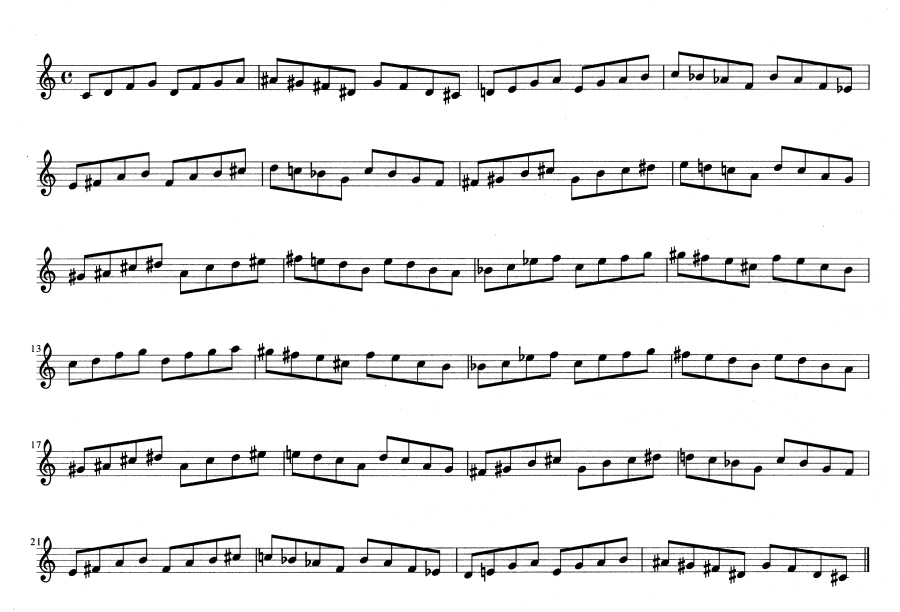
pentatonic-mode-4Here is a simple exercise I’ve been using, built on mode four of the major pentatonic scale. (Click on the image to enlarge it.) There’s nothing particularly novel or creative about it, but that’s not the point. Its meant to help develop dexterity in shifting from one tonality to another, in this case by half-step. The exercise begins with the fourth mode of the F pentatonic scale, and then, as you can see, moves chromatically up and then back down. Work it out two to four bars at a time, focusing on problem areas till you’ve smoothed them out, and then connect the dots one by one until you can play the exercise throughout the full range of your instrument.

Good luck, practice hard, and, as always, enjoy yourself! And don’t forget to check out the many other exercises, articles, and solo transcriptions on my jazz page. They’re all free, and free is good, yes?

It Was a Dark and Stormy Night, But the Band Played On

Happy New Year! Last year was tough but we made it through, didn’t we. I hope that 2011 will be a good year for you, for me, for us all.

Yeesh, I’m starting to talk like Tiny Tim. I’d better get on with this post, which is a summary of yesterday. Weatherwise, the last day of 2010 was a humdinger for convective connoisseurs, and jazz-wise, it was a fun evening for yours truly. While the two topics may seem unrelated, they are in fact integrally connected. It’s a well-known fact among my storm chasing buddies that any time I commit myself to a gig and am therefore unable to chase, tornadoes will drop out of the sky like confetti at a gala event. It’s a gift I have. Statistically, my powers hit their zenith the weekend of the Grand Rapids Festival of the Arts in early June. But anytime of the year, all hell is liable to break loose when I’m booked to play somewhere.

Yesterday was a prime case in point. While Steve Durst and I played a thoroughly enjoyable piano-sax gig for the dinner crowd at the Cobblestone Bistro here in Caledonia, tornadoes mowed across Missouri, Illinois, and Mississippi. You could see the event shaping up earlier in the week, with forecast models depicting a potent longwave trough digging deep into the nation’s midsection on Friday; a surface low working its way northward through Missouri and Iowa; high-velocity mid- and upper-level jets generating massive shear; and, critically, a long and broad plume of unseasonably rich moisture juicing the atmosphere up into Illinois ahead of an advancing cold front.

If you want to get some great insights into yesterday’s setup compared with two other similar wintertime severe weather events, check out this superb article by Adam Lucio in Convective Addiction. Adam’s analysis was spot-on. Tornadoes began spinning up early yesterday morning in Oklahoma and Arkansas and continued on through the day in Missouri and Illinois, surprisingly far north. Rolla and Saint Louis, Missouri, got whacked pretty solidly. Later, as expected, the action shifted south, with severe storms firing in Louisiana and a batch of night-time tornadoes gnawing their way across central Mississippi. Yazoo City found itself in the crosshairs for the third time this year as a strong radar couplet grazed past it, but, mercifully, this time the town appears to have escaped yet another direct hit.

With yesterday’s dust finally settled, the SPC’s present tally shows 40 preliminary tornado reports. Sadly, there were some fatalities, not all of which the reports show. What an awful way for the families affected to end a year that has already been difficult enough for so many people.

And the show isn’t quite over. Today, on the first day of 2011, Tornado Watch #3 is in effect for the Florida panhandle and southern Alabama. If that’s any kind of augur for this year’s severe weather season, April through June could be an interesting time for storm chasers.

But enough about the weather already. Let’s talk about jazz.

The Cobblestone Bistro is a beautiful place to play. I can’t believe that something like it exists in Caledonia, a community not exactly renowned as either a jazz hot spot or a north star of destination dining. But here the bistro is, fully operational now that a long-forthcoming liquor license has put its winsome and comfortable bar in business, and with an owner who appreciates and supports live jazz.

Last night I played my first gig at the Cobblestone for the New Years Eve dinner crowd from 6:00-10:00 p.m. Steve Durst joined me on the keyboards, and we spent an enjoyable four hours playing jazz standards in as elegant and ambiance-rich a setting as you could hope to find.

In a restaurant, particularly in a smaller room, it’s important not to play too loudly. People want to talk, and the music needs to add to the mood, not subtract from it by being too intrusive. That can be tricky for a sax player. A saxophone is not by nature a shy, quiet instrument, and a lot of energy is required to play it softly. But with three tables positioned directly in front of Steve and me, both of us absolutely had to reign in our volume.

Evidently we succeeded. We got no complaints of playing too loudly, but we did get some very nice compliments on our sound.

I’ll be playing at the Cobblestone again next Saturday, January 8, from 6:30-9:30 p.m. with Dave DeVos on bass and Paul Lesinski on keyboards. The trio will be playing as well on the 15th and 22nd, with Steve occupying the keyboard seat on the 15th. If you’re looking for a great night out in a beautiful setting, come and check us out.

And with that, I’m signing off and getting this first afternoon of a brand new year underway. I wish you a very happy and prosperous 2011.

–Storm (aka Bob)

Remembering “I Remember”: A Tribute to Phil Woods

My introduction to the magnificent alto saxophonist Phil Woods back in my music school days came in the form of a vinyl LP titled “I Remember.” I had been hearing of Woods’ lyrical approach and decided to acquaint myself with it. So off to the music store I went, and returned with the record album that was Woods’ tribute to some of his departed friends and musical influences–Paul Desmond, Cannonball Adderley, Oscar Pettiford, Charlie Parker, and others. The tunes, written by Phil, captured something of the personality and unique qualities of the men he had eulogized in the album.

I remember my first hearing of “I Remember.” I slapped the record on the turntable, dropped the needle, and proceeded to be utterly blown away. Phil Woods not only possessed complete mastery of the alto sax, but he also had a gorgeous, full-bodied tone and a personal, trademark sense of swing by which I’ve been able to instantly identify him ever since. Best of all, though, Phil played beautifully–and I’m using that adverb here in its strict sense. Phil’s playing on that record was truly so beautiful and so passionate that in places, it literally moved me to tears.

I have in mind the tender, deeply moving ballad “Paul,” written in tribute to Paul Desmond. Phil’s solo on that tune just took my breath away, and having listened to it again recently, I still am left speechless by its perfection. “Paul” is very possibly the most creative, flawlessly executed, and heart-wrenchingly lovely rendering of a ballad that I’ve ever heard, and its first impact on me was to raise up Phil Woods forever in my mind as the man to emulate when it came to ballad interpretation. In that I’m far from alone. Countless alto players over the years have looked to Woods as a jazz waymaker, fount of ideas, and source of inspiration.

My stack of LPs is long gone, and when I finally got to thinking about “I Remember” again a couple years ago, I couldn’t find it in a CD edition. It appeared to no longer be in publication, and regretfully, I consigned myself to never again listening to Phil’s beautiful playing on that album.

Jump forward to this Christmas. My sister Diane gave me my very first iPod (have I mentioned that I’m a slow joiner?) plus thirty dollars worth of iTune gift cards. So iTune shopping I went, and guess what I found? Of all the myriad albums to choose from, I chose “I Remember” as my first download.

You can’t imagine how thrilled I am to reacquaint myself with the collection of tunes that was my first exposure to Phil Woods. It seems impossible that thirty years have passed since that time, but today, “I Remember” still has the same effect on me as it did back then. Having developed a degree of expertise on the alto sax that I didn’t possess in those days, I find Phil’s playing to be, if anything, even more awe-inspiring and beautiful than when I first heard him. “Julian” still makes me want to shout for joy. “Charles Christopher” still floors me with its incendiary bebop.

And “Paul” still makes me cry.

New Years Eve Gig at the Cobblestone

Man, this year has blown by fast, hasn’t it! Five days from now we’ll have turned the corner into circa 2011. New Years Eve is the last of the big holidays. After that, we get down to the business of doing winter up here in the circumboreal region.

So what are you doing for New Years Eve? How’s about enjoying it with Steve Durst and me at the Cobblestone Bistro here in Caledonia, Michigan? We’ll be playing jazz standards through the dinner hours from 6:00-10:00 p.m.

Let me tell you a bit about the Cobblestone, because it’s a jewel. Located on the east side of M-37 (aka Cherry Valley Road) on the south end of Caledonia, the Cobblestone is designed for ambiance. Step inside and you’ll find an elegant, modestly sized dining room that features a fireplace, a waterfall fountain, superb cuisine, a selection of world-class wines, and a very nice bar. We’re talking destination dining right here in little old Caledonia. If you’re looking for a cozy place to spend the evening with your special someone, you’ll be absolutely delighted.

Of course, besides all of the above, this New Years Eve you’ll also get Steve on the keyboards and me on the alto saxophone providing live jazz to complement the mood. So come and enjoy dinner with us in one of the nicest settings you can imagine. Here’s the info:

• Date & Time: December 31, 6:00-10:00 p.m.

• Place: The Cobblestone Bistro & Banquet Center

• Address: 9818 Cherry Valley Ave. SE (M-37), Caledonia, MI

• Phone: (616) 588-3223

If the weather proves to be as warm as is currently forecast, this New Years Eve should be perfect for a night out. Spend it with us at the Cobblestone! I hope to see you there.

A Diminished Whole Tone Lick

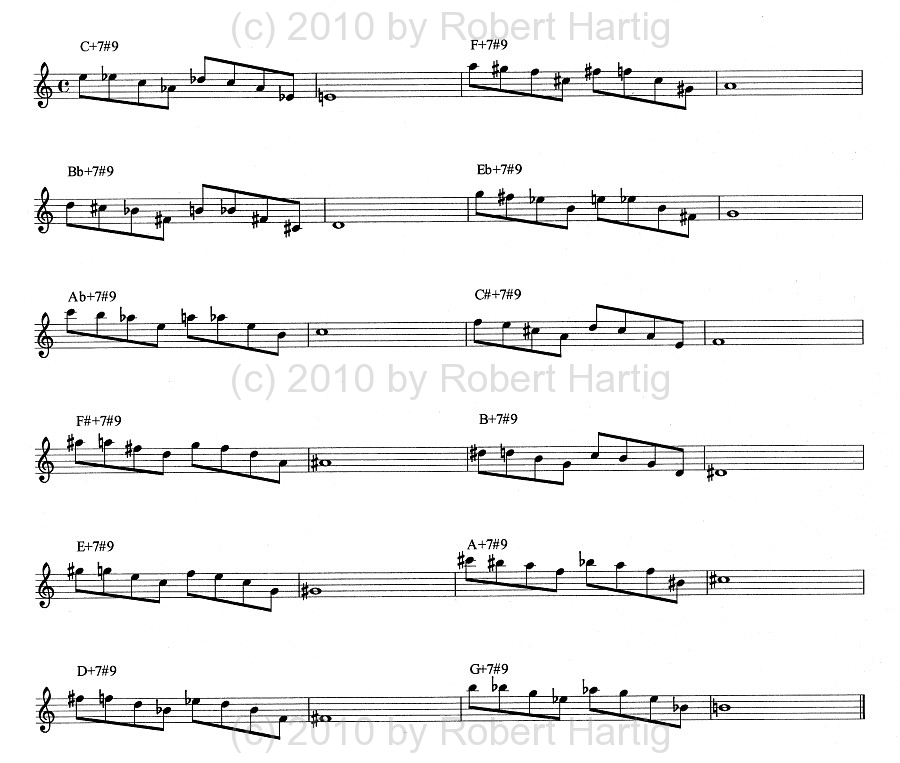
The diminished whole tone scale (aka super locrian scale, altered scale, altered dominant scale, Pomeroy scale) is nothing if not colorful. A mode of the ascending melodic minor scale built on that scale’s seventh degree, the diminished whole tone scale encompasses virtually every alteration to a dominant chord that you can think of: #5, b9, #9, and #11. It’s commonly used over dominant chords of various alterations, and is ideally suited to the V+7#9.

The name “diminished whole tone” refers to the scale’s two tetrachords. The bottom tetrachord derives from a half-whole diminished scale, and the top tetrachord suggests a whole tone scale. For example, connecting the tetrachord B, C, D, and Eb with the tetrachord F, G, A, and B will give you a B diminished whole tone scale: B, C, D, Eb, F, G, A, B. (In actual use, you’d want to think of the Eb enharmonically as a D#, the major third of a B+7#9 chord).

diminished-whole-tone-exercise_0To your right is an exercise that will take you around the cycle of fifths with one of my favorite diminished whole tone licks. (Click on the thumbnail to enlarge it.) I like the lick for three reasons. It starts and finishes on the highly consonant major third of the altered dominant chord, but in between it spotlights the altered tones of the chord (#5, b9, #9). It emphasizes the half-step relationship between the third and #9, and between the b9 and the chord root. And it outlines the major triad built on the raised fifth of the altered dominant–e.g. the #5 of a D+7#9, A# (Bb enharmonically) gives rise to a Bb major triad.

Have fun with the exercise. If you’re not familiar with the diminished whole tone sound, it may take a while to get it into your ear, but you’ll be glad you did.

Look for more exercises, helpful articles, and solo transcriptions on my jazz page.

Playing with Another Horn Person

Last night I moseyed over to Noto’s in Cascade and sat in with Kathy Lamar, Bob VanStee, and Bobby Thompson. Kathy is a fantastic vocalist, and with Bob on keyboards and Bobby on drums, she has a rhythm accompaniment with abilities equal to her own. In recent months I’ve popped in a few times and joined in, and I’ve always enjoyed myself, but never more than last night.

It had been a while since I’d made it out to Noto’s, and I thought I’d call my friend Dave DeVos and see if he wanted to join me out there. He did, and when I walked through the door he was already there, setting up his electric bass. Even better, Dan Jacobs was there with his fluegelhorn, which created a format I’m particularly fond of.

This was my first acquaintance with Dan, but I’d heard of him and had touched base with him on Facebook. Dan is an accomplished player, and sharing the stage with someone of his caliber is a joy. I love to hear what another capable instrumentalist is doing; that fresh influx of inventiveness and technique tweaks my creativity, suggests new ideas to try, and overall kicks me in the butt. Best of all is the interpersonal exchange, the trading fours and switching back and forth between melody and improvised counterpoints, that kind of thing.

As an alto saxophonist, I think I like sharing the stage with a trumpet/fluegelhorn player even more than with a tenor sax player. The variety in sound and approach is greater, and even visually the contrast is striking and, to me, more interesting. Of course, there are some challenges. At least I find there to be. The main one is to play with that other horn person without overplaying. Often enough, I’ll just bow out, and I noticed that Dan did the same last night. Actually, I find that approach enjoyable. It’s nice to just put down one’s horn and enjoy what the other guy is doing. We usually learn more by listening than by talking, and that maxim can certainly be applied to jazz, provided the person we’re listening to has something to say. Dan does, and it was really nice to hear him last night and get a chance to make a little music with him.

Dan, if you happen to read this, you’re great! Thanks for the melodies. I look forward to next time.

Some New Audio Clips for Your Listening Pleasure

Last Monday I got together with Ric Troll (guitar), Dave DeVos (bass), and Randy Marsh (drums), and we rehearsed a few of Ric’s original tunes in his studio, Tallmadge Mill. These guys are wonderful jazz musicians, and Ric is a composer of long standing. His music can be chewy stuff to work through, but this last session the tunes started to gel and we got some pretty nice grooves going.

Ric recorded the whole session, so I’m able to share some sample tracks with you. What you’ll hear are the tunes in rough, but there’s some very nice playing going on.

The New Hip is a basic 12-bar blues, but Ric’s head suggests a soloing approach different from your standard bebop. Attempting to free myself from cliches, I incorporated a more angular style.

The Urge is a fun tune with a high-energy A section and a swinging, cooler-sounding bridge that offers a lovely contrast.

Orcs has been the most challenging number, with it’s polymetric approach and shift to 7/4. It is coming together, though, and will be one heck of a tune once we’ve nailed down the form and the feel. Listen to Randy–the guy just tears it up on the set! Here’s a second take for all you double-dippers.

If you like what you hear, check out my Jazz Page for more sound samples as well as solo transcriptions, articles, and exercises of interest to improvising musicians.

Angularity Exercises

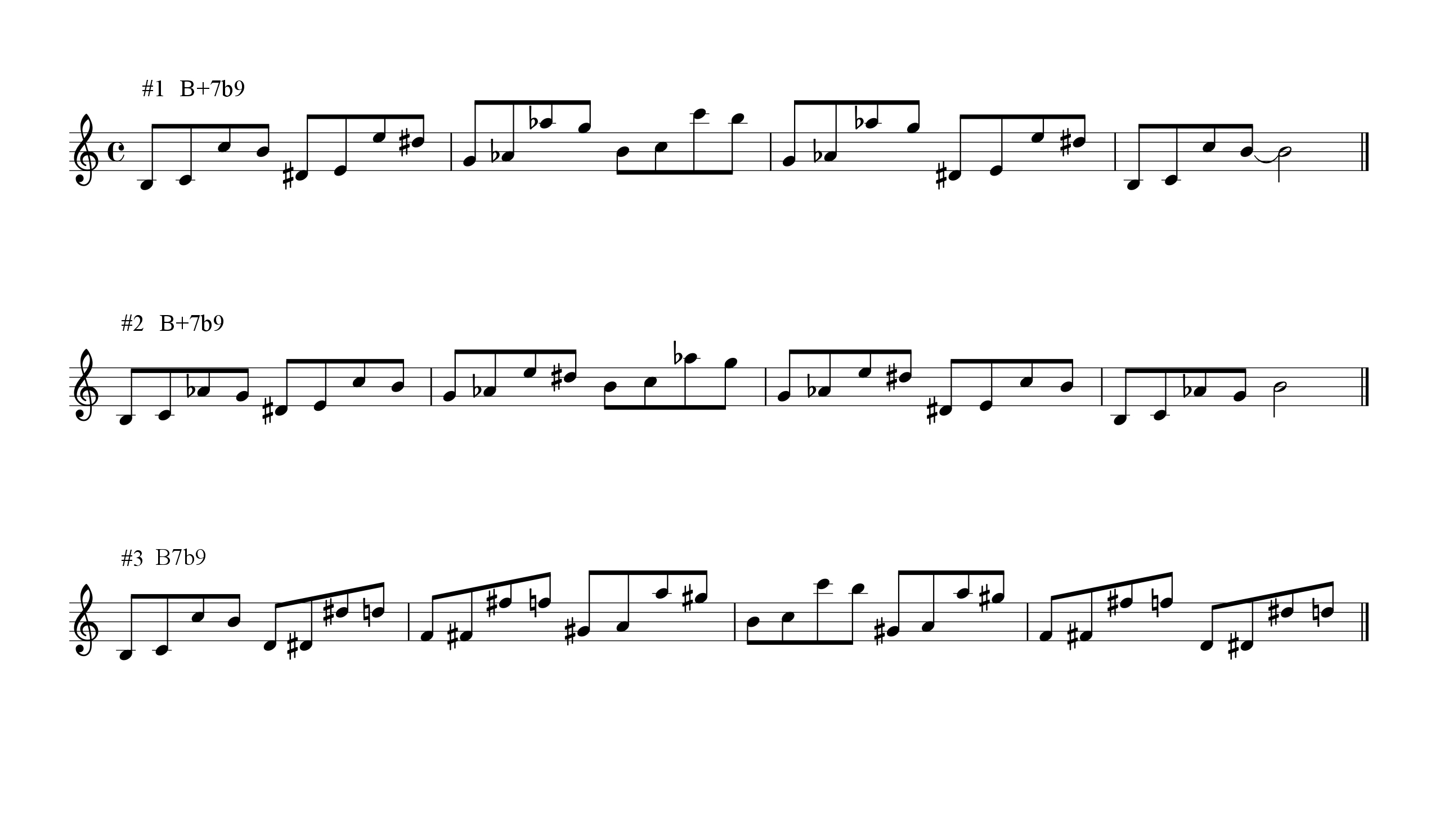
angularity-exercise-1-msczMuch of my playing is pretty boppish, and I’ve wanted to break it up with some different flavors and larger intervals. Lately I’ve been toying with some exercises on angularity involving couplets applied to the augmented scale, and I thought I’d share the wealth. Click on the thumbnail to the right to enlarge it.

The first two exercises are ones I’ve been woodshedding for about a week. They go well, as indicated, with altered dominant chords, but of course they work in any situation where you’d use an augmented scale. While the written exercises specify a B+7b9 chord, you can also use it with an Eb+7b9 and a G+7b9.

The third exercise outlines a half-whole diminished scale and will function as such. I’ve paired it with a B7b9, but it also works with a D7b9, and F7b9, and an Ab7b9.

While it probably goes without saying, play each exercise through the entire range of your instrument and through all twelve keys (“keys” being used here for lack of a better word). Since both the augmented and diminished scales are symmetrical scales, much of your work is done for you. You need learn only four versions of the first two exercises and three versions of the third one.

Happy woodshedding! And if you find these exercises helpful, check out the rest of the offerings on my jazz page.