Exploring the Lydian Flat Seven Sound (or, Ruminations on a Flatted Fifth)

Hey, there, fellow jazz saxophonists and other jazz instrumentalists, I haven’t forgotten you! Even as I’ve been blogging about the big, late-October weather system that has been blowing through the Great Lakes, I’ve been contemplating my next post for sax players. I hope you’ll find that what follows was worth waiting for.

A riff from Jimmy Forrest

Back in my college days, Basie tenor man Jimmy Forrest lived in Grand Rapids. Naturally, I owned one of his albums, a vinyl LP titled “Black Forrest.” It was a hard-swinging, straight-ahead collection of tunes that showcased Jimmy’s ability to deliver both high-testosterone bebop and wonderfully lyrical balladry. The album included a heaping helping of blues, and in one of those blues, Jimmy worked into his solo a lick reminiscent of the old Jetsons cartoon theme song, which sounded something like this:
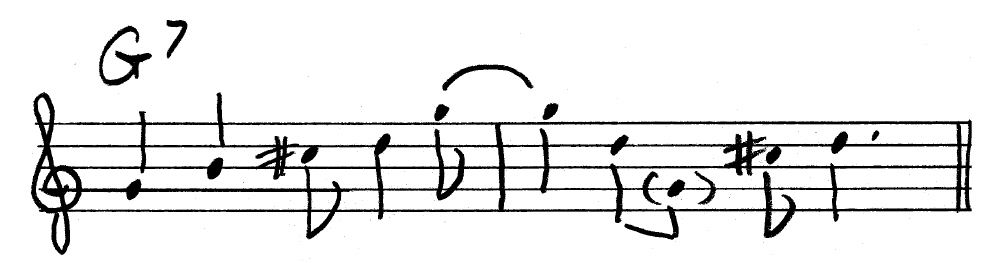
I liked that lick, and I incorporated it into my blues playing. The thing that made it sound so hip was the sharped fourth–aka the flat five, though in this application, that’s not the correct theoretical term–which defines the lydian sound.

What makes lydian sound so lydian?

Good question. There are two scales that can be considered lydian: the traditional lydian church mode built off the fourth degree of the major scale, and the lydian flat seven scale, also known as the lydian dominant.

The term “lydian dominant” is a bit confusing, since each word, “lydian” and “dominant,” suggests a function of the scale that cancels out the other one. In this case, however, “lydian” refers to the raised fourth scale degree, and “dominant” describes how the scale and its characteristic chord function. The more accurate term is actually “mixolydian sharp four,” since the scale is used the same way that a standard mixolydian mode is used: as a scale choice for dominant seventh chords.

Whatever you wish to call it, the lydian flat seven sound is defined by its raised fourth scale degree. But other scale options for dominant seventh chords also contain the raised fourth/flatted fifth. The half/whole-step diminished scale and the diminished whole tone scale both come instantly to mind. What makes the lydian flat seven different?

Its consonance with an unaltered dominant seventh chord.

Following is a G lydian flat seven scale, which you would use over a standard G7 chord:
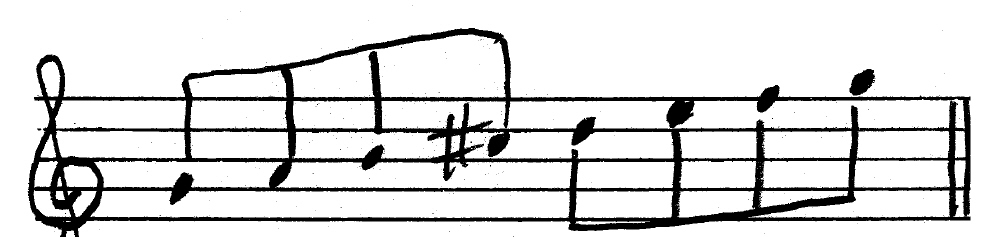
Lydian_Dominant_Scale

Note that this scale neither raises nor lowers the ninth of the G7, nor does it alter the fifth, nor does it lower the thirteenth. Only the fourth degree gets raised a half-step to create the characteristic lydian sound. The raised fourth doesn’t clash with the third of the dominant chord the way that the unaltered third of the standard mixolydian mode does, in effect making the lydian flat seven scale the more consonant scale.

Triad superimposition

When you build triads off of the first and second degrees of the lydian flat seven scale, each triad is major in quality. For instance, a G lydian flat seven scale gives you the following:
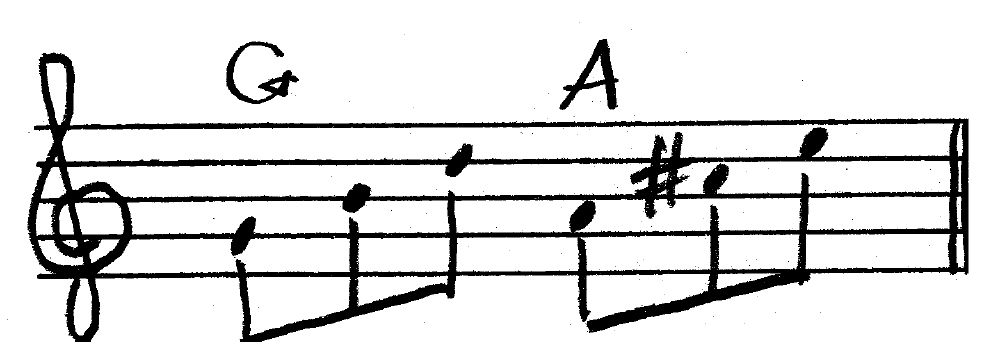
Lydian_Triad_Couplets

Note that the first triad outlines the foundational notes of the G7 chord, minus the seventh, while the second triad emphasizes the ninth, raised fourth, and thirteenth. Thus,  a quick way to emphasize the lydian sound over a dominant seventh chord is to superimpose a major triad whose root is a whole step above the chord root. In other words, if you’re soloing over a Bb7, play a C major triad; if you’re working with a D9, play an E major triad, and so forth.

By the way, since neither triad includes the seventh of the scale, you can apply the above superimposition equally well to both the G7 and Gmaj7 chords.

Major triad couplets in inversion for the lydian sound

Okay, time to start getting the stuff I’ve just covered into your fingers and your ears. Click on the exercise to your right to enlarge it. It’s a practical extension of the superimposition principle I’ve just described that takes you through different inversions of the triad couplets based on the G lydian flat seven scale. As always, take the exercise up and down the full range of your instrument, and through all twelve keys.

I’ll have more to say about the lydian flat seven scale, but this ought to keep your woodshed smoking for a while.

Visit my jazz page for more articles on jazz improvisation, jazz theory, and saxophone playing.
“Giant Steps” Licks and Patterns

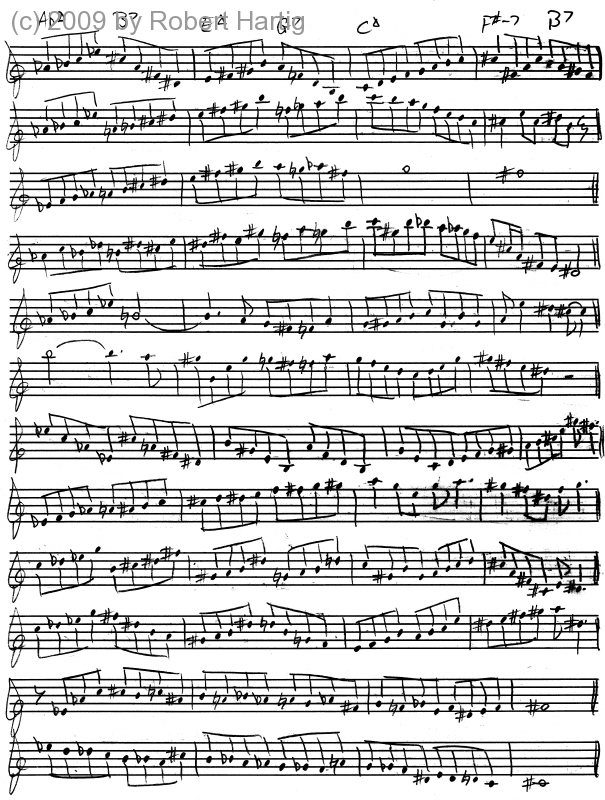
After posting a couple days ago on how to use the augmented scale with “Giant Steps” changes, I’ve experienced a renewed interest in woodshedding John Coltrane’s high-hurdle chord cycle.

There was a time in my musical life, maybe ten years ago, when I became moderately obsessed with “Giant Steps.” I painstakingly wrote down my practice material in a music notebook, which I continued to add to until I had a veritable blizzard of ideas to work with.

Today, looking through the web, I see plenty of resources that explore the theory behind the changes to “Giant Steps.” However, I don’t see much in the way of licks and patterns, of application-oriented stuff that a sax player can actually wrap his or her fingers around. So, since I’m presently re-exploring my “Giant Steps” notebook, I thought I’d share a page with you.

Click on the image to the right to enlarge it. It’s all hands-on stuff. If you want to study Coltrane’s theory involving key centers moving by major thirds, you can find plenty of information on the Internet, such as this excellent Wikipedia article. But understanding the “Giant Steps” cycle isn’t the same as playing it, and that’s where this article can help.

One caveat: since I’m an alto sax player, I wrote out the changes in my key. If you play an instrument pitched in Bb or C, such as tenor sax or flute, you’ll need to transpose.

The patterns shown here are for the first four bars of the tune’s A section. With it’s lopsided arrangement of V7-I cadences–which would be simple enough in themselves to negotiate if Coltrane hadn’t placed the bar lines so inconveniently–this section is the one that can be hard to master. I wrote out material for the B section as well, but what I’ve shown here will probably be more to your immediate interest.

Enjoy the material, practice hard, and have fun!

UPDATE: My entire “Giant Steps” practice notebook is now available for sale in C, Bb, Eb, and bass clef editions. Using music notation software, I transcribed all of the handwritten material (including the above image) into a clear, easy-to-read format; wrote a front section that discusses the basic theory of Coltrane changes and gives tips and insights for practice; and had a cover professionally designed.

The Giant Steps Scratch Pad is available as

* PDF download–$9.50

* Print edition–$10.95 plus shipping

The PDF will provide you with the full contents of the book instantly and save you money. The print edition gives you the complete, finished production complete with glossy cover. If you enjoyed the licks and patterns on this page, then The Giant Steps Scratch Pad is for you. View page samples from the Bb edition and order your copy today!

Using the Augmented Scale with “Giant Steps”

I tend to arrive at things the hard way, which is to say, by personal discovery. For instance, I come across a large circular object and find that it has a unique quality, namely, that it rolls, and this gets me all excited, and of course I have to go tell all my friends. “Hey, Fred,” I say, rolling my circular object around on the lawn in front of him, “check this out! Pretty nifty, eh?”

“Ermmm, yeah. Nice. A wheel,” says Fred.

“A what?” I reply.

“A wheel,” Fred repeats, confirming my sudden suspicion that others may have already crossed this territory before me.

“Exactly, ” I say. “A wheel. Isn’t it great?”

Fred scrutinizes me for a second, then walks away. Now you know why I don’t have any friends named Fred. Used to, don’t anymore.

Anyway, the same principle probably applies to this post on using the augmented scale over “Giant Steps” changes. I’m sure it has already been done, and I’m probably just the last person to know about it. But since I haven’t come across any other literature that addresses the subject, either on the Internet or elsewhere, I thought I’d talk about it here.*

I do seem to recall reading somewhere about a connection between the augmented scale and the Coltrane tune, but it was just a passing comment that never went into any detail. I have no idea where I came across it. Evidently it planted a seed, though, because the relationship between the scale and the set of chord changes, both of whose symmetrical constructions emphasize the interval of a major third, has been intriguing me lately.

So earlier this evening, having thought the theory of the thing through, I finally sat down with my sax and my Jamie Aebersold “John Coltrane” CD and played around with the concept. It’s still very new to me, as is the sound of the augmented scale, but I’m satisfied at this point that I’ve acquired a very useful and colorful tool.

Simply put, the augmented scale is as close as you can get to a universal scale that covers “Giant Steps” in its entirety–not just the cantilevered dominant-tonic cycle, but also the ii-V7-I cadences. The application isn’t picture-perfect, but it works, and besides, a little dissonance is beautiful, right?

I’m not going to get deeply into the theory behind my thinking. I’m just going to assure you that, just as you can play an entire 12-bar blues using one blues scale, you can improvise on all of of “Giant Steps” using a single augmented scale. It’s not something you want to base an entire solo on, particularly since the augmented scale is such a foreign sound; but for that same reason, it’s also a very nice color to tap into, and you can coast along on it for as long as you please without having to think too much about making the changes. As long as you stay within the scale, you’re golden.

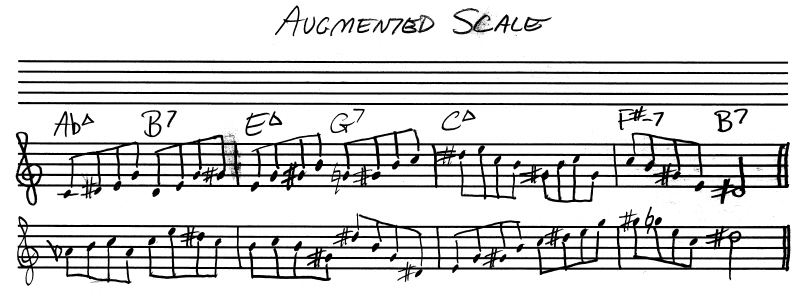
But of course, you want an example. So without further ado, here are a couple of licks on four bars of the “Giant Steps” cycle. Me being an alto man, I’ve written them for Eb instruments, so you may need to transpose. Click on the image to enlarge it.

Three points to be aware of:

• Use care in handling the perfect fourths of the dominant chords and the flatted thirds of the tonics.

• I’ve shown the standard chords without alterations. However, by virtue of its construction, the augmented scale works best with “Giant Steps” when you flat the ninths and raise the fifths of the dominant chords and flat the fifths of the minor sevenths.

• The sound of the augmented scale is quite different from everyday major/minor tonalities. So set those standards aside and suspend judgment until you’ve worked with the augmented scale long enough to get it into your ear.

That’s it. As for any further brain work, that’s up to you. Of course, you’re probably way ahead of me on it to begin with. That’s why, at this point, I’m turning my mind in other directions. For instance, I was sitting under an apple tree the other day, and an apple dropped off and bonked me on the head. I wondered why. What makes things fall? It’s almost like there’s some kind of a force or something. Has anyone looked into that?

They have?

Nuts. I was afraid of that.

————————–

* ADDENDUM: I take it back. After posting this article, I came across an excellent writeup by Jason Lyon that digs deeply into the theory of using the augmented scale with “Giant Steps.”

Stormhorn Blog is Back Up and Running

Lately, due to life’s fast pace, I haven’t kept a close track of the Stormhorn blog. So I was unaware, until my buddy Kurt Hulst informed me of it, that folks have been unable to link to my blogsite.

This is to let you know that the problem has been fixed, thanks to my lovely computer tech girlfriend, Lisa, who instantly and correctly suggested that a corrupt plug-in was the culprit.

Stay tuned–I’ll be posting content of greater interest this weekend. For now, this is just a heads-up that Stormhorn is back (just in case ya missed me).

Sonny Stitt “Au Privave” Solo Transcription for Alto Sax

Sonny Stitt. Just in case you forgot how bad he really was, there’s a CD out there titled…

Sonny Stitt: Just in Case You Forgot How Bad He Really Was.

.

With an all-star lineup of guest musicians including fellow saxophonists Richie Cole and John Handy, the CD, published by 32 Jazz, is a Stitt tour de force featuring the American songbook and classic bebop.

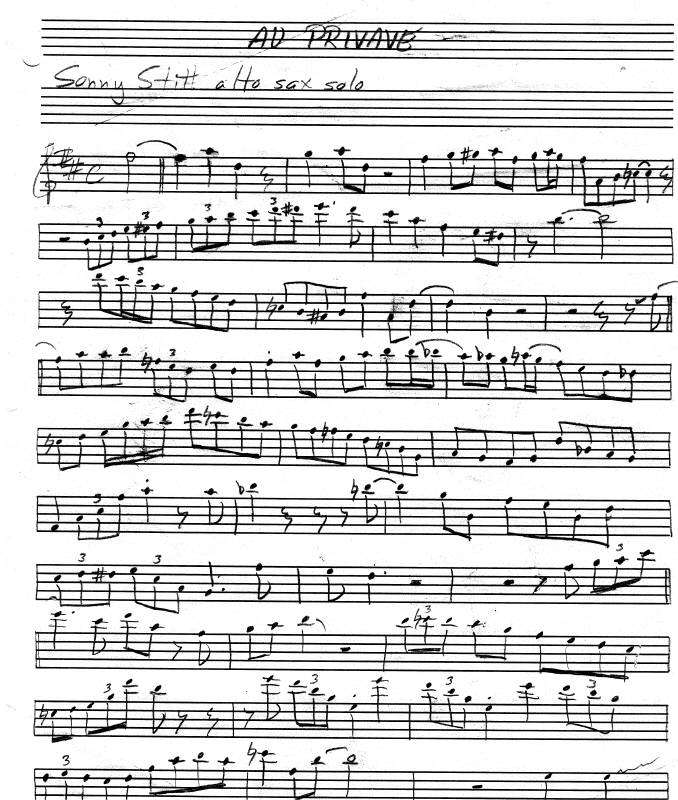
Among the selections is the Parker tune “Au Privave.” Like Bird and virtually all of the other great boppers and jazz musicians before, during, and after him, Stitt was steeped in the blues. “Au Privave” features Stitt blowing several headlong, muscular choruses, demonstrating exactly what an alto player of his caliber is capable of doing with the old, familiar twelve-bar form.

I thought you might enjoy letting your fingers travel the same patterns as Sonny’s did on his “Au Privave” solo. So here for your enjoyment and edification is my transcription of the first three choruses. Please forgive the sizing disparity between the two sheet music copies. I haven’t yet gotten image reproduction down to a fine science. But it’s Sonny’s inventiveness that is the focus, and I trust that will survive even my mutilations.

Sonny Stitt solo on Au Privave

Sonny Stitt, Au Privave p. 2

Diminished Lick for Cycle of Dominants

The following pattern is nothing new. If you’ve worked at all on the diminished scale, you’ve doubtless encountered it. But have you worked it out in descending half-steps until it lies smoothly under your fingers from the top to the bottom of your horn? Because that root movement downward by minor seconds is what makes it, or any diminished pattern, particularly useful.

Let’s take a look at  why this is. First, here’s the lick:

Diminished Lick

Note that while each measure brings the diminished scale pattern progressively downward by a half-step, the corresponding chord progression is moving around the circle of fifths. Why?

Remember tritone substitution?

The diminished scale functions perfectly as a scale of choice for V7b9 chords and their tritone substitutes because of its symmetrical nature. Due to its structure, every diminished scale will accommodate not just one, but four possible V7b9 chords.

For instance, a half-step/whole-step diminished scale beginning on the note A will obviously work with an A7b9 chord. But it will also work equally well with C7b9, Eb7b9, and F#7b9.

Note that the A7b9 and Eb7b9 have roots a tritone apart, as do the C7b9 and F#7b9. In other words, tritone substitution is hardwired into the diminished scale.

Herein lies the magic of diminished scales descending by half-steps.

Look closely at the above diminished pattern and you’ll note that root movement downward by a half-step gives you the same scales that you’d arrive at with the circle of fifths.

For instance, in the first bar, the diminished pattern starting on the note C repeats itself sequentially a half-step down in the following measure, starting on the note B.

But what scale would you have arrived at if, instead of dropping a by a minor second, you had dropped by a perfect fifth to the note F, as you would do if you were moving around the circle of fifths? Guess what? You’d have the same scale–i.e. B, C, D, Eb, F, Gb, Ab, A. You’d just be starting on a different note of that scale.

Now, if you’re thinking…

…you’ll realize that because every diminished scale contains four possible roots, you can also achieve the results I’ve just described by moving upward by major seconds, another easy root movement.

You can also move down by a major third or a perfect fifth, but it’s easier to focus on the two root movements that are close at hand.

In summary

When woodshedding a diminished scale lick, it particularly behooves you to get it laying smoothly under your fingers in root movements of descending half-steps and ascending whole steps.

And that, Grasshopper, is that. The rest is up to you.

Sitting in with the Local Musicians

It’s always a pleasure to sit in with local musicians. In Suttons Bay, Michigan, I got a chance to blow with some very, er, unusual cats. Talk about jazz being an art form.

I had played a fun gig in Leelanau the previous evening just north of Cedar with the Rhythm Section Jazz Band. Lisa came with me, with the idea that we’d overnight in Traverse City and then take in a bit of northern Michigan. There’s no more beautiful place than the Leelanau peninsula in the fall, and we took our time driving through the area, up the east coast along Grand Traverse Bay to Leelanau State Park and the Grand Traverse Lighthouse, then down the shoreline of Lake Michigan to Sleeping Bear.

Stopping in the artsy-craftsy town of Suttons Bay, we had gotten some coffee and were heading back to the car when I happened to spot a jam session taking place outside a shop. Strangely, though, not a note was being played. As you can see, the band was in fact a group of stylized jazz musicians made

out of metal and set out on the lawn. Whatever the tune was that they were playing, they seemed to be really getting into  it, but something was missing. Ya can’t have a jazz band without a sax player, ya know!

Naturally, I volunteered my services, and we went at it. Lisa caught our little ensemble with her camera. Hope you enjoy the pics!

Once There Were Trains

For many years, it has been my habit to practice my saxophone in my car. Living in an apartment and not wishing to bother my neighbors has forced me to find alternatives for my woodshedding, and my vehicle has served me well in that regard. In fact, I like it so well that if I ever do get around to buying a house, I will probably continue to practice in my car.

Since I love trains, my habit has been to park along a railroad track that stretches between Grand Rapids and Lansing. It has always been a fairly active route, and most days I’ve been able to count on seeing at least one train, and usually two or more, go by while I’m playing my horn.

Until recently. What has happened to the trains? Lately I haven’t seen a one. Really. Not in days. I just returned a while ago from one of my practice spots by the railroad crossing near Alto, and I didn’t get so much as a flicker on the semaphore lights.

This economy has hit a lot of folks pretty hard here in Michigan. I’ve got to believe that the collapse of the auto industry has had a dramatic impact on railroad transport. What I can say for sure is, the trains are no longer rolling along my favorite tracks the way they’ve done for so many years. I hope it’s just a temporary lull, and that railroad traffic will pick up again over time. Practice is still good, and I love being out in the countryside by the tracks, working my sax over and watching the sun set over the woods and the fields of alfalfa, corn, and soybean. But something’s missing. It just isn’t the same without the trains.

How to Master Circular Breathing on the Saxophone

It has been so many years since I first learned how to circular breathe that I rarely give the matter a thought anymore. It occurs to me, though, that to many sax players, circular breathing remains a technique shrouded in mystery.

There is, after all, something about it that appears almost miraculous. Most saxophonists would be challenged to hold a tone for thirty seconds. So how on earth did saxophonist Vann Burchfield manage to sustain a single note for 47 minutes, 6 seconds, in 2003, beating the previous record set by Kenny G of 45 minutes, 47 seconds? (An even more interesting question is, why did he do it? But the point of this article is to discuss the mechanics behind such a feat, not the psychology.)

Sensationalism aside, circular breathing is a useful technique with practical benefits for those who add it to their tool kit. But how does one go about doing so?

Begin by understanding the basics of how circular breathing works.

The principle is fairly simple (which is not to say, easy to master). You support your tone with air from your lungs in the usual way. However, when your air supply begins to dwindle, you store a quick reservoir of air in your cheeks. Then, closing off the back of your throat, you sustain your tone by contracting your cheeks while simultaneously–and very quickly–replenishing your lungs with air by breathing in through your nose.

This accomplished, you reopen the back of your throat and once again blow from your lungs. Repeat the procedure as often as necessary.

It sounds tricky, and it is at first, but the essentials really aren’t any great secret. Like any discipline, though, circular breathing takes time and persistence to master. Once you’ve got the hang of it, you’ll find that you’re able to continue playing indefinitely, spinning out lines for as long as you please without having to break the flow.

Here’s a simple, step-by-step process to get you started.

1. Get in touch with your air reservoir. How do you do this? Simple: take a breath and then puff out your cheeks. Now continue to puff out your cheeks while breathing in and out through your nose. Note how the back of your throat automatically closes in order for you to accomplish this, sealing off a reservoir of air in your mouth that keeps your cheeks “inflated” while your lungs continue their normal breathing rhythm.

2. Repeat the above procedure. But this time, blow a controlled stream of air through your lips, allowing the reservoir of air in your cheeks to empty itself like a leaky balloon. When you start losing pressure in your cheeks, then–without interrupting the air flow through your lips–breathe in through your nose and then release the air from your lungs into your mouth, replenishing the reservoir of air. Then close off your throat again. Continue doing this till it seems easy (which will probably happen fairly quickly because it is easy, much easier to do than it is to describe!).

The objective is to maintain a steady air stream through your lips while opening and closing your throat to replenish your air reservoir.

3. Till this point, the focus has been on getting a feel for the air reservoir in your mouth/cheeks. The reservoir is key, but in circular breathing, you’ll only use it for the second it takes to fill your lungs with air, after which your throat remains open and you blow in the normal fashion.

So in this exercise, blow a steady stream of air through your lips, allowing the pressure to puff out your cheeks, but support the air stream from your lungs. Keep it going for five or ten seconds, until your lungs begin to empty. Then close off your throat and keep the air stream moving by using the air in your mouth reservoir, as in exercise number two. Simultaneously, inhaling through your nostrils, fill your lungs back up with air. Then open your throat back up and blow from your lungs once again.

4. Once you can comfortably and consistently perform the above exercise, you’ll have gotten your arms around the essentials of circular breathing. At this point, you are in fact performing the technique. Now it’s just a matter of transferring it to your instrument.

When I was first learning to circular breathe, I found it helpful to work with the soprano saxophone. Assuming a conservative reed/mouthpiece combination, the soprano uses less air than the larger horns, making the learning curve easier. If you’ve got a soprano sax, I highly recommend that you practice circular breathing on it before you try it on your alto or tenor.

Start by seeing how long you can sustain a single tone in the middle register of your instrument. The note C on the staff works great. Avoid extremely high and low notes for the time being. Concentrate on making a smooth transition between lung support and reservoir support, striving for minimal pitch wavering, change in volume, and certainly break in tone when closing and reopening the back of your throat.

From here on, gaining proficiency is just a matter of focused, self-analytical practice. However, there are…

A few things to be aware of.

These involve the way you use your mouth reservoir to sustain a tone.

In the above exercises, you’ve had your cheeks puffed out and allowed the air to leak out of them in a controlled stream. Once you start blowing through a mouthpiece, you’ll find that things aren’t quite so easy. The air goes at a faster rate, and you need to contract your cheeks like a bellows in order to provide enough air pressure to sustain a tone on the horn.

Ultimately, of course, you want to dispense with puffing out your cheeks as much as possible. Cheek-puffing is handy as a preliminary learning device, but it’s ruinous on intonation and good breath support. As you spend time refining your circular breathing technique, you’ll find that you can exert air pressure from the back of your throat by lifting your tongue forward. I don’t know how better to describe what I’m getting at, but I’m quite certain that you’ll discover it for yourself if you continue to practice circular breathing.

Once you’re able to sustain a single tone with reasonable control, try playing a scale using circular breathing. From there, try a favorite lick. Circular breathing while playing lines is challenging at first, but once you’ve acquired the ability, you’ll find that moving notes are actually more forgiving than long tones. They tend to mask the unwelcome waver that often attends the shift in air support.

And that, my friends, is that. My job is done. Yours is just beginning. Grab your horn and get started.

Practicing Intervals for Jazz Improvisation

If you’re a budding jazz saxophonist, this post can make a huge difference in your playing. If you’re a seasoned player, you can probably skip it. Then again, you just might find it valuable, in the manner that hearing your mother’s voice in the back of your head asking you whether you’re eating your vegetables can be valuable.

Are you practicing your intervals?

They’re so good for you.

Oh, I know, you’d rather shove them aside and concentrate on the steak and potatoes of memorizing jazz licks and solo transcriptions. But if you want your instrumental technique to grow up big and strong, then don’t forget to sit down with your Larry Teal workbook, or whatever technique book you’re using, and invest some serious time memorizing and maintaining interval exercises along the chromatic scale. Seconds, thirds, fourths, all the way up to sevenths and even beyond…unless you plan to play nothing but scales in all your solos, all of the aforementioned are building blocks that you really need to get your arms around. So don’t ignore interval practice. Do it because you’ll acquire a greater command of your instrument, speed up your thinking, and enhance your creativity. Do it because your mother would want you to.

Increasing your dexterity is of course an important objective of interval exercises. But don’t make that your sole focus. As you practice, also think of application.

Let’s say, for instance, that you’re spending some time taking diads of a minor sixth up and down the chromatic scale. What are some practical uses of that interval that you’re likely to encounter?

For starters, you can use it to ascend from the third of a major triad to its root. Also, in an augmented triad, a minor sixth (or, enharmonically, an augmented fifth) is the distance both from the root to the raised fifth of the chord, and from the third to the root. With a V9, you can ascend from the root to the flatted thirteenth (aka flatted sixth) and resolve down a half-step to the fifth; or you can leap from the second to the flatted seventh.

And of course, the order of these upward leaps can be reversed. For instance, you can leap downward from the flat seventh to the second of the V9 chord, or from the root downward to the third.

The point is, while you’re practicing your intervals, exercise your mind along with your fingers by thinking of ways you’re actually going to apply all that fabulous technique you’re building. Engage your brain and ears as you’re doing the grunt work.

And with all that being said, sit down and git ‘er done. Practice, practice, practice. Make your mother proud.