Shakin’ the Shack: A Dave Koz Alto Sax Solo Transcription, Part 1

Saxophonist Dave Koz is, pardon my French, a bitch. Man, can that guy play the alto sax! I just got a reminder of how good he is after listening to a YouTube cut of his tune “Shakin’ the Shack” from off of his “Lucky Man” CD.

I bought the CD years ago and was so enamored with Koz’s electrifying, hard-bop approach to smooth jazz that I transcribed a couple of his solos. I thought I had lost those transcriptions long ago, but guess what surfaced the other day while I was sifting through some old music charts I had written? That’s right: my transcription of Dave Koz playing his solo on “Shakin’ the Shack.”

Well…at least part of the solo. Evidently I never completed the transcription, which is really a shame, because this first section is just the preamble. Dave is a fabulous musical storyteller, and his solo really starts cooking in the section that follows, building momentum and tremendous excitement in ashakin-the-shack_dave-koz-solo joyous musical romp that makes me want to laugh and shout and dance and do other things most unbecoming of a 54-year-old white, Germanic male.
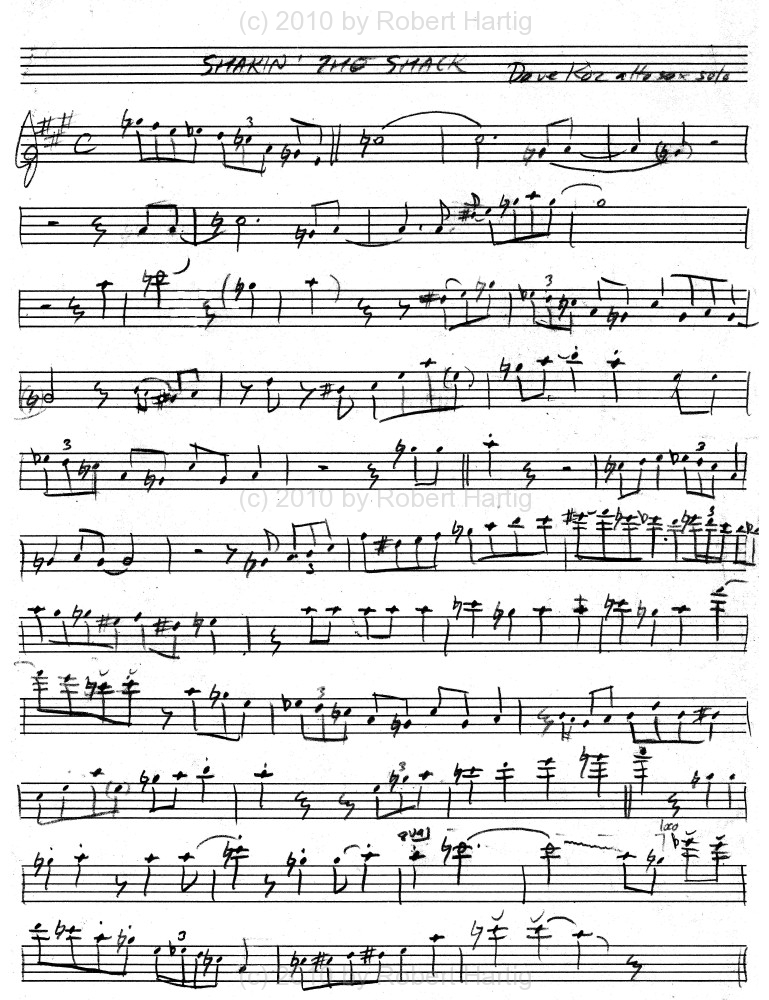
I regret that I can’t offer you the full transcription of Dave’s solo, but such as I have, I share with you now. Click on the thumbnail to enlarge it.

If you’ve never heard “Shakin’ the Shack,” I strongly encourage you to give it a listen so you can hear how the solo actually sounds in its musical context. For that matter, do yourself a biiiiiig favor and buy the entire “Lucky Man” CD. It’s beautifully produced and bubbling over with  joie de vivre–traveling music of the first order, perfect for putting a smile on your face when you’re out on the open road.

Sax ‘n Wedge: A Life Goal

This last week I was so preoccupied with chasing storms that I hardly blogged at all. When I did, naturally it was about weather. Jazz, music, and the saxophone have languished in the background, at least blogically speaking.

Not, however, in practice. When I headed out west for some dryline action, my horn went with me. It always does. My chase partners know that when I head for any chase over a day in duration, the sax is as much a part of my travel gear as my suitcase, laptop, and camera. Some folks toss a baseball or football while waiting for storm initiation; I practice my saxophone. Any time is a good time to get in a few licks.

I have several reasons for bringing my horn along on chases, all of them having to do with eventualities. The most likely scenario is, as I’ve just said, that I’ll get a chance to woodshed my instrument. Far less likely–but still, ya never know–is the possibility of winding up in some restaurant where a band is playing, and it’s the kind of band that makes me wish I could sit in for a tune or two. Like I said, unlikely; most Great Plains towns aren’t exactly jazz hotbeds. Still, as I learned back in the Boy Scouts, it pays to be prepared.

My main reason for taking my saxophone with me on storm chases, though, is because of a particular life goal of mine: I want to get a good photo, or maybe some video, or even both, of me jamming on my sax while a monster wedge churns away in the distance. For that matter, I’ll settle for just a nice, photogenic tornado of any shape or size. I just want some kind of visual record that captures the raison d’etre of Stormhorn and the essence of who I am as a storm chaser and jazz saxophonist.

Assuming that a storm is moving slowly enough to make a photo shoot practical, my preparations once towers start muscling up are:

* Rain-X windows

* Remove camera from case and make sure it’s ready for action

* Get tripod out of trunk

* Assemble saxophone

Just a handy checklist. Reasonable enough, wouldn’t you say?

So cross your fingers for me, or better still, pray. This season could be the one where I fulfill an ambition and get some very cool photos to show for it.

I’m a maniac, you say? Of course I am. A maniac is just someone with a different kind of dream.

Sax Practice: A Chromatic Motif on the Cycle of Dominants

If you want to develop fluency at voice-leading and switching keys, cycle exercises are mandatory and the cycle of fifths is supreme. Taking dominant patterns and licks around the cycle of fifths is a longstanding habit of mine. As with a lot of musical disciplines, at first I delayed, I kicked, I resisted tackling this one for a long time because, well, it was work. Finally I decided to buck up and eat my spinach, and today the circle of fifths is a key component of my practice regimen, particularly for V7 chords.

After all, the dominant seventh, more than any other chord, defines the key center; it’s the chord that screams “resolve me!” So it pays for sax players and other jazz improvisers to consistently drill their ears and their fingers with exercises that can build their facility with dominant seventh chords.

Here’s one such exercise that I’ve been having fun with lately. Click on it to enlarge it. There’s nothing mysterious about this little motif; I could pull it off easily in a number of keys right where I stand without making a practice issue of it. I’ve practiced enough related material that my fingers already know the way. But spotlighting the figure makes it likelier that I’ll use it in my solos; it ensures that my technique will follow me into any key; and, as with all cycle of fifth exercises, it helps me hear how the pattern lays out in root movements by fifth.

For each dominant chord, the exercise ascends chromatically from the ninth to the third, and then from the root to the seventh. I’ve set it in triplets, but you’ll want to experiment with different rhythms.  I might add, this little motif sounds great in blues solos.

No need for me to say more–except, of course, to pester you to check out more exercises on my jazz page. Have fun practicing!

Intuitive Jazz Solos: Hearing the Music with Your Fingers

Last night, after a particularly inspirational practice session, I found myself thinking about what it was that I was accomplishing. Saturating myself in the rarely used key of concert A, as I’ve been doing lately, and also taking new material through all twelve keys, has not only been unlocking my saxophone technique overall, but it is also causing me to consider the result I’m after. In a nutshell, I want my fingers to hear the music.

That’s my way of saying that I want to get the muscle memory in my fingers integrally linked with my inner ear, and my inner ear to what I’m actually hearing moment by moment in a given improvisational setting, so intimately that I can conceive ideas instantly and execute them flawlessly.

Have you noticed that there are certain keys in which your fingers just naturally know where to go? Keys and tunes in which you’ve mastered your melodic materials to the point where they’re innate; where licks and patterns are just tools in your toolkit, not your life raft that keeps you afloat? Concert Bb, F, and C major are keys most jazz musicians are quite familiar with, for instance. But what about B, D, A, or F#? The American Songbook may not abound with tunes written in the “hard” keys, but lots of songs have momentary digressions to them.

“Ornithology,” for example, has a temporary excursion into the key of concert A in the form of a iii-VI7-ii-V7 progression. The bridge section to “Cherokee” includes an entire four-bar ii-V7-I cadence in that same key. Spending time trying to master those two tunes has given me incentive to hash out the key of A, to the point where my fingers are starting to “hear” in that key. They “feel” where the third and leading tone of the scale are, and how those notes fit into different harmonic contexts; they’re getting better at handling the avoid-tone of the fourth; they’re becoming friends with passing and non-harmonic tones, and growing more adept at using non-diatonic notes to realize borrowed harmonies.

It’s a process that begins with thinking things through, then working your thinking into your fingers through repetition over many practice sessions. The result, over time, is less deliberation (“If I play an E, that’ll be the #9 of the C#+7#9 chord, moving down to D, then resolving to the root”) and more instantaneous response. Once you reach that point, you no longer need to tell your fingers what to do; they feel it for themselves in their wee little finger souls. Your thinking speeds up, and your fingers are right there with you, eager to serve your ideas and fully capable of doing so.

How many keys, and how many tunes, can you hear with your fingers? Pay your dues in the woodshed, transcribe and memorize jazz solos, play out whenever you get a chance, and over time, your fingers will develop big ears.

Charlie Parker: His Music and Life (Book Review)

Intellectually, all saxophonists understand that Charlie Parker had to pay his dues just like anyone else. We’ve heard the stories about a high-school-age Parker learning to play on a clunky old artifact of an alto saxophone held together by rubber bands; about his mortification when drummer Jo Jones “gonged” him by skittering a cymbal across the floor at a jam session; about Parker woodshedding for 13-hour stints in the Ozarks, developing his formidable technique. In theory at least, we know that Bird wasn’t born with an alto sax in his hands. He had a learning curve just like the rest of us mere mortals. There was even–and I realize this will leave many of you in a state of shock and denial, but it’s nevertheless true–a time when Bird sucked.

We know these things. Personally, though, I still find the idea of Charlie Parker as a novice hard to wrap my mind around.

So reading the book Charlie Parker: His Music and Life by Carl Woideck has proved not only enlightening, but also reassuring.* Musical genius though he was, Bird was still just a very human, flawed possessor of a God-given gift that he worked hard to develop. Seen in that light, Parker represents not an unattainable ideal, but a waymaker, a teacher, and an inspiration who encourages the rest of us to keep at it; to push past our personal limitations; to practice, practice, and practice some more.

A number of excellent biographies have been written on Charlie Parker, providing fascinating glimpses into his quirky personality, immense talent, and tragic excesses. Rather than merely adding one more book to the firmament of Charlie Parker life stories, Woideck has taken a different approach, focusing on the development of Bird as a musician. Woideck’s tome offers eye-opening and profitable insights into the different phases of Charlie Parker’s music, from Parker’s apprenticeship with Kansas City saxophonist Buster Smith, to his tenures with the Jay McShann and Fletcher Henderson big bands, to his co-development of new musical concepts with trumpeter Dizzy Gillespie, to his peak playing years in the late 40s, to his latter period in the 50s, when Parker’s sense that he had taken the bebop approach as far as he could left him groping for a new direction even as his addictions increasingly took their toll.

A glance at the table of contents reveals the book’s logical, easy-to-follow organization. Part one offers a brief biographical sketch of Bird, creating a context for the examination of his musicianship that follows. Part two explores Parker’s music in four different periods: 1940–43, 1944–46, 1947–49, and 1950–55.

Woideck substantiates his discussion of Parker’s musical trajectory and playing style with copious analyses of Bird solos, using excerpts from such tunes as “Honey and Body,” “Embraceable You,” “Ko Ko,” “I’ve Found a New Baby,” “Body and Soul,” “Swingmatism,” and many more to illustrate Bird’s changing palette of nuances and techniques.

This is easily the most comprehensive exploration of Parker’s music that I’ve come across, made all the more so by appendices that provide a select discography and four complete solo transcriptions: “Honey and Body,” “Oh, Lady Be Good!” “Parker’s Mood” (take 5), and “Just Friends.” Being an alto sax man myself, like Bird, I could wish that the solos had been transcribed in the Eb alto key that Parker played them in. However, from a standpoint of general usefulness to all musicians, it’s understandable that the transcriptions and discussion examples appear in concert pitch.

Painstakingly researched and written with clarity and crispness, Charlie Parker: His Music and Life is a fascinating and enriching book for any musician and a must-read for alto saxophonists.

__________________________

* Carl Woideck, Charlie Parker: His Music and Life (Ann Arbor: University of Michigan Press, 1996).

Recording Session with Ric Troll and Dave DeVos

This afternoon was a great time in the studio with my friends Ric Troll and Dave DeVos. Ric’s recording studio, Tallmadge Mill, is a topnotch home studio. Some years ago, Ric and I used it to record Eyes on Mars, a CD of free jazz and experimental music featuring drums and saxophone. Now another project is on the griddle, this time with the very welcome addition of Dave on bass.

After warming up with “Big Foot,” a Charlie Parker blues, the three of us launched into a broad variety of original tunes, some with written heads and changes by Ric, and others that were simply concepts and musical games which maximized listening and empathic, responsive improvisation. What a privilege to make music with two such high-caliber musicians–guys who enjoy exploring far beyond the American Songbook, and who possess the imagination and technical finesse to turn such experimentation into a genuinely musical experience.

More recording lies in store. I’m not sure just how much, but I’ll keep you posted as things develop. At some point, I should also have a few audio clips to share with you, so stay tuned to this blog for updates.

Shifting Meters: Energize Your Solos with Implied Polyrhythms

Okay, sax players and jazz soloists, I haven’t forgotten you! I’ve been quite focused on the weather recently, but I’ve also been practicing my horn pretty industriously, and, in the words of the old pop classic, you were always on my mind.

It’s high time I wrote a musical post. This one ought to give you a little something to thrash with. The bit in the headline about “implied polyrhythms” sounds impressive, but I’m not sure it’s entirely accurate. I just don’t know what other term to use–I don’t think “hemiola” is quite right. So we’ll go with “polyrhythm” for the sake of having some kind of handle of nomenclature with which to pick up our suitcase of application.

The concept itself is simple: by taking a pattern that normally lays well in triplets and recasting it in eighth notes, or vice-versa, you automatically rearrange the way that certain notes are accented. The result is usually some pretty cool syncopation that will grab your listeners by the lapels, throttle them into submission, and make them hand over their wallets. Well, okay, nothing that dramatic, but it should certainly get their attention.

Since your eyes and ears will explain to

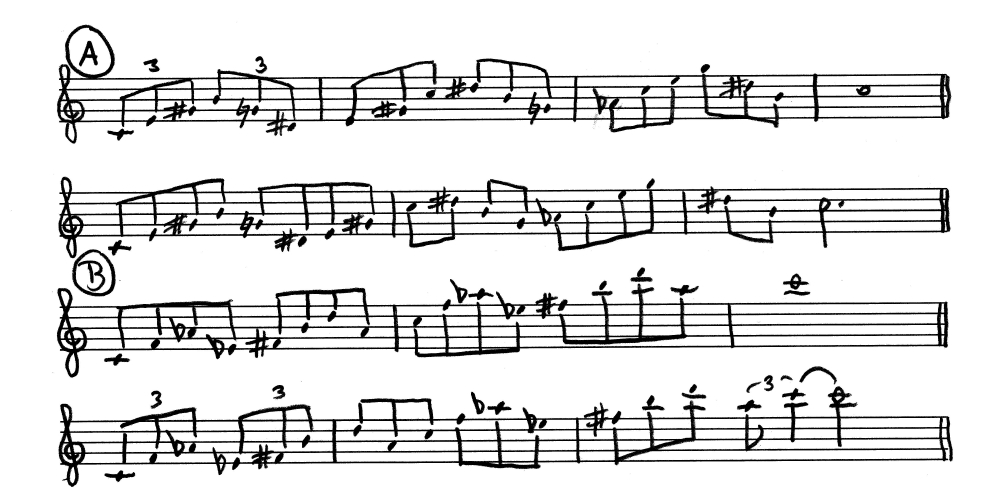
you what I mean better than my words can, to your right you’ll find a couple of examples. Click on the image to enlarge it, then print it out and take it with you to the woodshed.

The first line of example A features triplet arpeggios on the augmented scale. The following line uses exactly the same note order, but converts it to eighth notes.

Example B shows you how the concept works in reverse, taking a simple sequence of fourths in duple meter and converting it to triple meter.

The result is hipness, pure and unmitigated.

Experiment with this concept. And don’t limit yourself to just triplets and eighth notes. You can reframe any odd grouping of notes into eighth notes or sixteenth notes, and the converse also applies. The practice of translating one meter into another is no mystery, and if you’ve been playing the sax for some time, you’re probably already an old hand at doing so. It’s a nice way to spice up your improvised solos with rhythmic energy.

That’s all for tonight. There’s a bottle of Double Crooked Tree Imperial IPA sitting in the fridge, and its siren song is too powerful for me to ignore any longer. For more articles on jazz improv, including exercises and transcribed solos, visit my jazz page.

How to Use the Flat Sixth of the Major Bebop Scale

It was when I picked up some David Baker books on bebop scales back in my junior year in college that I finally began to make some sense out of how jazz worked. Nobody had told me that one of the secrets of those bop musicians was to smooth out the seven-note scales and modes by interpolating an extra note–typically a raised seventh in Mixolydian modes and a raised fifth, or flatted sixth, in the tonic major scale. Once I latched onto that concept and began to flesh it out with various licks from Baker’s great publications, things slowly began to gel for me.

g-major-bebop-scaleThe thumbnail your right shows a G major bebop scale, with the D#/Eb serving as the raised fifth/flatted sixth. Click on the image to enlarge it.

.

NOTE: All examples on this page are in the key of G major. Because note function changes relative to chord function, all references to the flat sixth in the following discussion are understood to mean the flat sixth of the major bebop scale.

The flat sixth most likely came into use as a passing tone designed to create an eight-note scale which could smoothly take a player from tonic to octave. But the note has applications that make it useful as more than just a linear connecting device, and I suspect that its insertion into the major scale also involved harmonic considerations. Chordally, the flat sixth of the major bebop scale helps define structures that a jazz improviser regularly encounters.

g-major-triad-with-b6The most apparent harmonic use of the flat sixth, as the flat sixth (or flat thirteenth) of a tonic major chord, is not as common as other applications. But it is nevertheless an interesting and colorful tone which imparts an augmented sound to the tonic chord–a suspended sound that wants to resolve downward to the fifth. The second example on this page outlines a GMb6 chord, ending in a lick that emphasizes the b6.

iv-chord-major-and-minorThe flat sixth crops up much more often as a minor third of the IV chord. It’s common to encounter a change of modality from major to minor in the IV chord, and the flat sixth is the tone that establishes this shift. The third example shows both CM7 and CmMaj7 chords. It’s common, in the shift from major to minor, to also lower the seventh, as shown in the bebop lick that’s included in the example.

v7b9Another extremely common use of the flat sixth is as the flat nine of a V7b9 chord. This next example outlines a D7b9 chord. Because the V7b9 is so ubiquitous in jazz, the flat sixth, far from serving as merely a passing tone, can often become a target tone. Also, as indicated at the end of the example, it can serve as a chromatic bracketing device.

v7b9-bebop-scale-lickThe final example shows how the b6 fits into a V7b9 lick.

The harmonic applications of the flat sixth that I’ve just described are just three of its uses. It also functions as the b5 of a IIm7b5 chord; as the major third of the V7 of VI chord (ex. B7 in the key of G); and in other borrowed-chord applications that easily relate to the tonic key.

I’ll leave it to you to figure out the rest. This article should give you a good start. If you enjoyed it, be sure to check out other articles of interest to saxophonists and jazz improvisers on my jazz page.

An Easy Way to Use the Augmented Scale in Major Keys

As I’ve continued to spend time incorporating the augmented scale into my working vocabulary as a jazz saxophonist, I’ve made one recent discovery which simplifies its application, at least in part. It is this: the same augmented scale used with the tonic chord in a major key also works beautifully for the altered dominant.

For example, in the key of C, use the C augmented scale for both the tonic C Maj 7 and the G+7(b9, #9). Just keep in mind how you handle the root of the scale when the G dominant is sounding, same as you would do if you were playing a G Mixolydian mode.

The reason this same-scale approach works is because every augmented scale, being symmetrical by design, is actually three different scales spaced a major third apart, all sharing the same notes and interval relationships. The C augmented scale also functions as an E and an Ab augmented scale, and each version works nicely with an altered dominant seventh chord built on its leading tone. Thus the Ab augmented scale is the scale of choice for imposing the augmented sound on the altered G7 chord.

Try the above tip with a blues as well. It works fine, adding color and enough “wrong notes” to sound right, providing you bring the free-floating augmented sound back to earth by resolving it properly to a chord tone and maybe adding a nice, earthy dash of the blues scale.

If you have other ways in which you like to use the augmented scale, please drop a comment and share them. And check out my jazz page for more articles and transcriptions geared for the practicing jazz musician.

A Charlie Parker Lick Around the Cycle of Fifths

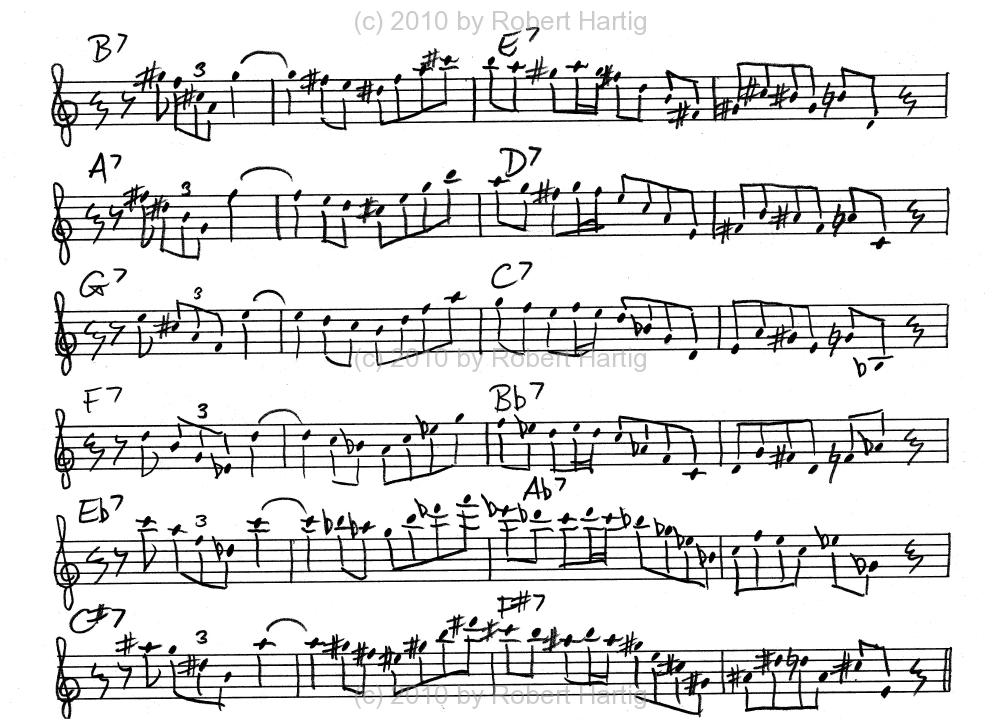
Okay, campers, listen up: Uncle Bob says it’s time again for another great sax lick. So gather round the campfire with your saxophones, and grease your fingers to keep them from igniting, because this lick comes to you from the immortal Bird. That’s right, Charlie Parker, the indisputable emperor of the alto sax–not merely a luminary of jazz, but one of its incendiaries. It pays to light your tinder with Bird’s flame, and this exercise will help you to do so. Click on the thumbnail to enlarge it to readable size.

bird_lick_cycle_of_fifthsThe lick comes from the first bridge section of Parker’s solo on “Thriving from a Riff,” which is one of the myriad contrafacts based on the changes to “I Got Rhythm” that were written back in the bebop era. An alternate and perhaps better-known name for this particular tune is “Anthropology.” Same head, same changes, just a different title.

While a number of variations exist on the chord changes to the Rhythm bridge section, the basic progression, and arguably the most frequently used, is four dominant seventh chords moving around the circle of fifths in two-bar increments. Since the cycle of dominants is the foundation for the Rhythm bridge, extending a lick written over the bridge so that it covers all twelve keys is a great way to develop fluency in every key. That’s the premise of the exercise on this page.

Note that I’ve done only half your work for you. Once you’ve mastered the written material, you’ll need to transpose the lick so that it starts on E7 instead of B7, and work your way through the remaining transpositions.

Parker played Rhythm changes in a number of keys, but the standard key of concert Bb is the one he used most often, and it’s the one that “Thriving from a Riff” was written in. It puts the Eb alto sax in the key of G, with B7 being the first chord of the bridge section. For Bb instruments such as tenor sax, soprano sax, and trumpet, the first chord will be E7. But for purposes of practicing the cycle of fifths, it really doesn’t matter which chord you start with–it’s all good, and it’ll all take you around the complete cycle through all twelve keys, which is the purpose of this exercise.

It’s de rigeur these days to offer analyses of transcribed solos that are so exacting they could split the hairs on a fly’s behind. I admire the insight and effort that go into such exhaustive examinations of an artist’s work, but I frankly find them a bit overwhelming. I do, however, appreciate having points of particular interest spotlighted, and I will offer a few such highlights here.

The opening figure, an arpeggio descending from the thirteenth of the chord, superimposes an A+(#7) over the B7. Bird couldn’t have more effectively avoided playing the basic triad tones. Note his use of the flatted fifth, creating a Lydian sonority. The parent scale at this point is a B Lydian dominant scale, but it’s only a temporary application. In the following bar, Parker clearly defines the B7 and his approach becomes purely diatonic up to bar 4, where he injects a touch of chromaticism in the form of a passing tone. Look closely and you’ll see a hidden chromatic line descending from the note D in bar 3 through C# and B# in bar four and landing on the note B. The final two notes, B and D, are chord tones, the fifth and flat seventh of the E7.

So much for the fancy analytical stuff. If it helps you, fantastic; if it just loses you, don’t worry about it. The main thing is for you to get the exercise drilled into your fingers and your ears. In other words, make a point of memorizing it. Doing so won’t make another Charlie Parker out of you, but it will make you a better player.

That’s the goal, right, campers? You bet it is. Uncle Bob has spoken. Now get your little butts back to your cabins–you’ve got some practicing to do.