A Table of Non-Diatonic Tones and Their Common Uses

A while back I shared some ideas on how jazz improvisers can make optimal use of the added flat sixth tone of the major bebop scale. I pointed out that, besides its obvious use as a passing tone that evens out the scale and allows players to move seamlessly from root to octave (or third to third, or fifth to fifth, etc.), the flat sixth also functions readily in a number of harmonic contexts common in jazz.

Yet, useful as the flat sixth (or sharp five) of the major bebop scale can be, it is nevertheless only one of five non-diatonic tones that occur in a major key. In addition, the tonic, supertonic, subdominant, and submediant scale degrees can all be similarly raised a half-step and used in a variety of harmonic applications.
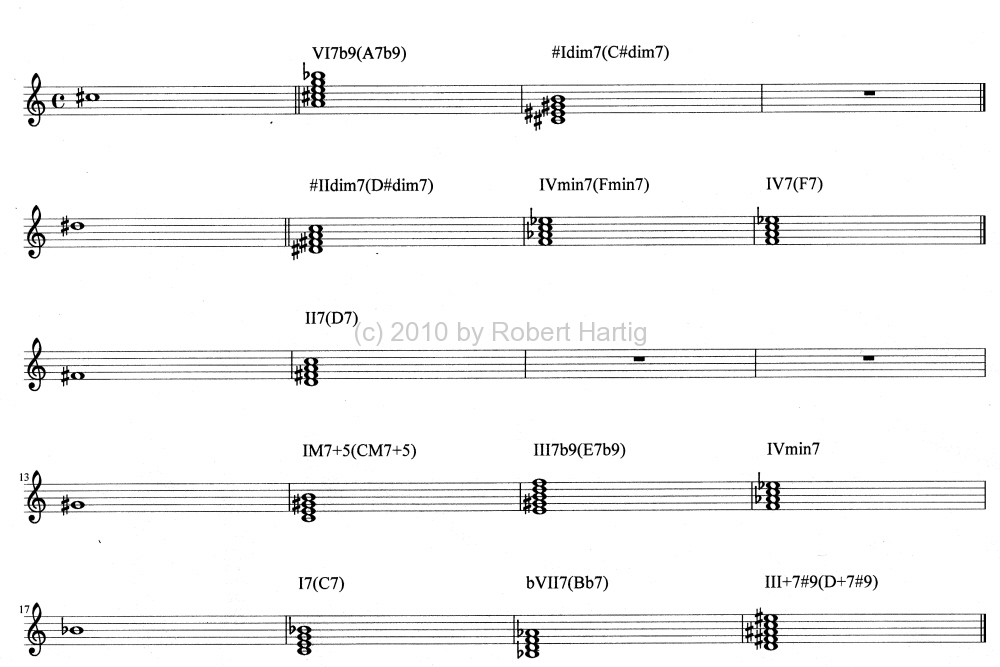
borrowed-tone-applications-002The image to your right  is a table that shows some common uses for each non-diatonic tone in the major scale. (Click on the thumbnail to enlarge it.) The table is by no means exhaustive; it’s just meant to give you a handy reference to harmonic situations you’re likely to encounter as an improviser.

The table is based on the C major scale. In that key, the five non-diatonic tones are C#, D#, F#, G#, and A#.  From top to bottom, the staves begin with a given tone, then show how that tone fits into various chords. The chords are numbered according to their functions and also named (eg. IVmin7, Fmin7). Depending on their application, I may use the enharmonic equivalents of some tones. For instance, instead of A#, I’ve chosen to show Bb, which makes better sense in actual usage.

In stave 1, the VI7b9 and #Idim7 are interchangeable, leading almost inevitably to the IIm7 chord. In the next stave down, the #IIdim7 wants to resolve to the mediant. By adding the scale’s leading tone as the chord root, you wind up with a B7b9, which is the V7 of III. Glancing over the rest of the table, you’ll notice numerous other uses in secondary dominant harmony.

I’m not going to go into detailed explications of every chord, as–assuming that you know your basic jazz theory–the uses of the different non-diatonic tones should be self-evident. Again, the table is not definitive. It’s intended simply to give you a handy reference that can heighten your awareness and help you make more deliberate use of all twelve tones in the chromatic scale. You’re bound to think of other applications not shown in the table.

For practice purposes, you could try working with a single tone. Incorporate it into a major scale to create an eight note scale. Then work out various chordal possibilities that utilize the tone, always keeping in mind the parent major key you’re working in as a frame of reference.

If you’ve found this article useful, make sure you check out the many other articles, exercises, and solo transcriptions on my jazz page. And, as always, practice hard and with focus–and have fun!

Hard-to-Read Music Exercises on Stormhorn: Follow-Up

Have you been having a hard time reading the exercises I’ve provided in my more recent music instructional posts–the ones in which I’ve used transcription software rather than scanned, handwritten material? Some people–including me–have had problems, though not everyone. It seems that some of the lines on the music staves appear faint to nonexistent in places, making it hard to tell the identity of notes.

From what I’m able to tell so far, the issue appears to be part browser-related and part a matter of scale, requiring that the image be adequately enlarged.

Browser: Firefox is my preferred browser. Unfortunately this is the browser on which the problem crops up for me. However, once I click on the image and then zoom in a step or two, everything clears up nicely.

Internet Explorer: When I click on the image, I just don’t have the same problem as with Firefox. The image is clear.

In a nutshell…

If you’re having a hard time reading the exercises, try (a) switching browsers; (b) magnifying the image; or (c) both.

I have an idea up my sleeve that may make everyone happy if it works. I’m going to try it next time I include written exercises in a music post. That shouldn’t be too far down the road now, as it has been a while since I’ve shared such a post. So stay tuned.

Until then, I’ll value your input on the clarity of the exercises. If you’ve had trouble, let me know whether the above suggestions fix things for you. And if you’ve had no problems, let me know that as well.

Thanks!

Bob

Hard-to-Read Exercises on Stormhorn Music Posts

One of my readers has commented that he had difficulty reading an exercise in one of my music posts. I’m guessing that he’s not the only who’s had that problem, since I’ve encountered it myself.

For some reason, while the original image files for my music examples are quite legible, something happens when I upload them to WordPress. The result is that the staves have been reproducing unevenly, making it difficult in places to determine the placement of notes.

Each new instructional post has sent me searching for a fix. So far I’ve been unsuccessful, and I’ve depended on you, my readers, to fill in the blanks, trusting you’d find that the benefits of the exercises outweighed the inconvenience. However, this approach obviously is just a stop-gap, not an acceptable solution.

I’m not sure what the cure is–whether the problem lies in the transcription software I’m using, in WordPress, or in my own lack of technological expertise. Other sites don’t have the same trouble, so I’ve got to believe there’s a simple, viable solution. Until I find it, I thought I’d let you know that I’m aware of the problem, it bothers me at least as much as it does you, and I’m looking for a way to solve it. Meanwhile, thanks for your forbearance!

All the best,

Bob

Between Idolatry and Joy: Some Thoughts on Life from a Jazz Saxophonist and Storm Chaser

There is an art to pursuing the things we’re most passionate about without letting them consume us. I certainly find this to be true of my own two interests, jazz saxophone and storm chasing, but the principle applies to all of us in whatever our preoccupations may be. Without fascination, energy, focus, and joy to drive us wholeheartedly in our pursuits, there’s no point to them; yet without restraint, self-awareness, and awareness of the broader world around us, it is easy to become a mile deep in our passions and an inch deep in life at large. Between these two realities, for me and I think for many of us, there lies a dynamic tension.

As a disciple of Jesus, I have to reckon with the issue of idolatry. In Old Testament times, an idol was easy to identify. It’s hard for us today to fathom people fashioning gold calves and graven images, both human and bestial, and then worshiping the things that they themselves had crafted. Yet that’s exactly what people did back then, both in pagan nations and in apostate Israel.

The funny thing is, we’re no different. We still bow down to the works of our hands, to things that are capable of becoming our gods if we let them. Things that blind us to truths bigger than ourselves and hinder our capacity to love God and others.

The problem with our modern idols, however, is that they’re not readily identifiable as such in the same manner as, say, a brazen bull or a figurine of Marduk. Anything in our lives can become an idol–our careers, our pursuits, significant relationships, the desire for love, our injuries and disappointments, our causes, our appetites, our emotions, our cars and other possessions, even our ministries and charitable occupations. Idolatry today is not usually something that is innate to the things in our lives, but is a matter of our attitude toward them and God. In ways subtle and not so subtle, it’s easy for us to invest ourselves in what we have and what we do in such a way that we allow it to define life and purpose for us. That’s a problem, because any of it can be taken away from us at any time, and sooner or later all of it is going to go. Then where do we find meaning; then where do we find life?

Moreover, we can become irresponsible and selfish in reaching for what we’ve defined as life, setting our pursuits above people we love and who love us. When we’re frustrated in those pursuits, we can become downright nasty, even destructive, toward persons who seem to inconvenience us, challenge us, or obstruct us. We’ll sacrifice others to our idols and justify ourselves in doing so rather than deal with our own hearts.

All this in the quest for life on our own terms.

Well do the words of Isaiah the prophet speak to us today: “[The idolater] feeds on ashes; a deluded heart misleads him. He cannot save himself or say, ‘Is not this thing in my right hand a lie?'”

Is there a flip side to this coin?

Of course there is. If God never intended for us to enshrine the things that we enjoy and love to do, neither does he want us to smother those things in sackcloth. In the Bible’s book of Genesis, in the Creation story, God from the beginning gave Adam and Eve something meaningful to do. They were gardeners, caring for the trees and flowers in Eden. Ironically, after they sinned, the man and woman’s immediate response was to hide from God behind the very things he had assigned them to cultivate and protect.

The problem lay not in the shrubs and trees and vines, but in Adam and Eve. The greenery in the garden was the same as the day when God first looked on it and called it good; it was the human heart that had changed. Ever since, in various ways, we’ve had a tendency to conceal ourselves from God and from each other behind the things we do.

Yet those same pursuits also have the potential to express the robust life of Jesus living in us untamed and unfettered. There’s nothing at all winsome about Christians who are so paranoid about idolatry that everything they do is constrained by a gray, lackluster religiosity. Many well-meaning believers confuse holiness with a boxed-in, sanctimonious, hermetically sealed existence that is about as invigorating as paper pulp. It hardly mirrors God’s exuberance in the act of creation, when with a decisive word he spun the visions of his heart into being–planets, suns, galaxies, luminous gas clouds, multiplied quintillions of celestial objects, all whirling across the velvet-black vastness; ocean tides pulsing and surf crashing against craggy shorelines; wildflowers waving in vivid, multi-hued pointillism in meadows and forests, knit together, unseen, by untold millions of miles of subterranean roots and rootlets.

Talk about a hobby! It was no dour, stuff-shirted God who created this fabulous world around us, this universe that awes and fascinates and humbles us; no, it was an eternal being who throughout the ages remains forever young–smarter than the most brilliant scientist, wiser than the wisest sage, yet passionately, perpetually, and unapologetically a child at heart.

God created us to live our lives as wholeheartedly, creatively, lovingly, generously, fearlessly, and beautifully as he lives his, in ways unique to each of us. Failure to do so is in itself a form of idolatry, a lack of trust that the One who hardwired us with our personal interests also supplies the grace and wisdom to express his life and fulfill his intentions through those interests.

The overarching principle is love–love of God and love of others. Love is ultimately what separates between idolatry–which is about pursuing our own independent way on our own terms–and the abundant, God-dependent life that Jesus offers. Christianity is not about good morals and rock-hard dogma; it is about nothing less than the life of Jesus himself living inside us, energizing us, guiding us in the pathway of his character. That is no weak, wan way of living. To be sure, it is a way that is often marked by self-sacrifice, pain, loneliness, misunderstanding, prayer, struggle, and self-control. But it is also a way infused with immense purpose, remarkable potential, endless fascination, and a joy that can be found in nothing else this life can offer.

In conclusion

Bringing all of the above to bear in a practical way for those of us who chase storms and/or play music: Whatever you do, do it with all your heart. God is not glorified by a timorous approach to the things you enjoy, nor does he want you to walk on eggshells for fear of offending him. Just keep in mind that there is more to life than your pursuits. Enjoy those pursuits, treasure them, but don’t grasp them so tightly that you can’t let go, and don’t let them give you tunnel vision so that you fail to see and participate in the broadness of life around you. Other people’s worlds are as rich and important as yours; to the best of your ability, enter into them, celebrate them, and let them expand you. Harness your interests in a way that makes your life bigger, not smaller–an expression of generosity, not selfishness, and of a Christlike perspective that values God and others most of all.

Behind the sound of a saxophone playing now tenderly, now exuberantly, always striving for creativity and beauty…behind the sublimity, the fascination, and the awe of a tornado churning across the open prairie…you can, if you choose, hear the song and see the face of God. If you submit your heart to him, he will in turn release his own magnificent heart in and through the things you love to do.

This, in part, is what life, true life, is about: allowing the things that are central to us to become the servants and the expressions of Someone far bigger than ourselves, and of a kingdom greater than our own.

Sax Practice by the Airport–Now Verboten?

It seems that practicing the saxophone now poses a threat to homeland security.

Surprised? Not nearly as surprised as I was when I first found out last night.

I surely wasn’t aware of the risk I presented when I parked my car near the railroad tracks at the end of Kraft Avenue, a stone’s throw from the hurricane fence that circumscribes the perimeter of the Gerald R. Ford International Airport. I’ll grant you, it’s an unusual location for a person to hang out at, but it’s by no means anything new for me. I’ve been parking there with varying frequency for roughly 25 years, practicing my saxophone and watching the trains go by.

Of course I’ve been checked out numerous times by the police. I haven’t minded at all; rather, I’ve appreciated that the cops have been on their toes and diligent in doing their jobs. The officers, in turn, have invariably been courteous and usually friendly, and often enough I’ve enjoyed some pleasant conversations with them. Once they determined that I was eccentric but harmless, they always drove off and left me to practice my horn in peace. Over time, a number of them came to recognize me. (Cop, peering in at me: “Oh, it’s you. Enjoy your evening!” Heads back to car and drives away.)

I’ve never had any problems at that location. Not ever. Until last night, that is, when suddenly and inexplicably everything changed.

What I’m about to share is not a rant. I’m not angry, just sad. Maybe once I gain a better understanding of whatever federal laws and/or local ordinances I’m dealing with, I will feel angry at having been jerked around. Or maybe I’ll just have a better understanding of what happened. Right now, though, I have the sense that the policeman I encountered last night was simply doing what he believed was the right thing. He didn’t project a nasty, belligerent, or power-drunk attitude; he was simply adamant that I had to leave my practice spot by the railroad tracks and not practice there in the future.

Just like that. It’s kind of like being told that the old fishing hole where you’ve fished for a quarter of a century is suddenly off limits. You’re given a reason, but it doesn’t ring true, and you get the sense that something you value has been taken from you without your ever having a voice in the matter.

Why all of a sudden? If homeland security was really the issue, which is what I was told, then why did none of the scores of other police officers I’ve encountered in that location over the long years ever mention it to me? Even in the tense months following 9/11, no cop ever requested that I relocate due to security concerns. Not that security–albeit not homeland security that I’m aware–hasn’t always been an issue in that spot. Some of the cops told me that vandalism had sometimes been a problem, and on a couple of occasions I was able to answer questions by the police concerning other visitors at the site. I’d like to think that my presence there has proved, if anything, helpful at times rather than a liability.

So here’s what happened: I was hashing out the Charlie Parker solo to “Dewey Square” yesterday evening when a police car pulled up behind me and the spotlight appeared in my mirror. No sweat; as I’ve mentioned, I’m used to having law enforcement check me out. I set down my horn in the passenger seat, handed the officer my driver’s license upon his request, and then waited while he ran a background check on me. He returned to my vehicle in a couple of minutes and handed me back my license, and at that point I figured things were clear and I could get back to my practicing.

Not so. The cop informed me that I was trespassing (perhaps because I had pulled off the road closer to the tracks, where I could see the semaphore lights, but that had never been an issue before); that I was parked in a high-risk zone less than 100 feet from airport property; and that in order to avoid compromising homeland security, he needed me to move.

Say what?

I reiterated to the officer–I had already mentioned it to him when he first appeared at my window–that I had a long and trouble-free history of practicing at this site; that I was here because the place was convenient and I enjoyed watching the trains go by; that I had been checked out countless times by the police over the years and never experienced any problem; that some of the cops had become familiar with my unusual but harmless habit; that never once had any of them asked me to move; and that this was the first time anyone had ever mentioned the issue of homeland security.

The officer in turn suggested that I relocate to the airport viewing area on the far side of the airport, where I could watch the planes. I appreciated that he was trying to offer what to him seemed like a reasonable solution, but I repeated that I liked to watch the trains. Again he raised the security issue.

“Look,” I said, “I’m not out to argue with you. I’ll leave if you insist. But I’m trying to wrap my mind around what you’re telling me, because for as many years as I’ve been coming here, and as many times as the police have checked me out, this is the first time I’ve ever been told me to leave.”

The officer said he was sorry, but that I would have to find another place to practice. Henceforth I would have to consider this location off limits.

Wow. After 25 years, suddenly out of the clear blue somebody sticks a “No Fishing” sign right in front of my nose at the old fishing hole.

Very well; I had made my case, and it’s my policy not to argue with law enforcement officers. They are, after all, the embodiment of the law, and even when I don’t agree with them, I will comply with them. As I’ve already said, this cop didn’t come across as nasty, just inflexible, and I don’t know what realities he was dealing with. Perhaps a recent change in local ordinances, or even federal law, required him to deal with me differently than what I had experienced in the past.

Then again, maybe nothing at all had changed and the guy was just being a jerk. I don’t know–right now. But I will make a point of finding out. If I need to secure some form of permissions from CSX or the airport, I’ll pursue that avenue. I hate to have a convenient and enjoyable practice place that I’ve resorted to for so many years get suddenly and seemingly arbitrarily yanked out from under me.

Even more, though, I hate the erosion of freedom that such an event reflects.

Jamming with the Guys

As the fall season progresses and the flow du jour remains northwesterly, I’m glad I’ve got music to keep me occupied. Ridging may be a storm chaser’s nightmare, but here in Michigan it’s a color tourist’s dream as the slanting sun illuminates hillsides ablaze with scarlet, yellow, purple, orange, and the summer’s last green. Now, in this poet’s season, is when the musician in me comes alive.

Thursday’s gig with keyboard monster Paul Lesinski at The Seasonal Grille in Hastings, Michigan, went beautifully. It’s amazing how much music a sax player can make with just a piano accompaniment when the pianist is as gifted as Paul.

Of course, nothing can beat playing with a complete rhythm section of hugely competent players. That was the setting this morning into the early afternoon at Ric Troll’s studio west of Grand Rapids. It’s a privilege and a joy to make music with players the caliber of Ric, Randy Marsh, and Dave DeVos. Today, it was doubly nice to break away from the usual American songbook repertoire and work on some original material by Ric plus a couple of Pat Metheny tunes. Don’t get me wrong, I love the old standards. But I really welcome the opportunity to explore fresh directions that call for a different approach, free from the cliches that are so easy to fall into with the traditional 32-bar song form.

I had thought that today would be a recording session, but it didn’t turn out that way. Some of the tunes are quite challenging–one, with it’s three-against-four polymeter, took me a good while to digest–and I think Ric’s goal for this session was for all of us to simply get a feel for the music. Can’t fault him there, though there were some very nice moments that I’d have loved to listen to the replay of. Maybe next time. And I hope we can make that next time soon. I really like what came out of today’s creative ferment, and once we’ve got the material down tight, I think we’ll have the makings of a very nice recording.

More on Saxophone Double-Tonguing

Lately, during the parts of my practice sessions that I devote to double-tonguing, I’ve noticed a change. The technique is becoming smoother, the notes more connected and better sounding. I’m now double-tonguing scales, licks, and patterns in sixteenth notes with increasing comfort and accuracy throughout the full range of my saxophone at a tempo up to 140 mm. While I may not make any great gains in speed anytime soon, I can definitely tell the difference in accuracy and quality of sound since my last post on double-tonguing.

What is making the difference? Several things, I think.

* A responsive reed. I’ve found that having the right reed makes a big difference in how well I’m able to execute double-tonguing. A reed that combines instant responsiveness with just enough resistance to be lively–the kind of crisp, richly resonant reed that is a joy to play–is also the ideal reed for double-tonguing. Reeds that are too hard get balky in double-tonguing, and reeds that are too soft have their intonation issues amplified.

For most playing demands, I can get by with a fairly broad spectrum of reeds, but double-tonguing seems to be a finickier technique in that regard.

* Reversing the double-tongue syllable order. Instead of playing “da-ga-da-ga,” I’ll do some exercises using single tones as well as scales starting with the glottal articulation first, thus: “ga-da-ga-da.” I also practice articulation using my glottis only: “ga-ga-ga-ga.” My aim is to develop the response in the back of my throat.

This approach really helps! Try it yourself. Warm up with a minute or two of these glottal exercises, then shift to the standard double-tonguing pattern, “da-ga-da-ga,” and see whether you don’t notice an improvement.

* As an adjunct to the preceding point, practice all of the above articulations without your horn. See how fast you can do them, and pay attention to any subtle changes you’re making as you build up speed. I use this “dry firing” approach when I’m driving in my car. What better way to put my drive time to good use?

* Practice. That’s right–practice. There’s no magical secret for learning double-tonguing. One simply has to stick with it. As I do so, I’m finding that my embouchure, oral chamber, tongue, and air stream are intuitively making the adjustments they need to make. Also, as I work at connecting double-tonguing with scales and licks, my fingering technique is becoming cleaner. It has to in order to link up precisely with the rapid articulation of double-tonguing.

I’m at a point now where this technique is becoming a functional part of my playing. Not that I use it often, but I am using it more frequently in a variety of applications with increasing success.

An article by the Peabody Institute states that “a fast single tongue can articulate sixteenth notes at quarter note equals 152. Some people can even reach speeds of up to 168 for brief periods. The double tongue can achieve speeds as high as of 232!”

Hmmm…okay. My own single-tonguing is by no means up to to the speed of these racehorses. Of course, I haven’t really worked at it, but according to the article, some saxophonists can single-tongue faster than I can presently double-tongue. That’s fine with me. I’m not out to win any speed contests, just grow as a player. My guess is that most saxophonists who read this article and my other articles on double-tonguing are more daunted by than adept at the technique, so I figured I would share my personal journey as I took on the challenge of learning it.

The Peabody article also says, “The double tonguing technique is a natural technique that is actually simple to learn and master. A few weeks of hard work can produce remarkable results.”

That has not been my experience. Of course, I’m not a Peabody student under the tutelage of a master saxophone professor. I’m a self-didact guided by no instructor other than my own instincts. I will say that at the very beginning, double-tonguing indeed came to me with ridiculous ease, and right out of the gate I was executing sixteenth notes like machine gun fire. Then I put the horn in my mouth, and suddenly it all fell apart. I was left with the realization that the technique was going to take work, patience, and dogged persistence.

Today, not quite a year later, I can tell you that the persistence pays off. Whether I’ll ever be able to double-tongue sixteenth notes at 232 mm, or even 200, only time will tell. What’s certain for now is that this technique which can seem so formidable and frustrating at the beginning is one that a saxophonist can actually acquire and use with increasing mastery. If I can pull it off, so can you. You just have to make up your mind that you’re going to do it–and then follow through with patience and consistency.

This Week: Gig and Recording Project

I’m pleased to say that all the time I’ve been spending these days practicing my saxophone is going to get some practical application. This week Thursday, October 7, I’ll be playing with keyboardist Paul Lesinski at The Seasonal Grille in downtown Hastings, Michigan. Then Saturday, I’ll be getting together for a recording project over at Tallmadge Mill studios west of Grand Rapids.

THURSDAY’S GIG: October 7, the town of Hastings is promoting a Ladies’ Night on the Town. With The Seasonal Grille offering a combination of wonderful ambiance, superb Italian cuisine at eminently affordable prices, and a good selection of wines and beers, I’m sure the place will be doing a thriving business. I’m pleased to be providing the music there with Paul. Come on out and get a mouthful, an earful, and a beerful!

Place: The Seasonal Grille

Address: 150 W. State Street in downtown Hastings, Michigan

Phone: (269) 948-9222

Time: 6:00-9:00 p.m.

SATURDAY RECORDING SESSION: I’m really excited about this! The guys I’m getting together with are some of my musical heroes. Ric Troll, owner of Tallmadge Mill Studio and organizer of the get-together, is not only an extremely tasty drummer, and more recently a guitarist, but also a wonderful composer. Anything I could say about him would be too little, and that goes for the rest of the guys as well. Randy Marsh, Kurt Ellenberger, and Dave DeVos are not merely superb players, they’re also fantastic, complete musicians, widely known and respected in West Michigan. I’m thrilled that I’ll be playing some original music with them this weekend. Look for cuts from the session here on Stormhorn.com in the future as they become available.

That’s the news for now. It’s late and I’m tired. Time to call it a night.

Now Available: Bass Clef Edition of “The Giant Steps Scratch Pad”

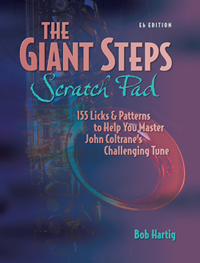
A few minutes ago I completed the last of the downloads, filled in the information fields, and then, with one final click of the mouse, published the bass clef edition of “The Giant Steps Scratch Pad.”

At last! I can finally say that I’ve accomplished the goals I set for this book as it evolved from my initial concept to something considerably more ambitious. The “Scratch Pad” is now available in all four editions: C, Bb, Eb, and bass clef.

So, trombonists, bass players, tuba players, and–well, have I missed anyone?–whoever else lives and moves in the bass clef universe, here is the practice resource for Coltrane changes that you’ve been hoping for, pining for, craving with all the intensity of your bass clef hearts. All kidding aside, if you’re at a stage of development on your instrument where you want to tackle the challenge of “Giant Steps,” this book is for you. It’s made for the woodshed and will help you build formidable chops for John Coltrane’s rite-of-passage tune.

Instant PDF download, $9.50
C edition Add to Cart
Bb edition Add to Cart
Eb edition Add to Cart
Bass clef edition Add to Cart
View Cart

Print editions–retail quality with full-color cover, $10.95 plus shipping: order here.

Voice Leading for the Giant Steps Cycle

Both in print and on the Internet, there’s no paucity of theoretical material available when it comes to “Giant Steps” and Coltrane changes. Of course, theoretical knowledge can’t take the place of time in the woodshed hashing out the changes on your instrument. But it can help you make some sense of what you’re practicing by revealing the order in what can at first seem like an odd, rambling array of chords. Once you understand some of the voice leading in “Giant Steps,” you’ll be able to pinpoint certain guide tones and use them effectively in your solos.

This post is by no means intended to offer an in-depth explication of “Giant Steps” theory. All I’m going to do is call your attention to how a few select tones proceed, so you can be mindful of them for the reason I’ve just stated. Let’s begin by naming the changes to the first four bars of section A in “Giant Steps.” In concert pitch, they are: Bmaj7 D7 / Gmaj7 Bb7 / Ebmaj7 / A-7 D7.

The second four bars repeats that chord progression a major third lower, thus: GMaj7 Bb7 / Ebmaj7 F#7 / Bmaj7 / F-7 Bb7.

If you delete the last two bars in each four-bar phrase and crunch together the remaining chords, you get the following sequence: Bmaj7 D7 / Gmaj7 Bb7 / Ebmaj7 F#7. This is the essential Giant Steps cycle. As you can see, once you reach the end of the cycle it repeats itself as the F#7 resolves downward by a fifth to the Bmaj7.

So far, so good. Now let’s see what happens when we start moving some basic chord tones. We’ll start with the root of the Bmaj7 chord. If you move it down by a whole step, you wind up on the note A, which functions as the fifth of the next chord, the D7. Move A down another whole step and you land on the root of  Gmaj7. Continuing down by whole steps in this manner–in other words, moving down the B whole tone scale–will move you from root to fifth to root to fifth through the entire Giant Steps cycle.

You can also apply the same down-by-major-second movement starting on the fifth of the Bmaj7, which is F#. In this case, the fifth moves down a whole step to E, which functions as the ninth of the D7 chord. (You could also look at it as the fifth of an A minor chord that serves as the ii/V7 to the D7.) This note in turn moves downward to the fifth of the Gmaj7. Again you’re descending through a whole tone scale, this one beginning on the fifth of the Bmaj7.

So if you want a handy memory aid to help you organize your guide tones in the Giant Steps cycle, simply think of two whole tone scales (using half notes to match the harmonic rhythm), one descending from the root and the other from the fifth of the Bmaj7 chord.

When you spotlight the third of the major seventh chords, things get more interesting. The third of the Bmaj7 is D#. Moving down a half step lands you on the note D, which is the root of the D7. To get from there to the third of the next chord, Gmaj7, you have to jump down a minor third. When you extend this downward movement of half step/minor third throughout the entire cycle, you wind up with an augmented scale.

You also get an augmented scale when you use the same movement starting on the seventh of the Bmaj7 chord, thus: A#, A / F#, F / D, C#.

To recap:

* For voice leading from the root and fifth of the major chords in “Giant Steps,” consider using, respectively, the B and F# whole tone scales.

* For voice leading from the third and seventh, use the D# and A# descending augmented scales.

I hope these concepts will help you see the symmetry in Coltrane changes and make life easier for you as a result. If you want a resource you can take into the practice room with you to help you master “Giant Steps,” check out my book The Giant Steps Scratch Pad. It’s available in C, Bb, Eb, and bass clef editions. See below for ordering info.

Happy practicing! Oh, and be sure to visit my jazz page for plenty more tips, solo transcriptions, exercises, and articles of interest to jazz musicians.

The Giant Steps Scratch Pad

.
Instant PDF download, $9.50
C edition Add to Cart
Bb edition Add to Cart
Eb edition Add to Cart
Bass clef edition Add to Cart
View Cart

Print editions–retail quality with full-color cover, $12.95 plus shipping: order here.