Near-Blizzard Conditions in Michigan on Winter Solstice

“Near blizzard conditions” is what KGRR is calling it. I call it a good, old-fashioned Michigan snowstorm, the kind I remember from my boyhood down in Niles. Seems like such storms started to peter out once my family moved to Grand Rapids back in 1968, though I remember we still got a few good, solid blasts. It has been a long time, though, since I’ve seen a December like this one. Last year”s winter set a record for snow accumulation; this year”s looks well on its way to becoming another record-breaker, if it isn”t one already.

Here is the view from my apartment onto my deck.

The two mushroom-like objects on the bottom left are pots of chicken soup, thoroughly frozen. On days like today, I like to chisel out a nice chunk and enjoy it at my leisure. Explosives could accelerate the process, but out of consideration for my neighbors, I refrain and use an air hammer instead. It”s a more time-consuming approach, but it”s worth it. There’s nothing like a good, hearty slab of chicken soup on a blustery winter day, that’s what I say.

Where was I, anyway? Oh, yes–near-blizzard conditions. I have to agree with the NWS on that one. Here”s a view of the parking lot.

Nothing about that picture says “tank top and shorts.” The current station reading at 11:30 a.m. shows 11 degrees Fahrenheit, winds of 24 miles an hour gusting to 33, and a wind chill of -9. If you”ve ever felt an urge to go streaking down Main Street, today would not be the day. No, this is the kind of day when you can hunker down inside with a cup of hot tea and feel totally guiltless about doing absolutely nothing.

It seems particularly fitting that we’re getting a major winter storm on the day of the winter solstice. Today isn’t just the snowiest day of the year so far, it”s also the shortest. From here on, we begin the slow but encouraging trek toward spring. Winter has just begun and–though, looking out the window, the thought seems unbelievable–the worst still lies ahead. Three months of ice, slush, flying snow spray, slippery roads, and bitter cold. But we’ve finally descended to the utmost depth of the long nights, and now we’re heading back for the sunny surface. March, the transitional month, isn”t that terribly far away. And amazingly, we may get a crack at a storm chase as near as next week in southern Illinois and Indiana.

This last chase season got off to an early start on January 7, and then a month later on February 5 with the Super Tuesday Outbreak. So who knows what next weekend will hold. I”m not holding my breath, but I am crossing my fingers.

More Winter Weather: This Round Looks to Be a Doozy

We’ve got another winter storm on the way. It’s expected to hit around 1:00 a.m. and hit its max here around 7:00. By the time it”s over, we could have up to eight inches of new snow, and with more winter storms in the forecast for these next few days, that’s just the leading edge of the snowfall.

But this is nothing new. Already snow is old hat. Since November, Michigan has gotten slammed with one major winter storm after another. A series of Alberta Clippers dumped a squatload of the white stuff on us a few weeks ago, and that was just part of the cold season”s synoptic fun. We’ve had freezing rain, flurries, and whiteouts. Of course lake effect snow has pitched in its obligatory contribution; what would Michigan be without that?

And it’s not even winter yet. Not officially, not till Sunday.

Sure seems like winter, though. Not only so, but it seems like this winter is well on the way to eclipsing the one we had last year, and that one set a record for snowfall.

This latest round of incoming winter weather promises to chuck in pretty much everything a body could hope for. I see lightning flashes recorded in Iowa. We may be logging some of that here in West Michigan come morning. Interestingly, besides looping us in for a winter storm warning, the SPC has included our area in a “general thunderstorms” region. With thundersnow a distinct possibility, I have a hunch that life is about to get fun.

Tomorrow will be a day to lay low, write, and enjoy being indoors with a good mug of brew and my friend Lisa to make for good conversation. I don’t mind that arrangement, not at all. I can”t believe I”m saying this, but…winter ain’t all that bad.

Another Hartig on Saxophone?

I came across this interesting YouTube clip by a fellow saxophonist named Tom Hartig. Naturally, I was intrigued to see what another person who shares both my last name and my passion for the saxophone is doing musically. I wasn’t disappointed. This guy has a nice little sample clip that demonstrates a unique, original, meticulously arranged approach that manages to meld a strange, haunting, even slightly disturbing feel with lyrical beauty.

Tom’s clip is well worth checking out. In his note, he says he hopes you’ll buy his CD. I do too, and I may pick up a copy myself. After all, we Hartigs have got to stick together. And I assure you, having listened to a couple of Tom”s other video clips from years gone by, that the man can really play the sax.

Saxophone Art

Ready for a little personal window into my life? I’ve got this sax art thing going on in my apartment. Nothing major, but I thought it would be fun to give you a glimpse of some of the saxophonical objects that occupy my living room.

We’ll start with my saxophone lamp. This was a gift from my beautiful mother. I’ve gotten a lot of compliments on it. It”s majorly cool–the photo doesn”t nearly do it justice. And yes, it’s made out of a real saxophone. I could take the guts out of the lamp, have the horn reworked, and then play it. But I like it as a lamp much better.

This funky little guy was given to me by my wonderful sister, Diane, one Christmas years ago. He’s the product of a nylon stocking, a bit of fabric, and Diane’s immense creativity. Another treasure. I love the gnarly expression on his face. He’s clearly a street musician. His saxophone looks a bit like something you’d find swimming around in the sea, but its lack of anatomical correctness contributes mightily to its coolness quotient.

If you’ve never seen a saxofrog before, now you have. He may not be green like Kermit, but he plays ten times the horn. My beloved buddy Duane gave him to me out of the blue one day. He’s found a nice, shady spot to busk beneath my Chinese evergreens. The frog, that is, not Duane.

I know just what you”re thinking: “Aaawwww!!!” Let me tell you, though, that besides cornering the market on Cute, my little furry bear pal, here, is a formidable alto player, and as a section leader, he”s dynamite. Besides that, he’s quite the literati, and loves to surround himself with good books.

There you have it–the things that make for a sax player”s living room. Hope you enjoyed the tour!

Tornado Photos I Have Known and Flubbed

Even as I’m discovering the rewards of winter photography, I confess that I’m beyond eager for storm season 2009 to arrive. I expect that it will be the year when I finally–finally!–start taking some decent storm photos.

I bought my Canon Rebel XTi with Sigma 18-200mm OS glass in March of this year. Not knowing a thing about DSLR cameras, I naively figured that the automatic settings would make up for my lack of experience. As a result, I made an absolute mishmash of my chase photos. In the extremely low light of some of the storm environments I encountered out west this last May, my camera would refuse to fire at the worst possible moments. Alternatively, the flash would go off, illuminating such fascinating subjects as the rain streaks on the windshield which my auto-focus, in a display of whimsical and sadistic humor, was zeroing in on while ignoring the tornado crossing the road in front of our vehicle at close range. Here”s what I”m talkin” about…

Not exactly everything one could hope for, right?

Please don’t chide me for not spending time getting to know my camera–I thought I had done just that. But the fully manual mode, which could have saved me a lot of grief, was still a mystery to me. So was RAW, and white balance, and bracketing, and anything beyond the basic automatic settings. Nuff said. I got what I got.

Not all of it was terrible, either. If you like wall clouds, I wound up with some cool shots. And at least one tornado photo turned out well enough that you can actually see an elephant”s trunk waaaaay off in the distance, provided you squint and use your imagination.

Still, the Oberlin cone…the small tornadoes circumnavigating the backside of what I think was the Quinter meso…the Hazleton, Iowa, wedge…oh, maaan, the shots I screwed up! I see some of the beautiful images captured by other chasers on Stormtrack, and I’m filled with a mix of admiration and pure-green envy. I could”a been a contender!

But 2009–that’s when I get to redeem myself. I hope. If it”s a good year for storms, and if it’s a good year for me as far as getting to where the storms are, then I think I”ve finally got both the equipment and the basic know-how to put some decent taxidermy in my convective game room. I can”t wait to try!

Phrygian Dominant Licks: Capturing the Essence of Minor Bebop

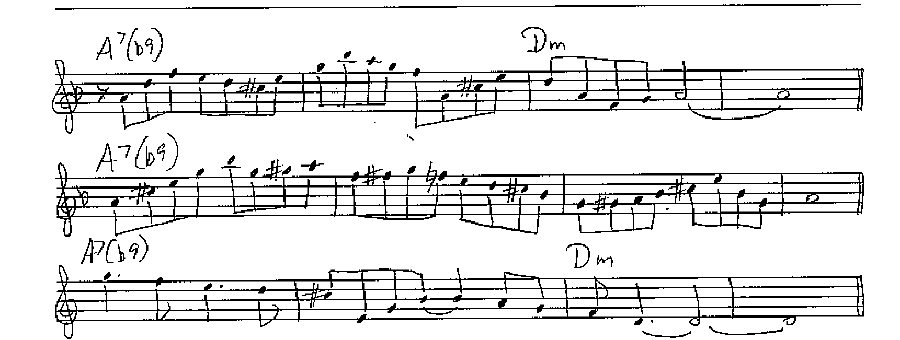
The harmonic minor scale was the first scale I learned to apply in a minor jazz setting over an altered dominant chord. No doubt that was because it was the easiest, but it also seemed to me to be the most consistent with the vocabulary of bebop a la Charlie Parker. Just as a given major scale generates the appropriate Mixolydian mode for the dominant of its key, so a harmonic minor scale produces a scale that works well with its dominant. Known as the Phrygian dominant (aka Jewish scale, Gypsy scale, or Spanish scale), this scale works beautifully with V7b9 chords. With its lowered sixth, and with the minor third interval between its lowered second and major third, it possesses an evocative, Eastern quality that makes me think of belly dancers and snake charmers.

The scale you’re likeliest to learn as the first choice for V7b9 chords is the half/whole diminished. It’s certainly a time-saver, as you need learn only three of this symmetrical scale in order to know all twelve. But the Phrygian dominant has an exotic beauty to it that the diminished scale doesn’t quite capture, and a built-in ease of use rooted in its relationship to the parent minor key.

In a previous post, I offered a couple of written exercises on major triad couplets. Now, in the spirit of Bird, here are three licks utilizing the A Phrygian dominant scale. The first and third one resolve to the tonic chord of D minor; the second is just a straight A7b9 lick, but you can still resolve it to the D minor–it just waits longer to define that chord.

As always, memorize each exercise in all twelve keys. And have fun!

[ADDENDUM: I just noticed that, in the third exercise, I didn’t include a Bb in the key signature. Please mentally insert it so you’re playing in the key of D minor and the ninth of the A7 chord is flatted.]

Historical Tornadoes: Remembering the Worst of the Worst

Every year, scores of tornadoes roam the United States. Probably the better part of them have minimal to no human impact, but there are always a fair number that inflict damage, injury, and even death. Some hit a farm or two; others sweep through communities, tearing up homes. No matter how you cut it, they’re bad news, and the people affected by them will never forget the experience.

Once in a great while, though, a tornado comes along whose ferocity and the toll it inflicts on communities set it apart into the upper echelon–that rare one percent which comprise the absolute worst of the worst. There is a uniquely horrifying, haunting, and almost mythical quality about such extreme storms. The great grand-daddy of them all is, of course, the Great Tri-State Tornado of 1925. But there are others, usually known by the town they destroyed. Woodward, Oklahoma. Xenia, Ohio. Topeka, Kansas. Dunlap, Indiana. Moore, Oklahoma. Greensburg, Kansas. Plainfield, Illinois. Wichita Falls, Texas. Saint Louis, Missouri. Flint, Michigan. Worcester, Massachusetts. The list continues.

Many of these monsters, such as the Tri-State and Woodward tornadoes, have no photographic record of the actual storm. Lots of damage photos, but nothing that shows the actual funnel. Others, dating at least back into the early 1950s with the Worcester tornado, were captured on camera.

Many of these storms were a part of larger outbreaks, including such notorious, massive events as the 1974 Super Outbreak, the 1965 Palm Sunday Outbreak, and the 1999 Central Oklahoma Outbreak. Others, such as the Flint-Beecher tornado, occurred as the worst of a relative handful of tornadoes.

Regardless of its unique circumstances, each storm stands apart in terms of property damage, intensity, and either loss of life or, in some cases, a surprisingly low mortality rate given the circumstances. Most notably, the supercell that spawned the 1.7-mile-wide 2007 Greensburg, Kansas, tornado may have also generated the largest tornado ever recorded. Over four miles wide at cloud base, the radar-detected circulation may forever remain a subject of speculation as to whether its tornado-force winds actually reached the ground, but it seems reasonable to think that they could have.

I’ve had the good fortune to chase the historical Six State Supercell, and the exhilarating but disturbing experience of locking onto the tornado following the EF-5 that wiped out a third of Parkersburg, Iowa. But a truly historical tornado, in the league of Greensburg or Moore? Not yet. Hopefully never. I don”t want to witness that kind of carnage. It”s bound to happen from time to time. Thank goodness, such occurrences are uncommon. The part of me that is fascinated with tornadoes would like to score such a coup. But another part of me which recognizes what that implies hopes I never get the chance to see something so awful. I have friends whose lives were terribly impacted by just such an event. I can’t imagine going through something like that, or witnessing it in progress. Metaphorically, it’s one thing to film lions in the wild; it”s another to watch one maul a fellow human being.

Triad Couplets for Jazz Improv: Two Written Exercises

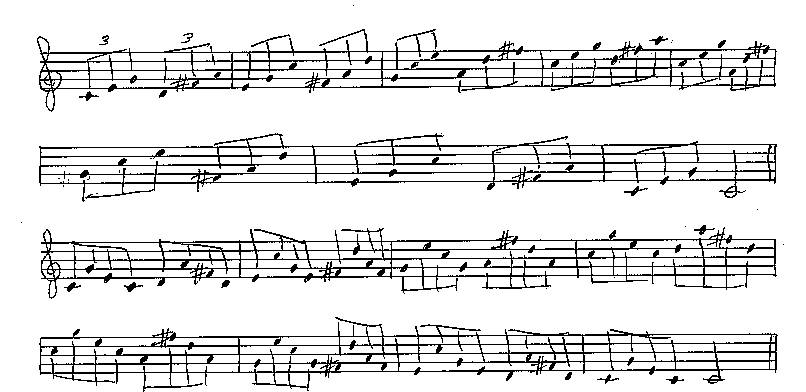
In a previous blog, I wrote about practicing scales with a jazz purpose in mind, and I offered a few suggestions. In keeping with that post, here are a couple fun little exercises that involve juxtaposing two triads a major second apart from each other and running them through their various inversions. Take them through the full range of your instrument, and work out other variations on them to develop complete facility with them.

Please bear with the small size of the staff and notation. This is the first time I’ve attempted uploading a written exercise on this blog.

Always keep application in mind. Play these exercises against a C major chord, for instance, and the raised fourth–F# of the D major triad–gives you a Lydian quality. Play the exercises against a D major and you get a dominant sound, with the C functioning as the flat seventh.

Work with the Aebersold Gettin” It Together CD, or Band in a Box, or simply with a piano, holding down a chord, so you can hear how this exercise sounds against actual harmony.

Subconscious-Lee

When you think of original voices on the alto saxophone, Lee Konitz inevitably comes to mind. A student of blind pianist Lenny Tristano, Konitz unites a limpid tone with fluid technique and a unique, uncliched melodic conception.

I find interviews with jazz musicians fascinating, and in previous posts I”ve included links to clips featuring both the playing and the personal insights of Sonny Rollins, Bill Evans, and Michael Brecker. Now joining them is this video segment from the television show The Subject Is Jazz featuring a young Lee Konitz and tenor compatriot Warne Marsh playing the tune “Subconscious-Lee,” followed by a brief but interesting interview with Konitz.

I’m struck by Konitz”s early tone–clear, pretty, and creamy. His sound has evolved quite a bit since then, and possesses an unmistakable, instantly recognizable signature quality. Melodically, note Konitz”s use of sequence, and his ease of interpolating unusual, more angular ideas into his lines. The tune, and both Konitz”s and Marsh”s playing, showcase fabulous technique masked by a cool, intellectual approach. Standing in the hot shadow of the boppers, Konitz offered a thoughtful and engaging alternative.

A Winter of Contrasts

Yesterday I drove out to an area near the Coldwater River in extreme southeast Kent County and returned with the following photos among many.

Ice and Snow

Linear

I just showed you those shots because I felt like it. Also, though, to give you an idea of what a mixed bag this December is proving to be. While snow has been the rule up here in the frozen tundra of Michgan, the Gulf has been doing brisk business farther south. Pulling juicy dewpoints northwards and combining them with high helicities and good bulk shear, a low has been firing off severe thunderstorms and tornadoes across the Dixie Alley. In fact, Wednesday’s tally shows twenty-two tornadoes spread across Mississippi, Louisiana, and Alabama. Perhaps that figure will be modified, but I”m simply impressed with the fact that there were any tornadoes at all. Up here in the land of ice and snow, such phenomena seem like mere pipe dreams.

But who knows what this winter has in store for us. The last one held a few surprises. In Michigan, the surprise so far has been the massive amount of snow that has already been deposited on the landscape. It”s not a bad thing; the Great Lakes water levels can use another good, snowy winter of the kind we got last year, and as a new enthusiast of winter photography, I don’t mind so much if we get one. But I can still hardly wait for March, and the first rumblings of serious convection. Bring it on, I say. The sooner, the better.