Going Beyond the Music

Last night’s rehearsal for our June 11 concert at the Buttermilk Jamboree with Ed Englerth, Alan Dunst, and Don Cheeseman was much more than a shared creative time with three of my favorite musical droogs. Life has been pretty intense lately–financial pressures, Mom recovering from a knee replacement, Lisa struggling with what appears to be a ruptured bicep, physical concerns of my own–and I’d be lying to say that I’ve born it all with a smile on my face. I haven’t. I’ve felt weary, discouraged, and depressed. So reconnecting with the band and working on Ed’s music gave me a badly needed release. I needed to just forget about the rest of life for a while and play my horn with some friends with whom I’ve shared a love of music for many years now under the auspices of Ed’s songwriting.

Speaking of which, the guy just keeps getting better and better, and so does the band. Ed’s upcoming CD may be his best effort yet, which is saying a hunk considering the benchmark set by his last CD, Restless Ghost. I hope to finally hear the final master tonight, and then I’ll know for sure which album is my favorite. What’s certain is that we pulled out a few extra stops in the studio with this project, including the use of multiple sax tracks to create the effect of an entire sax section. Also, in an unprecedented departure from my die-hard devotion to the alto sax, I played my soprano on a couple tunes. I may have even played it in tune; I’ll find out soon enough.

But I was talking about how much I needed to tune up, blow some notes, and forget about the rest of life for while. Music is as much a part of life as anything else. In my case, it’s a very good part and a very large part, and I needed to be reminded of that. When I forget what “normal” looks like, nights like last night help me draw back to the center of who God created me to be and reclaim some parts of myself that I sometimes lose track of.

It seems that I wasn’t the only one. Don and his wife have been going through a difficult, hugely demanding time with their new baby son, who has Down Syndrome and has struggled nonstop with acute allergies. Ed has been dealing with the advancing, age-related health problems of his beloved mother- and father-in-law, who reside with him and his wife, Panda. Alan was the only guy who didn’t seem to have heavy stuff going on in his life at the moment, or if he did, chose not to share. But he’s been through his own fires. We all have, and last night at least three of us were feeling the heat.

So it seemed that the right thing to do, after we had finished practicing, was spend some time talking and praying together. It’s so easy to just pack up the instruments and head home without ever thinking to pray. But there’s power and healing in the honesty, faith, earnestness, and hope of collectively conversing with our heavenly Father. I would go so far as to say that a band of Christian musicians that bypasses the opportunity to get real with each other and with the Lord is missing what may well be the most vital part of their time together, more important even than the music (though that’s important).

Real is what the four of us got last night, and it was good. I left feeling not only connected with God and with the guys, but also reconnected with myself. Something about standing humbly and openly in the presence of Jesus has a way of doing that, of reminding me who and Whose I really am. The gloom lifts, the lies and warping influence of the world’s nonstop millrace lose their grip, and I discover once again that quiet place where I can hear God speak. It is a place of peace and a place of power. When David spoke in Psalm 23 of God as the one who restored his soul, I understand what he meant.

I think, I hope, that all of us last night discovered the potential of prayer and our need to incorporate it into our rehearsals more often. More even than the songs we play and the creative passion we share, the Spirit of Jesus Christ draws us together, and it’s the thing that can take our band to the next level–possibly the next musical level, but more certainly the next level of what God has in mind for us.

Lord, I thank you for last night’s blessing of connecting with you and with my brothers Ed, Don, and Alan through the gift of heartfelt, down-to-earth, unpretentious prayer. Please look after each of my friends. You know their needs and you know mine. Care for us and our loved ones as a shepherd cares for the sheep of his pasture, for that is who you are: The Good Shepherd. Give us to hear and treasure your voice–for in it, and it alone, is life.
Altered Major Scales for Secondary Dominant Chords

Some months ago I shared a table of non-diatonic tones and their common uses. This morning I found myself thinking once again about non-diatonic tones, and specifically about an effective way to practice them, one that could quickly translate to actual jazz improvisation.

The standard bebop scales came to mind. The insertion of one extra note into a scale–typically a raised fifth in a major scale, and a raised seventh in a dominant (Mixolydian) scale–does more than allow a soloist to move through a scale with ease and land on an octave. It also creates new harmonic possibilities. That principle can be exploited by inserting other tones that also suggest secondary harmonies.

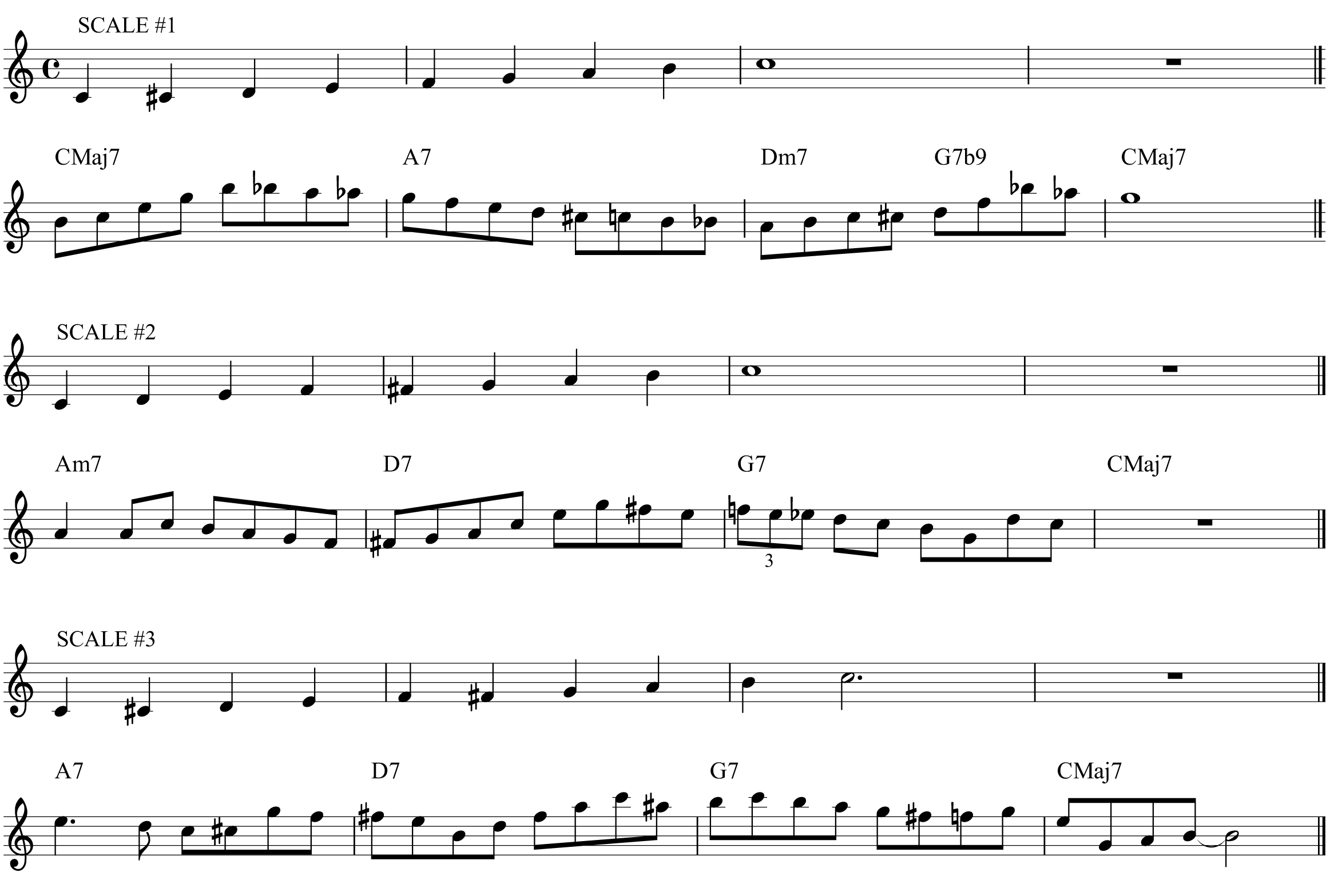
Click on the image to your right to enlarge it. You’ll see three scales. The first two contain a single added note. Scale #1 includes a raised first, and scale #2, a raised fourth. The interpolation of these notes adapts a basic major scale for use with two commonly encountered secondary dominant chords: the V7/ii (or VI7) and the V7 of V (or II7). In the key of C, which these scales are written in, those chords are A7 and D7.

These scales are as fresh to me as they are to you at the time of this writing. Not that I’ve never played them before; I just haven’t made a conscious point of focusing on them as actual scales to invest my time in practicing. I see two benefits to doing do. The first is, obviously, developing technical facility. The second is raising one’s awareness of the added notes as harmonic devices, with an eye on the secondary chords that they apply to.

Each added note serves as the major third–a critical identifying tone–of its secondary dominant chord. So when you play scale #1, remember that it works readily with the VI7; and likewise, scale #2 pairs with the II7. Many playing situations feature both of those secondary dominants, and often the VI7 moves directly to the II7, which in turn moves to the V7–in essence, coasting around a segment of the cycle of fifths.

The third scale incorporates both the raised first and the raised fourth, making it a kind of granddaddy scale that accommodates both secondary dominants.

Now, don’t look at these scales as magic harmonic bullets.. Rather, look at them as resources that allow you to judiciously select certain tones when you need them as well as furnishing you with good linear resources. It’s not all about your fingers mastering the technique of the scales. It’s also very much about applying your mind to grasp the uses of the introduced tones.

In other words, build harmonic awareness, not just digital dexterity. To assist you, I’ve included an exercise for each scale that will help you hear how each added note implies a certain harmony. Play these exercises on the piano so you can chord along with the melody line, or else get a keyboard player or guitarist to comp for you while you play the different lines.

Have fun! And if you enjoyed this post, drop in on my Jazz page and check out the many other exercises, articles, and solo transcriptions.

Sax and Wedge: Maybe This Year

This afternoon I have a gig with Paul Lesinski at the Amway Grand. I’m looking forward to it, but it indisposes me to chase what could be Michigan’s first round of severe weather this afternoon. Practically speaking, the “storm” and “horn” parts of Stormhorn sometimes conflict with each other. I can’t do two things at once; I can’t play a gig and chase storms, and when I post here about one subject, then the other half of my readership gets left out.

Yet I view the two interests as connected in spirit, to such an extent that one of my life goals is to get some footage and/or photos of me playing my sax out on the Plains with a big wedge churning in the background. Given how active this April has been, maybe 2011 will be the year when I fulfill that ambition. I almost always bring my horn with me on my long-distance chases for just that reason (plus, yeah, I like to get in some sax practice when I can). The one notable occasion when I left it home last year was on May 22, a milemarker in my chase career. Unfortunately, the vehicle was so packed that there was no room for the horn, and given how events unfolded out there by Roscoe, it was probably just as well.

Today my buddy Bill is chasing down in Arkansas. Yesterday he filmed a large, violent wedge that hit the town of Vilonia. Round two today looks to be at least as bad, and I hope Bill stays safe. I don’t have a good feeling about what lies in store for the folks in that region. But I won’t be following any of the developments because I’ll be doing the other thing I love as much as storm chasing: playing my saxophone. This time of year the storm chaser in me has the edge over the musician, but once I’ve got my horn in my hands I forget everything else and just go with the flow of the music. Playing jazz is one of the most in-the-moment experiences a person can have, and I get tremendous satisfaction out of being a practitioner.

Afterwards maybe I’ll still get a crack at whatever weather shapes up. Probably not; today, such as it is, looks like it’ll play out on the eastern side of the state.  But I’ll take my gear with me to the gig just in case.

Jazz Sax Friday at The Seasonal Grille

With the advent of storm season, I’ve been so preoccupied with severe weather that I’ve let my jazz saxophone posts slide. But the jazz musician in me is still very much alive, and I’ll be kicking out the jams this Friday evening in downtown Hastings. Did I mention that besides playing the sax, I’ve added vocals to my tool kit? Yes, I can sing! And having finally gathered the courage to do so, I’m finding that people like my voice.

The Seasonal Grille is the venue. I’ve played there once before. It’s a wonderful new restaurant, all ambience, featuring gourmet Italian food impeccably prepared by Justin Straube, the owner and head chef, at prices that are almost ridiculously affordable. Really, it’s one of the best dining deals you’ll find in these parts, and the setting is enhanced by a beautiful bar. I’ll be playing there from 6:00–9:00 p.m. with West Michigan keyboard veteran Bob “Gus” VanStee, so you can pleasure not only your taste buds but your ears as well.

I might add that Bob and I will be fitting into the larger tapestry of the annual Hastings Jazz Festival. It’s a weekend of urban music in an unexpected and very cool small-town setting. I love how this modestly sized community halfway between Grand Rapids and Battle Creek has embraced the American art form known as jazz! Kudos to Justin for supporting the music at his restaurant. It’s a perfect fit. The Seasonal Grille is the kind of place that’s tailor made for live jazz.

So ink this Friday into your planner. Here are the details:

The Seasonal Grille

150 W State St, Hastings, MI 49058

Friday, April 15

6:00–9:00 p.m.

(269) 948-9222

Video: One for Daddy-O

The classic Cannonball Adderly album Something Else includes a wonderful Bb minor blues written by Cannon’s brother, Nat, titled “One for Daddy-O.” The moody head fits the slow, shuffle groove perfectly and sets the tone for some fun improvisation.

I videotaped this tune with my new Panasonic HDC-TM700 camcorder in my buddy Ed Englerth’s basement studio, Blueside Down, the same evening as I taped “The Summer Knows.” My Band-in-a-Box accompaniment doesn’t capture the original arrangement’s antiphonal quality, but it did what I needed it to for a simple, low-key recording.

Video: The Summer Knows by Michel Legrand

Ever since I heard Phil Woods’ rendition of it, I’ve loved Michel Legrand’s haunting ballad “The Summer Knows.” The theme song for the 1971 movie The Summer of ’42, the tune showcases Legrand’s ability to extract tremendous beauty and emotion from a simple, four-note motif.

Videotaped with my brand-new Panasonic camcorder in Ed Englerth’s basement studio, here is my version of “The Summer Knows.” Just me on my beloved Conn 6M Ladyface, the trusty Band-in-a-Box orchestra (even gives you string if you want them!), and Ed operating the video camera. Maybe not studio quality, but the internal microphone didn’t do a bad job. I hope you like it!

Sax at the Park

Yesterday was gorgeous though a bit chilly–what can you expect in Michigan in mid-March, after all?–and I was anxious to put my new camcorder through its paces. So off to Fallasburg Park I went. Located north of Lowell on the Flat River, the park is a beautiful location adjacent to a historical village complete with a functional and well-trafficked covered bridge.

I had meant to use my tripod, but when I got to Fallasburg I discovered that I had left behind the plate that screws into the bottom of my camcorder so it can engage with the tripod’s quick release. Fortunately, I was able to induce a young guy who was at the park with his wife and little boy to film me. The result: not too shabby for a whimsical production using an on-the-spot cameraman! Just a little free-form saxophone improvisation–nothing fancy, just fun. Start with a note and then see where it takes you. Pardon the wind noise about halfway through–it was pretty breezy out there.

This is my first attempt at embedding a video in WordPress. Let’s see how it goes.

The Tritone Scale

Many years ago, when I first became aware of chord superimposition, I hit upon a unique concept. Inspired by my new awareness of tritone substitution, I thought, What would happen if I took two major triads a diminished fifth apart–C and F#, for example–and crunched all the notes together to form a scale? Wouldn’t that be cool!

Of course it had already been done, just not by me. My musical innovations tend to be in the same league as my discovering fire, gravity, the wheel, Chicken McNuggets, things like that. In this case, I had stumbled upon the tritone scale, so named for obvious reasons.

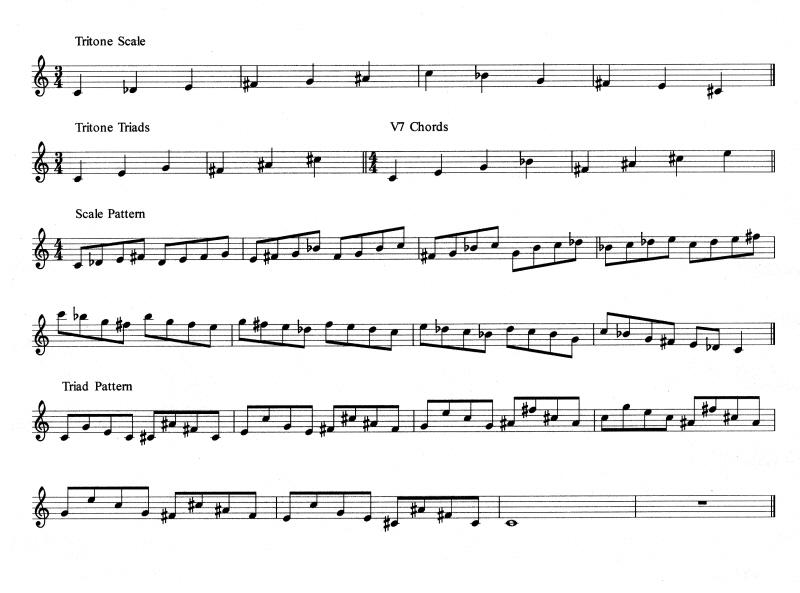
Think of a diminished scale with two notes missing, kind of like a smile with a couple teeth knocked out, and you have the tritone scale. The standard C half/whole-step diminished scale consists of the notes C, Db, D#, E, F#, G, A, Bb, C. If you remove the notes D# and A, the result–as shown in the first example (click to enlarge)– is a C tritone scale: C, Db, E, F#, G, Bb, C.

The tritone scale falls in the class of scales called hexatonic (six-tone), which also includes the augmented, whole tone, and blues scales. Since the tritone scale is derived from two major triads, you’ll of course find those triads contained in it. You’ll also find two dominant seventh chords native to the tritone scale. (See second and third examples.)

The leap of a minor third between the second and third tones, and between the fifth and sixth tones, renders the tritone scale asymmetrical. That asymmetry lends color to the scale and makes it a good source of angularity. By its nature, the tritone scale will make you think a bit differently than you would if you were using a complete diminished scale–with which, I should add, the tritone scale is interchangeable.

The last two examples in the image are actually exercises on the tritone scale. The first is a straightforward scale exercise. The second alternates the two triads that are native to the scale, taking you through their different inversions. As always, play each exercise through the full range of your instrument.

How to use the tritone scale in improvisation

All that theory is fine, but what about actual application? Naturally you want to know how the tritone scale is used.

Use it anywhere you would use a whole/half-step diminished scale. The most obvious use is with a V7b9 chord. Since, as I’ve said, the tritone scale is interchangeable with the diminished scale, you can use it with any of four different dominant chords. For instance, you can use the C tritone scale with C7b9, Eb7b9, F#7b9, and A7b9. Note that two of these chords, the Eb7b9 and A7b9, are built upon the “missing notes,” which means you can skate around the chord roots without ever landing on them.

Tritone scales built on the roots of dominant chords pack the advantage of having the tritone substitution built right into them. The second exercise (last example) demonstrates this beautifully and is one you definitely should get under your fingers.

The tritone scale also adds interest to minor scales. Use the seventh of the scale as the chord root. Another way of thinking of it is, use the note that’s a major second above the chord root as the tonic of your scale. For example, if the chord is a Bbmin7, use a C tritone scale.

If you want a good example of the tritone scale in action, the first part of Michael Brecker’s solo on “Quartet Number 3” in the Three Quartets album by Chic Corea is a tritone tour de force.

And with that, I’ll sign off. Practice hard, experiment, and have fun!

Contrafact for “Cherokee”

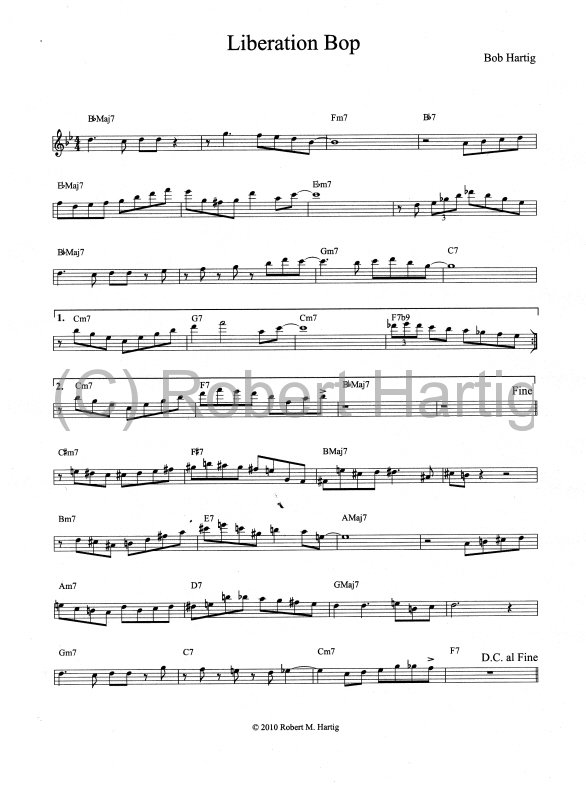
Okay, all you bebop saxophonists and assorted jazz instrumentalists, here’s a little something to have some fun with. Next time you want to work over “Cherokee,” try this instead. It’s a contrafact I wrote over the “Cherokee” changes–quite a few years ago, in fact; it’s copyrighted 2010 only because that’s when I finally got around to charting it with transcription software so it looks nice and pretty. Just click on the image, print it out, and you’re good to go.

It’s a good, strong melody, so I’m accompanying it with this statement:

1) You may use “Liberation Bop” on the gig.

2) You may NOT use “Liberation Bop” for any other commercial purposes, such as but not limited to recordings or written music collections, without my express consent. If you want to use it for commercial purposes, click the tab that says “contact” and shoot me a request.

In other words, keep it honest. And that being said, I hope you’ll enjoy the tune.

PS–I didn’t intend for the watermark to be that freaking big. But I don’t think it’ll interfere, so I’m leaving it as, at least for now.

Moonlight in Vermont: American Songbook Haiku

“Moonlight in Vermont” is one of my favorite ballads to play on the sax. Written by John Blackburn and Karl Suessdorf and published in 1943, it’s a gemstone of the American Songbook with its sensory, impressionistic lyrics and evocative melody. Simple as it is, nevertheless it’s also a tune with a few surprises, notably its cadence to an altered V7/vi chord, which injects color into the otherwise static harmony of the A section; and also its six-bar form, again in the A section.

Having finally given myself credit as a vocalist as well as a saxophonist, I recently learned the lyrics to “Moonlight in Vermont” and have been singing it quite a bit in the shower, driving down the road, and of course when I’m playing a gig. Naturally I got to thinking about that odd six-bar A section. It was the first thing that struck me about the tune when I acquired it years ago as a developing jazz musician seeking a nice ballad to improvise on. Why write a six-bar A section? Not that one can’t, not that one shouldn’t, but why abbreviate the usual, deeply ingrained eight-bar phrase? How strange, yet how effective.

Yesterday the answer finally dawned on me in an inspired flash. I started counting syllables to make sure–five syllables in the first line…seven in the second…and, sure enough, five in the third…why, the song lyrics were written as a haiku!

Now, I realize that this discovery is probably no news flash to some of you, but it was to me. Each of the three stanzas in the A section is a little haiku gem which, married to the limpid melody, flows beautifully and demonstrates just how evocative compactness can be. The  pentatonically derived A section, steadily descending, pausing at the end of each line, reminds me of a stream flowing through the woods, tumbling over little waterfalls and reposing in quiet, reflective pools before commencing the next phase of its journey.

“Moonlight in Vermont” is a song of the seasons, painting the annual progression in three-line daubs of verse. The first tercet gives us “falling leaves, a sycamore”; the second stanza moves us into winter with “snowlight in Vermont”; and the last one brings us a summer evening filled with meadowlark song.

The first half of the tune’s bridge continues with the word pictures while providing a digression into standard, eight-bar phrasing. The second half injects, for a brief moment, a human element into a tune whose romantic images have hitherto mentioned nothing of romance or of people.

Songwriters who contributed to the body of music we call the American Songbook were masters at their craft, and “Moonlight in Vermont” is exquisite proof. For more on the tune, read this commentary in Jazz Standards. A Wikipedia article also does a good job of addressing the haiku aspect of “Moonlight in Vermont,” though it incorrectly attributes two inaccuracies to lyricist Karl Suessdorf. Vermont is in fact well within the range of the eastern meadowlark, and while sycamores may be uncommon in the state, the southern part lies within range of the tree.

And that’s enough about that. I don’t know whether Vermont was moonlit last night, but it’s presently a cloudy Saturday morning here in Michigan and time I got on with my day.