Street Musician on the Paul Henry Thornapple Trail

Yesterday I made my first dollar ever as a street musician. It wasn’t a conscious effort. I’ve never busked in my life, and if I were to take up busking as a serious practice, I wouldn’t choose the place I was at. For that matter, the term “street musician” doesn’t at all capture the essence of either my location or my activity.

I was out on the Paul Henry Thornapple Trail in Middleville, one of my favorite outdoor spots to practice my saxophone. The Paul Henry is an old railroad bed that has been converted to a paved hiking trail. It winds through an area of considerable natural beauty, blessed with an impressive diversity of habitats and a commensurately large variety of wild birds.  Along the south side of the trail, the lovely Thornapple River flows serenely by. To the north, an ancient millpond serves as a haven for sandhill cranes, great blue herons, mute swans, and other waterfowl. Red-headed woodpeckers flit among the trees, and farther down, where the open marsh grades into a hardwood swamp, cardinal flowers punctuate the shade-dappled trailside with exclamations of crimson.

I love to take my sax out to the trail, out to the bridge over the short channel connecting the Thornapple River to the millpond, and practice my horn. I was doing so yesterday evening, hammering out some material in the keys of Eb and F#, when a red-headed woodpecker flew up and perched on the trunk of a small tree not fifteen feet away. It was a striking bird, with black wings and upper body, a white breast, and a shocking red head–a sight rarely seen in these parts but one you can’t miss when it’s in front of you. However, not being a seasoned bird watcher, I wasn’t quite certain it was a woodpecker.

So when an elderly couple came strolling along the trail, I addressed them. “Did you see the bird that flew into that tree?” I asked. “It’s got a bright red head. I think it’s a red-headed woodpecker.  Do you know your birds? Maybe you can tell me.”

The man said no, he didn’t know what kind of bird it was, but he wanted to give me something. He unfolded a dollar bill that he had in his hand and handed it to me. “We’ve been listening to you down the trail,” he said with a smile.

I laughed and accepted the dollar bill from him. “Thanks!” I replied. “I think I’ll frame it. That’s the first dollar I’ve ever made as a busker–and I’m not even busking!”

The three of us talked for a while about the woodpeckers, and music, and the beauty of the trail. Then the couple went their way and I pocketed the dollar and returned to my practicing.

One of the rewards of practicing outdoors is the variety. You never know what you’ll see or whom you’ll meet.

And with that thought, it’s time to end this post and go practice my horn. See you in July.
On Beyond Rhythm Changes: Kurt Ellenberger Addresses Underlying Issues of Jazz Culture

In a couple of recent posts, pianist and jazz professor Kurt Ellenberger and I traded salvos on the strengths and weaknesses of that ubiquitous jazz form, rhythm changes. In a nutshell, I enjoy playing rhythm changes and Kurt can’t stand them. However, that summary is cosmetic; scratch below the surface and you’ll find that Kurt and I think on a very similar frequency.

Kurt is the one who came up with the idea for a point-counterpoint dialog on the topic, with each of us sharing opposing perspectives in the interest of exploring an issue from different angles. I really liked his idea and I’m pleased with how it has opened up a much broader conversation.

Kurt has responded to my last post in a way that I think brings this particular discussion to a satisfying conclusion, albeit one that makes me want to find my stone axe (where on earth did I put it?). I feel, however, that the issues that have been raised may provide material for more exchanges in the future. Without further ado, here are Kurt’s closing thoughts on…

Rhythm Changes: Looking Deeper Than the Form

I find myself almost entirely in agreement with Bob’s thoughtful and well-written response to my post on rhythm changes. As he points out, my dislike for rhythm changes is simply an aspect of my personal tastes, which run the gamut from Scarlatti to Skinny Puppy and all points between and beyond, but do not include rhythm changes. If you like the form, that’s great—love the music that moves you, and never apologize for any of it.  (The corollary of that is to never pretend to love or admire something that doesn’t move you.)

Bob’s response identifies what (I think) bothered me the most about this form—namely, the tendency of many in the jazz community to be very doctrinaire in matters that should be left to personal taste. If you’re a “jazz musician” then you must publicly profess your love for all the sacraments of the jazz church,* which include the following:

  1. Louis Armstrong
  2. Dixieland
  3. Dance bands of the ’30s and ’40s
  4. Jazz vocalists
  5. Blues, rhythm changes, and Cherokee (all in 12 keys, of course)
  6. All Ellington (but not necessarily Basie, Kenton, or Herman)

Of course, I’m being somewhat facetious, but there is a kernel of truth in this list that most jazz musicians will recognize. There are elements of stylistic intolerance in the jazz community, which is not surprising given how marginalized it is in the modern world. The more unpopular a genre becomes (or the more ignored it is), the more important its mythology becomes to its adherents; nothing demonstrates this more than the romanticized history of jazz and the sacraments (as I call them) contained therein.

That said, I’ll end my counter-counter-point post with one observation: When jazz is referenced in popular culture, it is generally used as a symbol of sophistication, detached coolness, and intellectual refinement. Rhythm changes, however, are not the chosen form for this highbrow signifier, but they are found in at least one prominent position. Where? As the theme song for The Flintstones!

——————————–

* Lest I’m accused of exaggerating about the “jazz church,” I would point out that the term “jazz police” (which originates, I think, from a wonderfully odd tune by Leonard Cohen) is well-known to all jazz musicians. The Jazz Police are (metaphorically, I assume) the “enforcement arm” of the jazz church, desperately trying to maintain order and stylistic purity within the genre. As hard as it is to believe, there is even a Jazz Police website.

What about Fourths?

How did I ever forget about fourths? Used to be, I was getting a fairly decent handle on the Angular Interval, but in the course of practicing other material I forgot all about it.

Then yesterday, as I was pondering what else I could do to help me get more deeply inside the key of F# (which I continue to practice religiously–you’d think I’d have it down by now), suddenly it dawned on me: What about fourths? What better way to break away from the tedious predictability of tertian harmony than to reacquaint myself with the spacious, somewhat stark-sounding quartal sound.

So last night I began the process, and tonight I tightened down on what I started yesterday and then added onto it.

In my experience, fourths are more difficult to play diatonically than as sequences of straight perfect fourths. I’m not talking about fourth diads; those are fairly easy to get one’s chops around. But start stacking fourths and then taking them stepwise up and down a scale, and from a standpoint of technique, suddenly the job is no longer quite so simple.

And that’s perfect. Becoming truly fluent in an odd key such as F# is challenging, and to really unlock it, you’ve got to hit it from every angle. Practicing fourths can help you break out of the box, introducing angularity to your playing and helping you to land on notes you wouldn’t ordinarily think of in relation to other notes.

But of course you’d rather find out for yourself than listen to me talk. Since there’s no better teacher than experience, here’s a little exercise that will help you to experience fourths for yourself. It’s one of the patterns I was working on earlier tonight, set in the key of Eb (another key I’ve just started tacking onto F# as one I want to saturate myself in).

Now, it’s late and I’m lazy, too lazy to actually write out an exercise and go through all the hassle of scanning it. So I’m just going to tell you the pitches, okay? They’re arranged in groups of three, which you’ll play as triplets ascending and descending the Eb major scale. Here they are:

Eb-Ab-D, F-Bb-Eb, G-C-F, Ab-D-G, Bb-Eb-Ab, C-F-Bb, D-G-C, Eb-Ab-D; D-Ab-Eb, C-G-D, Bb-F-C, Ab-Eb-Bb, G-D-Ab, F-C-G, Eb-Bb-F, D-Ab-Eb.

That’s it for tonight. I’m tired and more in the mood to read and drink my Dark Horse Raspberry Ale than to write. I’ve already done my heavy lifting on my horn for today. Now it’s your turn.

Counterpoint: Why I STILL Love Playing Rhythm Changes

In his recent guest article on Stormhorn.com, my esteemed colleague Kurt Ellenberger explained why he dislikes–nay, loathes, abhors–soloing over rhythm changes.

By George, I enjoy calling Kurt that: “my esteemed colleague.” It sounds so dignified, so prawpuh, so…so pretentious. Hmmm…I relent, Kurt. That description is as cloying as some of the sacred jazz cows that I know you’d like to kebab. So I’ll retract the “esteemed colleague” bit and just call you my friend; a funny, thoughtful, and insightful guy; and, need I say, an absolute monster musician.

But I still disagree with you about rhythm changes.

To an extent, that is. I’ll begin my rebuttal to your post by agreeing with you. Given your musical experience and the high level at which you play, you get to hate rhythm changes to your heart’s content, along with any other musical formulae that you choose. You’ve attained, man. Once a person has mastered the rudiments of jazz to a world-class degree, there’s no need to keep rehashing them. The point of laying a foundation is to build something new upon it, not enshrine it.

This being said, foundations are important, and rhythm changes are an exercise in foundational material. Moreover, whether they’re banal is a matter of  perspective.

In his post, Kurt provides an analysis of rhythm changes that emphasizes their mostly static harmonic nature, with the exception of a temporary digression to the circle of fifths at the bridge section, which Kurt labels as trite. Overall, he is unimpressed by RCs.

But “trite” is simply a viewpoint, and viewpoints are personal. Some perspectives change as an individual accumulates experiences, while others deepen as time helps to clarify and reinforce them. This, I think, is the heart of the matter. As Kurt puts it, following his analysis, “In general, I prefer music that has a higher degree of harmonic activity and direction, or, absent that (as in music of a more minimalist nature, much of which I enjoy tremendously), there must be some other complexity in play to retain my interest. These preferences have become more pronounced over the years. As a result, I’ve lost interest in a lot of tunes that are similar in construction.”

Note the words “prefer” and “preferences.” They are personal terms. Everyone is entitled to his or her preferences, but one’s reasons for them are not necessarily a definitive yardstick for determining the value of a thing, particularly when other criteria can also be applied.

If I ever attain to Kurt’s level of harmonic and overall musical sophistication, then perhaps I’ll feel as he does about rhythm changes and the 32-bar song form overall. Probably not, though. Rhythm changes just never bothered me at the onset the way they did Kurt. But then–and this should come as no surprise–I see them in a different light.

For one thing, I’m a saxophonist, and as such, my concerns as they apply to my instrument are purely melodic. By this I don’t mean that I’m uninterested in harmony–I’m keenly interested in it, of course–but rather, that I’ve only got one note at a time at my disposal, not entire clusters. This alone creates a different outlook than Kurt has as a pianist.

For another thing, I’ve taken a different and slower developmental path than Kurt’s. For still another, I’ve worked on rhythm changes by choice, not because of an educational or cultural mandate. Finally, I’m me, with my own set of preferences and dislikes. And on both artistic and practical levels, I find playing rhythm changes to be enjoyable, valuable, and, yes, challenging.

On the practical level, rhythm changes are a great way to take rudimentary elements of improvisation such as turnarounds, cycles, and ii-V7s out of isolation and set them in an applied context. I’ve already addressed this matter in my original post on rhythm change, so I won’t rehash it here. The points I made then remain valid. From a developmental standpoint, RCs are–like that other even more foundational form, the blues–good for you. You don’t have to build your world around them, but learning how to play them well gives you some substantial building blocks which you can adapt in other ways that may interest you more. As a musical exercise, I view rhythm changes in somewhat the same category as scale work and etudes.

As a young improviser, I first began to make the leap from technique to musicality by memorizing a Charlie Parker solo based on rhythm changes. Today, I’m still finding RCs invaluable for helping me to build my chops in different keys. I’m convinced of their value. A raftload of Charlie Parker contrafacts can’t be wrong.

However, those same Charlie Parker tunes are now very old, and jazz has traveled in a lot of directions from its 1940s bebop watershed. Bird himself, in the final years of his life, felt that he had taken bebop as far as he could and was seeking a new direction. Which brings me to the artistic aspect of rhythm changes.

Rhythm changes, banal? I suppose they can be, but I don’t think they have to be. Listen to Michael Brecker ripping through “Oleo” and tell me that’s banal. The difference lies in Michael’s approach. He’s not merely regurgitating old licks; he has developed his own voice and is applying it masterfully to the changes. Michael certainly doesn’t seem disenchanted.

While I can’t say for sure, I suspect that the late tenor master had absorbed so much music of all different kinds that he didn’t much care whether he was playing a sparklingly contemporary, harmonically complex tune or an old chestnut. Like Kurt, I’m sure that Michael had his preferences, but that didn’t keep him from weaving magic with rhythm changes and, to all appearances, enjoying himself in the process.

Kurt mentions getting locked into a formulaic approach to RCs. I know what he means–I face that same challenge. But since I don’t have an innate bias against rhythm changes, I view the rote licks and patterns as just a framework which, as I master it, can ultimately enable me to move beyond it. Kurt knows, far better than I, that rhythm changes, like any tune, can be altered in creative ways that are only limited by one’s imagination.

And, I might add, by one’s level of interest. If a player isn’t motivated to explore the possibilities, then rhythm changes, like any well-worn standard in the American songbook, will indeed become banal through over-repetition of the same-old-same-old. I fully concur with Kurt that there has to be some level of complexity present, some kind of intellectual and/or technical challenge, to hold my attention.

However, I maintain that the potential for such complexity exists in any tune. I mean, how innately fascinating is a Dorian mode? But we understand that there’s a whole lot more to modal music than a single scale played ad nauseum over a single minor chord. It’s not a matter of what you’re given, but of what you do with it and, I should add, whom you do it with.

I could say more on the matter, but there’s no point in doing so since it really does boil down to a matter of personal preference. Instead, I have a couple observations to make with which I think Kurt will fully concur.

First, while I’m obviously a proponent of rhythm changes, I would emphasize that they’re just a stopover on a much larger musical journey. I think it’s wise for a developing jazz musician to go through them, it’s helpful to camp out on them for a season, and it’s fun to return to them and enjoy the view, but for goodness sake, don’t buy a house there. The neighborhood is already 80 years old and the heyday of its development in the bebop era is long past. Use what’s been done as a basis for finding your way toward newer, more personal musical directions.

Second, jazz traditions may be venerable but they’re not sacred, and this certainly applies to rhythm changes or to any musical form. It’s okay not to like them and it’s okay to say so.

Jazz culture has been a breeding ground for some affectations and norms that I don’t much care for. Some of them may have served a purpose at one time, but, as Kurt has done a great job of pointing out in a post titled “Jazz in Crisis” on his own blog, Also Sprach Frackathustra, they’re now outdated in a larger world that has moved far beyond the jazz era.

So let’s be real. If jazz is about freedom, as we say it is, then saying that one doesn’t care for rhythm changes shouldn’t require some sort of hush-hush, confessional tone for fear that Big Brother is listening. I’ve never been aware of such a cultural pressure, but I don’t doubt that Kurt has experienced it, and that bothers me. Good grief, we’re talking about a set of chord changes, not the Ark of the Covenant.

Many of us jazz practitioners need to distinguish between the true non-negotiables of the music we play versus the affectations and cultural mores that surround it. If we don’t search our own souls, believe me, the rest of the world doesn’t care enough to do the job for us. Many of us could start by dropping our smug, musicianly superiority and becoming just plain, down-to-earth, nice people who treat both our fellow musicians and non-musicians graciously.

With that, I think I’ve worked the rant out of my system. Kurt, I guess I’ll continue to enjoy playing rhythm changes, at least until, like you, I experience them as more limiting than beneficial. Until then, I promise, cross my heart, that if you and I do a gig together, I won’t call for rhythm changes.

However, if I catch you playing solo somewhere, I may request “Anthropology” just to see you wince.

ADDENDUM: Be sure to check out the final installment of this series, in which Kurt offers his own closing thoughts.

Guest Blog: Jazz Pianist Kurt Ellenberger Tells Why He Hates Rhythm Changes

“I’m attracted to sophisticated harmony, interesting voice-leading, rich chords and dense chord voicings, and tone color…None of that is present in rhythm changes, and the ornate weaving through the static changes is just not compelling enough to mitigate what is missing.”–Kurt Ellenberger

Some time back, I wrote a post titled “Why I Love Playing ‘Rhythm’ Changes.” Evidently not every jazz musician feels the same way. Judging from the following post, jazz pianist Kurt Ellenberger may be slightly fonder of rhythm changes than he is of leprosy, but it’s a close contest.

I’d be tempted to whap Kurt for taking a whack at my article, except that Kurt is one of those rare musicians who makes me want to put my saxophone down and just listen to him play. He is a truly amazing, well-rounded pianist and complete musician who, drawing from a huge array of musical influences, can sweep you away on an inventive, marvelously textural journey that will make you forget there’s anything but the music you’re listening to.

Kurt is also a composer, the jazz professor at Grand Valley State University, the creator of Frakathustra’s Blog (aka Also Sprach Frak), and the author of “Materials and Concepts in Jazz Improvisation.”

All of the above to say, Kurt is hugely qualified to express a conflicting opinion. He’s also a great guy with a nutty sense of humor. So I guess I won’t whap him. Instead, I’m featuring him here as a guest blogger, knowing that he has some valuable, thoughtful, and provocative perspectives to share.

Naturally I’ll be writing a rebuttal.* Ain’t no Hatfield crosses a McCoy without there be a return salvo. For now, though, it’s time for Kurt to share his thoughts in an article he calls…

Why I Hate Rhythm Changes

By Kurt Ellenberger

In case the title isn’t clear enough, I’ll say it unequivocally: I don’t like rhythm changes at all, I have no interest in the form, nor any affinity for it whatsoever, and I know I’m not alone. I’ve heard many of my fellow jazz musicians say similar things, but we’ve done it in a sheepish manner, as if uttering some kind of sacrilege against one of the sacraments of the jazz church. Sacrament or not, I think it’s probably the most banal structure in all of jazz.

That’s a provocative statement requiring some explanation, which I’m happy to provide. But first, some context and background.

When I was listening to jazz for the first time as a teenager, there were certain tunes that I never (for the most part) liked very much. As I became more knowledgeable about form and harmony, I found there was a consistent pattern to my dislike: They were tunes based on rhythm changes such as “Moose the Mooch,” “Rhythm-a-ning,” “Shaw Nuff,” “Cottontail,” “Anthropology,” “Dexterity,”and others.  There were few that I liked, a very few.  In fact, I can name them specifically, because there were only two that I can remember being interested in: Bill Evans’ studio version of “Oleo” and some of Miles Davis’ recordings of “The Theme.” That’s not to say I didn’t appreciate the playing and the technical prowess in display in countless other recordings, I just didn’t enjoy listening to the form, regardless of how well it was played, and that hasn’t changed to this day.

As a dutiful jazz student, I worked hard to learn the form.  I transcribed solos, studied them as jazz etudes, extracted licks and learned them in 12 keys, until I could make it through and play it in a reasonably convincing manner.  I say “convincing” because I always felt as if I was acting a part when playing rhythm changes. I had no passion for it and I couldn’t manufacture a musical love affair.  I’m sure that it came across as such, no matter how hard I tried.  I relied on clichés and formulaic licks, especially at faster tempos. I never felt like I was improvising; rather, that I was regurgitating my stable of licks in a form that was completely uninteresting to me in order to be employable as a jazz musician.

As time went on, my emotional detachment from rhythm changes made it harder and harder to fake it. I just couldn’t force myself to play those licks as required to maintain the facade.  When someone called a tune based on rhythm changes, I tried to avoid a solo entirely if at all possible.

I examined the form to see if I could figure out what I didn’t like about it, and it wasn’t hard to determine.  Rhythm changes is a 32-bar form (AABA). The ‘A’ section is eight measures in length, the first four of which are (as Bob writes in his post) a simple turnaround repeated. In the second four measures, the bass moves from tonic to dominant, highlighting the subdominant briefly, before moving back to tonic again(there are some minor variations there, but essentially this is what is found). The ‘B’ section attempts to generate some degree of harmonic “surprise” as it moves from tonic to V/vi (chromatic mediant). This transparent and trite interjection fails to surprise as it immediately decays into a string of very predictable secondary dominants leading to the dominant of B-flat, which then sets up the return of the ‘A’ section.   To summarize:

* There are three ‘A’ sections in the piece, comprising 24 of its 32 measures.

*The ‘A’ section is a prolongation of the tonic.

*The ‘B’ section is nothing more than a series of passing chords leading to tonic.

The form is therefore virtually static from a harmonic (granted, Schenkerian) perspective which is problematic for me. In general, I prefer music that has a higher degree of harmonic activity and direction, or, absent that (as in music of a more minimalist nature, much of which I enjoy tremendously), there must be some other complexity in play to retain my interest. These preferences have become more pronounced over the years. As a result, I’ve lost interest in a lot of tunes that are similar in construction.

The primary reason that I pursued jazz was because of my love for the music of Bill Evans, which goes a long way in explaining what motivates and inspires me musically. To be precise, I’m attracted to sophisticated harmony, interesting voice-leading, rich chords and dense chord voicings, and tone color, all of which Evans excels in. None of that is present in rhythm changes, and the ornate weaving through the static changes is just not compelling enough to mitigate what is missing. Yet I really was attracted to Evans’ recording of “Oleo,” going so far as to transcribe it in order to learn what he was doing.** His recording is remarkable in that it eschews the original harmony almost completely, and treats the form in a very free manner, with implied new progressions (especially in the ‘A’ section), prolonged hemiolas and other polyrhythms, and surprisingly chromatic melodic figures; in other words, it’s barely recognizable as rhythm changes, which is probably why I like it.

I write this with enormous respect and admiration for all of the great musicians who have done (and continue to do) remarkable things with rhythm changes. I can appreciate that on many levels, but I simply don’t respond to it emotionally, and without that, what’s the point?

——————-

* ADDENDUM: To read my rebuttal to Kurt’s post, click here.

** It is interesting to note that, as far as I know, Evans recorded rhythm changes only once in a studio album (“Oleo” from “Everybody Digs Bill Evans”). I certainly don’t know the reason, but the fact that he didn’t record it again is notable for a jazz pianist of that era. I’ve wondered about it for many years, especially given my love for Evans’ music and my own dislike for rhythm changes.

Mastering the Sax: Building a Baseline of Ability

As I sat in my car by the railroad tracks last night out in the countryside, practicing my saxophone and doing my best impression of a Shady Character Waiting To Make A Drug Deal for the benefit of curious passers-by, it struck me how far I’ve come since I began woodshedding in earnest back in college. It’s a long way, but not far enough. There are high-school-age kids who can do what I do. Not many, but they’re out there, along with a host of college music majors who are blazing incendiary trails across today’s jazz firmament.

I can’t afford to think about it. Topnotch jazz programs featuring world class saxophone instructors have multiplied over the years, and out of that educational milieu are arising some brilliant young players. There are bound to be a few who at half my age possess twice my ability.

A few. But probably not all that many. Because while those music majors have been in the practice rooms busily learning their instruments, I’ve been in my car by the tracks doing the same thing. However, my practice schedule has probably been more spotty than theirs, and so have my opportunities to play jazz live with other experienced jazz musicians. Unless you’re in a position where you can immerse yourself in music without interruption, the demands of making a living have a way of imposing themselves on your practice time. They can stop you if you let them, but they probably don’t have to. You just have to accept a slower rate of growth that accommodates the rest of life.

The learning curve for mastering a musical instrument is different for everyone. We all have different circumstances, different degrees of natural ability, different competing interests that round us out as individuals, and so on.

I thought about this last night as I worked out some bop tunes in the key of F# and revisited “Giant Steps.” My storm chasing excursion out west last weekend had cost me several days of practice, and my fingers could tell the difference. But they snapped back into shape quickly.

Playing the saxophone is not like riding a bike. You don’t just hop back on and regain instant command after not having ridden in a while. You’ve got to reclaim old ground.

What does happen, though, is that when you practice diligently, you continue to raise the baseline of your abilities. Persistent, focused practice not only will put you at the top of your game, but it will also build and expand a musical foundation you can fall back on during those times when your practice routine falls by the wayside.

My book on “Giant Steps” patterns is nearing pub time, but to be honest, I haven’t spent much time actually playing “Steps” in recent history. So last night I broke out my workbook and my Aebersold CD of Coltrane tunes, and I got a pleasant surprise. It has been years since the period in my musical development when I saturated myself in “Giant Steps.” But I found myself navigating the changes, finding my way through familiar patterns, exploring ideas–not on the same level as if I’d been consistently practicing Coltrane changes, true, but well enough for me to feel pretty good about what I was doing. In fact, in some ways I played the tune better than I did in the past. Other musical material that I’ve acquired over the years provided a richer repository of ideas and technical finesse. Old and new came together, and while the result wasn’t perfect, it was at least coherent.

To sum up: Stick with your instrument. Never give up. Life has its seasons and its discouragements, but persistence really does pay off. Don’t measure your musical growth by other players, but by the satisfaction you get as you set and accomplish realistic personal goals. Be honest with yourself, be as diligent in practicing as you can be, be hard on yourself only when you have to be, listen to and study great players, and don’t get so obsessed with arriving at your destination that you forget to enjoy the journey. Do this, and over time you’ll build a solid baseline of craftsmanship and musicality that will serve you well during the off-seasons of your musical life.

The Giant Steps Scratch Pad: Getting Back on Track

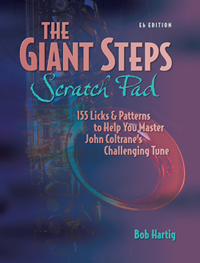
Finally…the grunt work is done. I’m pleased to announce that today I finished keying in the last of the patterns and licks in my “Giant Steps” practice book. Not only so, but I completely revised the introduction and wrote a new section of “Preliminaries and Practice Tips.”

Preparing “The Giant Steps Scratch Pad” for publication has been a longer haul than I had anticipated, but the extra time and effort I’ve invested have produced a much better product. And in the process of transcribing it using MuseScore notation software, I’ve had ample opportunity to better consider my options for self-publishing.

“The Giant Steps Scratch Pad” will be available in C, Eb, Bb, and bass clef editions. I’m now weighing the pros and cons of print versus electronic editions and the feasibility of offering both. Whatever I decide, the hardest part is now behind me (knock on wood). I still need to figure out how to merge my text and music score files into a single document, and I need to create a cover, and I need to set up an online store. But the book in its essence now exists in a format that is a huge improvement over the scanned, handwritten material I had initially envisioned as an e-book.

Bottom line: If you’ve ever wanted to build the chops needed to play John Coltrane’s tune “Giant Steps,” this book will help you immensely.

Continuing on in the spirit of shameless self-promotion–hey, it’s my blog, and I get to do this sort of thing!–I thought I’d share the “Preliminaries” part of the section titled “Preliminaries and Practice Tips.” You know, just to whet your whistle, start a little buzz, put a bug in your ear, that kinda thing. I think you’ll find this little writeup interesting, maybe even enlightening, possibly even useful:

“The Giant Steps Scratch Pad” is straightforward. It’s about building your chops for Coltrane changes. Still, there are a few things you’ll want to keep in mind.

“Giant Steps” cycles through three key centers spaced a major third apart. The tune is written in B concert (if you can really pin it to a single key), and it takes you through the keys of B major, G major, and Eb major. A quick glance will tell you that the notes B, G, and Eb (D# enharmonically) spell out a B augmented triad.

Formally, the tune consists of two eight-bar sections in an A-B format. Each section has its unique hallmarks:

* The A section can be distilled into a series of V7–I cadences that descend by major third, thus: F#7–BMaj7, D7–GMaj7, Bb7­­–EbMaj7. Simple enough, except that Coltrane had the audacity to insert a bar line in the middle of each cadence. So instead of a nice, perfectly symmetrical treadmill of chord changes, you wind up with this awkward roller-coaster: BMaj7–D7, GMaj7–Bb7, EbMaj7–F#7.

* The B section is essentially a series of two-bar ii–V7–I cadences that ascend by major third. But of course, once again Coltrane complicates a simple thing by beginning each two-bar phrase with a major chord, then in the following bar modulating abruptly to the ii–V7 of the next key. In other words, the chord series Am7–D7–GMaj7, C#m7–F#7–BMaj7, Fm7–Bb7–EbMaj7, becomes EbMaj7–Am7–D7, GMaj7–C#m7–F#7, BMaj7–Fm7–Bb7.

In a nutshell, “Giant Steps” was John Coltrane’s way of tweaking simple, essential musical formulae in a way that has had jazz musicians stubbing their toes ever since.

Just remember: The A section of “Giant Steps” descends by major thirds through three keys, and the B section ascends by major thirds through those same keys. Got it? Good. With that conceptual foundation in place, here are a few pointers for practicing…

I’ll close with that cliffhanger. Can’t you just feel the tension? You want to know my “Giant Steps” practice tips, don’t you.  I can just tell. Don’t worry, you can find out all about them once the book is released. So stay tuned, jazz campers. A little more work and then I’ll look forward to announcing publication.

“Giant Steps” E-Book: Taking a Step Back in Order to Step Forward

Here’s an update on my book of “Giant Steps” licks and patterns.

By now I had hoped to have it available for purchase online as an e-book. However, after getting feedback from a couple friends whose wisdom and musical expertise I highly respect, I’ve decided to take a little more time to do the job right.

Initially, the idea of simply scanning my handwritten practice book appealed to me. I liked the homespun, pencil-and-staff-paper feel. Nothing fancy, just solid practice material that will help jazz musicians get a firm handle on Coltrane changes. For that reason, I had titled the book–and still plan to title it–“The Giant Steps Scratch Pad.”

But there are limitations to the approach I’ve described. For one thing, legibility is an issue in some parts of the scanned material. In the process of copying all of my handwritten material, the scanner was also picking up on smudges and erasures, and it was failing to clearly copy some of the lighter print. After taking up pencil and eraser and editing several pages for better effect, and doing a bit of clean-up work with PhotoShop as well, the result is acceptable. Frankly, I kinda like it, and part of me wants to offer it as is. But I can do better.

So I’m going to get the material properly notated using transcription software. Not only will the finished result look much more polished, but I will be able to offer it for the entire suite of C, Bb, Eb, and bass clef instruments. The scanned approach doesn’t offer that flexibility; I had written the patterns for my own instrument, the Eb alto sax, and the book was what it was.

Taking to heart the advice I’ve gotten, then, I’m taking a step back in order to take “Giant Steps” forward. Hopefully the delay won’t be a long one. I’m eager to get the book published. I just want to make sure it’s everything it can be right out of the starting gate.

So keep your eyes peeled for further developments. The hard, creative work is already done. I just need to explore my options, then take the best one and git ‘er done.

–Bob

Giant Steps E-Book Update

Last week I announced the upcoming release of an e-book filled with licks and patterns designed to help jazz musicians  improvise on the famous John Coltrane tune “Giant Steps.”

As is true of just about any big endeavor that’s worth doing, though, this one is taking a little longer than I’d anticipated. Much of the reason for that is due to touch-up work I needed to do after scanning all my handwritten material. And of course I needed to design a cover. Now I’m seeking a few endorsements, and I still need to set up an online store.

So I thought I’d give you a quick update just to reassure you that this ebook is moving along. If you’re interested in getting hold of a practical, hands-on book you can take with you into the woodshed and emerge better equipped to tackle those gnarly “Giant Steps” changes, then keep watching this blog for further announcements. I won’t keep you waiting very long–promise!

Giant Steps E-Book Soon to Be Released

If you want to bone up on the theory behind John Goltrane’s landmark tune “Giant Steps,” you’ll find plenty of information online as well as in print. But when it comes to actually cultivating the chops it takes to play “Giant Steps,” you may have a tougher time finding material.  Could be that I’m uninformed, but I just haven’t seen much in the way of practice resources for Coltrane changes.

So I’ve decided to share my personal material. Years ago, I went through a period when I steeped myself in “Giant Steps,” and during that time, I started writing down licks and patterns for  “Giant Steps” in a music notebook.  Today, after supplementing the stuff I had already written with some new material, including licks using the augmented scale, I completed the front matter and introduction.

All that remains to be done now is to register the copyright and set up an online store on Stormhorn.com. The e-book’s title is  “The Giant Steps Scratch Pad.” It will be the first product I’ve created and sold on this site, and I feel excited about offering it to you.

If you want to view a sample page (and cop some free licks), click here. Otherwise, stay tuned. I expect to have “The Giant Steps Scratch Pad” available for purchase soon, and will announce its publication upon release.