The Giant Steps Scratch Pad: NOW PUBLISHED!

You read right: The Giant Steps Scratch Pad has finally hit the streets!

I hadn’t wanted to give further updates until now because it seemed that I kept running into snags and delays. That kind of news gets embarrassing to write about after a while, and no doubt it’s tiresome to read. But all the hurdles have finally been crossed, and I am extremely pleased to announce that my book of 155 licks and patterns on Giant Steps changes is at long-last published and available for purchase.
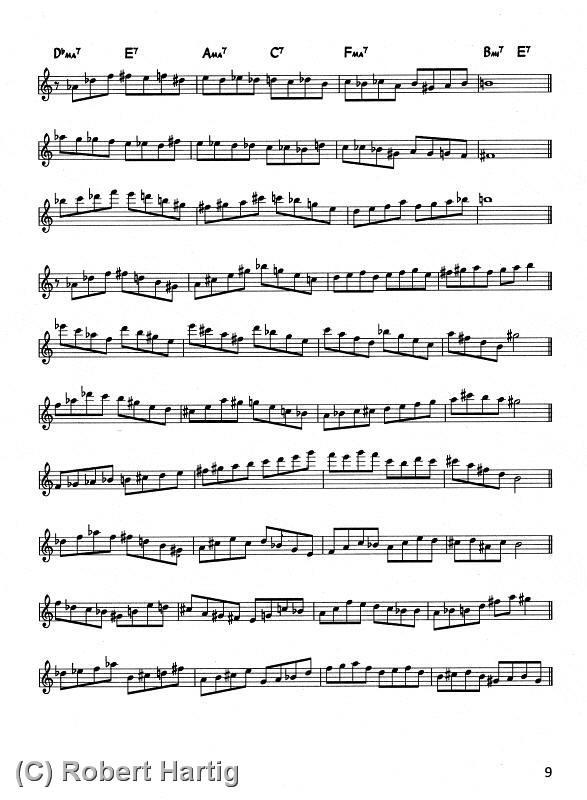
Let me quickly follow with this caveat: The Eb edition is the one that is presently available. However, with that trail finally blazed, Bb, C, and bass clef editions are all in the works and will be following shortly. I finished editing the Bb edition earlier today, and I hope to complete the job tomorrow, so look for it in a day or two, or at least sometime this week. After that will come the C and bass clef editions. (UPDATE: ALL FOUR EDITIONS OF THE GIANT STEPS SCRATCH PAD ARE NOW AVAILABLE FOR PURCHASE. SEE BOTTOM OF PAGE TO ORDER. CLICK AND ENLARGE IMAGE TO YOUR LEFT TO VIEW A PAGE SAMPLE FROM THE Bb EDITION)

If you’ve ever wanted to build the technique to blaze your way through the changes to John Coltrane’s jazz landmark, “Giant Steps,” this is the book to help you do it. It’s truly a one-of-a-kind. Here’s the cover copy for it:

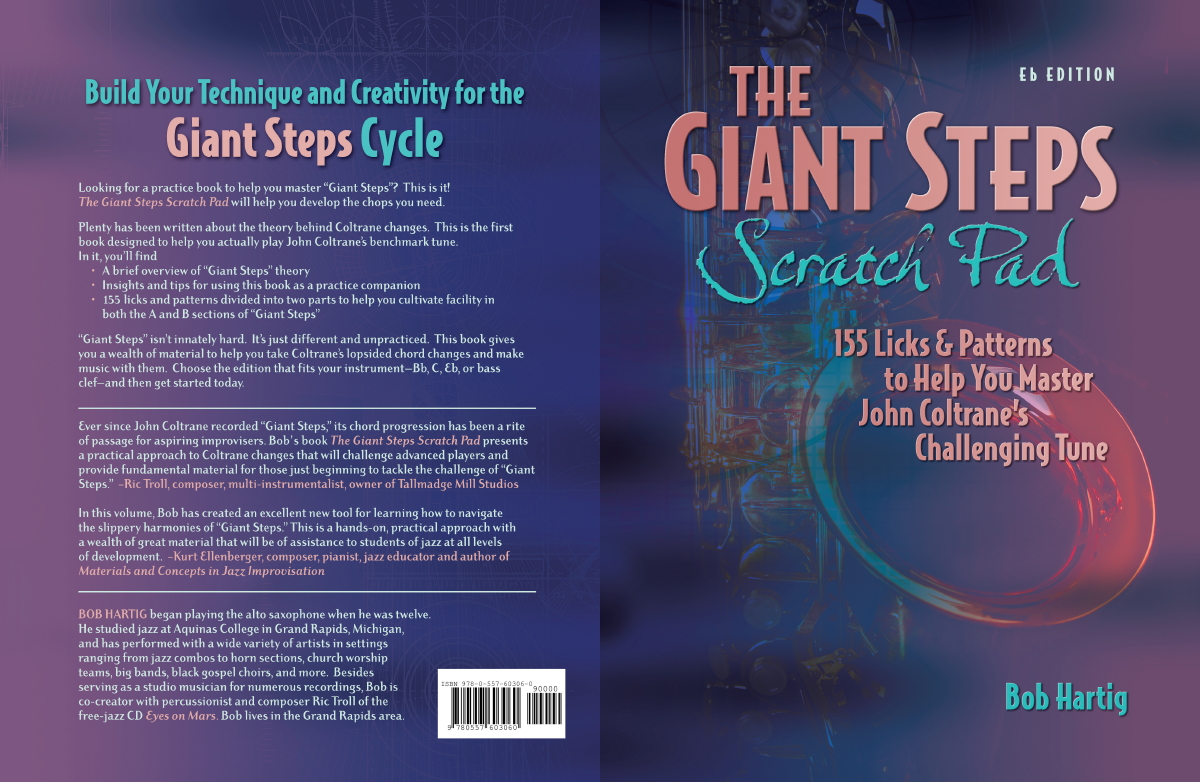
Build Your Technique and Creativity for the Giant Steps Cycle

Looking for a practice book to help you master “Giant Steps”? The Giant Steps Scratch Pad will help you develop the chops you need.

Plenty has been written about the theory behind Coltrane changes. This is the first book designed to help you actually improvise on John Coltrane’s benchmark tune. In it, you’ll find

  • * A brief overview of “Giant Steps” theory
  • * Insights and tips for using this book as a practice companion
  • * 155 licks and patterns divided into two parts to help you cultivate facility in both the A and B sections of “Giant Steps”

“Giant Steps” isn’t innately hard. It’s just different and unpracticed. This book gives you a wealth of material to help you take Coltrane’s lopsided chord changes and make music with them. Choose the edition that fits your instrument—Bb, C, Eb, or bass clef—and then get started today.

“Ever since John Coltrane recorded ‘Giant Steps,’ its chord progression has been a rite of passage for aspiring improvisers. Bob’s book The Giant Steps Scratch Pad presents a practical approach to Coltrane changes that will challenge advanced players and provide fundamental material for those just beginning to tackle the challenge of Giant Steps.’”Ric Troll, composer, multi-instrumentalist, owner of Tallmadge Mill Studios

“In this volume, Bob has created an excellent new tool for learning how to navigate the harmonies of ‘Giant Steps.’ This is a hands-on, practical approach with a wealth of great material that will be of assistance to students of jazz at all levels of development.” Kurt Ellenberger, composer, pianist, jazz educator and author of Materials and Concepts in Jazz Improvisation

I’ll of course be putting up an advertisement for the book on this site. But no need to wait for that. If you’re an alto sax or baritone sax player, you can purchase the Eb edition right now!
Trumpeters, tenor saxophonists, soprano saxophonists, and clarinet players (did I miss anyone?), the party is coming your way next, so keep your eyes open for the next announcement.

It seems strange to me that something like this book hasn’t been done before, but as far as I know, The Giant Steps Scratch Pad truly is unique. It has been a lot more work than I ever anticipated, but I’m really proud of the results. Major thanks to my friend Brian Fowler of DesignTeam for creating such a totally killer cover for the print edition. But there’s more to this book than good looks alone. I trust that those of you who purchase it will find that its contents live up to its appearance. If you’re ready to tackle Coltrane changes, this book will give you plenty to keep you occupied for a long time to come.

NOW AVAILABLE IN C, Bb, Eb, AND BASS CLEF EDITIONS, AND BOTH IN PRINT AND AS A PDF DOWNLOAD.

Instant PDF download, $9.50
C edition Add to Cart
Bb edition Add to Cart
Eb edition Add to Cart
Bass clef edition Add to Cart
View Cart

Print editions–retail quality with full-color cover, $10.95 plus shipping: order here.
Oldies But Goodies

Sorry–I seem to have let an entire week slip by without posting. Many bloggers have a knack for slapping out short, cogent posts in 15 minutes or so, but that’s not a gift of mine. Just about every post takes me several hours to write, particularly the ones that include musical exercises. So when I have other things packing my schedule, the prospect of sitting down and creating a post can seem daunting.

That has been the case this week. Could be a streak of just plain old laziness somewhere in the mix, too, but mainly, these past few days have been busy ones. My brothers Pat and Terry arrived for a two-week visit Monday, so family has been a priority. And work still goes on, regardless–gotta make a living.

Today my bros, my sister, Diane, and I headed to Newaygo, rented some kayaks, plopped them into the Muskegon River, and spent the afternoon taking a delightful 6-mile drift with the current. The Muskegon is a surpassingly beautiful stretch of water. I saw three bald eagles soaring overhead, slews of large turtles sunning themselves on logs, several kingfishers, a green heron, and brilliant red cardinal flowers rimming the banks in swampy areas. Altogether it was a most satisfying day.

But of course, as I said, I haven’t had time to write. So I figured that instead, I’d refer you to a couple of links to archived articles. The first is one I wrote one year ago, titled “Will I Ever Become a Good Jazz Improviser?” The second article is for storm chasers by guest poster Andrew Revering of Convective Development, Inc., on how to forecast severe weather during northwest flow.

I hope you enjoy the articles, and will find your journey back to last August’s posts profitable and refreshing. As for me, I’m tired. It has been a long day, it’s now after midnight, and I’m going to bed. G’night!

Chromatic Exercises: Descending and Ascending Lines Against Static Tones

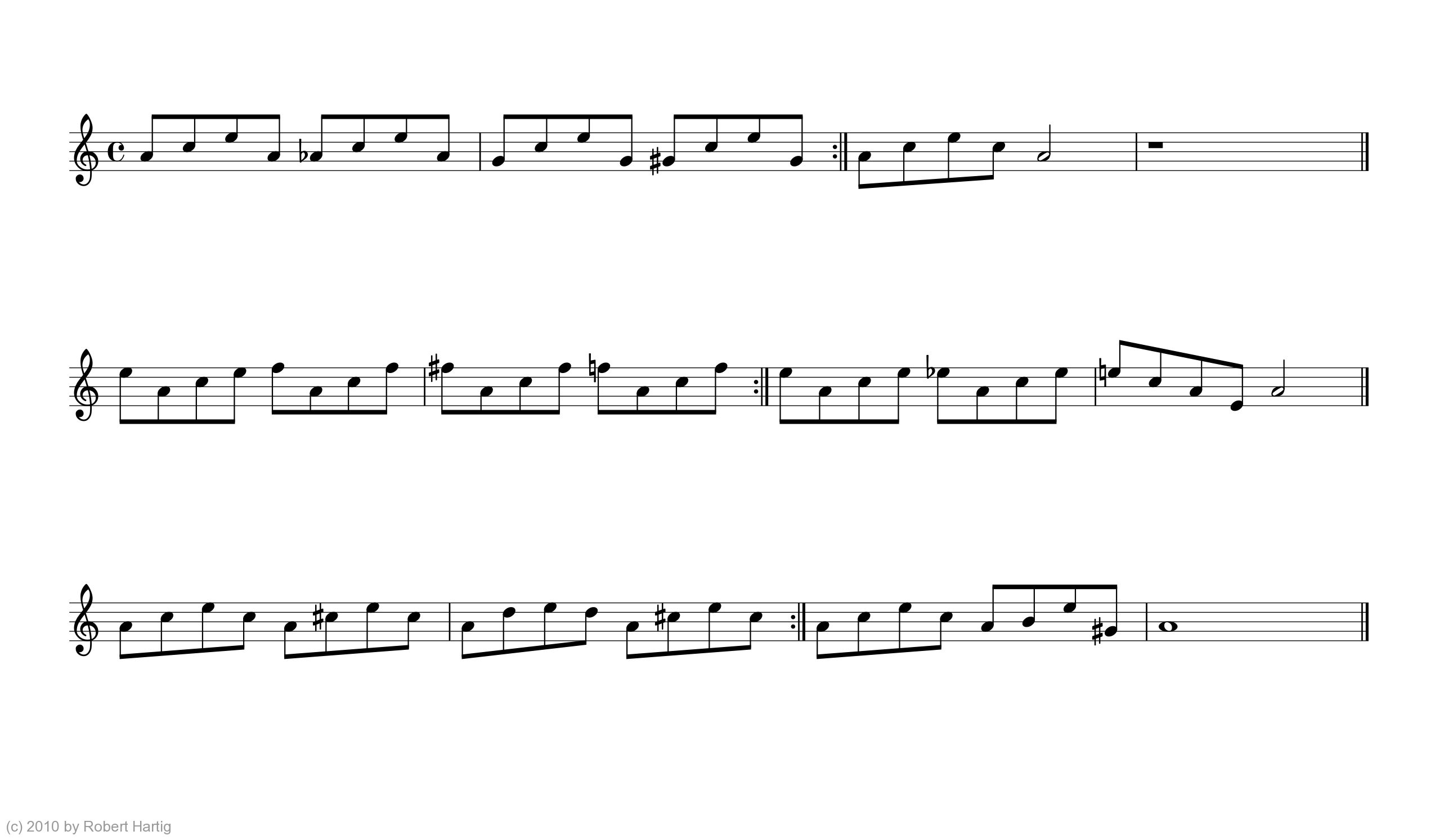
chromatic-lines-mscz-1The thumbnail to your cleft contains a couple of patterns I like to practice from time to time to limber up my ability to interpolate chromatic lines with common tones. I’ve also included a third exercise that I just thought of, and since I’ll be incorporating it into my saxophone practice sessions from now on, I figured I’d drop it into your lap as well. Click on the thumbnail to enlarge it.

The repeat signs don’t mean repeat just once; they mean repeat ad infinitum until the pattern is laying easily under your fingers. Then bump it up or down a half step and practice it in the new key. Repeat this process until you own the pattern in all twelve keys throughout the full range of your instrument.

While each pattern begins by outlining an A minor triad, it implies other harmonies as the chromatic line descends or ascends while the remaining tones remain static. I’ll leave it to you to figure out different practical applications.

You’ll find plenty more patterns, exercises, solo transcriptions, and articles of interest to jazz musicians on my jazz page.

Double Tonguing: It Doesn’t Come Easily, But It Does Come

Last November I posted an article on double tonguing on the saxophone, a technique I was just beginning to incorporate as a regular part of my practice sessions. Eight months have elapsed since then. I’d like to say that I’ve mastered double tonguing, but I’d be lying. I have, however, kept at it, and the gains, if slow, have nevertheless been significant.

This is a HARD technique to master! At least, it has been difficult for me. Maybe it has come easily to other saxophonists, but not to this one. By comparison, when I took up circular breathing years ago, I was quite comfortable with it within a few months. But double tonguing…well, the best thing I can do is to keep on keeping on with it, and to strive to apply it increasingly in my playing.

I have in fact gotten to the point where I’ve finally begun to use double tonguing when I’m playing out. It’s not a steady feature of my sax solos, just something that I experiment with.

But it’s in my practice sessions that I’ve been pushing myself, working on scales and licks using double tonguing. Does it sound polished? No. But it’s coming together, and at times it even sounds reasonably convincing.

As is true of any other musical challenge, repetition and perseverance are undoubtedly the key to mastering this technique. It’s a discipline, trying to get my tonguing to not only coincide with my fingerings, but also to make the results sound halfway musical rather than clunky. I seem to be able to handle about ten minutes of double tongue work, after which I move on. My patience is probably integrally tied to my tongue and embouchure’s endurance, and my philosophy is, work it and then leave it be.

At the time of this post, I’m capable of executing sixteenth notes at a tempo of around 135-140 mm. Not gracefully, to be sure, and not on the turn of a dime. I have to work into it. But that’s better than where I started.

Why am I even writing about this? Well, I’m not aware of anyone else who has actually chronicled their efforts to master this technique. If you’re working on it and it’s coming easily for you, then bully for you! But if you’re one who, like me, is finding double tonguing to be a real challenge to bring to a point of usefulness, then you might find it reassuring to know that you’re not the only one.  You might also take courage in hearing that improvements, while slow, do come.

Repeat Notes

Amid the fast flow of notes that so often characterizes a jazz solo, it’s good to add a little punctuation. Your listeners need it and so do you–a pause here, an accent there, something to break things up for the sake of creative interest. I probably should devote an entire article to the concept of space. In this post, however, I want to talk for a second about a more subtle form of musical punctuation: repeat notes.

I don’t know whether I’m using an actual technical term, but “repeat notes” is the handle I’m hanging on the concept I’m about to describe. It’s as simple a technique as you can imagine: you simply repeat a note in the midst of your flow of ideas. You may repeat it just once. You may repeat it several times for dramatic effect. You may choose to ghost the note or use an alternate fingering for effect. The point is, you’re momentarily bringing the jumble of tones to rest on a single pitch, and you’re working that pitch, spotlighting it, whether for a microsecond or for several bars.

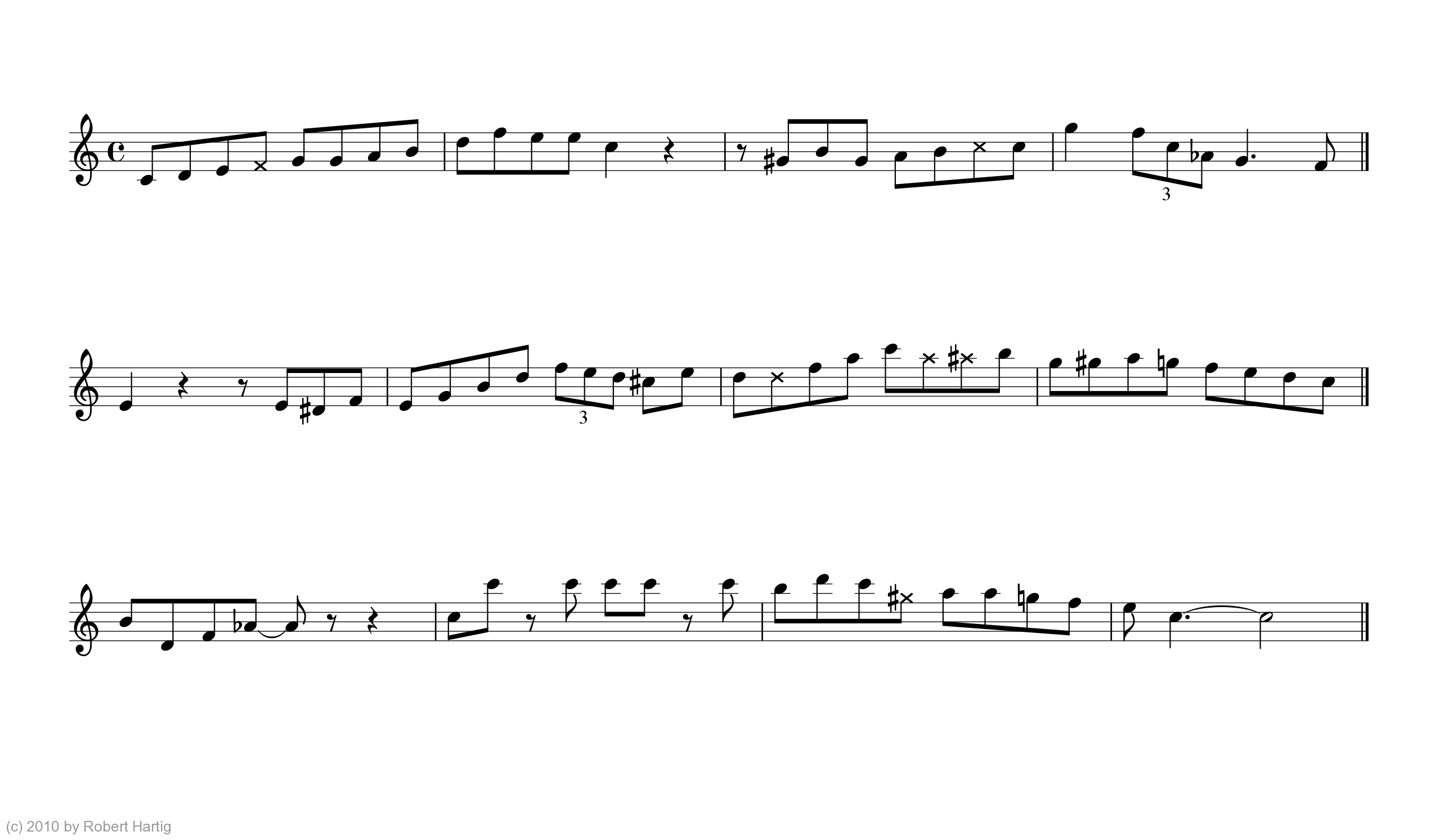
Like many musical concepts, this one is easier to illustrate than to explain. So click on the image and take a look at the exercise I’ve included. It’ll give you a start on repeat notes. From there, the possibilities are limited only by your imagination.

By the way, the note heads with X’s are ghost notes. For whatever reason–probably because we’re talking about punctuating solos–it seemed appropriate to include a few of them in this exercise along with the repeat notes.

Kirk Whalum on What To Practice When You’re Stuck

You are reading what will likely prove to be the shortest post I’ve ever written on this blog. There’s no need for me to write a lot. I’m just going to redirect you to Neal Battaglia’s Sax Station website, where I came across a terrific YouTube video by Kirk Whalum. If you’re looking for some new practice ideas with which to challenge yourself and improve your saxophone technique, you have got to check this out!

A Fun Gig at the Boatwerks

One of the things I enjoy most is playing jazz with friends whose musicianship I respect and whose company I enjoy. Interpersonal dynamics make such a difference. The format does too. My preferred habitat is the small combo, which offers a maximum amount of spontaneity and creative interplay, and allows me to stretch out as a sax soloist.

All of what I’ve just described was the setting today out on the patio at the Boatwerks in Holland, Michigan. The musicians were Paul Sherwood on drums, Wright McCargar on keyboards, and Dave DeVos on bass–guys I’ve played with quite a bit over the past few years and whose abilities I trust.

This gig was my introduction to the Boatwerks, and it was a delightful one. The Boatwerks is situated on the south side of the channel that connects Lake Macatawa to Lake Michigan, across from Holland State Park. It is a lovely setting and today’s audience was an appreciative one. The only improvement I could have asked for would have been to dial down the temperature and dewpoints by about 10 degrees. Unfortunately the weather doesn’t take requests, and me being a sweaty kinda guy, my face quickly began perspiring like a sprinkler system. Kiss any images of being a cool jazz musicianly type good-bye!

That was just a minor detraction, though. This was the kind of gig I love to do: three hours in a beautiful location outdoors on the waterfront on a pleasant summer afternoon. I had really been looking forward  to it, and I was pleased with how my chops rose to the occasion. They’ve been feeling great lately. The practice I’ve been doing in the keys of F# and Eb seems to be paying dividends all across the board.

Between Paul and me, we did a few vocal numbers as well as instrumentals. I love to sing, and while it has taken me time to muster up the confidence to do so, it turns out that I’ve got a pretty decent voice. It was nice to be able to sing “Days of Wine and Roses” and “My Funny Valentine” and then follow up the lyrics with a sax solo.

The Boatwerks is a great place and I hope we’ll get an opportunity to play there again soon.

What Is Jazz?

The headline for this post is a bit deceptive. I’m really not interested in offering one more definition of jazz, or of discussing elements such as swing, syncopation, improvisation, blue notes, and so on. All of that has been abundantly covered in a bazillion books on jazz history, jazz theory, and jazz musicians.

A better title, though a more confusing one at first glance, might be, “What ISN’T Jazz?” It’s a question I’ve contemplated off and on. In that respect, I guess I’m no different from a multitude of other jazz musicians who have pondered the same issue over the years and ventured their opinions. Often you don’t hear the question expressed as a question, but as a conviction delivered with some heat: “That isn’t jazz!”

Let me say up front that I consider the topic of what is and isn’t jazz to be pretty academic. I’m more fascinated by the fact that some people get so passionate about defending a sacred ideal, some essence of jazzness, than I am by the subject itself.

Yet I have to confess that I find the same attitude rearing up in me on occasion–times when it bothers me to hear the word “jazz” used to describe something I wouldn’t consider to be even close to jazz. Improvised music, quite possibly; jazz, no.

So what am I, an elitist? If I am, I’m certainly not hardcore about it. Frankly, the intensity and hair-splitting that I’ve witnessed over the jazz/not-jazz issue has struck me as ridiculous, not to mention pointless, since it’s one of those debates that will never be settled.

That being said, I think the word “jazz” does get used too freely at times.

Case in point: I’ve played in lots of church worship teams over the years. Most of them have involved a lot of white folks playing guitars. Nothing wrong with that, but I cringe whenever I hear someone say, “Let’s jazz it up.” It’s kind of like hearing a mariachi accordionist say, “Let’s rock and roll!” What does it mean to “jazz it up”? I’m not sure, but I can testify that the results I’ve witnessed have never resembled jazz. Musicians who rarely if ever listen to jazz, let alone practice it, aren’t going to just suddenly produce it like Bullwinkle pulling a rabbit out of the hat.

So here I am, caught between two extremes. On the one hand, I can be a jazz racist, aggressively and vehemently defending the purity of the form (according to my ideal of it) and getting my undies all in a bunch over musical miscegenation. On the other hand, I can adopt so inclusive a perspective that the word “jazz” can mean just about anything under the sun, and consequently mean nothing at all.

It seems like there ought to be a less polarized option. Maybe there is. If so, finding it is probably best begun by defusing some of the negativity inherent to this topic. Coming from a jazz purist, the words, “That’s not jazz!” come across as an indictment. Upon hearing Weather Report in concert, Ben Webster is reported to have flown into one of his famous rages, walked onstage, and overturned Joe Zawinul’s electric piano. Such behavior is an extreme, but it captures the attitude of those who are so entrenched in an ideal that they judge and attack whatever doesn’t match up.

It doesn’t have to be that way. It shouldn’t be that way. How can any two people have a decent, productive discussion with that kind of Hatfield-McCoy mentality?

So let me be plain: When I say that something isn’t jazz, I’m not saying it’s bad music. Neither am I saying it’s good music. I’m not making value judgments at all. I’m just saying that I don’t consider the music I’m hearing to fit under the jazz umbrella. That’s all. Why try to make something be what it isn’t? Why not just let it be what it is and recognize that, if it’s done well, it has its own legitimacy?

Distinguishing between jazz and non-jazz involves at least a certain amount of subjectivity. That’s certainly true of me as I share a few of my own thoughts on the topic. With that acknowledgment, I’d like to address what I think are a few misconceptions about jazz:

* IMPROVISATION. Some people use the word “jazz” to describe extemporaneous playing. But while improvisation is a crucial hallmark of jazz, it’s not an exclusive one. Rock musicians improvise. Bluegrass musicians improvise. Classical musicians improvise. Beethoven wove melodies and harmonies out of thin air long before Louis Armstrong and Sidney Bechet ever played a blue note.

* THE BLUES SCALE. Playing the blues scale is not the same thing as playing jazz. Playing the blues scale is playing the blues scale. The blues scale and blue notes are components of a good jazz vocabulary, but they’re only a part of it, and, as with improvisation, they’re not exclusive to jazz. Rock guitarists use the blues scale extensively.

* HARMONY. The chords associated with jazz are usually quite colorful due to the use of upper tones and creative voicings. Ninths, elevenths, and thirteenths are normative, along with various chord alterations. In jazz, a V7 chord is rarely just a V7 chord; keyboard players and guitarists add upper extensions as a matter of course. While simple triads are used from time to time, jazz is not a triadic idiom. It is vertically complex, giving rise to sophisticated voice leadings.

That’s one big reason why non-jazz musicians who decide they’re going to “jazz up” a piece of music usually wind up sounding hokey rather than hip. Conceptually, they don’t have the harmonic (and rhythmic) know-how to pull it off. If that’s you, don’t let me discourage you from making the attempt. Rather let me encourage you, while you’re in the process, to learn a bit about jazz harmony and voice leading. There’s plenty of knowledge that’s available on the topic both in print and online. This Wikipedia article is a good place to start.

* HORNS. Adding a sax or trumpet to a tune, or even using that tune to showcase a horn player, does not automatically result in jazz.

* TUNES. Jazz is not a matter of the song that’s played but of how it’s interpreted. Playing “In the Mood” or “Take the A Train” doesn’t mean that a band is playing jazz. It means they’re playing melodies and chord changes that were written in the Big Band Era, but stylistically, the way a tune is handled might be closer to a polka than to jazz.

I could easily add to the above list, but what I’ve written is enough to get the idea across. Again, though, the topic of what is and isn’t jazz is prone to subjectivity. It’s safe to say that at some point, a piece of music–or rather, how that piece gets interpreted–crosses a jazz/non-jazz line. But different people, including and especially jazz musicians, will have different ideas about where that line lies.

That’s one reason why I don’t work myself into a lather over whether, for example, the stuff that Kenny G. puts out is jazz. Does it really matter? Kenny’s music may not be my personal cup of tea, but I have a hunch that if you hired the guy for a standards gig, he’d make it through the evening just fine. As it stands, what he does for a living beats delivering pizzas.

As for the debate over what is and isn’t jazz, a more fruitful question to ask is, do you like what you hear? Do you like what you’re playing? Then enjoy it and don’t worry too much about defining it. It may or may not be jazz, but good music is good music no matter what you call it.

Patterns on Diatonic Fourths

In a recent post, I wrote about how reacquainting myself with diatonic fourths was helping me to get inside keys in a different way, breaking me away from the usual tertian harmony and giving me a more open sound in my sax improvisations.

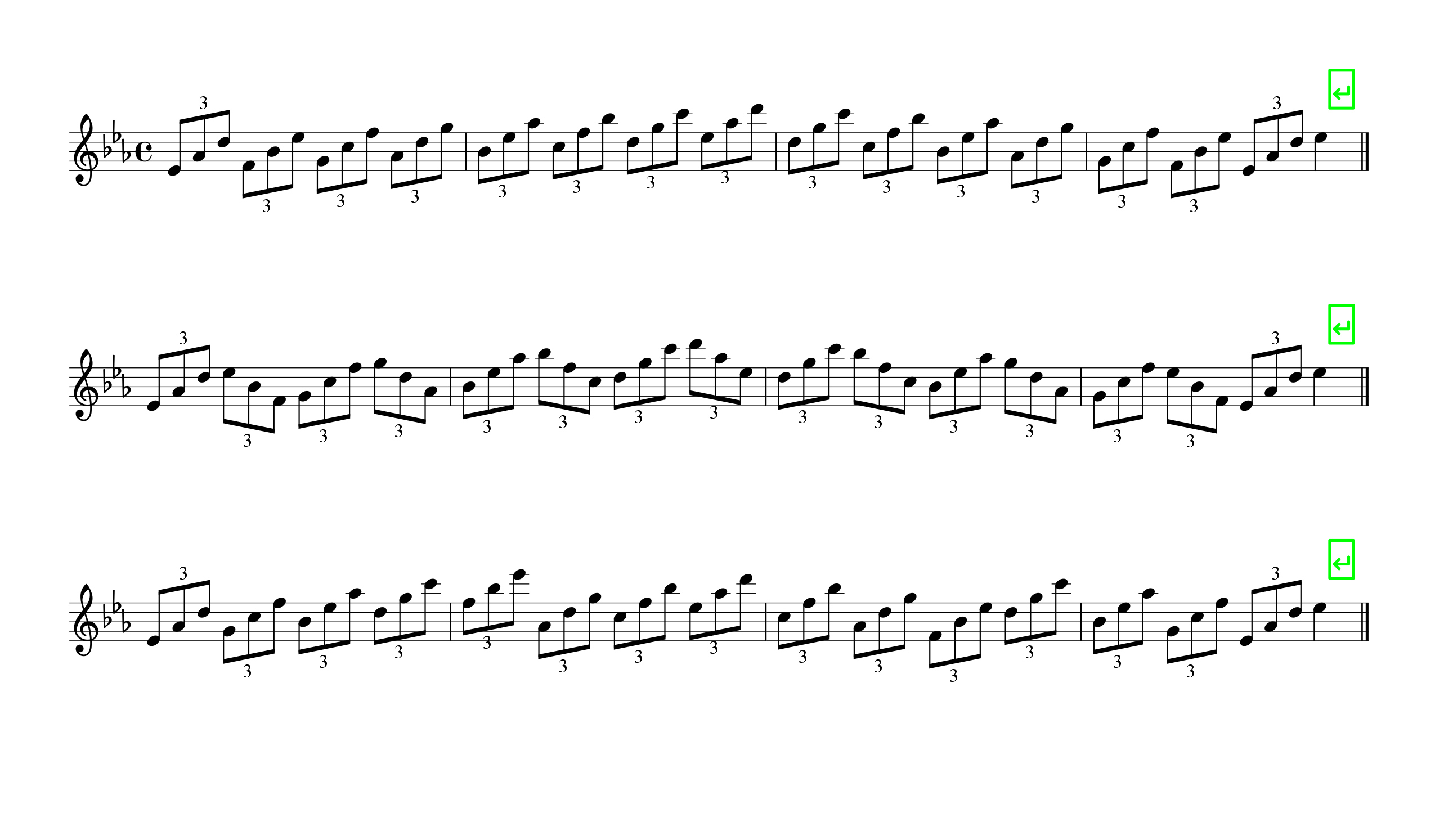
fourth-patterns-in-ebI thought I’d share with you a few of the exercises I’m using. Click on the thumbnail to enlarge it. As always, take each pattern up and down the full range of your instrument.

This is my first use of scoring software in a blog post. I’ve only recently familiarized myself with MuseScore and I still have plenty to learn about it. (The latest upgrade has introduced some significant improvements since I first reviewed this great open-source music transcription program a couple months ago.) It took me a little casting about to convert the music file to a format that works in WordPress, and the example here isn’t perfect. Kindly bear with the little green boxes at the ends of the staves and with the vagueness of some of the bar lines. I expect I’ll figure out how to get everything picture-perfect in the future, but for now, I’ve spent enough time dithering about. Now I’m putting the results out on the table, imperfect but serviceable.

If you’ve never worked with fourths before, get ready for a bit of a challenge. Fourths don’t lay under the fingers as easily as thirds. But that’s part of their merit: the fact that they break you away from easy formulae, making you think differently and programming your fingers with a new kind of muscle memory.

Stick with it and have fun!

Update on “The Giant Steps Scratch Pad”

“If something’s worth doing, then it’s worth doing right.”

Hear, hear! I agree with that old axiom. But doing something right often takes longer than we expected when we first got our project underway. In the case of “The Giant Steps Scratch Pad”–my book of licks and patterns for Coltrane changes–it has been taking considerably longer. So I thought I’d share another update for those of you who are interested. Here’s the status of the project and my plans for it:

* After many a headache and blind alley, the music and text files for the Eb edition are now merged into a single document and the interior of the book is ready to go.

* Registration for copyright has been filed at the U. S. Copyright Office.

* Rather than use one of the templates at Lulu.com, I’ve decided to have the cover professionally done by a friend of mine who specializes in graphic design for book and CD covers. I meet with him next week. This should be the last big task (knock on wood).

* Once the cover is completed, the Eb edition will be ready for publication through Lulu.com. At that point, I’ll just need to set up a store account and make the book available.

* Bb, C, and bass clef editions will follow once the Eb edition is published. So tenor sax, trumpet, piano, flute, trombone, and bass players, never fear! I’ve definitely got you on the radar. It just makes sense, from my standpoint, to publish the material as I initially wrote it first, so I can at least get alto sax player like me underway.

That’s it for now. When there’s more to tell, I’ll let you know, so stay dialed in.