Practical Tips for Playing the Sax in Church

It has been a couple years since I’ve played my saxophone in a worship team. At some point I will probably participate again, but after 30 years as a disciple of Jesus, during most of which I’ve been involved in church music ministries, I’m not in a rush. Music is a wonderful gift, but in church it can also be an overwhelming one, a powerful categorizing force that can overshadow other aspects of who a musician is as a complete person. So the hiatus has, for me, been necessary and beneficial.

That’s where I’m at, but for many of you, your concern is more pragmatic. You haven’t spent three decades playing in church. You’re just getting started, and what you’d really like to know is how to fit in as a saxophonist–or a trumpet player, or a flutist, or an ocarina player, or whatever–with the rest of your church’s worship team. How do you play your part successfully?

That’s a straightforward question, and I’m happy to respond with a few simple, to-the-point suggestions.

◊ Determine what keys your worship band most often plays in. Black gospel music is typically organ- and keyboard-driven and is likely to use flat keys such as Bb, F, and Eb major. Contemporary music in white churches almost always revolves around guitar, which puts the emphasis on sharp keys such as E, A, D, and G.

◊ As would be true in any setting, whether in church or in a club, know your transposition. If you’re a tenor sax or trumpet player, the key you play in is up a major second from the piano and guitar. If  you’re an alto sax player like me, you’ll be down a minor third. If you play the flute or trombone, you don’t need to transpose to a different key.

◊ Learn pentatonic scales in the most commonly used keys. Most church music is harmonically simple and largely diatonic, and you can cover many a song using a single pentatonic. It’s hard to hit a wrong note playing a pentatonic scale! Of course, you’ll want to add more colors to your palette as you gain familiarity with the music, but pentatonics make a great foundation. The melody for “Amazing Grace” is written entirely from a single pentatonic scale.

◊ Similar to the previous point, learn the major scales of the most commonly used keys. One caveat: Watch how you handle the fourth and seventh scale degrees, as they have the potential to clash with certain chords. That’s one reason why you need to…

◊ Listen! Get a feel for which notes sound good with the chords of a particular tune in different places. In particular, listen to the vocalist and don’t step on his or her toes. Fill in the cracks between lyric phrases, and lay back more when the vocalist is singing. Listen also for what other melodic instruments such as the guitar and keyboard are doing so you can coordinate with them. Overall, be sensitive to the moods of the music and where it’s going.

◊ Don’t be afraid to play! How else are you going to learn? Make your mistakes–that’s part of paying your musical dues. Trust me, most people will never notice the clinkers, and the few who do won’t care.

◊ Strive not to overplay. Unless you’ve been given a solo spot where you get to strut your stuff, keep things simple. If you find yourself playing busily like a beaver in every chorus of every song, cool your jets and give another lead instrument a chance to provide some fills. Consider playing long, held-out chord tones. And remember, often the most effective thing you can play is nothing at all. Drop out for a chorus and notice how subtracting your instrument adds to the music by modifying its texture; and also notice how reentering in the next chorus creates an energy that wouldn’t have existed if you’d been playing all the way through. Contrast is beautiful!

◊ Don’t just learn the tunes–learn your instrument! Practice scales, arpeggios, licks, and patterns. Do the hard work with a spirit of excellence when no one is listening–“heartily, as unto the Lord”–and you’ll be increasingly pleased with the results when you’re playing with the band.

◊ Develop your ears and your instincts as an improviser. You can’t count on charts to get you through. Unless your team uses professional arrangements, chances are good that the way you practice a tune during Wednesday rehearsal isn’t going to be duplicated exactly on Sunday. You’ve got to be able to flex instantly with shifts in direction and even mistakes by the team leader or vocalist. That means you’ve got to–did I already mention this?–listen!

◊ Learn the melody and the form of a song. Doing so will give you a frame of reference so that you’ll never get lost in that tune. You may get temporarily displaced, but you’ll always be able to find your way back to where the rest of the band is without having to hunt it down on a fake sheet. Best of all, knowing the tune will free you to soar within the framework of the music, allowing you to focus on creativity and musicality rather than following a chart.

◊ Be careful about playing in the same range as the vocalist. I’m not saying don’t do it; I’m saying, exercise care and good taste. In particular, try to avoid hitting unison notes with the singer except as a calculated effect. Consider playing in the octave below the vocal range.

◊ Don’t feel you’ve got to play in every song. Not all music was made for the saxophone. For instance, if the band is playing a tune that emphasizes a fast-paced, heavy metal guitar sound, then you might want to sit that one out. Or if a tune is simply too complex for your level of development, to the point where you don’t feel comfortable playing it, then step off to the side and let the rest of the band take it. Just because your instrument can be used doesn’t mean it always should be. It’s a voice; add it or subtract it in a way that best serves the music.

I could offer still more suggestions, and maybe other experienced players will lean in with advice of their own, but this is plenty ’nuff to get you going. Note that I’ve said nothing about the spiritual side of playing in a worship team. Important as that is, it’s not the focus of this post. My intention here has been to give you some nuts-and-bolts input that you can start applying right away. I hope you’ll find it both helpful and encouraging.

If you enjoyed this post, then check out my jazz page, where you’ll find more useful and insightful articles, exercises, and solo transcriptions.
A Diminished Whole Tone Lick

The diminished whole tone scale (aka super locrian scale, altered scale, altered dominant scale, Pomeroy scale) is nothing if not colorful. A mode of the ascending melodic minor scale built on that scale’s seventh degree, the diminished whole tone scale encompasses virtually every alteration to a dominant chord that you can think of: #5, b9, #9, and #11. It’s commonly used over dominant chords of various alterations, and is ideally suited to the V+7#9.

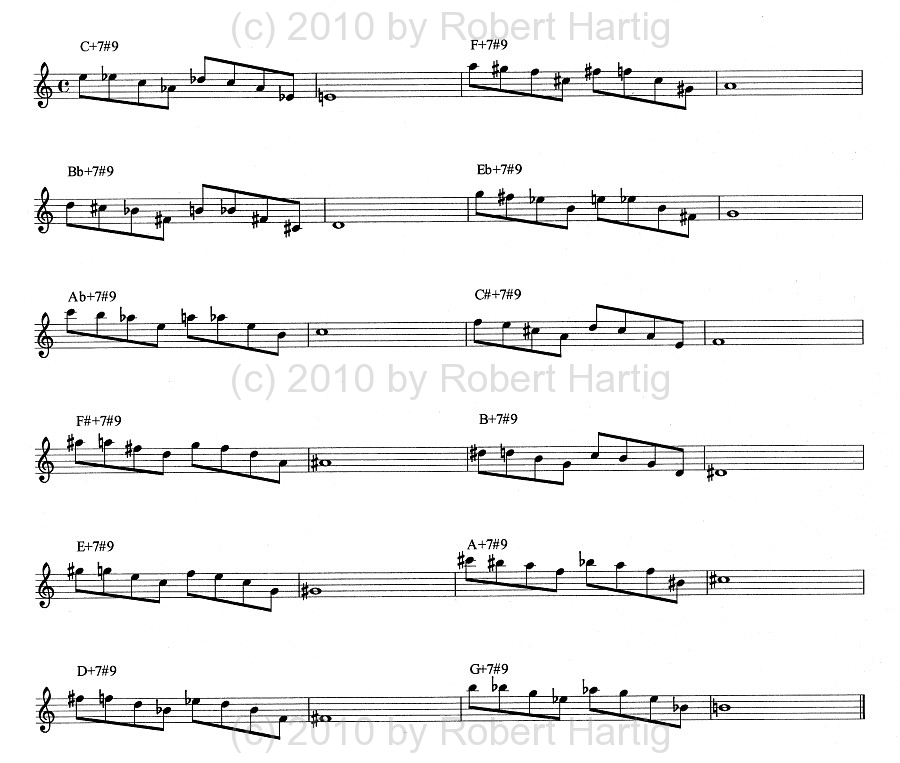
The name “diminished whole tone” refers to the scale’s two tetrachords. The bottom tetrachord derives from a half-whole diminished scale, and the top tetrachord suggests a whole tone scale. For example, connecting the tetrachord B, C, D, and Eb with the tetrachord F, G, A, and B will give you a B diminished whole tone scale: B, C, D, Eb, F, G, A, B. (In actual use, you’d want to think of the Eb enharmonically as a D#, the major third of a B+7#9 chord).

diminished-whole-tone-exercise_0To your right is an exercise that will take you around the cycle of fifths with one of my favorite diminished whole tone licks. (Click on the thumbnail to enlarge it.) I like the lick for three reasons. It starts and finishes on the highly consonant major third of the altered dominant chord, but in between it spotlights the altered tones of the chord (#5, b9, #9). It emphasizes the half-step relationship between the third and #9, and between the b9 and the chord root. And it outlines the major triad built on the raised fifth of the altered dominant–e.g. the #5 of a D+7#9, A# (Bb enharmonically) gives rise to a Bb major triad.

Have fun with the exercise. If you’re not familiar with the diminished whole tone sound, it may take a while to get it into your ear, but you’ll be glad you did.

Look for more exercises, helpful articles, and solo transcriptions on my jazz page.

Playing with Another Horn Person

Last night I moseyed over to Noto’s in Cascade and sat in with Kathy Lamar, Bob VanStee, and Bobby Thompson. Kathy is a fantastic vocalist, and with Bob on keyboards and Bobby on drums, she has a rhythm accompaniment with abilities equal to her own. In recent months I’ve popped in a few times and joined in, and I’ve always enjoyed myself, but never more than last night.

It had been a while since I’d made it out to Noto’s, and I thought I’d call my friend Dave DeVos and see if he wanted to join me out there. He did, and when I walked through the door he was already there, setting up his electric bass. Even better, Dan Jacobs was there with his fluegelhorn, which created a format I’m particularly fond of.

This was my first acquaintance with Dan, but I’d heard of him and had touched base with him on Facebook. Dan is an accomplished player, and sharing the stage with someone of his caliber is a joy. I love to hear what another capable instrumentalist is doing; that fresh influx of inventiveness and technique tweaks my creativity, suggests new ideas to try, and overall kicks me in the butt. Best of all is the interpersonal exchange, the trading fours and switching back and forth between melody and improvised counterpoints, that kind of thing.

As an alto saxophonist, I think I like sharing the stage with a trumpet/fluegelhorn player even more than with a tenor sax player. The variety in sound and approach is greater, and even visually the contrast is striking and, to me, more interesting. Of course, there are some challenges. At least I find there to be. The main one is to play with that other horn person without overplaying. Often enough, I’ll just bow out, and I noticed that Dan did the same last night. Actually, I find that approach enjoyable. It’s nice to just put down one’s horn and enjoy what the other guy is doing. We usually learn more by listening than by talking, and that maxim can certainly be applied to jazz, provided the person we’re listening to has something to say. Dan does, and it was really nice to hear him last night and get a chance to make a little music with him.

Dan, if you happen to read this, you’re great! Thanks for the melodies. I look forward to next time.

Angularity Exercises

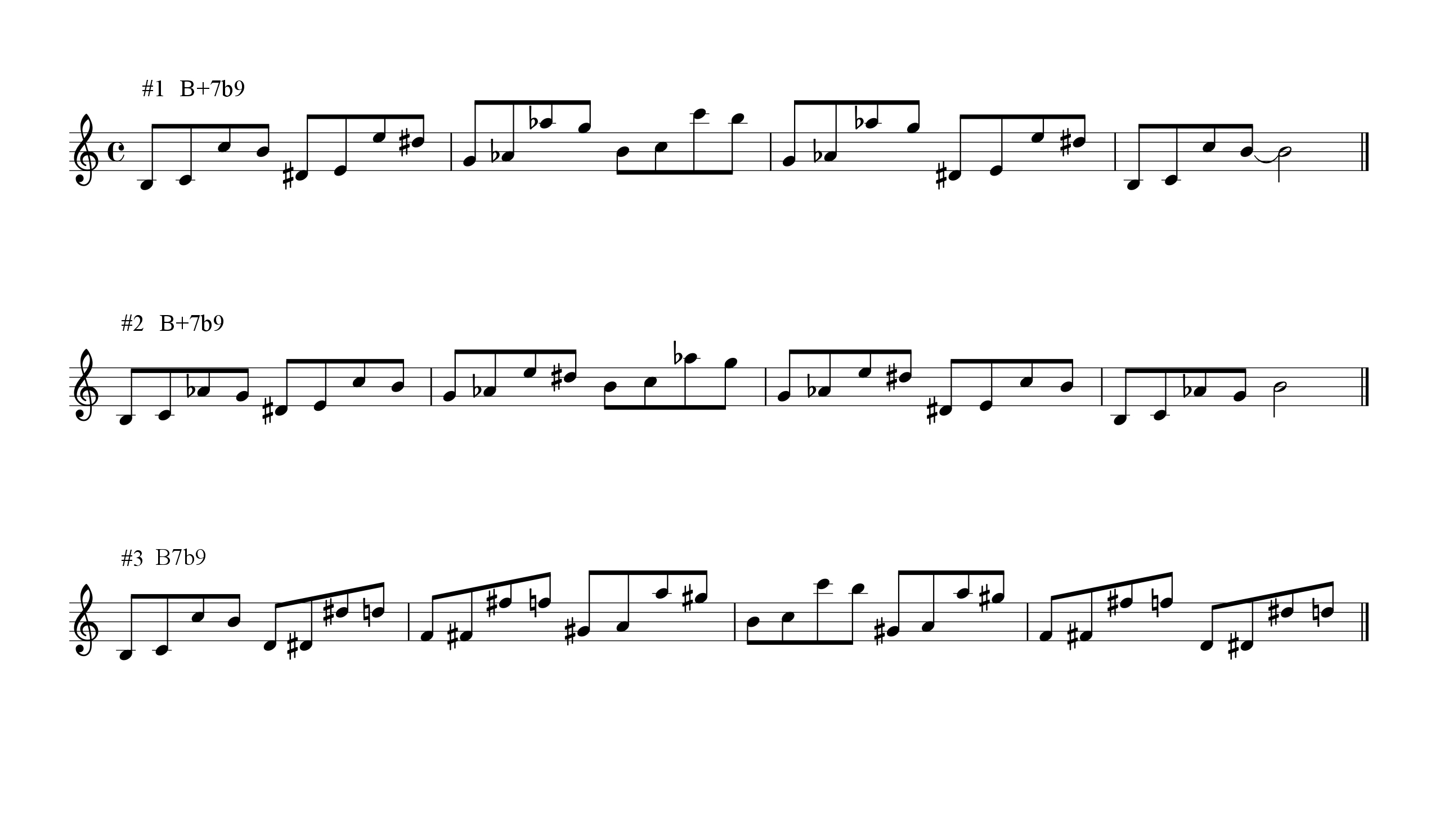
angularity-exercise-1-msczMuch of my playing is pretty boppish, and I’ve wanted to break it up with some different flavors and larger intervals. Lately I’ve been toying with some exercises on angularity involving couplets applied to the augmented scale, and I thought I’d share the wealth. Click on the thumbnail to the right to enlarge it.

The first two exercises are ones I’ve been woodshedding for about a week. They go well, as indicated, with altered dominant chords, but of course they work in any situation where you’d use an augmented scale. While the written exercises specify a B+7b9 chord, you can also use it with an Eb+7b9 and a G+7b9.

The third exercise outlines a half-whole diminished scale and will function as such. I’ve paired it with a B7b9, but it also works with a D7b9, and F7b9, and an Ab7b9.

While it probably goes without saying, play each exercise through the entire range of your instrument and through all twelve keys (“keys” being used here for lack of a better word). Since both the augmented and diminished scales are symmetrical scales, much of your work is done for you. You need learn only four versions of the first two exercises and three versions of the third one.

Happy woodshedding! And if you find these exercises helpful, check out the rest of the offerings on my jazz page.

A Table of Non-Diatonic Tones and Their Common Uses

A while back I shared some ideas on how jazz improvisers can make optimal use of the added flat sixth tone of the major bebop scale. I pointed out that, besides its obvious use as a passing tone that evens out the scale and allows players to move seamlessly from root to octave (or third to third, or fifth to fifth, etc.), the flat sixth also functions readily in a number of harmonic contexts common in jazz.

Yet, useful as the flat sixth (or sharp five) of the major bebop scale can be, it is nevertheless only one of five non-diatonic tones that occur in a major key. In addition, the tonic, supertonic, subdominant, and submediant scale degrees can all be similarly raised a half-step and used in a variety of harmonic applications.

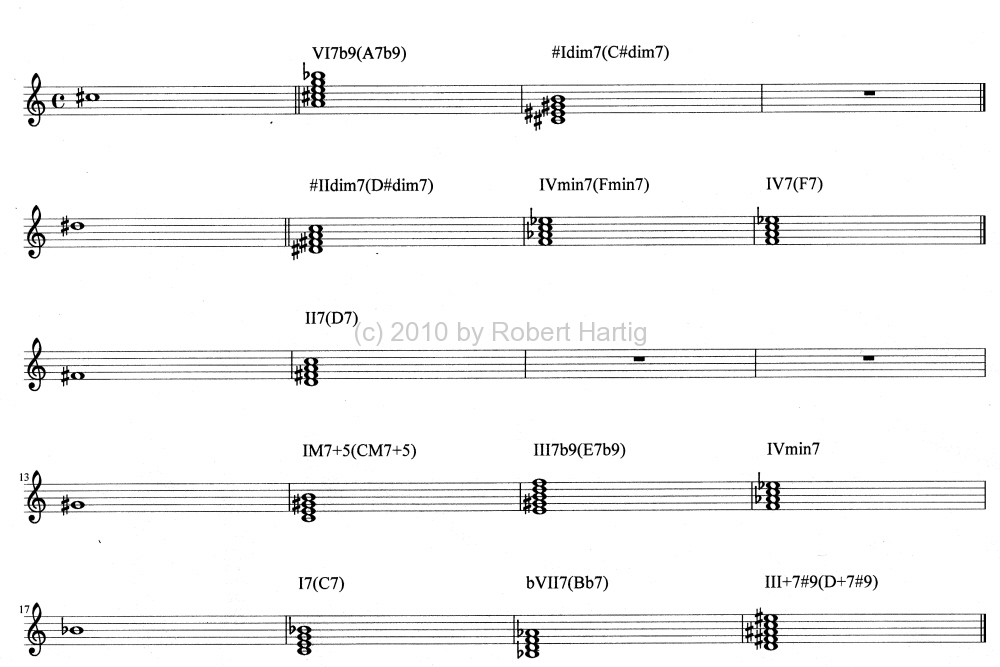
borrowed-tone-applications-002The image to your right  is a table that shows some common uses for each non-diatonic tone in the major scale. (Click on the thumbnail to enlarge it.) The table is by no means exhaustive; it’s just meant to give you a handy reference to harmonic situations you’re likely to encounter as an improviser.

The table is based on the C major scale. In that key, the five non-diatonic tones are C#, D#, F#, G#, and A#.  From top to bottom, the staves begin with a given tone, then show how that tone fits into various chords. The chords are numbered according to their functions and also named (eg. IVmin7, Fmin7). Depending on their application, I may use the enharmonic equivalents of some tones. For instance, instead of A#, I’ve chosen to show Bb, which makes better sense in actual usage.

In stave 1, the VI7b9 and #Idim7 are interchangeable, leading almost inevitably to the IIm7 chord. In the next stave down, the #IIdim7 wants to resolve to the mediant. By adding the scale’s leading tone as the chord root, you wind up with a B7b9, which is the V7 of III. Glancing over the rest of the table, you’ll notice numerous other uses in secondary dominant harmony.

I’m not going to go into detailed explications of every chord, as–assuming that you know your basic jazz theory–the uses of the different non-diatonic tones should be self-evident. Again, the table is not definitive. It’s intended simply to give you a handy reference that can heighten your awareness and help you make more deliberate use of all twelve tones in the chromatic scale. You’re bound to think of other applications not shown in the table.

For practice purposes, you could try working with a single tone. Incorporate it into a major scale to create an eight note scale. Then work out various chordal possibilities that utilize the tone, always keeping in mind the parent major key you’re working in as a frame of reference.

If you’ve found this article useful, make sure you check out the many other articles, exercises, and solo transcriptions on my jazz page. And, as always, practice hard and with focus–and have fun!

Hard-to-Read Music Exercises on Stormhorn: Follow-Up

Have you been having a hard time reading the exercises I’ve provided in my more recent music instructional posts–the ones in which I’ve used transcription software rather than scanned, handwritten material? Some people–including me–have had problems, though not everyone. It seems that some of the lines on the music staves appear faint to nonexistent in places, making it hard to tell the identity of notes.

From what I’m able to tell so far, the issue appears to be part browser-related and part a matter of scale, requiring that the image be adequately enlarged.

Browser: Firefox is my preferred browser. Unfortunately this is the browser on which the problem crops up for me. However, once I click on the image and then zoom in a step or two, everything clears up nicely.

Internet Explorer: When I click on the image, I just don’t have the same problem as with Firefox. The image is clear.

In a nutshell…

If you’re having a hard time reading the exercises, try (a) switching browsers; (b) magnifying the image; or (c) both.

I have an idea up my sleeve that may make everyone happy if it works. I’m going to try it next time I include written exercises in a music post. That shouldn’t be too far down the road now, as it has been a while since I’ve shared such a post. So stay tuned.

Until then, I’ll value your input on the clarity of the exercises. If you’ve had trouble, let me know whether the above suggestions fix things for you. And if you’ve had no problems, let me know that as well.

Thanks!

Bob

Hard-to-Read Exercises on Stormhorn Music Posts

One of my readers has commented that he had difficulty reading an exercise in one of my music posts. I’m guessing that he’s not the only who’s had that problem, since I’ve encountered it myself.

For some reason, while the original image files for my music examples are quite legible, something happens when I upload them to WordPress. The result is that the staves have been reproducing unevenly, making it difficult in places to determine the placement of notes.

Each new instructional post has sent me searching for a fix. So far I’ve been unsuccessful, and I’ve depended on you, my readers, to fill in the blanks, trusting you’d find that the benefits of the exercises outweighed the inconvenience. However, this approach obviously is just a stop-gap, not an acceptable solution.

I’m not sure what the cure is–whether the problem lies in the transcription software I’m using, in WordPress, or in my own lack of technological expertise. Other sites don’t have the same trouble, so I’ve got to believe there’s a simple, viable solution. Until I find it, I thought I’d let you know that I’m aware of the problem, it bothers me at least as much as it does you, and I’m looking for a way to solve it. Meanwhile, thanks for your forbearance!

All the best,

Bob

More on Saxophone Double-Tonguing

Lately, during the parts of my practice sessions that I devote to double-tonguing, I’ve noticed a change. The technique is becoming smoother, the notes more connected and better sounding. I’m now double-tonguing scales, licks, and patterns in sixteenth notes with increasing comfort and accuracy throughout the full range of my saxophone at a tempo up to 140 mm. While I may not make any great gains in speed anytime soon, I can definitely tell the difference in accuracy and quality of sound since my last post on double-tonguing.

What is making the difference? Several things, I think.

* A responsive reed. I’ve found that having the right reed makes a big difference in how well I’m able to execute double-tonguing. A reed that combines instant responsiveness with just enough resistance to be lively–the kind of crisp, richly resonant reed that is a joy to play–is also the ideal reed for double-tonguing. Reeds that are too hard get balky in double-tonguing, and reeds that are too soft have their intonation issues amplified.

For most playing demands, I can get by with a fairly broad spectrum of reeds, but double-tonguing seems to be a finickier technique in that regard.

* Reversing the double-tongue syllable order. Instead of playing “da-ga-da-ga,” I’ll do some exercises using single tones as well as scales starting with the glottal articulation first, thus: “ga-da-ga-da.” I also practice articulation using my glottis only: “ga-ga-ga-ga.” My aim is to develop the response in the back of my throat.

This approach really helps! Try it yourself. Warm up with a minute or two of these glottal exercises, then shift to the standard double-tonguing pattern, “da-ga-da-ga,” and see whether you don’t notice an improvement.

* As an adjunct to the preceding point, practice all of the above articulations without your horn. See how fast you can do them, and pay attention to any subtle changes you’re making as you build up speed. I use this “dry firing” approach when I’m driving in my car. What better way to put my drive time to good use?

* Practice. That’s right–practice. There’s no magical secret for learning double-tonguing. One simply has to stick with it. As I do so, I’m finding that my embouchure, oral chamber, tongue, and air stream are intuitively making the adjustments they need to make. Also, as I work at connecting double-tonguing with scales and licks, my fingering technique is becoming cleaner. It has to in order to link up precisely with the rapid articulation of double-tonguing.

I’m at a point now where this technique is becoming a functional part of my playing. Not that I use it often, but I am using it more frequently in a variety of applications with increasing success.

An article by the Peabody Institute states that “a fast single tongue can articulate sixteenth notes at quarter note equals 152. Some people can even reach speeds of up to 168 for brief periods. The double tongue can achieve speeds as high as of 232!”

Hmmm…okay. My own single-tonguing is by no means up to to the speed of these racehorses. Of course, I haven’t really worked at it, but according to the article, some saxophonists can single-tongue faster than I can presently double-tongue. That’s fine with me. I’m not out to win any speed contests, just grow as a player. My guess is that most saxophonists who read this article and my other articles on double-tonguing are more daunted by than adept at the technique, so I figured I would share my personal journey as I took on the challenge of learning it.

The Peabody article also says, “The double tonguing technique is a natural technique that is actually simple to learn and master. A few weeks of hard work can produce remarkable results.”

That has not been my experience. Of course, I’m not a Peabody student under the tutelage of a master saxophone professor. I’m a self-didact guided by no instructor other than my own instincts. I will say that at the very beginning, double-tonguing indeed came to me with ridiculous ease, and right out of the gate I was executing sixteenth notes like machine gun fire. Then I put the horn in my mouth, and suddenly it all fell apart. I was left with the realization that the technique was going to take work, patience, and dogged persistence.

Today, not quite a year later, I can tell you that the persistence pays off. Whether I’ll ever be able to double-tongue sixteenth notes at 232 mm, or even 200, only time will tell. What’s certain for now is that this technique which can seem so formidable and frustrating at the beginning is one that a saxophonist can actually acquire and use with increasing mastery. If I can pull it off, so can you. You just have to make up your mind that you’re going to do it–and then follow through with patience and consistency.

Now Available: Bass Clef Edition of “The Giant Steps Scratch Pad”

A few minutes ago I completed the last of the downloads, filled in the information fields, and then, with one final click of the mouse, published the bass clef edition of “The Giant Steps Scratch Pad.”

At last! I can finally say that I’ve accomplished the goals I set for this book as it evolved from my initial concept to something considerably more ambitious. The “Scratch Pad” is now available in all four editions: C, Bb, Eb, and bass clef.

So, trombonists, bass players, tuba players, and–well, have I missed anyone?–whoever else lives and moves in the bass clef universe, here is the practice resource for Coltrane changes that you’ve been hoping for, pining for, craving with all the intensity of your bass clef hearts. All kidding aside, if you’re at a stage of development on your instrument where you want to tackle the challenge of “Giant Steps,” this book is for you. It’s made for the woodshed and will help you build formidable chops for John Coltrane’s rite-of-passage tune.

Instant PDF download, $9.50
C edition Add to Cart
Bb edition Add to Cart
Eb edition Add to Cart
Bass clef edition Add to Cart
View Cart

Print editions–retail quality with full-color cover, $10.95 plus shipping: order here.

Voice Leading for the Giant Steps Cycle

Both in print and on the Internet, there’s no paucity of theoretical material available when it comes to “Giant Steps” and Coltrane changes. Of course, theoretical knowledge can’t take the place of time in the woodshed hashing out the changes on your instrument. But it can help you make some sense of what you’re practicing by revealing the order in what can at first seem like an odd, rambling array of chords. Once you understand some of the voice leading in “Giant Steps,” you’ll be able to pinpoint certain guide tones and use them effectively in your solos.

This post is by no means intended to offer an in-depth explication of “Giant Steps” theory. All I’m going to do is call your attention to how a few select tones proceed, so you can be mindful of them for the reason I’ve just stated. Let’s begin by naming the changes to the first four bars of section A in “Giant Steps.” In concert pitch, they are: Bmaj7 D7 / Gmaj7 Bb7 / Ebmaj7 / A-7 D7.

The second four bars repeats that chord progression a major third lower, thus: GMaj7 Bb7 / Ebmaj7 F#7 / Bmaj7 / F-7 Bb7.

If you delete the last two bars in each four-bar phrase and crunch together the remaining chords, you get the following sequence: Bmaj7 D7 / Gmaj7 Bb7 / Ebmaj7 F#7. This is the essential Giant Steps cycle. As you can see, once you reach the end of the cycle it repeats itself as the F#7 resolves downward by a fifth to the Bmaj7.

So far, so good. Now let’s see what happens when we start moving some basic chord tones. We’ll start with the root of the Bmaj7 chord. If you move it down by a whole step, you wind up on the note A, which functions as the fifth of the next chord, the D7. Move A down another whole step and you land on the root of  Gmaj7. Continuing down by whole steps in this manner–in other words, moving down the B whole tone scale–will move you from root to fifth to root to fifth through the entire Giant Steps cycle.

You can also apply the same down-by-major-second movement starting on the fifth of the Bmaj7, which is F#. In this case, the fifth moves down a whole step to E, which functions as the ninth of the D7 chord. (You could also look at it as the fifth of an A minor chord that serves as the ii/V7 to the D7.) This note in turn moves downward to the fifth of the Gmaj7. Again you’re descending through a whole tone scale, this one beginning on the fifth of the Bmaj7.

So if you want a handy memory aid to help you organize your guide tones in the Giant Steps cycle, simply think of two whole tone scales (using half notes to match the harmonic rhythm), one descending from the root and the other from the fifth of the Bmaj7 chord.

When you spotlight the third of the major seventh chords, things get more interesting. The third of the Bmaj7 is D#. Moving down a half step lands you on the note D, which is the root of the D7. To get from there to the third of the next chord, Gmaj7, you have to jump down a minor third. When you extend this downward movement of half step/minor third throughout the entire cycle, you wind up with an augmented scale.

You also get an augmented scale when you use the same movement starting on the seventh of the Bmaj7 chord, thus: A#, A / F#, F / D, C#.

To recap:

* For voice leading from the root and fifth of the major chords in “Giant Steps,” consider using, respectively, the B and F# whole tone scales.

* For voice leading from the third and seventh, use the D# and A# descending augmented scales.

I hope these concepts will help you see the symmetry in Coltrane changes and make life easier for you as a result. If you want a resource you can take into the practice room with you to help you master “Giant Steps,” check out my book The Giant Steps Scratch Pad. It’s available in C, Bb, Eb, and bass clef editions. See below for ordering info.

Happy practicing! Oh, and be sure to visit my jazz page for plenty more tips, solo transcriptions, exercises, and articles of interest to jazz musicians.

The Giant Steps Scratch Pad

.
Instant PDF download, $9.50
C edition Add to Cart
Bb edition Add to Cart
Eb edition Add to Cart
Bass clef edition Add to Cart
View Cart

Print editions–retail quality with full-color cover, $12.95 plus shipping: order here.